O R I G I N A L R E S E A R C H
Using Multiple Mini-Interviews for Students
’
Admissions in Pakistan: A Pilot Study
This article was published in the following Dove Press journal: Advances in Medical Education and Practice
Sonia Ijaz Haider1
Muhammad Furqan Bari2
Shamaila Ijaz 3
1Department of Education and
Development, Aga Khan University, Karachi, Pakistan;2Department of
Pathology, Dow University of Health Sciences, Karachi, Pakistan;3Lahore
Institute for Special Care and Attention, Lahore, Pakistan
Background:A significant challenge continuing to face medical educators is the
develop-ment of an effective method for student admissions into medical school. Conventional interviews have been commonly used for assessment of non-cognitive skills; however, they are subject to different biases and lack of standardization. The present study aims to determine the validity, reliability, feasibility, and acceptability of implementing Multiple Mini-Interviews (MMI) as a selection method for undergraduate medical students.
Methods: MMI consisting of 8 stations was developed and implemented. A variance
component analysis was computed to identify different sources of variance and estimate overall reliability. Content validity was established by seeking consensus on non-cognitive attributes desired by stakeholders. Acceptability and feasibility were determined by a post-MMI questionnaire.
Results: A total of 381 out of 450 (84.66%) candidates participated in the study. The
G coefficient was 0.70. Participants found MMI as an acceptable and feasible method of assessment, with 75% of candidates and 95% of assessors preferring MMI to traditional interviews.
Conclusion:MMI as an assessment method for students’admissions demonstrated reliable
findings. Stakeholders found it feasible and acceptable. Individual institutions can tailor the stations towards selection of the characteristics that are most valued within their local context.
Keywords:multiple mini-interviews, medical students, reliable, valid, feasible, admissions
Introduction
A significant challenge continuing to face medical educators is the development of
an effective method for students admission into the medical school.1 Student
selection for a medical school is mostly based on multiple criteria including academic grades attained from high and secondary school, personal statements,
letters of professional references, aptitude tests and interviews.2,3 Conventional
interviews have been commonly used for assessment of non-cognitive skills,4
however, they are subject to different biases, lack of standardization and reported
to have low reliability.3,5,6Multiple mini-interviews are a reliable and valid method
of selection of candidates for admission, as they allow to gain an accurate insight of
each person’s strengths and limitations.1,5,7 In the interview process, candidates
rotate through a series of short, timed, and structured mini–interviews, or stations in
which an interviewer asks questions based on a scenario using standardized scoring descriptors. Each station is designed to measure one or more non-cognitive attributes.8
Correspondence: Sonia Ijaz Haider Department of Education and Development, Aga Khan University, Karachi, Pakistan
Tel +92 213 4864502 Email [email protected]
Advances in Medical Education and Practice
Dove
press
open access to scientific and medical research
Open Access Full Text Article
Advances in Medical Education and Practice downloaded from https://www.dovepress.com/ by 118.70.13.36 on 24-Aug-2020
A number of studies have been conducted about MMI as an admission criterion in various disciplines.5,9,10Hofmeister
et al11conducted a study for selection of international
grad-uates into family medicine residency while Barbour’s and
Sandy's12study focused on selection of students for dentistry.
Cameron and Mackeigan8conducted a study in which pilot
testing of MMI was conducted for pharmacy admission, and
Perkinset al13used MMI as a selection tool for
undergrad-uate nursing program.
In institutions where the predominant mode of selec-tion of medical students is academic scores, introducing a different method of selection can raise issues in terms of acceptability and feasibility to its stakeholders. In addition, the psychometric performance of an MMI can vary as it is likely to be contingent upon the approach used for station
development and testing.2Therefore, the aim of the study
was to explore the validity, reliability, feasibility, and acceptability of MMI as a selection method for under-graduate medical students.
1. Is MMI a valid and reliable method of selection for admissions of undergraduate medical students? 2. Does the candidates and faculty consider it an
acceptable and feasible method of assessment for admission in medical schools?
Methods
The study was conducted in one of the Medical Colleges
(Shalamar Medical and Dental College, Lahore) affiliated
with the University of Health Sciences, Lahore, Pakistan. The ethical approval for this study was obtained by the
Institutional Review Board (IRB). For the year
2016–2017, the medical college received many
applica-tions of which only those students who had secured >80% marks in their premedical years, and the medical college entrance test were invited for interviews.
Previous to this year only academic scores were used for admission to the medical school. This comprised of their O level (or equivalent), A level (or equivalent), and their medical college admission test (MCAT) scores. The MCAT is a state (provincial) admission test that is content-based consisting of multiple-choice questions from the subjects of Physics, Chemistry, Biology, and English. A 10% weightage was given to the O levels, 40% to the
A level scores and 50% to the MCAT scores infinalizing
their merit for admission.
We decided to include interviews in the admission pro-cess to assess some of the attributes that we as an institution
felt were important for a medical student and future doctors. The attributes selected are listed below. MMI was selected as an interview modality over conventional interviews because of their greater validity and reliability. The MMI scores were given a 4% weightage which was added to their academic scores for admission.
Content for Each Station
The content for each station was selected by reviewing the literature and taking on the attributes deemed important for future doctors. This committee included the dean, chairper-sons, section heads, consultants, professors, and lecturers of basic and clinical sciences. After several iterations, the com-mittee reached consensus on eight attributes. These eight attributes were formulated into 8 MMI stations.
1. Communication
2. Ethical decision-making 3. Admitting fault
4. Problem-solving 5. Integrity 6. Teamwork 7. Motivation
8. Knowledge about existing medical schools
Specific content and scoring rubrics for each station were
also refined by the committee.
Interviewers
Interviewers were faculty members from both basic and
clinical sciences including Medicine, Surgery,
Gynaecology, Eye, ENT, Radiology, Anatomy,
Biochemistry, Pathology, Physiology, Pediatrics,
Community Health Sciences, and Psychiatry. A total of 90 interviewers were invited to participate in the study. All these interviewers had the experience of conducting conven-tional interviews also. A week prior to MMI, two hours mandatory workshop was conducted in which all the inter-viewers were shown sample interviews/ questions and the rating scale, and were given opportunities to clarify any queries regarding MMI. Interviewers did not have access to any information about candidates and were not informed of interview scores at any other stations.
Interview Process
The interviews were conducted over a period of one week. Letters were sent to the candidates inviting them for the
interview and informing them briefly about the purpose
Advances in Medical Education and Practice downloaded from https://www.dovepress.com/ by 118.70.13.36 on 24-Aug-2020
and process of the interview. Written consent was obtained from all participants of the study. All the candidates con-sented to participate in the study. On the day of the inter-view, candidates were briefed about MMI prior to the interview.
On the day of the MMI, interviewers were provided with the objectives of the station and background information about the case scenario and the prompt questions for each station. Each mini-interview took place in a separate room and lasted for eight minutes. Between each station, candidates were given two minutes duration in which they read the scenario for the next station. Interviewers were instructed to allow the candidates to talk at length without interrupting them and use prompt questions only if necessary. Each interviewer scored the candidate on a 10 point global scale on the overall perfor-mance in each station. Station scores were summed to obtain a score for each candidate based on a maximum possible score of 80. Towards the end of the MMI, interviewers and candi-dates were also asked to provide anonymous feedback regard-ing the MMI by usregard-ing a semi-structured questionnaire.
Data Analysis
Descriptive statistics for both the socio-demographic data and each station were tabulated. To determine whether each station was measuring a single domain, correlation between stations was examined. We expected stations to assess different attributes and arrive at different scores A Generalizability study (G-study) was calculated to iden-tify the different sources of variances and a decision study (D study) was also performed to determine reliability by varying the number of interviewers and stations. The design of the present study was crossed and random. This design allowed us to explore variance due to overall
student’s ability; overall interviewers’ stringency and
leniency; stations (level of difficulty); students*stations
(students' station-specific performance);
students*inter-viewers (interstudents*inter-viewers' student-specific marking),
intervie-wers*stations (interviewers' station-specific marking).
Pearson correlation was used to examine the concordance between students overall school academic grades and MMI scores. ANOVA was used to determine differences between males and females at each station. Quantitative and qualitative analysis of post-survey questionnaires determined the feasibility and acceptability of the MMI.
Results
Demographics
A total of 381 (84.66%) out of 450 students participated in the study. Of these, 175 (46%) were males and 206 (54%) were females, while a total of 75 (44 males and 31 females) faculty members were involved in conducting the interviews.
Scores
Overall, all students (males and females combined) scored highest at station 8 (knowledge about existing medical schools) with mean value of (6.71±1.391); followed by station 7 (ethical decision-making)(6.48±1.297); station 1 (admitting fault)(6.4±1.398); station 5 (motivation) (6.24±1.668); station 4 (integrity) (5.95±1.624); station 2 (communication) (5.93 ±1.451); station 3 (teamwork) (5.678±1.561); and lastly sta-tion 6 (problem solving) (5.51±1.605). None of the students failed the MMI, i.e., scored less than 50%. Scores achieved by male and female students at each stations and group
compar-ison by one-way ANOVA is summarized inTable 1. Values
are given as mean ± standard error of mean.
Reliability Analysis
The range of station/ total score correlations between 0.006 and 0.387 indicated that each station was measuring
Table 1Group Comparison and Scores Achieved by Male and Female on Each Station
Stations Scores Achieved by Males (Mean
± Standard Deviation)
Scores Achieved by Females (Mean± Standard Deviation)
F p-value
1 (admitting fault) 6.431±1.467 6.374±1.338 0.161 0.689
2 (communication) 5.87±1.489 5.99±1.419 0.613 0.434
3 (problem solving) 5.551±1.611 5.785±1.513 2.124 0.146
4 (integrity) 5.93±1.649 5.97±1.606 0.043 0.836
5 (motivation) 6.1±1.797 6.35±1.544 2.076 0.15
6 (teamwork) 5.26±1.685 5.72±1.507 7.757 0.006
7 (ethical decision making) 6.32±1.335 6.61±1.251 4.834 0.029
8 (knowledge existing medical schools)
6.48±1.376 6.9±1.377 8.723 0.003
Advances in Medical Education and Practice downloaded from https://www.dovepress.com/ by 118.70.13.36 on 24-Aug-2020
a different domain. The overall Generalizability coefficient
(G coefficient) for 8 MMI stations (questions) was 0.70. The
highest source of variability (37%) was due to students’
performance on different stations, which allowed gaining
insight into each student’s strengths and limitations. This
was followed by overall students’performance on a station
which was 21%. Overall interviewers’stringency/ leniency
was 16% while interviewer student-specific variation was
11.78% indicating that it could be further minimized by rigorous training. Variability due to interviewers
station-specific marking was 8.19% and station difficulty was 4.38%.
The result of D study indicated projected reliability with different number of stations and interviewers. For the present study, we had 8 stations with 1 interviewer, increasing the number of interviewers to 2 does not
sig-nificantly increase reliability. However, for future,
increas-ing the number of stations (questions) to 11 and havincreas-ing two interviewers, will increase the reliability to 0.80.
Concordance Between Total School
Academic Marks and MMI Interview
Scores
No correlation (−0.065) was found between the marks
obtained in the MMI interview and total marks (MCAT +12th Grade+10th Grade) of the students.
Post-MMI Surveys
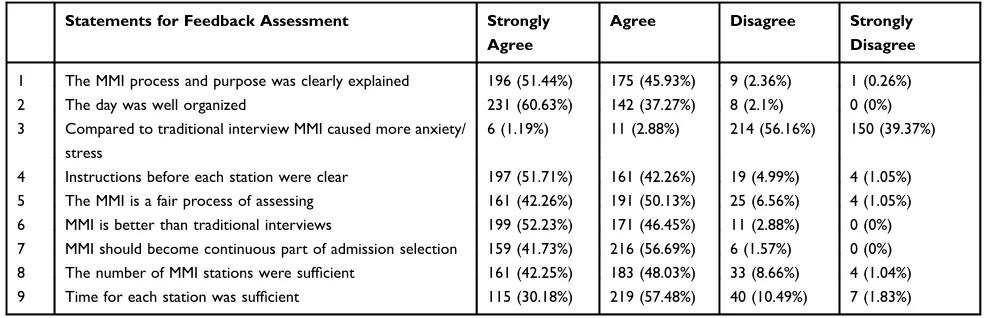
Table 2 illustrates the responses given by the candidates
regarding their views of the MMI experience. Overall candi-dates gave a positive feedback regarding the MMI process. In addition to these questions, candidates were also asked four
open-ended questions: In response to the question,“What did
you like most about the MMI”, majority of the candidates
found MMI to be a fair process for assessing the students. Examples of some of the comments are: MMI checks a student’s general knowledge, his/ her confidence and intelli-gence which are not very easily or properly checked just by their academic scores. As compared to other interviews, MMI gives and provides a better opportunity to a student to express and explain his/her views and it is a fair process of assessing as well.
In response to the question, “What did you like the
least about the MMI,” candidates’responses focused
pri-marily around logistics issues such as timing and waiting period for students. Examples of some of the comments are less time on a single station to discuss the issues properly. Fast-paced questioning. The duration of explain-ing our points and answer at every station is quite less, more time like 15 mins should be given.
In response to the question of how MMI could be improved for the next year, candidates did not suggest any
significant improvements. Some candidates suggested
add-ing more stations.
Table 3illustrates the responses given by the interviewers
regarding their views of the experience. Interviewers were also asked the same open-ended questions. In response to the question of what did you like most about the MMI, inter-viewers found MMI to be useful for assessing the students. Examples of some of the comments are, a useful means to have insight of capabilities of the candidate. Candidate has full opportunity to express his/ her thoughts. You have multi-ple stations to assess the candidate in multimulti-ple ways.
In response to the question of what did you like least about the MMI, interviewers' responses focused primarily around time. Examples of some of the comments are; it is a very long exercise, time, and candidates should be mini-mized. Length of interviewing process is long.
Table 2Candidate Feedback to Post-MMI Survey
Statements for Feedback Assessment Strongly
Agree
Agree Disagree Strongly
Disagree
1 The MMI process and purpose was clearly explained 196 (51.44%) 175 (45.93%) 9 (2.36%) 1 (0.26%)
2 The day was well organized 231 (60.63%) 142 (37.27%) 8 (2.1%) 0 (0%)
3 Compared to traditional interview MMI caused more anxiety/ stress
6 (1.19%) 11 (2.88%) 214 (56.16%) 150 (39.37%)
4 Instructions before each station were clear 197 (51.71%) 161 (42.26%) 19 (4.99%) 4 (1.05%)
5 The MMI is a fair process of assessing 161 (42.26%) 191 (50.13%) 25 (6.56%) 4 (1.05%)
6 MMI is better than traditional interviews 199 (52.23%) 171 (46.45%) 11 (2.88%) 0 (0%) 7 MMI should become continuous part of admission selection 159 (41.73%) 216 (56.69%) 6 (1.57%) 0 (0%) 8 The number of MMI stations were sufficient 161 (42.25%) 183 (48.03%) 33 (8.66%) 4 (1.04%)
9 Time for each station was sufficient 115 (30.18%) 219 (57.48%) 40 (10.49%) 7 (1.83%)
Advances in Medical Education and Practice downloaded from https://www.dovepress.com/ by 118.70.13.36 on 24-Aug-2020
In response to the question of how MMI could be improved for the next year, interviewers suggested invol-vement of more faculty and stations. Examples of some of the comments are, more faculty members' training, and involvement. Involve large number of interviewers.
Discussion
The aim of the study was to explore the validity, reliability, feasibility, and acceptability of using MMI as an assess-ment method for student selection in Pakistan. MMI is globally used as a method of assessment to discern the
attributes of candidates for admission purposes.14–16
Thefindings of the present study can be compared with
the findings of other similar studies2,11,17where reportedly
the reliability G coefficient was between 0.65 and 0.85. In the
present study, the G coefficient was 0.70 which is considered
acceptable for MMI. The highest source of variance was due
to student*station which implies that candidate’s ability is
influenced by each station. This finding corroborates with
Evaet al17,and is imperative in fulfilling the very purpose of
MMI that is, providing insight into each candidate’s strengths
and limitations, and differentiating between outstanding and
mediocre candidates. However, interviewer’s stringency/
leniency was 16%, which could be minimized by providing
more specific training to the interviewers, to ensure that all
interviewers have the same interpretation of the rating scale, and the stations.
Correlation between stations was minimal which indi-cates that each station was measuring a different domain.
Thisfinding is supported by other studies in which reported
correlation between stations were from 0.057 to 0.363.2
Evidence reports negligible correlation between MMI and
other pre-interview selection measures.2,11Thefindings from
the present study also report no correlation between MMI
and other pre-interview selection measures. This is not sur-prising considering that MMI aims to measure non-cognitive attributes while other pre-interview measures are focused on measuring cognitive abilities.
In the present study, both interviewers and candidates preferred MMI as compared to the conventional interviews. The majority reported it as an acceptable method of assess-ment. This demonstrated to the other faculty members in the medical school that conducting MMI is feasible.
The only suggestion from faculty members for improv-ing MMI was to make it less time-consumimprov-ing. For future MMI, this could be addressed by training more faculty members to conduct the interviews which would reduce the number of hours per faculty member.
A vast majority of candidates scored 50% or above in all stations which suggested that candidates were able to comprehend the scenarios in each station. In two stations (problem solving and teamwork) the majority of the stu-dents scored considerably low which may imply that the content of the station needs to be reviewed for better understanding. In terms of improvement, only some can-didates suggested increasing the time duration between stations so that they could explain their answer but major-ity reported it as adequate.
For the present study, faculty members’consensus was
sought on the non-cognitive attributes which they deemed pertinent for future doctors, keeping in view the institution’s vision and its curriculum tenets. Although, the attributes list could have been compiled from the existing literature alone but faculty opinion ensured the attributes deemed important by the host faculty were assessed in the stations set. Eva
et al17 also advocated that medical schools engaging in
MMI should consider the blueprint technique to ensure that the attributes they value in students are assessed at
Table 3Assessor Feedback to Post-MMI Survey
Statements for Feedback Strongly
Agree
Agree Disagree Strongly
Disagree
1 The MMI process and purpose was clearly explained 34 (45.33%) 39 (52%) 2 (2.67%) 0 (0%) 2 The training for my station was clear and sufficient 38 (50.67%) 33 (44%) 3 (4%) 0 (0%) 3 The evaluation form for applicants was clear and easy to use 40 (53.33%) 35 (46.67%) 0 (0%) 0 (0%)
4 The number of MMI stations was sufficient 23 (30.67%) 46 (61.33%) 6 (8%) 0 (0%)
5 The day was well organized 40 (53.33%) 31 (41.33%) 2 (2.67%) 2 (2.67%)
6 It was possible to determine the candidates attributes in the allotted time
25 (33.33%) 48 (64%) 2 (2.67%) 0 (0%)
7 The instructions given to candidates before your station were clear 28 (37.33%) 47 (62.67%) 3 (4%) 0 (0%)
8 The MMI is a fair process of assessing 28 (37.33%) 40 (53.33%) 7 (9.33%) 0 (0%)
9 MMI is better than traditional interviews 39 (52.0) 32 (42.66) 3(4%) 1(1.33%)
Advances in Medical Education and Practice downloaded from https://www.dovepress.com/ by 118.70.13.36 on 24-Aug-2020
selection. In addition, considering MMI was introduced for
the first time in the college, it was imperative that key
stakeholders take collective responsibility and ownership for its development, implementation, and decision on its continuous use as an assessment method.
The sample size for our study was 381, which is relatively
small sample; however, evidence indicates that reliablefi
nd-ings for MMI can be demonstrated with smaller sample size
of 115 candidates and 26 candidates.5,18Limitations of the
study include (a) Construct and concurrent validity were not established, and (b) Results are from single institution only. However, considering that the culture and ethos is similar across other institutions, there is no reason why the candi-dates interviewed through this process should not be broadly representative of all applicants.
The results of the present study are encouraging, but additional work is needed to determine whether the stu-dents selected through MMI perform better in medical school than those students who were previously selected through conventional methods. We will be following the
selected students over the next six years, ie,five years of
medical school and one year of mandatory internship. During this period, we will be monitoring their perfor-mance and see if the MMI scores correlate with their academic performance. In addition, we will be getting feedback from faculty, students, and staff about the attri-butes of students during their medical school and espe-cially during their internship. Attributes such as ethics, admitting fault, integrity, teamwork, and problem solving will be assessed relative to their interview scores. We would be interested in seeing if the scores in the station on motivation were related to their future performance in the medical school. In addition, there is a need to build
interventions in areas where the students’scores were on
the lower side, eg, communication skills, teamwork, and problem-solving. Timely interventions during the next six years will help to overcome these weak areas and hope-fully produce even better doctors with a better skill set to
serve the society in a more befitting manner. Although
validity, reliability, feasibility, and acceptability of MMI has been established, this study is an addition in further
confirming these attributes of MMI.
Conclusion
The present study reports the experience of using MMI as an assessment method for student selection in Pakistan. Primarily the aim was to determine the validity, reliability, acceptability, and feasibility of the MMI. MMI is a moderately reliable
method of selection for admissions of undergraduate medical students. Despite concerns that MMI may not be acceptable to the stakeholders, the interviews were well accepted by the faculty members and candidates alike, and demonstrated
reli-ablefindings. Individual institutions can tailor MMI stations
towards selection of the characteristics that are most valued within their local context.
Acknowledgments
The authors would like to thank the Principal
Dr Mohammad Zahid Bashir, faculty members, and stu-dents of the Medical College, Lahore, Pakistan for their participation in the study.
Disclosure
The authors report no conflicts of interest in this work.
References
1. Roberts C, Zoanetti N, Rothnie I. Validating a multiple mini-interview question bank assessing entry-level reasoning skills in candidates for graduate-entry medicine and dentistry programmes.
Med Educ.2009;43(4):350–359. doi:10.1111/med.2009.43.issue-4 2. Dowell J, Lynch B, Till H, Kumwenda B, Husbands A. The multiple
mini-interview in the U.K. context: 3 years of experience at Dundee.
Med Teach.2012;34(4):297–304. doi:10.3109/0142159X.2012.652706 3. Steele K. Selecting tomorrow’s doctors. Ulster Med J. 2011;80
(2):62–67.
4. Johnson EK, Edwards JC. Current practices in admission interviews at US medical schools.Acad Med.1991;66:408–412. doi:10.1097/ 00001888-199107000-00008
5. Harris S, Owen C. Discerning quality: using the multiple mini-interview in student selection for the Australian National University Medical School. Med Educ. 2007;41(3):234–241. doi:10.1111/med.2007.41.issue-3
6. Kreiter CD, Yin P, Solow C, Brennan RL. Investigating the reliability of the medical school admissions interview. Adv Health Sci Educ Theory Pract. 2004;9(2):147–159. doi:10.1023/B:AHSE.00000274 64.22411.0f
7. O’brien A, Harvey J, Shannon M, Lewis K, Valencia O. A comparison of multiple mini-interviews and structured interviews in a UK setting. Med Teach. 2011;33(5):397–402. doi:10.3109/ 0142159X.2010.541532
8. Cameron AJ, Mackeigan LD. Development and pilot testing of a multiple mini-interview for admission to a pharmacy degree program.Am J Pharm Educ.2012;76(1):10. doi:10.5688/ajpe76110 9. Dodson M, Crotty B, Prideaux D, Carne R, Ward A, de Leeuw E. The
multiple mini-interview: how long is long enough? Med Educ.
2009;43(2):168–174. doi:10.1111/med.2009.43.issue-2
10. Reiter HI, Salvatori P, Rosenfeld J, Trinh K, Eva KW. The effect of defined violations of test security on admissions outcomes using multiple mini-interviews. Med Educ. 2006;40(1):36–42. doi:10. 1111/med.2006.40.issue-1
11. Hofmeister M, Lockyer J, Crutcher R. The acceptability of the multi-ple mini interview for resident selection. Fam Med. 2008;40 (10):734–740.
12. Barbour ME, Sandy JR. Multiple mini interviews for selection of dental students: influence of gender and starting station.J Dent Educ.
2014;78(4):589–596.
Advances in Medical Education and Practice downloaded from https://www.dovepress.com/ by 118.70.13.36 on 24-Aug-2020
13. Perkins A, Burton L, Dray B, Elcock K. Evaluation of a multiple-mini-interview protocol used as a selection tool for entry to an undergraduate nursing programme.Nurse Educ Today.2013;33 (5):465–469. doi:10.1016/j.nedt.2012.04.023
14. Roh H, Lee HJ, Park SB, et al. Multiple mini-interview in selecting medical students. Korean J Med Educ. 2009;21(2):103–115. doi:10.3946/kjme.2009.21.2.103
15. Campagna-vaillancourt M, Manoukian J, Razack S, Nguyen LH. Acceptability and reliability of multiple mini interviews for admis-sion to otolaryngology residency.Laryngoscope.2014;124(1):91–96. doi:10.1002/lary.24122
16. McAndrew R, Ellis J. An evaluation of the multiple mini-interview as a selection tool for dental students.Br Dent J.2012;212(7):331–335. doi:10.1038/sj.bdj.2012.267
17. Eva KW, Rosenfeld J, Reiter HI, Norman GR. An admissions OSCE: the multiple mini-interview. Med Educ. 2004;38(3):314–326. doi:10.1046/j.1365-2923.2004.01776.x
18. Yoshimura H, Kitazono H, Fujitani S, et al. Past-behavioural versus situational questions in a postgraduate admissions multiple mini-interview: a reliability and acceptability comparison. BMC Med Educ.2015;15:75. doi:10.1186/s12909-015-0361-y
Advances in Medical Education and Practice
Dove
press
Publish your work in this journal
Advances in Medical Education and Practice is an international, peer-reviewed, open access journal that aims to present and publish research on Medical Education covering medical, dental, nursing and allied health care professional education. The journal covers undergraduate education, postgraduate training and continuing medical education
including emerging trends and innovative models linking education, research, and health care services. The manuscript management system is completely online and includes a very quick and fair peer-review system. Visit http://www.dovepress.com/testimonials.php to read real quotes from published authors.
Submit your manuscript here:http://www.dovepress.com/advances-in-medical-education-and-practice-journal
Advances in Medical Education and Practice downloaded from https://www.dovepress.com/ by 118.70.13.36 on 24-Aug-2020