© 2014 IJEDR | Volume 2, Issue 1 | ISSN: 2321-9939
IJEDR1401015 International Journal of Engineering Development and Research ( www.ijedr.org) 73
Aquifer based water security of cities of Eastern India
1
Arunangshu Mukherjee,2Sudhanshu Shekhar
Central Ground Water Board, HN-IV, Faridabad, 121001, India 1[email protected], 2[email protected]
_______________________________________________________________________________________________________ Abstract - The natural resources of Eastern India are still comparatively less exploited. The availability of sustainable water resource in urban environment is a key to development and human health of the Region. 116 Eastern Indian cities with more than 0.1 million population are having adequate water resources. These cities are hotspots for progressive economic development of the country. Water requirement and availability of ground water resources up to present extractable depth of 250 meter has been assessed for 7 capital cities of Eastern India as a case study. The results so obtained clearly indicate availability of ground water is adequate to cope up with the pace of growing population and urbanisation in these cities. Aquifer based water security as sustainable solution of these cities of Eastern India has given the confidence for futuristic development. The result of these studies can be used to predict the aquifer based water security of other Eastern Indian Cities.
Keywords - Urban hydrogeology, food and water security, drinking water, aquifer,India
I. INTRODUCTION
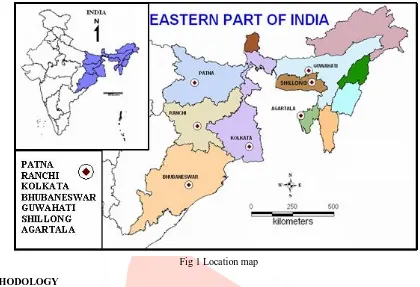
The unprecedented increased rate of human population worldwide with much of these growths taking place in urban areas forced the scientific community and planners internationally to understand the urban ground water issues in depth (Lerner, 1996, Chilton, et al 1997, Chilton, 1999, Howard, 2007). An estimated 1.5 billion people in Asian cities rely on groundwater for their drinking water and other needs (Foster et. al., 2010). The rate of growth of the Asian mega-cities in particular places cause enormous stress on groundwater resources, and leads to the types of over-extraction and pollution that are severely debilitating to these resources (Foster et al., 1998). The urban population of world is expected to reach almost 5 billion, i.e 60% of global population by 2030 ( Howard, 2007). More than half of the world’s population currently lives in cities; urban dwellers will account for 70 percent of humanity in 2050 (UNESCO,2011). Modern India has witnessed large scale shifting of population from rural tourban areas for their livelihood. Due to migration of rural population mass to the cities, the cities are becoming mega cities and urban centres are enveloping with peri-urban areas to cope up the population explosion. India is a vast country with over 31 percent urban population (Census of India, 2011). The cities are hotspots for progressive economic development of the country. Sustenance of India’s economic growth achieved over past two decades needs effective groundwater management (Harsha, 2012). Eastern India comprising of 315 million population, covers the states of Bihar & Jharkhand, Coastal states of Orissa & West Bengal, Seven states of North East (Assam, Meghalaya, Arunachal Pradesh, Manipur, Mizoram, Nagaland and Tripura) and Sikkim. According to the Census of India, 2011, the population in 116 cities of Eastern India is approx 35 million, out of which 110 cities are having > 0.1 million population and 6 cities have over 1.0 million populations. (Table-1).
Table-1. Status of Population as per Census of India, 2011
Sl No State No of Cities having Population
0.1-1.0 million >1 million
1. Bihar 25 1
2. Jharkhand 7 3
3. Orissa 10 0
4. North Eastern States 9 0
5. West Bengal 59 2
Total 110 6
IJEDR1401015 International Journal of Engineering Development and Research ( www.ijedr.org) 74 Fig 1 Location map
II. METHODOLOGY
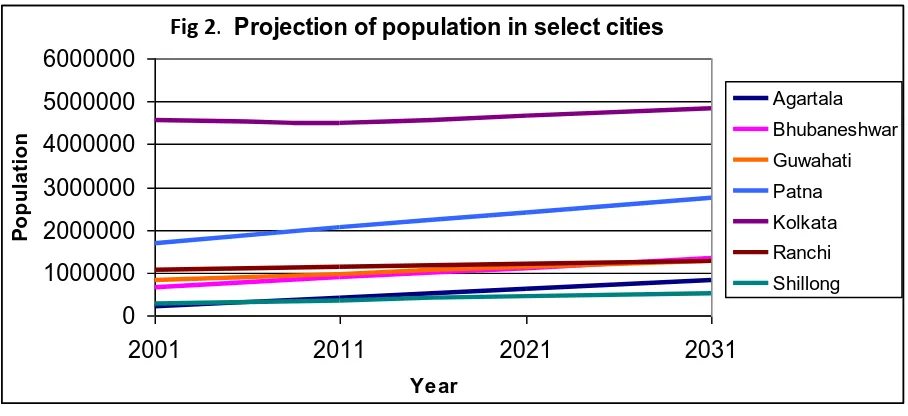
The potentiality of ground water towards sustainable solution has been evaluated estimating various parameters. The present total water requirement has been worked out considering 135 litres per capita per day (lpcd) except for Kolkata metropolitan, where 202 litres is taken.The population figures are based on Census of India, 2011 and population growth is projected taking the historical census data to arrive the expected 2031 population. The water level is monitored regionally as well as locally for select cities by the government agencies. The aquifer geometry and its potentiality have been obtained through ground water exploration programme of Central Ground Water Board (CGWB). The ground water resources have been estimated up to 250m depth based on volume of aquifer in the cities and specific yield for the aquifer as determined in exploration. Suitability of groundwater for human consumption has been determined comparing analytical data with BIS standards. The data were collected and compiled for these selected seven cities and analysed to obtain the results.
III. RESULTS
Aquifer based water security of cities of Eastern India
IJEDR1401015 International Journal of Engineering Development and Research ( www.ijedr.org) 75 Hydrogeological Setup
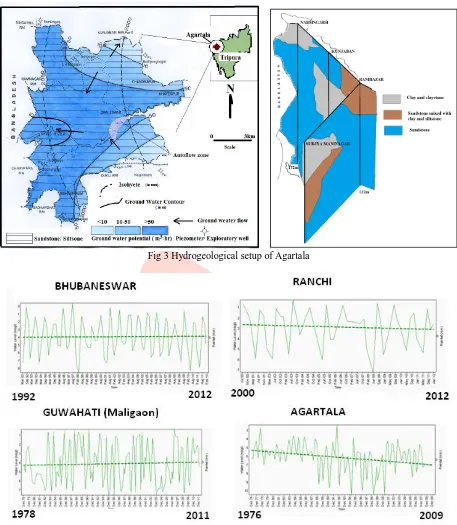
AgartalaThe semi-consolidated Tipam sandstone of Tertiary age forms the main hydrogeological unit for water supply to the city of Agartala. These sandstones are friable, fine
Table-2. Salient features of availability and water demand for study area
to medium grained, nearly 200m thick and forms productive aquifers ( Fig 3). In the city area semi confined aquifers found to occur between 40 and 200 mbgl, which are capable to yield 30-160m3/hr. Transmissivity value varies from 933-6859 m2/day for this aquifer (CGWB, 2011). Its piezometric head varies between 3 and 25m bgl. Long term monitoring of the piezometric head in the area depict marginally falling trend( Fig 4). The phreatic aquifer of the city area is in supportive role, having limited potential and is being tapped by individuals through open sanitary wells for household domestic use.
S
N
City Presen
t area of city
in km2
Present Supply
of Water in
MLD
Projected Demand of
water in
2031 MLD
Major Aquifer
with
thickness up to 250m depth
Availability of ground water resource down
to depth of
250m in MCM
Decadal
trend of
ground water level Surfac e water Groun d water
1 Agartala MC 62.60 31.78 28.18 111 TipamSst 25-55
m
156 Minute
Falling trend
2 Bhubeneshwar
UA
125 154 62 180 AthgarhS
st
50-100m
444 Constant
3 Guwahati UA 315 98 35 172 Alluvium 40-60
m
998 Constant
4 Kolkata MC 187 1161 305 976 Alluvium
30-50m
562 Falling
trend
5 Patna UA 137 0 493 371 Alluvium
100-140m
1370 Minute
Falling trend
6 Ranchi UA 257 199 45 173 Gneiss 200m 308 Nearly
Constant
7 Shilong UA 40 35.16 7.5 71 Quartzite 200m 40 Nearly
Constant UA -Urban agglomerate, MC- Municipal Corporation, MLD- Million litters per day, MCM- Million cubic meter
Projection of population in select cities
0
1000000
2000000
3000000
4000000
5000000
6000000
2001
2011
2021
2031
Year P o p u la ti o n Agartala Bhubaneshwar Guwahati Patna Kolkata Ranchi Shillong
IJEDR1401015 International Journal of Engineering Development and Research ( www.ijedr.org) 76 Fig 3 Hydrogeological setup of Agartala
Fig 4.Plot of long term ground water trend Bhuwaneshwar
The city is mainly underlain by semi consolidated shale-sandstone of Athgarh Formation belonging to the upper Gondwana Group. Laterites and alluvium of quaternary age also occur in small patches in the town. The Athgarh sandstones are fine to coarse grained feldspathic in nature, more than 200 m in thickness. This fractured and friable sandstone down to the depth of 150 m can yield 5-100m3/hr. Transmissivity value ranges from 15-258 m2/day for this aquifer. Its piezometric head remains between 2 and 20m bgl. Long term monitoring of the piezometric head in the area depict nearly constant trend( Fig 4). The laterites and alluvium form unconfined aquifers mostly in western and west central parts of the city having limited potential.
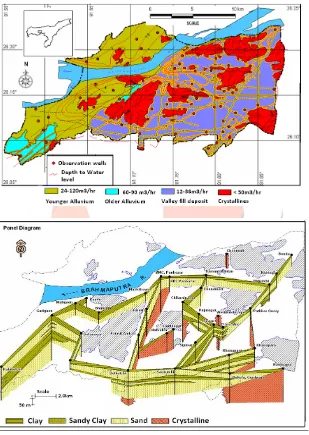
Guwahati
Aquifer based water security of cities of Eastern India
IJEDR1401015 International Journal of Engineering Development and Research ( www.ijedr.org) 77 Kolkata
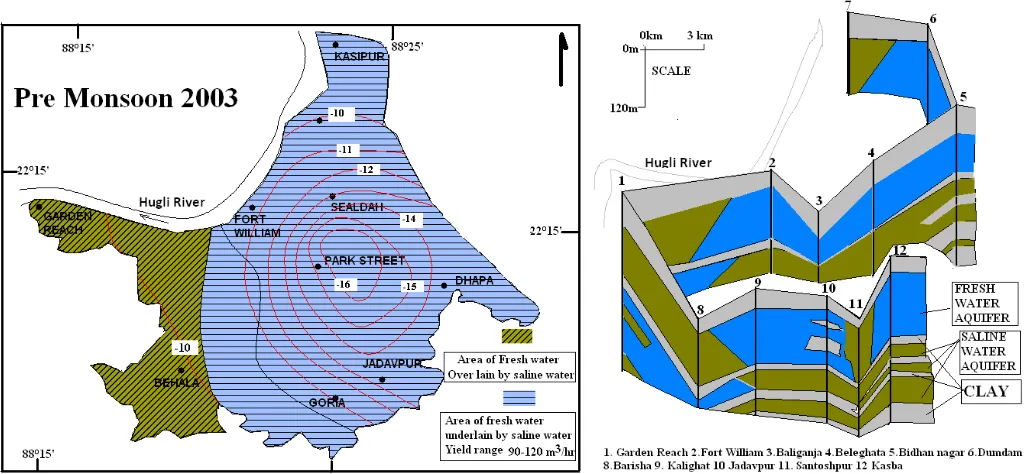
Kolkata Municipal Corporation (KMC) area is underlain by unconsolidated sediments of quaternary and upper tertiary age deposited under fluvial and sub-marine to marine environments. The principal aquifer in the area occurs in different depth range ,between 40 and 100mbgl in northern part, 60 and 160 mbgl in central part, 180-300mbgl in south western aprt. (Dhiman, 2011).Ground Water in extreme northern , eastern and western part of KMC is brackish with chloride and specific conductance nearly 500mg/l and 2000s/cm respectively. In western part brackish water aquifer occur down to the depth of 160mgl & 200mbgl. These brackish aquifers are underlain by fresh water aquifer ( Fig6). The yield of the well range from 90-120m3/yr. Maximum Transmissivity found upto 2300 m2/day. Storativity varies from 33x10-3 to 20x10-5 indicating confined nature of aquifer(Guha, 2009).There is a significant decline in peizometric head. The peizometric trough formed with a core of more than -9m has been expanded in the area and the core has become more than -16 m from 1989-2003. However the present peizometric head remain 7-18m bgl.
IJEDR1401015 International Journal of Engineering Development and Research ( www.ijedr.org) 78 Fig 6. Hydrogeological setup of Kolkata Municipal Corporation area
Patna
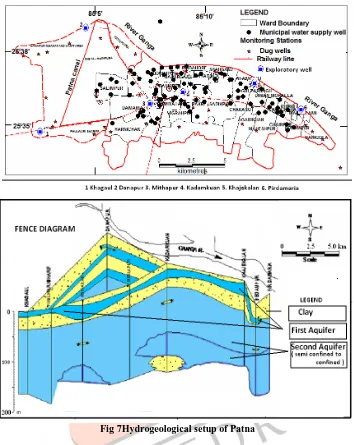
Geologically Patna is underlain by quaternary alluvium. Two main group of aquifers exist in the city.Fine to medium sand below the top clay layer constitute the shallow aquifer, while the deeper aquifer having medium to coarse sand occur between 70-200 m. The yield of well range from 60-210 m3/hr. Transmissivity value varies from 3500-15000 m2/day. The high potential aquifers can sustain the increased yield on account of future increasing water demand. ( Fig7). The piezometric head varies from 12-14 m bgl in major part during the pre-monsoon ( Dwivedi, et al 2011). Over the year, the ground water regime of shallow aquifers has not shown any major change, however deeper aquifers shows minute declining trend.
Ranchi
Aquifer based water security of cities of Eastern India
IJEDR1401015 International Journal of Engineering Development and Research ( www.ijedr.org) 79 Fig 7Hydrogeological setup of Patna
ShillongGeologically Shillongcity is underlain by Shillong Group of rocks consisting of quartzite &phyllites. Ground water occur under water table condition in weathered and fractured zone of Precambrian quarzites, while semi-confined to confined condition in joints, fractures in the depth of 60-180m. Yield of bore wells range from 1-20m3/hr. Artesian wells having free flowing discharge of 0.13 -3.6 m3/hr. Depth to water level varies from 5-10m bgl while the piezometric head remains between 2.0 and 17.0mbgl.Long term monitoring of the piezometric head in the area depict nearly constant trend. Springs play an important role in domestic water supply having discharge in the range of 0.3-7.0m3/hr
Ground water quality aspects
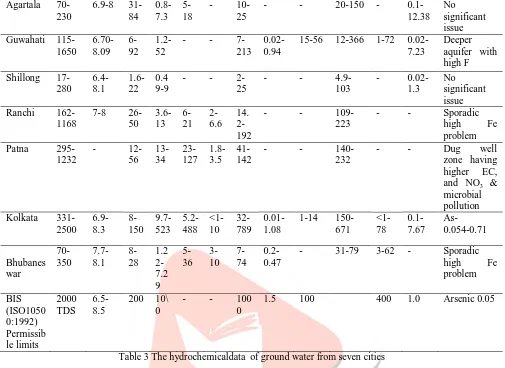
Ground water quality of these selected cities by and large is good and not posing any serious threat whatsoever to the water supply agencies (CGWB,2010 and 2011). The hydrochemicaldata of ground water from these cities are presented in Table-3 and is compared with the BIS standards. Patna and Kolkata urban area having all along thick clay layer beneath these cities at shallow depth(fig 6 and 7), protecting the principal aquifers from anthropogenic pollution,the aquifers which is under use provides safe drinking water source. The other cities like Agartala, Bhuwaneshwar and Guwahati situated on porous aquifer having potable water at desirable depth. However higher concentration of Iron in ground water tapped from semi-confined to confined aquifer is the real challenge at many sporadic places over these cities. The cities on hard rock suchas Ranchi and Shillong are having fractured aquifer with suitable quality of water,occasional higher iron incidence is noted. Higher Fluoride in deeper granular zone has been reported by Central Ground Water Board during its exploratory drilling, ranging 1.5 to
4.48 ppm in Guwahati (Roy,2007). Higher Arsenic contamination has been reported from few
City EC pH Ca Mg Na K Cl F NO3 HCO3 SO4 Fe Remarks
s/c m
IJEDR1401015 International Journal of Engineering Development and Research ( www.ijedr.org) 80 Agartala
70-230
6.9-8 31-84
0.8-7.3
5-18
-
10-25
- - 20-150 -
0.1-12.38 No significant issue Guwahati
115-1650 6.70-8.09 6-92 1.2-52
- -
7-213 0.02-0.94
15-56 12-366 1-72 0.02-7.23
Deeper aquifer with high F Shillong
17-280 6.4-8.1 1.6-22 0.4 9-9
- -
2-25
- -
4.9-103
-
0.02-1.3
No significant issue Ranchi
162-1168
7-8 26-50 3.6-13 6-21 2-6.6 14. 2-192
- -
109-223
- - Sporadic
high Fe
problem
Patna
295-1232
-
12-56 13-34 23-127 1.8-3.5 41-142
- -
140-232
- - Dug well
zone having higher EC, and NO3 & microbial pollution Kolkata
331-2500 6.9-8.3 8-150 9.7-523 5.2-488 <1-10 32-789 0.01-1.08
1-14 150-671 <1-78 0.1-7.67 As- 0.054-0.71 Bhubanes war 70-350 7.7-8.1 8-28 1.2 2-7.2 9 5-36 3-10 7-74 0.2-0.47
- 31-79 3-62 - Sporadic
high Fe
problem BIS (ISO1050 0:1992) Permissib le limits 2000 TDS 6.5-8.5
200 10\ 0
- - 100
0
1.5 100 400 1.0 Arsenic 0.05
Table 3 The hydrochemicaldata of ground water from seven cities
places in shallow aquifer zone of KMC ranging from 0.054-.071 ppm ( Dhiman, 2011), however the principal aquifer from where drinking water is being extracted is free from Arsenic contaminations. Central Ground Water Board through specially designed cement seal wells (Mishra and Nag, 2009) has established arsenic free ground water supply. Utmost care has to be taken to protect the deeper aquifer from the contamination of arsenic from shallow zone through specialised well designing. Proper ground water regulation in this regard has to be initiated at state level to protect the deeper arsenic free zone from contamination due to faulty construction of deep tube wells in KMC area. State govt agencies from sub-urban areas of Danapur block of Patna have reported sporadic high arsenic values, which need further investigations.
IV. DISCUSSIONS
The results as obtained clearly indicate availability of ground water to cope up with the pace of growing population and urbanisation in these cities (Table 2). The constant to nearly constant long term ground water trend ( except Kolkata) in these cities reflect the low stress conditions on aquifer. Ground Water quality barring Kolkata is good and potable with sporadic high iron and fluoride concentration. However patches of anthropogenic contamination have been observed in the shallow aquifer, which are not being in use for drinking purposes. In Kolkata the fresh water aquifers are occurring in between brackish aquifer and are constrained due to presence of geogenic Arsenic contamination. The aquifer based water security has provided additional sustainable source of safe drinking water. If the proportion of ground water abstraction remain nearly same as today then the present ground water resource is adequate for long term basis. Higher abstraction proportion than present also sustain fairly long with the help of regional ground water flow pattern and recharge condition. However adequate managed aquifer recharge projects can enhance the sustainability. The limited fresh ground water resource of Kolkata city can sustain the present draft ratio through adequate management strategies. For additional requirement the deeper aquifer to be tapped beyond 250 m depth as in the Bengal basin the sediment thickness is over 5000 m .The deeper arsenic free aquifer at KMC has to be protected from arsenic contaminated shallow aquifer through proper ground water regulation. The faulty construction of tube wells should not contaminate the deeper aquifer connecting to the shallower aquifer through leakage.
Aquifer based water security of cities of Eastern India
IJEDR1401015 International Journal of Engineering Development and Research ( www.ijedr.org) 81 CONCLUSION
The case study of seven capital cities from eastern India clearly indicatethat the ground water availability is adequate to cope up with the pace of growing population and urbanisation in these cities in near future. The quality of ground water of principal aquifer within these cities is good and portable in general, which also support the availability. Aquifer based water security as sustainable solution of these cities of the eastern India has given the confidence for futuristic development. Proper ground water regulation has been recommended for the Kolkata metropolitan to protect the deeper arsenic free aquifer from contamination.The result of these studies can be reproduced to predict the aquifer based water security of other eastern Indian cities reliably.
ACKNOWLEDGEMENT
The authors are thankful toShSushil Gupta Chairman,Central Ground Water Board for permitting to send the paper for publication. Groundwater data of eastern Indian State obtained from respective CGWB regional office is thankfully acknowledged.
References
[1] Census of India, 2011Provisional Population totals of India, www. census2011.gov.in [2] CGWB, 2010:Ground water quality in shallow aquifers of India, CGWB Report, Faridabad [3] CGWB, 2011: Ground water scenario in major cities of India,CGWB report, Faridabad229p.
[4] Chilton J. et al (Edt) 1997 Groundwater in Urban environment. Vol –I Problem, process and Management; Proc. Of the XXVII IAH Congress on Groundwater in Urban environment Nottingham, UK, 21-27 sep1997, Rotterdam,682 p.
[5] Chilton J. (Edt) 1999 Groundwater in Urban environment: selected city Profiles, Rotterdam,Balkema,342 p [6] Dhiman, S.C 2011, Coastal Aquifer Systems of India, CGWB Report, p 175.
[7] Dwivedi, S. N Singh, R. K.. Singh, S. K 2011:Ground Water Modelling Study of Patna Urban Area, CGWB technical report. [8] Foster, S., A. Lawrence and B. Morris. 1998. Groundwater in Urban Development: Assessing Management Needs and
Formulating Policy Strategies. World Bank Technical Paper No. 390. Washington DC: The World Bank.
[9] Foster, S., Hirata Recardo, Mishra S, Garduno H. 2010. in Urban Groundwater Polic balancing the benefits and risks in developing nations. World Bank Technical publication The GW•MATE Strategic overview series -3.Washington DC: [10] Guha R.K, 2009: Ground Water exploration in West Bengal, CGWB report no. 219 p 119.
[11] Harsha J, 2012: IWRM and IRBM concepts envisioned in Indian Water policies, Current science, Vol. 102, No-7, pp986-990 [12] Howard, Ken W F ( Edt) 2007 Urban Groundwater - Meeting the Challenge, selected papers from the 32 IGC, Florence,
Italy, Aug,2004, Taylor and Francis 307p.
[13] Jain S K 2012 India s water balance and evapotranspiration. Current science, Vol. 102, No-7, pp964-966
[14] Lerner, David N 1996: Theme use on Urban Ground Water, Guest Editors’s preface: Hydrogeology Journal, Vol-4, No-1, 1996.
[15] Misra A.K and .Nag S.K, 2009: Aquifer Characteristics in South 24-paraganas and Kolkata Municipal Corporation( KMC) area, West Bengal. Bhujal News, Vol-24, No-1, Jan- March 2009, pp 28-36.
[16] Mukherjee Arunangshu:-2007: Report on Hydrogeology of Bilaspur Urban Agglomerate, Chhattisgarh, CGWB, Technical report,58p.
[17] Roy,Indranil 2007:Hydrogeological Framework and Impact of Urbanisation on Ground Water Regime in Greater Guwahati Area, Assam, Technical Report of CGWB.