Load Frequency Control Under Availability
Based Tariff Environment Using Client-Server
Communication: A Case Study
Avani Pujara, Jigar Pujara, Geeta Velhal, Dr S.M. Bakre, Dr V. Muralidhara
Abstract: This research paper focuses on load frequency control and reduction of unscheduled interchange charges in ABT metering. Program is developed for algorithm of load frequency control using client server communication. Use of GSM and mobile computing allows easy communication among utilities and from utility to consumer Developed algorithm is implemented on actual data of the power system. An Android based emulator and Java based server program to simulate the algorithm for load prioritization using Client-Server communication architecture is developed. It is implemented on three different feeders and third component of Availability Based Tariff i.e. UI charges are calculated after and before implementation of algorithm. We can observe actual saving of penalty paid by state utility to central utility in INR.
Index Terms: Availability Based Tariff, Android based emulator, Client-Server communication, GSM, load prioritization, Unscheduled interchange, penalty
—————————— ——————————
1.
INTRODUCTION
To maintain grid discipline, Central Electricity Regulatory Commission (CERC) has introduced Availability based tariff (ABT) mechanism, based on the financial principals [1]. ABT comprises of following three components: Three-part tariff. Billed energy=A+B+C where, A-Fixed charges B-Variable charges and C-Unscheduled Interchange charges. Before the implementation of Availability Based Tariff, it was the two parts tariff namely capacity cost and fixed cost [4]. First component of ABT, the fixed cost consists of installation cost, interest on loan and working capital, equity returns, operation and maintenance cost, insurance and tax [4]. Fixed cost depends on availability of plant. Second component of ABT comprises cost for fuel which is dependent on consumption of fuel and actual generation of plant. [5]. ABT (Availability-Based Tariff) meter tries to improve the quality of power [19]. i) It can help to control undesirable frequency deviations. ii) It also minimizes frequent grid disturbances which result in generator tripping iii) It gives frequency linked pricing.
In the Fig. 1 RJ11 are the serial connectors provided at ABT and Multi-Function Meter (MFM) terminals for serial communications. Data is collected by DCU via mod bus which is serial communication protocol DCU is the data concentrator unit which collects data from all the meters. When the network switch is on, the data is transmitted to the Load dispatch center server. At the same time, it is stored at Energy
Management Software at substation. Energy Management Software at zonal office and corporate office can also access it from Web Server [5].
Fig 1. Data communication over internet
2
ALGORITHM
FOR
LOAD
FREQUENCY
CONTROL
[1]
Step 1: Start
Step 2: Read the frequency from display parameter of ABT meter, provide three different ranges of frequency in meter itself
Step 3: Decide priority of load as mentioned in Table 1 and assign frequency range to each load type.
Step 4: Is the display frequency 50.5 Hz to 50 Hz? If yes very low or no UI charges, keep reading frequency
Step 5: If frequency value in between 49.5 HZ to 50 Hz? Then cutoff load C which is least priority load send intimation to upcharge engineer via SMS or Email.
Step 6: If frequency less than 49.5 Hz then cutoff load B up to 49 Hz which is Industrial load and medium priority load, send intimation to upcharge engineer via SMS or Email
Step 7: Keep load A on in all conditions, keep reading frequency
Step 8: Stop ————————————————
Avani Pujara is currently pursuing PhD in electrical engineering
from Jain University, Bangalore. India E-mail:
Jigar Pujara is Director, Head of Engineering at Truein, www.GoTruein.com,[email protected]
Geeta Velhal is currently pursuing PhD in electric engineering from
Jain University, Bangalore India, E-mail:
Dr S.M Bakre is working as a professor in Electrical Engineering Department, AISSMS IOIT college, Pune, India
2643
Table 1 Load Priority List
The development of Server-side program and the Android based emulator is done in two phases
Phase1: The algorithm for load prioritization is implemented in server program using Java Servlets for one sample feeder data and the response is sent across to the Client. The Android based emulator is developed to trigger the call flow and display the response received from server in a tabular format
Phase 2: The algorithm for load prioritization is enhanced to deploy and instantiate server-side Java based program on Amazon web service cloud platform using API Gateway, Identity Access Management and AWS Lambda functions, to compute all the collected sample feeder data and the response is sent across to the Client. The Android based emulator is enhanced to trigger the call flow for all the collected sample feeder data and display the response received from server.
3 CLIENT
SERVER
IMPLEMENTATION
ARCHITECTURE
Load Frequency Controller program is implemented using client server architecture. The server-side implementation is done in Amazon Web Services, AWS and the client-side simulation is implemented using android based load frequency controller app. Fig 3 represents the architecture developed for client server communication where engineer’s mobile can talk to meter server and vice versa. It is two-way communication. There are two lambda functions defined here, first function will get triggered when in-charge engineer will enter his details of email address and mobile number, via internet and single entrée API gateway, it will get stored in dynamo DB. Second function lambda will get triggered for every reading of frequency but it will send notification via simple notification service when frequency goes below specified range defined in ABT meter. Application programming interface is single entrée gate way for client server communication. Identity Access Management, IAM keys are security keys via which each function of server-side programming can communicate with each other.
Fig 2. Developed Client-Server Architecture
4
AWS
IMPLEMENTATION
DETAILS
FOR
LOADFREQ
CONTROLLER
PROGRAM
[49]
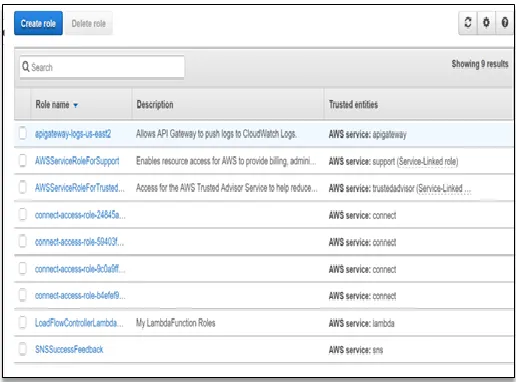
The implementation steps are as below Open the AWS IAM console at
https://console.aws.amazon.com/iam/ Create new roles for following
Accessing customized Lambda functions for Load Freq Controller Program
Role to enable logging for allowing AWS API Gateway and its access via AWS Cloud Watch
Role to enable AWS Connect access via Lambda functions
All the defined roles are as shown below
Fig 3. AWS IAM implementation
5 AWS
L
AMBDAI
MPLEMENTATIOND
ETAILS FORL
OADF
REQC
ONTROLLERP
ROGRAMAs part of Load Freq Controller program, multiple Lambda functions are developed for different user flows. All functions are implemented using Java 8. The implementation steps are as below
Open the AWS Lamda console at https://console.aws.amazon.com/lambda/ Name of load Frequency
range
Priority Type of load
A 50 Hz to 50.5 Hz
Highest Hospital Aircraft ammunition factories Load B 49.5 Hz to 49
Hz
Medium priority Industrial Load
C 49.5 Hz to 50 Hz
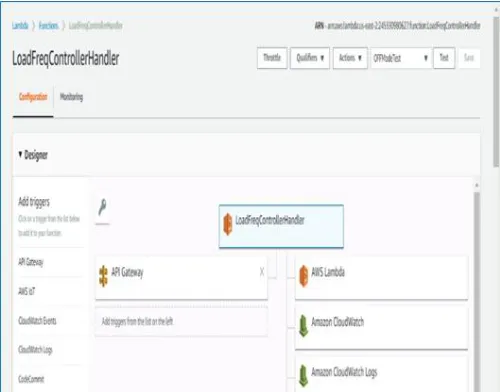
Fig 4. Creating required lambda function
Do one of the following:
If the welcome page appears, choose Get Started Now and then choose Create a function. If the Lambda > Functions list page appears,
choose Create a function. Choose Author from scratch.
Using Author from scratch pane, following is done
Two new Lambda functions are created – Registration Handler and Load Freq Controller
For Runtime, Java8 is selected
For Execution role, choose existing role created using IAM (Identity and Access Management)
Click on Create Function to create required lambda function (as shown below)
Fig 5. Execution
Fig 6. AWS SNS Implementation Details for Load Freq Controller Program
6 IMPLEMENTATIONS
Proposed Algorithm is implemented on 22 kV Jiav feeder of 66 kV Vesu Substation Surat, India for validation Load will get cut-off as per change in frequency. Also, it is implemented on 22 KV Tirupati feeder of 66 KV Vesu Substation and 11 KV Aakash feeder of 66 KV Vadod Substation, India.
Table 2 Results for 22 kV Jiav feeder,66 KV VESU substation Load 5100 kW
Iteration No
Freq Read
UI charges before implementa
tion (INR)
UI charges After implement ation (INR)
Saving (INR)
1 50.05 4612.8 4612.8 0
2 50.08 3459.6 3459.6 0
3 50.11 2883 2883 0
4 50.09 3459.6 3459.6 0
5 50.14 1729.8 1729.8 0
6 50.19 576.6 576.6 0
7 50.07 4036.2 4036.2 0
8 49.99 6342.6 5766 576.6
9 50.05 4612.8 4612.8 0
10 49.97 6919.2 5766 1153.2
11 50.08 3459.6 3459.6 0
12 50.11 2883 2883 0
13 50.16 1153.2 1153.2 0
14 50.07 4036.2 4036.2 0
15 50.05 4612.8 4612.8 0
16 50.06 4036.2 4036.2 0
17 50.23 0 0 0
18 50.17 1153.2 1153.2 0
19 50.05 4612.8 4612.8 0
20 49.99 6342.6 5766 576.6
21 50.11 2883 2883 0
22 50.21 0 0 0
23 50.13 2306.4 2306.4 0
24 49.97 6919.2 6919.2 0
2645
Table3 Results for 22kV Tirupati feeder,66 KV VESU substation
Load 3580 kW
Fig 8. UI charge reduction graph of Tirupati Feeder feeder
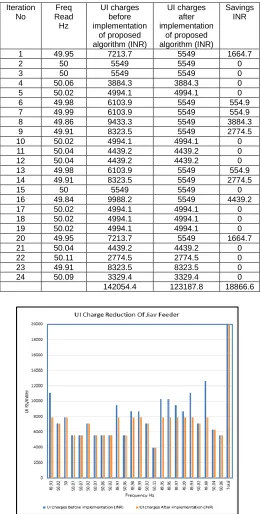
Table 4 Results for11 kV Aakash feeder,66 KV VADOD substation, Load 3720 KW
Fig 7. UI charge reduction graph of Jiav feeder Iteration
No
Freq Read Hz
UI charges before implementation
of proposed algorithm (INR)
UI charges after implementation
of proposed algorithm (INR)
Savings (INR)
1 49.93 11067 7905 3162
2 50.02 7114.5 7114.5 0
3 50 7905 7905 0
4 50.07 5533.5 5533.5 0
5 50.07 5533.5 5533.5 0
6 50.02 7114.5 7114.5 0
7 50.07 5533.5 5533.5 0
8 50.06 5533.5 5533.5 0
9 50.02 5533.5 5533.5 0
10 49.97 9486 7905 1581
11 50.06 5533.5 5533.5 0
12 49.98 8695.5 7905 790.5
13 49.99 8695.5 7905 790.5
14 50.02 7114.5 7114.5 0
15 50.11 3952.5 3952.5 0
16 49.95 10276.5 7905 2371.5
17 49.95 10276.5 7905 2371.5
18 49.97 9486 7905 1581
19 49.99 8695.5 7905 790.5
20 49.93 11067 7905 3162
21 50.02 7114.5 7114.5 0
22 49.88 12648 7905 4743
23 50.04 6324 6324 0
24 50.06 5533.5 5533.5 0
185767.5 164424 21343.5
Iteration No
Freq Read Hz
UI charges before implementation
of proposed algorithm (INR)
UI charges after implementation
of proposed algorithm (INR)
Savings INR
1 49.95 7213.7 5549 1664.7
2 50 5549 5549 0
3 50 5549 5549 0
4 50.06 3884.3 3884.3 0
5 50.02 4994.1 4994.1 0
6 49.98 6103.9 5549 554.9
7 49.99 6103.9 5549 554.9
8 49.86 9433.3 5549 3884.3
9 49.91 8323.5 5549 2774.5
10 50.02 4994.1 4994.1 0
11 50.04 4439.2 4439.2 0
12 50.04 4439.2 4439.2 0
13 49.98 6103.9 5549 554.9
14 49.91 8323.5 5549 2774.5
15 50 5549 5549 0
16 49.84 9988.2 5549 4439.2
17 50.02 4994.1 4994.1 0
18 50.02 4994.1 4994.1 0
19 50.02 4994.1 4994.1 0
20 49.95 7213.7 5549 1664.7
21 50.04 4439.2 4439.2 0
22 50.11 2774.5 2774.5 0
23 49.91 8323.5 8323.5 0
24 50.09 3329.4 3329.4 0
Fig 9. UI Charge reduction of Aakash Feeder
4
SIMULATION
RESULTS
Fig 10. Simulation results for Jiav feeder
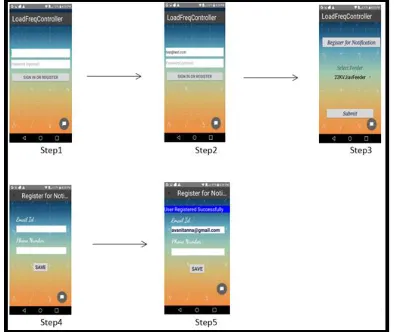
Fig 11. User Registration flow
Fig 12. Client registration user start
Fig 13. Client-side run
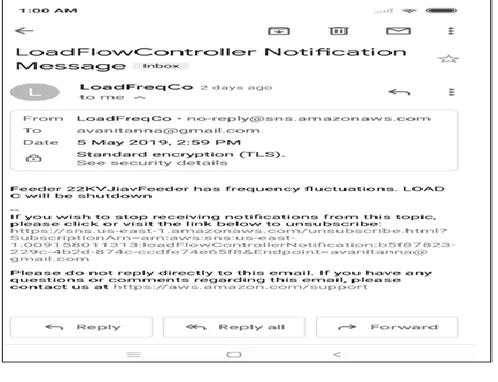
2647 Fig 15. Email notification
7.
CONCLUSIONS
Results show ON/OFF pattern of least priority load C which is the domestic load. Load shedding is done as per frequency profile and UI payable charges are eliminated
Proposed algorithm gives fast load control and saves Unscheduled Interchange charges.
Using GSM technology engineer working at system monitoring station gets immediate intimation of low frequency and load shedding can be done automatically.
Simulation results shows communication between ABT meter CPU and Cell phone using JAVA programming.
The algorithm worked well with client server communication. Based on the frequency variations it will compute and determine priority of load to be shut down and alert will be generated and sent over to the in-charge engineer via an email and also Text message on the subscribed mobile number. It will make easy communication among utilities and from utility to consumer.
In a nutshell, the new method of reducing UI charges would improve stability and minimize grid disturbance of the system. Also, it will minimize human efforts by making system smarter.
FUTURE SCOPE: This research represents an implementation of novice method for load and frequency control based on control of third parameter of three-part Availability Based Tariff (ABT) i.e. Unscheduled Interchange charges.
The same proposed idea can be studied for more enhancements/applications as follows:
Can be used for large-scale research in era of smart metering
Can be implemented by deploying the idea to actual
power system having low frequency issue.
ACKNOWLEDGMENT
The Authors are grateful to Jain University, Bangalore, India for providing required research facilities and encouragement. Also, Authors are very much thankful DGVCL Surat Gujarat, India for sharing data.
REFERENCES
[1] Avani Pujara, Velhal Geeta, Dr S.M. Bakre, Dr V. Muralidhara, ―A Novel approach for UI charge reduction using AMI based load prioritization in smart grid‖ Elsevier, Journal of Electrical Systems and Information Technology 4 (2017) 338–346
[2] Avani Pujara,Velhal Geeta,Dr S.M. Bakre,Dr V. Muralidhara,―Communication Feasibility Study for smart grid with Advanced Metering Infrastructure‖,International Journal of Electrical and Electronics Engineering Research (IJEEER) ISSN(P): 2250-155X; ISSN(E): 2278-943X Vol. 5, Issue 6, Dec 2015, 53-60
[3] Avani Pujara,Velhal Geeta,Dr S.M. Bakre,Dr V. Muralidhara, ―Application of AMI for unscheduled interchange pricing and fault location‖, IJARIIE-ISSN (O)-2395-4396,Vol-1 Issue-5 2016 [4] Bhushan Bhanu, ―ABC of ABT‖, CERC report June 2005 [5] Dr S.M. Bakre, ―Smart Grid‖ A Book May 2019
[6] Dr S.M. Bakre, ―Object Oriented Web Enabled Approachfor Detection of Distorted Input Current Signals to the Numeric Meters due toHigh Order Harmonics Generated by the Non-Linear Loads‖ PhD thesis
[7] Dr.S.M. Bakre, ―Electricity Metering in Easy Steps‖ A book, Jan 2015
[8] Dr.S.M. Bakre, ―Electrical Harmonics in Easy Steps‖ A book, Aug 2015
[9] Velhal Geeta Vilas, Avani Pujara, SM Bakre, V Muralidhara, ―Implementation‖, Smart Technologies and Management for Computing, Communication, Controls, Energy and Materials (ICSTM), 2015 International conference, IEEE 2015
[10]―Positives of ABT for Bulk power generation-A review‖, IEEMA Journal Article, January 2009
[11]S.K. Soonee, S.R. Narasimhan and V. Pandey, ―Significance of Unscheduled Interchange Mechanism in the Indian Electricity Supply Industry‖, ICPSODR-2006
[12]―Recommendations regarding implementation of availability-based tariff (a.b.t.) in intra-state systems‖, Forum of Indian Regulatory commissions, http://www.foir-india.org
[13]S.K. Parida S.N. Singh, C.Shrivastava,P.Chanda and A.K. Sukla, ―Pros and cons of existing Frequency regulation mechanism in Indian power Industry‖ Joint International Conference on Power System Technology and IEEE Power India Conference,IEEE 2008
[14]M. Santosh, V.Naren Bharatwaj, A.R Abhyanker and Nikhil Gupta,―Location bias to frequency linked unscheduled Interchange pricing in India‖ IEEE Power and Energy Society General Meeting IEEE 2011.
[15]K.V.V.reddy, Ashwini Kumar and Saurabh Chanana,―Frequency linked pricing as an Instrument for Frequency Regulation Market and ABT Mechanism‖, International Conference on Power Electronic, Drives and Energy Systems IEEE 2006
[16]―Rules and regulations for Indian electricity market‖ CERC REPORT,www.cercind.gov.in
[18]Avani Pujara, Geeta Velhal, Dr.S.M. Bakre, Dr. V. Muralidhara, ―A Review on Smart Grid in India‖, International journal of innovative research in electrical, electronics, instrumentation and control engineering vol. 3, issue 3, 2015
[19]Geeta Velhal, Avani Pujara, SM Bakre, V Muralidhara, ―On progress of communication infrastructure for fault location and ABT metering‖ ICSTM, IEEE 2015
[20] ―GSM Based Energy Meter Reading System with Remote Cut-Off and GUI Application‖ International Journal of Advanced Research in Electrical, Electronics and Instrumentation Engineering, Vol. 6, Issue 6, June 2017
[21] Avani Pujara, Velhal Geeta, Dr S.M. Bakre, Dr V. Muralidhara, ―Smart solution for low frequency problem in smart grid ―International Journal of Computer Engineering and Applications, Volume XII, Special Issue, March 18, www.ijcea.com ISSN 2321-3469
[22]Avani Pujara, Velhal Geeta, Dr S.M. Bakre, Dr V. Muralidhara, ―UI Charge Reduction and Load Management in Smart Grid: A Modern Approach‖ National conference proceeding, Inspire Innovations and Emerging trends in Electronics Telecommunication and Electrical Engineering on March 2016 [23]―Availability based tariff‖, State Load Dispatch
Center,www.sldccg.com
[24]Avani Pujara, Velhal Geeta, Dr S.M. Bakre, Dr V. Muralidhara, ―Smart way of controlling frequency linked component of Availability based tariff‖ IEEMA Journal Volume 8 Issue no.8 p. no 54-57. ISSN 0970-2946April 2017
[25]Mrs. P A Kulkarni, Prof.R.M. Holmukhe ―Infrastructural Analysis of Load Dispatch Centre ―International Journal of Computer Applications (0975 – 8887) Volume 1 – No. 7 Science,2010 [26]Avani Pujara, Geeta Velhal, Dr S.M. Bakre, Dr V. Muralidhara,
―Smart approach for Under Frequency Load Shedding Scheme based on Frequency Linked Pricing‖, Majlesi Journal of
Mechatronic Systems, Vol. 6, No. 3, September 2017