Available online: https://edupediapublications.org/journals/index.php/IJR/ P a g e | 5715
Power Quality Improvement of A Grid Connected Wind Energy System
Using Dstatcom And Pid Controller
G. Sravani, Ph.D Scholar,
Department of Electronic and Electrical Engineering, Shri Jagdishprasad Jhabarmal Tibrewala University,
Email: [email protected].
Dr. A. Rajesh, Associate Professor,
Department of Electronics and Communications Engineering CVR College of Engineering, Hyderabad, Telangana.
Abstract:
Now a days, as the consumption of the power is increasing, the quality of the power plays a major role in the operation of power grid. In order to increase the generation of power most of the generating stations are designed in such a way that they can make use of renewable energy sources. Renewable energy source is adopted for the electric power generation, because of its
valuable need. Among them wind based generation is one of the motivated sources for power
production. In wind based power generation the wind turbines are used for generation purpose. Mostly the wind energy system is directly integrated with the power system for power supply. In case of direct integration, there arises a complexity for maintaining power quality. The harmonics, voltage sag, swell, compensation of reactive power and power factor is a main problem dealt here. In order to maintain the power quality in power system while the usage of wind energy system, an external circuit is adopted. In this paper, we presents a novel approach to enrich the power quality in wind energy system by using Proportional Integral Derivative (PID based Distribution Static Compensator (DSTATCOM).Battery Energy Storage is integrated with DSTATCOM to withstand the power at grid under fluctuating wind power. In our proposed method, The power quality improvement for the grid connected wind energy system by using PID based DSTATCOM is implemented in MATLAB working platform and their experimental results are compared with existing controllers like PI and PID controllers.
Keywords: Wind Energy System, Distribution Static Compensator (DSTATCOM), Harmonics,
Available online: https://edupediapublications.org/journals/index.php/IJR/ P a g e | 5716
INTRODUCTION
Today’s technological word completely depends on electricity; however the availability of electric source is low. The deficiency of electricity becomes the breaking point for developing countries like India. Hence the research organizations tend into research to find a suitable solution for providing uninterruptable electricity. In this situation the usage of renewable energy sources are the better solution, so these renewable energy sources are encouraged for electricity production [1, 2]. In India most available renewable source is wind and solar. The researches on these to area are under progressing [3, 4]. The wind based energy acquisition is most encouraging research area because of its low complexity in installation and maintain. In wind energy acquisition the wind turbine is used [5]. The wind energy systems are directly integrated into the power system for power system usage
The integration of wind energy into existing power system presents a technical challenges and that requires consideration of voltage regulation, stability, power quality problems [7].
The power quality is an essential customer focused measure and is greatly affected by the operation of a distribution and transmission network. The issue of power quality is of great importance to the wind turbine [8, 9]. During the normal operation, wind turbine produces a continuous variable output power. These power variations are mainly caused by the effect of turbulence, wind shear and tower-shadow and of control system in the power system [10]. Thus, the network needs to manage for such fluctuations. The power quality issues can be viewed with respect to the wind generation, transmission and distribution network, such as voltages, swells, flickers, harmonics etc. [11]. However the wind generator introduces disturbances into the distribution network. One of the simple methods of running a wind generating system is to use the induction generator connected directly to the grid system [12].The induction generator has inherent advantages of cost effectiveness and robustness. However induction generators require reactive power for magnetization [13]. When the generated active power of an induction generator is varied due to wind, absorbed reactive power and terminal voltage of an induction generator can be significantly affected [14].
A proper control scheme in wind energy generation system is required under normal operating condition to allow the proper control over the active power production
Available online: https://edupediapublications.org/journals/index.php/IJR/ P a g e | 5717
maintain the power quality norms in the grid system. The current control strategy is included in the control scheme that defines the functional operation of the DSTATCOM compensator in the power system
A single DSTATCOM using insulated gate bipolar transistor was proposed to have a reactive power support, to the induction generator and to the nonlinear load in the grid system [20].
The organization of the paper is summarized as follows. Section 2 gives some of the recent research works held in power quality improvement of wind energy system. The proposed methodology for the power quality enrichment by PID-ANN based DSTATCOM is explained in section 3. The implementation of the proposed method and the experimental result with comparison is given in section 4 followed by conclusion in section 5.
Related Works
Some of the Recent Research Work Related to the Wind Energy System: Maintaining a
close balance between power generation and demand is essential for sustaining the quality and
reliability of a power system. Currently, due to increased renewable energy generation, frequency deviations and power fluctuations of greater concern are being introduced to the grid, particularly in regions that are weakly interconnected with their surrounding areas, such as small
islands. Angel Molina-García et al. [21] have proposed a system for frequency control in isolated
power systems with relevant inclusion of wind power generation. They have analyzed the contribution of the demand side to the primary frequency control together with an auxiliary frequency control, which was carried out by variable-speed wind turbines through an additional control loop that synthesizes virtual inertia. Both the suitability of these two additional control actions counteracting frequency deviation and their potential reserves and compatibility was evaluated. The results indicated a substantial improvement in both the dynamic performance and grid frequency stability.
Mahmoud M. Amin et al. [22] have presented an improvement technique for the power quality
of the electrical part of a wind generation system with a self-excited induction generator (SEIG) which aims to optimize the utilization of wind power injected into weak grids. The advantage of the proposed system was its simplicity due to fewer controlled switches which leads to less control complexity. It also provided full control of active and reactive power injected into the grid using a voltage source inverter (VSI) as a dynamic volt ampere reactive (VAR) compensator. A voltage oriented control (VOC) scheme was presented in order to control the energy to be injected into the grid. In an attempt to minimize the harmonics in the inverter current and voltage and to avoid poor power quality of the wind energy conversion system (WECS), a filter was inserted between VOC VSI and the grid.
Venkata Yaramasu et al. [23] have proposed a new medium voltage power converter topology
Available online: https://edupediapublications.org/journals/index.php/IJR/ P a g e | 5718
conversion system. The generator-side TLB converter performed the maximum power point tracking and balancing of dc-link capacitor voltages, while the grid -side NPC inverter regulates the net dc-bus voltage and reactive power to the grid. A significant improvement in the grid power quality was accomplished as the NPC inverter no longer controls the dc-link neutral point voltage. A model predictive strategy was proposed to control the complete system where the discrete-time models of the proposed power electronic converters are used to predict the future behavior of control variables. These predictions were evaluated using two independent cost functions and the switching states which minimize these cost functions were selected and applied to the generator and grid-side converters directly.
Ahmed M. Kassem et al. [24] have investigated the application of the Takagi –Sugeno (TS)
fuzzy approach for voltage and frequency control of an isolated wind turbine (WT) system with variable-speed permanent magnet synchronous generator (PMSG) and a system for storing energy during wind speed and load variations. Initially, the holistic model of the entire system was achieved, including the PMSG, the uncontrolled rectifier, the buck converter and the storage system. The power absorbed by the connected loads was effectively delivered and supplied by the proposed WT and energy storage systems, subject to TS-fuzzy control. The performance of the system was compared with the system without storage system.
Wind power (WP) penetration in weak distribution networks is associated with adverse impacts on voltage quality. The installation of an energy storage system (ESS) is a possible voltage
quality remedy in such milieus. Moataz Ammar et al. [25] have proposed a super capacitor ESS
for alleviation of voltage flicker resulting from WP integration. Their ESS control and management were tailored to that purpose such that the ESS offsets the flicker-producing fluctuations in the generated WP. The proposed power sizing of the ESS was defined by the estimated turbulence intensity and wind speed average at the installation site. A 2 MW wind generator of the doubly fed induction generator type was employed as a source of WP and simulations were conducted on a simplified test system, as well as a detailed 25 kV distribution network on which results were compared with acknowledged reactive power flicker mitigation approaches and verified by prototyping in a real-time simulation platform.
Available online: https://edupediapublications.org/journals/index.php/IJR/ P a g e | 5719
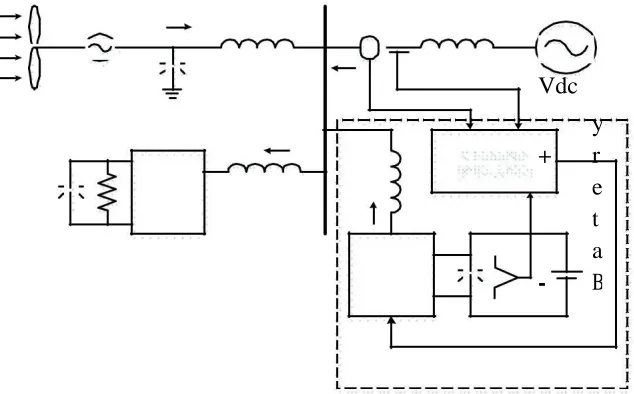
according to the controlled strategy, so as to maintain the power quality norms in the grid system. The current control strategy is included in the control scheme that defines the functional operation of the STATCOM compensator in the power system. A single DSTATCOM using insulated gate bipolar transistor is proposed to have a reactive power support, to the induction generator and to the nonlinear load in the grid system. The control scheme approach is based on injecting the currents into the grid using PID-ANN. The architecture of the proposed method is shown in Figure 1.
Power Quality Issues and Its Standards InternationalElectro Technical Commission Guidelines: International Standards are established by the group of technical committee-88 of International Electro-Technical Commission (IEC), IEC standard 61400-21, defines the method for defining the power quality characteristics of wind turbine [26].
Variation of Voltage: The issue of variation of voltage results from generator torque and wind velocity. The variation of voltage is directly linked to variations of real and reactive power. The voltage flicker problem defines dynamic variations in the network caused by varying loads or wind turbines. Thus, the power fluctuation from wind turbine arises during nonstop operation. The amplitude of voltage fluctuation depends on network impedance, grid strength, phase angle and power factor of wind turbines. It is described as a fluctuation of voltage in a frequency of 10-35 Hz. The IEC 61400-4-15 postulates a flicker meter that can be used to measure directly.
Vdc
+
y r e t
-a B
Available online: https://edupediapublications.org/journals/index.php/IJR/ P a g e | 5720
Harmonics: Harmonicsarises due to operation of power electronics converters. The harmonic voltage and current should be restricted to the acceptable level at the point of wind turbine connection to network. To certify the harmonic voltage within limit, each source of harmonic current can allow only a limited influence, as per the IEC-61400-36 guideline. The rapid switching provides a large decrease in lower order harmonic current compared to the line commutated converter, but the output current will have high frequency current and can be easily filter out.
Wind Turbine Location: The path of connecting the wind generating system into the power system highly affects the power quality. Thus the operation and its effect on power system depend on the structure of connecting power network.
Self- Excitation of WTGS: The self -excitation of WTGSwith an asynchronous generator takes place after disconnection of WTGS with local load. The risk of self-excitation occurs especially when WTGS is equipped with compensating capacitor. The capacitor connected to induction generator offers reactive power compensation. However the voltage and frequency are calculated by balancing the system. The drawbacks of self-excitation are the safety aspect and balance between real and reactive power [27].
Consequences of Issues: The voltage variation, harmonics, flicker causes the malfunction of apparatus’s namely microprocessor based control system, adjustable speed drives, programmable logic controller, flickering of screen and light. It leads to tripping of protection devices, tripping of contractors, stoppage of sensitive equipment’s like programmable logic control system, personal computer and may stop the operation and even can damage of sensitive equipment’s. Thus it reduces the power quality of the grid.
Topology for Power Quality Improvement
Modelling of Wind Energy Generating System: In this setup, wind generators are based on constant speed topology with pitch control turbine. In our proposed method, we have used induction generator because of its simplicity. Some of the properties of induction generator it does not require separate field circuit; it accepts constant and variable loads and has natural protection against short circuit. The obtainable power of wind energy system is given by
P= 1
AV 3
wind 2
wind
Available online: https://edupediapublications.org/journals/index.php/IJR/ P a g e | 5721
where (kg/m3 ) is air density and A (m2) is area swept out by turbine, Vwind is wind speed in
meter/sec. It is not likely to mine all kinetic energy of wind.
Voltage Source Converter: Generally there are two types of converters are available they are voltage source converter (VSC) and current source converter (CSC) depends on the storage component used they are capacitive or inductive respectively. VSC is a power electronics based equipment [29]. Because of the advantage of having less dissipation of heat, less cost and smaller size VSC are utilized. It generates a sinusoidal voltage with appropriate magnitude, phase angle and frequency. VSC are utilized to mitigate the voltage dips and are mostly utilized in variable speed drives.VSC completely utilized to replace the voltage or to inject the ‘missing voltage’. The missing voltage gives the difference between the nominal voltage and actual voltage. Also it can able to convert DC voltage across storage devices to three phase AC output voltage. In addition, DSTATCOM generates or absorbs reactive power. If the VSC output voltage is larger than AC bus terminal voltages, DSTATCOM will be in capacitive mode. So that it will compensate the reactive power through AC system and regulates the voltages. These voltages are in phase and coupled with the AC system through the reactance of coupling transformers. Appropriate change of the phase and magnitude of the DSTATCOM output voltages allows effective control of active and reactive power exchanges between DSTATCOM and AC system.
Battery Energy Storage: The battery energy storage (BES) is utilized as an energy storage component for the purpose of regulation of voltage. The BES maintains dc capacitor voltage constant and is well suited in DSTATCOM because it rapidly absorbs or injects reactive power to stabilize the grid system. When power fluctuation happens in the system, the BES can be utilized to level the power fluctuation by charging and discharging operation. The battery is connected in parallel to the dc capacitor of DSTATCOM.
Operating Principle of DSTATCOM: The VSCconnected in shunt with ac system delivers a multifunctional topology which can be utilized for up to three relatively distinct purposes. They are regulation of voltage and reactive power compensation, power factor correction and current harmonics elimination. Such device is engaged to deliver continuous regulation of voltage by
using an indirectly controlled converter. The shunt injected current Ish adjusts the voltage sag by
adjusting the voltage drop across the system impedance Zth. The value of Ish is controlled by
altering the output voltage of the converter. The shunt injected current is given by
I sh= I L− I S = I L− (Vth − V L )/
Zth (2)
where IL is the load current, IS is the source current, Vth is the thevenin voltage, VL is the load
voltage and Z th is the impedance. Referring to the above equation, shunt current will correct the
Available online: https://edupediapublications.org/journals/index.php/IJR/ P a g e | 5722
PSh= VL Ish* (3)
When the shunt injected current ISh is kept in quadrature with VL, the desired voltage correction
can be attained without injecting any reactive power into the system. On the other side, when
value of I Sh is minimized, the similar voltage correction can be attained with minimum apparent
power injection into the system.
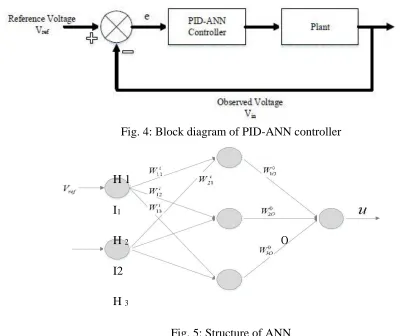
Controller for DSTATCOM: In our proposed method we have used PID-ANN based controlling strategy for DSTATCOM. A proportional-integral-derivative controller (PID controller) is a control loop feedback mechanism (controller) widely used in industrial control systems. A PID controller calculates an error value as the difference between a measured process variable and a desired set point. The controller attempts to minimize the error by adjusting the process through use of a manipulated variable. The PID controller algorithm involves three separate constant parameters and is accordingly sometimes called three-term control: the proportional, the integral and derivative values, denoted P, I and D. Simply put, these values can be interpreted in terms of time: P depends on the present error, I on the accumulation of past errors and D is a prediction of future errors, based on current rate of change. The weighted sum of these three actions is used to adjust the process via a control element to control various systems. Adaptive environment of Artificial Neural Network controllers have made them a wide area of interest among researchers in extensive fields, mainly because ANN controllers can proficiently learn the unknown or continuously varying environment and act accordingly. Hence in this proposed method we have utilized ANN for tuning of PID parameters. Consider the general feedback system with a PID controller and plant, which is shown in Figure 4.
The output of the PID controller is given by
1 t
de (t) u (t )= K p e( t
)+
∫e ( t )dt +
Kd (4)
Ki dt
Available online: https://edupediapublications.org/journals/index.php/IJR/ P a g e | 5723
Fig. 4: Block diagram of PID-ANN controller
H 1
I1
H 2 O
I2
H 3
Fig. 5: Structure of ANN
where u(t) is the controller output, K p is the proportional gain, KI is the integral gain, K D is the
derivative time and e(t) is the error between the reference voltage and the observed voltage which is given by
e = Vref− Vin (5)
An artificial neural network tuned PID (PID-ANN) has two inputs, one outputs and three layers they are input layer, hidden layer and output layer. The input layers has two neurons which are
reference voltage Vref and observed voltage Vin and the output layer has one which is controller
output u(t). The hidden layers has three neurons they are P-Neuron, I-Neuron and D-Neuron respectively.
Step:1 Assign the weights for neurons
Step:2 Generate the neural network with twoinputs , three hidden layers
and one output layer.
Step:3 The final output of neural network is given bywhere m indicates no. of hidden neurons, n
represents no. of input, is the nth inputvalue and is the weight assigned between hidden
layer and output layer, is the weight assigned between inputlayer and hidden layer.
Available online: https://edupediapublications.org/journals/index.php/IJR/ P a g e | 5724
RESULTS AND DISCUSSIONS
The proposed system for the power quality control in wind energy system using DSTATCOM based on PID-ANN controller is implemented in the working platform of Matlab/Simulink. The system parameter for the proposed method is given Table 1.
The performance of the proposed method for stabilization of wind energy system is analyzed based on three conditions they are normal condition, sag condition and swell condition. In normal, the voltage required and the generated are same hence there is no need of compensation in this case the DSTATCOM will not be operated. In sag condition, voltage sag or voltage dip is a short duration reduction in rms voltage which can be caused by a short circuit, overload etc.
A voltage sag happens when the rms voltage decreases between 10 and 90 percent of nominal voltage for one-half cycle to one minute. At voltage sag condition the generating power is lower than the required power the waveform obtained at the voltage sag condition.
Available online: https://edupediapublications.org/journals/index.php/IJR/ P a g e | 5725
Figure: Output of proposed DSTATCOM based on PID-ANN at Voltage Sag Condition
Figure: Output of DSTATCOM based on PID at Voltage Sag Condition
Available online: https://edupediapublications.org/journals/index.php/IJR/ P a g e | 5726
Figure: Output of proposed DSTATCOM based on PID-ANN at Swell condition
Figure: Output of DSTATCOM based on PID at swell condition
Figure: Output of DSTATCOM based on PI at swell condition
CONCLUSION
Available online: https://edupediapublications.org/journals/index.php/IJR/ P a g e | 5727
REFERENCES
[1] Orlikowski, W.J. and J.J. Baroudi, Studying information technology in organizations: Research approaches and assumptions. Information systems research, 1991; 2 (1): 1-28.
[2] Dresselhaus, M.S., and I.L. Thomas, 2001. Alternative energy technologies. Nature, 414(6861): 332-337.
[3] Jacobson, M.Z. and M.A. Delucchi, 2011. Providing all global energy with wind, water and solar power, Part I: Technologies, energy resources, quantities and areas of infrastructure and materials. Energy Policy, 39(3): 1154-1169.
[4] Vries, B.J.M.D., D.P.V. Vuuren and M.M. Hoogwijk, 2007. Renewable energy sources: Their global potential for the first-half of the 21st century at a global level: An integrated approach. Energy policy, 35(4): 2590-2610.
[5] Lewis, J.I., 2007. Technology acquisition and innovation in the developing world: wind turbine development in China and India. Studies in comparative International Development, 42(3-4): 208-232.
[6] Carrasco, J.M., L.G. Franquelo, J.T. Bialasiewicz, E. Galván, R.C.P. Guisado, M.A.M. Prats and J.I. León, 2006. Moreno-Alfonso N. Power-electronic systems for the grid integration of renewable energy sources: A survey. IEEE Transactions on Industrial Electronics, 53(4): 1002-1016.
[7] Lopes, J.A., N. Hatziargyriou, J. Mutale, P. Djapic and N. Jenkins, 2007. Integrating distributed generation into electric power systems: A review of drivers, challenges and opportunities. Electric Power Systems Research, 77(9): 1189-1203.
[8] Vilar, C., H. Amarís and J. Usaola, 2006. Assessment of flicker limits compliance for wind energy conversion system in the frequency domain. Renewable Energy, 31(8): 1089-1106. [9] Fan, J. and S. Borlase, 2009. The evolution of distribution. IEEE Power and Energy Magazine, 7(2): 63-68.
[10] Mohod, S.W. and M.V. Aware, 2010. A STATCOM-control scheme for grid connected wind energy system for power quality improvement. IEEE Systems Journal, 4(3): 346-352. [11] Arrillaga, J., M.H.J. Bollen and N.R. Watson, 2000. Power quality following deregulation. Proceedings of the IEEE, 88(2): 246-261.
[12] Datta, R. and V.T. Ranganathan, 2003. A method of tracking the peak power points for a variable speed wind energy conversion system. IEEE transactions on Energy Conversion, 18(1): 163-168.
[13] Chen, Z., J.M. Guerrero and F. Blaabjerg, 2009. A review of the state of the art of power electronics for wind turbines. IEEE Transactions on Power Electronics, 24(8): 1859-1875.
[14] Tan, K. and S. Islam, 2004. Optimum control strategies in energy conversion of PMSG wind turbine system without mechanical sensors. IEEE Transactions on Energy Conversion, 19(2): 392-399.
[15] Divya, K.C. and J. Ostergaard, 2009. Battery energy storage technology for power systems-An overview. Electric Power Systems Research, 79(4): 511-520.
Available online: https://edupediapublications.org/journals/index.php/IJR/ P a g e | 5728
Proceedings of IEEE Joint 3rd Int'l Workshop on Nonlinear Dynamics and Synchronization & 16th International Symposium on Theoretical Electrical Engineering, pp: 1-7.
[17]Qiao, W., G.K. Venayagamoorthy and R.G. Harley, 2009. Real-time implementation of a STATCOM on a wind farm equipped with doubly fed induction generators. IEEE Transactions on Industry Applications, 45(1): 98-107.
[18] Muthusamy, M. and C.S. Kumar, 2014. New STATCOM control scheme for power quality improvement in wind farm. In Proceedings of IEEE International Conference on In Green Computing Communication and Electrical Engineering, pp: 1-5.
[19] Singh, B. and G.K. Kasal, 2008. Solid state voltage and frequency controller for a standalone wind power generating system. IEEE Transactions on Power Electronics, 23(3): 1170-1177.
[20] Molina-García, A., I. Muñoz-Benavente, A.D. Hansen and E. Gómez-Lázaro, 2014. Demand-Side Contribution to Primary Frequency Control With Wind Farm Auxiliary Control. IEEE Transactions on Power Systems, 29(5): 2391-2399.
[21] Amin, M.M. and O.A. Mohammed, 2011. Development of High-Performance Grid-Connected Wind Energy Conversion System for Optimum Utilization of Variable Speed Wind Turbines. IEEE Transactions on Sustainable Energy, 2(3): 235-245.
[22] Yaramasu, V. and B. Wu, 2014. Predictive Control of a Three-Level Boost Converter and an NPC Inverter for High-Power PMSG-Based Medium Voltage Wind Energy Conversion Systems. IEEE Transactions on Power Electronics, 29(10): 5308-5313.
[23] Kassem, A.M. and S.A. Zaid, 2014. Load parameter waveforms improvement of a standalone wind-based energy storage system and Takagi– Sugeno fuzzy logic algorithm. IET Renewable Power Generation, 8(7): 775-785.
[24] Ammar, M. and G. Joos, 2014. A Short-Term Energy Storage System for Voltage Quality Improvement in Distributed Wind Power. IEEE Transactions on Energy Conversion, 29(4): 997-1007.
[25] Tsili, M. and S. Papathanassiou, 2009. A review of grid code technical requirements for wind farms. IET Renewable Power Generation, 3(3): 308-332.
Gutierrez, J.J., J. Ruiz, L.A. Leturiondo and A. Lazkano, 2008. Flicker measurement system for wind turbine certification. IEEE Transactions on Instrumentation and Measurement, 57(12): 375-382.