© 2014, IJCSMC All Rights Reserved 10 Available Online at www.ijcsmc.com
International Journal of Computer Science and Mobile Computing
A Monthly Journal of Computer Science and Information Technology
ISSN 2320–088X
IJCSMC, Vol. 3, Issue. 11, November 2014, pg.10 – 20
RESEARCH ARTICLE
SYNTHESIS THE OCULAR IMAGES
ON IRIS RECOGNITION BY USING
LDA TECHNIQUES
T. UMMAL SARIBA BEGUM
1, C.REVATHI*
2Assistant Processor
1School of Computer Science, Thanthai Hans Roever College, Perambalur, TamilNadu, India
Research Scholar
2School of Computer Science, Thanthai Hans Roever College, Perambalur, TamilNadu, India
[email protected]
1[email protected]
2Abstract Biometric can provide substantial help is in guarding against attempts to establish fraudulent multiple identifies or prevent identity fraud. By searching through the stored references, individuals who appear to have previously enrolled using a different identity can be highlighted for future investigation. It is very difficult to perform this type of check without the use of biometrics. The biometric suggest the several parts such as iris, fingerprint, ear and face recognition. This dissertation uses the iris recognition and analyzes the degraded ocular images. Iris recognition is the best of breed authentication process available today. While many mistake it for retinal scanning, iris recognition simply involves taking a picture of the iris; this picture is used solely for authentication. This work can synthesis the iris images to overcome the degraded factors. The degraded factors are known as illumination, light resources, occlusions and blur images. In this paper, we perform the segmentation, edge detection and LDA techniques to synthesis the degraded images. Then our experimental results guarantee that proposed work is correctly performed.
Keywords Biometric, Iris, Degraded factors, Ocular Images, LDA Techniques
I. INTRODUCTION
© 2014, IJCSMC All Rights Reserved 11
The primary visible characteristic of iris is the trabecular meshwork that makes possible to divide the iris in a radial fashion. It is formed in the eighth month of gestation [5]. Iris is stable and does not change during the whole life. Iris recognition is an automated method of biometric identification that uses mathematical, pattern-recognition techniques on video images of the irises of an individual's eyes, whose complex random patterns are unique and can be seen from some distance. Not to be confused with other, less prevalent, ocular-based technologies, retina scanning and eye printing, iris recognition uses camera technology with subtle infrared illumination to acquire images of the detail-rich, intricate structures of the iris externally visible at the front of the eye.
A. Problem Definition
A large number of new iris encoding and processing algorithms. Most of developed systems and algorithms are claimed to have exclusively high performance. However, since there are no publicly available large scale and even medium size databases, neither of the algorithms has undergone extensive testing. The largest dataset of frontal view infrared iris images presently available for several data bases with the lack of data, two major solutions to the problem of algorithm testing are possible: (i) physically collect a large number of iris images or (ii) synthetically generating a large scale database of iris images. Then existing work use the model based/anatomy based method to synthesize iris images and evaluate the performance of synthetic irises by using a traditional Gabor filter based system. The issue of security and privacy is another argument in favor of generation of synthetic data. In existing system, there are various iris recognition algorithms to construct the iris databases. But due to the real conditions, this work can’t maintain the large iris databases. An iris image synthesis method based on Principal Component analysis (PCA) and constructs the images with coefficients. Then controlling the coefficients with specified classes
B. Proposed System
With an increase emphasis on security, personal identification has become more and more important. Traditional ways for personal identification depend on external things such as keys, passwords, smart card, etc. But such things may be lost or forgotten. One possible way to solve these problems is through biometrics, for every person has unique physiological or behavioral features which have been used for automatic identification of the individuals. In recent years, iris recognition has become the major recognition technology since it is the most reliable form of biometrics. Iris patterns are unique and stable, even over long period of time. Unfortunately iris recognition has some disadvantages that must be considered. To over this problem iris recognition and pupil recognition is used. Pupil is a circular hole inside the iris and the radius of the pupil unique for each person. One difficulty in processing pupil images for biometric is that the pupil changes in size due to involuntary dilation. The size of the pupil is changed according to two muscles called sphincter and dilator muscle. Then using LDA features and overcome the various degraded features which are an especially difficult factor in terms of recognition effectiveness, because lenses might introduce nonlinear deformations in the appearance of the iris texture.
II. LITERATURE SURVEY
A. Image Understanding for Iris Biometrics: Survey
Biometrics can be used in at least two different types of applications. In a verification scenario, a person claims a particular identity and the biometric system are used to verify or reject the claim. Verification is done by matching a biometric sample acquired at the time of the claim against the sample previously enrolled for the claimed identity. If the two samples match well enough, the identity claim is verified, and if the two samples do not match well enough, the claim is rejected. Thus there are four possible outcomes [2]. A true accept occurs when the system accepts, or verifies, an identity claim, and the claim is true. A false accepts occurs when the system accepts an identity claim, but the claim is not true. A true reject occurs when the system rejects an identity claim and the claim is false. A false reject occurs when the system rejects an identity claim, but the claim is true. The two types of errors that can be made are a false accepts and a false reject. Biometric performance in a verification scenario is often summarized in a receiver operating characteristic (ROC) curve.
1) Drawbacks:
© 2014, IJCSMC All Rights Reserved 12
B. An Iris Image Synthesis Method Based on PCA and Super-resolution
To evaluate the performance of the existing iris recognition algorithms and provide more knowledge of essential information of iris characteristics, it needs larger iris databases. However, it is difficult to capture so many iris images from the volunteers because the iris images have close relation with personal privacy. Driven by the applications of synthesis method in fingerprint recognition, this paper focuses on the construction of iris databases with synthesis method [6]. The main idea of the algorithm is that the iris images can be classified and constructed with the coefficients on the given bases and the iris image classification can be done through selecting the high dimensional spheres those coefficients belong to. As much as that know, there are no papers about iris image synthesis. In the iris synthesis method, iris images belong to the same class are constructed through letting the coefficients lie in the same sphere centered at a sample iris image in a high dimensional space. To construct different classes, this search in a limited high-dimensional space. Super-resolution method can be used to enhance the synthesized iris images. Theoretical analysis and extensive experimental results show that the algorithm has good clustering.
1) Drawbacks:
1.Eyelid occlusion can’t be measured in this system 2.Synthesis methods can’t be implemented.
C. The importance of being random: statistical principles of iris recognition
Robust representations for pattern recognition must be invariant under transformations in the size, position, and orientation of the patterns. For the case of iris recognition, this means that it must create a representation that is invariant to the optical size of the iris in the image (which depends upon both the distance to the eye, and the camera optical magnification factor); the size of the pupil within the iris (which introduces a non-aDne pattern deformation); the location of the iris within the image; and the iris orientation, which depends upon head tilt, torsional eye rotation within its socket (cyclovergence), and camera angles, compounded with imaging through pan tilt eye finding mirrors that introduce additional image rotation factors as a function of eye position, camera position, and mirror angles. [4]. Fortunately, invariance to all of these factors can readily be achieved. It is informative to calculate the significance of any observed HD matching score, in terms of the likelihood that it could have arisen by chance from two different irises. These probabilities give a confidence level associated with any recognition decision.
1) Drawbacks:
1. More difficult to localize accurately the iris sclera boundary. 2. Inefficient to acquire eye images at distances
3. Increased FP rates for authentication
D. How Iris Recognition Works
Only phase information is used for recognizing irises because amplitude information is not very discriminating, and it depends upon extraneous factors such as imaging contrast, illumination, and camera gain. The phase bit settings which code the sequence of projection quadrants capture the information of wavelet zero-crossings, as is clear from the sign operator. [3]. The extraction of phase has the further advantage that phase angles are assigned regardless of how low the image contrast may be, as illustrated by the extremely out-of-focus image.[4] Its phase bit stream has statistical properties such as run lengths similar to those of the code for the properly focused eye image that phase bits are set also for a poorly focused image as shown here, even if based only on random CCD noise, is that different poorly focused irises never become confused with each other when their phase codes are compared. By contrast, images of different faces look increasingly alike when poorly resolved, and may be confused with each other by appearance-based face recognition algorithms.
1) Drawbacks:
1. Insufficient for implement in large scale applications. 2. Provide worst matches for iris images
E. An Ocularist’s Approach to Human Iris Synthesis
© 2014, IJCSMC All Rights Reserved 13
methods. For example, for a grid the number of voxels along the z-axis could adapt to the number of cones.[1]. However, a small number of voxels and limit ourselves to modeling the sclera, iris and cornea, because other parts of the eye, such as the lens, the vitreous body and the retina, only contribute to the rendered results in very rare and specific cases. An example which it is currently not able to recreate is light scattering off the back of the retina. The aqueous humor is not modeled because its index of refraction is very similar to that of the cornea. Hence, its contribution to the rendered result is small. Ocularists also make this assumption when building an ocular prosthesis.
1) Drawbacks:
1. This method mimics the ocularist’s approach by adding one layer at a time to the model and rendering an intermediate result.
2. This allows the decremented creation of an iris using single layers taken from our standard library of textures, although additional layers could be easily painted in standard paint programs.
III. DEGRADING PROCESS
A. Preprocessing
It performs the gray scale conversion operation to identify black and white illumination and to analyze the noises. Then use the segmentation algorithm to group the iris features and calculate the pupil features to segment the pupil values. Canny edge detection algorithm is used. The Canny edge detector is an edge detection operator that uses a multi-stage algorithm to detect a wide range of edges in images. Canny's aim was to discover the optimal edge detection algorithm. The figure 3.1 shows the steps of preprocessing function. In this situation, an "optimal" edge detector means:
1. Good detection – the algorithm should mark as many real edges in the image as possible. 2. Good localization – edges marked should be as close as possible to the edge in the real image.
3. Minimal response – a given edge in the image should only be marked once, and where possible, image noise should not create false edges.
Fig.1 Preprocessing Method
B. Feature Extraction
With an increase emphasis on security, personal identification has become more and more important. Traditional ways for personal identification depend on external things such as keys, passwords, smart card, etc. But such things may be lost or forgotten. One possible way to solve these problems is through biometrics, for every person has unique physiological or behavioral features which have been used for automatic identification of the individuals. In recent years, iris recognition has become the major recognition technology since it is the most reliable form of biometrics.
Preprocessing Noise Removal
Eye Segmentation
Edge detection
IRIS & Pupil Segmentatio
© 2014, IJCSMC All Rights Reserved 14
To over this problem iris recognition and pupil recognition is used. Pupil is a circular hole inside the iris and the radius of the pupil unique for each person. One difficulty in processing pupil images for biometric is that the pupil changes in size due to involuntary dilation. The size of the pupil is changed according to two muscles called sphincter and dilator muscle. Then using LDA features and overcome the various degraded features which are an especially difficult factor in terms of recognition effectiveness, because lenses might introduce nonlinear deformations in the appearance of the iris texture.
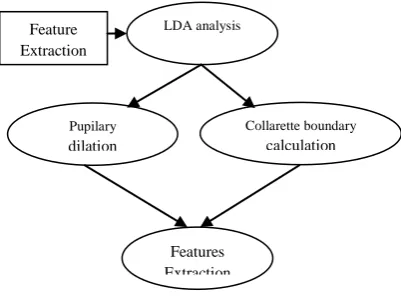
In this module it uses the features to synthesized the layers and create the collarette. Then each fiber of the iris has a singular color distribution depending on its composition in terms of minerals and of muscle contractions. It can use the LDA techniques to get the features. That can overcome the degraded factors such as illumination, occluded conditions, and glasses and so on. The figure 2 describes the process of feature extraction.
Fig. 2 Feature Extraction Method
C. LDA analysis
In this module, it extracts iris features by using LDA techniques. The biometrics has attained a very significant place in human verification and identification. It can use Linear discriminate analysis. Then this module consist of pupil localization, image refinement, iris localization a normalization procedures. Iris recognition is seen as a highly reliable biometric technology. The performance of iris recognition is severely impacted when encountering poor quality images. The selection of the features subset and the classification is an important issue for iris biometrics. Here, it explored the contribution of collarette region in identifying a person. The detailed process of LDA analysis is displayed in figure 3
Fig.3. LDA Analysis Feature
Extraction
LDA analysis
Pupilary
dilation
Collarette boundary
calculation
Features Extraction
LDA analysis Preprocessed Images
© 2014, IJCSMC All Rights Reserved 15
D. LDA Algorithm
Linear discriminate analysis (LDA) and the related Fisher's linear discriminant are methods used in statistics, pattern recognition and machine learning to find a linear combination of features which characterizes or separates two or more classes of objects or events. The resulting combination may be used as a linear classifier, or, more commonly, for dimensionality reduction before later classification.
LDA is closely related to ANOVA (analysis of variance) and regression analysis, which also attempt to express one dependent variable as a linear combination of other features or measurements. However, ANOVA uses categorical independent variables and a continuous dependent variable, whereas discriminant analysis has continuous independent variables and a categorical dependent variable (i.e. the class label). Logistic regression and probit regression are more similar to LDA, as they also explain a categorical variable by the values of continuous independent variables. These other methods are preferable in applications where it is not reasonable to assume that the independent variables are normally distributed, which is a fundamental assumption of the LDA method.
LDA is also closely related to principal component analysis (PCA) and factor analysis in that they both look for linear combinations of variables which best explain the data. LDA explicitly attempts to model the difference between the classes of data. PCA on the other hand does not take into account any difference in class, and factor analysis builds the feature combinations based on differences rather than similarities. Discriminant analysis is also different from factor analysis in that it is not an interdependence technique: a distinction between independent variables and dependent variables (also called criterion variables) must be made.
LDA works when the measurements made on independent variables for each observation are continuous quantities. When dealing with categorical independent variables, the equivalent technique is discriminate correspondence analysis.
E. Segmentation
Segmentation is the important phase in the Iris Recognition process. It refers to the process of partitioning a digital image into multiple regions (sets of pixels). The goal of segmentation is to simplify and/or change the representation of an image into something that is more meaningful and easier to analyze. Image segmentation is typically used to locate objects and boundaries (lines, curves, etc.) in images. The result of image segmentation is a set of regions that collectively cover the entire image or a set of contours extracted from the image. Each of the pixels in a region are similar with respect to some characteristic or computed property such as color, intensity, or texture. Adjacent regions are significantly different with respect to the same characteristic.
F. Normalization
Normalization method for iris recognition, which is different from the conventional one in which the annular iris region is unwrapped to a rectangular block under polar coordinate. In this method, it investigate the effect of interpolation and decimation in conventional normalization method to recognition rate for the first time. this used the original texture to fill the pupil area, then a novel normalized image can be obtained with the geometric structure and directional information of original iris image well preserved, which enables us to choose simpler features than before. Subsequently, that extracted the multi-direction and multi-scale information feature of normalized iris image by contourlet transform, and adopts SVM to classify the features. Experimental results validate the improvement of recognition rate.
G. Matching
© 2014, IJCSMC All Rights Reserved 16
IV. EXPERIMENTAL RESULT AND ANALYSIS
System implementation is the practice of creating or modifying a system to create a new business process or replace an existing business process. System implementation is the practice of creating or modifying a system to create a new business process or replace an existing business process. Iris recognition is an automated method of biometric identification that uses mathematical pattern-recognition techniques on video images of the irises of an individual's eyes, whose complex random patterns are unique and can be seen from some distance.
In this paper, iris recognition implemented in c#.net .The iris pattern of each person is different and it remains unchanged in life time. So it is used for much Security system. First stores the segment of the eye and the details of the user store in the database. Then the user ID is created for the user. After the user login the user eye segment the segment is detected by the cam and then it match to the database user details if the eye segment is correct the user enter into the user account otherwise it allowed to enter into the login details it show the mismatch message.
A. Main Page
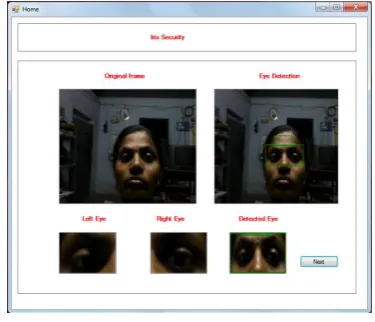
The First Main page is shows the in the figure 4. It has 3 buttons which is used to get the new user (Train Eye), Verification process and Exit Process (Quit).
Fig.4 Main Page
B. Train Eye
© 2014, IJCSMC All Rights Reserved 17
Fig.5 Train Eye
Fig.6 Train Eye to store Dataset
C. Upload image
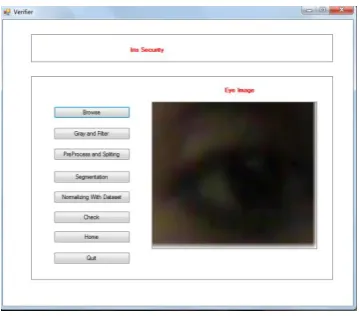
In this module, it can upload the eye images that can extract the iris from those images. The figure 7.1 &7.2 shows the process of upload eye for process.
© 2014, IJCSMC All Rights Reserved 18
Fig 7.2 Upload Image
D. Gray
In this module, it performs the gray scale conversion operation to identify black and white illumination and to analyze the noises. Figure 8 describes the gray scale image of the given image. Filtering module process of filtering the eye. The figure 9 shows it.
Fig.8 Gray
© 2014, IJCSMC All Rights Reserved 19
E. Segmentation
In this module, the process of partitioning a digital image into multiple regions (sets of pixels). The segmentation is to simplify and/or change the representation of an image into something that is more meaningful and easier to analyze. The figure 10 describes it.
Fig.10 Segmentation
F. Normalization
In this module, it investigates the effect of interpolation and decimation in conventional normalization method to recognition rate for the first time. The figure 11 given below shows it.
Fig.11 Normalization
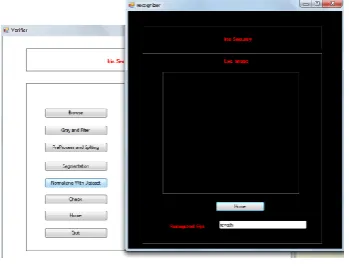
G. Matching
In this module is used to finding the user is authorized person or not. The eye detection eye is match into data in the dataset. If it is matched, the message is displayed “You are Authorized Person”. Otherwise it terminates the process and load a home page. The figure 12 shows it.
© 2014, IJCSMC All Rights Reserved 20
V. CONCLUSION AND FUTURE ENHANCEMENT
It concludes that, this paper performs the segmentation, edge detection and Linear Discriminate Analysis (LDA) techniques to synthesis the degraded images. Then our experimental results guarantee that proposed work is correctly performed. Persons are authenticated to eyes, which increases the challenge of realistic rendering. Also, due to the diversity of components and of their optical properties, the ocular region is the most difficult part of the face to render realistically. Because there are several degraded conditions occurred such as optically defocused, motion blurred, off-angle, and occluded data. This framework is useful for evaluation and robustness in degraded features. This can perform the iris segmentation; edge detection and wavelet transform to preprocess the iris data. Then perform the LDA techniques to synthesis the iris images. And also it concentrate the between class and within class variability. In future work it test iris images in real time datasets and analyze the measurements for authentication and improve the validation in degraded factors. In future a person can use the eye segment as a user id and password.
References
[1] Aaron Lefohn, Brian Budge, Peter Shirley, Richard Caruso, and Erik Reinhard, An ocularist’s approach to human iris
synthesis,Computer Graphics Applicat., vol. 23, no. 6, pp. 70–75, 2003.
[2] Bowyer. K, Hollingsworth. K and Flynn. P, Image understanding for iris biometrics: A Survey, Comput. Vis. Image Understand., vol. 110, no. 2, pp. 281 = 307, 2008.
[3] Daugman. J, How iris recognition works, IEEE Trans. Circuits Syst. Video Technol., vol. 14, no. 1, pp. 21–30, Jan. 2004.
[4] Daugman. J, The importance of being random: Statistical principles of iris recognition, Pattern Recognit., Vol. 36, pp. 279-291, 2003.
[5] Jain.A.K, Ross.A, and Prabhakar.S, An introduction to biometric recognition, IEEE Trans. Circuits Syst. Video Technol., vol. 14, no. 1, pp. 4–20, Jan. 2004