Available online:
https://edupediapublications.org/journals/index.php/IJR/
P a g e | 264Enhanced Data Sharing Security and Searching At the Edge of
Cloud-Assisted Internet of Things
Mrs.M.Sangeetha
Assistant Professor, DEPARTMENT OF COMPUTER SCIENCE & ENGINEERING , visvesvaraya college of
engineering and technology
[email protected]
.
ABSTRACT─ Cloud computing even though Internet of sense information without the guide of human
mediation" was comprehensively adjusted to different
fields for instance social insurance, transports, condition
and home.
Internet of things (IoT) is considered as a
future web that broadens the association of the web to all
sorts of true physical brilliant devices. IoT will give
created brilliant and self-governing digital physical
situations in the region of brilliant matrices, brilliant
urban areas, shrewd homes, keen restorative also; human
services frameworks, wearable innovations,
transportation frameworks, and so on. Be that as it may,
the larger part of these devices are a piece of a huge
stage, henceforth, a gigantic measure of information are
created that requires high computational capacities for
capacity, preparing, and dissecting purposes in a
protected and productive way. By and large, the savvy
devices have constrained assets. Then again, cloud assets
have for all intents and purposes boundless capacity and
preparing abilities with adaptability and on-request
openness anyplace. In this manner with the assistance of
the cloud, the IoT sense devices can improve the weight
of restricted assets. For IoT applications, savvy devices
require low inertness, high information rate, quick
information access, and constant information
examination/handling with basic leadership and
portability bolster. Because of a few downsides, the
cloud can't satisfy the previously mentioned
prerequisites.
Information sharing at the edge enables
brilliant devices to impart information to bring down 1. INTRODUCTION
Distributed computing has to a great degree changed
the way we live, occupation, and research since its
beginning around .For example, a product as an
administration (SaaS) examples, such as Flicker, Face
book, Twitter, and Google Apps, have been usually
utilized as a part of the day by day life of our
Own. Moreover, adaptable foundations, as well as
preparing motors made to help cloud benefit, are
additionally impressively affecting the method for
dealing with the organization. Web of Things (IoT)
was supply chain administration, and next "making a
PC
Things (IoT), two in general different advancements, is
all things considered both accurate now part of the life
of our own. Their take preferred position of with
massive reception are expected to build all the further
essential parts of the Future Internet. A novel paradigm
where IoT and Cloud are really combining is for seen as
challenging and in addition an empowering manipulate
of a great deal of use scenario. This paper proposes a
viable information sharing framework which takes into
consideration smart products to share secure
information with other individuals at the edge of cloud
helped Web of Things (IoT). We inside like manner
recommend a secured seeking plan to Data inside
claim/shared information on storage space were wanted
Available online:
https://edupediapublications.org/journals/index.php/IJR/
P a g e | 265dormancy and have quick information get to and higher
data transfer capacity. The cutting edge remote
interchanges innovation will incredibly rely upon such
arrangements where monstrous IoT brilliant devices are
interconnected with high information rates at ultralow
idleness. At the point when the IoT savvy devices share
information with different devices, potential security
issues emerge, for example, information spillage,
modification, uprightness, and unapproved get to. Thus,
it is basic that such shared information be guaranteed
confidentiality, honesty, and access control while
sharing at the edge. Besides, safe information looking
procedure is expected to seek furthermore, recover the
mutual information by approved devices. At show, there
is couple of answers for address the difficulties of secure
information sharing and looking in mists. Ordinarily, to
guarantee confidentiality of shared information,
symmetric key, public key and homomorphic
encryption-based instrument are as of now utilized.
Access control approaches in light of access control
rundown and dynamic trait are utilized for get to control
purposes. Accessible encryptions in view of symmetric
and open keys are utilized for looking through the
coveted information. In every one of these plans, for
information security, real security-situated preparing, for
example, encryption, decoding, and access control
systems are dealt with by the client's device itself. In
IoT, the asset constrained keen devices can't deal with
these calculations escalated operations in light of the fact
that the security-situated operations will build the
substantial computational weight.
2. RELATED WORK
The Number of papers managing Cloud and IoT
independently demonstrates an expanding pattern since
2008. On the other hand, a later and quickly expanding
pattern bargains with Cloud and IoT together. Following
the signs reported, we embrace the examination
technique schematically delineated. We to begin with
give a worldly portrayal of the literature going for
appearing subjectively the temporal behavior of the
exploration and the normal enthusiasm about the Cloud
IoT worldview. Second, we give a definite discussion on
the Cloud IoT worldview, featuring the complementarily
and the requirement for their incorporation. Third, we
detail the new application situations coming from the
selection of the Cloud IoT worldview. Fourth, mutually
dissecting the Cloud IoT paradigm and the application
situations, we infer the hot topics and related issues for
investigate. Fifth, we describe the principle stages (both
business and open source) and research extends in the
field of Cloud IoT. At long last, thanks to the past seven
stages, we infer the open issues what's more, future
directions in the field of Cloud IoT. An autonomous
development has been seen by the 2 universes of IoT and
Cloud. All things considered, numerous shared points of
interest determining from their mix have been
characterized in writing and are really anticipated down
the street. From one viewpoint, IoT can without much of
a stretch pick up from the virtually boundless highlights
and materials of Cloud to remunerate its mechanical
imperatives (e.g., capacity, processing, and energy). In
particular, the Cloud can offer a successful solution to
execute IoT benefit administration and also creation as
well as applications that adventure the information or the
things made by them. On the different other hand, the
Cloud can effectively advantage from IoT by broadening
the extent of it’s to adapt to world things that are genuine
in a considerably more conveyed and intense mold, and
for providing pristine administrations in a major choice
of genuine situations. The complementary highlights of
IoT and Cloud emerging from the different
recommendations in writing also, spurring the Cloud IoT
Available online:
https://edupediapublications.org/journals/index.php/IJR/
P a g e | 266between the applications, and the things where it shrouds
the greater part of the unpredictability and furthermore
the functionalities expected to apply the last mentioned.
This structure will impact future program advancement,
in which information gathering, Brand new difficulties
will be created by handling, and transmission to be
settled, additionally in a multi cloud condition.
Cloud-based secure information sharing plans
are exhibited whereby clients can share their information
with others/among a gathering by means of the cloud. A
certificate less intermediary re-encryption conspires by
utilizing both symmetric key and open key encryption.
In this plan, the information proprietor initially encodes
the information with the mystery key and the mystery
key is scrambled with information proprietor's open key,
which is at that point sent to the cloud. In the wake of
accepting, an intermediary re-encryption operator inside,
the cloud re-scrambles the encoded type of the mystery
key and this re-scrambled frame can be decoded just by
client's private key. Be that as it may, the private-open
key sets are not related with an authentication. A
certificate less plan for information sharing but without
bilinear pairing. In this plan, the cloud is in charge of
both secure information stockpiling and public private
key combine age. The information proprietor scrambles
the information with open keys as indicated by its
entrance control approaches and sends this scrambled
information to the cloud. In this plan, the unscrambling
is performed twice by approved open keys. At in the first
place, the cloud incompletely unscrambles the scrambled
information and after that the beneficiary clients decode
at last to get the first information. Khan et al. use an
incremental cryptography-based information sharing
plan where the information is separated into a few pieces
and these squares are then incrementally encoded. A
trusted outsider is utilized as a intermediary for key age,
re-encryption, and access control purposes. In addition,
ElGamal cryptosystem what's more, bilinear matching
are additionally utilized as a part of this plan. A mystery
key-based encryption what's more, get to control list for
secure information sharing where a trusted thirst party is
occupied with encryption/unscrambling, key
administration, and access control rather client's device
itself is used.
3. FRAME WORK
In this paper, by considering the previously mentioned
impediments of current answers for resource limited
shrewd devices, we propose a lightweight cryptographic
plot with the goal that IoT brilliant devices can share
information with others at the edge of cloud-helped IoT
wherein all security-situated operations are offloaded to
close-by edge servers. Besides, albeit at first we
concentrate on information sharing security, we likewise
propose an information looking plan to search desired
information/shared information by approved clients on
capacity where all information is in encoded shape. At
long last, security and execution an investigation
demonstrates that our proposed conspire is productive
also, diminishes the calculation and correspondence
overhead of all elements that are utilized as a part of our
Available online:
https://edupediapublications.org/journals/index.php/IJR/
P a g e | 267Figure1: System Architecture.
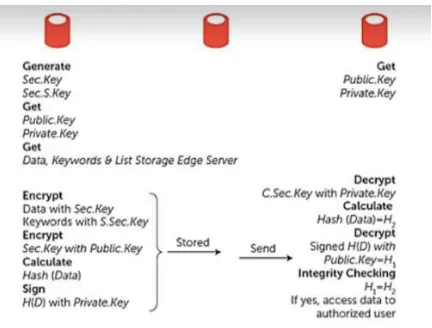
In secret key encryption, the end client unit
initially makes a mystery key. At that point the data is
scrambled with the key and is really conveyed to the
beneficiary pc client device. By utilizing the very same
component, the beneficiary device is capable to recover
the data from the scrambled kind of data by
unscrambling with the mystery key component. With a
specific end goal to keep the procedure secret, the
arrangement is talked about with conveying devices
using secure correspondence principals. Open Key
Encryption: out in the open pivotal encryption, there are
really 2 sorts of keys: an open component what's more, a
mystery component. Before sending, the information is
as a matter of fact encoded with the beneficiary's open
key and in the wake of getting the information is really
decoded by the beneficiary's mystery fixing to recoup
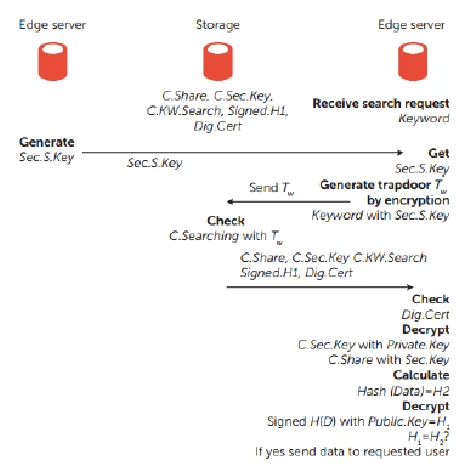
the information. Accessible Secret Key Encryption: This
system is all things considered grounded on mystery key
encryption which empowers looking through specific
points of interest on outsourced capacity scrambled
information through a created trapdoor. The data
proprietor device needs to talk about the mystery
essential factor with every approved item to make the
trapdoor. Subsequent to imparting, it's basic to affirm the
information isn’t modified in any capacity in the middle
of the sender and additionally the collector. This check is
really called respectability checking. By and large, the
trustworthiness checking is completed by a hash include.
On the off chance that an openly known hash work is
really put onto the data with a predetermined length, at
that point the end result is really known as the hash
worth of the data. By and by, this method is only
one-way, it can't recoup the comparing data from the hash
esteem. The sender sends the data with its relating hash
esteem. After getting the data, the receiver assessments
information respectability by precisely the same,
executing the hash highlight to the got data; on the off
chance that both hash values are really precisely the
same, the data has been turned out to be authentic.
4. EXPERIMENTAL RESULTS
We show our proposed scheme that secures the sharing
and looking of information at the edge of cloud-helped
IoT. Before information sharing and looking, all clients
need to enroll with edge servers by username and secret
key to profit data sharing, downloading, wanted
information looking and retrieving. Make secure
information sharing plan that utilizations both mystery
key encryption and open key encryption.
Figure 2: Data Sharing Scheme
Edge servers handle all security operations make
scanning plan for approved clients to look for desired
information put away nervous/cloud Make check process
for shared information and information retrieval after
looking (demonstrating information honesty) Examine
execution of plan to appear proficiency and efficacy for
Available online:
https://edupediapublications.org/journals/index.php/IJR/
P a g e | 268Figure 3: Data Searching Scheme
In the produce of determining the combined transferring
and downloading times, we contrast our outcomes and a
few other cloud-based plans and trapdoor age time is
immaterial contrasted with the recovering time; we don't
contrast these circumstances and the other cloud-based
looking plans
Figure 4: Processing Time Graph
5. CONCLUSION
In this paper, we show a proposed information sharing
furthermore, - seeking plan to share and pursuit
information safely by IoT keen gadgets at the edge of
cloud-helped IoT. The execution investigation shows
that our plan can accomplish better productivity as far as
preparing time contrasted and existing cloud-based
frameworks. In future work, we anticipate confirming
and getting to control challenges around there. We trust
that our proposed conspire is functional to be conveyed
and opens another entryway in edge-situated security
look into for cloud assisted IoT applications.
6.
REFRENCES
[1]. M.R. Palattella, M. Dohler, A. Grieco, G. Rizzo, J. Torsner, T. Engel, et al., “Internet of Things in the 5G Era: Enablers, Architecture, and Business Models,” IEEE J. Selected Areas in Communications, vol. 34, no. 3, 2016, pp. 510–527.[2]. L. Wang and R. Ranjan, “Processing Distributed Internet of Things Data in Clouds,” IEEE Cloud Computing, vol. 2, no. 1, 2015, pp. 76–80.
[3]. M. Satyanarayanan, P. Simoens, Y. Xiao, P. Pillai, Z. Chen, K. Ha, et al., “Edge Analytics in the Internet of Things,” IEEE Pervasive Computing, vol. 14, 2015, pp. 24–31.
[4]. S. Yi, Z. Hao, Z. Qin, and Q. Li, “Fog Computing: Platform and Applications,” 2015 3rd IEEE Workshop Hot Topics Web Systems and Technologies (HotWeb), 2015, pp. 73–78.
[5]. J. Singh, T. Pasquier, J. Bacon, H. Ko, and D. Eyers, “Twenty Security Considerations for CloudSupported Internet of Things,” IEEE Internet of Things J., vol. 3, no. 3, 2016, pp. 269–284.
[6]. M. Ali, R. Dhamotharan, E. Khan, S. U. Khan, A.V. Vasilakos, K. Li, et al., “SeDaSC: Secure Data Sharing in Clouds,” IEEE Systems J., vol. 99, 2015, pp. 1–10.
[7]. S.-H. Seo, M. Nabeel, X. Ding, and E. Bertino, “An Efficient Certificate less Encryption for Secure Data Sharing in Public Clouds,” IEEE Trans. Knowledge and Data Engineering, vol. 26, no. 9, 2014, pp. 2107–2119.
[8]. H. Kumarage, I. Khalil, A. Alabdulatif, Z. Tari, and X. Yi, “Secure Data Analytics for Cloud Integrated Internet of Things Applications,” IEEE Cloud Computing, vol. 3, no. 2, 2016, pp. 46–56.
[9]. J.B. Bernabe, J.L.H. Ramos, and A.F.S. Gomez, “TACIoT: Multidimensional Trust-Aware Access Control System for the Internet of Things,” Soft Computing, vol. 20, no. 5, 2016, pp. 1763–1779.
[10]. F. Li, Y. Rahulamathavan, M. Conti, and M. Rajarajan, “Robust Access Control Framework for Mobile Cloud Computing Network,” Computer Communications, vol. 68, 2015, pp. 61–72.
Available online:
https://edupediapublications.org/journals/index.php/IJR/
P a g e | 269Encrypted Mobile Cloud Data Through Blind Storage,” IEEE Trans. Emerging Topics in Computing, vol. 3, no. 1, 2015, pp. 127–138.
[12]. H. Li, D. Liu, Y. Dai, and T.H. Luan, “Engineering Searchable Encryption of Mobile Cloud Networks: When Qoe Meets Qop,” IEEE Wireless Communications, vol. 22, no. 4, 2015, pp. 74–80.