Volume 8, No. 5, May – June 2017
International Journal of Advanced Research in Computer Science RESEARCH PAPER
Available Online at www.ijarcs.info
An Application of Image Processing – License Plate Recognition
Manjit Sandhu
Department of Electronics and Communication Engineering Guru Nanak Dev University Regional Campus
Sathiala, Amritsar, India
Sukhdeep Kaur
Department of Electronics and Communication Engineering Guru Nanak Dev University Regional Campus
Sathiala, Amritsar, India
Jaipreet Kaur
Department of Electronics and Communication Engineering Guru Nanak Dev University Regional Campus
Sathiala, Amritsar, India
Abstract
:
License plates are used for the identification of registered vehicles. It Consists of alphanumeric characters i.e. sequence of some alphabets and some numbers. License Plate Recognition (LPR) is an image-processing technology used to identify vehicles by their license plate. This technology is gaining fame in security and traffic installations. It has many applications in parking, access control, tolling, border control, stolen cars identification, enforcement, traffic control etc. The input to the License Plate Recognition system is a coloured image of the license plate and the output is the registration number of the vehicle which is alphanumeric characters. The required information from the license plate is acquired by using four steps. These are image acquisition, plate extraction, character segmentation and character recognition.Keywords: LPR, Pre-processing, character segmentation, character recognition.
INTRODUCTION
License plate recognition (LPR) is a form of automatic vehicle identification. It is an image processing technology used to identify vehicles by only their license plates. Real time LPR plays a major role in automatic monitoring of traffic rules and maintaining law enforcement on public roads [1]
[image:1.595.323.540.474.650.2]An automated system is developed using MATLAB in which image is captured from camera and converted in Gray scale image for pre processing. After conversion, dilation process is applied on image and unwanted holes in image have been filled. After dilation, horizontal and vertical edge processing of has been done and passed these histograms through low pass filters. Low pass filters filter out unwanted regions or unwanted noise from image. After this filtering, image is segmented and region of interest is extracted and image is converted into binary form. Binary images are easily processed as compared to coloured images. After Binarization, each alphanumeric character on number plate is extracted and then recognized with the help of template images of alphanumeric characters. After this, each alphanumeric character is stored in file and whole number plate is extracted successfully [2]
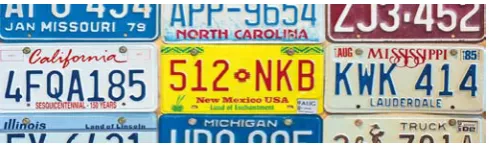
Figure 1 Diffreent number plates with alphanumeric characters.
TECHNIQUES USED IN LICENSE PLATE RECOGNITION
There are following methods which are used to detect number plate recognition.
Figure 2 Steps of license plate recognition system
A. IMAGE ACQUISITION
[image:1.595.37.282.683.758.2]reduce the problem of low quality and low contrast in car images[3]
B. PREPROCESSING TECHNIQUES
In basic aim of pre-processing is to improve the contrast of the input image, to reduce the noise in the image, hence to enhance the processing speed.[4]
RGB to Gray Scale Conversion: The captured input image is RGB format. The first step of preprocessing is to convert RGB image into grayscale image.
Noise Removal : The basic aim of filtering is to remove noise and distortion from the image. The noise can occur during camera capturing and due to weather conditions. Iterative bilateral filter can be used for noise removal. Iterative bilateral filter is non-linear filter. It provides the mechanism for noise reduction while preserving edges more effectively than median filter.
The median filter is a non-linear filtering technique used to remove noise from image under consideration. While it helps in removing the impulse noise it preserves the edges. After segmentation filtering was used for remove all lines expect characters. It is take consider noise. It is widely used and it is very effective at removing noise while preserving edges. It is particularly effective at removing 'salt and pepper' type noise [6]
Contrast Enhancement: Contrast is defined as difference between lowest and highest intensity level. Histogram equalization is a method for spreading the histogram of pixels level more effectively. Adaptive histogram equalization shows better contrast than histogram equalization.
Morphological opening operation is performed on the contrast enhanced gray scale image by using disc shaped structuring element. In image subtraction the morphological opened image is subtracted from contrast enhanced gray scale image.[4]
C.PLATE REGION EXTRACTION
Image binarization: Image binarization is a process to convert an image to black and white. In this method, certain threshold is chosen to classify certain pixels as black and certain pixels as white. But the main problem is how to choose correct threshold value for particular image. Sometimes it becomes very difficult or impossible to select optimal threshold value. Adaptive Thresholding can be used to overcome this problem.[3]
Edge detection is the process of localizing pixel intensities transitions or identification of sudden changes (discontinuities) in an object within the image. Edges are a significant local change of intensity in an image. Edges typically occur on boundary between two different regions in an image. To find edges, edge detection function is used. This function rapid change varies in images brightness and marks the edge. Edge detection aims capturing important features, events and properties of an image. Edge return a binary image containing ones at edges and zeros elsewhere. Available edge detectors available are sobel, prewitts, Roberts, canny and artificial
as powerful edge detector because it uses two thresholds detecting strong and weak edges [9]
Hough Transform: It is a feature extraction technique initially used for line detection. Later on it has been extended to find position of arbitrary shape like circle or oval. [3]
Blob detection: Blob detection is used to detect points or regions that differ in brightness or color as compared to surroundings. The main purpose of using this approach is to find complimentary regions which are not detected by edge detection or corner detection algorithms.[3]
Smearing :To find the plate region, firstly smearing algorithm is used. Smearing is a method for the extraction of text areas on a mixed image. With the smearing algorithm, the image is processed along vertical and horizontal runs (scan-lines). If the number of white pixels is less than a desired threshold or greater than any other desired threshold, white pixels are converted to black. In this system, threshold values are selected as 10 and 100 for both horizontal and vertical smearing.
If number of ‘white’ pixels < 10 ; pixels become ‘black’
Else ; no change
If number of ‘white’ pixels > 100 ; pixels become ‘black’
Else ; no change
After smearing, a morphological operation, dilation, is applied to the image for specifying the plate location[1]
Yellow search algorithm: A yellow search algorithm is used to extract the ROI in an image. The image is search for the yellow colour pixels or some which are closer to yellow in value. If the pixel value is of yellow colour or close to the yellow colour the pixel is set to 1, otherwise the pixel value is set to 0.and we can find required ROI. [7]
D.CHARACTER SEGMENTATION
The goal of this phase, given the dilation image, is to segment all the characters, without losing features of the characters. Segmentation is one of the most important processes in the automatic number plate recognition. If the segmentation fails, a character can be improperly divided into two pieces, or two characters can be improperly merged together. In order to recognize the vehicle number plate characters afterwards, each character must be divided respectively. The individual characters have to be distinguished (segmented) from each other. In Character Segmentation, the characters & digits of the plate are segmented and each is saved as different image. [6]
E. CHARACTER RECOGNITION
measure. It works by pixel-by-pixel comparison of the image and the template for each possible displacement of the template. This process involves the use of a database of characters or templates. There exists a template for all possible input characters. Templates are created for each of the alphanumeric characters (from A-Z and 0-9) using 'Regular' font style. For recognition to occur, the current input character is compared to each template to find either an exact match, or the template with the closest representation of the input character. It can capture the best position where the character is by moving standard template, thereby carry out the exact match. Moving template matching method is based on the template of target character, using the template of standard character to match the target character from eight directions of up, down, left, right, upper left, lower left, upper right, lower right.[5] Another method for character recognition is the optical character recognition (OCR) is used to compare the each individual character against the complete alphanumeric database. The OCR actually uses correlation method to match individual character and finally the number is identified and stored in string format in a variable. The character is then compared with the database for the vehicle authorization. The resultant signals are given according to the result of comparison. Templates will exist for all the characters i.e. A-Z and 0-9 [7]
III. RESULTS
[image:3.595.322.547.53.413.2]1. Input image
Figure 3 Input image
[image:3.595.54.272.358.543.2]2. Resizing the image keeping aspect ratio same
Figure 4 Resized image 3. Converting the RGB (color) image to gray (intensity).
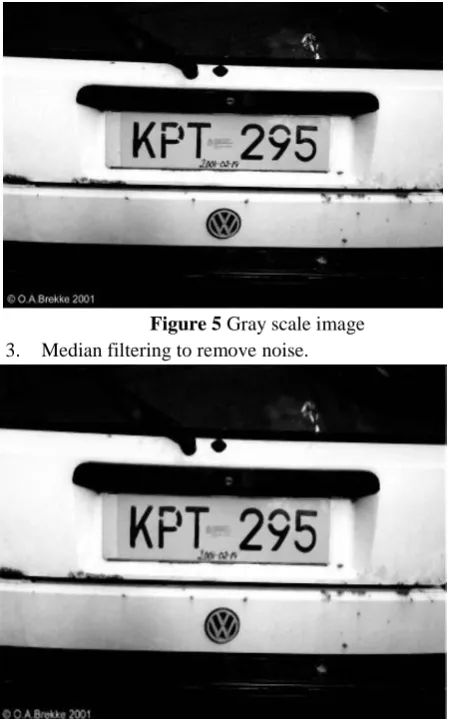
Figure 5 Gray scale image 3. Median filtering to remove noise.
Figure 6 Filtered image
4.Binary image
Figure 7 Binary image
[image:3.595.57.271.599.744.2]Figure 8 Image with eliminated possible horizontal lines
[image:4.595.76.288.55.196.2]6.Filling all the regions of the image.
Figure 9 Image with holes filled
4. Thinning the image to ensure character isolation.
Figure 10Thinning image
[image:4.595.76.282.248.432.2]5. Selecting all the regions that are of pixels area more than 100.
Figure 11. Selecting all the regions that are of pixel area more than 100.
1.
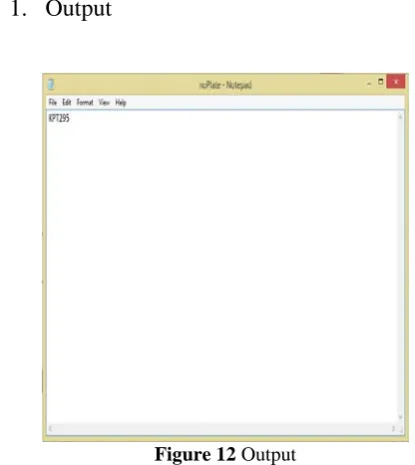
Output
Figure 12 Output
IV.CONCLUSION
Image processing are a robust involving diverse methodologies. The system uses series of image processing techniques to detect, segment and recognize the vehicle license plate. However it should be noted that a complete licence plate recognition systems requires effective set of hardware and software components, most preferably efficient infra-red cameras and powerful computers to provide high quality images. Canny edge detector as it is proven to have higher accuracy.
V.REFERENCES
[1 ] Serkan Ozbay, and Ergun Erceleb ,” Automatic Vehicle Identification by Plate Recognition “ International Journal of Electrical, Computer, Energetic, Electronic and Communication Engineering Vol:1, No:9, 2007
[image:4.595.320.528.251.484.2] [image:4.595.70.292.477.641.2][3] Dinesh Bhardwaj, Sunil Mahajan ,” Review Paper on Automated Number Plate Recognition Techniques International Journal of Emerging Research in Management &Technology ISSN: 2278-9359 (Volume-4, Issue-5) 2015
[4] Sukhvir kaur, sarbjit kaur,” An Efficient Approach for Number Plate Extraction from Vehicles Image under Image Processing “,(IJCSIT) International Journal of Computer Science and Information Technologies, Vol. 5 (3) , 2014
[5] Aniruddh puranic , Deepak k. T. , Umadevi v. ,” Vehicle Number Plate Recognition System: A Literature Review and Implementation using Template Matching “International Journal of
Computer Applications (0975 – 8887) Volume 134 – No.1, January 2016
[6] Mr A. N. Shah, Ms A. S. Gaikwad ,” A Review-Recognition of License Number Plate using Character Segmentation and OCR with Template Matching “International Journal of Advanced Research in Computer and Communication Engineering Vol. 5, Issue 2, February 2016