International Journal of Advanced Research in Computer Science
RESEARCH PAPER
Available Online at www.ijarcs.info
For Benefit or Oblivion? From Idea and Vision to the Implementation and Support of
Learning Applications
Dr P. Karlsudd Associate professor Linnaeus University Kalmar, Sweden [email protected]
Abstract: In this article an overarching analysis is made of four articles published in refereed international journals. The articles describe the development and implementation of learning support systems/learning support applications. In the analysis that is made of learning support ap-plications the following questions are in focus. What results have the projects achieved and how have the experiences gained been utilized? What factors in the described projects have facilitated or hindered the idea, vision, design and implementation of the learning support systems? How have university intentions of supporting entrepreneurship and the commercialization of ideas and products benefited the projects? The re-sults show that there are a great many similarities in the ideas and visions that have initiated and affected the learning support work. Improved communication and availability are expected from all the applications, as well as coordination, creating order and an overarching view. In spite of a large number of positive users, it has been difficult for the applications described to become integrated into the organizations. One possible reason for this is the bad anchoring of the projects in the management organization. Further, there was a lack of funding in the final phases of the projects, which considerably reduced the chances of establishing and continuing operating them. In the gap arising between the end of the im-plementation phase and the possible application for and granting of new funding, the project dies out of itself.
Keywords: Computer science, E-learning, implementation, learning support systems, support applications
I. INTRODUCTION
In this work four articles/projects on IT-based learning support systems/learning support applications form the anal-ysis. They contain learning support systems which have been designed, built and tested. The first of these main articles, Thesis web dialogue [1], describes support for supervisors and students in essay supervision and essay-writing. The project was financed by the Swedish Net University. The second article, E- Collaboration around children with func-tional disabilities [2], is a health-related application intended to improve collaboration and competence transfer in rehabili-tation and habilirehabili-tation efforts. The project has received finan-cial support from Kalmar University’s e-Health Institute. The third publication, Web coherence learning: Web support to create context and continuity in learning [3], describes the work on an application supporting learning in the encounter between schools and institutions outside school, such as co-operation with an art museum and a science center. This pro-ject was financed by the Savings Bank Foundation. The fourth article, Theory, method and tools for evaluation using a systems-based approach approach [4], describes an applica-tion that supports systematic evaluaapplica-tion, which is a basic condition for creating continuity and progression in learning. The e-Health Institute at Kalmar University provided the financial basis for this project.
Common to all the projects are the positive responses that the initiatives have received. However, none of the projects has been constituted in a well-established system or as part of continuous educational efforts. Hence, using all the articles as a foundation, I wish to search for or at least discuss and find clues to the answer to the overarching research questions of the articles, namely:
• What results have the projects attained, and how
have the experiences gained been taken care of?
• What factors in the projects described have
facili-tated, or hindered, the idea, vision, design and im-plementation of learning support systems?
• How have the university intentions of supporting
en-trepreneurship and the commercialization of ideas and products benefited the projects?
II. DEVELOPING IT SYSTEMS
The methods for developing IT systems are multitudinous [5]. Some researchers emphasize the strong connection be-tween development method and result [6,7], while others consider this a weak link [8]. It is essential that there exists an overarching view of how the information system should be developed, and methods and techniques must be defined for checking the work. A clear role distribution in the project is another condition for creating vital systems. The most im-portant element in the development of a system is not the technical solution but making an unambiguous decision about the purpose of the system [6].
According to Dahlbom & Mathiassen [9], there are three different strategies driving the development of IT-based ac-tivity systems. The first strategy is of a type that automatizes work in the organization, which means that there is no radical change. According to the second strategy, the IT system is developed to improve or solve a work problem, with a change in the organization as a result. The third strategy is used to create an entirely new organization, in other words, a total radical transformation. In the learning support systems described in this article I would, on the basis of this division, define all the applications as attempts at improving and solv-ing organization problems.
time is too short and the budget too meager. Naturally, the deficiencies may be due to other factors like ignorant systems developers, too much or too little user contribution, or bad ordering competence, and several other reasons that may be listed [10,11]. It is not unusual for an organization to adapt to the IT system, which may then turn out to be more of an ob-stacle than a support [11,12] claims that the gaps that may arise between an IT system and the organization may be due to the developers having no understanding of their mutual relation.
III. IMPLEMENTATION
A modern computer-based education system is founded on strong interactivity between human users and computers, the “soft” human part of the system being regarded by many researchers as the most crucial [13]. Using ICT in learning situations is often more a matter of a paradigm shift and changes in the learning culture than of purely technical solu-tions [14]. The interplay between humans and computers is affected by the characteristics of the participants as well as by their contexts [15]. What is essential is that the learning applications used are adapted to the target group, which in-volves at least four different factors that determine the use-fulness of an application. The four factors are adaptation, user-friendliness, user acceptance and user competence. Ad-aptation means that a program is designed in a way that op-timally follows the structure of the task the user tries to solve. User-friendliness contains a number of different aspects, one of them being accessibility. It should be possible to combine the programs with other ones as well as giving support to the way the user acts. One important aspect of user-friendliness is individualization. User acceptance means that users are positive to the program and its functions, whereas user com-petence presupposes that the user has a sufficient understand-ing and ability to productively interact with the application [16]. While working with the applications presented in this thesis, the four factors of adaptation, user-friendliness, user acceptance and user competence have been central in the conceptual phase of the construction.
Technical problems constitute the major source of irrita-tion to users of different learning platforms. In most cases technical support is required to start and maintain continuity in the systems used [17]. When a new service or system is going to be introduced it often faces both motivational and practical problems. Introducing IT-based systems in organi-zations is not altogether simple or self-evident; instead it can often be a complicated, time-consuming process [18]. A fun-damental principle is that developers and users take part in the work [6].
There may also be a number of obstacles that make peo-ple resist changes. According to Dalin [19], they can be di-vided into practical, psychological, value and power barriers. If a radical change is to be performed, these barriers have to be overcome. Practical obstacles may include economy, ac-cessibility, training possibilities, etc. A psychological barrier may be, for instance, that teachers feel threatened in their teaching role, perhaps even fearing that the students may know more than they. Value barriers may consist of values related to the technology that do not agree with those of the teacher. When a power barrier appears, the teachers may feel that their entire situation is threatened.
A. University Support for Innovations
For researchers and students developing systems and products, there is a section in the Swedish university that is
expected to provide support and help to stimulate the market-ing of the products. The university plays an active role in building up an innovation environment to promote such work. This involves both that researchers and teachers ac-quire knowledge of and insight into what commercializing research results implies and that those who wish to go into commercialization are offered support. This work is chan-neled via a variety of activities, such as seminars and work-shops, coaching, support in writing applications, as well as competence and network support.
IV. AIM
Expectations have run high that IT systems will solve problems, facilitate and effectivize work in a range of activi-ties. Unfortunately, if often happens that no result is forth-coming, and that the hopes attached to the technology have not materialized. Sometimes the consequences may also take the wrong direction. Several factors must interact to make the use of IT simpler, more reliable and more effective. This does not only involve technology, but also human beings, organization, economy and, not least, their interrelation.
Taking the articles as my starting point I wish to look for factors that are essential to make the idea, the vision, the de-sign and the testing of the learning application awaken an interest and proceed to becoming implemented in a firm es-tablishment. The study also explores what happens after the implementation. What results have the projects achieved and how have the experiences gained been taken care of? How have the university’s intentions of supporting entrepreneur-ship and the commercialization of ideas and products bene-fited the projects?
The main questions may be summarized in the following questions, which have already been presented in the introduc-tion:
• What results have the projects attained, and how
have the experiences gained been taken care of?
• What factors in the projects described have
facili-tated, or hindered, the idea, vision, design and im-plementation of learning support systems?
• How have the university intentions of supporting
en-trepreneurship and the commercialization of ideas and products benefited the projects?
V. APPLICATIONANDPROJECTDESCRIPTION
This part gives a brief summary of the articles/project. The presentation of each article is divided into four parts: needs, goals, effect and current situation.
A. Thesis Web Dialogue (Article 1):
This article describes a development project, where an application specially adapted to essay-writing and essay su-pervision is constructed and tested.
1) Needs: University education in Europe and the USA
entail using IT support to develop solutions and strengthen supervision and essay work. There are a number of studies indicating that IT-based communication can offer interaction of a quality that is at least as high as traditional encounters [21,22].
2) Goals: With the ambition to strengthen the factors
important for efficient and effective supervision and essay-writing the aim and requirements of the program were formulated. From the supervisors’ perspective the main purpose was that it would make it easy for them to organize their own work and to effectively follow that of the essay-writer. The chief aim of the essay-writers was to get easy access to supervision and support and to information relevant for the essay in question. In the virtual rooms created for supervisors and essay groups the endeavor is to obtain a complete environment for dialogue, support and information search. One goal was to make the application function as a quality booster without increasing the total work effort. To choose assessment forms that focus on feedback and continuous learning may strengthen the insight into and control of processes and progression [23,24]. Against this background another important application goal emerged in offering a continuous formative examination system to avoid cheating during essay-writing.
3) Effect: The majority of the supervisors and
essay-writers to whom the thesis web dialogue had been presented were positive to its idea and function. The most positive was the student group. Very few students expressed any skepticism towards using the program. However, some of them felt insecurity when confronted with the technology, while others obviously wished to avoid facing increasing demands on and insight into their essay work. Many students voiced positive views of the application but were critical of supervisors who were unwilling to use the service or who lacked the necessary competence. A few supervisors expressed their concern that the students would raise their demands on supervisor availability. Perhaps the use of web support might lead to increasing their share in the work instead of maintaining or reducing it. Several students expressed their appreciation that all information and communication was concentrated to one place. There were many students and supervisors who experienced having got an “exclusive, sheltered space” for supervision and essay work.
4) The Current Situation: The program drew a great deal
of attention at conferences and fairs and was much appreciated by colleagues from all over the country. By making use of targeted means from the Net University in the “Open Learning Resources” project the program was adapted for implementation at other universities. After the project’s completion no one was left responsible for the application, and today there are few users of the web dialogue and nobody to take care of maintenance and development. Who owns the system is unclear, and no funding is set aside for the work. The application may thus be regarded as an open source product with an invisible distribution channel.
B. E-Collaboration Around Children with Functional
Disabilities (Article 2):
The following article describes the design and testing of an application for communication, information and collabo-ration.
1) Needs: Habilitation work involves a series of
different professions in the treatment of, for example, a disabled child. Every actor makes important decisions and contributions which affect the measures taken by everyone else. One well-known problem in this chain of care is that the communication does not function as desired. Many decisions are made that should be communicated to other people in responsible positions, but the information stops halfway. It is not entirely uncommon that the measures totally lack elements of co-planning and consensus. Sometimes the different professional teams do not know how many are part of the work around the person undergoing habilitation or who they are, let alone what are the overarching methods applicable to the efforts or how they are carried out. Occasionally the different measures work at cross purposes, which creates inefficiency and unnecessary cost and leads to frustration in everyone involved. Updating and disseminating information in all directions is a prerequisite for creating trust between the client and others in the chain of care [25,26]. Attempts at applying modern technology to find effective solutions in the health care system are becoming increasingly frequent [27,28].
2) Goals: To improve and facilitate collaboration
between different organizations, professions and other actors, like relatives, was one of the application goals described in this article. The IT support referred to as CIDS is meant to facilitate communication, information, documentation and collaboration. Collaboration is defined in this context as active learning, an exchange of resources and experience between the members of the system or, briefly, “competence transfer”. The system places the patient in focus of, for instance, the habilitation process. This may increase the motivation and understanding of the efforts made [29,30]. The aim is to design a system that turns the patients and/or their relatives into active partners, or subjects, and not into passive objects [31,32]. The basic structure contains a number of functions gathered in a website designed for collaboration. This e-collaboration room may preferably be defined as e-Health learning.
3) Effect: The system was applied among the parents of
functionally disabled children and among all the various professional groups included in the habilitation efforts around the child. It was easy to implement and increased communication between the actors considerably. As for the parents, their insight, overview and motivation and their knowledge about the efforts carried out increased. All users experienced that the presentation of the information was well structured. The competence transfer between the professional groups increased; however, not to the expected extent. Most of the users found the system user-friendly. Some users vented their anxiety that the system would increase rather than decrease the work load.
responsible for the system. When the privacy between the different actors was waived by the parent to give access to important information, there was a positive response. Many important documents have thus become available to those affected by the measures. Some comments from question-naires and interviews reflect the fear of an increasing work load. It is obvious that the quality of the interaction has in-creased, but many people in this study claim that the time spent on information has increased, too. The system has drawn positive attention in Dagens medicin, a Swedish pro-fessional journal, and several organizations and county coun-cils have asked for the service. The application has been awarded a research prize.
4) The Current Situation:The application is used today
by some 30 parents of disabled children, and in some cases special needs teachers have made use of it to keep in contact with their classes. The system has no clear owner, and the application is operated by one of the university servers with no one directly responsible for maintenance or development. There is a definite demand for the application but, unfortunately, no plan for how it should be distributed and further developed. There are quite a few good suggestions for how to develop and improve the system but no funding is available for carrying out this work.
C. Web Coherence Learning: Web Support to Create
Context and Continuity in Learning (Article 3):
“Webbhang” is a learning system constructed to facili-tate teaching and learning between schools and organizations that collaborate with schools to contribute to student knowl-edge development.
1) Needs: The interaction between teachers/pedagogues
and students, as well as pedagogues’ understanding of students, is one very important learning quality factor [33]. It falls upon the teacher to capture students’ previous knowledge and their life situation and to offer them space to make their own choices and tasks [34]. What is right and self-evident to one individual may be totally unintelligible to another, so in order to understand what others have in mind we have to try to look upon the world from their perspective [35]. Creating context and continuity in teaching and learning also requires collaboration among the pedagogues involved in students’ learning [36]. Students use different strategies for learning [37,38]. and making room for alternative ways of expression like pictures, films and simulation favors the individual learning environment. It is also important that students are faced with problems and tasks which are felt meaningful to solve and which are neither too easy nor too difficult [39]. This is why it is essential for pedagogues to obtain a clear picture of the students they encounter in their pedagogical work.
2) Goals: Organizations that collaborate with schools to
contribute to student knowledge development, such as science centers, museums or organizations with creative elements, often have difficulty in making good contacts and achieving continuity with the groups of children that visit them. These visits tend to become isolated events or “happenings”, since the pedagogues of the independent organization rarely establish any contact with the students before or after the visit. The planning of the visits often runs along similar lines, without any solid foundation whatsoever in the children’s experience. If a qualitative contact is
established continuously between teachers, students and independent pedagogues before and after the visit, the organization is more likely to come nearer to fulfilling its goals. Via an early dialogue tasks can be linked to the children’s own world by being related to the children’s questions, their own stories and experiences. If the visit leads to establishing a better contact, it should facilitate documentation, follow-up, and the planning of new visits.
A purposeful web system which creates more favorable conditions for communication and follow-up should increase the chances of continuity and progression in the contacts created. By facilitating introduction and planning on the basis of the experiences and needs of the group in question and by introducing the knowledge area in dialogue with the partici-pants [40] the described system may be an efficient way to-wards creating a continuous context.
3) Effect: In a small pilot study the system was used
before the class visit to establish a deeper contact with students and teachers, and also during and after the period of the visits to maintain a more qualitative and continuous dialogue. With the support of the dialogue kept up via the application the staff experienced that it enabled them to deepen the contact during the visit and to give the students more challenging tasks. The pedagogues realized that they acquired a much better image of the group than at the students’ first physical visit, and the students found it easier to relate to the activities. Since the task was already familiar they needed much less time for the introduction and the actual task work could receive more focus than during traditional visits. The creative pedagogues experienced that, in comparison with the control group, it was easier to engage the children after receiving a clearer picture of the their previous experiences. Most of the interviewed students found the discussions before and after the physical encounter with the organization stimulating.
4) The Current Situation: After completing the small
pilot study all work with the application has come to an end. The more comprehensive follow-up study that was planned has not materialized. The system is no longer in operation and there is no funding available for making improvements or new attempts at implementation.
D. Theory, Method and Tools for Evaluation using a
Systems-Based Approach (Article 4):
The ensuing article describes an evaluation model where a web-based tool has been developed in support of conduct-ing evaluations in a simpler and more efficient way.
1) Needs: The importance of evaluating and analyzing
scrutinizing the learning processes that have been of importance. One research survey examining empirical studies of how IT usage affects learning environments suggests that both a theoretical connection and a solid research methodology have been lacking [43]. A traditional evaluation often includes an assessment, whereas a theory-based evaluation broadens the issue and paves the way to a more analytical, critical and reflexive attitude. The application described in this article is a web-based evaluation tool built on a theoretical model with systems theory as the basis.
2) Goals: The model on which the method is founded
focuses on and studies special issues concerning activities based on modern information and communication technology. According to the authors of the article, a traditional evaluation model is less adapted than a specially adapted one to focusing on the technology-based interaction taking place in the organization. Evaluating an organization on a systems theoretical basis entails arriving at an overall view by studying the parts and then transferring these results to the organization via a holistic approach.
For this reason it is important that all parts of importance to the organization are visualized and included in the evalua-tion at the same time as the holistic perspective must domi-nate. The goal of the evaluation is to thoroughly involve all the experiences and ideas or the parties concerned. Accord-ing to the SUV evaluation model, the structures and proc-esses of importance to the development of an organization may be captured by using as starting points seven areas and three different levels. Focusing on the three levels of individ-ual, technology and organization safeguards a thorough elu-cidation of the factors of central importance to activities that are largely founded on modern information and communica-tion technology.
3) Effect: The SUV model as an evaluation tool has
been tried out in a number of evaluations at the e-Health Institute in Kalmar and has turned out to be an effective model for studying an organization from a holistic perspective. With the support of the model an overarching evaluation is arrived at, where the areas with the greatest need of reinforcing are identified. To obtain a comparative picture of previously conducted evaluations these can be categorized, retrieved and analyzed by the model. The studies performed with the support of SUV questionnaires have effectively widened the issues in relation to traditionally constructed questionnaires. According to the constructors, a traditional evaluation model, in comparison with a specially adapted one, is less well equipped to focus on the technology-based interaction taking place in the organization.
4) The Current Situation: Currently, all work with the
web application has ceased. There are no means for further development. The expectations made on the model have been toned down, and other evaluation models have acquired more space within the activities of the e-Health
Institute. SUV is being used, but only selectively and to a limited extent. During 2010 SUV is being subjected to internal evaluation in a relatively comprehensive meta analysis, and the result may be that the model will receive renewed attention in the future.
VI. METHOD
The main starting point of this is constituted by the arti-cles which describe the design, conceptual construction, presentation, testing and attempts at implementing the four learning systems. The projects are not linked by a consistent methodology, even though there are many similarities in the strategies and approaches used. The ambition of this article has been to summarize the implemented projects and, in a retrospective perspective, trying to find factors facilitating or hindering the development and implementation of learning support applications. Studying each project per se, and focus-ing on the implementation in relation to the current situation may hopefully provide important information about what has facilitated the projects or prevented them from proceeding all the way to becoming well established learning support sys-tems. The aim is to summarize and analyze the experiences made and to search for possible explanations in the documen-tation that formed the basis of the systems. In this analysis the articles as well as funding applications, requirement spe-cifications and the dialogue carried on between users and projects leaders have been scrutinized. After this the current status of the applications has been updated.
Definitions
In this study I have chosen to define a few of the central concepts used in the article. The first concept is learning, where I concur with the definition that “the focus of learning is on a change in the subject’s relation to the surrounding world, and at the same time on the way this learning is de-pendent on and affected by the world around.” [44]. Learning is thus a matter of communication and dialogue. This is why the learning support applications are defined as a system where digital technology supports learning by facilitating communication and dialogue. The aim of these dialogue-supporting systems is to create favorable conditions for learning.
A. Starting Points for the Analysis
B. Reliability Issues
In result processing and analysis eight projects have been examined. In all the projects the main responsibility has rested with me, which will of course have consequences for results and analysis. Three of the articles presented (1, 2, 3) may be regarded as action research projects [45,46,47] where my colleagues and I have tried to gear the work towards a high degree of goal fulfillment. The search for different fac-tors, the division into categories as well as the estimates made of the effect on the project caused by the influential factors must be assessed with a great deal of restriction. The result cannot be generalized but may possibly provide clues to further studies within the area.
Figure 1: Starting points for the analysis
The three-level division presented above is not an un-problematic one. To regard the individual as the focal aspect in the above model is axiomatic to me, organization and technology being products of the efforts of one or several individuals. However, some of the factors defined may be placed in more than one category. Separating the individual from the organization may be difficult, as well as distinguish-ing technology from the individual. Although the model may have different outcomes, depending on whoever applies it, it may be worthwhile analyzing and discussing the material on the basis of this division.
VII. RESULT/ANALYSIS
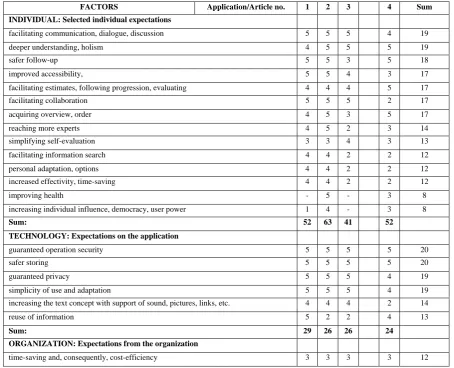
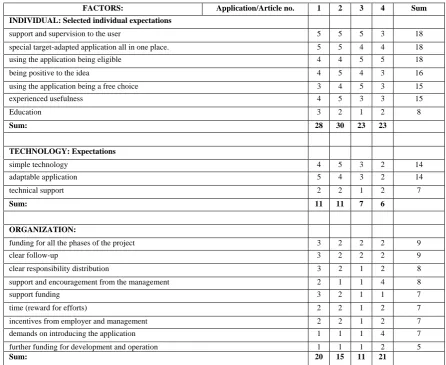
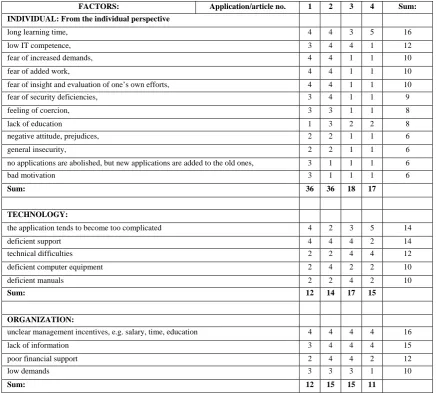
In this part the factors made visible in the analysis are in-troduced. It also gives an account of the evaluation made of each factor in every single project. Table I lists the ideas and visions that have been largely shared between the conceptual developers and the users. Table II presents the factors in the projects that have facilitated the implementation and utiliza-tion of the learning applicautiliza-tions. Factors which have ob-structed the implementation and use of applications in the projects described are presented in Table III. Each table is followed by a brief summary.
Table I: Ideas and visions deemed valuable in the projects for creating learning applications. Value 1 represents low expectations/demands and Value 5 high ex-pectations/demands.
FACTORS Application/Article no. 1 2 3 4 Sum
INDIVIDUAL: Selected individual expectations
facilitating communication, dialogue, discussion 5 5 5 4 19
deeper understanding, holism 4 5 5 5 19
safer follow-up 5 5 3 5 18
improved accessibility, 5 5 4 3 17
facilitating estimates, following progression, evaluating 4 4 4 5 17
facilitating collaboration 5 5 5 2 17
acquiring overview, order 4 5 3 5 17
reaching more experts 4 5 2 3 14
simplifying self-evaluation 3 3 4 3 13
facilitating information search 4 4 2 2 12
personal adaptation, options 4 4 2 2 12
increased effectivity, time-saving 4 4 2 2 12
improving health - 5 - 3 8
increasing individual influence, democracy, user power 1 4 - 3 8
Sum: 52 63 41 52
TECHNOLOGY: Expectations on the application
guaranteed operation security 5 5 5 5 20
safer storing 5 5 5 5 20
guaranteed privacy 5 5 5 4 19
simplicity of use and adaptation 5 5 5 4 19
increasing the text concept with support of sound, pictures, links, etc. 4 4 4 2 14
reuse of information 5 2 2 4 13
Sum: 29 26 26 24
ORGANIZATION: Expectations from the organization
increased quality as a result of organization improvements 3 3 2 4 12
Sum: 6 6 5 7
A. Summary, Ideas and Visions
1) Individual: There are a great many ideas and visions
that are common to the learning applications analyzed. Improved communication and accessibility are definite examples of expectations made on all the systems. To arrive via the application at a more holistic view of the organization is another example of expectations appearing from the analysis. The same applies to working for collaboration as well as creating order and overview. Personal adaptation and increasing the individual influence
are expectations that have not been considered especially valuable at the idea stage.
2) Technology: The basic requirement of all the
applications was that they should be operation secure, protected against intrusion, easy to use and adapted to user demands. With regard to Application 4 the broader text concept has not been given any particular importance.
3) Organization: In retrospect it may be stated that the
administration and management have not formulated any great expectations except for Application 4. Saving time and gaining higher quality were some of the expectations, but the demands in these respects were small.
Table II: Assessment of factors identified in the projects as having facilitated the implementation and use of learner applications value 1 stands for a small real impact and Value 5 where the real impact in the project was great.
FACTORS: Application/Article no. 1 2 3 4 Sum
INDIVIDUAL: Selected individual expectations
support and supervision to the user 5 5 5 3 18
special target-adapted application all in one place. 5 5 4 4 18
using the application being eligible 4 4 5 5 18
being positive to the idea 4 5 4 3 16
using the application being a free choice 3 4 5 3 15
experienced usefulness 4 5 3 3 15
Education 3 2 1 2 8
Sum: 28 30 23 23
TECHNOLOGY: Expectations
simple technology 4 5 3 2 14
adaptable application 5 4 3 2 14
technical support 2 2 1 2 7
Sum: 11 11 7 6
ORGANIZATION:
funding for all the phases of the project 3 2 2 2 9
clear follow-up 3 2 2 2 9
clear responsibility distribution 3 2 1 2 8
support and encouragement from the management 2 1 1 4 8
support funding 3 2 1 1 7
time (reward for efforts) 2 2 1 2 7
incentives from employer and management 2 2 1 2 7
demands on introducing the application 1 1 1 4 7
further funding for development and operation 1 1 1 2 5
Sum: 20 15 11 21
B. Summary, Factors having Facilitated:
1) Individual: Utilization support and supervision are
important. The same goes for the individual adaptability of the application and the possibility of choosing functions that add to the benefit of individual user demands. For the implementation to succeed the users must be positive to the idea, feeling that the application is useful and adds quality. In applications 1 and 2 the users have received immediate
benefit from the system, which has facilitated the implication.
2) Technology: The fact that the projects have suffered
from insufficient support has not facilitated the implementation. Neither has its purely technical adaptability to the user.
3) Organization:
applica-tions. The organization has been fairly uninterested in, or possibly uninformed about, the major part of the project and
its progress. All organizational factors identified as likely to facilitate the implementation have received low values.
Table III: Factors in the project which have been assessed as obstructing the implementation and use of the applications. Value 1 represents little impact, Value 5 great impact.
FACTORS: Application/article no. 1 2 3 4 Sum:
INDIVIDUAL: From the individual perspective
long learning time, 4 4 3 5 16
low IT competence, 3 4 4 1 12
fear of increased demands, 4 4 1 1 10
fear of added work, 4 4 1 1 10
fear of insight and evaluation of one’s own efforts, 4 4 1 1 10
fear of security deficiencies, 3 4 1 1 9
feeling of coercion, 3 3 1 1 8
lack of education 1 3 2 2 8
negative attitude, prejudices, 2 2 1 1 6
general insecurity, 2 2 1 1 6
no applications are abolished, but new applications are added to the old ones, 3 1 1 1 6
bad motivation 3 1 1 1 6
Sum: 36 36 18 17
TECHNOLOGY:
the application tends to become too complicated 4 2 3 5 14
deficient support 4 4 4 2 14
technical difficulties 2 2 4 4 12
deficient computer equipment 2 4 2 2 10
deficient manuals 2 2 4 2 10
Sum: 12 14 17 15
ORGANIZATION:
unclear management incentives, e.g. salary, time, education 4 4 4 4 16
lack of information 3 4 4 4 15
poor financial support 2 4 4 2 12
low demands 3 3 3 1 10
Sum: 12 15 15 11
C. Summary, Factors assessed as Obstructing:
1) Individual: One factor obstructing the implementation
is the time required for learning a new application. Time is hard to come by in the organizations that participated in the projects. Fear of more work, increased demands, fear of insight and of facilitating for others to evaluate one’s own work are other obstructive factors. Time is seldom set aside for education and training in using the application. Quite often double systems must be in operation when new technology is introduced. This makes for more work and a certain redundancy and disorder.
2) Technology: There is a great risk that the simplicity
supposed to characterize the application tends to disappear because of the impact on the development of the application from different users with different requirements and IT competence. This has happened in all the projects. Technical problems occur more or less in all projects but have not been identified as serious in connection with implementation and use. In Applications 3 and 4 technical problems have arisen in the design phase due to lack of funding for programming.
Deficient computer equipment was a problem when introducing Application 2.
3) Organization: A much greater problem, according to
the assessment made of the implementation of learning applications, is the lack of clear signals from organization and management. It may concern the lack of information, time for education or encouragement, or of clear signals that the initial development has the support of the organization. Often there is no overarching management strategy. In the two applications which support activities outside the university the shortage of funding has been a tangible problem.
VIII. DISCUSSION
A. Project Results
thesis web dialogue application was used for a little more than a year, but since nobody took the responsibility for con-tinued development and implementation it has now become more or less phased out. One of the four learner applications, CIDS, which has been described in this thesis, still has some 30 users. Even though its operation and maintenance are not guaranteed, it is an important application to many parents of functionally disabled children. The lack of a person to main-tain and develop the application is definitely unsatisfactory. In the end it is most likely that the system will cease func-tioning. The implementation and development of the Webb-hang application has also ceased. Work on the SUV evalua-tion model with its accessory web applicaevalua-tion has stopped pending further evaluation. Consequently, of the four learner applications described CIDS is the only one established in the organization, but its future is highly uncertain.
B. Ideas and Visions
The motives for introducing learner applications that have been elucidated are definitely vital and well motivated. At bottom it is a matter of a willingness to improve communica-tion and accessibility, but it is factors like order, overview and the intention to create a holistic approach that form the basis of visible ideas and visions. Accessibility and security are other factors driving the development. No strong eco-nomic incentives emerge from the analysis. The bases for developing IT-based learning support systems agree well with the arguments presented by Dahlbom [48] and Dahlin [49].
C. Possibilities and Obstacles
It is obvious that support and supervision are important for implementing learning support systems. It is also impor-tant that users are positive to the idea and realize the useful-ness of the application. Not feeling coerced to use the appli-cation may facilitate the implementation, perhaps chiefly for those well versed in using computers who are open to new solutions. To reach those who are less positive to change and not used to computers better results may be achieved by en-forced usage. A dictate followed by other positive signals from the management would probably facilitate implementa-tion.
That resistance and distrust among users can be great is apparent from all the projects. There is always some group resisting the new demands an application makes on the pro-fessional role. This skepticism, or even fear, may be founded in any one of the barriers discussed earlier [19]. As for tech-nology, it seldom constitutes an immediate obstacle to im-plementation. If only enough time and money are set aside for development, operation and support, the technical re-quirements will be met. The quality of the technical equip-ment available to the users is usually sufficient for utilizing the applications. One exception appears in the E- Collabora-tion around children with funcCollabora-tional disabilities project, due to the lack of computers and broadband connection in a small section of the municipal organization. In that section the user competence is also very low.
The biggest problem identified in the analysis is the or-ganization’s attitude towards implementing new applications. There is oftentimes a want of a clear strategy, division of responsibility and incentive for this kind of work. It is essen-tial that the organizations stand clearly behind the efforts planned as well as providing support during all the phases of the project. As for efforts within ICT and learning education this support emerges more clearly. Here the participants have been given time for training and valuable qualifications in the
form of higher education credits in pedagogy. With the same clarity as regards the implementation and use of learning applications the outcome would probably be different.
The most vital project currently is E- Collaboration around children with functional disabilities. The reason for this is hardly organizational interest in and desire for higher quality, but parents’ willingness to improve activities. The experienced usefulness has in this case been the factor that keeps the project going. In spite of the low IT competence and the poor interest on the part of the organiza-tion/management, the system has become somewhat estab-lished thanks to the parents’ wishes. Here the individual’s own motivation to change has been strong.
In all projects voluntariness and eligibility have been the guiding-star. Giving the employee the right to choose wheth-er to use an application or not is probably not always the best method. It often happens that some choose the offered nov-elty, but as the system does not include everyone, it has no lasting impact.
The thesis web dialogue application has been positively assessed and many departments have expressed the wish to use it in essay supervision. Since there is no coordinated re-sponsibility or clear distribution of costs, utilization and de-velopment have come to a complete stop. Perhaps a national center for ICT resources (similar to the former Net Univer-sity) could safeguard continued development.
In my opinion, the suggestions for further research and development that are usually expressed in the conclusion of reports and theses are seldom realized. This generally wise rhetoric is not followed up. Maybe the suggested measures should always be accompanied by descriptions of economic consequences which clearly indicate the profits in terms of money saved.
D. The Uneven Flow Project Flow
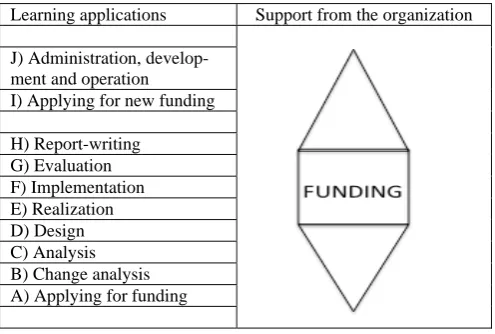
All the research projects described have their starting point in university activities. A distinct pattern emerges for the principles of financing. Funding is usually allotted for the first phases of the project planning and/or is inadequate to cover all the project phases. Activities that should follow upon a successful project result are often left without finan-cial support and the final product tends to die out of itself. The Theory, method and tools for evaluation using a sys-tems-based approach article describes a system that has met with a great deal of praise and back-up from the manage-ment, but the economic conditions have not sufficed to arrive at a well functioning system technically. In the figure below (Fig. 2) an attempt is made to illustrate the unevenness of the projects and educational efforts presented.
are given other tasks and no time or resource remains to con-tinue the work towards a well established product or educa-tion effort. A clear example of this is the applicaeduca-tion de-scribed in the article Web coherence learning: Web support to create context and continuity in learning.
Learning applications Support from the organization
J) Administration, develop-ment and operation I) Applying for new funding
H) Report-writing G) Evaluation F) Implementation E) Realization D) Design C) Analysis B) Change analysis A) Applying for funding
Figure 2.“The uneven flow”. Organization support from application to continued development.
In academia the highest priority is mostly given to pre-senting the project in a refereed international journal. When the article has been accepted, the project has received suffi-cient recognition and status as a “successful project”. It seems close at hand to suggest that a higher value should be ascribed to a project venture that becomes established in the organization than to the articles produced.
E. University Support for Establishing
There is some backing to be found in universities by way of grants and support, often in the form of prizes in competi-tions (e.g. the Vinova “Idea Bridge”, Venturecup etc.). In these competitions great value is attributed to being knowl-edgeable about business plans, entrepreneurship, economics, etc. These are competencies which participants in the de-scribed and similar projects often lack.
One possibility of vitalizing the projects may be to in-clude more interdisciplinary work, like adding colleagues like marketers and economists to a project group. Perhaps projects that have reached their final phase should be handed over to new individuals who are better qualified for establish-ing the result in the organization? Handestablish-ing over the responsi-bility to students within the framework of their education I do not consider a fruitful idea. This would often entail the contradictory demands of carrying out the task and fulfilling the course requirements.
F. Consequences for Future Projects
The dominating academic focus on evaluating reports, theses and articles will probably matter greatly to future ideas and project results. After this has been performed projects are usually regarded as completed. In spite of any positive ex-periences described in the articles, the result does not really manage to become established in the organization. There is a lack of clear incentives to proceed towards a more entrepre-neurial approach. To set aside money in the funding budget for subsequent establishing might be one way of improving the result. This would entail that the same grant givers who have supported the project from the very beginning would, in case of a successful evaluation, make demands and offer chances for the result to become more firmly rooted in the
organization. A further way of setting a higher value on this work would be by awarding greater recognition among aca-demic qualifications to achieving establishment.
Naturally, the argumentation can be turned around by saying that the last phase, that of establishing the project as part of the regular activities, should be possible without fund-ing or new support from new investors. Perhaps this would be the best market approach. However, it is likely that a great many good ideas and products are forced to stand back to the benefit of new projects and articles. If teachers and re-searches are rewarded in various ways for establishing suc-cessful projects in the core of the organization, for instance in university teaching, it would probably lead the development two steps forward, in contrast to the current situation, where one step forward is soon followed by one step backward. By changing strategies more learning applications and educa-tional efforts might lead to continuous use in the organization and not, as it is now, fall into academic oblivion.
IX. REFERENCES
[1] P. Jokela & P. Karlsudd. Thesis web dialogue.
European Journal of Open Distance and E-Learning. 2007:1.
[2] P. Karlsudd. E- Collaboration around children with
functional disabilities. Tele-medicine and e-Health, 14:7, pp. 687-694, 2008.
[3] P. Karlsudd. Web coherence learning: Web support to
create context and continuity in learning. International Journal of Emerging Technologies in Learning iJET, 3:3, pp. 10 – 14, 2008.
[4] P. Jokela, P. Karlsudd & M. Östlund. Theory, method
and tools for evaluation using a systems-based approach. The Electronic Journal of Information Systems Evaluation, 11:3, pp. 197 – 212, 2008.
[5] B. Fitzgerald, N.L. Russo & E. Stolterman. Information System Development: Methods in Action. London. McGrawHill, 2002.
[6] E.S. Andersen. System development, principles,
methods and techniques. Transl. (Systemutveckling, principer, metoder och tekniker). Lund: Studentlitteratur, 1994.
[7] J. Mingers. Multimethodology – mixing and matching
methods, In Rosenhead, J. & Mingers, J. (eds.) Rational Analysis for a Problematic World Revisited – Problem Structuring Methods for Complexity, Uncertainty and Conflict 2 ed., Wiley, Chichester, 2001.
[8] N. L. Russo & E. Stolterman. Exploring the
assumptions underlying information system methodologies - Their impact on past, present and future ISM research. Information Technology and People, 13:4, 2000.
[9] B. Dahlbom & L. Mathiassen. Computers in Context –
The Philosophy and Practice of System Design, Oxford: Blackwell Publishing, 1993.
[10]R. Heeks. Health information system: Failure, success
and improvisation, International Journal of Medical Informatics, 75, 125-137, 2006.
[11]H. Broberg. DEVICE: Design of business supporting IT
systems - a design theory and methodology. Transl. (DEVIS: Design av verksamhetsstödjande IT-system – En designteori och metod). Linköping: Studies in Arts and Science No. 478, Linköpings universitet, 2009.
[12]S. Cronholm & G. Goldkuhl. Actable information
[13]P. Gali. Informationssäkerhet: Information: How to protect data, text, audio and video. Transl. (Hur du skyddar data, text, ljud och bild). Linköping: Affärslitteratur AB, 1992.
[14]K. Jandér. Access to Educational Resources in the
College - a pilot study. Transl. (Tillgång till digitala lärresurser inom högskolan – en förstudie). Nätuniversitetet, 2005.
[15]C.M. Allwood. The human-computer interaction: A
psychological perspective Transl. (Människan-datorinteraktion: Ett psykologiskt perspektiv). Lund: Studentlitteratur, 1998.
[16]P. Karlsudd. Learning on the thin lines and broad bands. Pedagogy in education based on ICT. Construction of an analysis tool. Transl. (Att lära på tunna linor och bred(a) band. Pedagogik i utbildning baserad på informations- och kommunikationsteknologi. Konstruktion av ett analysverktyg). Kalmar: Högskolan i Kalmar, 2001.
[17]L. Svensson & C. Åberg. E-learning och
arbetsplatslärande. Stockholm: Bilda Förlag, 2001.
[18]W. Pelgrum & T. Plomp. The IEA Study of Computers
in Education: Implementation of an Innovation in 21 Education Systems. Pergamon Press, (1993).
[19]P. Dalin. Limits to Educational Research. New York:
St. Martins’ Press, 1978.
[20]P.R. Trowler. Academics Responding to Change: New
Higher Education Frameworks and Academic Culture. Buckingham: Society for Research into Higher Education & Open University Press, 1998.
[21]N.S. Berger. Pioneering experiences in distance
learning: lessons learned. Journal of Management Education, 23:6, 1999.
[22]T.W. Peterman. Elements of success at a
traditional/virtual university: Les-sons learned from three years of growth in cyberspace, Journal of Academic Librarianship, January, 2000.
[23]M. Gunnarsson, T. Lingefjärd, T. Mekki-Berrada & C-A. Sjöblom. Flexible learning - learning examinations. Transl. Flexibelt lärande – lärande examination. FLEX. UFL-rapport 2002:1. Göteborg: Göteborgs universitet, 2002.
[24]B. Martin. Plagiarism: Policy against Cheating or Policy for Learning. Nexus, 16:2, p. 15-16, 2004.
[25]G.M. Acker. The impact of clients’ mental illness on
social workers’ job satisfaction and burnout. Health and Social Work, 24:2, pp. 112-119, 1999.
[26]C. Lloyd, R. King & L. Chenoweth Social work, stress and burnout. Journal of Mental Health, 11:3. pp. 225-265, 2002.
[27]M.H. Harun. Integrating e-learning into the workplace. The Internet and Higher Education, 4, pp. 301-310, 2002.
[28]Y. Zhao, Y. Yagi, I. Nakajima & H. Jujozi. IP
Telephony – new horizon for telemedicine and e-health. Journal of Medical Systems, 4:4, pp. 277-283, 2002.
[29]B. Åhgren. Chains of care: a counterbalance to
fragmented health care. Journal of Integrated Care Pathways 2001b: 5, 126-132, 2001.
[30]P. Wold-Olsen. The customer revolution: The
pharmaceutical industry and direct communication to patients and the public. Eurohealth 2002/2003; 5:11-13, 2002.
[31]B. Levin & R. Normann. Opportunity of care: a model of tomorrow’s medical care and eldercare. Transl. Vårdens chans: en modell för morgondagens vård och äldreomsorg. Stockholm: Ekerlid förlag, 2000.
[32]A. Coulter. Paternalism or partnership? Patients have
grown up – and there’s no going back. British Medical Journal, 319, pp. 719-720, 1999.
[33]Bennett, J.B. (1998). Collegial Professionalism. The
Academy, Individualism and the Common Good. American Council on Education: Series on Higher Education: Phoenix, Arizona: Oryx Press.
[34]P. Christensen & A. James. “What are schools for?”
The contemporal experience of children’s learning in Northern England. In Alanen, L. & Mayall, B. (eds.): Conceptualizing Child-Adult-Relations, London and New York: Routledge Falmer, pp. 70-85, 2001.
[35]S. Booth & F. Marton. Learning and Awareness. New
Jersey: Erlbaum,1997.
[36]A. Tucker & R.A. Bryan. Chairing the Academic
Department: Leadership among Peers. Phoenix, Arizona: Oryx Press, 1999.
[37]N.J. Entwistle & P. Ramsden. Understanding Student
Learning. London: Croom Helm, 1983.
[38]F. Marton. Learning and world view. Transl. (Inlärning och omvärldsuppfattning). Stockholm: Prisma, 1999.
[39]M. Yorke. Retention, persistence and success in
on-campus higher education, and their enhancement in open and distance learning. Open Learning, 19:1, pp. 19-32, 2004.
[40]Drew, S. Student perceptions of what helps them learn
and develop in higher education. Teaching in Higher Education, 6:2, pp. 309-331, 2001.
[41]M. Langerth Zetterman & S. Lindblad. Learning about e-learning. A strater about Internet discourses and borderless education. 29 NFPF congress. Stockholm, Sweden, 2001.
[42]E. R. House. Evaluating with Quality, London, Sage
Publications, 1980.
[43]W. E. Blanton, G. Moorman & W. Trathen.
Telecommunications and teacher education: A social constructivist review. Review of Research in Education, 23, pp. 235-275, 1998.
[44]L. Svensson. Introduction to Education. Transl.
Introduktion till pedagogik. Norstedts Akademiska Förlag, 2009..
[45]C. Argyris, R. Putnam & D. McLain Smith. Action
Science. San Francisco: Jossey Bass, 1985.
[46]B. Starrin. Applied Social Research. Transl. Tillämpad socialforskning. In J. Holmer & B. Starrin (eds.) Deltagarorienterad forskning. Lund: Studentlitteratur, pp.11-26, 1993.
[47]T. Tiller, A. Sparkes, S. Kårhus & F. Dowling Næss. The Qualitative Challenge Reflections on Educational Research. Landås: Caspar Forlag A/S, 1995.
[48]B. Dahlbom, The new informatics. In F. Ljungberg,
(ed.). Informatics in the Next Millennium. Lund: Studentlitteratur, 1998.