Speech Recognition Grammar Compilation in Grammatical Framework
Bj¨orn Bringert
Department of Computer Science and Engineering Chalmers University of Technology and G¨oteborg University
SE-412 96 G¨oteborg, Sweden [email protected]
Abstract
This paper describes how grammar-based language models for speech recognition sys-tems can be generated from Grammatical Framework (GF) grammars. Context-free grammars and finite-state models can be generated in several formats: GSL, SRGS, JSGF, and HTK SLF. In addition, semantic interpretation code can be embedded in the generated context-free grammars. This en-ables rapid development of portable, multi-lingual and easily modifiable speech recog-nition applications.
1 Introduction
Speech recognition grammars are used for guid-ing speech recognizers in many applications. How-ever, there are a number of problems associated with writing grammars in the low-level, system-specific formats required by speech recognizers. This work addresses these problems by generat-ing speech recognition grammars and semantic in-terpretation components from grammars written in Grammatical Framework (GF), a high-level, type-theoretical grammar formalism. Compared to exist-ing work on compilexist-ing unification grammars, such as Regulus (Rayner et al., 2006), our work uses a type-theoretical grammar formalism with a focus on multilinguality and modular grammar development, and supports multiple speech recognition grammar formalisms, including finite-state models.
We first outline some existing problems in the de-velopment and maintenance of speech recognition
grammars, and describe how our work attempts to address these problems. In the following two sec-tions we introduce speech recognition grammars and Grammatical Framework. The bulk of the paper then describes how we generate context-free speech recognition grammars, finite-state language models and semantic interpretation code from GF gram-mars. We conclude by giving references to a number of experimental dialogue systems which already use our grammar compiler for generating speech recog-nition grammars.
Expressivity Speech recognition grammars are written in simple formalisms which do not have the powerful constructs of high-level grammar for-malisms. This makes speech recognition grammar writing labor-intensive and error prone, especially for languages with more inflection and agreement than English.
This is solved by using a high-level grammar for-malism with powerful constructs and a grammar library which implements the domain-independent linguistic details.
Duplicated work When speech recognition gram-mars are written directly in the low-level format re-quired by the speech recognizer, other parts of the system, such as semantic interpretation components, must often be constructed separately.
This duplicated work can be avoided by gener-ating all the components from a single declarative source, such as a GF grammar.
to modify a system which uses hand-written speech recognition grammars. The problem is multiplied when the system is multilingual. The developer has to modify the speech recognition grammar and the semantic interpretation component manually for each language. A simple change may require touch-ing many parts of the grammar, and there are no au-tomatic consistency checks.
The strong typing of the GF language enforces consistency between the semantics and the concrete representation in each language.
Localization With hand-written grammars, it is about as difficult to add support for a new language as it is to write the grammar and semantic interpre-tation for the first language.
GF’s support for multilingual grammars and the common interface implemented by all grammars in the GF resource grammar library makes it easier to translate a grammar to a new language.
Portability A grammar in any given speech recog-nition grammar format cannot be used with a speech recognizer which uses another format.
In our approach, a GF grammar is used as the canonical representation which the developer works with, and speech recognition grammars in many for-mats can be generated automatically from this rep-resentation.
2 Speech Recognition Grammars
To achieve acceptable accuracy, speech recognition software is guided by alanguage model which de-fines the language which can be recognized. A lan-guage model may also assign different probabilities to different strings in the language. A language model can either be a statistical language model (SLM), such as an n-gram model, or a grammar-based language model, for example a context-free grammar (CFG)or a finite-state automaton (FSA). In this paper, we use the term speech recogni-tion grammar (SRG) to refer to all grammar-based language models, including context-free grammars, regular grammars and finite-state automata.
3 Grammatical Framework
Grammatical Framework (GF) (Ranta, 2004) is a grammar formalism based on constructive type
the-ory. In GF, an abstract syntax defines a seman-tic representation. Aconcrete syntaxdeclares how terms in an abstract syntax are linearized, that is, how they are mapped to concrete representations. GF grammars can be made multilingual by having multiple concrete syntaxes for a single abstract syn-tax.
3.1 The Resource Grammar Library
The GF Resource Grammar Library (Ranta et al., 2006) currently implements the morphological and syntactic details of 10 languages. This library is in-tended to make it possible to write grammars with-out caring abwith-out the linguistic details of particular languages. It is inspired bylibrary-based software engineering, where complex functionality is imple-mented in reusable software libraries with simple in-terfaces.
The resource grammar library is used through GF’s facility for grammar composition, where the abstract syntax of one grammar is used in the imple-mentation of the concrete syntax of another gram-mar. Thus, an application grammar writer who uses a resource grammar uses its abstract syntax terms to implement the linearizations in the application grammar.
The resource grammars for the different lan-guages implement a common interface, i.e. they all have a common abstract syntax. This means that grammars which are implemented using re-source grammars can be easily localized to other languages. Localization normally consists of trans-lating the application-specific lexical items, and ad-justing any linearizations which turn out to be uni-diomatic in the language in question. For example, when the GoTGoDiS (Ericsson et al., 2006) appli-cation was localized to Finnish, only 3 out of 180 linearization rules had to be changed.
3.2 An Example GF Grammar
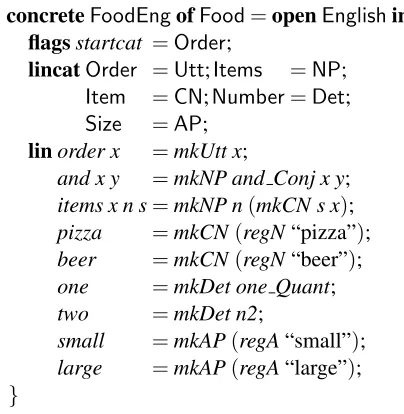
Figure 1 contains a small example GF abstract syn-tax. Figure 2 defines an English concrete syntax for it, using the resource grammar library. We will use this grammar when we show examples of speech recognition grammar generation later.
abstractFood= {
cat Order;Items;Item;Number;Size; funorder:Items→Order;
and :Items→Items→Items;
items:Item→Number→Size→Items; pizza,beer :Item;
one,two :Number; small,large:Size;
[image:3.612.83.285.220.427.2]}
Figure 1:Food.gf: A GF abstract syntax module.
concreteFoodEngofFood=openEnglishin {
flagsstartcat =Order;
lincatOrder =Utt;Items =NP;
Item =CN;Number=Det;
Size =AP; linorder x =mkUtt x;
and x y =mkNP and Conj x y; items x n s=mkNP n(mkCN s x); pizza =mkCN(regN“pizza”); beer =mkCN(regN“beer”); one =mkDet one Quant; two =mkDet n2;
small =mkAP(regA“small”); large =mkAP(regA“large”);
}
Figure 2: FoodEng.gf: English concrete syntax for the abstract syntax in Figure 1.
itemsconstructor makes anItemsterm from anItem, aNumberand aSize. The termitems pizza two small is an example of a term in this abstract syntax.
In the concrete syntax, a lincat judgement de-clares the type of the concrete terms generated from the abstract syntax terms in a given category. The linearization of each constructor is declared with a lin judgement. In the concrete syntax in Figure 2, library functions from the English resource gram-mar are used for the linearizations, but it is also pos-sible to write concrete syntax terms directly. The linearization of the term items pizza two small is
{s=“two small pizzas”}, a record containing a sin-gle string field.
By changing the imports and the four lexical items, this grammar can be translated to any other language for which there is a resource grammar.
For example, in the German version, we replace (regN “beer”) with (reg2N “Bier” “Biere”neuter) and so on. The functionsregNandreg2Nimplement paradigms for regular English and German nouns, respectively. This replacement can be formalized using GF’sparameterized modules, which lets one write a common implementation that can be instan-tiated with the language-specific parts. Note that the application grammar does not deal with details such as agreement, as this is taken care of by the resource grammar.
4 Generating Context-free Grammars
4.1 Algorithm
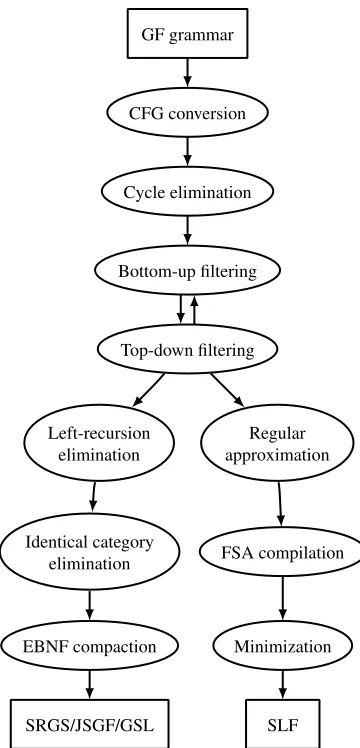
GF grammars are converted to context-free speech recognition grammars in a number of steps. An overview of the compilation pipeline is show in Fig-ure 3. The figFig-ure also includes compilation to finite-state automata, as described in Section 5. Each step of the compilation is described in more detail in the sections below.
Conversion to CFG The GF grammar is first converted into a context-free grammar annotated with functions and profiles, as described by Ljungl¨of (2004).
Cycle elimination All directly and indirectly cyclic productions are removed, since they cannot be handled gracefully by the subsequent left-recursion elimination. Such productions do not contribute to the coverage to the grammar, only to the set of pos-sible semantic results.
Bottom-up filtering Productions whose right-hand sides use categories for which there are no pro-ductions are removed, since these will never match any input.
in-GF grammar
CFG conversion
Cycle elimination
Bottom-up filtering
Top-down filtering
Left-recursion elimination
Identical category elimination
EBNF compaction
SRGS/JSGF/GSL
Regular approximation
FSA compilation
Minimization
[image:4.612.94.274.51.425.2]SLF
Figure 3: Grammar compilation pipeline.
put. Top-down filtering then has the effect of ex-cluding the non-speech modalities from the speech recognition grammar.
The bottom-up and top-down filtering steps are it-erated until a fixed point is reached, since both these steps may produce new filtering opportunities.
Left-recursion elimination All direct and indi-rect left-recursion is removed using theLCLR trans-form described by Moore (2000). We have modi-fied theLCLRtransform to avoid adding productions which use a category A−X when there are no pro-ductions forA−X.
Identical category elimination In this step, the categories are grouped into equivalence classes by their right-hand sides and semantic annotations. The categories A1. . .An in each class are replaced by a single categoryA1+. . .+Anthroughout the grammar, discarding any duplicate productions. This has the
effect of replacing all categories which have identi-cal sets of productions with a single category. Con-crete syntax parameters which do not affect inflec-tion is one source of such redundancy; the LCLR transform is another.
EBNF compaction The resulting context-free grammar is compacted into an Extended Backus-Naur Form (EBNF)representation. This reduces the size and improves the readability of the final gram-mar. The compaction is done by, for each cate-gory, grouping all the productions which have the same semantic interpretation, and the same sequence of non-terminals on their right-hand sides, ignoring any terminals. The productions in each group are merged into one EBNF production, where the ter-minal sequences between the non-terter-minals are con-verted to regular expressions which are the unions of the original terminal sequences. These regular ex-pressions are then minimized.
Conversion to output format The resulting non-left-recursive grammar is converted to SRGS, JSGF or Nuance GSL format.
A fragment of a SRGS ABNF grammar generated from the GF grammar in Figure 2 is shown below. The left-recursive and rule was removed from the grammar before compilation, as the left-recursion elimination step makes it difficult to read the gen-erated grammar. The fragment shown here is for the singular part of theitemsrule.
$FE1 = $FE6 $FE9 $FE4; $FE6 = one;
$FE9 = large | small; $FE4 = beer | pizza;
The corresponding fragment generated from the German version of the grammar is more complex, since the numeral and the adjective must agree with the gender of the noun.
$FG1 = $FG10 $FG13 $FG6 | $FG9 $FG12 $FG4; $FG9 = eine; $FG10 = ein;
$FG12 = große | kleine; $FG13 = großes | kleines; $FG4 = Pizza; $FG6 = Bier;
4.2 Discussion
context-free grammars, for example through its sup-port for reduplication. GF’s supsup-port for dependently typed and higher-order abstract syntax is also not yet carried over to the generated speech recogni-tion grammars. This could be handled in a subse-quent semantic interpretation step. However, that requires that the speech recognizer considers mul-tiple hypotheses, since some may be discarded by the semantic interpretation. Currently, if the abstract syntax types are only dependent on finite types, the grammar can be expanded to remove the dependen-cies. This appears to be sufficient for many realistic applications.
In some cases, empty productions in the gener-ated grammar could cause problems for the cycle and left-recursion elimination, though we have yet to encounter this in practice. Empty productions can be removed by transforming the grammar, though this has not yet been implemented.
For some grammars, the initial CFG generation can generate a very large number of productions. While the resulting speech recognition grammars are of a reasonable size, the large intermediate gram-mars can cause memory problems. Further opti-mization is needed to address this problem.
5 Finite-State Models
5.1 Algorithm
[image:5.612.316.539.546.668.2]Some speech recognition systems use finite-state au-tomata rather than context-free grammars as lan-guage models. GF grammars can be compiled to finite-state automata using the procedure shown in Figure 3. The initial part of the compilation to a finite-state model is shared with the context-free SRG compilation, and is described in Section 4.
Regular approximation The context-free gram-mar is approximated with a regular gramgram-mar, us-ing the algorithm described by Mohri and Neder-hof (2001).
Compilation to finite-state automata The reg-ular grammar is transformed into a set of non-deterministic finite automata (NFA) using a modi-fied version of themake fa algorithm described by Nederhof (2000). For realistic grammars, applying the original make faalgorithm to the whole gram-mar generates a very large automaton, since a copy
of the sub-automaton corresponding to a given cate-gory is made for every use of the catecate-gory.
Instead, one automaton is generated for each cat-egory in the regular grammar. All categories which are not in the same mutually recursive set as the category for which the automaton is generated are treated as terminal symbols. This results in a set of automata with edges labeled with either terminal symbols or the names of other automata.
If desired, the set of automata can be con-verted into a single automaton by substituting each category-labeled edge with a copy of the corre-sponding automaton. Note that this always termi-nates, since the sub-automata do not have edges la-beled with the categories from the same mutually re-cursive set.
Minimization Each of the automata is turned into a minimal deterministic finite automaton (DFA)by using Brzozowski’s (1962) algorithm, which min-imizes the automaton by performing two deter-minizations and reversals.
Conversion to output format The resulting finite automaton can be output in HTKStandard Lattice Format (SLF). SLF supports sub-lattices, which al-lows us to convert our set of automata directly into a set of lattices. Since SLF uses labeled nodes, rather than labeled edges, we move the labels to the nodes. This is done by first introducing a new labeled node for each edge, and then eliminating all internal un-labeled nodes. Figure 4 shows the SLF model gen-erated from the example grammar. For clarity, the sub-lattices have been inlined.
and one
two
pizzas beers pizza beer small
large
small
large
END START
5.2 Discussion
Finite-state models are even more restrictive than context-free grammars. This problem is handled by approximating the context-free grammar with an overgenerating finite-state automaton. This may lead to failure in a subsequent parsing step, which, as in the context-free case, is acceptable if the rec-ognizer can return all hypotheses.
6 Semantic Interpretation
Semantic interpretation can be done as a separate parsing step after speech recognition, or it can be done with semantic information embedded in the speech recognition grammar. The latter approach re-sembles thesemantic actionsused by parser genera-tors for programming languages. One formalism for semantic interpretation is the proposedSemantic In-terpretation for Speech Recognition (SISR)standard. SISR tags are pieces of ECMAScript code embed-ded in the speech recognition grammar.
6.1 Algorithm
The GF system can include SISR tags when gen-erating speech recognitions grammars in SRGS and JSGF format. The SISR tags are generated from the semantic information in the annotated CFG (Ljungl¨of, 2004). The result of the semantic interpretation is an abstract syntax term.
The left-recursion elimination step makes it somewhat challenging to produce correct abstract syntax trees. We have extended Moore’s (2000) LCLRtransform to preserve the semantic interpreta-tion. TheLCLRtransform introduces new categories of the formA−X whereX is a proper left corner of a categoryA. The new categoryA−X can be under-stood as “the categoryA, but missing an initialX”. Thus the semantic interpretation for a production in A−Xis the semantic interpretation for the original A-production, abstracted (in theλ-calculus sense) over
the semantic interpretation of the missingX. Con-versely, where-ever a category A−X is used, its re-sult is applied to the interpretation of the occurrence ofX.
6.2 Discussion
As discussed in Section 4.2, the semantic interpre-tation code could be used to implement the
non-context-free features of GF, but this is not yet done. The slot-filling mechanism in the GSL format could also be used to build semantic representations, by returning program code which can then be ex-ecuted. The UNIANCE grammar compiler (Bos, 2002) uses that approach.
7 Related Work
7.1 Unification Grammar Compilation
Compilation of unification grammars to speech recognition grammars is well described in the liter-ature (Moore, 1999; Dowding et al., 2001). Regu-lus (Rayner et al., 2006) is perhaps the most ambi-tious such system. Like GF, Regulus uses a general grammar for each language, which is specialized to a domain-specific one. Ljungl¨of (Ljungl¨of, 2007b) re-lates GF and Regulus by showing how to convert GF grammars to Regulus grammars. We carry composi-tional semantic interpretation through left-recursion elimination using the same idea as the UNIANCE grammar compiler (Bos, 2002), though our version handles both direct and indirect left-recursion.
The main difference between our work and the existing compilers is that we work with type-theoretical grammars rather than unification gram-mars. While the existing work focuses on GSL as the output language, we also support a number of other formats, including finite-state models. By using the GF resource grammars, speech recogni-tion language models can be produced for more lan-guages than with previous systems. One shortcom-ing of our system is that it does not yet have support for weighted grammars.
7.2 Generating SLMs from GF Grammars
Jonson (2006) has shown that in addition to gener-ating grammar-based language models, GF can be used to build statistical language models (SLMs). It was found that compared to our grammar-based ap-proach, use of generated SLMs improved the recog-nition performance for out-of-grammar utterances significantly.
8 Results
GOTTIS (Bringert et al., 2005; Ericsson et al., 2006), an experimental multimodal and multilingual dialogue system for public transportation queries, uses GF grammars for parsing multimodal input. For speech recognition, it uses GSL grammars gen-erated from the speech modality part of the GF grammars.
DJ-GoDiS, GoDiS-deLUX, and GoTGoDiS (Er-icsson et al., 2006) are three applications which use GF grammars for speech recognition and parsing together with the GoDiS implementation of issue-based dialogue management (Larsson, 2002). GoT-GoDiS has been translated to 7 languages using the GF resource grammar library, with each new transla-tion taking less than one day (Ericsson et al., 2006). The DICO (Villing and Larsson, 2006) dialogue system for trucks has recently been modified to use GF grammars for speech recognition and pars-ing (Ljungl¨of, 2007a).
DUDE (Lemon and Liu, 2006) and its extension REALL-DUDE (Lemon et al., 2006b) are environ-ments where non-experts can develop dialogue sys-tems based on Business Process Models describing the applications. From keywords, prompts and an-swer sets defined by the developer, the system gen-erates a GF grammar. This grammar is used for pars-ing input, and for generatpars-ing a language model in SLF or GSL format.
The Voice Programming system by Georgila and Lemon (Georgila and Lemon, 2006; Lemon et al., 2006a) uses an SLF language model generated from a GF grammar.
Perera and Ranta (2007) have studied how GF grammars can be used for localization of dialogue systems. A GF grammar was developed and local-ized to 4 other languages in significantly less time than an equivalent GSL grammar. They also found the GSL grammar generated by GF to be much smaller than the hand-written GSL grammar.
9 Conclusions
We have shown how GF grammars can be compiled to several common speech recognition grammar for-mats. This has helped decrease development time, improve modifiability, aid localization and enable portability in a number of experimental dialogue systems.
Several systems developed in the TALK and DICO projects use the same GF grammars for speech recognition, parsing and multimodal fu-sion (Ericsson et al., 2006). Using the same gram-mar for multiple system componentsreduces devel-opment and modification costs, and makes it easier tomaintain consistencywithin the system.
The feasibility ofrapid localization of dialogue systems which use GF grammars has been demon-strated in the GoTGoDiS (Ericsson et al., 2006) sys-tem, and in experiments by Perera and Ranta (2007). Using speech recognition grammars generated by GF makes it easy tosupport different speech rec-ognizers. For example, by using the GF grammar compiler, the DUDE (Lemon and Liu, 2006) system can support both the ATK and Nuance recognizers.
Implementations of the methods described in this paper are freely available as part of the GF distribu-tion1.
Acknowledgments
Aarne Ranta, Peter Ljungl¨of, Rebecca Jonson, David Hjelm, Ann-Charlotte Forslund, H˚akan Bur-den, Xingkun Liu, Oliver Lemon, and the anony-mous referees have contributed valuable comments on the grammar compiler implementation and/or this article. We would like to thank Nuance Com-munications, Inc., OptimSys, s.r.o., and Opera Soft-ware ASA for softSoft-ware licenses and technical sup-port. The code in this paper has been typeset using lhs2TeX, with help from Andres L¨oh. This work has been partly funded by the EU TALK project, IST-507802.
References
Johan Bos. 2002. Compilation of unification grammars with compositional semantics to speech recognition packages. In Proceedings of the 19th international conference on Computational linguistics, pages 1–7, Morristown, NJ, USA. Association for Computational Linguistics.
Bj¨orn Bringert, Robin Cooper, Peter Ljungl¨of, and Aarne Ranta. 2005. Multimodal Dialogue System Gram-mars. InProceedings of DIALOR’05, Ninth Workshop on the Semantics and Pragmatics of Dialogue, pages 53–60.
Janusz A. Brzozowski. 1962. Canonical regular expres-sions and minimal state graphs for definite events. In
Mathematical theory of Automata, Volume 12 of MRI Symposia Series, pages 529–561. Polytechnic Press, Polytechnic Institute of Brooklyn, N.Y.
John Dowding, Beth A. Hockey, Jean M. Gawron, and Christopher Culy. 2001. Practical issues in compil-ing typed unification grammars for speech recognition. InACL ’01: Proceedings of the 39th Annual Meeting on Association for Computational Linguistics, pages 164–171, Morristown, NJ, USA. Association for Com-putational Linguistics.
Stina Ericsson, Gabriel Amores, Bj¨orn Bringert, H˚akan Burden, Ann C. Forslund, David Hjelm, Rebecca Jon-son, Staffan LarsJon-son, Peter Ljungl¨of, Pilar Manch´on, David Milward, Guillermo P´erez, and Mikael Sandin. 2006. Software illustrating a unified approach to mul-timodality and multilinguality in the in-home domain. Technical Report 1.6, TALK Project.
Kallirroi Georgila and Oliver Lemon. 2006. Program-ming by Voice: enhancing adaptivity and robustness of spoken dialogue systems. In BRANDIAL’06, Pro-ceedings of the 10th Workshop on the Semantics and Pragmatics of Dialogue, pages 199–200.
Rebecca Jonson. 2006. Generating Statistical Lan-guage Models from Interpretation Grammars in Dia-logue Systems. InProceedings of EACL’06.
Staffan Larsson. 2002. Issue-based Dialogue Manage-ment. Ph.D. thesis, G¨oteborg University.
Oliver Lemon and Xingkun Liu. 2006. DUDE: a Dialogue and Understanding Development Environ-ment, mapping Business Process Models to Informa-tion State Update dialogue systems. In EACL 2006, 11st Conference of the European Chapter of the Asso-ciation for Computational Linguistics.
Oliver Lemon, Kallirroi Georgila, David Milward, and Tommy Herbert. 2006a. Programming Devices and Services. Technical Report 2.3, TALK Project.
Oliver Lemon, Xingkun Liu, Daniel Shapiro, and Carl Tollander. 2006b. Hierarchical Reinforcement Learn-ing of Dialogue Policies in a development environment for dialogue systems: REALL-DUDE. In BRAN-DIAL’06, Proceedings of the 10th Workshop on the Se-mantics and Pragmatics of Dialogue, pages 185–186, September.
Peter Ljungl¨of. 2004. Expressivity and Complexity of the Grammatical Framework. Ph.D. thesis, G¨oteborg University, G¨oteborg, Sweden.
Peter Ljungl¨of. 2007a. Personal communication, March.
Peter Ljungl¨of. 2007b. Converting Grammatical Frame-work to Regulus.
Mehryar Mohri and Mark J. Nederhof. 2001. Regu-lar Approximation of Context-Free Grammars through Transformation. In Jean C. Junqua and Gertjan van Noord, editors, Robustness in Language and Speech Technology, pages 153–163. Kluwer Academic Pub-lishers, Dordrecht.
Robert C. Moore. 1999. Using Natural-Language Knowledge Sources in Speech Recognition. In K. M. Ponting, editor,Computational Models of Speech Pat-tern Processing, pages 304–327. Springer.
Robert C. Moore. 2000. Removing left recursion from context-free grammars. In Proceedings of the first conference on North American chapter of the Associ-ation for ComputAssoci-ational Linguistics, pages 249–255, San Francisco, CA, USA. Morgan Kaufmann Publish-ers Inc.
Mark J. Nederhof. 2000. Regular Approximation of CFLs: A Grammatical View. In Harry Bunt and Anton Nijholt, editors, Advances in Probabilistic and other Parsing Technologies, pages 221–241. Kluwer Aca-demic Publishers.
Nadine Perera and Aarne Ranta. 2007. An Experiment in Dialogue System Localization with the GF Resource Grammar Library.
Aarne Ranta, Ali El Dada, and Janna Khegai. 2006. The GF Resource Grammar Library, June.
Aarne Ranta. 2004. Grammatical Framework: A Type-Theoretical Grammar Formalism. Journal of Func-tional Programming, 14(2):145–189, March.
Manny Rayner, Beth A. Hockey, and Pierrette Bouil-lon. 2006. Putting Linguistics into Speech Recogni-tion: The Regulus Grammar Compiler. CSLI Publica-tions, Ventura Hall, Stanford University, Stanford, CA 94305, USA, July.