Dynamic Correspondences: An Object-Oriented Approach to
Tracking Sound Reconstructions
Tyler Peterson
University of British Columbia E270-1866 Main Mall Vancouver, BC, Canada V6T-1Z1 [email protected]
Gessiane Picanc¸o Universidade Federal do Par´a
Bel´em – Par´a – Brasil CEP 66075-110
Abstract
This paper reports the results of a re-search project that experiments with cross-tabulation in aiding phonemic reconstruc-tion. Data from the Tup´ı stock was used, and three tests were conducted in order to determine the efficacy of this application: the confirmation and challenging of a previ-ously established reconstruction in the fam-ily; testing a new reconstruction generated by our model; and testing the upper limit of simultaneous, multiple correspondences across several languages. Our conclusion is that the use of cross tabulations (imple-mented within a database aspivot tables) of-fers an innovative and effective tool in com-parative study and sound reconstruction.
1 Introduction
In the past decade databases have transitioned from a useful resource as a searchable repository of linguis-tic tokens of some type, to an actual tool capable of not only organising vast amounts of data, but execut-ing complex statistical functions and queries on the data it stores. These advances in database technol-ogy complement those made in computational lin-guistics, and both have recently begun to converge on the domain of comparative and historical linguis-tic research.
This paper contributes to this line of research through describing the database projectBase de Da-dos para EstuDa-dos Comparativos – Tup´ı(BDEC-T) (Database for Comparative Studies – Tup´ı), which
is part of a larger research program investigating the phonemic reconstruction of the Tup´ı languages. The database component of the BDEC-T is designed to capitalise on the functionality of cross-tabulation tables, commonly known as pivot tables, a recent innovation in the implementation SQL queries in many database and spreadsheet applications. Pivot tables can be described as an ‘object-oriented’ rep-resentation of SQL statements in the sense that columns of data are treated as objects, which al-low the user to create multidimensional views of the data by ‘dragging and dropping’ columns into var-ious sorting arrangements. We have found that this dynamic, multidimensional manipulation of the data can greatly aid the researcher in identifying relation-ships and correspondences that are otherwise diffi-cult to summarize by other query types.
In this paper we report on the results of an ex-periment that tests the applicability of pivot tables to language data, in particular, the comparative and historical reconstruction of the proto-phonemes in a language family. In doing this, three tests were con-ducted:
1. The confirmation and challenging of a ‘man-ual’ and/or previously established reconstruc-tion of a proto-language, Proto-Tup´ı;
2. The testing of a new reconstruction generated by our model, and checking it against a manual reconstruction;
3. The testing the upper limit of simultaneous, multiple correspondences across several lan-guages.
It is argued that this type of object-oriented im-plementation of SQL statements using pivot tables, offers two unique features: the first is the abil-ity to check several one-to-one and one-to-many correspondences simultaneously across several lan-guages; and secondly, the ability to dynamically sur-vey the language-internal distribution of segments and their features.
The former feature represents a notable advan-tage over other ‘manual’ methods, as the recon-structed forms may be entered in the database as proto-languages, which can be continually revised and tested against all other languages. The latter fea-ture offers the ability to check the language-internal distribution of the (proto-)segments which will aid in preventing possible cases of skewed occurrences, as is shown below. Basic statistical analyses, such as numbers of occurrences, can also be reported, graphed and plotted by the pivot tables, thus provid-ing further details of individual languages and proto-languages, and, ultimately, a more quantitatively re-liable analysis.
The net outcome of this is the presentation of a practical methodology that is easily and quickly im-plementable, and that makes use of a function that many people already have with their database or spreadsheet.
1.1 The Data
The Tup´ı stock of language families is concentrated in the Amazon river basin of Brazil (and areas of neighbouring countries) and comprises 10 fam-ilies of languages: Arik´em, Awet´ı, Juruna, Maw´e, Mond´e, Munduruk´u, Purubor´a, Ramarama, Tupar´ı, and Tup´ı-Guaran´ı (Rodrigues 1958; revised in Ro-drigues 1985), totaling approximately 64 languages. Tup´ı-Guaran´ı is the largest family with more than 40 languages, while the other families range from one language (e.g. Awet´ı, Purubor´a) to six languages (e.g. Mond´e). From these, the Tup´ı-Guaran´ı family is the only family that has been mostly analized from a historical point of view (e.g. Lemle 1971, Jensen 1989, Schleicher 1998, Mello 2000, etc.); there is also a proposal for Proto-Tupar´ı (Tupar´ı family), by Moore and Gal´ucio (1993), and Proto-Munduruk´u (Munduruk´u family), by Picanc¸o (2005). A prelim-inary reconstruction at level of the Tup´ı stock was proposed by Rodrigues (1995), in which he
recon-structs a list of 67 items for Proto-Tup´ı (see further details below). The BDEC-T also includes these reconstructed languages, as they allow us to com-pare the results obtained from the database with the results of previous, manual historical-comparative studies.
2 The Application: Design and Method
The BDEC-T was initially developed as repository database for language data from various Tup´ı lan-guages described above, with the purpose of allow-ing the user to generate lists of word and phoneme correspondences through standard boolean search queries or SQL statements. These lists aided the researcher in exploring different correspondences in the course of a proto-phoneme or word reconstruc-tion. The BDEC-T is implemented within MS Ac-cess 2003, which provides the user an interface for entering language data that is then externally linked to tab-delimited text files in order to preserve its declarative format.1 This also allowed flexibility in accessing the data for whatever purpose in the plat-form or program of the researcher’s choosing.
At present, the BDEC-T for the Tup´ı stock con-tains a glossary of 813 words and up to 3,785 entries distributed across 15 Tup´ıan languages. Approxi-mately 18% of this 813-word list appear to have cog-nates in the majority of languages entered so far, and which can be used as reference for a reliable set of robust cognates across the entire Tup´ı stock.2 This number is continually increasing as more languages are entered in the database, and at least 50% of the glossary is filled up for all languages. The average number of entries for each language varies consid-erably as it depends largely on available sources; yet, in general, the average is of approximately 250 words per language (i.e. about 30%).
1
The choice of using a proprietary database such as MS Ac-cess is mostly a practical one: after considering various fac-tors such as programming, maintenance, distribution and other practical issues, we decided that a database of this type should be useable by researchers with little or no programming expe-rience, as it is fairly easy to learn and modify (see also Bre-denkamp, Sadler and Spencer (1998: 149) for similar argu-ments). It should also be noted that all the procedures outlined here are implementable in open source database and spreadsheet programs such as OpenOffice Calc and Base (vers. 2.3).
2
2.1 Data entry and Segmentation
Each of the 65 languages and 4 proto-languages in BDEC-T is associated with its own data entry form. Each data entry form is divided into three main parts:
1. The word entry fieldswhere the word for that language is entered (along with two other op-tional features);
2. The comparison viewer that contains fields which simultaneously display that same word in the all the other languages in the database;
3. Thesegmentation sectionwhich contains an ar-rangement fields for recording segment data.
The structure of the stored data is straightforward: the data entered in these forms is stored in a master table where all of the languages are represented as columns. Glosses are the rows, where each gloss is assigned a unique, autogenerated number in the master record when it is entered into the database. This serves as the primary key for all the translations of that gloss across all of the languages.
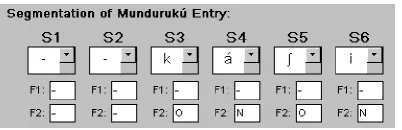
The third component of the language data entry form, the segmentation section (Fig. 1), contains a linear arrangement of ten columns, S1 to S10, and three rows, each cell of which corresponds to a field. The first row of the ten columns are fields where the user can enter in the segmentation of that particu-lar word, which contains the segments themselves. The second and third rows correspond to optional features (F) that are associated with that segment. In this particular version F1 is unused, while F2 encodes syllable structure (i.e. ‘O’ onset, ‘N’ nu-cleus).3
For example, Figure 1 is a screenshot of a portion of the segmentation section in the language data en-try form for Munduruk´u. The word being entered is ‘moon’, and the word in Munduruk´u is k´aSi. Seg-ment slots S3 to S6 are used to segSeg-ment the word.
As a convention, a word will typically be seg-mented starting with the S3 slot, and not with S1. The reason for this is to allow for at least two seg-ment fields (S1 and S2) to accommodate cognates in
3
[image:3.612.328.529.56.121.2]There is no restriction on the kind of information that can be stored in the two Feature fields. However, in order for them to be useful, they would need to contain a limited set of compa-rable features across all the languages.
Figure 1: Screenshot of a portion of the Segmenta-tion secSegmenta-tion in the Munduruk´u Data entry form.
Segmentation slot S1 S2 S3 S4 S5
Av´a-Canoeiro 1 t 1
Guaj´a w 1 t 1
Arawet´e i w i t 1
Table 1: Segmentation of‘wind’
other languages that have segments that occur before S3, but are entered into the database at a later time. This is done in order to maintain a consistency be-tween correspondences, regardless of what slot they are in the data base. In other words, we need to be prepared to handle cases that are shown in Tables 1 and 2 above. If the Av´a Canoeiro word for ‘wind’ is entered first in Table 1, it is prudent to have segment slots available for languages that are entered later that may have additional segments occurring before. Guaj´a and Arawet´e were entered into the database after Av´a Canoeiro, and both have additional seg-ments. Keeping S1 and S2 available as a general rule can accommodate these cases.
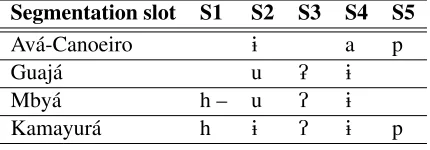
Our purpose in designing the segmentation com-ponent of the form this way was to give the re-searcher complete control over how words are seg-mented. This also allows the researcher to cross-check their segmentations in real time with those in the other languages already in the database, which can be done in the comparison viewer (not shown due to space limitations). This is essential for more complicated cases, such as those in Table 2, where there are not only word edge mismatches, but also gaps and (grammaticalized) morphological bound-aries that need to be properly corresponded. The significance of this will be demonstrated below.4
4
Segmentation slot S1 S2 S3 S4 S5
Av´a-Canoeiro 1 a p
Guaj´a u Ü 1
Mby´a h – u P 1
[image:4.612.79.294.58.133.2]Kamayur´a h 1 P 1 p
Table 2: Segmentation of‘arrow’
The data entered in the segmentation section of a language’s data entry form is stored in language-specific tables, which has columns for each of the ten segments, and columns recording the two op-tional features associated with that segment. All of the segment data in the language-specific tables are coordinated by the primary key generated and kept in the master table. The next subsection de-scribes how this segmental data can be used in two specific ways: 1) to track correspondences between languages for a particular cognate or segment slot; and 2), for monitoring the language-internal distri-bution of segments. We propose that this is achieved through using cross-tabulations of the segment data recorded in each column, and outline a practical im-plementation of this is using pivot tables.
2.2 Cross-tabulation: ‘Pivot tables’
Access 2003 includes a graphical implementation of SQL statements in the form of cross tabulations, orpivot tables, which provide the user an interface with which they can manipulate multiple columns of data to create dynamic, multi-dimensional orga-nizations of the data. There are three basic reasons for organizing data into a pivot table, all of which are relevant to the task at hand: first, to summa-rize data contained in lengthy lists into a compact format; secondly, to find relationships within that data that are otherwise hard to see because of the amount of detail; and thirdly, to organize the data into a format that is easy to chart. Pivot tables are dy-namic because columns of data are treated as objects that can be moved, or literally ‘swapped’ in, out our around in relation to other columns. They are multi-dimensional because column data can be organized along either axis, yielding different ‘snapshots’ of the data. It is this kind of functionality that will be capitalised on in examining correspondences
be-or switched between by the master switchboard.
tween columns of segment data (S1-10) across any number of languages in the database.
A cross tabulation displays the joint distribution of two or more variables. They are usually presented as a contingency table which describes the distribu-tion of two or more variables simultaneously. Thus, cross tabulation allows us to examine frequencies of observations that belong to specific categories on more than one variable. By examining these fre-quencies, we can identify relations between cross-tabulated variables. Typically, only variables with a relatively small number of different meaningful val-ues are cross tabulated. We suggest that phonemes fit this criteria, as there is a finite and relatively low number of total unique phonemes that can ever be potentially cross tabulated.
For example, Figure 2 (below) is a screen shot of a pivot table generated in the BDEC-T that shows the distribution of word and morpheme-initial voice-less stops in Munduruk´u in relation to those in the same position for three other languages: Karitiana, Gavi˜ao and Karo. This was achieved in the follow-ing way: as described above, we assume that the word-initial segment for most words is S3. The S3 column for Munduruk´u is then taken to the ‘drop field’ (shaded grey), where all of the values in the S3 of Munduruk´u become dependent variables. The S3 columns for Karitiana, Gavi˜ao and Karo become independent variables, which allow us to monitor the distribution of voiceless stops in these languages in relation to the S3 segments in Munduruk´u. In essence, Munduruk´u S3 becomes a sort function on any other S3 columns to the right of it.5
Where this method becomes effective is when we ‘swap’ out Munduruk´u S3 and replace it with Gavi˜ao S3, which is done by pulling the column header and placing it into the grey ‘drop field’. This is shown in Figure 3 below. What Figure 3 immediately demonstrates is the asymmetric cor-respondence between Munduruk´u and Gavi˜ao for S3: broadly speaking, the correspondences between Munduruk´u and Karitiana, Gavi˜ao and Karo are more general, whereas the same correspondences for
5
Figure 2: Screenshot of a pivot table for voiceless stops in Munduruk´u (shaded) corresponding with Karitiana, Gavi˜ao and Karo in BDEC-T.
Figure 3: Screenshot of a pivot table for voice-less stops in Gavi˜ao (shaded) corresponding with Munduruk´u, Karitiana and Karo in BDEC-T.
Gavi˜ao are more restricted.
There is no restriction on the number of indepen-dent or depenindepen-dent variables, and this can be used to investigate the language-internal distribution of seg-ments. Figure 4 shows how the segment data in S3 and S4 from the same language can be used in a pivot table, allowing the user to track the distribu-tion of certain word or morpheme-initial segments and the segments that follow them. This arrange-ment gives us a snapshot of consonant-vowel pat-terns in Karo, where S3 has been additionally fil-tered to show the distribution of vowels that follow the palatals [c] and [j].
One important advantage to this arrangement of data and the use of pivot tables is the potential for tracking multiple correspondences across several languages simultaneously. So far, this is only lim-ited by processor speed and viewing space. We have tested up to five segment correspondences (i.e. S3-8) across three languages, or one correspondence (i.e.
Figure 4: Screenshot of a pivot table for language-internal distribution of [c] and [j] morpheme and syllable-initially in Karo.
S3) for as many as ten languages simultaneously. Given that most words in the Tup´ı language family have on average three to five segments, the former of these amounts to the ability of corresponding the segments of entire words simultaneously. Consider-ing that any segment column can be swapped in and out dynamically, this adds a substantial amount of power in tracking single correspondences simultane-ously across a variety of languages, proto-languages, and potentially even entire families.
Various statistics can be applied to these pivot ta-bles, where the results can be graphed and exported. The analyst may now take these results and proceed with the appropriate detailed investigation, an exam-ple of which is presented in the following sections.
3 Proto-Tup´ı and Munduruk ´u
To demonstrate the efficacy of this approach, we show now the results obtained with the BDEC-T and the use of pivot tables, and compare them with the results of a previously established set of sound corre-spondences and reconstructed proto-phonemes. For this, we chose Proto-Tup´ı, for which Rodrigues (1995) reconstructed 67 lexical proto-forms and es-tablished a consonant inventory composed of four complex series of stops, divided into plain, labi-alized (still uncertain), palatlabi-alized, and glottlabi-alized (ejectives), shown Table 3.
[image:5.612.74.298.314.366.2]Plain p t,ţ Ù k Labialized (pw) w (kw)
Palatalized tj kj
[image:6.612.313.545.57.118.2]Glottalized pP, (pPw) tP,ţP ÙP kP, (kPw)
Table 3: Proto-Tup´ı stop series (Rodrigues 1995)
Rodrigues BDEC-T Rodrigues BDEC-T
P-T Mund. P-T Mund. P-T Mund. P-T Mund.
*p p *p p *Ù S *Ù S
∅ Ù Ù
ps à Ã
p/b
*pP b *pP b *ÙP t *ÙP t
p d d
*t n *t n *ţ Ã *ţ Ã
s Ù,Ã
Ù S S
t/n
*tP d *tP d *P P *P P
à ∅ *VPV V
˜
t/d
*k k *k k *kP
P *kP
[image:6.612.79.294.60.116.2]P S
Table 4: The correspondence sets as proposed by Rodrigues (1995) compared with those generated by the BDEC-T.
including Munduruk´u. Here we compare the cor-respondence sets postulated by Rodrigues and com-pare them to those generated by the BDEC-T. The results of the pivot table analysis are shown in Table 4. Note that the BDEC-T predicts a larger set of correspondences than those posited by Rodrigues. However, there are a few cases where both lists agree; for example, for Proto-Tup´ı *Ùwhich corre-sponds toS,ÙandÃin both cases.
Another important result obtained with the BDEC-T is the possibility of relating other types of segmental information. For example, Munduruk´u exhibits a feature that makes it distinct from any other Tup´ıan language: it is the only Tup´ıan lan-guage known to make a phonological contrast be-tween modal and creaky (laryngealised) vowels (Picanc¸o 2005). Munduruk´u phonation types are crucial for any reconstruction at the stock level –
S1 S2 S3 S4 S5 S6 Proto-Tup´ı: *upiPa ∅ u p i P a Munduruk´u:topsa
˜ t o ps ∅ ∅ a˜
Mek´ens:upia ∅ u p i ∅ a
Table 5: *(C)VPV corresponding with (C)V
˜
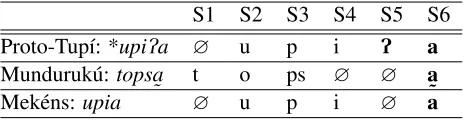
especially in the case of the ejectives proposed by Rodrigues – but this was completely ignored in his proposal. As shown in Table 5 (on the following page), some Proto-Tup´ı sequences *(C)VPV yielded (C)V
˜ sequences (where the tilde underneath a vowel
marks creaky voice on the vowel).
A comparison that considers only a segment-to-segment correspondence will mistakenly posit the correspondence set *P/∅ for both Munduruk´u and Sakirabi´a (Mek´ens, Tupar´ı family), when the correspondence is in fact *P/∅ for Sakirabi´a but *(C)VPV/(C)V
˜ for Munduruk´u. This is true for
Rodrigues’ analysis, which mistakenly established that “in Munduruk´u [the glottal stop] has dropped” (1995: 6). The BDEC-T, on the other hand, allows us to compare features to segments, and to examine various correspondences of segments in a sequence. This is a particular advantage as there will be no missing information. With this, this unique property of Munduruk´u, specifically creaky voice, can be ex-plained historically in a principled way.
3.1 Language-internal distribution
[image:6.612.71.301.155.396.2]p e pP 1 t ˜a tP a
1 a i
i ˜ı u
o ˜u
u
Ù 1 ÙP 1 ţ u ţP a
[image:7.612.330.522.57.352.2]a 1
Table 6: Language-internal distribution of segments
pivot tables, the analyst is able to easily monitor and track distributional gaps or contrasts and so provide a more systematic diachronic analysis.
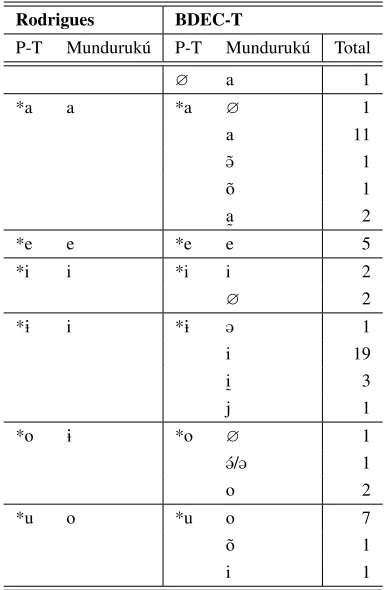
Another case which illustrates the applicabil-ity of pivot tables in arranging segment data con-cerns the vowels. Rodrigues’ comparison pro-duced vowel correspondences between Proto-Tup´ı and Munduruk´u. Again we compare his findings with those detected by the database: Table 7 com-pares the oral vowel correspondences as in Ro-drigues (1995) with those obtained by the pivot ta-bles in the BDEC-T, supplemented by the total of words with the respective correspondence.
In Rodrigues’ analysis, the correspondences be-tween proto-Tup´ı oral vowels and their reflexes in Munduruk´u are straightforward: it is a one-to-one correspondence. BDEC-T, however, challenges this analysis as there appear to be other correspondences that have not been observed, with the exception of the correspondence set *e/e, where both methods achieved the same results. Rodrigues’ intuitions are, nonetheless, relatively close to what the database produced: the largest number of correspondences match the ones posited by Rodrigues, indicating that a ‘manual’ analysis, although valid, still has the po-tential to miss details that the database captures.
In sum, we employed the function of cross tab-ulations in the form of pivot tables to arrange seg-mented data. The object oriented function of pivot tables allowed us to dynamically arrange segment data which aided in tracking phonemic and featural correspondences. This was tested against a manual analysis of the data and it was shown to confirm, re-vise and produce new results.
Rodrigues BDEC-T
P-T Munduruk´u P-T Munduruk´u Total
∅ a 1
*a a *a ∅ 1
a 11
˜
@ 1
˜o 1
a
˜ 2
*e e *e e 5
*i i *i i 2
∅ 2
*1 i *1 @ 1
i 19
i
˜ 3
j 1
*o 1 *o ∅ 1
´
@/@ 1
o 2
*u o *u o 7
˜o 1
i 1
Table 7: Rodrigues’ (1995) oral vowel correspon-dence sets compared with those generated by the BDEC-T.
4 Conclusion
[image:7.612.109.260.57.159.2]adjust-ments where needed in the S1-S10 segmentations made in the languages. This also offers a measure of accuracy, as the pivot tables will only yield invalid results if the segments aren’t aligned properly.6
Although not discussed in this paper, we have promising results from using the optional feature fields (F1 and F2) to generate syllable template to accompany the phonemic correspondences gener-ated by the pivot tables. Also, the application of pivot tables in the BDEC-T has also had success in tabulating mappings between cognate and semantic sets in the Tup´ıan languages (Peterson 2007a). Ul-timately, we would like to explore innovative visu-alizing techniques to display the interdependent re-lationships between phonemes at various stages of reconstruction (through the proto-languages in the database), and the languages whose inventories they belong to. Conceptually, this would give us a (scal-able) two- or three-dimensional plots or ‘webs’ of correspondences across the languages, perhaps im-plemented by recent visualization techniques such as treemaps or ConeTrees (Fekete & Plaisant 2002). The purpose of the BDEC-T is ultimately to com-plement other current computational approaches to the domain of historical and comparative research by offering a practical level of interactivity and pro-ductivity in a research tool. Where automation is not necessary, the BDEC-T offers a database model that effectively enhances the functionality of the kinds of databases that are already widely used.
References
Andrew Bredenkamp, Louisa Sadler and Andrew
Spencer. 1998. Investigating Argument Structure:
The Russian Nominalization Database. Linguistic
Databases, John Nerbonne, (ed.) CSLI Publications
Jean-Daniel Fekete and Catherine Plaisant. 2002. In-teractive Information Visualization of a Million Items. Proceedings of the IEEE Symposium on Information Visualization, IEEE Computer Society, Wash., DC
Cheryl Jensen. 1989. O desenvolvimento hist´orico da l´ıngua Wayamp´ı. Master’s Thesis. Campinas: Univer-sidade Estadual de Campinas.
Grzegorz Kondrak. 2002. Algorithms for Language Re-construction. Ph.D Thesis, University of Toronto
6
We have developed a set of ‘diagnostic’ pivot tables to help control against improperly aligned segmentations.
Mirian Lemle. 1971. Internal classification of the
Tup-Guaran linguistic family. Tupi Studies I., David
Bendor-Samuel (ed.), pp. 107-129. Norman: SIL
Augusto S. Mello. 2000. Estudo Hist´orico da Fam´ılia ling¨u´ıstica Tup-Guaran´ı: Aspectos Fonol´ogicos e Lex-icais. PhD Dissertation. Santa Catarina: UFSC
Denny Moore and Vilacy Gal´ucio. 2005. Reconstruction
of Proto-Tupari consonants and vowels. inSurvey of
California and Other Indian Languages, Report 8, M. Langdon and L. Hinton (eds.), pp. 119-137.
John Nerbonne. 1998. Linguistic Databases:
Introduc-tion. John Nerbonne, (ed.) CSLI Publications
Tyler Peterson. 2007a. Analytical Database Design: Ap-proaches in the Mapping between Cognate and
Se-mantic Sets. Proceedings of the 7th Intl. Workshop
on Computational Semantics, J. Goertzenet al(eds). Tilburg: Tilburg University, pp. 359–361.
Gessiane L. Picanc¸o. 2005. Munduruk´u: Phonetics,
Phonology, Synchrony, Diachrony. PhD Dissertation. Vancouver: University of British Columbia.
Aryon D. Rodrigues. 1958. Die Klassifikation des
Tupi-Sprachstammes. Proceedings of the 32nd
Interna-tional Congress of Americanists, Copenhagen, 1956; pp. 679-684.
Aryon D. Rodrigues. 1985. Relac¸˜oes internas na fam´ılia
ling¨u´ıstica Tup-Guaran´ı. Revista de Antropologia
27/28, S˜ao Paulo, 1956 pp. 33-53.
Aryon D. Rodrigues. 1995. Glottalized stops in Proto-Tup´ı. Paper presented at the SSILA Summer Meeting, University of New Mexico, Albuquerque, NM.