Volume 4, No. 8, May-June 2013
International Journal of Advanced Research in Computer Science
RESEARCH PAPER
Available Online at www.ijarcs.info
ISSN No. 0976-5697
Whistleblower’s Protection Act 2011, India: A Critical Analysis
Dr. V.K. Chaurasiya
Assistant Professor
Indian Institute of Information Technology Allahabad, India
Nandita Singh
MS Cyber Laws and Information Security Indian Institute of Information Technology
Allahabad, India [email protected]
Priyanka Dwivedi
MS Cyber Laws and Information Security Indian Institute of Information Technology
Allahabad, India [email protected]
Trishna Chaturvedi*
MS Cyber Laws and Information Security Indian Institute of Information Technology
Allahabad, India
Abstract:Corruption, which today has become a plague ruining the economical and ethical environment at the industrial level in India, often goes unchallenged when people are frightened to raise voice about it. Initiations to a committed Whistleblower Policy will provide an invaluableinsight intocorruption.From exposing high profile scandals to financial scam, whistleblowers play a critical role in saving both resources and lives. Timely disclosure of wrongdoing can also helpto protect human rights.But today, in our country blowing the whistle can result into high personal risk becausein the current state there is no legal procedure against an unauthorized expulsion, humiliation or even physical abuse related to whistleblowing conduct. Whistleblowers often face retaliation, from the group or organization which they have accused, and sometimes under the law.Whistleblower Act will provide a safeguard which will help people to speak about corruption. We must importune our country to introduce the policy to protect those whospeak out and ensure that their claims are properly investigated in whistleblower policy.
This paper analyses the serious issue related to the current conduct of whistleblowing and whistleblowers protection in India, which is still in its way to become a country wide actto be enforced on the public and private sector companies. It examines the consequences of inexistence of a formal whistleblower policy and contains recommendations for formulating such kind of policy.The purpose of the study is first to identify common shortcomings in the regional legislations; second aim is to recognize the most important barriers that obstruct public interest disclosures; and third, to devote to more successful whistleblower protection by highlighting favourable and effective practices.
Keywords-Whistleblower, Central Whistleblower council,Protected Disclosure,Reprisal,victimization, Identity Protection, Anonymous Complaints.
Roadmap: This research paper begins with a high-level introduction about whistleblowing in Section 1. Section 2 speaks about the consequences of lacking a formal model for whistleblower’s protection. A brief description of related work is given in Section 3 and analysis of current scenario has been done in Section 4. In section 5 we have given recommendations for forming a Whistleblower’s act. We have concluded in Section 6.
I.INTRODUCTION
Whistleblowing for an employee is an act for disclosingwhatever he believes is unethical or illegal on the part of higher management,the organization or to an external authority or the public. With the increasing rate of industrial crimes by public and private sector organizations, which is thereby affecting the economy, it is essential, to have a formal system of reporting in which the employees can file about the misconducts at the workplace [1].
Unfortunately, whistleblowers commonly face retribution in different ways like, harassment, termination, blacklisting, threats and even physical violence.The major issue is that their disclosures are frequently ignored.It is imperative that the definition of an individual's right to freedom is amended to include the right to expose any act of corruption, bribery and wrong doing, at the work places without the fear of reprisal. This requires enactment of new laws to protect individuals who come forward to expose the illegitimate actions, and to provide resources to acknowledge formalise and investigate those exposés.
The first law on the protection of whistleblower was the United States “False Claims Act” given in 1863[2]and was
revised in 1986, tried to encounter fraud by suppliers of the U.S. government during the Civil War. This act inspired the whistleblowers by protecting them from unlawful release and encouraging them by giving the damages acquired by the government.
II.CONSEQUENCES OF NOT HAVING A FORMAL ACT
As a risk management perspective, there are lots of powerful practical reasons for accepting a whistleblower policy. More effective management and governance, given by internal reporting will provide much better protection to the organization, its officials and authorities against future liability. Due to lack of such a basic Act or policy, there is a corporate mismanagement or a general lack of interest in anticipating and react to corporate abuses. Few of the consequences are -
A. Frauds hampering the economic growth:
Everyday various types of frauds are occurring due to lack of proper channel to address about the mishappenings. Alarge number of high profile whistleblowing scandals are occurring in the public domain whichhighlights the malfunctioning and wrongdoings, in various sectors as corporate sectors, financial services, central government, health and social care.This depictsthat earlier disclosure & intervention of Government in the fraudulent activities could save the country from a huge economic loss. For example, the Stock Market scam by Harshad Mehta that caused loss worth more than 4000 crores INR, Ketan Parekh Scam looted Bank of India of around $30 million, and
Satyam Scam, which caused a loss of around 14000 crores considered as one of the largest corporate scam in the Indian history [3].But stillvarious frauds are left uncovered; therefore it is necessary to have the whistle blowing policy. One of the important reasons of whistle-blowing is accountability; the superiors are often approached by their employees who morph into whistle-blowers for explanations of puzzling activities, never conceptualize the consequences of those early conversations.
B. Lack of protective measures for employees:
Individuals should be free to express their concerns. But because of not having any procedure for concerning the anonymous claims, there is any policy to protect the employee against the retaliation actions made by others towards the whistleblower. Many of them are not buzzing the whistle against the fraud even though they are aware about it. Thus, the organizations should accept those claims confidentially and at the same time provide immunity and safety for the employee. This way, organizations will be acting in the interest of not just the employees, but also the stakeholders. Whistle blowing can also be perceived as a deterrent against wrong doing and misconduct.
C. Absence of hidden channel for anonymous
complaints:
Whistleblowing provides a solution to settle situations by opening fictional or hidden information channels and their causes.Therecan be several reasons for revealing information like malignant or unlawful activities going on at working place.People will have to take help of extra-organisational channels, as within the organisation their might not be proper investigation procedures or they might be subjected to reprisals later on.Due to the absence of hidden channel in the organization employees are frightened of registering their complaints as they might face reprisals in future.
III.RELATED WORK
Preventing and fighting corruption, bribery, fraud and theft of public funds is a challenging issue as it happens at all levels, and involves officials and middle men. Effulgent the light on corruption is one of the most direct methods of whistle blowing.
In order to encourage responsible and meaningful whistle blowing, many countries and international organisations have developed their own legislation, standards and protection protocols.Most of which have been derived from the principles developed by U.S. The European Commission has set an example by taking a lead in co-funding a project led by U.S. that conducts in-depth assessments of whistleblower laws in member states and recommends areas of improvement. After the initial success with 10 member states, this is now being expanded to all 27 countries to promote Europe wide advocacy efforts.
U.S. government decided to have awidespread legislation SOX that would be a response to several major corporate frauds, conflict of interest and accounting scandals that chatter investors’ confidence in the integrity of the nation’s securities market as well as the accountability of the corporate governance system [4].
The Sarbanes-Oxley Act of 2002 given by U.S. is the first Act which has formulated the procedure to protect and encourage whistleblowers in various ways, byimposing criminal penalties for reprisal against whistleblower, and also defining various channels for whistleblowing.
The following sections of SOX talks about the whistleblowers-
a. The most important is Section 806, which states that a company cannot “discharge, degrade, suspend, extort, harass, or in any other way discriminate” against whistleblower who has informed the person having authority to investigate, discover or terminate.
b. Section 301 states that audit committee of the covered companies should have policy of whistleblowing, where employee can anonymously submit issues of concern regarding finance or misrepresentation made in balance sheet, whereas it does not protect those who go to the media.
c. Section 1107 states to charge penalties on covered company or individuals those who are knowingly taking revenge against whistleblower [5].
IV.FINDING BASED ON THE ANALYSIS OF CURRENT SCENARIO
At present, India has a bill named “Public Interest Disclosure and Protection toPersons Making the Disclosures Act, 2010”which is still in the process of getting converted to a powerful law. This bill got passed in the lower of house of Parliament but has to get through the upper house of Parliament.The bill, if got approved, would serve as our country’s first ever law made for the protecting the whistleblowers. Many incidents of harassment,threatening and assault have been reported in recent years all across the
countryby whistleblowers. This has demoralised citizens from exposing any kind of wrongdoings in public and private sector. On implementation, the bill would form a legal constitution for investigation of corruption cases involving bureaucrats.
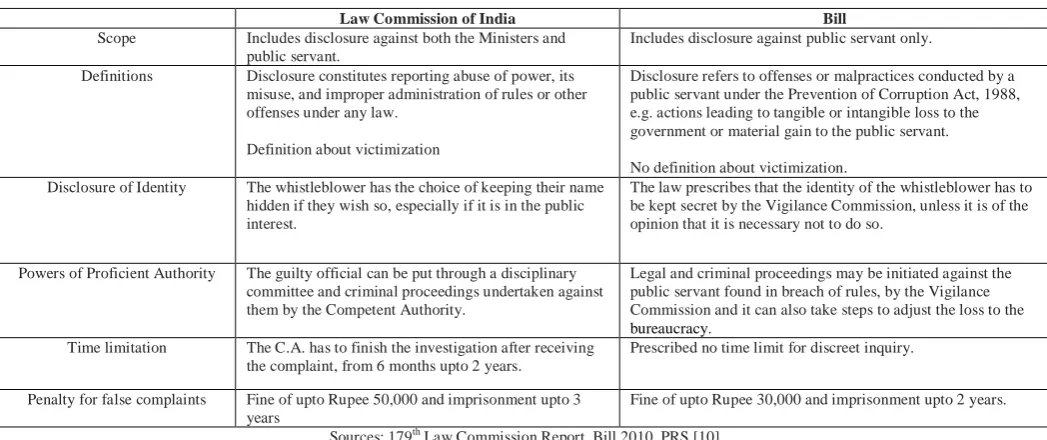
[image:3.595.35.559.219.439.2]In December 2001,report of the Law Commission of India interrogated the issues of whistle-blowing and gave certain suggestions. The scope of these suggestions were wider in the current Bill, as they included ministers within the scope and provided powers to the Authorities to initiate criminal proceedings, within a fixed time limit.
Table 1.Compares the recommendations of the Commission with the provisions of the Bill.
Law Commission of India Bill
Scope Includes disclosure against both the Ministers and public servant.
Includes disclosure against public servant only.
Definitions Disclosure constitutes reporting abuse of power, its misuse, and improper administration of rules or other offenses under any law.
Definition about victimization
Disclosure refers to offenses or malpractices conducted by a public servant under the Prevention of Corruption Act, 1988, e.g. actions leading to tangible or intangible loss to the government or material gain to the public servant.
No definition about victimization. Disclosure of Identity The whistleblower has the choice of keeping their name
hidden if they wish so, especially if it is in the public interest.
The law prescribes that the identity of the whistleblower has to be kept secret by the Vigilance Commission, unless it is of the opinion that it is necessary not to do so.
Powers of Proficient Authority The guilty official can be put through a disciplinary committee and criminal proceedings undertaken against them by the Competent Authority.
Legal and criminal proceedings may be initiated against the public servant found in breach of rules, by the Vigilance Commission and it can also take steps to adjust the loss to the
bureaucracy. Time limitation The C.A. has to finish the investigation after receiving
the complaint, from 6 months upto 2 years.
Prescribed no time limit for discreet inquiry.
Penalty for false complaints Fine of upto Rupee 50,000 and imprisonment upto 3 years
Fine of upto Rupee 30,000 and imprisonment upto 2 years.
Sources: 179th Law Commission Report, Bill 2010, PRS.[10]
Table 1: Comparison of the Law Commission of India with the Proposed Bill
In this paper, on comparison with various other whistleblower protection laws in several countries like Public Interest Disclosure Act (U.K), Whistleblower protection Act of 1989 (U.S.) etc., we analysed that the present bill in India has a number of shortcomings as follows:
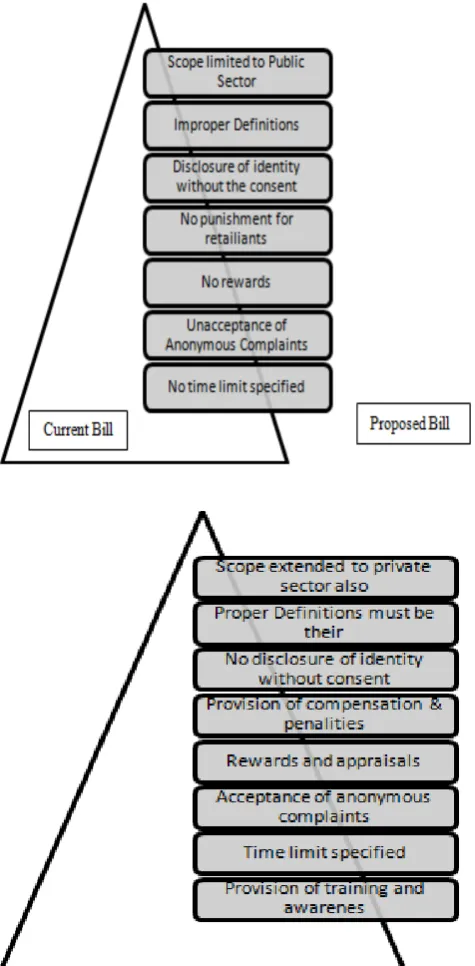
a. The bill has a limited scope as it is applicable only for complaints against government sector employees. It does not include State government and private sector employees.
b. It also provides limited interpretations for victimisation and disclosurei.e. it lacks proper definitions for them which in other countries law are broadly defined.The Whistleblower protection bill of India has also given definitions but they are very vague and does not give a clear understanding of the terms.
c. There are no provisions for acceptance of anonymous complaints i.e. anonymous complains will not be filed according to the present bill.
d. It does not outlines punishments or penalties for those who are found guilty for victimising whistleblowers. e. The central authority “Central Vigilance Commission”
has not been given authority for imposing penalties. f. Bill recommends concealment of identity of
complainant but it has the authority to disclose it to the government department’s head which is under scrutiny.
g. The bill also does not offer any kind of rewards for those who provide original information to catch the perpetrators that is no financial incentives are given. h. There is no time limit specified by the bill in order to
resolve cases which can lead to indefinite delay in their disposition.
Figure 1: Gap Analysis of Current Bill in India and our Proposed Bill
V.RECOMMENDATIONS
In this paper after analysis of certain major issues like, protecting whistleblowers that expose illegality and corruption, acceptance of anonymous complaints and deficiency of penalties for officials who victimise whistleblowers, we have recommended a structured set of requirements, containing amalgamation of various laws of different nations like Public Interest Disclosure Act 1998 (U.K.), Whistleblower Protection Act of 1989 (U.S.) andMinnesota False Claims Actfor the formation of an efficient Whistleblower policy. Every individual’s right of expression must be given a voice by stepping ahead in this direction.These recommendations will also open easy access to avenues for making their disclosures.
a. One of the major requirements for the formation of an act is to decide its scope. For instance, the whistleblower laws of Florida,Hawaii, Minnesota and
several other states have considered both public and private sector employers, to be included under the whistleblower’s protection acts [6]. On this basis, it seems essential to cover both work domains, within the act, to strengthen the protection of public and private sector employees who blow whistle[11].
b. Disclosure of identity is also a debating point, as Sec. 1213(h) of Whistleblower Protection Act of 1989 (US) states that the identity of a whistleblower to be disclosed by the special council only after his approval or in case there is an inevitable danger to public health and safety[7].Thus, individual’s identity shall not be disclosed until unless he gives his consent on it or it is required in the public interest.Such a mechanism will help toensure robust protection to whistleblowers identity.
c. An upper limit on the time period should also be standardised for the timely resolution of the complaints. As under Section 11 of Whistleblower Protection Act of 1989, U.S. and under section 1213 it is proclaimed that the case should be file in written format within 60 days of noticed, and investigation should also be completed within 90 days after the case is filed in written format to head agency [7].The case should get filed in written format to the Central Whistleblower council within 15 days of reporting and must be resolved in 6 months.
d. Meaningful definitions must also be provided so that the agenda in the act can be made comprehensive. While referring to U.S. law (Whistleblower Protection Act of 1989), Section 1213 states the provisions relating the disclosures of violation of law, gross mismanagement and various other matters, which specifies the situations when the disclosures will be considered within the scope of act [7]. Similarly, The Public Interest Disclosure Act 1998 of UK also defines protected disclosures and whistleblowers as worker in its part IV (43A, 43B, 43K). The term “victimization or reprisal” must also be explained as it is described in U.S. law of whistleblowing under Sec.4 “Reprisal” and in UK’s PIDA as “unfair dismissal” [8]. Such elaborated definitions will easily help to differentiate what kind of disclosures are to be included and considered as violation of various related mandatory laws.
In such a case the identity can be disclosed in lieu of public interest.
f. Penalties must be imposed which will act as a deterrent control over wrongdoers.It is required that strict disciplinary actions must be taken in following cases:
a) Penalty against victimisation b) Penalty for false complaints
Whistleblower Protection Act of 1989(U.S.) in its section 1215 [7] has spoken about the penalties for the different scenarios.The act should be formed to strengthen the protection of public and private sector employees who blow whistle against corruption. This can only be done when special measures will be taken against those who try to suppress the voice of whistleblowers.Broader protection must be provided to protect them from harassment in their workplace. Employment status must be prevented from unfair dismissal, discrimination in terms professional promotion, trainings, remuneration, assignments and transfer. This shows that how important it is to clearly define the retaliatory actions in order to ensure thorough protection. This can be done by listing out all feasible retaliatory actions. Also effective channels must be established for reporting reprisals against whistleblowers. Independent body must also be formed to process complaints, investigate them and to take necessary corrective actions.
SOX also speak about penalties in Section 1107 of H.R. 3763 that prohibits retaliation against whistlebloweremployees. The new provision states that
anyone who knowingly takes any action to harm a person including hindrance to his lawful employment or livelihood, for providing truthful information related to any federal offence to legal enforcement bodies must be fined or imprisoned for around 10 years or both [5].
g. Rewards acts an encouragement for filing complains so it is important to have a provision for some rewards to whistleblowers. This can be a monetary token like giving 10 to 30 percent of the collected fines or award that will honour them in the society.The SEC has formalized the award process under the whistleblower law. Dodd-Frank Wall Street Reform and Consumer Protection Act,offers incentives to those who report illegal activities violating the federal laws at companies required to report to the SEC [9].
h. Another essential part of implementing any act is that the people must be made aware about the act and its usage. Educating people is necessary so that they can understand the benefits of disclosing the wrongdoings. When the complainants are confident about their reporting abilities, corrupt entities won’t be able to conceal their identity.Sensitization and public education are also essential to encourage whistleblowing, so that citizens understand how revealing of wrongdoing benefits the public good. These above recommendations are explained in brief in Table2.
Table 2: Our Recommendations
Scope Disclosure can be against Public servant and Private servant. Disclosure of
identity
The identity of a whistleblower shall not be disclosed until unless he gives his consent on it or it is required in the public interest.
Time Limit The competent authority must be able to resolve the case within a certain time limit depending on the sensitivity of fraud or its negative impact on the economy or severe damage to public interest.
Definitions Proper definition of whistleblowing, whistle-blower , disclosure, victimisation Penalty 1. Penalty for Victimisation
2. Penalty for false complaints
Identity Protection Protection should be provided to the whistleblower by assurance of confidentiality and anonymous complaints must be allowed. Reward The Reward should be provided to whistleblower to encourage whistleblowing.
Training and awareness
Proper training and awareness programs must be provided within the organization.
VI.CONCLUSION
In summation, we can say that whistleblowing is an essential prospect within every sector of work to curb corruption, misconduct and fraud. This is necessary for both public and private sector environment. A whistleblower policy will be a testimonial for the commitment to good governance, and a guide for the employees for acknowledging their responsibility towards their organization, their clients and the nation as a whole. Protection of public sector whistleblowers will promote the reporting of passive bribery, waste and misuse of public funds, fraud and many other corruption forms. Also protecting whistleblowers in private sector will facilitate the reposting of different corrupt acts done by the companies.
The act of whistleblowing can also be portrayed as a heroic act, but to sustain this, it is necessary to stop perceiving a whistleblower as a snitch or a grass. It will act as a benchmark helping authorities in monitoring compliance and detecting violations of various corruption laws.
By implementing the policy, as aforesaid in this paper, an environment for the effective corrective actions to be taken in order to protect the whistleblowers and work accordingly will be created. Effective protection of whistleblowers will support an open enterprise culture where employees not only have confidence in reporting but are also aware of the reporting procedures. An effective whistleblowing policy will facilitate a transparency among employees. It will act as a powerful tool to curb corruption.
Without absolute legal regulations, the condition of whistleblowers is not secure; it is very difficult for them to determine the legal repercussions of their actions.
VII.REFERENCES
[2]. History of Whistle Blowing,Wikipedia, http://en.wikipedia.org/wiki/Whistleblower,16 December 2012
[3]. ChareviewNewsroom,
http://www.chakreview.com/Politics/10-biggest-corruption-scams-in-Indian-history, 7 February 2013
[4]. Reasons of Sarbanes Oxley Act, http://www.ehow.com/about_5526341_reasons-sarbane-oxley-act.html#ixzz2Km2hSfvT,5 January 2013
[5]. National WhistleBlowers Centre,
http://www.whistleblowers.org/index.php?option=com_con tent&task=view&id=27, 20 December 2012
[6]. National Conference of State
Legislatures,http://www.ncsl.org/issues-research/labor/state-whistleblower laws.aspx, 30 December 2012
[7]. First Congress of the United States of America Guide, http://www.usda.gov/oig/webdocs/whistle1989.pdf,25 December 2012
[8]. Public Interest Disclosure Act Guide, 1998 CHAPTER 23
http://www.legislation.gov.uk/ukpga/1998/23/section/1,27 December 2012
[9]. Dodd-Frank Wall Street Reform and Consumer Protection Act Securities Whistleblowers Incentives and Protection,
http://www.sec.gov/about/laws/wallstreetreform-cpa.pdf, 25 December 2012
[10]. PRS Legislative Research pdf
http://www.prsindia.org/uploads/media/Public
Disclosure/Legislative Brief -Public Interest Disclosure Bil.pdf, 14 January 2013