Volume 4, No. 3, March 2013 (Special Issue)
International Journal of Advanced Research in Computer Science
RESEARCH PAPER
Available Online at www.ijarcs.info
© 2010, IJARCS All Rights Reserved CONFERENCE PAPER II International Conference on 120 “Advance Computing and Creating Entrepreneurs (ACCE2013)”
On 19-20 Feb 2013 Organized by
2nd SIG-WNs, Div IV & Udaipur Chapter , CSI , IEEE Computer Society Chapter India Council , IEEE Student Chapter Geetanjali Institute of Technical Studies, Udaipur, Rajasthan, India
Dynamic Spectrum Access in Cognitive Radio Using Markovian Queuing Model
Pinki Yadav
Department of Electronics and Communication Engineering Faculty of Engineering and Technology,
Mody Institute of Technology & Science (Deemed University) Lakshmangarh, Dist. Sikar, Rajasthan,
Pin-332311, India. [email protected]
Partha Pratim Bhattacharya
Department of Electronics and Communication Engineering Faculty of Engineering and Technology,
Mody Institute of Technology & Science (Deemed University) Lakshmangarh, Dist. Sikar, Rajasthan,
Pin-332311, India. [email protected]
Abstract: Today there is huge demand for radio spectrum in wireless communication networks. Fixed spectrum policy is a major problem in solving spectrum crisis. Dynamic spectrum access is one method which gives the solution by allocating the available limited radio spectrum band between different licensed and unlicensed users. Dynamically accessing the unused spectrum is known as dynamic spectrum access (DSA) which becomes a promising approach to increase the efficiency of spectrum usage. This allows unlicensed wireless users (secondary users) to dynamically access the licensed bands from legacy spectrum holders (primary users) on an opportunistic basis. In this paper, DSA approach by using hierarchical access model is proposed with Markovian Queuing model for centralized architecture. The blocking probability and mean access delay for infinite and finite users are also found out. Results are then compared.
Keywords: Dynamic spectrum access; Primary users; Secondary user; Markovian Queuing model; blocking probability
I. INTRODUCTIONTODYNAMICSPECTRUM ACCESS
National regulatory bodies provide the radio spectrum band for utilization in different wireless services. In the U.S., the main authority for radio spectrum regulation is the Federal Communication Commission (FCC). The FCC’s spectrum policy gives the actual spectrum usage measurements. Radio spectrum is not fully utilized often and so the proper way for utilization of radio spectrum is to use dynamic spectrum access technique which is adopted in cognitive radio.
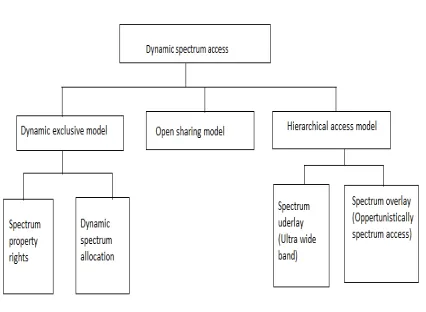
Dynamic spectrum access is a technique by which a radio system dynamically adapts to available spectrum holes with limited spectrum use rights, in response changing circumstance and objectives: interference created changes the radio’s state, changes in environmental constraints [1]. The main objective of the DSA is to overcome two types of interference concern: harmful interference caused by malfunctioning device and harmful interference caused by malicious users. Dynamic spectrum management is also referred to as dynamic spectrum access. DSA that was first demonstrated in 2006 by the Defense Advanced Research Project Agency (DARPA) and Shared Spectrum Company (SSC) of Vienna, VA [2]. Dynamic spectrum access overcomes the limitation of fixed frequency spectrum assignment and management. Dynamic spectrum access models can be broadly categorized under three models as dynamic exclusive-use, open sharing model, and hierarchical access model as shown in Fig. 1 [3].
Figure 1. Dynamic Spectrum Access
A. Dynamic exclusive use model:
Dynamic exclusive use model maintains the basic structure of the current spectrum regulation policy. Spectrum bands are licensed to services for exclusive use. The main objective of the dynamic exclusive use model improves the flexibility and spectrum efficiency. It manages spectrum in finer scales of time, space and frequency and use dimensions. There are two types of dynamic exclusive use model [3]:
a. Spectrum property rights: In spectrum property
rights licenses are allowed to sell and trade spectrum and to freely choose the technology. The economy and market will thus play a more important role in driving toward the most profitable use of this limited resource. Licenses have the rights to lease or share the spectrum for profit, such sharing is not mandated by the regulation policy.
b. Dynamic spectrum allocation: Dynamic spectrum
© than the cu
B. Open sharin
Open sharing m model. This m users as the ba model is supp wireless service scientific and m
ypes [4]: Unco Private-commo
a. Uncontro
open spec c. Private-co
technolog can be simu licensed) user users can oppo t is not occup There are also and Spectrum u
a. Spectrum
actively e
b. Spectrum
approach
davet al, Internat
All Rights Reserve nd temporal tra
Spectrum is use in a giv s allocation va urrent policy.
ng mode:
model is also odel employs asis for manag ported from th
es operating in medical (ISM ontrolled- comm ons.
lled-commons
ctrum access. no entity has
band. It is m t.
d-commons: Th
e tragedy of orm of order
ommons: Sp
gy and protoco may receive a ransmission p access the spe
cal access mod
ccess model [5 ultaneously s r and seconda ortunistically ac pied or fully u two types of underlay.
overlay: The
xplored in a go cated by Mito stic exploitat
“gaps” in spa e Radio will
band, which a certain time a trum bands d is model is s ows primary an y users can us y communicati
o relay prim premises for mple of spec nd OFDMA sy
underlay:
imposes const secondary use floor of prim ed signals ove
econdary user ge high data
ion power sho se, the assum users transmit
tional Journal of
d CONFEREN
affic statistics allocated to en region and aries in a much
called spectru open sharing ing a spectral he phenomenal n the unlicense ) radio band. mons, Manage
s: This is also
When a spect exclusive lice maximum tran
his represents commons by or structure
ectrum owne ol for the CR a command fro parameter). CR
ccess the radio utilized by pr f model; Spect
e spectrum ov oing DARAP X ola targets fo tion of whi atial-temporal have to ident are not used and location an dynamically to shown in Fig.
nd secondary t se part of thei ion and remain mary transmis an overlay sy trum overlay ystem [7].
The spectrum traints on the ers so they op mary users. B er a wide freq s can potential a rate with own in Fig. 2 mption is ma all the time; th
Advanced Resea
NCE PAPER of different services for d at a given h faster scale
um commons among
peer-region. This l success of ed industrial,
It has three ed-commons,
o referred as trum band is ensed to the nsmit power
an effort to imposing a of spectrum
er specifies user access. om spectrum R user may
dio spectrum en primary d) user. CR o spectrum if
imary users. trum overlay
verlay model XG program r aggressive te-space or
domain [4]. tify the idle
by licensed nd use those o unlicensed
2 (a). This transmission.
ir power for n part of the ssion, these ystem model
is TDMA,
m underlay transmission perate below By spreading quency band lly achieve a very low 2 (b). In the ade that the
his approach
arch in Computer
pectrum white
Figure 2. Spectru
ctrum overlay on by SU in restriction on th h cases, the lic
limiting interf um overlay a d to as opportu een that availa queue model ion in cognitiv
II. Q
gle station queu of finite or infi
as shown in m is also referre A server can se
in a “busy or the arrival of mer is buffered ble, and wait
tly service dep cted for service
fferent types o e-time, queuin s can be class d by a standar ndall and it is ll’s Notation Kendall’s nota
ntary Queuing ine and is sow ymbols, i.e. A ost important p
igure 3. A Stand
pecial Issue, Marc
l C f
on detection space [3].
um overlay and un
approach relie the network a heir transmissi censed spectrum
ference to PU approach is u unistic spectrum ability is increa
is chosen for ve radio.
QUEUINGSY
uing system c finite size and o n Fig. 3. An d to as a servic erve only one c “idle” state. If
the customer, d, assuming t for its turn. parts, one of th
e according to of arrival patter ng discipline
ified by a que rd notation. It
named as Ke
ation is widel g system A/B wn in Table I. M A/B/X are ment
parameters to
dard Graphical Not
ch 2013, 120-125
n and utilizati
nderlay approaches
es on spectrum and does not i ion power. The m is open to t U. In this pap used which i m access (OSA
ased with queu Dynamic Spe
YSTEM
onsists of a qu one or more id
elementary qu ce station or sim customer at a t f all servers ar , the newly ar that buffer sp
When the cu he waiting cust
a queuing dis rn, distribution and the numb euing system
was proposed ndall’s Notatio
ly used to de B/X/Y/Z in qu Most of the tim tioned since th represent a qu
tation for the queu
© a passion strea heir service t distributed. Se exponentially d or a group of s he arrived cust position of a qu
Parameters
The rule that a from the queue of the current Commonly use
c.
Priority-service, Se
d. RSS - Ran e. FQ - Fair
priority, b way.
III. P
This model i Markovian que
nteresting feat both infrastru centralized net allocation to in master or clust base station
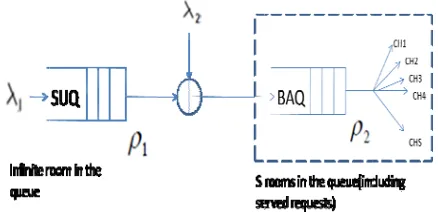
nfrastructure b scheme is an queuing netw distributed que other as a se equivalent mod s as shown in F queue where M denotes single BAQ) is mode Here G is gene of requests fro system. S deno available with
davet al, Internat
All Rights Reserve l situations cus am (exponenti times are ind ervice time distributed. Th servers to proc tomers. Practic ueuing system
TableI. Kenda
Refers To
nter-arrival distrib of customer
Service Time Distribution
Number of Paral servers
Maximum numbe ustomers allowed
queue
Scheduling discipli queuing strateg
a server uses to e when the ser
customer is ed queue discip Service reque st-serve basis rrives when th ocks the reques Service request
e manner. According to ervice requests ndom Selection r queuing does but serve the
PROPOSEDQ
is unique in euing for Cog ture of our mo ucture based
tworks. A re ntended users ter head and b
(BS) in based network nalyzed using ork model w ues is modeled emi Markovia del of a networ Fig. 4. In this m M means Mark
server and ba eled as an M/G eral distribution om both PU otes the availab h head and N
tional Journal of
d CONFEREN
stomers arrive al inter-arrival dependent and can be deter ere may be a s cess the service cally the numb
is limited.
all’s Notation
Ex
o select the ne rver is finished called queuing plines are:
sts are served . In FCFS, i he queue is f st.
s are served in
o the importa s are served. n for Services. s not consider service reque
QUEUINGMO
sense based nitive radio n odel is its ada and infras ecord of spec is to be perfo by the fixed c
infrastructur ks respectively g distributed where one o d as M/M/1 qu an M/G/S/N rk of queues fo model SUQ is kovian distribut andwidth alloc G/S/N loss que
n as there may and SU ente ble of unoccup N denotes lim
Advanced Resea
NCE PAPER according to l times) and d identically
rministic or single server e requests of
ext customer d the service g discipline.
d on a
first-d first-distributefirst-d networks. An
aptability for structure-less ctra and its
rmed by the controller or re-less and y. The MAC cation queue uing system. y be a variety ering to this pied channels
mited BAQ
arch in Computer
ty. A special ca r of available AQ becomes a s is Poisson an ential for a q vian queuing of stochastic
process of s ts to be proc r the requests e process [10].
Figure 4. Queui
ueue stacking dary user que ng this queue ar ) basis. At any ed to the SU ts from SU an el. Thus wh
ncies to PU an are summed to
The queue so ion queue (BA
rformance Ana
rlang B formul (1878-1929) a [11]. It is us ng probability
g model and i secondary use sumption that
is less than es stable and mean rate , du
updated with idth requests nsed users, ind
rates and idth allocation
rate at BAQ i ty for BAQ is ean service dur t by CR that fi ed, blocking p Erlang-B form
PB
pecial Issue, Marc
l C f
ase when queu channels in th an M/M/S/S q nd the service t queuing mode model. These processes, c ervice request essed, queuing are selected
ing model for DSA
all entries of eue (SUQ) an formed is refe AQ) [10].
alysis using Er
la was develop and is also kn sed for infinite . Erlang mode is based on qu r queue) is of the traffic int an unity (i.e.
the output pro ue to Bruke’s t
CR engine ca of both lic dependent Poi
are summ n queue BAQ
is + .
= + ration for BAQ finds all the ch probability PB
mula as given b
ch 2013, 120-125
ue size is same he system, i.e queue. If the g discipline i to be served
A in CR Network
SUs is referre nd all the re first come firs bandwidth nee considers bo ho needs it li ing a numb ival rates of bo frequencies wi rred to as band
rlang-B model
ped by Anger K nown as Erlan e users and fin el is also kno ueuing theory. f M/M/1 type. tensity of this
<1Erlang), ocess is still P theorem. The apabilities to censed as w isson processe hannels with H
is given by th below in (1)[10
Pinki Yadavet al, International Journal of Advanced Research in Computer Science, 4 (3) Special Issue, March 2013, 120-125
© 2010, IJARCS All Rights Reserved CONFERENCE PAPER II International Conference on 123 “Advance Computing and Creating Entrepreneurs (ACCE2013)”
On 19-20 Feb 2013 Organized by
2nd SIG-WNs, Div IV & Udaipur Chapter , CSI , IEEE Computer Society Chapter India Council , IEEE Student Chapter Geetanjali Institute of Technical Studies, Udaipur, Rajasthan, India Let N1 and N2 denote the mean number of messages in
queues SUQ and BAQ respectively. According to the M/M/1 classical theory, we have for queue SUQ [10]:
N1= (2)
According to the M/M/S/S classical theory, we have for queue BAQ:
N2= 1 (3)
Let T1 and T2 denote the mean delay experienced by a
message in crossing SUQ and BAQ, respectively in (4) from the little theorem:
T1 = and T2= (4)
To determine the total mean access delay T, we have considered two different cases depending on the input of the message in our system as follows:
Case a. SU messages arriving at SUQ from outside the
system. The probability that these messages arrive at SUQ from outside the system is given as
⁄ with a mean message delay TD1 given as (5):
TD1=T1+ 1 T2 (5)
Case b. PU messages arriving at BAQ from outside the
system. This situation occurs with probability ⁄ with the mean message delay TD2 given as
(6):
TD2=PB 0+ (1-PB) T2= (1-PB) T2 (6)
Thus, T can be obtained as in (7):
T= [T1+ (1-PB) T2] + [(1-PB) T2]
T= T1+ (1-PB) T2 (7)
By means of expressions of T1 and T2 using (4) and N1
and N2 using (2) and (3), we obtained the overall access
latency, T as follows in (8):
T=
T= (8) The equation defines the overall delay encountered by any SU to access a channel for transmission of its own voice/data. Thus, T represents the time interval between the request initiated by the SU and the request granted the required bandwidth.
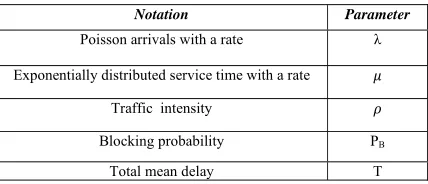
TableII. Parameter Used in Calculation
Notation Parameter
Poisson arrivals with a rate λ
Exponentially distributed service time with a rate
Traffic intensity
Blocking probability PB
Total mean delay T
Blocking probability from (1) is plotted in Fig. 5. Fig. 5 shows the relation between the numbers of channels (s) and blocking probability (PB) for different values of
traffic intensity (SU). So it is clear from the figure that
when number of channel increases, blocking probability decreases and when the traffic intensity (SU) increases, blocking probability also increases.
Figure 5. Blocking probability (PB) as a function of different number
of channel(s)
Figure 6. Mean access delay (T) against traffic intensity of BAQ
From (8), total access delay against blocking probabilities of 5%, 10%, 30%, 50%, 75% and 95% are plotted in Fig. 6 for variation in traffic intensity of BAQ as 0.2, 0.4, 0.6, 0.8. The plot shows that for any given traffic intensity of BAQ, T increases with increase in traffic intensity of BAQ while decreases for an increase in the blocking probability.
B. Performance Analysis using Engset formula:
The Engset formula was developed by Tore Olaus Engset. Engset is used with “Finite sources” when blocked call is cleared [11]. The Enset loss formula applies to situations where the number of customers is small relative to the number of available channel [12]. SU type M/M/1/L queue used, where L is the size of waiting room. The case of the M/M/1/L queue represents the queue in which the arrival and departure rates are not constant. The customer arrival rate is λ1 is
Pinki Yadavet al, International Journal of Advanced Research in Computer Science, 4 (3) Special Issue, March 2013, 120-125
© 2010, IJARCS All Rights Reserved CONFERENCE PAPER II International Conference on 124 “Advance Computing and Creating Entrepreneurs (ACCE2013)”
On 19-20 Feb 2013 Organized by
2nd SIG-WNs, Div IV & Udaipur Chapter , CSI , IEEE Computer Society Chapter India Council , IEEE Student Chapter Geetanjali Institute of Technical Studies, Udaipur, Rajasthan, India sources. The number of customers is assumed to be M,
the number of channel S and the blocking probability PB
[12].
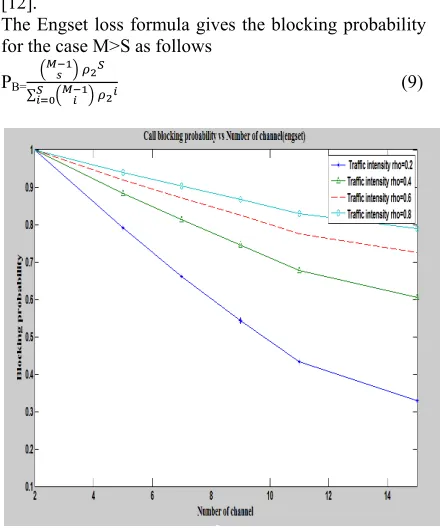
The Engset loss formula gives the blocking probability for the case M>S as follows
PB=
∑ (9)
Figure 7. Blocking probability(PB) as a function of different number
of channel(s)
Blocking probability from (9) is plotted in Fig. 7. It shows the relation between the number of channels (s) and blocking probability (PB) for different values of
traffic intensity (SU). It is clear that when number of channel increases, blocking probability decreases. It is also analyzed that when the traffic intensity (SU) increases, blocking probability also increases. From equation (8), total access delay against blocking probabilities of 5%, 10%, 30%, 50%, 75% and 95% are calculated for variation in traffic intensity of BAQ as 0.2, 0.4, 0.6, 0.8 and plotted in Fig. 8. The plot shows that for any given traffic intensity of BAQ, T increases with increase in traffic intensity of BAQ while decreases for an increase in the blocking probability.
Figure 8. Mean access delay (T) against traffic intensity of BAQ
C. Performance comparison between Erlang-B and Engset formula:
Comparison between the results obtained using Erlang-B and Engset formula are shown in Fig.9. For equal traffic intensities, the engset formula gives a lower blocking probability than the Erlang formula and tends to the later when the user population grows to infinity. Regarding the computational complexity the engset model is much more simple than the bidirectional markov chain used in Erlang formula.
Figure 9. Comparison between Erlang-B and Engset model
IV. CONCLUSION
Dynamic Spectrum access is a promising approach to utilize the unused spectrum by the primary user. In this paper, a centralized architecture coexisting with licensed users and unlicensed users is used for Markovian queuing model. Blocking probability and mean access delay for infinite users are calculated using Erlang-B formula and for finite users using Engset formula. Results obtained are found to be satisfactory. The results are then compared. For equal traffic intensities, the Engset formula gives a lower blocking probability than the Erlang formula and tends to be equal when the user population grows to infinity. The future work will include separate queue for high and low priority users.
V. ACKNOWLEDGMENT
The authors want to acknowledge the facilities provided by Mody Institute of Technology & Science (Deemed University), Lakshmangarh, Rajasthan for supporting the present work.
VI. REFERENCES
[1] Przemyslaw s Pawelczak, Gerard J.M Janssen and R.Venkatesha Prasad, “Performance Measures of Dynamic Spectrum Access Networks” IEEE Globecom, 28 November 2006 pp.1-22..
[2] http://www.mwrf.com/.
[3] Qings Zhao and Brian M. Sadler, “A Survey of Dynamic Spectrum Access” IEEE Signal Processing Magazine, May 2007 pp.79-89.
0 0.2 0.4 0.6 0.8 1
2 3 4 5 6 7 8 9 10 11 12 13 14
Blocking
Pr
oba
b
ili
ty
Number of channels
Pinki Yadavet al, International Journal of Advanced Research in Computer Science, 4 (3) Special Issue, March 2013, 120-125
© 2010, IJARCS All Rights Reserved CONFERENCE PAPER II International Conference on 125 “Advance Computing and Creating Entrepreneurs (ACCE2013)”
On 19-20 Feb 2013 Organized by
2nd SIG-WNs, Div IV & Udaipur Chapter , CSI , IEEE Computer Society Chapter India Council , IEEE Student Chapter Geetanjali Institute of Technical Studies, Udaipur, Rajasthan, India
[4] Anita Garhwal, Partha Pratim Bhattacharya,
“Dynamic Spectrum Access in Cognitive Radio: a brief review”, International Journal of Computer Application in Engineering Sciences, Special Issue on Computer Networks & Security, Vol.1 December 2011, pp. 149-153.
[5] Xavier Gelabert, “Cognitive Radio Enabling
Opportunistic Spectrum Access (OSA): Challenges and Modeling Approaches” UPF-DTIC Weekly Research seminar 28 October 2010.
[6] Sudhir Srinivasa and Syed Ali Jafar, “The
Throughput Potential of Cognitive Radio: A Theoretical Perspective” IEEE Communications Magazine, May 2007 pp.73-79.
[7] Danda B. Rawat and Gongjun Yan, “Spectrum
Sensing Methods and Dynamic Spectrum Sharing in Cognitive Radio Networks: A Survey” International Journal of Research and Reviews in Wireless Sensor Networks Vol. 1, No. 1, March 2011.
[8] www.eventhelix.com.
[9] Indika Anuradha Mendis Balapuwaduge,
“Performance Evaluation of Channel Aggregation Strategies in Cognitive Radio Networks with Queues” May 2012.
[10] Prabhjot Kaur, Arun Khosla and Moin Uddin,
“Markovian Queuing Model for Dynamic Spectrum Allocation in Centralized Architecture for Cognitive Radios” IACSIT International Journal of Engineering and Technology, Vol.3, No.1, February 2011 ISSN: 1793-8236.
[11] Richard parkison, “Traffic engineering Techniques in Telecommunications” copyright Infotel Systems corporation pp.1-29.
[12] Moshe Zukerman, “Introduction to Queuing
Theory and Stochastic Tele traffic Models” copyright 2000-2012.