Exploring Large-Data Issues in the Curriculum:
A Case Study with MapReduce
Jimmy Lin
The iSchool, College of Information Studies
Laboratory for Computational Linguistics and Information Processing University of Maryland, College Park
Abstract
This paper describes the design of a pilot re-search and educational effort at the Univer-sity of Maryland centered around technologies for tackling Web-scale problems. In the con-text of a “cloud computing” initiative lead by Google and IBM, students and researchers are provided access to a computer cluster running Hadoop, an open-source Java implementation of Google’s MapReduce framework. This technology provides an opportunity for stu-dents to explore large-data issues in the con-text of a course organized around teams of graduate and undergraduate students, in which they tackle open research problems in the hu-man language technologies. This design rep-resents one attempt to bridge traditional in-struction with real-world, large-data research challenges.
1 Introduction
Over the past couple of decades, the field of compu-tational linguistics, and more broadly, human lan-guage technologies, has seen the emergence and later dominance of empirical techniques and data-driven research. Concomitant with this trend is the requirement of systems and algorithms to handle large quantities of data. Banko and Brill (2001) were among the first to demonstrate the importance of dataset size as a significant factor governing pre-diction accuracy in a supervised machine learning task. In fact, they argue that size of training set is perhaps more important than the choice of ma-chine learning algorithm itself. Similarly, exper-iments in question answering have shown the
ef-fectiveness of simple pattern-matching techniques when applied to large quantities of data (Brill et al., 2001). More recently, this line of argumenta-tion has been echoed in experiments with large-scale language models. Brants et al. (2007) show that for statistical machine translation, a simple smooth-ing method (dubbedStupid Backoff) approaches the quality of Kneser-Ney Smoothing as the amount of training data increases, and with the simple method one can process significantly more data.
Given these observations, it is important to in-tegrate discussions of large-data issues into any course on human language technology. Most ex-isting courses focus on smaller-sized problems and datasets that can be processed on students’ personal computers, making them ill-prepared to cope with the vast quantities of data in operational environ-ments. Even when larger datasets are leveraged in the classroom, they are mostly used as static re-sources. Thus, students experience a disconnect as they transition from a learning environment to one where they work on real-world problems.
Nevertheless, there are at least two major chal-lenges associated with explicit treatment of large-data issues in an HLT curriculum:
• The first concerns resources: it is unclear where one might acquire the hardware to support ed-ucational activities, especially if such activities are in direct competition with research.
• The second involves complexities inherently associated with parallel and distributed pro-cessing, currently the only practical solution to large-data problems. For any course, it is
cult to retain focus on HLT-relevant problems, since the exploration of large-data issues ne-cessitates (time-consuming) forays into parallel and distributed computing.
This paper presents a case study that grapples with the issues outlined above. Building on previ-ous experience with similar courses at the Univer-sity of Washington (Kimball et al., 2008), I present a pilot “cloud computing” course currently under-way at the University of Maryland that leverages a collaboration with Google and IBM, through which students are given access to hardware resources. To further alleviate the first issue, research is brought into alignment with education by structuring a team-oriented, project-focused course. The core idea is to organize teams of graduate and undergraduate stu-dents focused on tackling open research problems in natural language processing, information retrieval, and related areas. Ph.D. students serve as leaders on projects related to their research, and are given the opportunity to serve as mentors to undergradu-ate and masters students.
Google’s MapReduce programming framework is an elegant solution to the second issue raised above. By providing a functional abstraction that isolates the programmer from parallel and distributed pro-cessing issues, students can focus on solving the actual problem. I first provide the context for this academic–industrial collaboration, and then move on to describe the course setup.
2 Cloud Computing and MapReduce
In October 2007, Google and IBM jointly an-nounced the Academic Cloud Computing Initiative, with the goal of helping both researchers and stu-dents address the challenges of “Web-scale” com-puting. The initiative revolves around Google’s MapReduce programming paradigm (Dean and Ghemawat, 2004), which represents a proven ap-proach to tackling data-intensive problems in a dis-tributed manner. Six universities were involved in the collaboration at the outset: Carnegie Mellon University, Massachusetts Institute of Technology, Stanford University, the University of California at Berkeley, the University of Maryland, and Univer-sity of Washington. I am the lead faculty at the Uni-versity of Maryland on this project.
As part of this initiative, IBM and Google have dedicated a large cluster of several hundred ma-chines for use by faculty and students at the partic-ipating institutions. The cluster takes advantage of Hadoop, an open-source implementation of MapRe-duce in Java.1 By making these resources available,
Google and IBM hope to encourage faculty adop-tion of cloud computing in their research and also integration of the technology into the curriculum.
MapReduce builds on the observation that many information processing tasks have the same basic structure: a computation is applied over a large num-ber of records (e.g., Web pages) to generate par-tial results, which are then aggregated in some fash-ion. Naturally, the per-record computation and ag-gregation function vary according to task, but the ba-sic structure remains fixed. Taking inspiration from higher-order functions in functional programming, MapReduce provides an abstraction at the point of these two operations. Specifically, the programmer defines a “mapper” and a “reducer” with the follow-ing signatures:
map:(k1, v1)→[(k2, v2)] reduce:(k2,[v2])→[(k3, v3)]
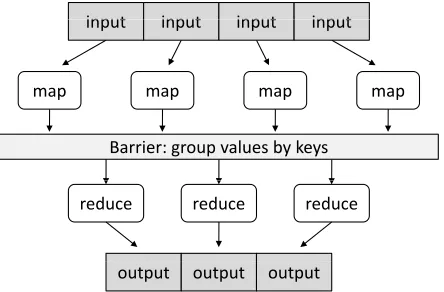
Key/value pairs form the basic data structure in MapReduce. The mapper is applied to every input key/value pair to generate an arbitrary number of in-termediate key/value pairs. The reducer is applied to all values associated with the same intermediate key to generate output key/value pairs. This two-stage processing structure is illustrated in Figure 1.
Under the framework, a programmer need only provide implementations of the mapper and reducer. On top of a distributed file system (Ghemawat et al., 2003), the runtime transparently handles all other aspects of execution, on clusters ranging from a few to a few thousand nodes. The runtime is re-sponsible for scheduling map and reduce workers on commodity hardware assumed to be unreliable, and thus is tolerant to various faults through a num-ber of error recovery mechanisms. The runtime also manages data distribution, including splitting the in-put across multiple map workers and the potentially very large sorting problem between the map and re-duce phases whereby intermediate key/value pairs must be grouped by key.
input input input input
map map map map
input input input input
Barrier: group values by keys
reduce reduce reduce
output output output
Figure 1: Illustration of the MapReduce framework: the “mapper” is applied to all input records, which generates results that are aggregated by the “reducer”.
The biggest advantage of MapReduce from a ped-agogical point of view is that it allows an HLT course to retain its focus on applications. Divide-and-conquer algorithms running on multiple ma-chines are currently the only effective strategy for tackling Web-scale problems. However, program-ming parallel and distributed systems is a difficult topic for students to master. Due to communica-tion and synchronizacommunica-tion issues, concurrent opera-tions are notoriously challenging to reason about— unanticipated race conditions are hard to detect and even harder to debug. MapReduce allows the pro-grammer to offload these problems (no doubt im-portant, but irrelevant from the perspective of HLT) onto the runtime, which handles the complexities as-sociated with distributed processing on large clus-ters. The functional abstraction allows a student to focus on problem solving, not managing the details of error recovery, data distribution, etc.
3 Course Design
This paper describes a “cloud computing” course at the University of Maryland being offered in Spring 2008. The core idea is to assemble small teams of graduate and undergraduate students to tackle re-search problems, primarily in the areas of informa-tion retrieval and natural language processing. Ph.D. students serve as team leaders, overseeing small groups of masters and undergraduates on topics re-lated to their doctoral research. The roles of “team leader” and “team member” are explicitly assigned
at the beginning of the semester, and are associated with different expectations and responsibilities. All course material and additional details are available on the course homepage.2
3.1 Objectives and Goals
I identified a list of desired competencies for stu-dents to acquire and refine throughout the course:
• Understand and be able to articulate the chal-lenges associated with distributed solutions to large-scale problems, e.g., scheduling, load balancing, fault tolerance, memory and band-width limitations, etc.
• Understand and be able to explain the concepts behind MapReduce as one framework for ad-dressing the above issues.
• Understand and be able to express well-known algorithms (e.g., PageRank) in the MapReduce framework.
• Understand and be able to reason about engi-neering tradeoffs in alternative approaches to processing large datasets.
• Gain in-depth experience with one research problem in Web-scale information processing (broadly defined).
With respect to the final bullet point, the students are expected to acquire the following abilities:
• Understand how current solutions to the par-ticular research problem can be cast into the MapReduce framework.
• Be able to explain what advantages the MapRe-duce framework provides over existing ap-proaches (or disadvantages if a MapReduce formulation turns out to be unsuitable for ex-pressing the problem).
• Articulate how adopting the MapReduce framework can potentially lead to advances in the state of the art by enabling processing not possible before.
I assumed that all students have a strong foun-dation in computer science, which was operational-ized in having completed basic courses in algo-rithms, data structures, and programming languages
Week Monday Wednesday
6 Project Meetings:Ph I
Proposal Presentations
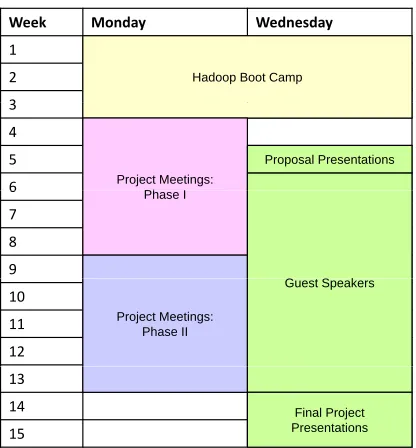
Figure 2: Overview of course schedule.
(in practice, this was trivially met for the graduate students, who all had undergraduate degrees in com-puter science). I explicitly made the decision that previous courses in parallel programming, systems, or networks was not required. Finally, prior experi-ence with natural language processing, information retrieval, or related areas was not assumed. How-ever, strong competency in Java programming was a strict requirement, as the Hadoop implementation of MapReduce is based in Java.
In the project-oriented setup, the team leaders (i.e., Ph.D. students) have additional roles to play. One of the goals of the course is to give them experi-ence in mentoring more junior colleagues and man-aging a team project. As such, they were expected to acquire real-world skills in project organization and management.
3.2 Schedule and Major Components
As designed, the course spans a standard fifteen week semester, meeting twice a week (Monday and Wednesday) for one hour and fifteen minutes each session. The general setup is shown in Figure 2. As this paper goes to press (mid-April), the course just concluded Week 11.
During the first three weeks, all students are im-mersed in a “Hadoop boot camp”, where they are
introduced to the MapReduce programming frame-work. Material was adapted from slides developed by Christophe Bisciglia and his colleagues from Google, who have delivered similar content in var-ious formats.3 As it was assumed that all students had strong foundations in computer science, the pace of the lectures was brisk. The themes of the five boot camp sessions are listed below:
• Introduction to parallel/distributed processing
• From functional programming to MapReduce and the Google File System (GFS)
• “Hello World” MapReduce lab
• Graph algorithms with MapReduce
• Information retrieval with MapReduce
A brief overview of parallel and distributed pro-cessing provides a natural transition into abstrac-tions afforded by functional programming, the inspi-ration behind MapReduce. That in turn provides the context to introduce MapReduce itself, along with the distributed file system upon which it depends. The final two lectures focus on specific case stud-ies of MapReduce applied to graph analysis and in-formation retrieval. The first covers graph search and PageRank, while the second covers algorithms for information retrieval. With the exception of the “Hello World” lab session, all lecture content was delivered at the conceptual level, without specific reference to the Hadoop API and implementation details (see Section 5 for discussion). The boot camp is capped off with a programming exercise (implementation of PageRank) to ensure that stu-dents have a passing knowledge of MapReduce con-cepts in general and the Hadoop API in particular.
Concurrent with the boot camp, team leaders are expected to develop a detailed plan of research: what they hope to accomplish, specific tasks that would lead to the goals, and possible distribution of those tasks across team members. I recommend that each project be structured into two phases: the first phase focusing on how existing solutions might be recast into the MapReduce framework, the second phase focusing on interesting extensions enabled by MapReduce. In addition to the detailed research
plan, the leaders are responsible for organizing intro-ductory material (papers, tutorials, etc.) since team members are not expected to have any prior experi-ence with the research topic.
The majority of the course is taken up by the re-search project itself. The Monday class sessions are devoted to the team project meetings, and the team leader is given discretion on how this is man-aged. Typical activities include evaluation of deliv-erables (code, experimental results, etc.) from the previous week and discussions of plans for the up-coming week, but other common uses of the meeting time include whiteboard sessions and code review. During the project meetings I circulate from group to group to track progress, offer helpful suggestions, and contribute substantially if possible.
To the extent practical, the teams adopt standard best practices for software development. Students use Eclipse as the development environment and take advantage of a plug-in that provides a seamless interface to the Hadoop cluster. Code is shared via Subversion, with both project-specific repositories and a course-wide repository for common libraries. A wiki is also provided as a point of collaboration.
Concurrent with the project meetings on Mon-days, a speaker series takes place on Wednesdays. Attendance for students is required, but otherwise the talks are open to the public. One of the goals for these invited talks is to build an active commu-nity of researchers interested in large datasets and distributed processing. Invited talks can be clas-sified into one of two types: infrastructure-focused and application-focused. Examples of the first in-clude alternative architectures for processing large datasets and dynamic provisioning of computing services. Examples of the second include survey of distributed data mining techniques and Web-scale sentiment analysis. It is not a requirement for the talks to focus on MapReduceper se—rather, an em-phasis on large-data issues is the thread that weaves all these presentations together.
3.3 Student Evaluation
At the beginning of the course, students are assigned specific roles (team leader or team member) and are evaluated according to different criteria (both in grade components and relative weights).
The team leaders are responsible for producing
the detailed research plan at the beginning of the semester. The entire team is responsible for three checkpoint deliverables throughout the course: an initial oral presentation outlining their plans, a short interim progress report at roughly the midpoint of the semester, and a final oral presentation accompa-nied by a written report at the end of the semester.
On a weekly basis, I request from each stu-dent a status report delivered as a concise email: a paragraph-length outline of progress from the previ-ous week and plans for the following week. This, coupled with my observations during each project meeting, provides the basis for continuous evalua-tion of student performance.
4 Course Implementation
Currently, 13 students (7 Ph.D., 3 masters, 3 under-graduates) are involved in the course, working on six different projects. Last fall, as planning was underway, Ph.D. students from the Laboratory for Computational Linguistics and Information Process-ing at the University of Maryland were recruited as team leaders. Three of them agreed, developing projects around their doctoral research—these repre-sent cases with maximal alignment of research and educational goals. In addition, the availability of this opportunity was announced on mailing lists, which generated substantial interest. Undergraduates were recruited from the Computer Science honors pro-gram; since it is a requirement for those students to complete an honors project, this course provided a suitable vehicle for satisfying that requirement.
Three elements are necessary for a successful project: interested students, an interesting research problem of appropriate scope, and the availability of data to support the work. I served as a broker for all three elements, and eventually settled on five projects that satisfied all the desiderata (one project was a later addition). As there was more interest than spaces available for team members, it was pos-sible to screen for suitable background and matching interests. The six ongoing projects are as follows:
• Large-data statistical machine translation
• Construction of large latent-variable language models
• Network analysis for enhancing biomedical text retrieval
• Text-background separation in children’s pic-ture books
• High-throughput biological sequence align-ment and processing
Of the six projects, four of them fall squarely in the area of human language technology: the first two are typical of problems in natural language process-ing, while the second two are problems in informa-tion retrieval. The final two projects represent at-tempts to push the boundaries of the MapReduce paradigm, into image processing and computational biology, respectively. Short project descriptions can be found on the course homepage.
5 Pedagogical Discussion
The design of any course is an exercise in tradeoffs, and this pilot project is no exception. In this section, I will attempt to justify course design decisions and discuss possible alternatives.
At the outset, I explicitly decided against a “tradi-tional” course format that would involve carefully-paced delivery of content with structured exercises (e.g., problem sets or labs). Such a design would perhaps be capped off with a multi-week final project. The pioneering MapReduce course at the University of Washington represents an example of this design (Kimball et al., 2008), combining six weeks of standard classroom instruction with an op-tional four week final project. As an alternative, I or-ganized my course around the research project. This choice meant that the time devoted to direct instruc-tion on foundainstruc-tional concepts was very limited, i.e., the three-week boot camp.
One consequence of the boot-camp setup is some disconnect between the lecture material and imple-mentation details. Students were expected to rapidly translate high-level concepts into low-level pro-gramming constructs and API calls without much guidance. There was only one “hands on” session in the boot camp, focusing on more mundane is-sues such as installation, configuration, connecting to the server, etc. Although that session also in-cluded overview of a simple Hadoop program, that by no means was sufficient to yield in-depth under-standing of the framework.
The intensity of the boot camp was mitigated by the composition of the students. Since students were self-selected and further screened by me in terms of their computational background, they represent the highest caliber of students at the university. Further-more, due to the novel nature of the material, stu-dents were highly motivated to rapidly acquire what-ever knowledge was necessary outside the class-room. In reality, the course design forced students to spend the first few weeks of the project simulta-neously learning about the research problem and the details of the Hadoop framework. However, this did not appear to be a problem.
Another interesting design choice is the mixing of students with different backgrounds in the same classroom environment. Obviously, the graduate students had stronger computer science backgrounds than the undergraduates overall, and the team lead-ers had far more experience on the particular re-search problem than everyone else by design. How-ever, this was less an issue than one would have ini-tially thought, parini-tially due to the selection of the students. Since MapReduce requires a different ap-proach to problem solving, significant learning was required from everyone, independent of prior expe-rience. In fact, prior knowledge of existing solutions may in some cases be limiting, since it precludes a fresh approach to the problem.
6 Course Evaluation
Has the course succeeded? Before this question can be meaningfully answered, one needs to define mea-sures for quantifying success. Note that the evalua-tion of the course is distinct from the evaluaevalua-tion of student performance (covered in Section 3.3). Given the explicit goal of integrating research and educa-tion, I propose the following evaluation criteria:
• Significance of research findings, as measured by the number of publications that arise directly or indirectly from this project.
• Placement of students, e.g., internships and permanent positions, or admission to graduate programs (for undergraduates).
• Amount of additional research support from other funding agencies (NSF, DARPA, etc.) for which the projects provided preliminary re-sults.
Here I provide an interim assessment, as this pa-per goes to press in mid-April. Preliminary results from the projects have already yielded two sepa-rate publications: one on statistical machine trans-lation (Dyer et al., 2008), the other on information retrieval (Elsayed et al., 2008). In terms of student placement, I believe that experience from this course has made several students highly attractive to com-panies such as Google, Yahoo, and Amazon—both for permanent positions and summer internships. It is far too early to have measurable results with re-spect to the final two criteria, but otherwise prelim-inary assessment appears to support the overall suc-cess of this course.
In addition to the above discussion, it is also worth mentioning that the course is emerging as a nexus of cloud computing on the Maryland campus (and beyond), serving to connect multiple organizations that share in having large-data problems. Already, the students are drawn from a variety of academic units on campus:
• The iSchool
• Department of Computer Science
• Department of Linguistics
• Department of Geography
And cross-cut multiple research labs:
• The Institute for Advanced Computer Studies
• The Laboratory for Computational Linguistics and Information Processing
• The Human-Computer Interaction Laboratory
• The Center for Bioinformatics and Computa-tional Biology
Off campus, there are ongoing collaborations with the National Center for Biotechnology In-formation (NCBI) within the National Library of Medicine (NLM). Other information-based organi-zations around the Washington, D.C. area have also expressed interest in cloud computing technology.
7 Conclusion
This paper describes the design of an integrated re-search and educational initiative focused on tackling Web-scale problems in natural language processing and information retrieval using MapReduce. Pre-liminary assessment indicates that this project rep-resents one viable approach to bridging classroom instruction and real-world research challenges. With the advent of clusters composed of commodity ma-chines and “rent-a-cluster” services such as Ama-zon’s EC2,4 I believe that large-data issues can be practically incorporated into an HLT curriculum at a reasonable cost.
Acknowledgments
I would like to thank the generous hardware sup-port of IBM and Google via the Academic Cloud Computing Initiative. Specifically, thanks go out to Dennis Quan and Eugene Hung from IBM for their tireless support of our efforts. This course would not have been possible without the participa-tion of 13 enthusiastic, dedicated students, for which I feel blessed to have the opportunity to work with. In alphabetical order, they are: Christiam Camacho, George Caragea, Aaron Cordova, Chris Dyer, Tamer Elsayed, Denis Filimonov, Chang Hu, Greg Jablon-ski, Alan Jackoway, Punit Mehta, Alexander Mont, Michael Schatz, and Hua Wei. Finally, I would like to thank Esther and Kiri for their kind support.
References
Michele Banko and Eric Brill. 2001. Scaling to very very large corpora for natural language disambiguation. In Proceedings of the 39th Annual Meeting of the As-sociation for Computational Linguistics (ACL 2001), pages 26–33, Toulouse, France.
Thorsten Brants, Ashok C. Popat, Peng Xu, Franz J. Och, and Jeffrey Dean. 2007. Large language models in machine translation. InProceedings of the 2007 Joint Conference on Empirical Methods in Natural guage Processing and Computational Natural Lan-guage Learning, pages 858–867, Prague, Czech Re-public.
Eric Brill, Jimmy Lin, Michele Banko, Susan Dumais, and Andrew Ng. 2001. Data-intensive question an-swering. In Proceedings of the Tenth Text REtrieval
Conference (TREC 2001), pages 393–400, Gaithers-burg, Maryland.
Jeffrey Dean and Sanjay Ghemawat. 2004. MapReduce: Simplified data processing on large clusters. In Pro-ceedings of the 6th Symposium on Operating System Design and Implementation (OSDI 2004), pages 137– 150, San Francisco, California.
Chris Dyer, Aaron Cordova, Alex Mont, and Jimmy Lin. 2008. Fast, easy, and cheap: Construction of statistical machine translation models with MapReduce. In Pro-ceedings of the Third Workshop on Statistical Machine Translation at ACL 2008, Columbus, Ohio.
Tamer Elsayed, Jimmy Lin, and Douglas Oard. 2008. Pairwise document similarity in large collections with MapReduce. InProceedings of the 46th Annual Meet-ing of the Association for Computational LMeet-inguistics (ACL 2008), Companion Volume, Columbus, Ohio. Sanjay Ghemawat, Howard Gobioff, and Shun-Tak
Le-ung. 2003. The Google File System. InProceedings of the 19th ACM Symposium on Operating Systems Principles (SOSP-03), pages 29–43, Bolton Landing, New York.