Proceedings of the Workshop on Cognitive Aspects of Computational Language Acquisition, pages 17–24,
Phon 1.2: A Computational Basis for Phonological
Database Elaboration and Model Testing
Yvan Rose1, Gregory J. Hedlund1, Rod Byrne2, Todd Wareham2, Brian MacWhinney3
1Department of Linguistics
Memorial University of Newfoundland
2Department of Computer Science
Memorial University of Newfoundland
3Department of Psychology
Carnegie Mellon University
[email protected], [email protected], [email protected], [email protected], [email protected]
Abstract
This paper discusses a new, open-source software program, called Phon, that is de-signed for the transcription, coding, and analysis of phonological corpora. Phon provides support for multimedia data link-age, segmentation, multiple-blind transcrip-tion, transcription validatranscrip-tion, syllabifica-tion, alignment of target and actual forms, and data analysis. All of these functions are available through a user-friendly graphical interface. Phon, available on most com-puter platforms, supports data exchange among researchers with the TalkBank XML document format and the Unicode character set.. This program provides the basis for the elaboration of PhonBank, a database project that seeks to broaden the scope of CHILDES into phonological de-velopment and disorders.
1 Introduction
Empirical studies of natural language and language acquisition will always be required in most types of linguistic research. These studies provide the basis for describing languages and linguistic pat-terns. In addition to providing us with baseline data, empirical data allow us to test theoretical, neuro-logical, psychological and computational models. However, the construction of natural language cor-pora is an extremely tedious and resource-consuming process, despite tremendous advances
in data recording, storage, and coding methods in recent decades.
Thanks to corpora and tools such as those de-veloped in the context of the CHILDES project (http://childes.psy.cmu.edu/), researchers in areas such as morphology and syntax have enjoyed a convenient and powerful method to analyze the morphosyntactic properties of adult languages and their acquisition by first and second language learners. In the area of phonetics, the Praat system (http://www.fon.hum.uva.nl/praat/) has expanded our abilities to conduct phonological modeling, computational simulations based on a variety of theoretical approaches, and articulatory synthesis.
In this rapidly-expanding software universe, phonologists interested in the organization of sound systems (e.g. phones, syllables, stress and intonational patterns) and their acquisition have not yet enjoyed the same level of computational sup-port. There is no developed platform for phonological analysis and no system for data-sharing parallel to that found in CHILDES. Unfor-tunately, this situation negatively affects the study of natural language phonology and phonological development. It also undermines potential studies pertaining to interfaces between various compo-nents of the grammar or the elaboration of compu-tational models of language or language develop-ment.
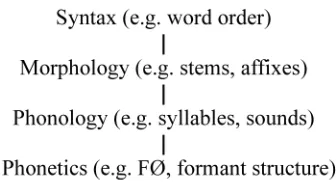
It is largely accepted that the grammar is hierar-chically organized such that larger domains (e.g. a sentence or a phrase) provide the conditioning en-vironments for patterns occurring in the domains
located lower in the hierarchy (e.g. the word or the syllable), as indicated in Figure 1.
Figure 1: General grammatical hierarchy
This hierarchical view of grammatical organization allows us to make reference to factors that link phonology to syntax. For example, in English, the phonological phrase, a domain that constrains phonological phenomena such as intonation, is best described using syntactic criteria (e.g. Selkirk 1986). Data on the acquisition of these grammati-cal structures and their phonologigrammati-cal consequences can help us understand how they are learned and assimilated by the learner.
In this paper we discuss Phon 1.2, the current version of an open-source software program that offers significant methodological advances in re-search in phonology and phonological develop-ment. On the one hand, Phon provides a powerful and flexible solution for phonological corpus elaboration and analysis. On the other hand, its ability to integrate with other open-source software will facilitate the construction of complete analyses across all levels of grammatical organization repre-sented in Figure 1.
The paper is organized as follows. In section 2, we discuss the general motivation behind the Phon project. In section 3, we discuss the current func-tionality supported in Phon 1.2. In section 4, we offer a glance at future plans for this project. Sec-tion 5 provides a final summary.
2 The PhonBank Project
PhonBank, the latest initiative within the CHILDES project, focuses on the construction of corpora suitable for phonological and phonetic an-alysis. In this section we first describe the goals and orientations of PhonBank. We then describe Phon, the software project designed to facilitate this endeavor.
2.1 PhonBank
The PhonBank project seeks to broaden the scope of the current CHILDES system to include the analysis of phonological development in first and second languages for language learners with and without language disorders. To achieve this goal, we will create a new phonological database called PhonBank and a program called Phon to facilitate analysis of PhonBank data. Using these tools, re-searchers will be in position to conduct a series of developmental, crosslinguistic, and methodological analyses based on large-scale corpora.
2.2 Phon
Phon consists of inter-connected modules that offer functionality to assist the researcher in important tasks related to corpus transcription, coding and analysis. (The main functions supported are dis-cussed in the next section.)
The application is developed in Java and is packaged to run on Macintosh (Mac OS X 10.4+) and Windows (Vista not tested yet) platforms.1
Phon is Unicode-compliant, a required feature for the sharing of data transcribed with phonetic sym-bols across computer platforms. Phon can share data with programs which utilize the TalkBank XML schema for their documents such as those provided by the TalkBank and CHILDES projects. Phon is available as free download directly from CHILDES (http://childes.psy.cmu.edu/phon/).
At the time of writing these lines, Phon is avail-able in its version 1.1, an iteration of the program that offered a proof of concept for the application envisioned (see Rose et al., 2006). Over the past year, however, we have thoroughly revised signifi-cant portions of the code to refine the functionality, ensure further compatibility with other TalkBank-compliant applications, and streamline the inter-face for better user experience and improved workflow. Despite what the minor version incre-ment (1.1 to 1.2) may imply, the new version, which is currently being tested internally and due for public release in June 2007, offers significant improvements as well as novel and innovative functionality.
3 Phon 1.2
[image:3.612.80.291.180.349.2]As illustrated in Figure 2, the general interface of Phon 1.2 consists of a media centre (top left of the interface), a section for metadata (e.g. recorded participants and their linguistic profiles; bottom left) and a Transcript Editor, the interface that pro-vides access to most of the functionality (right).
Figure 2: Phon 1.2 General Interface
One of the most significant improvements brought to version 1.2 comes from the integration of common tasks within the same user interface. In the previous version, completely separate inter-faces had to be accessed to achieve the following tasks, all of which are required in the elaboration of any corpus:
• Media linkage and segmentation.
• Data transcription and validation (including support for multiple-blind transcriptions).
• Segmentation of transcribed utterances (into e.g. phrases, words).
• Labeling of transcribed forms for syllabifi-cation.
• Phone and syllable alignment between target (expected) and actual (produced) forms. As a result the user often had to navigate between various modules in order to accomplish relatively simple operations. For example, a simple modifica-tion to a transcripmodifica-tion required, in addimodifica-tion to the modification itself, revalidation of the data, and then a verification of the syllabification and align-ment data generated from this revised
transcrip-tion, each of these steps requiring access to and subsequent exit from a separate module.
In Phon 1.2, most of this hurdle has been allevi-ated through an integration of most of the functions into the Transcript Editor, while the others (e.g. media linkage and segmentation; transcript valida-tion) are accessed directly from the general inter-face, without a need to exit the Transcript Editor. In the next subsections, we describe the main func-tions supported by the application.2
3.1 Media linkage and segmentation
As mentioned above, linkage of multimedia data and subsequent identification of the portions of the recorded media that are relevant for analysis are now available directly from the application’s main interface. These tasks follow the same logic as similar systems in programs like CLAN (http://childes.psy.cmu.edu/clan/). In addition to its integrated interface, Phon 1.2 offers support for linking different portions to a single transcript to different media files.
3.2 Data transcription
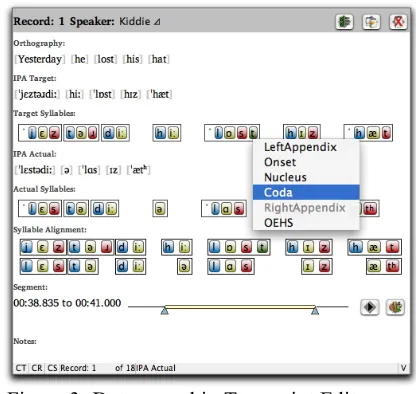
The Transcript Editor now incorporates in a single interface access to data transcription and annota-tion, transcription segmentaannota-tion, syllabification and alignment. This module is illustrated in more detail with the screen shot of a data record (correspond-ing to an utterance) in Figure 3.
Figure 3: Data record in Transcript Editor
[image:3.612.321.529.466.663.2]
As can be seen, the interface incorporates tiers for orthographic and phonetic transcriptions as well as other textual annotations. Phon also provides sup-port for an unlimited number of user-defined fields that can be used for all kinds of textual annotations that may be relevant to the coding of a particular dataset. All fields can be ordered to accommodate specific data visualization needs. Phonetic tran-scriptions are based on the phonetic symbols and conventions of the International Phonetic Associa-tion (IPA). A useful IPA character map is easily accessible from within the application, in the shape of a floating window within which IPA symbols and diacritics are organized into intuitive catego-ries. This map facilitates access to the IPA symbols for which there is no keyboard equivalent.
Target and actual IPA transcriptions are stored internally as strings of phonetic symbols. Each symbol is automatically associated with a set of descriptive features generally accepted in the fields of phonetics and phonology (e.g. bilabial, alveolar, voiced, voiceless, aspirated) (Ladefoged and Mad-dieson, 1996). These features are extremely useful in the sense that they provide series of descriptive labels to each transcribed symbol. The availability of these labels is essential for research involving the grouping of various sounds into natural classes (e.g. voiced consonants; non-high front vowels). The built-in set of features can also be reconfig-ured as needed to fit special research needs.
Phon 1.2 is also equipped with functionality to automatically insert IPA Target transcriptions based on the orthographic transcriptions. Citation form IPA transcriptions of these words are cur-rently available for English and French. The Eng-lish forms were obtained from the CMU Pronounc-ing Dictionary (www.speech.cs.cmu.edu/cgi-bin/cmudict); the French forms were obtained from the Lexique Project database (www.lexique.org).
In cases when more than one pronunciation are available from the built-in dictionaries for a given written form (e.g. the present and past tense ver-sions of the English word ‘read’), the application provides a quick way to select the wanted form.
Of course, idealized citation forms do not pro-vide accurate fine-grained characterizations of variations in the target language (e.g. dialect-specific pronunciation variants; phonetic details such as degree of aspiration in obstruent stops). They however typically provide a useful general baseline against which patterns can be identified.
1.1 Media playback and exporting
Actual forms (e.g. the forms produced by a lan-guage learner) must be transcribed manually. Tran-script validation, the task described in the next sec-tion, also requires access to the recorded data. To facilitate these tasks, Phon provides direct access to the segmented portions of the media for play-back in each record (see the ‘Segment’ tier in Fig-ure 3). The beginning and end times of these seg-ments can be edited directly from the record, which facilitates an accurate circumscription of the relevant portions of the recorded media. Finally, Phon can export the segmented portions of the me-dia into a sound file, which enables quick acoustic verifications using sound visualizing software such as Praat (http://www.fon.hum.uva.nl/praat/), SFS (http://www.phon.ucl.ac.uk/resource/sfs/), Signa-lyze (http://www.signalyze.com/) or CSL (http://www.kayelemetrics.com/).
1.2 Transcript validation
In projects where only a single transcription of the recorded data is utilized, this transcription can be entered directly in the Transcript Editor. In projects that rely on a multiple-blind transcription method, each transcription for a given form is stored sepa-rately. To appear in the Transcript Editor, a blind transcription must be selected through the Tran-script Validation mode. This interface allows the transcription supervisor (or, in a better setting, a team of supervisors working together) to compare competing transcriptions and resolve divergences. Alternative, non-validated transcriptions are pre-served for data recoverability and verification pur-poses. They are however unavailable for further processing, coding or analysis.
1.3 Transcription segmentation
circumscrib-ing each word. Not readily visible from this inter-face however is the important fact that the bracket-ing enforces a logical organization between Ortho-graphic, IPA Target and IPA Actual forms, the lat-ter two being treated as daughlat-ter nodes directly related to their corresponding parent bracketed form in the Orthography tier. This system of tier dependency offers several analytical advantages, for example for the identification of patterns that can relate to a particular grammatical category or position within the utterance.
In addition to the textual entry fields just de-scribed, the Transcript Editor contains color-coded graphical representations of syllabification infor-mation for both IPA Target and IPA Actual forms as well as for the segmental and syllabic alignment of these forms.
1.4 Syllabification algorithm
Once the researcher has identified the domains that are relevant for analysis, segmentation at the level of the syllable is performed automatically: seg-ments are assigned descriptive syllable labels (visually represented with colors) such as ‘onset’ or ‘coda’ for consonants and ‘nucleus’ for vowels. The program also identifies segmental sequences within syllable constituents (e.g. complex onsets or nuclei). Since controversy exists in both phonetic and phonological theory regarding guidelines for syllabification, the algorithm is parameterized to allow for analytical flexibility. The availability of different parameter settings also enables the re-searcher to test hypotheses on which analysis makes the best prediction for a given dataset. Phon 1.2 contains built-in syllabification algorithms for both English and French. The algorithm for Eng-lish incorporates fine distinctions such as those proposed by Davis and Hammond (1995) for the syllabification of on-glides. Both algorithms are based on earlier work by, e.g. Selkirk (1982) and Kaye and Lowenstamm (1984), the latter also documenting the most central properties of French syllabification. While these algorithms use specific syllable positions such as the left appendix (util-ized to identify strident fricatives at the left-edge of triconsonantal onset clusters; e.g. ‘strap’), a simple syllabification algorithm is also supplied, which restricts syllable position to onset, nucleus and coda only. Additional algorithms (for other lan-guages or assuming different syllable constructs) can easily be added to the program.
Our currently-implemented syllabification algo-rithms use a scheme based on a composition-cascade of seven deterministic FSTs (Finite State Tools). This cascade takes as input a sequence of phones and produces a sequence of phones and associated syllable-constituent symbols, which is subsequently parsed to create the full multi-level metrical structure. The initial FST in the cascade places syllable nuclei and the subsequent FSTs establish and adjust the boundaries of associated onset- and coda-domains. Changes in the definition of syllable nuclei in the initial FST and/or the or-dering and makeup of the subsequent FSTs give language-specific syllabification algorithms. To ease the development of this cascade, initial FST prototypes were written and tested using the Xerox Finite-State Tool (xFST) (Beesley and Karttunen 2003). However, following the requirements of easy algorithm execution within and integration into Phon, these FSTs were subsequently coded in Java. To date, the implemented algorithm has been tested on corpora from English and French, and has obtained accuracies of almost 100%.
Occasionally, the algorithm may produce spuri-ous results or flag symbols as unsyllabified. This is particularly true in the case of IPA Actual forms produced by young language learners, which sometimes contain strings of sounds that are not attested in natural languages. Syllabification is generated on the fly upon transcription of IPA forms; the researcher can thus quickly verify all results and modify them through a contextual menu (represented in Figure 3) whenever needed. Segments that are left unsyllabified are available for all queries on segmental features and strings of segments, but are not available for queries refer-ring to aspects of syllabification (see also Figure 4 for a closer look at the display of syllabification).
status of the syllable as stressed or unstressed, or by the position of the syllable within the word (e.g. Inkelas and Rose 2003).
1.5 Alignment algorithm
After syllabification, a second algorithm per-forms automatic, segment-by-segment and sylla-ble-by-syllable alignment of IPA-transcribed target and actual forms. Building on featural similarities and differences between the segments in each syl-lable and on sylsyl-lable properties such as stress, this algorithm automatically aligns corresponding seg-ments and syllables in target and actual forms. It provides alignments for both corresponding sounds and syllables. For example, in the target-actual word pair ‘apricot’ > ‘a_cot’, the algorithm aligns the first and final syllables of each form, and iden-tifies the middle syllable (‘pri’) as truncated. This is illustrated in Figure 4. Similarly, in cases of ren-ditions such as ‘blow’ > ‘bolow’ the alignment algorithm relates both syllables of the actual form to the only syllable of the target form and diagno-ses a case of vowel epenthesis.
Figure 4: Syllabification and Alignment
In this alignment algorithm, forms are viewed as sequences of phones and syllable-boundary mark-ers and the alignment is done on the phones in a way that preserves syllable integrity. This algo-rithm is a variant of the standard dynamic pro-gramming algorithm for pairwise global sequence alignment (see Sankoff and Kruskal 1983 and ref-erences therein); as such, it is similar to but ex-tends the phone-alignment algorithm described in Kondrak (2003). At the core of the Phon alignment algorithm is a function sim(x, y) that assesses the degree of similarity of a symbol x from the first given sequence and a symbol y from the second given sequence. In our sim() function, the similar-ity value of phones x and y is a function of a basic
score (which is the number of phonetic features shared by x and y) and the associated values of various applicable reward and penalty conditions, each of which encodes a linguistically-motivated constraint on the form of the alignment. There are nine such reward and penalty conditions, and the interaction of these rewards and penalties on phone matchings effectively simulates syllable integrity and matching constraints. Subsequent to this en-hanced phone alignment, a series of rules is in-voked to reintroduce the actual and target form syllable boundaries.
A full description of the alignment algorithm is given in Maddocks (2005) and Hedlund et al. (2005). Preliminary tests on attested data from the published literature on Dutch- and English-learning children (Fikkert, 1994; Pater, 1997) indi-cate an accuracy rate above 95% (96% for a Dutch corpus and 98% for an English corpus). As it is the case with the other algorithms included in the pro-gram, the user is able to perform manual adjust-ments of the computer-generated syllable align-ments whenever necessary. This process was made as easy as possible: it consists of clicking on the segment that needs to be realigned and moving it leftward or rightward using keyboard arrows.
The alignment algorithm, as well as the data processing steps that precede it (especially, syllabi-fication), are essential to any acquisition study that requires pair-wise comparisons between target and actual forms, from both segmental and syllabic perspectives.
Implicit to the description of the implementation of the syllabification and alignment functions is a careful approach whereby the algorithms imple-mented at this stage are used to assist data compi-lation; because every result generated by the algo-rithms can be modified by the user, no data analy-sis directly depends on them. The user thus has complete control on the processing of the data be-ing readied for analysis. After extensive testbe-ing on additional types of data sets, we will be able to op-timize their degree of reliability and then deter-mined how they can be used in truly automated analyses.
1.6 Database query
Using these functions, the research can identify records that contain:
• Phones and phone sequences (defined with IPA symbols or descriptive feature sets).
• Syllable types (e.g. CV, CVC, CGV, …).3
• Word types (e.g. number of syllables and the stress patterns that they compose).
• Segmental processes (obtained through fea-tural comparisons between Target-Actual aligned phones; e.g. devoicing, gliding).
• Syllabic processes (obtained through com-parisons between target-actual aligned sylla-bles e.g. complex onset reduction).
Using these functions, the researcher can quickly identify the records that match the search criteria within the transcript. The reported data are visual-ized in tables which can be saved as comma-separated value text files (.csv) that can subse-quently be open in statistical or spreadsheet appli-cations. Using an expression builder, i.e. a system to combine simple searches using functions such as intersection and union, the researcher can also take advantage of more elaborate search criteria. The expression builder thus enables the study of inter-action between factors such as feature combina-tions, stress, position within the syllable, word or any other larger domain circumscribed through the utterance segmentation function described above.
2 Future projects
Phon 1.2 now provides all the functionality re-quired for corpus elaboration, as well as a versatile system for data extraction. In future versions, we will incorporate an interface for the management of acoustic data and fuller support for data query-ing and searchquery-ing. At a later stage, we will con-struct a system for model testing. We discuss these plans briefly in the next subsections.
2.1 Interface for acoustic data
In order to facilitate research that requires acoustic measurements, Phon will also incorporate full in-terfacing with Praat and Speech Filing System, two software programs designed for acoustic analysis of speech sounds. As a result, researchers that
3 C=consonant; V=vowel; G=glide.
ize these programs will be able to take advantage of some of Phon’s unique functions and, similarly, researchers using Phon will be able to take advan-tage of the functionality of these two applications.
2.2 Extension of database query functionality
The search and report functions described in section 3.8 provide simple and flexible tools to generate general assessments of the corpus or de-tect and extract particular phonological patterns. However, to take full advantage of all of the re-search potential that Phon offers, a more powerful query system will be designed. This system will take the form of a query language supplemented with statistical functions.
Such a system will enable precise assessments of developmental data within and across corpora of language learners or learning situations. The query language will also offer the relevant functionality to take full advantage of the module for manage-ment of acoustic data described in the preceding subsection.
2.3 Platform for model testing
As presently implemented, Phon will allow us to continue with the construction of PhonBank and will provide tools for analyzing the new database. Once this system is in place, we will begin to de-velop additional tools for model testing. These new systems will formalize learning algorithms in ways that will allow users to run these algorithms on stored data, much as in the “Learn” feature in Praat. This new model-testing application will in-clude functions such as:
• Run an arbitrary language learning algo-rithm.
• Compare the results of the grammar pro-duced by such a language learning algorithm against actual language data.
• In the event that the learning algorithm pro-vides a sequence of grammars correspond-ing to the stages of human language learn-ing, compare the results of this sequence of grammars against actual longitudinal lan-guage data.
learn-ing algorithms could be facilitated uslearn-ing a Java API/interface-class combination specifying sub-routines provided by Phon. The outputs of a given computational model could be compared against adult productions stored in Phon using the align-ment algorithm described in Section 3.7 (which internally produces but does not output a score giv-ing the similarity of the two forms begiv-ing aligned). Finally, the outputs of a sequence of algorithm-produced grammars relative to a given target word could be compared against the sequence of produc-tions of that word made over the course of acquisi-tion by a particular learner by aligning these pro-duction sequences. Such an alignment could be done using the alignment algorithm described in Section 3.7 as a sim() function for matching up production-pairs in these sequences. In this case, more exotic forms of alignment such as local alignment or time-warping may be more appropri-ate than the global alignment used in Section 3.7. For a full description of such alignment options, see Gusfield (1997) and Sankoff and Kruskal (1983).
3 Discussion
In its current form, Phon 1.2 provides a powerful system for corpus transcription, coding and analy-sis. It also offers a sound computational foundation for the elaboration of the PhonBank database and its incorporation to the CHILDES system. Finally, it sets the basis for further improvements of its functionality, some of which was discussed briefly in the preceding section.
The model-testing tool design sketched above is ambitious and perhaps premature in some aspects —for example, should we expect the current (or even next) generation of language learning algo-rithms to mimic the longitudinal behavior of actual language learners? This question is especially rele-vant given that some language behaviors observed in learners can be driven by articulatory or percep-tual factors, the consideration of which implies relatively more complex models. That being said, the above suggests how Phon, by virtue of its lon-gitudinal data, output-form comparison routines, and software architecture, may provide an excel-lent platform for implementing the next generation of computational language analysis tools.
References
Beesley, K.R. and L. Karttunen (2003) Finite-State Morphology. Stanford CA: CSLI Publications. Davis, S. and M. Hammond (1995). On the Status of
Onglides in American English. Phonology 12:159-182.
Fikkert, P. (1994). On the Acquisition of Prosodic Structure. Dordrecht: ICG Printing.
Gusfield, D. (1997) Algorithms on Strings, Trees, and Sequences: Computer Science and Computational Biology. Cambridge: Cambridge University Press. Hedlund, G.J., K. Maddocks, Y. Rose, and T. Wareham
(2005) Natural Language Syllable Alignment: From Conception to Implementation. Proceedings of the Fifteenth Annual Newfoundland Electrical and Com-puter Engineering Conference (NECEC 2005). Inkelas, S. and Y. Rose (2003). Velar Fronting
Revis-ited. Proceedings of the 27th Boston University Con-ference on Language Development. Somerville, MA: Cascadilla Press. 334-345.
Kaye, J. and J. Lowenstamm (1984). De la syllabicité.
Forme sonore du langage. Paris: Hermann, 123-161. Kondrak, G. (2003) Phonetic alignment and similarity.
Computers and the Humanities 37: 273-291.
Ladefoged, P. and I. Maddieson (1996). The Sounds of the World’s Languages. Cambridge, MA: Blackwell.
Maddocks, K. (2005) An Effective Algorithm for the Alignment of Target and Actual Syllables for the Study of Language Acquisition. B.Sc.h. Thesis. De-partment of Computer Science, Memorial University of Newfoundland.
Pater, J. (1997). Minimal Violation and Phonological Development. Language Acquisition 6, 201-253.
Rose, Y., B. MacWhinney, R. Byrne, G. Hedlund, K. Maddocks, P. O’Brien and T. Wareham (2006). In-troducing Phon: A Software Solution for the Study of Phonological Acquisition. Proceedings of the 30th Boston University Conference on Language Devel-opment. Somerville, MA: Cascadilla Press. 489-500. Sankoff, D. and J.B. Kruskal (eds., 1983) Time Warps,
String Edits, and Macromolecules: The Theory and Practice of String Comparison. Reading, MA: Addison-Wesley.
Selkirk, E. (1982) The Syllable. The Structure of Phonological Representation. Dordrecht: Foris, 337-385.