www.ijrcog.org pISSN 2320-1770 | eISSN 2320-1789
Original Research Article
Comparative study to evaluate efficacy of 30 mg of ormeloxifene to 60
mg of ormeloxifene in cases of dysfunctional uterine bleeding
Pramodini V. Dhakne*, Alka S. Gupta
INTRODUCTION
Dysfunctional uterine bleeding (DUB) is abnormal bleeding from the uterus without any organic, systemic and iatrogenic causes diagnosable by clinical methods, and or palpable pelvic pathology or pregnancy. It is the most common menstrual disorder of women in reproductive age and is a diagnosis of exclusion.1 Menorrhagia (menstrual blood loss >80ml) is the 2nd most common gynecological condition resulting in hospital referrals.2
Approximately 20-30% of women, in the age group of 35-50 years visit the medical personnel for treatment of heavy menstrual bleeding.3,4 In a month if blood loss >60ml in any form occur it may result in anemia affecting the quality of life.5 Hysterectomy is the curative treatment for DUB. Over 75,000 hysterectomies are performed every year out of which, 30% are done for menstrual problems.6 Medical management of DUB remains a challenging task. Various modalities of medical management are available for these patients ranging from non-hormonal like NSAIDS, Tranexamic acid, hormonal Department of Obstetrics and Gynaecology, Seth G.S. Medical College and KEM Hospital, Mumbai, Maharashtra, India
Received: 10 October 2016
Accepted: 03 November 2016
*Correspondence:
Dr.Pramodini V. Dhakne,
E-mail: [email protected]
Copyright: © the author(s), publisher and licensee Medip Academy. This is an open-access article distributed under the terms of the Creative Commons Attribution Non-Commercial License, which permits unrestricted non-commercial use, distribution, and reproduction in any medium, provided the original work is properly cited.
ABSTRACT
Background: Dysfunctional uterine bleeding is most common menstrual disorder. Third generation selective estrogen receptor modulator ormeloxifene is relatively recent modality of treatment for this condition. Conventionally ormeloxifene in dose of 60 mg is used to treat this condition. In this study 30 mg of ormeloxifene was used for treatment of DUB and its efficacy was compared with 60 mg dose. Objective was to evaluate whether 30 mg of ormeloxifene will be as efficacious as 60mg of ormeloxifene in the treatment of dysfunctional uterine bleeding.
Methods: In this study patients presenting to the outpatient department or emergency with clinical features suggestive of dysfunctional uterine bleeding were included. Random number table was used and 60 patients assigned in two groups with 30 patients in each group. Study group and control group patients were administered T. ormeloxifene 30 mg and 60 mg respectively. Both groups received it twice week for 12 weeks and weekly for next 12 weeks. Patients followed up 4 weekly and efficacy of treatment assessed in terms of decrease pictorial blood assessment chart (PBAC) score, rise in hemoglobin and reduction in endometrial thickness.
Results: Treatment efficacy in terms of hemoglobin rise, decrease in PBAC score and reduction in endometrial thickness was assessed and it was found that ormeloxifene in dose of 30 mg as well as in 60 mg was equally efficacious.
Conclusions: Patients treated with 30mg dose of ormeloxifene showed efficacy of treatment comparable to 60 mg dose. Patients receiving 30 mg dose showed significant increase in mean hemoglobin, significant fall in mean endometrial thickness and also significant reduction in menstrual blood loss. 30 mg can be used as the optimum dose for the treatment of DUB with similar efficacy of treatment and more cost effectiveness.
like progestogens, estrogen-progesterone combination, high doses of estrogen, gonadotropin releasing hormone agonist, danazol, levonorgestol releasing intrauterine devices.7
Relatively newer modality of treatment for DUB is Selective Estrogen Receptor Modulator (SERM). Selective Estrogen Receptor Modulator (SERM) selectively binds to estrogen receptors with high affinity and act as agonist in some tissues while as antagonist in other tissues according to mRNA configuration for transcription.
Ormeloxifene the third generation SERM acts as estrogen antagonist in uterus and breast. This effect of the SERM on the vascular endothelium and uterine endometrium leads to decrease in blood loss and there by amelioration of symptoms in dysfunctional uterine bleeding.
Conventional dose of ormeloxifene is 60 mg biweekly for 12 weeks followed by 60 mg weekly for next 12 weeks in cases of DUB.
30 mg of ormeloxifene is used conventionally with trade name of saheli as a contraceptive with dose of biweekly for 12 weeks and then weekly for next 12 weeks. We decided to study whether this contraceptive dose of ormeloxifene would also be effective for controlling DUB and to what extent. In this context we designed this study to check efficacy of 60mg of ormeloxifene in comparison with 30 mg of ormeloxifene in cases of dysfunctional uterine bleeding.
METHODS
Present study is prospective case control type, single centered study carried out at tertiary care center during August 2012 to October 2013.
Study group
A total no. of 60 patients presented to the outpatient department or emergency with clinical features suggestive of dysfunctional uterine bleeding were included in the study.
Sample size
A total no. of 60 patients of dysfunctional uterine bleeding was treated with either 60 mg or 30 mg of ormeloxifene.
Inclusion criteria
Patients seeking outpatient services or emergency services with clinical and investigation evidence suggestive of dysfunctional uterine bleeding willing to participate in study.
Clinical criteria
Excessive blood loss during menstruation as per the subjective symptoms of the patient.
It was normal size uterus and no obvious pelvic pathology.
Radiological criteria
Pelvic USG showing no pathological finding.
Exclusion criteria
Patients with obvious pelvic pathology.
Patients desirous of pregnancy.
IUCD users and pill users.
Concurrent medical illness like autoimmune disease, coagulation disorder, liver pathology, hyperthyroidism, valve replacement on anticoagulant, cardiac valvular lesions.
The study was explained to the patients and relatives and written, informed consent taken. Patient underwent a physical, general, systemic and local pelvic examination. Random number table used and patients assigned to study group and control groups randomly. Study group patients were administered T. ormeloxifene 30mg twice week for 12 weeks and weekly for next 12 weeks. Control group patients were administered T. ormeloxifene 60mg twice week for 12 weeks and then 60mg weekly for next 12 weeks. All patients (both groups) were followed up 4 weekly in OPD for relief of symptoms and incidence of side effects.
Parameters to be studied at follow up
1. Symptomatic relief as stated by patients in terms of PBAC score.
2. Hemoglobin estimation at each visit for objective measure of effectiveness of treatment.
3. Pelvic USG with endometrial thickness at first visit and again at completion of treatment.
4. Endometrial brush cytology at first visit and again at completion of treatment to rule out malignancy.
Statistical methods
Unpaired t test
Wilcoxons matched pair test
Mann-Whitney test
RESULTS
Also in both the groups that are study group and control group age distribution was comparable.
Table 1: Age distribution.
Age Gr Group Age Gr
Control Study group
25-30 4 2 6
31-35 4 3 7
36-40 8 10 18
41-45 9 7 16
46-50 5 8 13
Grand total 30 30 60
Treatment efficacy for both the groups was assessed with respect to:
1. Rise in haemoglobin
2. Reduction in endometrial thickness 3. Reduction in PBAC score
[image:3.595.310.547.127.306.2]Mean hemoglobin value before treatment was comparable in both the groups. Mean post-treatment Hb in control group is 12.11 gm% and that in study group is 12.50 gm%. Thus mean rise in hemoglobin in control group was 2 gm% and in study group it was 2.3 gm%. This shows that ormeloxifene in both dosages was equally effective in controlling menorrhagia and thus resulting in hemoglobin rise.
Table 2: Rise in Hemoglobin.
Pre-treatment HB
Post-treatment HB
Mean Mean
Control 10.11 12.11 Study group 10.20 12.50
Mean pre-treatment ET in control group was 10.46mm and that in study group is 10.09 mm. Thus both the groups are comparable. Mean post-treatment ET in control group is 7.13mm and that in study group is 7.65mm. Thus mean reduction in control group was 3.33mm and that in study group was 2.44mm.
Table 3: Change in endometrial thickness with treatment.
ET Pretreatment ET Post-treatment
Mean Mean Control 10.46mm 7.13mm Study group 10.09mm 7.65mm
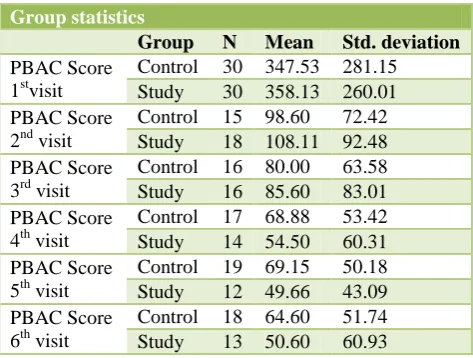
PBAC score in each group has decreased over the period of treatment. In control group mean pretreatment median PBAC score was 347 which reduced to 64 at the end of treatment resulting in 78.67% decrease in menstrual blood loss. In study group mean pretreatment median PBAC score was 358 which reduced to 50 at the end of
treatment resulting in 86.03% decrease in menstrual blood loss.
Table 4: PBAC score at each visit.
Group statistics
Group N Mean Std. deviation
PBAC Score 1stvisit
Control 30 347.53 281.15 Study 30 358.13 260.01 PBAC Score
2nd visit
Control 15 98.60 72.42 Study 18 108.11 92.48 PBAC Score
3rd visit
Control 16 80.00 63.58 Study 16 85.60 83.01 PBAC Score
4th visit
Control 17 68.88 53.42 Study 14 54.50 60.31 PBAC Score
5th visit
Control 19 69.15 50.18 Study 12 49.66 43.09 PBAC Score
6th visit
Control 18 64.60 51.74 Study 13 50.60 60.93
The major side effect of ormeloxifene is amenorrhea. In present study 12 out of 27 patients in control group (44.44%) and 10 out of 25 patients in study group (40%) developed amenorrhea during treatment.
Table 5: Count of Amenorrhea in control and study group.
Count of amenorrhea post-treatment
Control group
Study group
Yes 12 (44.44%) 10 (40%) No 15 (55.55%) 15 (60%) Patient did not follow up 3 5
Total 30 30
In the control group 3 patients were lost to follow up, while in the study group 5 patients were lost to follow up. One patient from study group not responding to treatment was shifted to control group that is 30mg dose was increased to 60mg after 12 weeks. 60mg was given for next 12 weeks. Patient did not respond to 60mg as well and so hysterectomy was done due to failure of treatment and desire of the patient. Intraoperative diagnosis was adenomyosis.
One patient from study group followed up for 2 months and then was lost to follow up. On contacting her telephonically her husband stated that the patient underwent hysterectomy in private hospital. One patient from control group did not respond to treatment after 24 weeks of treatment, after that patient did not follow up so other definitive treatment could not be given.
[image:3.595.52.283.447.509.2]the analysis. Rest one patient from study group was lost to follow up after 2 visits. None of the patients had partial responses. All responders either responded completely or failed completely.
It shows that patients not responding to 30mg of ormeloxifene when shifted to 60mg, still do not respond to ormeloxifene. Thus it can be said that 30 mg can be used as the optimum dose for the treatment of DUB or the 30mg dose is as efficacious as the 60mg dose in these patients.
DISCUSSION
Dysfunctional uterine bleeding (DUB) is abnormal bleeding from the uterus without any organic, systemic and iatrogenic causes diagnosable by clinical methods, and or palpable pelvic pathology or pregnancy. Mainstay of management for DUB is medical treatment and surgical treatment is opted only if medical management fails. Ormeloxifene (SERM) is used in the dose of 60 mg for management of DUB. There are many studies showing effective results of the above dose in cases of DUB.8-14 Only one study was found by literature search which showed efficacy of half the standard dose that is 30 mg in cases of DUB.15 No study has been conducted till date which has compared the efficacy of the two doses of ormeloxifene (60mg vs 30mg) in case of DUB. The main parameters which were studied and reflected the results were rise in hemoglobin levels, decrease in endometrial thickness and reduction in PBAC score.
Our study shows hemoglobin rise of 2gm% and 2.3gm% in control and study group which is comparable with other studies. In a study conducted by Dhananjay et al, rise in hemoglobin concentration was 2.33. (8.26 to 10.59gm%; p<0.001).12 In a study by Biswas et al mean rise in hemoglobin after treatment was 1.31gm% (9.42 to
10.73gm%; p<0.001).11 In a study by Neha et al mean rise in hemoglobin was 2.88gm% (7.52 to 10.4gm%).14 In another study by Neha Agarwal and Saroj Singh mean rise in hemoglobin of 1.82gm% after 6 months of treatment (9.04 to 10.86gm%; p<0.0001).13 In a study by Bhattacharyya Tapan Kumar et al hemoglobin rise of 2.54 gm% seen postreatment (8.49 to 11.03gm%).9
After treatment endometrial thickness has decreased. In control group there is significant decrease in endometrial thickness. Mean pretreatment endometrial thickness was 10.46mm with standard deviation of 4.38mm. Post-treatment endometrial thickness was 7.13mm, with p value 0.0004. In control group mean reduction of endometrial thickness was 3.33mm.
Similarly there is significant decrease in endometrial thickness in study group as well. Mean pretreatment endometrial thickness was 10.09 with standard deviation of 3.59. Post-treatment endometrial thickness was 7.65, with p value of 0.0002. In study group mean reduction in endometrial thickness was 2.44mm (Table 3). Even though it seems that the reduction in endometrial thickness was greater (3.33mm) with 60mg dose than with 30mg dose (endometrial thickness 2.44mm) it was found that the p value was 0.3050 and so this difference was statistically not significant, suggesting that both the dosages were equally effective for treatment of DUB.
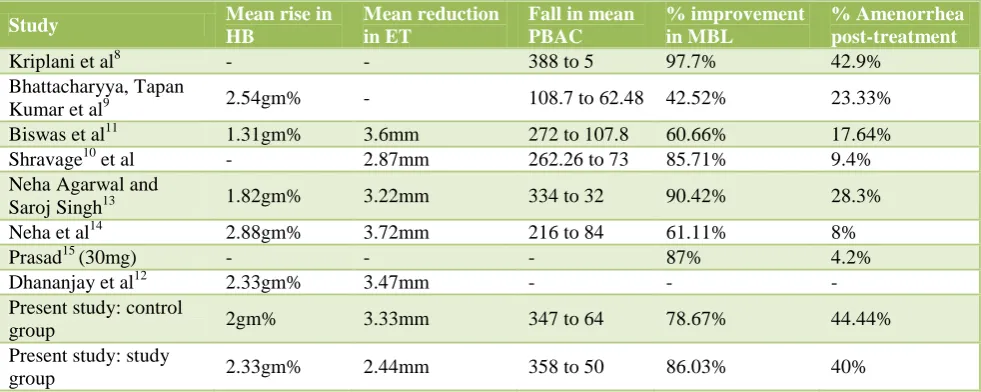
[image:4.595.53.544.563.759.2]Table 6 compares results of all the studies with the control and study group of our present study. It shows the reduction of endometrial thickness after treatment with ormeloxifene. Five out of 7 studies had studied the reduction in endometrial thickness as one of the parameters for efficacy of treatment. Reduction in ET is ranging from 2.87 mm to 3.72 mm for various studies. Present study shows ET reduction of 3.33 mm in control group while 2.44 mm in study group, which is comparable with other studies.
Table 6: Comparison of studies.
Study Mean rise in HB
Mean reduction in ET
Fall in mean PBAC
% improvement in MBL
% Amenorrhea post-treatment
Kriplani et al8 - - 388 to 5 97.7% 42.9% Bhattacharyya, Tapan
Kumar et al9 2.54gm% - 108.7 to 62.48 42.52% 23.33% Biswas et al11 1.31gm% 3.6mm 272 to 107.8 60.66% 17.64% Shravage10 et al - 2.87mm 262.26 to 73 85.71% 9.4% Neha Agarwal and
Saroj Singh13 1.82gm% 3.22mm 334 to 32 90.42% 28.3% Neha et al14 2.88gm% 3.72mm 216 to 84 61.11% 8%
Prasad15 (30mg) - - - 87% 4.2%
Dhananjay et al12 2.33gm% 3.47mm - - - Present study: control
group 2gm% 3.33mm 347 to 64 78.67% 44.44% Present study: study
Studies by Biswas et al, Dhananjay et al, Neha et al, Neha Agarwal and Dr. Saroj Singh et al, and Shravage et al had mean endometrial thickness reduction of 3.6mm (11.4mm to 7.8mm), 3.72mm (12.12mm to 8.4mm), 3.47mm (8.36mm to 4.39mm), 3.22mm (11.35mm to 8.13mm), 2.87mm (7.81mm to 4.94mm) respectively.10-14 Our data shows comparable results for reduction of endometrial thickness in both control group as well as study group and also comparable with other studies. It proves that 30mg of ormeloxifene is as effective as 60mg of ormeloxifene in treatment of DUB when effectiveness of treatment assessed in form of reduction of endometrial thickness. Results of 30mg are comparable within the study and also with the other studies done with dose of 60mg of ormeloxifene.
When PBAC score is compared at each visit between both control and study groups there is no statistically significant difference in reduction of PBAC score in both the groups. These results again show that the dose of ormeloxifene can be reduced from 60 mg to 30 mg without compromising patient response.
Various studies show a percentage reduction in menstrual blood loss ranging from 42.52% to 97.7%. In both our groups the percentage reduction in menstrual blood loss was 78.67% in the control group and 86.03% in the study group. In a study by Biswas et al pretreatment median PBAC score was 272 which decreased to 107.8 resulting in 60.66% reduction in menstrual blood loss.11
In a study by Kriplani et al pretreatment median PBAC score was 388 which reduced to 80 and then to 5 at the end of 2nd and 4th month of treatment.8 Thus percentage reduction in menstrual blood loss was 97.7% at the end of 4th month. In study by Neha Agarwal and Saroj Singh the median pre-treatment PBAC score was 334.13 After 3 months of treatment it was reduced to 111 and after 6 months to 32. Thus there was a 90.42% reduction in the menstrual blood loss after 6 months of therapy.
In a study by Neha et al mean pretreatment PBAC score was 216 which was reduced to 88 at 3rd month of treatment and to 84 at 6th month of treatment.14 Thus there was 61.11% reduction in menstrual blood flow. In a study by Bhattacharyya, Tapan Kumar et al mean PBAC score reduced to 62.48 after treatment from value of 108.7 of pretreatment.42.52% reduction in menstrual blood flow.9
In a study by Shravage et al mean PBAC score before treatment were 262.26 which reduced to 73 at the end of treatment resulting in 85.71% reduction of menstrual blood flow.10
Inference from above discussion is that the results in both the groups of present study are comparable with results of above studies, thus 30mg dose is as effective as 60mg in objective improvement and treatment in cases of DUB.
The major side effect of ormeloxifene is amenorrhea.
Incidence of amenorrhea is different in various studies ranging from 4.2% to 42.9%; in present study we had amenorrhea of 44.44% in control group and 40% in study group. When cost for total duration of treatment calculated for 60 mg dose it was found to be approximately 500 rupees. This cost will be reduced to half that is 250 rupees if 30 mg dose is used. This cost reduction will be without compromising the efficacy of treatment.
CONCLUSION
We did the study to see if the standard dose of 60mg could be reduced to 30mg without compromising its efficacy. The main parameters which were studied and reflected the results were rise in hemoglobin levels, decrease in endometrial thickness and reduction in PBAC score.
Above results show that patients treated with 30mg dose of ormeloxifene showed efficacy of treatment comparable to 60 mg dose and also comparable with most of the studies. Patients receiving 30 mg dose showed significant increase in mean hemoglobin, significant fall in mean endometrial thickness and also significant reduction in menstrual blood loss. Incidence of amenorrhea is less in patients receiving 30mg as compared to 60 mg dose. The patient not responding to 30mg dose when treated with 60 mg dose failed to respond to 60mg as well. If cost calculations are done for both the dosage regimens then we can see that 30 mg dose is more cost effective. Suggesting that, 30 mg can be used as the optimum dose for the treatment of DUB with similar efficacy of treatment and more cost effectiveness.
Funding: No funding sources Conflict of interest: None declared
Ethical approval: The study was approved by the Institutional Ethics Committee
REFERENCES
1. Dutta DC. Text book of Gynaecology, chapter 14,
Dysfunctional Uterine Bleeding, 5th edition,
Kolkata, New Central Book Agency; 2008:183-191.
2. National Health Committee. Guidelines for
management of heavy menstrual bleeding. May 1998, updated in 2001.
3. Hallberg L, Hodgahl AM, Nilsson L, Rybo G.
Menstrual blood loss- a population study Variation at different ages and attempts to define normality. Acta Obstet Gynecol Scand. 1966;45:320.
4. Cole SK, Billewicz WZ, Thomsom AM. Sources of
variation in menstrual blood loss - a population study. Jobstet Gynecol Br Commwlth. 1971;78:933-9.
5. Cohen JM, Gibor Y. Anemia and menstrual blood
6. Coulter A, Mc person K, Vessey M. Do British
women undergo too many or too few
hysterectomies? Soc sci Med. 1988;27:987-94.
7. Irvine GA, Cameron IT. Medical management of
dysfunctional uterine bleeding, Baillieres Best Pract Res Clin Obstet Gynaecol. 1999 Jun;13(2):189-202.
8. Kriplani A, Kulshreshtha V, Agarwal N. Efficacy
and safety of ormeloxifene in management of menorrhagia. A pilot study. The Journal of Obstetrics and Gynecology Research 2009;35(4):746-52.
9. Bhattacharyya TK, Banerji A. Efficacy of a Selective
estrogen receptor modulator: Ormeloxifene in management of Dysfunctional Uterine Bleeding.
South Asian federation of Obstetrics and
gynecology, September-December 2010;2(3):207-11.
10. Shravage J, Mekhala D, Bellad MB, Ganachari MS,
Dhumale HA. Ormeloxifene versus
Medroxyprogesterone Acetate (MPA) in the
treatment of Dysfunctional Uterine Bleeding: A double-blind randomized controlled trial, JSAFOG. 2011;3(1):21-4.
11. Biswas SC, Saha SK, Bag TS, Ghosh RSC, Roy AC,
Kabiraj SP. Ormeloxifene A Selective Estrogen
Receptor Modulator, for treatment of dysfunctional menorrhagia, J Obstet Gynecol. 2004;54(1):56-9.
12. D BS, Nanda SK. The role of Sevista in the
management of Dysfunctional Uterine Bleeding, J Clin Diagn Res. 2013;7(1):132-4.
13. Agarwal N, Singh S. The Efficacy and Safety of
Ormeloxifene in Dysfunctional Uterine Bleeding, IOSR Journal of Pharmacy and Biological Sciences (IOSR-JPBS) e-ISSN: 2278-3008. 2013;5(5):18-21.
14. Agarwal N, Singh S, Singh S, Agarwal M, Manocha
P. Comparative evaluation of the efficacy and safety of ormeloxifene and norethisterone in dysfunctional uterine bleeding. Int J Reprod Contracept Obstet Gynecol. 2013;2(2):194-8.
15. Centchroman PS. A novel drug for DUB. J. Obstet.
Gynecol India. 2000;50:77-9.