Volume 8, No. 3, March – April 2017
International Journal of Advanced Research in Computer Science RESEARCH PAPER
Available Online at www.ijarcs.info
ISSN No. 0976-5697
Implementation of Multilevel Thresholding on Image using Firefly Algorithm
K.Vennila Dept. of ECE,
Annamalai University, Annamalainagar, Tamil Nadu, India-608002
K. Thamizhmaran Dept. of ECE,
Annamalai University, Annamalainagar Tamilnadu, India-608002
Abstract: Multilevel image segmentation involves large computation and time-consuming. The firefly algorithm (FA) has been applied to emerging the efficiency of multilevel image segmentation. Threshold values are chosen from the intensity values of the image ranges from 0 to 255. In this work, OTSU based firefly algorithm is applied for the gray scale images. OTSU’S between-class variance function is maximized to obtain optimal threshold level for gray scale images. The existence Darwinian Particle Swarm Optimization (DPSO) gives few numbers of iterations and small swarm size. In FA, the performance assessment of the proposed algorithm is carried using prevailing parameters such as Objective function, Standard deviation, Peak-to-Signal ratio (PSNR) and best cost value and search time of CPU. The experimental results reveal that the proposed method can efficiently segment multilevel images and obtain better performance than DPSO.
Keywords: OTSU, Firefly algorithm, Darwinian Particle Swarm Optimization, Peak-to-Signal ratio.
1. INTRODUCTION
Digital images can be expressed as two dimensional matrix or two variables function. It consists of discrete points called pixels. In color images, each pixel has three values: red, green and blue. Each value has a range between 0 and L-1, where L is the number of levels of precision. On the other hand, gray level images are composed of pixels where each pixels has only one value between 0 and L-1 called gray level. It would be simple and more efficient to deal with gray level images than with the color images for many image processing problems. Applying image processing algorithms, color images are often converted to gray level images. The most widely adopted gray level is 256 (i.e. the value of each pixel is between 0 and 255).
Multilevel thresholding separates the pixels into several groups. Within a specified range, the pixels of the gray levels have same group. However, the problem gets more complex when the segmentation is achieved with greater details by employing multilevel thresholding. Then the image segmentation problem becomes a multiclass classification problem where pixels having gray levels within a specified range are grouped into one class. Usually it is not simple to determine exact locations of distinct valleys in a multimodal histogram of an image, that can segment the image efficiently and hence the problem of multilevel thresholding is regarded as an important area of research interest among the research communities worldwide [1-3].
Multi-thresholding approach generalizes the image thresholding by finding multiple thresholds which aim to separate multiple objects [4]. In general, for segmenting an
image that has ‘n’ objects and background ‘n’ threshold can be used. To find the thresholds that best separate objects, it is easier to deal with statistics of the image instead of the image itself. Image histogram statistics is one dimensional representation that shows the frequency of each gray level in the image. It is computed by counting number of pixels that have the same gray level.
Converting color images into gray level images and then using the one dimensional histogram of the image makes thresholding-based segmentation process an easy and computationally efficient task, which can be used in many real time applications. There are many methods to find thresholds from image histogram. In the case of one threshold, we can try all the values between 0 and L-1 and then we choose the values that give the best segmentation to use it as a threshold [5]. However, for multiple thresholds segmentation, trying all the possible combination needs L ×( L-1) ×….×( L-t+1) trails where t is the number of thresholds. In natural images, one can see that same objects have similar pixels and different object has unsimilar pixels, this suggest that the measure that will be taken into consideration is the inter-class variance and intra-class variance. The computational complexity and the existence of goodness measure in the case of multiple thresholds motivated the use of an efficient search algorithm. 2. BACKROUND
economic dispatch problems with valve loading effect Yang, et al (2012). An efficient method for segmentation of images based on fractional calculus and natural selection was done by Ghasmi, et al (2012). Vector quantization using the firefly algorithm for image compression was done by Horng et al (2012). A novel hybrid approach using wavelet firefly algorithm and fuzzy ARTMAP for day-ahead electricity price forecasting was done by Mandal, et al (2013). Firefly inspired algorithm for discrete optimization problems an application to manufacturing cell formation was done by Sayadi, et al (2013). Automatic detection of common surface defects on oranges using combined lighting transform and image ratio methods was done by Rao et al (2013). An adaptive modified firefly optimization algorithm based on hong's point estimate method to optimal operation management in a microgrid with consideration of uncertainties was done by Mohammadi, et al (2013).Diversity enhanced particle swarm optimization with
neighborhood search was done by Wang et
al,(2013).Thresholded and optimized histogram equalization for contrast enhancement of images was done by Shanmugavadivu, et al(2014).Cuckoo search and firefly algorithm applied to multilevel image thresholding was done
by Brajevic, and Tuba (2014). Segmentation of SAR images
using improved artificial bee colony algorithm and neutrosophic set was done by Hanbay and Talu (2014). Artificial bee colony optimizer with bee-to-bee communication and multipopulation coevolution for multilevel threshold image segmentation was done by Zhao et al (2015).
3. EXISTING SYSTEM
A general problem with optimization algorithms is that of becoming trapped in a local optimization. A particular algorithm may work well on one problem but may fail on another problem. If an algorithm could be designed to adapt to the fitness function adjusting self to the fitness landscape, a more robust algorithm with wider applicability, without a need for problem specific engineering would result. Strategies for avoiding local optima include stretching of parspolous and other convexification strategies. Nature points to a way that may help circumvent local optima. They propose a strategy based on natural selection in which, when a search in that is simply discarded and another area is searched instead. This is the type of search designed and analyzed.
In a simple implementation of PSO, a single swarm of test solution is utilized. To implement nature selection with a single swarm, the algorithm must detect when stagnation has occurred. Since a single swarm is unable to differentiate between a global optimum and a local optimum it cannot simply be extended to model natural selection. One could “time-out” the optimization and restart the algorithm or delete information about the current global optimum in hopes that the swarm will not return to it. At the end of each swarm update, the current fitness of the particles is used to order the particles.
The top halves of the particles are then duplicated and replace the positions and velocities of the bottom half of the particles. The personal bests of the particles are not changed. The author is able to achieve better convergence on some test problems. In search of a better model of natural selection using the PSO algorithm, they formulate what we call a Darwinian PSO, in which many swarms of test solution may exist at any time. Each swarm individually performs just like an ordinary PSO algorithm with some rules governing the collection of swarms that are design to simulate natural selection. The selection process implemented is a selection of swarms within a constantly changing collection of swarms.
The basic assumptions made to implement Darwinian PSO are:
• The longer a swarm lives, the more chance it has of processing offspring. This is achieved by giving each swarm a constant, small chance of spawning a new swarm.
• A swarm will have its life-time extended (be rewarded) by finding a more fit state.
• A swarm will have its life-time reduced (be punished) for failing to find a more fit state. These simple ideas implement an algorithm imitating natural selection. In nature, individuals or groups that posses a favorable adaptation are more likely to thrive and procreate. The favorable adaptation is assumed to prolong the lifetime of the individual. Unfavorable adaptations shorten the lifespan of an individual or group.
4. PROBLEM DESCRIPTION
5. PROPOSED SCHEME
The firefly algorithm is based on three main principles: 1. All fireflies are unisex, implying that all the elements
of a population can attract each other.
2. The attractiveness between fireflies is proportional to their brightness. The firefly with less bright will move towards the brighter one. If no one is brighter than a particular firefly, it moves randomly. Attractiveness is proportional to the brightness which decreases with increasing distance between fireflies.
3. The brightness or light intensity of a firefly is related with the type of function to be optimized. In practice, the brightness of each firefly can be directly proportional to the value of the objective function.
This algorithm is based on two key ideas: the light intensity emitted and the degree of attractiveness that is generated between two fireflies [9, 10].
The light intensity of firefly i, Ii depends on the intensity I0
light emitted by firefly i and the distance r between firefly i and j. In, the light intensity Ii varies with the distance rij
monotonically and exponentially . That is
=
(1)
Where γ is the light absorption coefficient. In theory, γ ϵ[0;+α [, but in practice γ can be taken as 1. Since the attractiveness βij of the firefly i depends on the light intensity seen by an
adjacent firefly j and its distance rij , then the attractiveness βij
is given by:
(2)
where β0 is the attractiveness at rij=0.
In the original method, the distance rij between any two
fireflies i e j ,at χi and χj , could be given by the Cartesian
distance:
= - 2 (3)
The movement of a firefly i towards another brightest firefly j is given by:
= + ( - ) + (4)
where ϵij is a random parameter generated by a uniform
distribution and α is a parameter of scale.
∑
=
=
tki k
i k
ip
0
ω
µ
In this work, the light intensity of a firefly i ,Iiis determined by its objective function value .
The pseudo code of the Firefly Algorithm for bound constrained optimization problems can be summarized as follows:
Initialize Population of m fireflies χi, i=1,2,…….m
Compute Light Intensity f(χi),for all i=1,2………..m
While (stopping criteria is not met) do for i= 1 to m
for j= 1 to m
if f(χi) > f( χj) then
Move firefly i towards j using (4) end if
end for end for
Update Light intensity f(χi) for all i=1,2,……….m
Rank the fireflies and find the current best end while
With the purpose of separating multiple objects from background, multilevel image segmentation is formulated. Otsu thresholding is a classical and efficient algorithm for image segmentation. In consequence, Otsu thresholding is selected to solve image segmentation problem in this work. The core idea of the Otsu thresholding algorithm is searching a threshold to maximize the between-class variance.
Suppose that there are 𝑁𝑁 pixels with 𝐿𝐿 gray levels in an image; the probability distribution of the gray level 𝑖𝑖 (𝑖𝑖 =0, . . . , 𝐿𝐿 − 1) can be defined by 𝑝𝑝𝑖𝑖=hi /𝑁𝑁, where Σi=0 L-1 𝑝𝑝𝑖𝑖= 1and h𝑖𝑖
represents the number of pixels with the specific gray level 𝑖𝑖. Hence, the mean value of the total image is 𝜇𝜇T=Σ i=0 L-1 𝑖𝑖𝑝𝑝𝑖𝑖. Let
a threshold 𝑡𝑡 partition the image into two classes: class 𝐶𝐶1
including the pixels 𝑖𝑖 ≤ 𝑡𝑡 and class 𝐶𝐶2 including the pixels 𝑖𝑖 > 𝑡𝑡
[11]. Define the probability of 𝐶𝐶1 and 𝐶𝐶2 to be 𝜔𝜔1= Σi=0t 𝑝𝑝𝑖𝑖
and 𝜔𝜔2= Σ i=t+1 L-1 𝑝𝑝𝑖𝑖. Then, mean values of the two classes can
be calculated as,
∑
=
=
tki k
i k
ip
0
ω
µ
,,
0∑
=
=
tki i
k
p
ω
In this situation, the maximum variance between two classes can be defined as
2
+ 2
To solve the multilevel Otsu thresholding problem, an image needs to be classified into 𝑗𝑗 classes (𝐶𝐶1, 𝐶𝐶2, . . . , 𝐶𝐶j) with the
set of thresholds (𝑡𝑡1, 𝑡𝑡2, . . . , 𝑡𝑡j-1). In a similar way, the
maximum between-class variance with multilevel thresholds can be defined as
2
1 2
)
(
k Tk j
k
mul
ω
µ
µ
σ
=
∑
−
=
∑
+ = −
=
kk
t
t
i k
i k
ip
1
1
ω
µ
,∑
− −+=
=
11 1
k
k
t
t i
i
k
p
ω
, 1 < k < j,
∑
− −+=
=
11 1
L
k
t
t
i k
i k
ip
ω
µ
,
11
1
∑
−+ = −
=
Lt i
i k
k
p
ω
k=j,In other words, the problem of multilevel otsu thresholding can be understand as searching a set of thresholds ( t1,t2,………t j-1) that can maximize the between-class variance. The
optimization problem is defined as
5. SIMULATION RESULTS
The Proposed digital image segmentation using Firefly algorithm is developed using MATLAB with input image. The results obtained by the proposed method are compared with the Darwinian Particle Swarm Optimization. The entire images are resized to dimension of (256 x 256). The quality metrics are evaluated for different input images such as PSNR, Threshold, std Val, Best cost, µ value and time (sec).
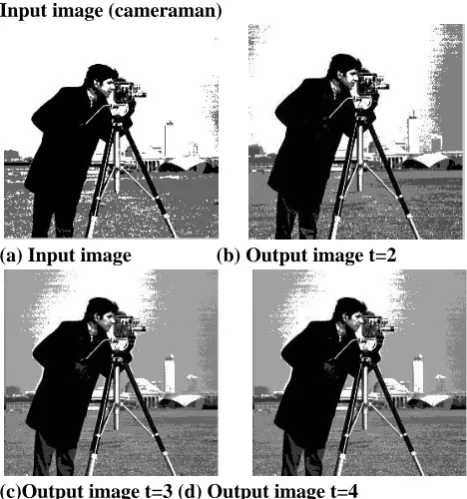
The input cameraman image Fig.1 shows that the threshold values for the output image t =2, 3, 4. The tabular column value represents that the different threshold values, std val, PSNR, Best cost, µ value and time (sec) for different t values
.Fig. 2 seems to be comparison of comparison of different output cameraman image with the PSNR value. The comparison of computational time in (sec) for various output cameraman image for different t-value [12, 13].
Input image (cameraman)
(a) Input image (b) Output image t=2
[image:4.595.307.541.121.371.2]
(c)Output image t=3 (d) Output image t=4
Fig. 1 Input and output images for various threshold level t=2, 3 and 4
[image:4.595.31.567.545.661.2](a) Input image, (b) Output image t=2, (c) Output image t=3, (d) Output image t=4
Table 1 Different threshold, Std Val, PSNR, Best cost, μ value and time(s) for different t values for cameraman image
Input image T Threshold Std val PSNR Best cost μ value Time (s)
Cameraman 2 70,144 0.0345 11.5392 3650.335 3.6503e+03 2.793
3 59,119,156 1.1866 13.0399 3725.715 3.7256e+03 2.923
Fig. 2 Comparison of different output cameraman image with SNR value
[image:5.595.40.291.79.227.2]
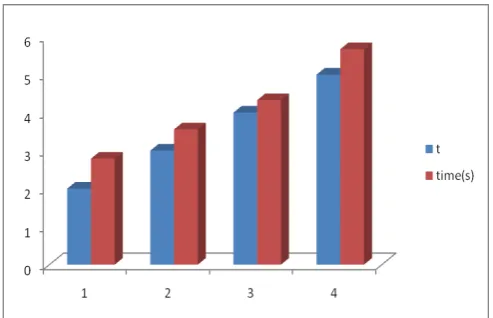
Fig. 3 Comparison of computational time in (sec) for various output cameraman image for different t – value
From Table1 The different threshold, std val, PSNR, Best cost, µ value and time in (sec) for different t values for cameraman image shows that the performance is better than DPSO. From Fig2.The bar graph showing that the increasing t level makes the increasing in PSNR values showing that the better quality of the segmented image and from Fig3. The bar graph showing that the increasing t value makes the computational time increases.so,that the thresholding levels is increasing to make the timing increases[14,15].
6. CONCLUSION
A multilevel image thresholding approach based on the proposed firefly algorithm.Otsu based multilevel thresholding between-class variance function is maximized to obtain optimal optimal threshold level for grayscale images. cameraman images is used to verify the proposed method. The performance parameters such as objective function, Standard deviation, PSNR, Bestcost value and search time of CPU. The experimental results reveal that the proposed method can efficiently segment multilevel images and obtain better performance than DPSO.
FUTURE WORK
The Firefly algorithm has to be applicable for real-time processing. To get better PSNR value and to implement for Multi-objective optimization functions.
ACKNOWLEDGEMENTS
The authors thank the authorities of Annamalai University for providing the necessary facilities in order to accomplish this piece of work.
REFERENCES
[1] Sathya, P. D., & Kayalvizhi, R. (2011). Optimal segmentation of brain MRI based on adaptive bacterial foraging algorithm. Neurocomputing, Vol. 74, No. 14, 2299-2313.
[2] Cuevas, et al (2012). Multithreshold segmentation based on artificial immune systems mathematical Problems in Engineering, 2012.
[3]Yang, X. S., Hosseini, S. S. S., & Gandomi, A. H. (2012). Firefly algorithm for solving non-convex economic dispatch problems with valve loading effect.Applied soft computing, 12(3), 1180-1186.
[4]Ghamisi, P., Couceiro, M. S., Benediktsson, J. A., & Ferreira, N. M. (2012). An efficient method for segmentation of images based on fractional calculus and natural selection. Expert Systems with Applications, 39(16), 12407-12417.
[5]Horng, M. H. (2012). Vector quantization using the firefly algorithm for image compression. Expert Systems with Applications, 39(1), 1078-1091.
[6] Li, et al (2013). Automatic detection of common surface defects on oranges using combined lighting transform and image ratio methods, Postharvest biology and technology, Vol. 82, pp. 59-69.
[7] Mandal, et al (2013). A novel hybrid approach using wavelet, firefly algorithm, and fuzzy ARTMAP for day-ahead electricity price forecasting, IEEE Transactions on Power Systems, Vol. 28, No. 2, pp. 1041-1051.
[8] Sayadi, et al (2013). Firefly-inspired algorithm for discrete optimization problems: an application to manufacturing cell formation. Journal of Manufacturing Systems, 32(1), 78-84. [9] Mohammadi, et al (2013). An Adaptive Modified Firefly
Optimisation Algorithm based on Hong's Point Estimate Method to optimal operation management in a microgrid with consideration of uncertainties. Energy, Vol. 51, pp. 339-348. [10]Huang, S. J., Liu, X. Z., Su, W. F., & Yang, S. H. (2013).
Application of hybrid firefly algorithm for sheath loss reduction of underground transmission systems. IEEE transactions on power delivery, 28(4), 2085-2092.
[11]Shanmugavadivu, P., & Balasubramanian, K. (2014). Thresholded and optimized histogram equalization for contrast enhancement of images.Computers & Electrical Engineering, 40(3), 757-768.
[12] Wang, H., Sun, H., Li, C., Rahnamayan, S., & Pan, J. S. (2013). Diversity enhanced particle swarm optimization with neighborhood search. Information Sciences, 223, 119-135.
[image:5.595.35.282.278.437.2]search and firefly algorithm, Springer international publishing. pp. 115-139.
[14] Hanbay, & Talu, (2014). Segmentation of SAR images using improved artificial bee colony algorithm and neutrosophic set. Applied Soft Computing, Vol. 21, pp. 433-443.
[15] Li, et al (2015). Artificial bee colony optimizer with bee-to-bee communication and multipopulation coevolution for multilevel threshold image segmentation, Mathematical problems in engineering, 2015.
Author’s Profile
Ms. K. Vennila received his B.E Degree in Electronics and
communication engineering from Annamalai University,
Annamalainagar, Tamilnadu, india. Currently she is pursuing now
Master degree in communication systems from Annamalai University, Annamalainagar and Tamilnadu, India. Her research interested includes Image Processing, Wireless Networks.