Volume 7, No. 4, July-August 2016
International Journal of Advanced Research in Computer Science
RESEARCH PAPER
Available Online at www.ijarcs.info
Facial Expression Recognition based on Local Binary Patterns (LBP)
Dr. Sukhjeet Kaur Ranade
Associate Professor,
Department of Computer Science, Punjabi University Patiala-147002, India
Amanpreet Kaur Mangat
Student,
Department of Computer Science, Punjabi University Patiala-147002, India
Abstract: A tough however exciting challenge is that the analysis of expressions of face be done automatically. Deriving effective facial representative features from face pictures being a significant step towards flourishing expression recognition is concentrated throughout this paper. Local features called Local Binary Patterns (LBP) are enforced for empirical analysis of face expression recognition. In depth experiments prove that this feature extraction is effective. The Uniform-LBP is employed and therefore the high performance is achieved.
Keywords: Facial Expression Recognition, Local Binary Patterns, Neural Network
I. INTRODUCTION
Expressions delineated on a one’s face remains an awfully powerful, natural and fast mean for us as individuals to speak out our feelings and emotions. So this potential capability results in myriad applications, such as:
Human-computer interaction (HCI)
Retrieving image and video knowledge and understanding those images
Artificially Intelligent animated faces
Interactive video
Security
Emotion analysis
Medical help and Behavioral science etc. [7] [10]
Automatic face expression recognition (FER) accounted with appropriate accuracy will facilitate within the development of robots and machines that are very like humans and it’ll move machine generation a step closer to humans. Although humans can acknowledge each other’s expressions at once and without much needed effort, however reliable and correct expression recognition by intelligent automaton continues to be a challenge.
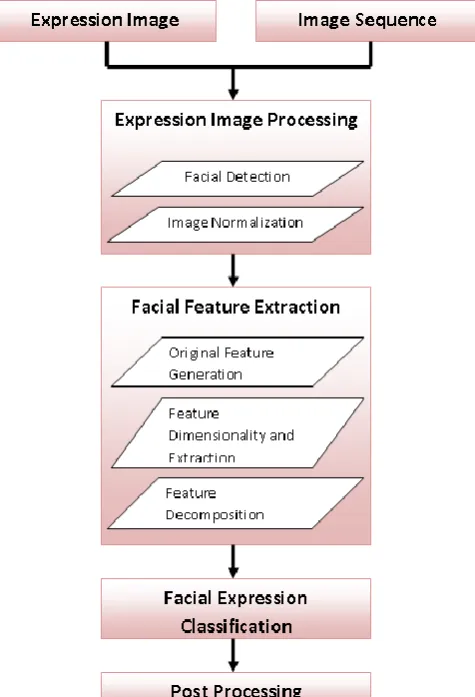
To date, many FER strategies have been planned. The essential steps of the face expression recognition procedure includes: first of all the acquisition of the face expression pictures, second the detection of faces for the face expression feature extraction and eventually comes the recognition of face expression. The steps are shown in Figure 1.
Recognition of facial expressions is done to perceive the distinction among emotions like sadness (disappointment), happiness, disgust, surprise, fear and anger. These expressions will vary in each individual. Mehrabian [2] indicated that spoken words (7%), voice (38%) and facial expressions (55%) are accustomed to convey messages by
humans. Extraction of face expression is the core step of derivation of expression recognition. The two necessary forms of approaches to extract features vectors are: appearance based strategies and geometric based strategies. In this paper, we introduce Local Binary Patterns (LBP) that is an appearance-based methodology for recognition of face expression. At the earliest LBP was used for texture analysis [4, 5] and Ahonen et al. [16] conferred LBP based strategies for detection and recognition of face and we are enhancing it further to acknowledge facial expressions person independent. My motivation is that face images can be seen as a composition of smaller patterns on that LBP can be applied.
Figure 1: Organizational Model (FER)
II. PREVIOUS WORK
The face expression analysis has been a vigorous analysis topic for behavioural scientists since the work of Darwin in 1872 [4]. Suwa et al. [15] bestowed an early endeavor to efficaciously analyze facial expressions. After the moment, a lot of progress has been done.
Automatic face expression recognition involves 2 important aspects: facial illustration and classifier style. Facial illustration is to derive a group of features from original face pictures to effectively represent faces. The optimum features ought to minimize within-class variations of expressions whereas maximize between class differences. If inappropriate features are employed, even the most effective classifier might fail to attain correct recognition.
Ekman and Friesen [5] represent six basic face expressions (emotions): Happy, Surprise, Disgust, Sad, Angry, and Fear. As per Meharabian [2], 55% communicative cues can be decided by facial expression; thence recognition of facial expressions became a serious modality.
A. Colmenarez et al. [1] introduced that faces sculpturesque as a group of regions containing sub-groups of face features. Model was bolstered upon the belief that the facial features can be accurately located. The looks of every facial feature is provided by the image sub-window set around its position and thence the feature position is normalized with reference to the outer eye corners.
X. Fenget al. [19] projected a completely unique approach to acknowledge facial expressions from static pictures. At the very first, LBP are accustomed to expeditiously represent the facial images requiring linear programming methodology to adopt the classification of 7 face expressions: neutral, happy, sad, fear, anger, disgust, surprise. 21 classifiers are made supported by linear programming technique and classification is enforced with a binary tree tournament theme.
T. Ahonen et al. [16] used template matching to execute face expression acknowledgement employing the LBP-based facial representation: a template is made for each Completely different techniques have been projected to classify facial expressions, akin to Neural Network, Support Vector Machine (SVM) and rule-based classifiers.
Caifeng Shanet al. [3] gave a comprehensive study. In that they judge LBP features for person-independent face expression recognition. Donato et al. [7] explored exclusively different methodology to present face images that embody PCA, ICA, Local Feature Analysis (LFA), LDA and local schemes akin to Gabor-wavelet representation and PCA. Top notch execution was obtained employing Gabor-wavelet representation and ICA.
The LBP operator produces 2P completely different output values, equivalent to the 2P total different binary patterns which can be fashioned by the P pixels within the neighbor set. It’s been shown that some bound bins contain additional information than others [17]. Therefore, it’s attainable to use solely a subset of the 2P Local Binary Patterns to explain the texture of pictures. Ojala et al. [17] referred to these basic patterns as uniform patterns. It’s ascertained that uniform pattern scores for c. 90% of all patterns within the (8, 1) neighborhood and for c. 70% within the (16, 2) neighborhood in texture images [17].
Pantic and Rothkrantz adopted rule-based reasoning to acknowledge action units and their combination [11]. To use the temporal behaviors of facial expressions, completely different techniques were acquainted for face expression recognition in image sequences. There have been many tries to trace and acknowledge facial expressions over time supported by optical flow analysis.
M. Pantic et al. [11] presented Local binary Patterns, that powerful entails texture description. Most vital properties of LBPs are its lustiness to alter in illumination and procedural
simplicity. A face expression recognition system wants a classifier which may perform well to classify 6 basic facial
expressions. The powerful classifiers those are typically applied in face expression recognition systems are: Multi Layer Perceptron (MLP3), NN, SVM etc.
III. OVERVIEW OF THE PROPOSED
APPROACH
This paper explores LBP approach of extraction of features for recognition of expression. The input is partitioned into vector that retains location and structural information of facial expression and dimensionality is reduced by employing PCA. Thus obtained feature vector is rendered to train our neural network based classification method.
The remainder of the paper is structured as follows: Section IV and Section V illustrate LBP methodology that is to be applied on image domain given in Section VI. Expressions’ recognition utilizing neural network for pattern recognition and the thence experimental results are followed up in Section VII and Section VIII.
IV. LOCAL BINARY PATTERNS
The goal of facial expression recognition is to see the emotional state of the face, let’s say, happy, sad, fear, anger, surprise, neutral, and disgust, notwithstanding the identity of the face.
The original LBP operator was introduced by Ojala et al. [17], and was proved a robust means of texture description. Several features such as gray-scale invariance and no normalization in a neighbor window make it favorable to be used in texture recognition. The true LBP operator points the pixels of a picture with decimal numbers, that are known as LBPs or LBP codes that inscribe the native structure
around every single pixel. It goes forward as illustrated in Figure 3. Every pixel is compared with its eight neighbours in a 3×3 neighborhood by subtracting the core pixel value. Within the result, negative values are staged as 0 and therefore the others with 1. For every given pixel, a binary number is obtained by merging of these binary values in a right-handed direction that starts from the one amongst its top-left neighbor corner value. The equivalent notation in decimal of the generated binary set is then put-upon as label for the given pixel and therefore the 256-bin histogram of the LBP labels computed over vicinity is employed as a texture-descriptor. Thus the inferred binary numbers (called Local Binary Patterns or LBP codes) systematize local primitives together with different kinds of curved edges, spots, flat areas, etc (as shown in Figure 2.).
Figure 2: Samples of textures which may be acknowledged by LBP (white circles represent 1 and black circles 0) [30]
Figure 4: Extended LBP: circular (8, 1), (12, 1.5), (16, 2) neighbourhood respectively
One limitation of the fundamental LBP operator is that they’re unable to capture some dominant features. So as to handle with the texture at completely different scales, hence the operator needed to be worked upon and thus emerged the use of the neighbourhoods of various sizes. A local neighbourhood is outlined as a group of sampling points equally spaced on a circle, that is focused at inside the pixels are interpolated utilizing bilinear interpolation, therefore allowing for any radius and any variety of sampling points within the neighbourhood.
See Figure 4. For samples of the extended LBP operator, where the notation (P, R) denotes a vicinity of P within which the points are equally spaced on a circle of radius of R that forge a circularly symmetric neighbor set.
The LBP operator LBPP, R produces 2P completely different
output values, resembling the 2P totally different binary
patterns that may be fashioned by the P pixels within the neighbor set. It’s been shown that bound bins contain a lot
of info than others [17]. Therefore, it’s certain to use solely a subset of the 2P Local Binary Patterns to explain the
texture of images. Ojala et al. [17] presented these basic patterns as uniform patterns thus a pattern is named uniform if it contains at the most 2 bitwise transitions from 0 to 1 or the other way around once the binary string is taken into account circular. It’s discovered that uniform patterns account for nearly 90% of all patterns within the (8, 1) neighborhood and for circa 70% in the (16, 2) neighborhood within texture images. Accumulating the patterns that have over 2 transitions into a single bin yields an LBP operator, denoted LBPu2P, R with lower than 2P bins. To illustrate, the
amount of labels for a neighbourhood of eight sampling points is 256 for the standard LBP but 59 for LBPu2.
Hence after tagging an image with the enhanced LBP operator, with following equation it’s histogram i.e. of the tagged image fl(x, y) may be outlined as
H
i= ∑
x, yI (f
l(x, y) = i),
eq1.
Where i has values from zero to n-1 and n is the range of different labels made by the LBP operator and
I (A) =
1 A is true0 A is false
For a gray scale image I(x, y), assume that the gray level at an arbitrary location (x, y) be given as gc.
g
c=
I
(
x
,
y
).
For an evenly space circular neighborhood with P sampling points and R radius around the center pixel (x, y), the gray value of pixel at pthsampling point is g
p, given by
g
p=
I
(
x
p,
y
p),
p = 0. . . P – 1 eq2.And the coordinate values of the sampling point is outlined as binary operator is computed by applying a binomial factor to every S (gp− gc). It’s calculated as
LBP
P, R(
x
c,
y
c) =
∑
𝑃−1𝑝=0S
(g
p-g
c) 2
p eq6.The main motivation behind using LBP patterns is its robustness to change in illumination and computational simplicity.
Figure 5: LBP (8, 1) transform
In this work we take advantage of uniform patterns instead of basic LBP patterns. A uniformity criterion of a local binary pattern U is the number of bit-wise transitions from 0 to 1 for a circular bit pattern. The uniformity measure of U
transition and patterns 00001111 falls under category of one transition and patterns 00111000 falls under two transition. The total number of labels in uniform LBPu2 (8, 2) is 59 (58 labels for uniform patterns with at most transition 2 and rest are assigned to a single label, totally 59 labels).
The histogram of the LBP image LBP(x, y) can be computed as
Hk= ∑x, yS (LBP(x, y) = k), k = 0. . . n – 1 eq7.
Where n range up to exclusively different labels produced by LBP operator. In this case n is equal to 59 for uniform LBP.
Figure 6: An example of sub-block classification technique using concatenated LBPs obtained from each sub-block
V. SUB-BLOCK BASED LBP FEATURES
EXTRACTION
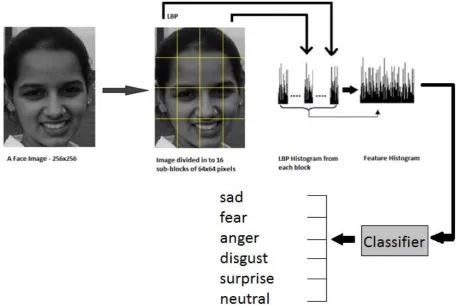
When LBP histogram of dimension 59 is extracted from the complete face image, the features encodes solely the presence of micro patterns. The patterns contain no data concerning it’s location. Face image of size 256 × 256 is equally sub-divided into blocks of size 64 × 64, totally 16 sub-blocks. Each sub-block (R1. . . R15) contributes uniform
LBP feature vector of dimension 59. Once all the feature vectors square measure concatenated so as, there is a tendency to get a replacement feature vector of dimension 944, that preserves location and shape data of the facial region.
The concatenated histogram can be outlined as
Where k = 0. . . 58, j = 0. . . 15.
VI. IMAGE DATABASE
We have considered each 6-class archetypical expression recognition as well as 7-class expression recognition by adding the neutral expression.
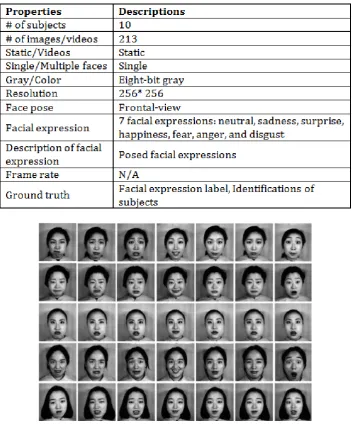
The data supply comes from Japanese Female Facial Expression (JAFFE) database that is an open face image database. It contains 10 women's expressions, including individuals KA, KL, KM, KR, MK, NA, NM, TM, UY and YM. Everybody has given 7 different expressions as AN, DI, FE, HA, NE, SA and SU. Every expression has 3 or 4 samples and therefore the total range is 213. Every image has been rated by 60 subjects on scale of 6.
Purpose: This database is primarily accustomed for acknowledgement of face expression
Table I. Properties of JAFFE Database
Figure 7: Shows some sample pictures from the JAFFE database.
VII. EXPRESSIONS RECOGNITION
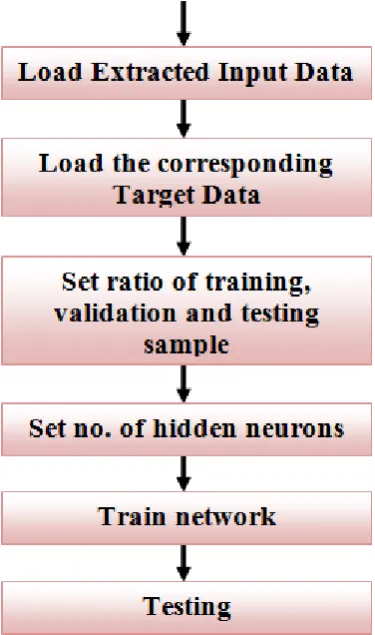
On the input image sub-divided into sixteen equal non-overlapping blocks with every block size 64 × 64 pixels, LBP filter (P,R)-(8,1) is applied on every block and corresponding LBP features are concatenated so as to obtain 944 dimensional feature vector. The feature vector after spatiality reduction is fed as input to the neural network of size 20×7. Since I’d like seven distinct categories as output classes (Happy, Sad, Surprise, Anger, Disgust, Fear and Neutral), we set the specified output to be either 1 or 0 format. That means if the specified output is happy expression, we set it as {1, 0, 0, 0, 0, 0, 0}. 1 represents true state of the class prevalence and 0 represents the false state. Subsequent to extraction, classification step follows. For this a two-layer feed-forward network utilizing sigmoid function each in the hidden layer and the output layer, is employed to distinguish vectors. Thus we employed a neural network to classify inputs into a group of target classes.After loading the extracted classification information, a network is created: The network has 7 output neurons, because there are 7 categories associated with each input vector. Each output neuron represents a category. Once an input vector of the apt class is applied to the network, the corresponding neuron should result a 1 and the alternative neurons ought to output a 0. Network therefore created is trained to classify the inputs keeping with the targets by arbitrarily dividing the input vectors and target vectors into three sets: coaching, validation and testing.
Coaching (Training): These are given to the network throughout coaching and therefore the network is adjusted in keeping with its error.
Validation: These are employed for network generalization and to halt coaching once generalization stops up.
Figure 8: Classification Model
VIII. EXPERIMENTAL RESULTS
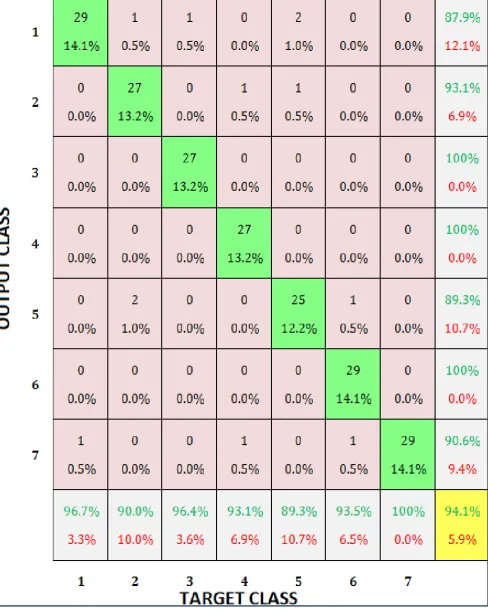
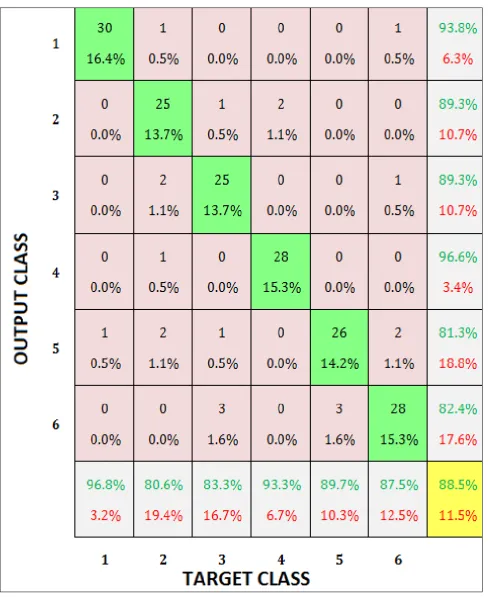
Among the provided data, 70% of the data is taken for coaching, 15% for validation and remaining 15% is employed for testing. LBP features extracted are of dimensions 944. The features are passed through PCA to get rid of the unessential or redundant information. The reduced LBP features are used for coaching neural network. Table II shows the confusion matrix for all the seven basic emotions: (happiness, sadness, disgusted, angry, surprised, fear, Neutral). It’s discovered that the average recognition accuracy obtained during this case is 82.08%. Table III shows the confusion matrix for six emotions except
neutrality and highest resultant accuracy of 6-class is 88.5% using original features and average accuracy being 80.66%. However after reduction it shows a dip with average accuracy being near 70.7%.
Table III. Confusion matrix using LBP - highest resultant accuracy 88.5% (6 class features)
IX. CONCLUSIONS
The paper presents a novel pattern recognition neural network based facial expression recognition system utilizing solely 59 dimensional uniform LBP features extracted from facial image. 16 non-overlapping sub-blocks, each of size 64 × 64 is placed over the facial region. 944 dimensional LBP feature vector is obtained after sequentially concatenating LBP vectors extracted from the every sub-block and so after
X. REFERENCE
[1]. Colmenarez, B. Frey, T.S. Huang, “A Probabilistic
Framework for Embedded Face and Facial Expression Recoginition” , IEEE 1999.
[2]. Mehrabian, “Communication without words”, psychology
today, Vol. 2, pp. 53-56, 1968.
[3]. Caifeng Shan, Shaogang Gong , Peter W. McOwan, “Facial
expression recognition based on Local Binary Patterns: A comprehensive study” Elsevier - Image and Vision
Expression Recognition Using a State-Based Model of
Spatially-Localised Facial Dynamics", Fifth IEEE
International Conference Automatic Face and Gesture Recognition, pp. 106-111, 2002.
[7]. G. Donato, M.S. Bartlett, J.C. Hager, P. Ekman, T.J.
Sejnowski, "Classifying Facial Actions", IEEE Transactions Pattern Analysis and Machine Intelligence, Vol. 21, No. 10, pp. 974-989, 1999.
[8]. H. Hong, H. Neven, C. von der Malsburg, “Online Facial
Expression Recognition Based on Personalized Galleries”, International Conference Automatic Face and Gesture Recognition, pp. 354-359, 1998.
I. Cohen, N. Sebe, A. Garg, L. Chen, T.S. Huang, “Facial
expression recognition from video sequences: temporal and static modeling”, Computer Vision and Image Understanding 91, pp. 160–187,2003.
[9]. I.A. Essa, A.P. Pentland, “Coding, Analysis, Interpretation,
and Recognition of Facial Expressions”, IEEE Transactions Pattern Analysis and Machine Intelligence, Vol. 19, No. 7, pp. 757-763, 1997.
[10]. M. Pantic, L.J.M. Rothkrantz, “Facial action recognition for
facial expression analysis from static face images”, IEEE Transactions on Systems, Man, and Cybernetics 34 (3) pp.1449–1461, 2004.
[11]. M. Wang, Y. Iwai, M. Yachida, “Expression Recognition
from Time-Sequential Facial Images by Use of Expression Change Model”, International Conference Automatic Face and Gesture Recognition, pp. 324-329, 1998.
[12]. M.J. Black,Y. Yacoob, “Recognizing Facial Expressions in
Image Sequences Using Local Parameterized Models of Image Motion”,Computer Vision, vol. 25, no. 1, pp. 23-48, 1997.
[13]. M.J. Lyons, J. Budynek, S. Akamatsu, “Automatic
Classification of Single Facial Images”, IEEE Transactions Pattern Analysis and Machine Intelligence, vol. 21, no. 12, pp. 1,357-1,362, 1999.
[14]. M. Suwa, N. Sugie, K. Fujimora, “A preliminary note on
pattern recognition of human emotional expression”, International Joint Conference on Pattern Recognition, pp. 408–410,1978.
[15]. T. Ahonen, A. Hadid, M. Pietikäinen, “Face recognition with
local binary patterns”, European Conference on Computer Vision (ECCV), 2004.
[16]. T. Ojala, M. Pietikäinen, T. Mäenpää, “Multiresolution
gray-scale and rotation invariant texture classification with local binary patterns”, IEEE Transactions on Pattern Analysis and Machine Intelligence 24 (7) pp. 971–987,2002.
[17]. X. Feng, A. Hadid, M. Pietikäinen, “A coarse-to-fine
classification scheme for Facial Expression Recognition”, Vol. 3212, Springer, pp. 668–675, 2004.
[18]. X. Feng, M. Pietikäinen, A. Hadid, “Facial Expression
Recognition with Local Binary Patterns and Linear Programming” Pattern Recognition and Image Analysis, Vol. 15, No. 2, pp. 546–548, 2005.
[19]. Y-L. Tian, T. Kanade, J.F. Cohn, "Recognizing Action Units
![Figure 2: Samples of textures which may be acknowledged by LBP (white circles represent 1 and black circles 0) [30]](https://thumb-us.123doks.com/thumbv2/123dok_us/692960.1076851/3.595.150.456.575.740/figure-samples-textures-acknowledged-white-circles-represent-circles.webp)