International Journal of Advanced Research in Computer Science
RESEARCH PAPER
Available Online at www.ijarcs.info
Impact Analysis of Localization of DNS For High Performance Computing
Ekta Gupta
M.tech(CSE)
Northwest Institute of Engineering & Technology, Dhudike(Moga).
Dr. Mohita
Computer Science & Engineering Northwest Institute of Engineering & Technology,
Dhudike(Moga).
Abstract: The internet is a universal system of hooked computer networks and adopting standard protocol suite to handle billion of users. When users browse on internet or send a query they require the name of the website which afterwards converted into the IP address of required web server. The role of DNS is to convert the user friendly domain names to unique IP addresses. The performance of DNS not only depends on the responsiveness or security or traffic controlling but also the quickness of the query answered by the resolver. In present study concept of having a local DNS in the network is used to study impact of Local DNS on the network performance. Local DNS is implemented within one Chassis of a Supercomputer to provide high computing performance. On the same time performance of Global or Non-Local DNS is also compared with the computing performance of the Local DNS. Performance is checked on the basis of the TCP window size varies from 16K to 64K. Using TCP window of size 16K the standard message size that can be sent comes out to be 1K which increases to 4K when we use TCP window size of 64K. When compared using window size 16K the average time of Non-local DNS comes out approximately double the time taken by the Local DNS to resolve a query. On the other hand Non-local DNS almost behaves like Local DNS when compared using TCP window size 64K. DNS is used for internet computation like email, browse etc. A new utility of DNS for high performance computing is analyzed.
Keywords: DNS, TCP window size, High performance computing.
I. INTRODUCTION
The internet is a universal system of hooked computer networks and adopting standard protocol suite Transmission Control Protocol/ Internet Protocol to handle billions of users. When users browse on internet they require the name of the website which afterwards converted into the IP address of the required web server. An IP address is an interesting feature of computer technology designed to allow one computer to connect with another computer with the help of internet. Likewise someone needs your email address to send you a letter, a remote computer needs an IP address to communicate with your computer. Two versions of addresses are in use: Internet protocol version 4 (IPV4) and Internet protocol version 6 (IPV6). Each version defines an IP address differently. In IPV4 an address consists of 32 bits which limits the address space to 232 unique addresses. Numbers of computers or hosts are increasing at a very high rate and IPV4 addresses are decreased which gave rise to the emergence of IPV6. IPV6 consists of 128 bits i.e. it can hold 2128 unique addresses. IP address is the major identifier on the Internet for its services and various Internet devices, but practically it is not possible to remember all of them manually. Therefore, IP addresses on the Internet are identified with textual word called host name.
A. DNS:
The system of conversion tables requires manual updating of the tables for all computers when an addition or modification of a machine name is done. Therefore, it becomes very difficult to add IP addresses manually when internet is having billion computers. DNS provides a management system for names which is hierarchical and easier to administrate.
B. DNS Structure:
With the spread of internet it is not feasible for humans to manually remember IP addresses of web servers and other internet devices. An automatic is required to map human memorable host names into IP addresses. On behalf of client programs DNS provides translation service to map easily memorable domain names into IP addresses. Internet today has become complete dependent on DNS. An end user can not even expect any other way for web browsing without DNS service. In this each name is made up of several parts. The first part can define the nature of organization and other part may define name of the organization. Three main components of DNS are:
Domain Name Space: DNS's distributed database is indexed
by domain names. Each domain name is essentially just a path in a large inverted tree, called the domain name space. A domain is simply a sub tree of the domain name space. The domain name of a domain is the same as the domain name of the node at the very top of the domain.
Name server: The programs that store information about the
domain name space are called name servers. These name servers are responsible for storing all the information about some part of domain name space which is known as zone.
Resolvers: DNS resolvers are the clients that access name
servers. DNS queries for name resolution are sent by resolver itself. Resolver is used when any program running on the host needs information from the domain name space. The client-side of the DNS is called a DNS resolver.
C. Top level domains:
a. “.com” is used by commercial organizations such as Sun Microsystems (sun.com), ibm.com.
b. “.edu” is used by the educational organizations such
as Punjab Agricultural University (pau.edu)
c. “.gov” is used by government organizations such as
NASA (nasa.gov).
d. “.mil” is used by military organizations such as U.S.
Army (army.mil).
e. “.net” is used by networking organizations (nsf.net).
f. “.org” is used by no commercial organizations
(eff.org).
g. “.int” is used by international organizations such as
NATO (nato.int).
II. METHODOLOGY
To show the impact of local DNS two different scenarios are created and results of both the scenarios are compared with each other. Two scenarios implemented are:
• In first scenario computation time for Local and Non-local DNS using TCP window size 16K is recorded.
• In second scenario computation time for Local and Non-local DNS using TCP window size 64K is recorded.
In the existing technique i.e. first scenario, performance is checked for Local DNS using TCP window of size 16K by sending message of different sizes. Same is checked for Non-local DNS and then results are compared and analyzed.
In second scenario, performance is checked for Local DNS using TCP window of size 64K by sending message of different sizes. Same is checked for Non-local DNS and then results are compared and analyzed.
III. RELATED WORK
This research discovers that Local DNS performs well when there is small TCP window size is used. Some related working algorithms are described bellow:-
First, Mohit Dhawan et al (2013) studied the impact of Local DNS on corporate network bandwidth. Performance enhancement of internet and effective use of bandwidth has been a major concern for researchers in the field of computer networks. In this study concept of having a local DNS in the network is used so that impact of Local DNS on the bandwidth can be studied. In this study, Network Simulator (NS2) is used to analyze the behavior of network when local DNS is used. Two different scenarios are created in the simulation one without local DNS and the other having local DNS. NS2 traces the flow of packets and generates graphs, from which impact of local DNS is studied. [1]
Ananya Tripathi et al (2011) presents an experimental study of DNS performance by the evaluation of a DNS server performance in the experimental backgrounds to establish the fact that frequent caching of results will improve the response time of the queries. It also simulates the client –server DNS model on OPNET. It thus proposes a performance-enhancing model for its better throughput keeping in mind, the various execution measures of DNS server like parallel requests, traffic
distribution and least response time, which were tested on the DNS server.[2]
Ridhi et al (2013) analyzed the performance
characterization of DNS relay in geographically distributed LAN. In the present study, an attempt is made to study the effect of relay DNS over the distributed LAN or WAN. The caching of the DNS in the local server is effective in handling the repeated request which is meant for the local domains and virtual private network having dedicated bandwidth to access the central services. This proposed design of the geographical distributed network will be quite effective and responsive to the queries from the local computers.[3]
IV. RESULTS AND DISCUSSIONS
A. Parameters Used:
1. TCP window size 16/64 KB 2. Message Size.
3. Response Time.
B. Performance Analysis:
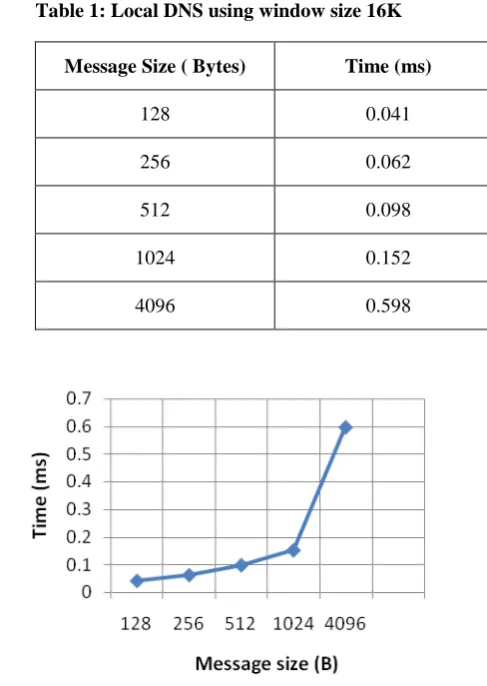
[image:2.595.307.551.403.746.2]Table represents the message size and time when DNS is placed locally by using window size of 16K. Here we find that the standard message size is 1K. When message size increases from 1K to 4K with window size 16K the receive time shoots up to approximate 45% which is very high in the case of local DNS.
Table 1: Local DNS using window size 16K
Message Size ( Bytes) Time (ms)
128 0.041
256 0.062
512 0.098
1024 0.152
4096 0.598
Table contains the timing when the DNS is placed remotely or it is not local to network. Table shows the timings when Non-Local DNS is used. Time taken by messages for different message sizes is given in this table. Message size is given in Bytes and time taken by message is given in milliseconds. Time for message size of 128 bytes is 0.101 ms. when the size of message is increased from 128 B to 4096 B the value of time also increases. Value of messages are 128, 256, 512, 1024 and 4096 bytes. Time taken by message of size 128 B is the smallest and time taken by message of size 4096 is highest. For Non-local DNS the time taken by the message size 4K increases nearly 85% which is higher than the time taken by local DNS message.
[image:3.595.40.276.248.566.2]
Table 2: Non-local DNS using window size 16K
0 0.2 0.4 0.6 0.8 1 1.2
128 256 512 1024 4096
Ti
me
(ms
)
Message size (B)
Fig 2: Graph for Non-local DNS window size 16K
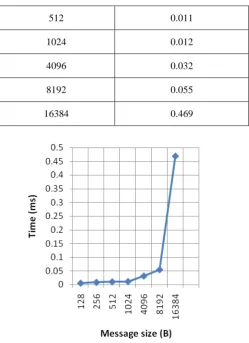
[image:3.595.303.561.530.710.2]Table represents the message size and time when DNS is placed locally by using window size of 64K. Here we find that the standard message size is 4K. When message size increases from 4K to 16K with window size 64K the receive time shoots up to approximate 45% which is very high in the case of local DNS.
Table 3: Local DNS using window size 64K
Message Size ( Bytes) Time (ms)
128 0.006
256 0.009
512 0.011
1024 0.012
4096 0.032
8192 0.055
16384 0.469
Fig 3: Graph of Local DNS using Window Size 64K
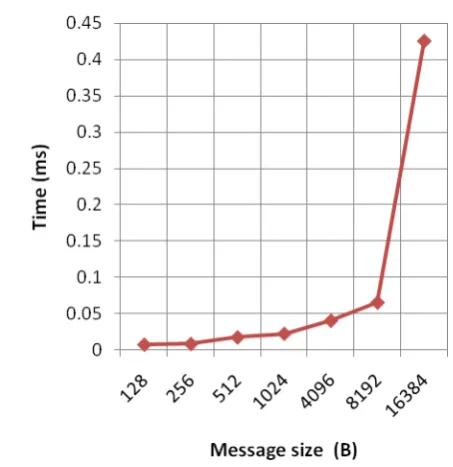
Similarly values are recorded for Non-local DNS using TCP window size 64K and analyzed.
When performance is checked for Local DNS using window size 64K the standard value of message that comes out is 8192 bytes. When message size is increased from 8192 bytes the computation time shoots up.
Table 4: Non Local DNS using window size 64K
Message Size (B) Send Time (ms)
128 0.101
256 0.130
512 0.169
1024 0.290
4096 1.067
Message Size (B) Send Time (ms)
128 0.007
256 0.008
512 0.017
1024 0.022
4096 0.040
8192 0.065
Fig 4: Graph of Non-local DNS using window size 64K
[image:4.595.51.278.89.323.2]Comparison between Local and Non-local DNS using window size 16K:
[image:4.595.37.294.505.741.2]Figure shows the comparison of the graphs shown for the case of Local and Non-local DNS using window size 16K. Graph shows that time taken by messages of different sizes in case of local DNS is shorter than the time taken by messages sent in case of Non-Local DNS. Size of messages is kept different ranging from 128 to 4096 Bytes. This shows that the performance of network increases when local DNS is used. Messages of higher sizes take less time in case of Local DNS. Red line in the graph shows the time taken by different packet sizes in case of Non-local DNS. Blue line shows the time taken by different packet sizes in case of Local DNS.
Fig 5:
Comparison between Local and Non-local DNS using window size 64K:
Figure shows the comparison of the graphs shown for the case of Local and Non-local DNS using window size 64k. Graph shows that time taken by messages of different sizes in case of local DNS is shorter than the time taken by messages sent in case of Non-Local DNS. Size of messages is kept different ranging from 128 to 16384 Bytes. This shows that the performance of Non-local DNS almost behaves similar to that of Local DNS. Red line in the graph shows the time taken by different packet sizes in case of Non-local DNS. Blue line shows the time taken by different packet sizes in case of Local DNS.
0.0060.0090.0110.0120.032 0.055
0.469
0.0070.0080.0170.022 0.04
0.065 0.425
0 0.1 0.2 0.3 0.4 0.5 0.6 0.7 0.8 0.9 1
12
8
25
6
51
2
10
24
40
96
81
92
16
38
4
Ti
me
(ms
)
Message size(B)
Non-local DNS Local DNS
Fig 6:
It has been analyzed that the performance is degraded in case of Non-local DNS when we use buffer size 16K and Local DNS thus can be used for high performance computing due to its quick responsiveness. Also it is analyzed that when the buffer size is increased the performance of both Local as well as Non-local DNS is increased. Thus results comes out that Local DNS performs well where window size is 16K.
V. CONCLUSIONANDFUTURESCOPE
message sizes in case of Local DNS is lower than the time taken by messages in case of Non-Local DNS.
This study can be further enhanced to remote access of Local Networks with Localized DNS and this study can also be conducted at DNS servers of Internet Service Providers for different data.
VI. REFERENCES
[1] Eason Mohit Dhawan1, OP Gupta2,” Impact of Local Domain Name System (DNS) on Corporate Network Bandwidth,” Vol. 2, Issue 11, November 2013 .
[2] Ananya Tripathi,” Experimental study of DNS
performance,”2011.