Effective Analysis of Causes and Inter-dependencies of Parsing Errors
Tadayoshi Hara1 Yusuke Miyao1
1Department of Computer Science, University of Tokyo
Hongo 7-3-1, Bunkyo-ku, Tokyo, 113-0033, JAPAN
2School of Computer Science, University of Manchester 3NaCTeM (National Center for Text Mining)
{harasan,yusuke,tsujii}@is.s.u-tokyo.ac.jp
Jun’ichi Tsujii1,2,3
Abstract
In this paper, we propose two methods for analyzing errors in parsing. One is to clas-sify errors into categories which grammar developers can easily associate with de-fects in grammar or a parsing model and thus its improvement. The other is to discover inter-dependencies among errors, and thus grammar developers can focus on errors which are crucial for improving the performance of a parsing model.
The first method uses patterns of er-rors to associate them with categories of causes for those errors, such as errors in scope determination of coordination, PP-attachment, identification of antecedent of relative clauses, etc. On the other hand, the second method, which is based on re-parsing with one of observed errors cor-rected, assesses inter-dependencies among errors by examining which other errors were to be corrected as a result if a spe-cific error was corrected.
Experiments show that these two meth-ods are complementary and by being com-bined, they can provide useful clues as to how to improve a given grammar.
1 Introduction
In any kind of complex systems, analyzing causes of errors is a crucial step for improving its perfor-mance. In recent sophisticated parsing technolo-gies, the step of error analysis has been becoming more and more convoluted and time-consuming, if not impossible. While common performance evaluation measures such as F-values are useful to compare the performance of systems or evaluate improvement of a system, they hardly give useful clues as to how to improve a system. Evaluation measures usually assume uniform units such as the
number of correctly or incorrectly recognized con-stituent boundaries and their labels, or in a similar vein, dependency links among words and their la-bels, and then compute single values such as the F-value. These values do not give any insights as to where the weaknesses exist in a parsing model. As a result, the improvement process takes the form of time consuming trial-error cycles.
Once grammar developers know the actual dis-tribution of errors across different categories such as PP-attachment, complement/adjunct distinc-tion, gerund/participle distincdistinc-tion, etc., they can think of focused and systematic improvement of a parsing model.
Another problem of the F-value in terms of uniform units is that it does not take inter-dependencies among errors into consideration. In particular, for parsers based on grammar for-malisms such as LFG (Kaplan and Bresnan, 1995), HPSG (Pollard and Sag, 1994), or CCG (Steed-man, 2000), units (eg. single predicate-argument links) are inter-related through hierarchical struc-tures and structure sharing assumed by these for-malisms. Single errors are inherently propagated to other sets of errors. This is also the case, though to a lesser extent, for parsing models in which shallow parsing is followed by another component for semantic label assignment.
In order to address these two issues, we propose two methods in this paper. One is to recognize cause categories of errors and the other is to cap-ture inter-dependencies among errors. The former method defines various patterns of errors to iden-tify categories of error causes. The latter method re-parses a sentence with a single target error cor-rected, and regards the errors which are corrected in re-parse as errors dependent on the target.
Although these two methods are implemented for a specific parser using HPSG (Miyao and Tsu-jii, 2005; Ninomiya et al., 2006), the same ideas can be applied to any type of parsing models.
Predicate
Sentence: John has come
Predicative event 1:
Predicative event 2: Word: has
Grammatical nature: auxiliary
# of arguments: 2
Argument 1
John
Argument 2
come
Predicate
Word: come
Grammatical nature: verb
# of arguments: 1
Argument 1
John
[image:2.595.308.523.64.137.2]Predicate-argument relations
Figure 1: Predicate-argument relations
John aux_2args
ARG1 ARG2
verb_1arg ARG1
[image:2.595.77.285.66.218.2]has : come :
Figure 2: Representation of predicate-argument relations
In the following, Section 2 introduces a parser and its evaluation metrics, Section 3 illustrates dif-ficulties in analyzing parsing errors based on com-mon evaluation measures, and Section 4 proposes the two methods for effective error analysis. Sec-tion 5 presents experimental results which show how our methods work for analyzing actual pars-ing errors. Section 6 and Section 7 illustrate fur-ther application of these methods to related topics. Section 8 summarizes this research and indicates some of future directions.
2 A parser and its evaluation
A parser is a system which interprets given sen-tences in terms of structures derived from syn-tactic or in some cases semantic viewpoints, and structures constructed as a result are used as es-sential information for various tasks of natural lan-guage processing such as information extraction, machine translation, and so on.
In this paper, we address issues involved in im-proving the performance of a parser which pro-duces structural representations deeper than sur-face constituent structures. Such a parser is called a “deep parser.” In many deep parsers, the output structure is defined by a linguistics-based gram-mar framework such as CFG, CCG (Steedman, 2000), LFG (Kaplan and Bresnan, 1995) or HPSG
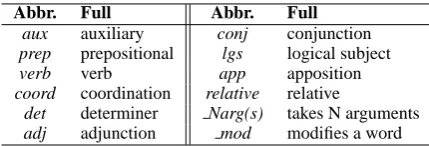
Abbr. Full Abbr. Full
aux auxiliary conj conjunction
prep prepositional lgs logical subject
verb verb app apposition
coord coordination relative relative
det determiner Narg(s) takes N arguments
adj adjunction mod modifies a word
Table 1: Descriptions for predicate types
(Pollard and Sag, 1994). Alternatively, some deep parsing models assume staged processing in which a stage of shallow parsing is followed by a stage of semantic role labeling, which assigns labels indi-cating semantic relationships between predicates and their arguments. In either case, we assume a parser to produce a single “deep” structural rep-resentation for a given sentence, which is chosen from a set of possible interpretations as the most probable one by a disambiguation model.
For evaluation of the performance of a parser, various metrics have been introduced according to the structure captured by a given grammar formalism or a system of semantic labels. In most cases, instead of examining correctness for a whole structure, a parser is evaluated in terms of the F-value which shows how correctly it recog-nizes relationships among words and assigns “la-bels” to the relationships in the structure. In this paper, we assume a certain type of “predicate-argument relation.”
In this measurement, a structure given for a sentence is decomposed into a set of predicative words and their arguments. A predicate takes other words as its arguments. In our representa-tion, the arguments are labeled by semantically
neutral labels such as ARGn(n = 1...5) and
MOD. In this representation, a basic unit is a triplet, such as
<Predicate:PredicateType, ArgumentLabel,
Argument>,
de-I saw a girl with a telescope
Correct answer:
ARG1 ARG2
ARG1 ARG2
Parser output:
ARG1 ARG2
ARG1 ARG2
Compare
Error (25%):
ARG1 ARG1 Correct (75%):
ARG1 ARG2
ARG2 ARG1 ARG2
ARG2
I saw a girl with a telescope
I saw a girl with a telescope
[image:3.595.303.526.62.335.2]I saw a girl with a telescope
Figure 3: An example of parsing performance evaluations
pendencies but also many dependencies which are essentially syntactic in nature. Figure 1 shows an example used in Miyao and Tsujii (2005) and Ni-nomiya et al. (2006).
This example shows predicate-argument rela-tions for “John has come.” There are two pred-icates in this sentence, “has” and ”come”. The word “has”, which is used as an auxiliary verb, takes two words, “John” and “come”, as its ar-guments, and therefore two triplets of predicate-argument relation,<has ARG1 John>and<has ARG2 come>. As for the predicative word “come”, we have one triplet<come ARG1 John>. Note that, in this HPSG analysis, the auxiliary verb “has” is analyzed in such a way that it takes one NP as subject and one VP as complement, and that the subject of the auxiliary verb is shared by the verb (“come”) in VP as its subject (Fig-ure 2). The fact that “has” in this sentence is an auxiliary verb is indicated by the “PredicateType”, aux 2args. A “PredicateType” consists of a type and the number of arguments it takes (Table 1).
3 Difficulties in analyzing parsing errors
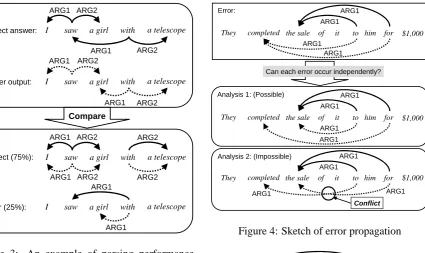
Figure 3 shows an example of the evaluation of the parser based on these predicate-argument rela-tions. Note that the predicate types are abbreviated in this figure. In the sentence “I saw a girl with a telescope”, there should be four triplets for the two predicates, ”saw” and “with,” each of which takes
Error:
They completed the sale of for
ARG1 ARG1
it to him $1,000
Conflict
Analysis 2: (Impossible)
They completed the sale of for
ARG1
ARG1
it to him $1,000
Analysis 1: (Possible) ARG1
ARG1
ARG1 ARG1
Can each error occur independently?
They completed the sale of for
ARG1 ARG1
it to him $1,000
[image:3.595.96.522.63.316.2]ARG1 ARG1
Figure 4: Sketch of error propagation
The book on the shelf which I read yesterday
ARG1 ARG2
ARG2 ARG1
Error:
Figure 5: Parsing errors around one relative clause attachment
two arguments. Although the parser output does indeed contain four triplets, the first argument of “with” is not the correct one. Thus, this output is erroneous, with the F-value of 75%.
While the F-value thus computed is fine for cap-turing the performance of a parser, it does not offer any help for improving its performance.
[image:3.595.73.293.66.296.2]realisti-cally large.
Another problem with the F-value is that it ig-nores inter-dependencies among errors. Since the F-value does not consider inter-dependencies, one cannot determine which errors are more crucial than others in terms of the performance of the sys-tem as a whole.
A simple example of inter-dependency is shown in Figure 4. “ARG1” of “for” and “to” were mis-taken by a parser, both of which can be classified as PP-attachments as in Figure 3. However, the two errors are not independent. The former error can occur by itself (Analysis 1) while the latter cannot because of the structural conflict with the former (Analysis 2). The occurrence of the latter error thus forces the former.
Moreover, inter-dependency in a deep parser based on linguistics-based formalisms can be complicated. Error propagation is ingrained in grammar itself. Consider Figure 5. In this exam-ple, a wrong decision on the antecedent of a rela-tive clause results in a wrong triplet of the predi-cate in the embedded clause with the antecedent. That is, the two erroneous triplets, one of the “ARG1” of “which” and the other of the “ARG2” of “read,” were caused by a single wrong deci-sion of the antecedent of a relative clause. Such a propagation of errors can be even more compli-cated, for example, when the predicate in the rela-tive clause is a control verb.
In the following section we propose two ods for analyzing errors. Although both meth-ods are implemented for the specific parser Enju (Miyao and Tsujii, 2005; Ninomiya et al., 2006), the same ideas can be implemented for any parsing model.
4 Methods for effective error analysis
4.1 Recognizing categories of error causes
While the Enju parser produces rich feature struc-tures as output, the performance is evaluated by the F-value in terms of basic units of predicate-argment structure. As we illustrated in Section 2, the basic unit is a triplet in the following form.
<Predicate:PredicateType, ArgumentLabel,
Argument>
We illustrated in Section 2 how we can identify errors in PP-attachment simply by examining a
The car was designed to : use it for ...
Correct output:
aux_2args
to : [ verb1] …
ARG3
[verb2] Parser output:
aux_mod_2args
MOD to :
ARG2
Unknown subject
ARG1 ARG1
[ verb1] … [verb2]
aux_2args
Example:
Parser output: Correct answer:
ARG3
The car was designed to :aux_mod_2args use it for ...
MOD ARG2
Unknown subject
ARG1 ARG1 Pattern:
[image:4.595.305.524.60.271.2](Patterns of correct answer and parser output can be interchanged)
Figure 6: Pattern for “To-infinitive for modi-fier/argument of verb”
triplet produced by the parser with the correspond-ing triplet in the gold standard parse.
However, in more complex cases, we have to consider a set of mismatched triplets collectively in order to map errors to meaningful error causes. The following are typical examples of error causes and pattern rules which identify them.
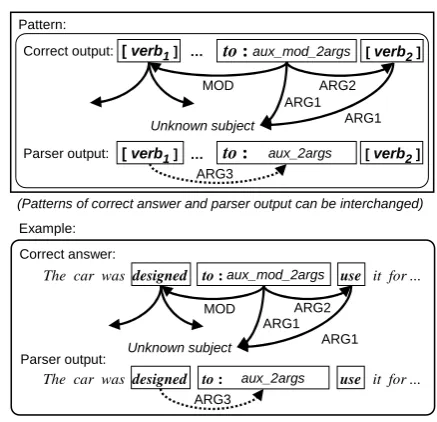
(1) Interpretation of Infinitival Clauses as Adjunct or Complement
Two different types of interpretations of the in-finitival clauses are explicitly indicated by “Predi-cateType.” Consider the following two sentences.
(a) [Infinitival clause as an adjunct of the main clause]
The car was designed (by John) to use it for business trips.
(b) [Infinitival clause as an argument of catena-tive verb]
The car is designed to run fast.
[ gerund ]: verb_Narg(s) Parser output:
[ gerund ]: verb_mod_Narg(s) Correct answer:
(Patterns of correct answer and parser output can be interchanged)
Pattern:
Example:
The customers walk the door
a package for them
expecting: verb_mod_3args
you to have
in
MOD ARG1
ARG2
ARG3
Parser output: Correct output:
The customers walk the door
a package for them
expecting: verb_3args
you to have
in
Not exist
ARG2
ARG3
ARG1 (MOD)
… …
[image:5.595.306.523.61.270.2]… …
Figure 7: Pattern for “Gerund acts as modifier or not”
clause as ARG3. Furthermore, in the catenative verb interpretation of “designed”, the deep object (the surface subject in this example) fills ARG1 of the verb in the infinitival clause (complement), while in the adjunct interpretation, the deep sub-ject which is missing in this sentence occupies the same role. Consequently, a single erroneous choice between these two interpretations results in a set of mismatched triplets.
We recognize such a set of mismatched triplets by a pattern rule (Figure 6) and map them to this type of error cause.
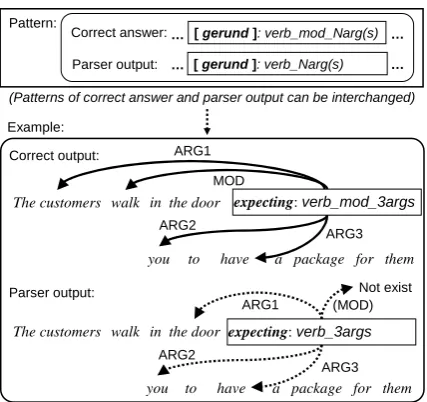
(2) Interpretation of Gerund-Participle interpreta-tions
A treatment similar to (1) is taken for different interpretations of Gerund. Interpretation as Ad-junct of a main clause is signaled by the “Predi-cateType” verb-mod-*, while an interpretation as a modifier of a noun is represented by the “Predi-cateType” verb (Figure 7).
(3) Interpretation of “by”
A prepositional phrase with “by” in a passive clause can be interpreted as a deep subject, while the same phrase can be interpreted as an ordinary PP phrase that is used as an adjunct. The first in-terpretation is marked by the “PredicateType” lgs (logical subject) which takes only one argument. The relationship between the passivized verb and the deep subject is captured by ARG1 which goes
Example: Pattern:
Correct output:
Parser output: prep_2args
Unknown subject
[ verb1] … ARG1 ARG1
…
lgs_1arg
ARG1
[verb1] … …
ARG1
A 50-state study released in September by : Friends …
Unknown subject
… ARG1 ARG1
prep_2args
Parser output: Correct answer:
A 50-state study released in September by :… Friends …
ARG1 ARG1
lgs_1arg
ARG1
[image:5.595.75.289.62.263.2](Patterns of correct answer and parser output can be interchanged)
Figure 8: Pattern for “Subject for passive sentence or not”
Example: Pattern:
relative_1arg
ARG1 Parser output: ARG1/2
Error
Parser output: Correct answer:
The book on which : read
ARG1
the shelf I yesterday
ARG2
The book on which : read
ARG1
the shelf I yesterday
ARG2
relative_1arg
relative_1arg
Error
… …
Figure 9: Pattern for “Relative clause attachment”
from the verb to the noun phrase. On the other hand, in the interpretation as an ordinary PP, the preposition as predicate links the main verb and NP via ARG1 and ARG2, respectively (Figure 8). Again, a set of mismatched triplets should be mapped to a single cause of errors via a pattern rule.
(4) Antecedent of a Relative Clause
This type of error is manifested by two mis-matched triplets with different predicates. This is because a wrong choice of antecedent for a rela-tive clause results in a wrong link for the trace of the relative clause.
[image:5.595.308.525.319.500.2]Cause categories Patterns [Argument selection]
Prepositional attachment ARG1 of prep *
Adjunction attachment ARG1 of adj *
Conjunction attachment ARG1 of conj * Head selection for noun phrase ARG1 of det *
Coordination ARG1/2 of coord *
[Predicate type selection]
Preposition/Adjunction prep *↔adj * Gerund acts as modifier/not verb mod Narg(s)
↔verb Narg(s) Coordination/conjunction coord *↔conj * # of arguments for preposition prep Marg(s)
↔prep Narg(s) Adjunction/adjunctive noun adj *↔noun * [More structural errors]
To-infinitive for see Figure 6
modifier/argument of verb
[image:6.595.71.289.61.289.2]Subject for passive sentence/not see Figure 8 [Others]
Comma any error around “,”
Relative clause attachment see Figure 9
Table 2: Defined patterns for cause categories
predicate which takes the antecedent as its single argument, identification of error type can be done simply by looking at ARG1. However, since the errors usually propagate to the triplets that contain their traces, we have to map them together to the single error (Figure 9).
Table 2 shows the errors across different types which our current version of pattern rules can identify.
4.2 Capturing inter-dependencies among errors
Some inter-dependencies among erroneous
triplets are ingrained in grammar, such as the case of antecedent of a relative clause in (4) in Section 4.1. Some are caused by general constraints such as the projection principle in dependency structure (Figure 4 in Section 2).
Regardless of causes of dependencies, to recog-nize inter-dependencies among errors is a crucial step of effective error analysis.
Our method consists of the following four steps:
[Step 1]Re-parsing a target sentence: A given sen-tence is re-parsed under the condition where an er-ror is forcibly corrected.
[Step 2]Forming a network of inter-dependencies of errors: By comparing the new parse result (a set of triplets) with the initial parse result, this step creates a directed graph of errors in the
ini-1
Re-parse a sentence under the condition where each error is forcibly corrected
1 2 3
Correct 2
1 1
Form inter-dependent error groups and error propagation network
4 1
4 3 3 Correct
Correct
Correct
disappear
disappear
disappear
disappear
,
, ,
1 2 3 4
ARG1
our work force today on
Errors:
ARG1 ARG1
ARG2 ARG2
ARG1 ARG1
ARG1
It has no bearing
2 3 4
5
5 4
Correct 1 , 2 , 3 , disappear 4
,
2 , 4 ,
2 , 3 ,
5 Propagation Resultant network:
Inter-dependent error group Inter-dependent error group (a)
(b)
(c)
Inter-dependency among errors: re-parse
re-parse
re-parse
re-parse
re-parse
Figure 10: Schema of capturing
inter-dependencies
tial parse. A directed link shows that correction of the error in the starting node produces a new parse result in which the error in the receiving node of the link disappears.
[Step 3]Forming groups of inter-dependent errors: This step recognizes a group of intdependent er-rors which forms a directed circle in the network created by[Step 2].
[Step 4]Forming a network of error propagation: This step creates a new network by reducing each of inter-dependent error groups of[Step 3]to a sin-gle node.
Figure 10 illustrates how these steps work. In this example, while “today” should modify the noun phrase “our work force”, the initial parse wrongly takes “today” as the head noun of the whole noun phrase. As a result, there are five er-rors; three wrong outputs, “ARG2” of “on” (Er-ror 1), “ARG1” of “our” (Er(Er-ror 2) and “ARG1” of “work” (Error 3). There is an extra triplet for “ARG1” of “force” (Error 4), and a triplet for “ARG1” of “today” (Error 5) is missing (Figure 10 (a)).
# of Cause categories of errors
Errors Locations
Classified 2,078 1,671
[Argument selection]
Prepositional attachment 579 579
Adjunction attachment 261 261
Conjunction attachment 43 40
Head selection for noun phrase 30 30
Coordination 202 184
[Predicate type selection]
Preposition/Adjunction 108 54
Gerund acts as modifier/not 84 31
Coordination/conjunction 54 27
# of arguments for preposition 51 17
Adjunction/adjunctive noun 13 13
[More structural errors]
To-infinitive for 120 22
modifier/argument of verb
[image:7.595.70.290.64.310.2] [image:7.595.308.525.143.250.2]Subject for passive sentence/not 8 3
[Others]
Comma 444 372
Relative clause attachment 102 38
Unclassified 2,631 −
Total 4,709 −
Table 3: Errors classified into cause categories
(c) shows what the resultant network looks like. An inter-dependent error group of 1, 2, 3 and 4 is recognized by[Step 3]and represented as a single node. Error 5 is propagated to this node in the final network.
5 Experiments
We applied our methods to the analyses of actual errors produced by Enju. This version of Enju was trained on the Penn Treebank (Marcus et al., 1994) Section 2-21.
5.1 Observation of identified cause categories
We first parsed sentences in PTB Section 22, and based on the observation of errors, we defined the patterns in Section 4. We then parsed sentences in Section 0. The errors in Section 0 were mapped to error cause categories by the pattern rules created for Section 22.
Table 3 summarizes the distribution across the causes of errors. The left and right numbers in the table show the number of erroneous triplets clas-sified into the categories and the frequency of the patterns matched, respectively. The table shows that, with the 14 pattern rules, we successfully ob-served 1,671 hits and 2,078 erroneous triplets are dealt with by these hits. This amounts to more than 40% erroneous triplets (2,078/4,709). Since this was the first attempt, we expect the coverage can be easily improved by adding new patterns.
Evaluated sentences (erroneous) 1,811 (1,009)
Errors (Correctable) 4,709 (3,085)
Inter-dependent error groups 1,978
Correction propagations 501
F-score (LP/LR) 90.69 (90.78/90.59)
Table 4: Summary of inter-dependencies
㪇 㪌 㪇 㪇 㪈 㪇 㪇 㪇 㪈 㪌 㪇 㪇
㪈 㪉 㪊 㪋 㪌 㪍 㪎 㪏 㪐 㪈 㪇
㪪㫀㫑㪼 㩷 㫆 㪽 㩷 㫀㫅 㫋㪼 㫉㪄 㪻㪼 㫇㪼 㫅 㪻㪼 㫅 㫋㩷 㪼 㫉㫉㫆 㫉㩷 㪾㫉㫆㫌 㫇
㪝
㫉
㪼
㫈
㫌
㪼
㫅
㪺
㫐
Figure 11: Frequency of each size of
inter-dependent error group
From the table, we can observe that a signif-icant portion of errors is covered by simple types of error causes such as PP-attachment and Adjunct attachment. They are simple in the sense that the number of erroneous triplets treated and the fre-quency of the pattern application coincide. How-ever, their conceived significance may be over-rated. These simple types may constitute parts of more complex error causes. Furthermore, since pattern rules for these simple causes are easy to prepare and have already been covered by the cur-rent version, most of the remaining 60% of the er-roneous triplets are likely to require patterns for more complex causes.
On the other hand, patterns for complex causes collect more erroneous triplets once they are fired. This tendency is more noticeable in structural pat-terns of errors. For example, in “To-infinitive for modifier/argument of verb,” there were only 22 hits for the pattern, while the number of erroneous triplets is 120. This implies five triplets per hit. This is because, in a deep parser, a wrong choice between adjunct or complement interpretations of a to-infinitival clause affects the interpretation of implicit arguments in the clause through control. Though expected, such detailed observations show how differences between shallow and deep parsers may affect evaluation methods and the methods of analyzing errors.
5.2 Observation of inter-dependencies
The asbestos fiber , crocidolite , is unusually resilient once
it enters the lungs , with even brief exposures to it causing
symptoms that show up decades later , researchers said . (a)
(b)
(c) (d)
… fiber , : app_2args crocidolite …
… fiber , : coord_2args crocidolite … Correct answer:
Parser output:
… is usually resilient … the lungs , with …
… symptoms that show : up decades later …
Parser output: Correct answer:
verb_1arg
… symptoms that show :verb_2args up decades later …
… it causing symptoms that show up decades later … Sentence:
Inter-dependent error group (a):
Inter-dependent error group (b):
Inter-dependent error group (c):
Inter-dependent error group (d):
ARG1 ARG2
ARG1 ARG2
ARG1 ARG1
ARG1 ARG1
ARG1
ARG1
ARG1
ARG2
ARG1
[image:8.595.309.525.62.315.2]ARG1
Figure 12: Obtained inter-dependent error groups
we use prunes less probable parse substructures during parsing. In some cases, even if we gave a large positive value to a triplet which should be in-cluded in the final parse, parsing paths which can contain the triplet were pruned before. In this re-search, we ignored such errors as “uncorrectable” ones, and focused on the remaining “correctable” errors.
Table 4 shows a summary of the analysis. As the previous experiment, Enju produced 4,709 errors for Section 0, of which 3,085 were correctable. By applying the method illustrated in Section 4.2, we obtained 1,978 inter-dependent error groups and 501 correction propagation relationships among the groups.
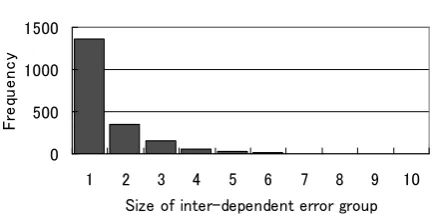
Figure 11 shows the frequency of the size of inter-dependent error groups. About half of the groups contain only single errors which could have only one-way correction propagations with other errors or were completely independent of other errors.
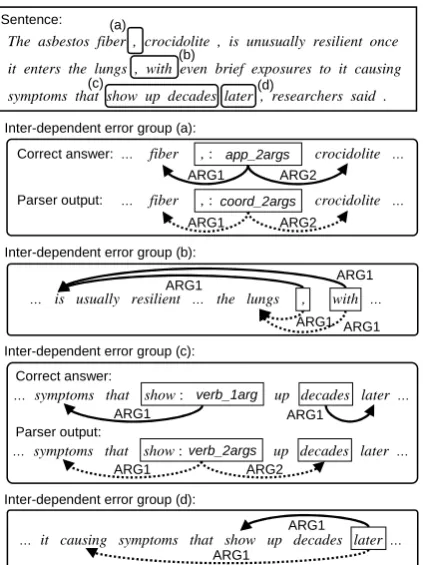
Figure 12 shows an example of the extracted inter-dependent error groups. For the sentence shown at the top, Enju gave seven errors. By ap-plying the method in Section 4.2, these errors were grouped into four inter-dependent error groups (a) to (d), and no correction propagations were
de-She says she offered Mrs. Yeargin a quiet resignation and
thought she could help save her teaching certificate .
(a) (b)
Sentence:
Inter-dependent error group (a):
Inter-dependent error group (b):
Correct answer:
Parser output:
… she could help save :verb_3args her teaching certificate . … she could help save :verb_2args her teaching certificate . Correct answer:
Parser output:
… thought she could help :verb_2args save …
… thought she could help : aux_2args save …
Correction propagation from (a) to (b) ARG2
ARG2 ARG2
ARG2
ARG1 ARG2
ARG1 ARG2
ARG3 ARG1
ARG1
ARG2 ARG2
[image:8.595.78.290.63.346.2]ARG1
Figure 13: Correction propagation between ob-tained inter-dependent error groups
tected among them. Group (a) contains two errors on the comma’s local behavior as apposition or co-ordination. Group (b) contains the errors on the words which give almost the same attachment be-haviors. Group (c) contains the errors on whether the verb “show” took “decades” as its object or not. Group (d) contains an error on the attachment of the adverb “later”. Regardless of the overlap of the regions in the sentence for (c) and (d), our approach successfully grouped the errors into two independent groups. The method shows that the errors in each group are intdependent, but er-rors in one group are independent of those in an-other. This enables us to concentrate on each of the co-occurring error groups separately, without minding the errors in other groups.
Figure 13 shows another example. In this ex-ample, eight errors for a sentence were classified into two inter-dependent error groups (a) and (b). Moreover, it shows that the correction of group (a) results in correction of group (b).
con-It invests heavily in dollar-denominated securities overseas and
is currently waiving management fees , which boosts its yield . (a)
(b) Sentence:
Inter-dependent error group (a):
Inter-dependent error group (b):
Adjunction attachment Cause categories:
Comma,
Relative clause attachment Cause categories:
It invests heavily in … securities overseas : adj_1arg … ARG1
ARG1
… is currently waiving management fees , which boosts …
ARG1 ARG1 ARG1
[image:9.595.79.289.61.272.2]ARG1 ARG1 ARG1
Figure 14: Combining our two methods (1)
flict could arise when correcting only each of the groups. We could then hypothesize that the cor-rection propagation between the two groups were caused by the disambiguation model.
By dividing the errors into minimal units and clarifying the effects of correcting a target error, we can conclude that the inter-dependent group (a) should be handled first for effective improve-ment of the parser. In such a way, obtained inter-dependencies among errors can suggest an effec-tive strategy for parser improvement.
5.3 Combination of the two methods
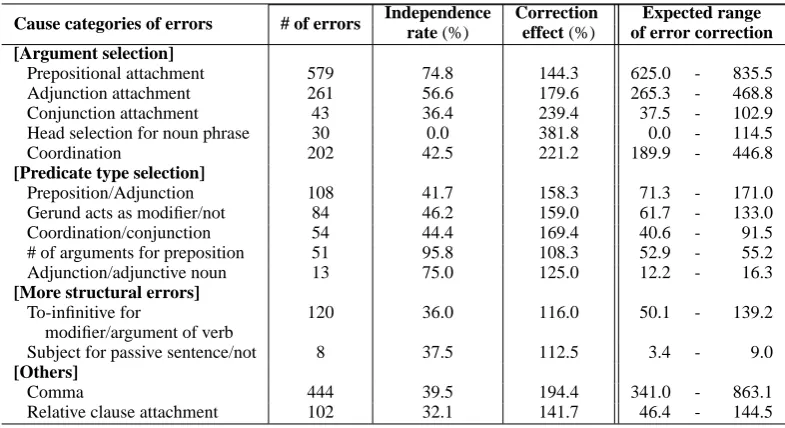
By combining the two methods described in Sec-tion 4.1 and 4.2, we can see how each error cause affects the performance of a parser. The results are summarized in Table 5. The leftmost column in the table shows the numbers of errors in terms of triplets, which are the same as the leftmost col-umn in Table 3.
The “independence rate” shows the ratio of er-roneous triplets in the category which are not af-fected by correction of other erroneous triplets. On the other hand, the “correction effect” shows how many erroneous triplets would be corrected if one of the erroneous triplets in the category was cor-rected. These two columns are computed by using the error propagation network constructed in Sec-tion 4.2. That is, by using the network we obtain the number of erroneous triplets to be corrected if a given erroneous triplet in the category was cor-rected, sum up these numbers and then calculate the average number of expected side-effect
correc-Clark J. Vitulli was named senior vice president and general
manager of this U.S. sales and marketing arm of Japanese
auto Maker Mazda Motor Corp . (b) (a)
Sentence:
Inter-dependent error group (a):
Inter-dependent error group (b):
Coordination (fragment) Head selection for noun phrase Cause categories:
… president … of this U.S. sales and :coord_2args … ARG1
ARG1
of this :det_1arg U.S. sales and :coord_2args marketing arm
ARG2 ARG1
ARG2
ARG1 ARG2
ARG1 ARG1
ARG1 ARG2
Correction propagation from (a) to (b)
[image:9.595.310.525.63.323.2]Coordination (fragment) Cause categories:
Figure 15: Combining our two methods (2)
tion per erroneous triplet in the category.
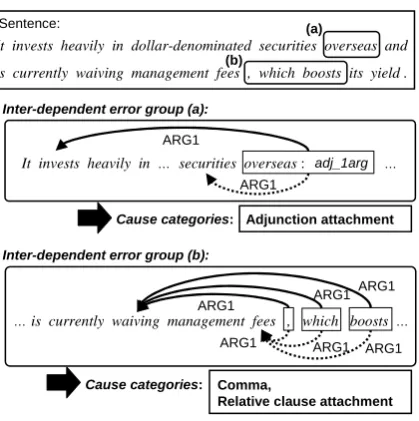
Figure 14 shows an example of independent er-rors. For the sentence at the top, the parser pro-duced four errors. The method in Section 4.2 successfully discovered two inter-dependent error groups (a) and (b). There was no error propaga-tion relapropaga-tion between the two groups. On the other hand, the method in Section 4.1 associated all of these four errors with the categories of “Adjunc-tion attachment,” “Comma” and “Relative clause attachment,” and the error for the “Adjunction at-tachment” corresponds to the intdependent er-ror group (a). Because this group is not a receiving node of any propagation in the network, the error is regarded as an “independent” one.
Independent errors mean that, if a new parsing model could correct them, the correction would not be destroyed by other errors which remain in the new parsing model.
The correction effect shows the opposite and desirable effect of the nature of the dependency among errors which the propagation network rep-resents. This means that, if one of erroneous triplets in the category was corrected, the correc-tion would be amplified through propagacorrec-tion, and as a result other errors would also be corrected.
Independence Correction Expected range Cause categories of errors # of errors rate (%) effect (%) of error correction [Argument selection]
Prepositional attachment 579 74.8 144.3 625.0 - 835.5
Adjunction attachment 261 56.6 179.6 265.3 - 468.8
Conjunction attachment 43 36.4 239.4 37.5 - 102.9
Head selection for noun phrase 30 0.0 381.8 0.0 - 114.5
Coordination 202 42.5 221.2 189.9 - 446.8
[Predicate type selection]
Preposition/Adjunction 108 41.7 158.3 71.3 - 171.0
Gerund acts as modifier/not 84 46.2 159.0 61.7 - 133.0
Coordination/conjunction 54 44.4 169.4 40.6 - 91.5
# of arguments for preposition 51 95.8 108.3 52.9 - 55.2
Adjunction/adjunctive noun 13 75.0 125.0 12.2 - 16.3
[More structural errors]
To-infinitive for 120 36.0 116.0 50.1 - 139.2
modifier/argument of verb
[image:10.595.102.495.64.278.2]Subject for passive sentence/not 8 37.5 112.5 3.4 - 9.0
[Others]
Comma 444 39.5 194.4 341.0 - 863.1
Relative clause attachment 102 32.1 141.7 46.4 - 144.5
Table 5: Correction propagations between errors for each cause category and the other errors
“U.S.,” two false outputs for ARG2 of “of” and “and,” and a missing output for ARG1 of “sales.” Our method for inter-dependencies classified these errors into two inter-dependent error groups (a) and (b), and extracted an correction propagation from (a) to (b). Our method for cause categories, on the other hand, associated two errors of “and” with the category “Coordination” and one error of “this” with the category “Head selection for noun phrase.” When we correct an error in the interde-pendent error group (a), the correction leads to not only correction of the other errors in (a) but also correction of the error in (b) via correction prop-agation from (a) to (b). Therefore, a correction effect of an error in group (a) results in 6.0.
On the basis of the above considerations, we es-timated the range of the effect which an error cor-rection in each category has. The minimum of ex-pected correction range in Table 5 is given by the product of the number of erroneous triplets in the category, the independence rate and the correction effect. On the other hand, the maximum is given by the product of the number of erroneous triplets in the category and the correction effect. This as-sumes that all corrections made in the category are not cancelled by other errors, while the figure in the minimum are based on the assumption that all corrections made in the category, except for the in-dependent ones, are cancelled by other errors.
Table 5 would thus suggest which categories should be resolved with high priority, from three points of view: the number of errors in the
cat-egory, the number of independent errors, and the correction effect.
6 Further applications of our methods
In this section, as an example of the further ap-plication of our methods, we attempt to analyze parsing behaviors in domain adaptation from the viewpoints of error cause categories.
In Hara et al. (2007), we proposed a method for adapting Enju to a target domain, and then suc-ceeded in improving the parser performance for the GENIA corpus (Kim et al., 2003), a biomed-ical domain. Table 6 summarizes the parsing re-sults for three types of settings respectively: pars-ing PTB with Enju (“Enju for PTB”), parspars-ing GE-NIA with Enju (“Enju for GEGE-NIA”), and parsing GENIA with the adapted model (“Adapted for GE-NIA”). We then analyzed the performance transi-tion among these settings from the viewpoint of the cause categories given in Section 4.1 (Table 7). In order to compare the error frequencies among different settings, we took the percentage of target errors in all of the evaluated triplets. The signed values between the two settings show how much the errors increased when moving from the left set-tings to the right ones.
“Coordi-Enju for PTB Enju for GENIA Adapted for GENIA
Evaluated sentences 1,811 842 842
Evaluated triplets 44,934 22,230 22,230
Errors 4,709 3,120 2,229
[image:11.595.127.470.64.117.2]F-score (LP/LR) 90.69 (90.78/90.59) 87.41 (87.60/87.22) 90.93 (91.10/90.76)
Table 6: Summary of parsing performances for domain and model variations
Rate of errors against total examined relations in test set (%) Cause categories of errors
Enju for PTB −→ Enju for GENIA −→ Adapted for GENIA
Classified 4.62 +2.60% 7.22 −1.80& 5.42
[Argument selection]
Prepositional attachment 1.29 +0.93% 2.22 −0.64& 1.58
Adjunction attachment 0.58 +0.38% 0.96 −0.20& 0.76
Conjunction attachment 0.10 −0.04& 0.06 −0.04& 0.02
Head selection for noun phrase 0.07 +0.17% 0.24 −0.06& 0.18
Coordination 0.45 +0.59% 1.04 −0.25& 0.79
[Predicate type selection]
Preposition/Adjunction 0.24 +0.08% 0.32 −0.06& 0.26
Gerund acts as modifier/not 0.19 −0.07& 0.12 +0.01% 0.13
Coordination/conjunction 0.12 ±0.00→ 0.12 −0.07& 0.05
# of arguments for preposition 0.11 −0.02& 0.09 ±0.00& 0.09
Adjunction/adjunctive noun 0.03 +0.19% 0.22 −0.08& 0.14
[More structural errors]
To-infinitive for 0.27 +0.02% 0.29 −0.09& 0.20
modifier/argument of verb
[image:11.595.72.525.153.397.2]Subject for passive sentence/not 0.02 +0.34% 0.36 +0.01% 0.37
[Others]
Comma 0.99 −0.03& 0.96 −0.31& 0.65
Relative clause attachment 0.23 +0.05% 0.28 −0.03& 0.25
Unclassified 5.86 +0.96% 6.82 −2.22& 4.60
Total (Classified + Unclassified) 10.48 +3.56% 14.04 −4.01& 10.03
Table 7: Error distributions for domain and model variations
nation” increased remarkably. On the other hand, the transition from “Enju for GENIA” to “Adapted for GENIA” shows that their adaptation method succeeded in reducing the errors for most cate-gories to some extent. However, for “Preposi-tional attachment,” “Coordination,” and “Subject for passive sentence or not,” there were still no-ticeable gaps in error distribution between “Enju for PTB” and “Adapted for GENIA.” This would mean that the adapted model requires further per-formance improvement if we expect the same level of performances for those categories as the parser originally obtained in PTB.
We could thus capture some biases of cause categories which occur in domain transition or in domain adaptation, which would not be clari-fied by F-score evaluation methods. With inter-dependencies given by the method described in Section 4.2, the above analysis would be useful for effectively exploring further adaptation.
7 Related works
Although there have been many researchers who analyzed errors in their own systems in the
experi-ments, there has been little research which focused on error analysis itself.
In the field of parsing, McDonald and Nivre (2007) compared parsing errors between graph-based and transition-graph-based parsers. They consid-ered accuracy transitions from various points of view, and the obtained statistical data suggested that error propagation seemed to occur in the graph structures of parsing outputs. Our research proceeded one step further and attempted to re-veal the nature of the propagations. In examin-ing the combination of the two types of parsexamin-ing, they utilized approaches similar to our method for capturing inter-dependencies of errors. They al-lowed a parser to give only structures produced by the parsers and utilized the ideas for evaluating the parser’s potentials, whereas we utilized it for ob-serving error propagations.
misunder-standing of what happens in domain transitions. The summarized error cause categories and inter-dependencies given by our methods would be use-ful clues for extracting such domain-dependent er-ror phenomena.
When we look into other research areas in nat-ural language processing, Gim´enez and M`arquez (2008) proposed an automatic error analysis ap-proach in machine translation (MT) technologies. They developed a metric set which could capture features in MT outputs at different linguistic lev-els with different levlev-els of granularity. Like we considered parsing systems, they explored ways to resolve costly and rewardless error analysis in the MT field. One of their objectives was to enable researchers to easily obtain detailed linguistic re-ports on the behavior of their systems, and to con-centrate on analyses for the system improvements.
8 Conclusion
We proposed two methods for analyzing parsing errors. One is to assign errors to cause categories, and the other is to capture inter-dependencies among errors. The first method defines error pat-terns to identify cause categories and then asso-ciates errors involved in the patterns with the cor-responding categories. The second method re-parses a sentence with a target error corrected, and regards errors corrected together as dependent on the target.
In our experiments with an HPSG parser, we successfully associated more than 40% of the er-rors with 14 cause categories, and captured 1,978 inter-dependent error groups. Moreover, the com-bination of our methods gave a more detailed error analysis for effective improvement of the parser.
In our future work, we would give more pat-tern rules for classifying a large percentage of er-rors into cause categories, and incorporate uncor-rectable errors into inter-dependency analysis. Af-ter improving the analytical facilities of our indi-vidual methods, we would explore the possibil-ity of combining the methods for obtaining more powerful and detailed clues on how to improve parsing performance.
Acknowledgments
This work was partially supported by Grant-in-Aid for Specially Promoted Research (MEXT, Japan).
References
Mark Dredze, John Blitzer, Partha Pratim Talukdar, Kuzman Ganchev, Jo˜ao V. Grac¸a, and Fernando Pereira. 2007. Frustratingly hard domain adapta-tion for dependency parsing. In Proceedings of the CoNLL Shared Task Session of the 2007 Joint Con-ference on Empirical Methods in Natural Language Processing and Computational Natural Language Learning (EMNLP-CoNLL), pages 1051–1055.
Jes´us Gim´enez and Llu´ıs M`arquez. 2008. Towards het-erogeneous automatic mt error analysis. In Proceed-ings of the Sixth International Language Resources and Evaluation (LREC’08), pages 1894–1901.
Tadayoshi Hara, Yusuke Miyao, and Jun’ichi Tsujii. 2007. Evaluating impact of re-training a lexical dis-ambiguation model on domain adaptation of an hpsg parser. In Proceedings of 10th International Confer-ence on Parsing Technologies (IWPT 2007), pages 11–22.
Ronald M. Kaplan and Joan Bresnan. 1995. Lexical-functional grammar: A formal system for gram-matical representation. Formal Issues in Lexical-Functional Grammar, pages 29–130.
Jin-Dong Kim, Tomoko Ohta, Yuka Teteisi, and Jun’ichi Tsujii. 2003. GENIA corpus - a seman-tically annotated corpus for bio-textmining. Bioin-formatics, 19(suppl. 1):i180–i182.
Mitchell Marcus, Grace Kim, Mary Ann
Marcinkiewicz, Robert Macintyre, Ann Bies, Mark Ferguson, Karen Katz, and Britta Schas-berger. 1994. The Penn Treebank: Annotating predicate argument structure. In Proceedings of ARPA Human Language Technology Workshop.
Ryan McDonald and Joakim Nivre. 2007. Charac-terizing the errors of data-driven dependency pars-ing models. In Proceedpars-ings of the 2007 Joint Con-ference on Empirical Methods in Natural Language Processing and Computational Natural Language Learning (EMNLP-CoNLL), pages 122–131.
Yusuke Miyao and Jun’ichi Tsujii. 2005. Probabilis-tic disambiguation models for wide-coverage HPSG parsing. In Proceedings of the 43rd Annual Meet-ing on Association for Computational LMeet-inguistics (ACL), pages 83–90.
Takashi Ninomiya, Takuya Matsuzaki, Yoshimasa Tsu-ruoka, Yusuke Miyao, and Jun’ichi Tsujii. 2006. Extremely lexicalized models for accurate and fast HPSG parsing. In Proceedings of the 2006 Con-ference on Empirical Methods in Natural Language Processing (EMNLP), pages 155–163.
Carl J. Pollard and Ivan A. Sag. 1994. Head-Driven Phrase Structure Grammar. University of Chicago Press.