Re-examining Automatic Keyphrase Extraction Approaches
in Scientific Articles
Su Nam Kim CSSE dept. University of Melbourne
Min-Yen Kan
Department of Computer Science National University of Singapore
Abstract
We tackle two major issues in automatic keyphrase extraction using scientific arti-cles:candidate selectionandfeature engi-neering. To develop an efficient candidate selection method, we analyze the nature and variation of keyphrases and then se-lect candidates using regular expressions. Secondly, we re-examine the existing fea-tures broadly used for the supervised ap-proach, exploring different ways to en-hance their performance. While most other approaches are supervised, we also study the optimal features for unsuper-vised keyphrase extraction. Our research has shown that effective candidate selec-tion leads to better performance as evalua-tion accounts for candidate coverage. Our work also attests that many of existing fea-tures are also usable in unsupervised ex-traction.
1 Introduction
Keyphrases are simplex nouns or noun phrases (NPs) that represent the key ideas of the document. Keyphrases can serve as a representative summary of the document and also serve as high quality in-dex terms. It is thus no surprise that keyphrases have been utilized to acquire critical information as well as to improve the quality of natural lan-guage processing (NLP) applications such as doc-ument summarizer(D´avanzo and Magnini, 2005), information retrieval (IR)(Gutwin et al., 1999) and document clustering(Hammouda et al., 2005).
In the past, various attempts have been made to boost automatic keyphrase extraction performance based primarily on statistics(Frank et al., 1999; Turney, 2003; Park et al., 2004; Wan and Xiao, 2008) and a rich set of heuristic features(Barker and Corrnacchia, 2000; Medelyan and Witten,
2006; Nguyen and Kan, 2007). In Section 2, we give a more comprehensive overview of previous attempts.
Current keyphrase technology still has much room for improvement. First of all, although sev-eral candidate selection methods have been pro-posed for automatic keyphrase extraction in the past (e.g. (Frank et al., 1999; Park et al., 2004; Nguyen and Kan, 2007)), most of them do not ef-fectively deal with various keyphrase forms which results in the ignorance of some keyphrases as can-didates. Moreover, no studies thus far have done a detailed investigation of the nature and varia-tion of manually-provided keyphrases. As a con-sequence, the community lacks a standardized list of candidate forms, which leads to difficulties in direct comparison across techniques during evalu-ation and hinders re-usability.
Secondly, previous studies have shown the ef-fectiveness of their own features but not many compared their features with other existing fea-tures. That leads to a redundancy in studies and hinders direct comparison. In addition, existing features are specifically designed for supervised approaches with few exceptions. However, this approach involves a large amount of manual labor, thus reducing its utility for real-world application. Hence, unsupervised approach is inevitable in or-der to minimize manual tasks and to encourage utilization. It is a worthy study to attest the re-liability and re-usability for the unsupervised ap-proach in order to set up the tentative guideline for applications.
This paper targets to resolve these issues of candidate selection and feature engineering. In our work on candidate selection, we analyze the nature and variation of keyphrases with the pur-pose of proposing a candidate selection method which improves the coverage of candidates that occur in various forms. Our second contribution re-examines existing keyphrase extraction features
reported in the literature, in terms of their effec-tiveness and re-usability. We test and compare the usefulness of each feature for further improve-ment. In addition, we assess how well these fea-tures can be applied in an unsupervised approach.
In the remaining sections, we describe an overview of related work in Section 2, our propos-als on candidate selection and feature engineering in Section 4 and 5, our system architecture and data in Section 6. Then, we evaluate our propos-als, discuss outcomes and conclude our work in Section 7, 8 and 9, respectively.
2 Related Work
The majority of related work has been carried out using statistical approaches, a rich set of symbolic resources and linguistically-motivated heuristics(Frank et al., 1999; Turney, 1999; Barker and Corrnacchia, 2000; Matsuo and Ishizuka, 2004; Nguyen and Kan, 2007). Features used can be categorized into three broad groups: (1) docu-ment cohesion features (i.e. relationship between document and keyphrases)(Frank et al., 1999; Matsuo and Ishizuka, 2004; Medelyan and Wit-ten, 2006; Nguyen and Kan, 2007), and to lesser, (2) keyphrase cohesion features (i.e. relationship among keyphrases)(Turney, 2003) and (3) term cohesion features (i.e. relationship among compo-nents in a keyphrase)(Park et al., 2004).
The simplest system is KEA (Frank et al., 1999; Witten et al., 1999) that uses TF*IDF(i.e. term frequency * inverse document frequency) and first occurrence in the document. TF*IDF mea-sures the document cohesion and the first occur-rence implies the importance of the abstract or introduction which indicates the keyphrases have a locality. Turney (2003) added the notion of keyphrase cohesion toKEA features and Nguyen and Kan (2007) added linguistic features such as section information and suffix sequence. The GenExsystem(Turney, 1999) employed an inven-tory of nine syntactic features, such as length in words and frequency of stemming phrase as a set of parametrized heuristic rules. Barker and Corrnacchia (2000) introduced a method based on head noun heuristics that took three features: length of candidate, frequency and head noun fre-quency. To take advantage of domain knowledge, Hulth et al. (2001) used a hierarchically-organized domain-specific thesaurus from Swedish Parlia-ment as a secondary knowledge source. The
Textract (Park et al., 2004) also ranks the can-didate keyphrases by its judgment of keyphrases’ degree of domain specificity based on subject-specific collocations(Damerau, 1993), in addi-tion to term cohesion using Dice coefficient(Dice, 1945). Recently, Wan and Xiao (2008) extracts automatic keyphrases from single documents, uti-lizing document clustering information. The as-sumption behind this work is that the documents with the same or similar topics interact with each other in terms of salience of words. The authors first clustered the documents then used the graph-based ranking algorithm to rank the candidates in a document by making use of mutual influences of other documents in the same cluster.
3 Keyphrase Analysis
In previous study, KEA employed the index-ing words as candidates whereas others such as (Park et al., 2004; Nguyen and Kan, 2007) gen-erated handcrafted regular expression rules. How-ever, none carefully undertook the analysis of keyphrases. We believe there is more to be learned from the reference keyphrases themselves by do-ing a fine-grained, careful analysis of their form and composition. Note that we used the articles collected from ACM digital library for both ana-lyzing keyphrases as well as evaluating methods. See Section 6 for data in detail.
Syntactically, keyphrases can be formed by ei-ther simplex nouns (e.g. algorithm, keyphrase, multi-agent) or noun phrases (NPs) which can be a sequence of nouns and their auxiliary words such as adjectives and adverbs (e.g. mobile network, fast computing, partially observable Markov de-cision process) despite few incidences. They can also incorporate a prepositional phrase (PP) (e.g. quality of service, policy of distributed caching). When keyphrases take the form of an NP with an attached PP (i.e. NPs inof-PP form), the preposi-tionof is most common, but others such asfor, in, viaalso occur (e.g. incentive for cooperation, in-equality in welfare, agent security via approximate policy, trade in financial instrument based on log-ical formula). The patterns above correlate well to part-of-speech (POS) patterns used in modern keyphrase extraction systems.
con-Criteria Rules
Frequency (Rule1)Frequency heuristici.e. frequency≥2 for simplex words vs. frequency≥1 for NPs
Length (Rule2)Length heuristici.e. up to length 3 for NPs in non-of-PP formvs. up to length 4 for NPs inof-PP form (e.g.synchronous concurrent program vs. model of multiagent interaction)
Alternation (Rule3)of-PP form alternation
(e.g.number of sensor = sensor number, history of past encounter = past encounter history) (Rule4)Possessive alternation
(e.g.agent’s goal = goal of agent, security’s value = value of security)
Extraction (Rule5)Noun Phrase =(N N|N N S|N N P|N N P S|JJ|JJR|JJS)∗(N N|N N S|N N P|N N P S)
(e.g.complexity, effective algorithm, grid computing, distributed web-service discovery architecture) (Rule6)Simplex Word/NP IN Simplex Word/NP
(e.g.quality of service, sensitivity of VOIP traffic (VOIP trafficextracted), simplified instantiation of zebroid (simplified instantiationextracted))
Table 1: Candidate Selection Rules
junctions (e.g.search and rescue, propagation and delivery), and much more rarely, as conjunctions of more complex NPs (e.g. history of past en-counter and transitivity). Some keyphrases appear to be more complex (e.g.pervasive document edit and management system, task and resource allo-cation in agent system). Similarly, abbreviations and possessive forms figure as common patterns (e.g. belief desire intention = BDI, inverse docu-ment frequency = (IDF);Bayes’ theorem, agent’s dominant strategy).
A critical insight of our work is that keyphrases can be morphologically and semantically altered. Keyphrases that incorporate a PP or have an un-derlying genitive composition are often easily var-ied by word order alternation. Previous studies have used the altered keyphrases when forming in of-PP form. For example, quality of service can be altered to service quality, sometimes with lit-tle semantic difference. Also, as most morpho-logical variation in English relates to noun num-ber and verb inflection, keyphrases are subject to these rules as well (e.g.distributed system6= dis-tributing system, dynamical caching6=dynamical cache). In addition, possessives tend to alternate withof-PP form(e.g.agent’s goal = goal of agent, security’s value = value of security).
4 Candidate Selection
We now describe our proposed candidate selection process. Candidate selection is a crucial step for automatic keyphrase extraction. This step is corre-lated to term extraction study since topNthranked terms become keyphrases in documents. In pre-vious study, KEA employed the indexing words as candidates whereas others such as (Park et al., 2004; Nguyen and Kan, 2007) generated hand-crafted regular expression rules. However, none carefully undertook the analysis of keyphrases. In
this section, before we present our method, we first describe the detail of keyphrase analysis.
In our keyphrase analysis, we observed that most ofauthor assigned keyphraseand/orreader assigned keyphrase are syntactically more of-ten simplex words and less ofof-ten NPs. When keyphrases take an NP form, they tend to be a sim-ple form of NPs. i.e. either without a PP or with only a PP or with a conjunction, but few appear as a mixture of such forms. We also noticed that the components of NPs are normally nouns and adjec-tives but rarely, are adverbs and verbs. As a re-sult, we decided to ignore NPs containing adverbs and verbs in this study as our candidates since they tend to produce more errors and to require more complexity.
Another observation is that keyphrases contain-ing more than three words are rare (i.e. 6% in our data set), validating what Paukkeri et al. (2008) observed. Hence, we apply alength heuristic. Our candidate selection rule collects candidates up to length 3, but also of length 4 for NPs in of-PP form, since they may have a non-genetive alter-nation that reduces its length to 3 (e.g. perfor-mance of distributed system=distributed system performance). In previous studies, words occur-ring at least twice are selected as candidates. How-ever, during our acquisition of reader assigned keyphrase, we observed that readers tend to collect NPs as keyphrases, regardless of their frequency. Due to this, we apply different frequency thresh-olds for simplex words (>= 2) and NPs (>= 1). Note that 30% of NPs occurred only once in our data.
possible candidates. i.e. with a given NPs in of-PP form, not only we collect simplex word(s), but we also extract non-of-PP form of NPs from noun phrases governing the PP and the PP. For example, our rule extracts effective algorithm of grid computingas well aseffective algorithmand grid computing as candidates while the previous works’ rules do not.
5 Feature Engineering
With a wider candidate selection criteria, the onus of filtering out irrelevant candidates becomes the responsibility of careful feature engineering. We list 25 features that we have found useful in ex-tracting keyphrases, comprising of 9 existing and 16 novel and/or modified features that we intro-duce in our work (marked with ∗). As one of our goals in feature engineering is to assess the suitability of features in the unsupervised setting, we have also indicated which features are suitable only for the supervised setting (S) or applicable to both (S, U).
5.1 Document Cohesion
Document cohesion indicates how important the candidates are for the given document. The most popular feature for this cohesion is TF*IDF but some works have also used context words to check the correlation between candidates and the given document. Other features for document cohesion are distance, section information and so on. We note that listed features other thanTF*IDFare re-lated to locality. That is, the intuition behind these features is that keyphrases tend to appear in spe-cific area such as the beginning and the end of doc-uments.
F1 : TF*IDF (S,U) TF*IDF indicates doc-ument cohesion by looking at the frequency of terms in the documents and is broadly used in pre-vious work(Frank et al., 1999; Witten et al., 1999; Nguyen and Kan, 2007). However, a disadvan-tage of the feature is in requiring a large corpus to compute useful IDF. As an alternative, con-text words(Matsuo and Ishizuka, 2004) can also be used to measure document cohesion. From our study of keyphrases, we saw that substrings within longer candidates need to be properly counted, and as such our method measuresTF in substrings as well as in exact matches. For example,grid com-putingis often a substring of other phrases such as grid computing algorithm andefficient grid
com-puting algorithm. We also normalizeTFwith re-spect to candidate types: i.e. we separately treat simplex words and NPs to computeTF. To make ourIDFsbroadly representative, we employed the Google n-gram counts, that were computed over terabytes of data. Given this large, generic source of word count, IDF can be incorporated without corpus-dependent processing, hence such features are useful in unsupervised approaches as well. The following list shows variations of TF*IDF, employed as features in our system.
• (F1a)TF*IDF
• (F1b*)TFincluding counts of substrings
• (F1c*)TFof substring as a separate feature
• (F1d*) normalized TF by candidate types (i.e. simplex words vs. NPs)
• (F1e*) normalizedTF by candidate types as a separate feature
• (F1f*)IDFusingGoogle n-gram
F2 : First Occurrence(S,U)KEA used the first appearance of the word in the document(Frank et al., 1999; Witten et al., 1999). The main idea behind this feature is that keyphrases tend to oc-cur in the beginning of documents, especially in structured reports (e.g., in abstract and introduc-tion secintroduc-tions) and newswire.
F3 : Section Information (S,U) Nguyen and Kan (2007) used the identity of which specific document section a candidate occurs in. This lo-cality feature attempts to identify key sections. For example, in their study of scientific papers, the authors weighted candidates differently depending on whether they occurred in the abstract, introduc-tion, conclusion, section head, title and/or refer-ences.
contains the majority of keyphrases while the ti-tle or section head contains many fewer due to the variation in size.
• (F4a*) section, ’related/previous work’
• (F4b*) counting substring occurring in key sections
• (F4c*) sectionTFacross all key sections
• (F4d*) weighting key sections according to the portion of keyphrases found
F5* : Last Occurrence (S,U) Similar to dis-tance inKEA , the position of the last occurrence of a candidate may also imply the importance of keyphrases, as keyphrases tend to appear in the last part of document such as the conclusion and discussion.
5.2 Keyphrase Cohesion
The intuition behind using keyphrase cohesion is that actual keyphrases are often associated with each other, since they are semantically related to topic of the document. Note that this assumption holds only when the document describes a single, coherent topic – a document that represents a col-lection may be first need to be segmented into its constituent topics.
F6* : Co-occurrence of Another Candidate in Section (S,U) When candidates co-occur in several key sections together, then they are more likely keyphrases. Hence, we used the number of sections that candidates co-occur.
F7* : Title overlap(S)In a way, titles also rep-resent the topics of their documents. A large col-lection of titles in the domain can act as a prob-abilistic prior of what words could stand as con-stituent words in keyphrases. In our work, as we examined scientific papers from computer science, we used a collection of titles obtained from the largeCiteSeer1collection to create this feature.
• (F7a*) co-occurrence (Boolean) in title col-location
• (F7b*) co-occurrence (TF) in title collection
F8 : Keyphrase Cohesion(S,U)Turney (2003) integrated keyphrase cohesion into his system by checking the semantic similarity between top N
ranked candidates against the remainder. In the
1It contains 1.3M titles from articles, papers and reports.
original work, a large, external web corpus was used to obtain the similarity judgments. As we did not have access to the same web corpus and all candidates/keyphrases were not found in the Google n-gram corpus, we approximated this fea-ture using a similar notion of contextual similarity. We simulated a latent 2-dimensional matrix (simi-lar to latent semantic analysis) by listing all candi-date words in rows and their neighboring words (nouns, verbs, and adjectives only) in columns. The cosine measure is then used to compute the similarity among keyphrases.
5.3 Term Cohesion
Term cohesion further refines the candidacy judg-ment, by incorporating an internal analysis of the candidate’s constituent words. Term cohesion posits that high values for internal word associa-tion measures correlates indicates that the candi-date is a keyphrase (Church and Hanks, 1989).
F9 : Term Cohesion (S,U) Park et al. (2004) used in the Dice coefficient (Dice, 1945) to measure term cohesion particularly for multi-word terms. In their work, as NPs are longer than simplex words, they simply discounted simplex word cohesion by 10%. In our work, we vary the measure of TF used in Dice coefficient, similar to our discussion earlier.
• (F9a) term cohesion by (Park et al., 2004),
• (F9b*) normalized TF by candidate types (i.e. simplex words vs. NPs),
• (F9c*) applying different weight by candi-date types,
• (F9d*) normalizedTF and different weight-ing by candidate types
5.4 Other Features
F10 : Acronym(S) Nguyen and Kan (2007) ac-counted for the importance of acronym as a fea-ture. We found that this feature is heavily depen-dent on the data set. Hence, we used it only for N&K to attest ourcandidate selection method.
F12 : Suffix sequence(S)Similar toacronym, Nguyen and Kan (2007) also used a candidate’s suffix sequenceas a feature, to capture the propen-sity of English to use certain Latin derivational morphology for technical keyphrases. This fea-ture is also a data dependent feafea-tures, thus used in supervised approach only.
F13 : Length of Keyphrases(S,U)Barker and Corrnacchia (2000) showed that candidate length is also a useful feature in extraction as well as in candidate selection, as the majority of keyphrases are one or two terms in length.
6 System and Data
To assess the performance of the proposed candi-date selection rules and features, we implemented a keyphrase extraction pipe line. We start with raw text of computer science articles converted from PDF by pdftotext. Then, we parti-tioned the into section such as title and sections via heuristic rules and applied sentence segmenter
2, ParsCit3(Councill et al., 2008) for
refer-ence collection, part-of-speech tagger4 and
lem-matizer5(Minnen et al., 2001) of the input.
Af-ter preprocessing, we built both supervised and unsupervised classifiers usingNaive Bayesfrom the WEKA machine learning toolkit(Witten and Frank, 2005), Maximum Entropy6, and simple weighting.
In evaluation, we collected 250 papers from four different categories7 of the ACM digital
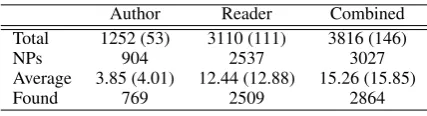
li-brary. Each paper was 6 to 8 pages on average. In author assigned keyphrase, we found many were missing or found as substrings. To rem-edy this, we collectedreader assigned keyphrase by hiring senior year undergraduates in computer science, each whom annotated five of the papers with an annotation guideline and on average, took about 15 minutes to annotate each paper. The fi-nal statistics of keyphrases is presented in Table 2 whereCombinedrepresents the total number of keyphrases. The numbers in()denotes the num-ber of keyphrases inof-PP form.Foundmeans the
2http://www.eng.ritsumei.ac.jp/asao/resources/sentseg/ 3http://wing.comp.nus.edu.sg/parsCit/
4 http://search.cpan.org/dist/Lingua-EN-Tagger/Tagger.pm
5http://www.informatics.susx.ac.uk/research/groups/nlp/carroll/morph.html
6http://maxent.sourceforge.net/index.html
7C2.4 (Distributed Systems), H3.3 (Information Search and Retrieval), I2.11 (Distributed Artificial Intelligence-Multiagent Systems) and J4 (Social and Behavioral Sciences-Economics)
number ofauthor assigned keyphraseandreader assigned keyphrasefound in the documents.
Author Reader Combined
Total 1252 (53) 3110 (111) 3816 (146)
NPs 904 2537 3027
Average 3.85 (4.01) 12.44 (12.88) 15.26 (15.85)
[image:6.595.308.522.98.156.2]Found 769 2509 2864
Table 2: Statistics in Keyphrases
7 Evaluation
The baseline system for both the supervised and unsupervised approaches is modifiedN&K which uses TF*IDF, distance, section information and additional section information (i.e. F1-4). Apart from baseline , we also implemented basic KEA andN&K to compare. Note thatN&K is con-sidered a supervised approach, as it utilizes fea-tures likeacronym, POS sequence, and suffix se-quence.
Table 3 and 4 shows the performance of our can-didate selection method and features with respect to supervised and unsupervised approaches using the current standard evaluation method (i.e. exact matching scheme) over top 5th,10th,15th candi-dates.
BestFeaturesincludesF1c:TF of substring as a separate feature,F2:first occurrence,F3:section information, F4d:weighting key sections, F5:last occurrence, F6:co-occurrence of another candi-date in section, F7b:title overlap, F9a:term co-hesion by (Park et al., 2004), F13:length of keyphrases. Best-TF*IDF means using all best features butTF*IDF.
In Tables 3 and 4,Cdenotes the classifier tech-nique: unsupervised (U) or supervised using Max-imum Entropy (S)8.
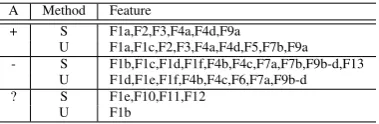
In Table 5, the performance of each feature is measured using N&K system and the target fea-ture. + indicates an improvement, - indicates a performance decline, and ? indicates no effect or unconfirmed due to small changes of perfor-mances. Again, supervised denotes Maximum Entropytraining andUnsupervisedis our unsu-pervised approach.
8 Discussion
We compared the performances over our candi-date selection and feature engineering with sim-pleKEA,N&K and our baseline system. In eval-uating candidate selection, we found that longer
Method Features C Five Ten Fifteen
[image:7.595.73.544.63.186.2]Match Precision Recall Fscore Match Precising Recall Fscore Match Precision Recall Fscore All KEA U 0.03 0.64% 0.21% 0.32% 0.09 0.92% 0.60% 0.73% 0.13 0.88% 0.86% 0.87% Candidates S 0.79 15.84% 5.19% 7.82% 1.39 13.88% 9.09% 10.99% 1.84 12.24% 12.03% 12.13% N&K S 1.32 26.48% 8.67% 13.06% 2.04 20.36% 13.34% 16.12% 2.54 16.93% 16.64% 16.78% baseline U 0.92 18.32% 6.00% 9.04% 1.57 15.68% 10.27% 12.41% 2.20 14.64% 14.39% 14.51% S 1.15 23.04% 7.55% 11.37% 1.90 18.96% 12.42% 15.01% 2.44 16.24% 15.96% 16.10% Length<=3 KEA U 0.03 0.64% 0.21% 0.32% 0.09 0.92% 0.60% 0.73% 0.13 0.88% 0.86% 0.87% Candidates S 0.81 16.16% 5.29% 7.97% 1.40 14.00% 9.17% 11.08% 1.84 12.24% 12.03% 12.13% N&K S 1.40 27.92% 9.15% 13.78% 2.10 21.04% 13.78% 16.65% 2.62 17.49% 17.19% 17.34% baseline U 0.92 18.4% 6.03% 9.08% 1.58 15.76% 10.32% 12.47% 2.20 14.64% 14.39% 14.51% S 1.18 23.68% 7.76% 11.69% 1.90 19.00% 12.45% 15.04% 2.40 16.00% 15.72% 15.86% Length<=3 KEA U 0.01 0.24% 0.08% 0.12% 0.05 0.52% 0.34% 0.41% 0.07 0.48% 0.47% 0.47% Candidates S 0.83 16.64% 5.45% 8.21% 1.42 14.24% 9.33% 11.27% 1.87 12.45% 12.24% 12.34% + Alternation N&K S 1.53 30.64% 10.04% 15.12% 2.31 23.08% 15.12% 18.27% 2.88 19.20% 18.87% 19.03% baseline U 0.98 19.68% 6.45% 9.72% 1.72 17.24% 11.29% 13.64% 2.37 15.79% 15.51% 15.65% S 1.33 26.56% 8.70% 13.11% 2.09 20.88% 13.68% 16.53% 2.69 17.92% 17.61% 17.76%
Table 3: Performance on Proposed Candidate Selection
Features C Five Ten Fifteen
Match Prec. Recall Fscore Match Prec. Recall Fscore Match Prec. Recall Fscore
Best U 1.14 .228 .747 .113 1.92 .192 .126 .152 2.61 .174 .171 .173
S 1.56 .312 .102 .154 2.50 .250 .164 .198 3.15 .210 .206 .208
Best U 1.14 .228 .74 .113 1.92 .192 .126 .152 2.61 .174 .171 .173
w/o TF*IDF S 1.56 .311 .102 .154 2.46 .246 .161 .194 3.12 .208 .204 .206
Table 4: Performance on Feature Engineering
A Method Feature
+ S F1a,F2,F3,F4a,F4d,F9a
U F1a,F1c,F2,F3,F4a,F4d,F5,F7b,F9a
- S F1b,F1c,F1d,F1f,F4b,F4c,F7a,F7b,F9b-d,F13
U F1d,F1e,F1f,F4b,F4c,F6,F7a,F9b-d
? S F1e,F10,F11,F12
U F1b
Table 5: Performance on Each Feature
length candidates play a role to be noises so de-creased the overall performance. We also con-firmed that candidate alternation offered the flexi-bility of keyphrases leading higher candidate cov-erage as well as better performance.
To re-examine features, we analyzed the impact of existing and new features and their variations. First of all, unlike previous studies, we found that the performance with and withoutTF*IDFdid not lead to a large difference which indicates the im-pact of TF*IDFwas minor, as long as other fea-tures are incorporated. Secondly, counting sub-strings for TF improved performance, while ap-plying term weighting for TFand/orIDF did not impact on the performance. We estimated the cause that many of keyphrases are substrings of candidates and vice versa. Thirdly, section in-formation was also validated to improve perfor-mance, as in Nguyen and Kan (2007). Extend-ing this logic, modelExtend-ing additional section infor-mation (related work) andweighting sectionsboth turned out to be useful features. Other locality features were also validated as helpful: bothfirst occurrence and last occurrence are helpful as it implies the locality of the key ideas. In
addi-tion, keyphrase co-occurrence with selected sec-tions was proposed in our work and found empiri-cally useful. Term cohesion (Park et al., 2004) is a useful feature although it has a heuristic factor that reduce the weight by 10% for simplex words. Nor-mally, term cohesion is subject to NPs only, hence it needs to be extended to work with multi-word NPs as well. Table 5 summarizes the reflections on each feature.
[image:7.595.87.277.315.377.2]9 Conclusion
We have identified and tackled two core issues in automatic keyphrase extraction: candidate se-lection and feature engineering. In the area of candidate selection, we observe variations and al-ternations that were previously unaccounted for. Our selection rules expand the scope of possible keyphrase coverage, while not overly expanding the total number candidates to consider. In our re-examination of feature engineering, we com-piled a comprehensive feature list from previous works while exploring the use of substrings in de-vising new features. Moreover, we also attested to each feature’s fitness for use in unsupervised proaches, in order to utilize them in real-world ap-plications with minimal cost.
10 Acknowledgement
This work was partially supported by a National Research Foundation grant,Interactive Media Search(grant # R 252 000 325 279), while the first author was a postdoctoral fellow at the National University of Singapore.
References
Ken Barker and Nadia Corrnacchia. Using noun phrase heads to extract document keyphrases. InProceedings of the 13th Biennial Conference of the Canadian Society on Computational Studies of Intelligence: Advances in Arti-ficial Intelligence. 2000.
Regina Barzilay and Michael Elhadad. Using lexical chains for text summarization. InProceedings of the ACL/EACL 1997 Workshop on Intelligent Scalable Text Summariza-tion. 1997, pp. 10–17.
Kenneth Church and Patrick Hanks. Word association norms, mutual information and lexicography. In Proceed-ings of ACL. 1989, 76–83.
Isaac Councill and C. Lee Giles and Min-Yen Kan. ParsCit: An open-source CRF reference string parsing package. In Proceedings of LREC. 2008, 28–30.
Ernesto D ´Avanzo and Bernado Magnini. A Keyphrase-Based Approach to Summarization:the LAKE System at DUC-2005. InProceedings of DUC. 2005.
F. Damerau. Generating and evaluating domain-oriented multi-word terms from texts.Information Processing and Management. 1993, 29, pp.43–447.
Lee Dice. Measures of the amount of ecologic associations between species.Journal of Ecology. 1945, 2.
Eibe Frank and Gordon Paynter and Ian Witten and Carl Gutwin and Craig Nevill-manning. Domain Specific Keyphrase Extraction. InProceedings of IJCAI. 1999, pp.668–673.
Carl Gutwin and Gordon Paynter and Ian Witten and Craig Nevill-Manning and Eibe Frank. Improving browsing in digital libraries with keyphrase indexes.Journal of Deci-sion Support Systems. 1999, 27, pp.81–104.
Khaled Hammouda and Diego Matute and Mohamed Kamel. CorePhrase: keyphrase extraction for document cluster-ing. InProceedings of MLDM. 2005.
Annette Hulth and Jussi Karlgren and Anna Jonsson and Henrik Bostrm and Lars Asker. Automatic Keyword Ex-traction using Domain Knowledge. InProceedings of CI-CLing. 2001.
Annette Hulth and Beata Megyesi. A study on automatically extracted keywords in text categorization. In Proceedings of ACL/COLING. 2006, 537–544.
Mario Jarmasz and Caroline Barriere. Using semantic sim-ilarity over tera-byte corpus, compute the performance of keyphrase extraction. InProceedings of CLINE. 2004. Dawn Lawrie and W. Bruce Croft and Arnold Rosenberg.
Finding Topic Words for Hierarchical Summarization. In Proceedings of SIGIR. 2001, pp. 349–357.
Y. Matsuo and M. Ishizuka. Keyword Extraction from a Sin-gle Document using Word Co-occurrence Statistical Infor-mation. InInternational Journal on Artificial Intelligence Tools. 2004, 13(1), pp. 157–169.
Olena Medelyan and Ian Witten. Thesaurus based automatic keyphrase indexing. In Proceedings of ACM/IEED-CS joint conference on Digital libraries. 2006, pp.296–297. Guido Minnen and John Carroll and Darren Pearce. Applied
morphological processing of English. NLE. 2001, 7(3), pp.207–223.
Thuy Dung Nguyen and Min-Yen Kan. Key phrase Extrac-tion in Scientific PublicaExtrac-tions. InProceeding of ICADL. 2007, pp.317-326.
Youngja Park and Roy Byrd and Branimir Boguraev. Auto-matic Glossary Extraction Beyond Terminology Identifi-cation. InProceedings of COLING. 2004, pp.48–55. Mari-Sanna Paukkeri and Ilari Nieminen and Matti Polla
and Timo Honkela. A Language-Independent Approach to Keyphrase Extraction and Evaluation. In Proceedings of COLING. 2008.
Peter Turney. Learning to Extract Keyphrases from Text. In National Research Council, Institute for Information Technology, Technical Report ERB-1057. 1999.
Peter Turney. Coherent keyphrase extraction via Web min-ing. InProceedings of IJCAI. 2003, pp. 434–439. Xiaojun Wan and Jianguo Xiao. CollabRank: towards a
col-laborative approach to single-document keyphrase extrac-tion. InProceedings of COLING. 2008.
Ian Witten and Gordon Paynter and Eibe Frank and Car Gutwin and Graig Nevill-Manning. KEA:Practical Au-tomatic Key phrase Extraction. InProceedings of ACM DL. 1999, pp.254–256.
Ian Witten and Eibe Frank. Data Mining: Practical Ma-chine Learning Tools and Techniques. Morgan Kauf-mann, 2005.