A Pairwise Event Coreference Model, Feature Impact and
Evaluation for Event Coreference Resolution
Zheng Chen The Graduate Center The City University of New York
Heng Ji
Queens College and The Graduate Center The City University of New York
Robert Haralick The Graduate Center The City University of New York
Abstract
In past years, there has been substantial work on the problem of entity coreference resolution whereas much less attention has been paid to event coreference resolution. Starting with some motivating examples, we formally state the problem of event coreference resolution in the ACE 1
Keywords
program, present an agglomerative clustering algorithm for the task, explore the feature impact in the event coreference model and compare three evaluation metrics that were previously adopted in entity coreference resolution: MUC F-Measure, B-Cubed F-Measure and ECM F-Measure.
Pairwise Event Coreference Model, Event Coreference Resolution, Event Attribute
1.
Introduction
In this paper, we address the task of event coreference resolution specified in the Automatic Content Extraction (ACE) program: grouping all the mentions of events in a document into equivalent classes so that all the mentions in a given class refer to a unified event. We adopt the following terminologies used in ACE [1]:
Entity: an object or set of objects in the world, such as person, organization, facility.
Event: a specific occurrence involving participants.
Event trigger: the word that most clearly expresses an event’s occurrence.
Event argument: an entity, or a temporal expression or a value that has a certain role (e.g., PLACE) in an event.
Event mention: a sentence or phrase that mentions an event, including a distinguished trigger and involving arguments. An event is a cluster of event mentions.
Event attributes: an event has six event attributes, event type, subtype, polarity, modality, genericity, and tense.
We demonstrate some motivating examples in table 1 (event triggers are surrounded by curly brackets and event arguments are underlined).
In example 1,event mention EM1 corefers with EM2 because they have the same event type and subtype
1
http://www.nist.gov/speech/tests/ace/
(CONFLICT: ATTACK) indicated by two verb triggers “tore” and “exploded” respectively, and the argument “a waiting shed” in EM1 corefers with “the waiting shed” in EM2. In example 2, EM1, EM2 and EM3 corefer with each other because they have the same event type and subtype (LIFE:MARRY) indicated by a verb trigger “wed” and two noun triggers “ceremony” and “nuptials” respectively. Furthermore, the two persons “Rudolph Giuliani” and “Judith Nathan” involving in the “Marry” event in EM1 corefer with “Giuliani” and “Nathan” in EM3 respectively. In example 3, EM1 does not corefer with EM2 although they have the same event type and subtype (LIFE:DIE) because the event attribute “polarity” of EM1 is “POSITIVE” (occurred) while in EM2, it is “NEGATIVE” (not occurred).
Table 1. Motivating examples for event coreference resolution
Example1
EM1: A powerful bomb {tore} through a waiting shed at the Davao City international airport
EM2:
.
The waiting shed literally {exploded}.
Example2
EM1: Rudolph Giuliani will {wed} his
companion, Judith Nathan, on May 24 in
EM2: Mayor Michael Bloomberg, will perform the {ceremony}.
the ex-mayor's old home.
EM3: The Giuliani-Nathan {nuptials} will be a first for Bloomberg, who is making an exception from his policy of not performing weddings.
Example3
EM1: At least 19 people
EM2: There were no reports of {deaths} in the second blast.
were {killed} in the first blast.
The major contributions of this paper are:
(1) A formal statement of event coreference resolution and an algorithm for the task.
(2) A close study of four event attributes: polarity, modality, genericity and tense.
2.
Event Coreference Resolution
We formulate the problem of event coreference resolution as an agglomerative clustering task. The basic idea is to start with singleton event mentions, traverse through each event mention (from left to right) and iteratively merge the active event mention into a prior established event or start the event mention as a new event. We first introduce the notation needed for our algorithm.
2.1
Notation
Let 𝐼𝐼 be the set of positive integers. Let 𝐴𝐴 be a set of attributes and 𝑉𝑉 be a set of values. Some attributes may have no values and some attributes may have one or more values. Any information about an event is a subset of 𝐴𝐴×𝑉𝑉, and the same applies to an event mention. Such abstraction makes it possible for us to extend the meaning of attributes.
In this paper we state that an event includes the following attribute members: 6 event attributes (type, subtype, modality, polarity, genericity and tense), a set of arguments, and a set of event mentions. Accordingly, we have the following notation:
Let 𝑒𝑒 be an ACE event. Let 𝑒𝑒.𝑎𝑎𝑎𝑎𝑎𝑎 be the set of arguments (entities, temporal expressions and values) in the event 𝑒𝑒. Let 𝑒𝑒.𝑒𝑒𝑒𝑒𝑒𝑒 be the set of event mentions in the event 𝑒𝑒.
An event mention has a distinguished trigger and a set of arguments. Accordingly, we have the following notation:
Let 𝑒𝑒𝑒𝑒 be an event mention. Let 𝑒𝑒𝑒𝑒.𝑡𝑡𝑎𝑎𝑡𝑡𝑎𝑎𝑎𝑎𝑒𝑒𝑎𝑎 be the event trigger. Let 𝑒𝑒𝑒𝑒.𝑎𝑎𝑎𝑎𝑎𝑎 be the set of arguments (entities, temporal expressions and values) in the event mention 𝑒𝑒𝑒𝑒.
Let 𝑀𝑀 be the set of possible event mentions in a document 𝐷𝐷. Let <𝑒𝑒𝑒𝑒𝑡𝑡∈ 𝑀𝑀 | 𝑡𝑡= 1, … ,𝑁𝑁> be the 𝑁𝑁 event mentions in the document 𝐷𝐷 listed in the order in which they occur in the document.
Let 𝐸𝐸 be the set of possible events in the document 𝐷𝐷. Let <𝑒𝑒𝑗𝑗 ∈ 𝐸𝐸 | 𝑗𝑗= 1, … ,𝐾𝐾> be the 𝐾𝐾 events.
The goal of event coreference resolution is to construct a function 𝑓𝑓: 𝐼𝐼 → 𝐼𝐼, mapping event mention index 𝑡𝑡 ∈ 𝐼𝐼 to event index 𝑗𝑗 ∈ 𝐼𝐼 .
Initially, each event mention 𝑒𝑒𝑒𝑒 is wrapped in an event
𝑒𝑒′ so that 𝑒𝑒′ contains a single event mention 𝑒𝑒𝑒𝑒. We denote
the wrapping function as 𝛼𝛼:𝑀𝑀 → 𝐸𝐸′, i.e., 𝑒𝑒′=𝛼𝛼(𝑒𝑒𝑒𝑒)where
𝐸𝐸′ is the set of 𝑒𝑒′ . Furthermore, 𝑒𝑒𝑒𝑒 and 𝑒𝑒′ satisfy the following properties: (1) 𝑒𝑒′.𝑒𝑒𝑒𝑒𝑒𝑒=𝑒𝑒𝑒𝑒 (2) 𝑒𝑒′.𝑎𝑎𝑎𝑎𝑎𝑎=
𝑒𝑒𝑒𝑒.𝑎𝑎𝑎𝑎𝑎𝑎
2.2
Algorithm
We describe an agglomerative clustering algorithm that gradually builds up the set of events by scanning each event mention from left to right.
Let 𝐸𝐸0 be the initial set of established events and𝐸𝐸0=
∅. 𝐸𝐸1= {𝛼𝛼(𝑒𝑒𝑒𝑒1)} and 𝑓𝑓(1) = 1. Let 𝛿𝛿 be a threshold. Let
𝑐𝑐𝑐𝑐𝑎𝑎𝑒𝑒𝑓𝑓:𝐸𝐸×𝑀𝑀 →(0,1) be a function which gives a score to any (event, event mention) pair.
At each iteration 𝑘𝑘 (𝑘𝑘= 2, … ,𝑁𝑁), let 𝑒𝑒𝑗𝑗 ∈ 𝐸𝐸𝑘𝑘−1 satisfy
𝑐𝑐𝑐𝑐𝑎𝑎𝑒𝑒𝑓𝑓�𝑒𝑒𝑗𝑗,𝑒𝑒𝑒𝑒𝑘𝑘� ≥ 𝑐𝑐𝑐𝑐𝑎𝑎𝑒𝑒𝑓𝑓(𝑒𝑒,𝑒𝑒𝑒𝑒𝑘𝑘) for any 𝑒𝑒 ∈ 𝐸𝐸𝑘𝑘−1
If 𝑐𝑐𝑐𝑐𝑎𝑎𝑒𝑒𝑓𝑓�𝑒𝑒𝑗𝑗,𝑒𝑒𝑒𝑒𝑘𝑘� ≥ 𝛿𝛿, then 𝑓𝑓(𝑘𝑘) =𝑗𝑗 and
𝐸𝐸𝑘𝑘= {𝑒𝑒1𝑘𝑘, … ,𝑒𝑒𝑁𝑁𝑘𝑘𝑘𝑘}
where 𝑒𝑒𝑛𝑛𝑘𝑘=𝑒𝑒𝑛𝑛𝑘𝑘−1for 𝑛𝑛 ≠ 𝑗𝑗 and 𝑒𝑒𝑛𝑛𝑘𝑘.𝑒𝑒𝑒𝑒𝑒𝑒=𝑒𝑒𝑛𝑛𝑘𝑘−1.𝑒𝑒𝑒𝑒𝑒𝑒 ∪ {𝑒𝑒𝑒𝑒𝑘𝑘},𝑒𝑒𝑛𝑛𝑘𝑘.𝑎𝑎𝑎𝑎𝑎𝑎=𝑒𝑒𝑛𝑛𝑘𝑘−1.𝑎𝑎𝑎𝑎𝑎𝑎 ∪ 𝑒𝑒𝑒𝑒𝑘𝑘.𝑎𝑎𝑎𝑎𝑎𝑎for 𝑛𝑛=𝑗𝑗.
If 𝑐𝑐𝑐𝑐𝑎𝑎𝑒𝑒𝑓𝑓�𝑒𝑒𝑗𝑗,𝑒𝑒𝑒𝑒𝑘𝑘�<𝛿𝛿, then 𝑓𝑓(𝑘𝑘) =𝑁𝑁𝑘𝑘−1+ 1 and
𝐸𝐸𝑘𝑘 =𝐸𝐸𝑘𝑘−1∪{𝑒𝑒𝑁𝑁𝑘𝑘𝑘𝑘} where 𝑁𝑁𝑘𝑘 =𝑁𝑁𝑘𝑘−1+ 1 and 𝑒𝑒𝑁𝑁𝑘𝑘𝑘𝑘=𝛼𝛼(𝑒𝑒𝑒𝑒𝑘𝑘)
After 𝑁𝑁 −1 iterations, we resolve all the event coreferences in the document.
The complexity of the algorithm is 𝛰𝛰(𝑁𝑁2). However, if we only consider those event mentions with the same event type and subtype, we can decrease its running time.
2.3
Pairwise Event Coreference Model
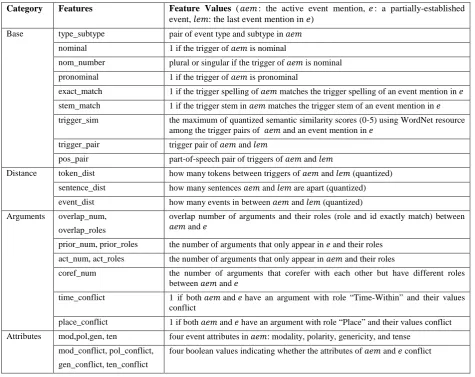
A key issue in the above algorithm is how to compute the coreference function 𝑐𝑐𝑐𝑐𝑎𝑎𝑒𝑒𝑓𝑓(∙ , ∙) which indicates the coreference score between the active event mention and a prior established event. We construct a Maximum-entropy model for learning such function. The features applied in our model are tabulated in Table 2. We categorize our features into base, distance, arguments and attributes feature sets to capture trigger relatedness, trigger distance, argument compatibility and event attribute compatibility respectively.
In this paper, we run NYU’s 2005 ACE system [2] to tag event mentions. However, their system can only extract triggers, arguments and two event attributes (event type and subtype) and cannot extract the other four event attributes. Therefore, we developed individual components for those four event attributes (polarity, modality, genericity and tense). Such efforts have been largely neglected in the prior research due to their low weights in the ACE scoring metric [1]. The event attributes absolutely play an important role in event coreference resolution because two event mentions cannot corefer with each other if any of the attributes conflict with each other. We encode the event attributes as features in our model and study their impact on the system performance. In the next section, we describe the four event attributes in details.
3.
Extracting the Four Event Attributes
3.1
Polarity
Table 2. Feature categories for the pairwise event coreference model
Category Features Feature Values (𝑎𝑎𝑒𝑒𝑒𝑒: the active event mention, 𝑒𝑒: a partially-established
event,𝑙𝑙𝑒𝑒𝑒𝑒: the last event mention in 𝑒𝑒)
Base type_subtype pair of event type and subtype in 𝑎𝑎𝑒𝑒𝑒𝑒
nominal 1 if the trigger of 𝑎𝑎𝑒𝑒𝑒𝑒 is nominal
nom_number plural or singular if the trigger of 𝑎𝑎𝑒𝑒𝑒𝑒 is nominal
pronominal 1 if the trigger of 𝑎𝑎𝑒𝑒𝑒𝑒 is pronominal
exact_match 1 if the trigger spelling of 𝑎𝑎𝑒𝑒𝑒𝑒 matches the trigger spelling of an event mention in 𝑒𝑒
stem_match 1 if the trigger stem in 𝑎𝑎𝑒𝑒𝑒𝑒 matches the trigger stem of an event mention in 𝑒𝑒
trigger_sim the maximum of quantized semantic similarity scores (0-5) using WordNet resource among the trigger pairs of 𝑎𝑎𝑒𝑒𝑒𝑒 and an event mention in 𝑒𝑒
trigger_pair trigger pair of 𝑎𝑎𝑒𝑒𝑒𝑒 and 𝑙𝑙𝑒𝑒𝑒𝑒
pos_pair part-of-speech pair of triggers of 𝑎𝑎𝑒𝑒𝑒𝑒 and 𝑙𝑙𝑒𝑒𝑒𝑒
Distance token_dist how many tokens between triggers of 𝑎𝑎𝑒𝑒𝑒𝑒 and 𝑙𝑙𝑒𝑒𝑒𝑒 (quantized)
sentence_dist how many sentences 𝑎𝑎𝑒𝑒𝑒𝑒 and 𝑙𝑙𝑒𝑒𝑒𝑒 are apart (quantized)
event_dist how many events in between 𝑎𝑎𝑒𝑒𝑒𝑒 and 𝑙𝑙𝑒𝑒𝑒𝑒 (quantized)
Arguments overlap_num, overlap_roles
overlap number of arguments and their roles (role and id exactly match) between
𝑎𝑎𝑒𝑒𝑒𝑒 and 𝑒𝑒
prior_num, prior_roles the number of arguments that only appear in 𝑒𝑒 and their roles
act_num, act_roles the number of arguments that only appear in 𝑎𝑎𝑒𝑒𝑒𝑒 and their roles
coref_num the number of arguments that corefer with each other but have different roles between 𝑎𝑎𝑒𝑒𝑒𝑒 and 𝑒𝑒
time_conflict 1 if both 𝑎𝑎𝑒𝑒𝑒𝑒 and 𝑒𝑒 have an argument with role “Time-Within” and their values conflict
place_conflict 1 if both 𝑎𝑎𝑒𝑒𝑒𝑒 and 𝑒𝑒 have an argument with role “Place” and their values conflict
Attributes mod,pol,gen, ten four event attributes in 𝑎𝑎𝑒𝑒𝑒𝑒: modality, polarity, genericity, and tense
mod_conflict, pol_conflict,
gen_conflict, ten_conflict
four boolean values indicating whether the attributes of 𝑎𝑎𝑒𝑒𝑒𝑒 and 𝑒𝑒 conflict
surrounded by curly brackets, the words indicating NEGATIVE are underscored)
• Using a negative word such as not, no Guns don’t {kill} people, people do.
No
• Using context, e.g., the embedding predicate with a negative meaning or sentence patterns
death sentence has ever been {executed} in the country.
Bush indefinitely postponed
She had decided to stay home
a {visit} to Canada.
rather than
3.2
Modality
{go} to a dance.
An event is ASSERTED if it is mentioned as if it were a real occurrence, otherwise it is OTHER. Two “ASSERTED” examples are listed as follows:
At least 19 people were {killed} in Tuesday’s blast.
We condemn all {attacks} against civilians in Haifa.
The “OTHER” examples have much more varieties. The examples include, but are not limited to (triggers are surrounded by curly brackets, the words indicating modality are underscored)
• believed events I believe
• hypothetical events
he will be {sentenced}.
If
• commanded and requested events
convicted of the killings, Vang {faces} life in prison.
He was commanded
• threatened, proposed and discussed events to {leave} his country.
He was threatened
• desired events
to {pay} the ransom.
• promised events The terrorist said he would
The modality of events can be characterized by a veridicality axis that ranges from truly factual to counter-factual and a spectrum of modal types fall between the two extremes, expressing degrees of possibility, belief, evidentiality, expectation, attempting, and command [3]. Actually, ACE has largely simplified the problem, i.e., the modality is “ASSERTED” for the two extremes, and is “OTHER” for all the other modal types.
{attack} the village.
3.3
Genericity
An event is SPECIFIC if it is a single occurrence at a particular place and time, or a finite set of such occurrences; otherwise, it is GENERIC.
Some GENERIC examples are listed as follows:
Hamas vowed to continue its {attacks}.
Roh has said any pre-emptive {strike} against the North's nuclear facilities could prove disastrous.
3.4
Tense
The tense of events can be characterized by a temporal axis in which we define the time of publication or broadcast as the textual anchor time. The PAST events occurred prior to the anchor time; the FUTURE events have not yet occurred at the anchor time; the PRESENT events occur at the anchor time; all the other events are UNSPECIFIED.
3.5
Models for the Four Event Attributes
We construct a Maximum-entropy model for each of the four event attributes. All the models apply the following common features:• the trigger and its part-of-speech
• event type and subtype
• the left two words of the trigger (lower case) and their POS tags
• the right two words of the trigger (lower case) and their POS tags
Furthermore, the polarity model also applies the following two features:
• the embedding verb of the trigger if any
• a boolean feature indicating whether a negative word exists (not, no, cannot or a word ending with n’t) ahead of the trigger and within the clause containing the trigger.
The modality model also applies the following feature:
• a boolean feature indicating whether a modal auxiliary (may, can, etc.) or modal adverbs (possibly, certainly, etc.) exists ahead of the trigger and within the clause containing the trigger.
The genericity model also applies the following three features:
• a boolean feature indicating whether the event mention has a “PLACE” argument
• a boolean feature indicating whether the event mention has a “TIME-WITHIN” argument
• the number of arguments that the event mention has except “PLACE” and “TIME-WITHIN”
The tense model also applies the following two features:
• the first verb within the clause containing the trigger and its POS tag
• the head words of the “TIME-WITHIN” argument if the event mention has one
4.
Experiments and Results
4.1
Data and Evaluation Metrics
For our experiments, we used the ACE 2005 English corpus which contains 599 documents in six genres: newswire, broadcast news, broadcast conversations, weblogs, newsgroups and conversational telephone speech transcripts. We first investigated the performance of the four event attribute classification models using the ground truth event mentions and system generated event mentions respectively. The evaluation metrics we adopted in this set of experiments are Precision (P), Recall (R) and F-Measure (F). We then validated our agglomerative clustering algorithm for the event coreference resolution using the ground truth event mentions and system generated event mentions respectively. The evaluation metrics we adopted in this set of experiments are three conventional metrics for entity coreference resolution, namely, MUC F-Measure [4], B-Cubed F-Measure [5] and ECM F-Measure [6]. We conducted all the experiments by ten times ten-fold cross validation and measured significance with the Wilcoxon signed rank test.
4.2
Performance of the Four Event Attribute
Classification Models
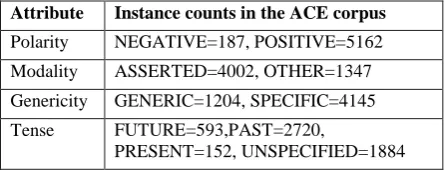
[image:4.595.314.537.599.684.2]Table 3 shows that the majority of event mentions are POSITIVE (5162/5349=0.965), ASSERTED (4002/5349 =0.748), SPECIFIC (4145/5349=0.775) and PAST (2720/5349=0.509).
Table 3. Statistics of the four event attributes in the corpus
Attribute Instance counts in the ACE corpus
Polarity NEGATIVE=187, POSITIVE=5162
Modality ASSERTED=4002, OTHER=1347
Genericity GENERIC=1204, SPECIFIC=4145
Tense FUTURE=593,PAST=2720,
PRESENT=152, UNSPECIFIED=1884
Table 4. Performance of the four event attribute classification models
Polarity Modality Genericity Tense
P R F P R F P R F P R F
Perfect (majority) 0.966 1.0 0.983 0.748 1.0 0.856 0.777 1.0 0.874 0.510 1.0 0.675
Perfect (model) 0.968 1.0 0.984 0.784 1.0 0.879 0.795 1.0 0.885 0.644 1.0 0.783
System (majority) 0.969 0.573 0.720 0.779 0.519 0.622 0.792 0.523 0.629 0.550 0.432 0.483
System (model) 0.974 0.574 0.722 0.805 0.527 0.637 0.799 0.525 0.633 0.677 0.484 0.564
baseline for each case using the majority value as output (e.g., for Polarity attribute, we always set the value to POSITIVE because POSITIVE is the majority).
Table 4 shows that the improvements for Polarity, Modality and Genericity over the baselines are quite limited while the improvements for Tense are significant, either using ground truth event mentions or using system generated event mentions.
4.3
Determining Coreference Threshold
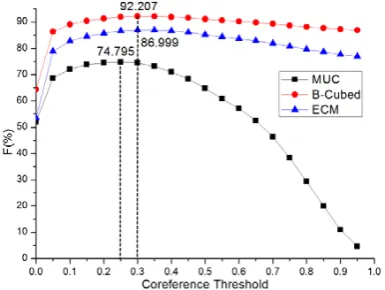
𝜹𝜹In order to determine the best coreference threshold 𝛿𝛿 in our agglomerative clustering algorithm, we conducted this set of experiments by integrating full feature sets (as listed in Table 2) in the pairwise event coreference model. We investigate how the performance varies by adjusting the coreference threshold𝛿𝛿. For this set of experiments, we use ground truth event mentions.
[image:5.595.319.530.320.399.2]Figure 1 shows the F-scores based on the three evaluation metrics by varying the coreference threshold 𝛿𝛿. The best MUC F-score, B-Cubed F-score and ECM F-score are obtained at 𝛿𝛿= 0.25,𝛿𝛿= 0.3,𝛿𝛿= 0.3 respectively. It is worth noting that the MUC F-score drops dramatically after𝛿𝛿= 0.5. We observed that as the threshold increases, more singleton events are produced and the dramatic decrease in MUC recall cannot offset the increase in MUC precision. As [5], [6] have pointed out, MUC metric does not give any credit for separating out singletons, therefore it is not quite effective in evaluating system responses with many singletons. The B-Cubed curve shows similar fluctuations compared to the ECM curve.
Figure 1. Determining the best coreference threshold 𝜹𝜹
4.4
Feature Impact
Table 5 presents the impact of aggregating feature sets on the performance of our pairwise event coreference model using the ground truth event mentions (coreference threshold 𝛿𝛿= 0.3).
Table 5. Feature impact using ground truth event mentions
MUC F B-Cubed F ECM F
Base 0.386 0.868 0.777
+Distance 0.446 0.866 0.781
+Arguments 0.530 0.879 0.804
+Attributes 0.723 0.919 0.865
Our Wilcoxon signed rank tests show that the F-score improvements are significant for all three metrics when we apply richer features except that there is a little deterioration for the distance feature set using B-Cubed metric. We observe that the improvement is dramatic using the MUC metric. However, it is not quite reasonable since we evaluate on the same system responses, varying in metrics. Since ECM overcomes some shortcomings of MUC and B-Cubed metrics as explained in [6], we focus on analyzing the results from ECM metric. In this setting, distance feature set contributes about 0.4% F-score improvement, while arguments feature set contributes nearly 2.4% F-score improvement. It is clear that the attribute feature set contributes the most significant contribution (6.08% absolute improvement).
[image:5.595.88.281.575.720.2]We then investigate whether the feature sets have similar impacts on the pairwise event coreference model using the system generated event mentions.
Table 6. Feature impact using system generated event mentions
MUC F B-Cubed F ECM F
Base 0.265 0.558 0.489
+Distance 0.254 0.548 0.483
+Arguments 0.274 0.552 0.490
+Attributes 0.28 0.554 0.492
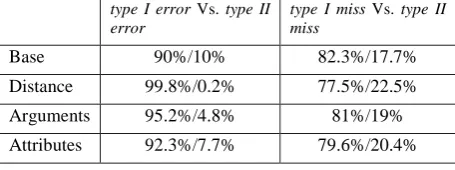
[image:5.595.315.532.611.688.2]directly affect the final score of event coreference, but also lead to the deteriorated event coreference model which is learned from spurious feature values. We name the spurious event coreference caused by the spurious event mentions as type I error, the spurious event coreference caused by the model and the clustering algorithm as type II error. Similarly, we define type I miss and type II miss, one is caused by the missing event mentions and the other is caused by the model and the algorithm. Table 7 shows the average ratio of type I error and type II error, ratio of type I miss and type II miss for each model which only applies the features in each feature category. It is clear that the performance bottleneck of event coreference resolution comes from the performance of system event mentions.
Table 7. Ratio of type I,II error and ratio of type I,II miss
type I error Vs. type II error
type I miss Vs. type II miss
Base 90%/10% 82.3%/17.7%
Distance 99.8%/0.2% 77.5%/22.5%
Arguments 95.2%/4.8% 81%/19%
Attributes 92.3%/7.7% 79.6%/20.4%
5.
Related Work
Earlier work on event coreference (e.g. [7], [8]) in MUC was limited to several scenarios, e.g., terrorist attacks, management succession, resignation. The ACE program takes a further step towards processing more fine-grained events. Ahn presented an event extraction system in which event coreference resolver is located at the end of a pipeline of event extraction [9]. However, Ahn did not point out what evaluation metric he used. [10] presented a graph-based method for event coreference resolution and proposed two methods for computing the coreference score between two event mentions. However, they only reported evaluation results on ground-truth event mentions.
Our experiments show that a high-performance event coreference resolver relies on a high-performance event mention extractor. Earlier work on event extraction systems was presented in [9],[11],[12],[13],[14].
6.
Conclusions and Future Work
We have formally stated the problem of event coreference resolution, presented an algorithm involving a pairwise event coreference model and studied the feature impacts on the pairwise event coreference model.
In the future, we will continue to put great efforts on improving the performance of event extraction system including trigger labelling, argument labelling and event attribute labelling. We believe that the improved components will finally help us improve the performance of event coreference resolution.
7.
Acknowledgements
This material is based upon work supported by the Defense
Advanced Research Projects Agency under Contract No. HR0011-06-C-0023 via 27-001022, Google Research, CUNY Research Enhancement Program and GRTI Program. Any opinions, findings and conclusions expressed in this material are those of the authors and do not necessarily reflect the views of the U. S. Government.
8.
References
[1] NIST. 2005. The ACE 2005 Evaluation
Plan. http://www.itl.nist.gov/iad/mig/tests/ace/ace05/doc/ace
05-evalplan.v3.pdf.
[2] R. Grishman, D. Westbrook, and A. Meyers. 2005. NYU’s English ACE 2005 System Description. In ACE 05 Evaluation Workshop, Gaithersburg, MD.
[3] R. Saurí, M. Verhagen and J. Pustejovsky. 2006. Annotating and Recognizing Event Modality in Text. In Proceedings of the 19th International FLAIRS Conference, FLAIRS 2006. Melbourne Beach, Florida. May 11-13, 2006.
[4] M. Vilain, J. Burger, J. Aberdeen, D. Connolly and L. Hirschman. 1995. A model-theoretic coreference scoring scheme. In Proceedings of the Sixth Message Understanding Conference (MUC-6).
[5] A. Bagga and B. Baldwin. 1998. Algorithms for scoring coreference chains. Proc. The First International Conference on Language Resources and Evaluation Workshop on Linguistics Coreference.
[6] X. Luo. 2005. On coreference resolution performance metrics. Proc. of HLT-EMNLP.
[7] A. Bagga and B. Baldwin. 1999. Cross-document event coreference: Annotations, experiments, and observations. In
Proc. ACL-99 Workshop on Coreference and Its Applications.
[8] K. Humphreys, R. Gaizauskas, S. Azzam. 1997. Event coreference for information extraction. In Proceedings of the ACL Workshop on Operational Factors in Practical Robust Anaphora Resolution for Unrestricted Texts.
[9] D. Ahn. 2006. The stages of event extraction. Proc. COLING/ACL 2006 Workshop on Annotating and Reasoning about Time and Events. Sydney, Australia.
[10]Z. Chen and H. Ji. 2009. Graph-based Event Coreference Resolution. Proc. ACL-IJCNLP 2009 workshop on TextGraphs-4: Graph-based Methods for Natural Language Processing.
[11]R. Grishman, D. Westbrook and A. Meyers. 2005. NYU’s English ACE 2005 System Description. Proc. ACE 2005 Evaluation Workshop. Washington, US.
[12]H. Ji and R. Grishman. 2008. Refining Event Extraction Through Cross-document Inference. Proc. ACL 2008. Ohio, USA.
[13]Z. Chen and H. Ji. 2009. Language Specific Issue and Feature Exploration in Chinese Event Extraction. Proc. HLT-NAACL 2009. Boulder, Co.