DOI: h
D
Abstra Track and u extrem of the proven applic system Keywo Prove some data, which destin lineag origin Exam The d its wa inject where action Da With sharin origin piece ensur and u the da new f strate high i The p some a brie[1] D value
http://dx.doi.or
DATA PRO
act:Data Prove
ing data provena sed significantly mely important f e main objective nance categorie cations which are m.
ords: Data Linea
enance means thing’s existen
the source of h is prepared nation in the s ge. Data prov nated to find mple Consider
drugs are trans ay the truck ge ted into the sy e the counterfe ns to recover fr ata Provenance the amount o ng of data, q nate from?”,“w of data is here re that data pr used appropriat ata be recorde field research i egies work and in data provena paper focuses examples on i ef review of W
II.MEANIN
Defines proven ed object or w
rg/10.26483/ija
Inte
OVENANC
nance means tra
ance helps in en y The area of d
for different app e of this paper i es like provenan e proposed to an
age, Data Proven
I. INTROD
something’s nce. Data prov f data. In toda d when circu same format or venance is stu
the lineage a Truck that sported from o
ts hijacked. An ystem. Data p eit drug got inje
rom it. e also has a va
f data increasi questions such who other is us
e?” are becomi rovided from tely, it is impo ed and made av is being going d also to reduce
ance. on the meani it, categories o 7 model for da
GANDAPPL PROVENA
nance as “the work of art or
arcs.v10i3.6418 V ernational Jou Av
CE TECH
Sonia Aro Comp Worldacing the lineag
suring that the
data provenance
lications, researc is to investigate nce granularity, nalyze present pr
nance, Data War
DUCTION
origin or the venance means ay’s scenario t ulated does n
r quality. This udying from w
during the d contains Drug one place to an nd some counte provenance is
ected, why it g
aluable role in ing in leaps an h as “where ing this data?” ing increasingl other sources ortant that the vailable to its on to study ho e the storage c
ing of data pr of provenance t ata managemen
LICATIONOF ANCE
history of ow literature” [1]
Volume 10, No urnal of Adva
REVIE
vailable Onlin
HNIQUES
RE
ora, Dr.Ritika puter Science & d College of Te Gurugram
ge of the source
data which is be
is becoming ve
ch on data prove e the semantics
data status, pr rovenance techn
rehouse,W7 Mod
e beginning of s the origin of the actual data not reach the s is called data where the data data flow. For gs loaded in it
nother. During erfeit drug gets studying from got injected and
scientific data nd bounds and
did this data ” and “why this ly common. To is trustworthy provenance of users. Being a ow provenance ost that is very
rovenance with techniques and nt.
FDATA
wnership of a . According to
o. 3, May-June anced Researc
W ARTICLE
ne at www.ija
AND SEM
EVIEW
a Balhara & D & Engineering
echnology & M m, Haryana, Ind
of data, who p
eing provided b
ery useful for s
enance has starte or meaning of d rovenance comp niques. We also
del f f a e a a r t, g s m d a. d a s o y f a e y h d a o [2], know importan and to e suggestin influence ownershi of data an while oth experime suggested the hope future. Th Consider missile s helps to b material w used dur available propertie and hen manufact The prov the predi tracing th a custom an organi Provenan debuggin traced to source da can also b holes can system.
e 2019 ch in Compute
arcs.info
MANTICS
Dr.Pooja Sapr Department Management dia performed manipby many differen
cientific researc
ed and there is s data provenance puting, semantic review a W7 m
wing the prov ce in that it c establish the ng other artis ed by it, and t ip. Some resea nd the process hers view it a ent workflow
d by [5], data that it is com he meaning ca an organizat system. In cas back track the d
was used while ring manufact and hence the s of other mate ce at the en turing process venance system iction of the s he workflow cy mer towards a p
ization. nce system ca ng and verificat find the actu ata can be remo
be useful durin n also be trac
er Science
S USING W
ra
pulation on data
nt providers and
ch work. Althou still a lot of work e. In this paper cs of provenanc odel for managi
venance of a can “help to de
historical imp sts who migh
to determine t archers define by which it ar as metadata r s, annotation provenance n mprehensive en
an be best exp tion manufactu se of a failure
design of the s e manufacturin turing, what ey are analyze erial in compar nd the best
again. m is a valuable
sales of an or ycle to predict product. It help
an prove to b tion. The error ual source of e oved during th ng the auditing cked very easi
ISSN No. 09
W7 MODE
a, how it came t
sources can be f ugh data proven k that needs to b we discuss with ce, provenance ing data for data
work of art i etermine the a portance of a ht have seen the legitimacy provenance as rrived at the da recording the ns and notes eeds to be cap nough to be us plained with an uring steering e the provenan system that spe ng, why was th other alternat ed to check wh rison to the ma alternative is
process that al rganization by t the liking pro ps to improve t
be a valuable r propagation p error. Any bug he processing. P g phase. The se
ily using the p 76-5697
EL-A
to existence,
fully trusted nance can be be done. One h some data storage and a provenance
is of great authenticity a work by
and been of current s the origin atabase [3], process of s [4]. As ptured with seful in the n example. part of a nce system ecifies what hat material tives were hat was the aterial used used for
lso helps in y backward
obability of the sales of
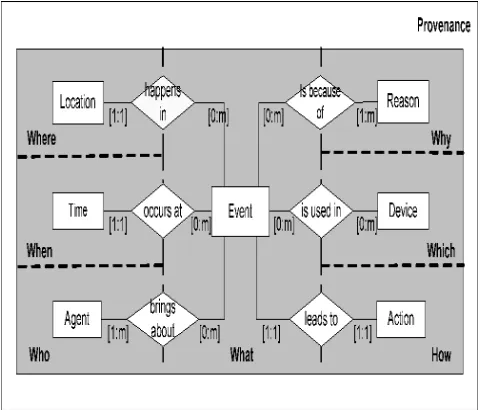
Figure1: Semantics of Provenance
The different application areas of provenance can be categorized as:
1. Data Quality: The reliability and data quality can be estimated by data lineage that is based on the source of the data and how it transforms[6].Proof statements on data derivation can also be provided[9].
2. Audit Trail: Audit trail is another application of the provenance system[10].It also determines the resource used[11] and the errors that propagated during data generation[12].
3. Replication Recipes: Detailing a provenance system can allow repetition of data derived. The currency of the data is maintained [10] and could serve as a recipe for replication [13].
4 Attribution: Ancestry of data can establish the copyright and ownership of data, enable its citation [14], and
determine liability in case of error prone data.
5. Informational: The inclusive use of pedigree is to query which is based on lineage metadata used for data discovery.
III. PROVENANCETECHNIQUES
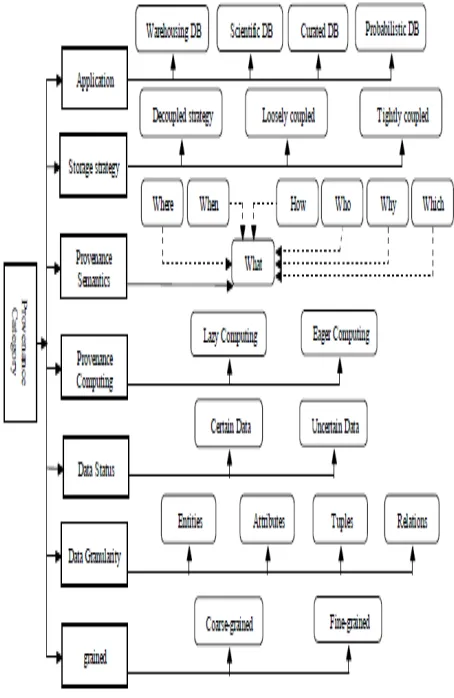
Figure 2: The Provenance Category
1. Provenance Granularity: Granularity a term which is associated with storage of provenance. It is divided into coarse grained or fine-grained provenance.
Coarse grained provenance basically records the complete history (or workflow) of the derivation of some dataset. It combines the pieces of information into one single piece. It records the input/output and transformations of derived data set into one single piece. It cannot however address any change in the database state. The storage cost however remains constant.
Fine Grained provenance stores the origin of each dataset. It provides with a detailed information on how the data is derived and the whole process involved in its transformation. However the storage cost is higher at this level since detailed storage of the dataset transformation is stored.
2. Data Granularity: Data granularity means the data exists in small pieces so that it becomes easier to abstract information from it. In DBMS data is stored in the form of attributes and when all attributes of similar interest are taken together they form a tuple or a record of data or information. The advantage of data granularity is that it can be molded in a way the scientists or researchers want.
3. Status of Data: A significant amount of data which is found in practice is imprecise, incomplete, and not reliable. Hence the data remains uncertain. The level of uncertainty in the data needs to be measured. It also needs to be recorded in order to estimate the confidence level of the results and find the potential sources of error. For some cases the dataset that is transformed needs to be examined in order to trace the errors involved and needs to be labeled accordingly. For this we need to back track to the input so that any further changes can be done to the input which could help in future processing. This is possible if the data is certain. But if the data is incomplete and the output is not labeled properly that is it is uncertain in that case the error sources could also be uncertain. Data provenance is useful in such cases for debugging scientific experiments which involves some sort of sensitive information.
4. Computing Data Provenance: There are two approaches for computing provenance. They are lazy and eager approaches. The eager approach is also known as the bookkeeping or annotation approach. In eager approach the query that is put to the dataset is re-engineered so that anything updated can be added to the output database during the process of transformation so that getting an answer to the provenance becomes simple. The result of it is that the provenance of output data can easily be derived from output database and the updates that are added.
The lazy approach on the other hand is also known as the non-annotation approach. It is a kind of approach that works only when a need arises. In this approach the provenance is calculated only when it is needed. When the need arises the source data, the output data and transformation is examined to compute the provenance. The advantage of this approach is that no space overhead is required and no further updates are necessary that incur cost.
In contrast in eager approach, extra space is required to store output database, transformations and updations and more cost is incurred to store the updates done time to time to the output database.
5. Semantics of Data Provenance: The actual semantics of the data provenance is still unclear and research is being done on what does it mean?, What are data provenance elements and many more questions to reveal its actual meaning. As pointed out by [43], a wide range of possible definitions exists in existing literature. Provenance can include literature references where data were first reported; its history in terms of how it had been stored, curated, and transferred; the series of experimental procedures, computations, and/or database queries through which it had been derived from other data; the sequence of ideas that lead to an experiment; its association with calibration and control data etc. Still at this point research is going on to conclude what does provenance means, what are its components, till what level of detail the provenance information is desired.
Coupled and Tightly Coupled.
Coupling refers to interdependence among data in the data provenance cycle. It means the degree to which data provenance relies on metadata.
In decoupled strategy of storage the provenance information is stored in separate stockroom which is independent of each other. Any change made to one stockroom would not affect the other stockroom.
In loosely coupled strategy of provenance storage, the data are stored independently in separate depositories, but there exist some mapping schemes which specifies how to track provenance using present data stored in different depositories.
In tightly coupled strategy of provenance storage there is dependence among the data stores and mapping exists to reveal data provenance from resent data. It is the most efficient storage scheme to track data provenance.
7. Database Applications: There are different database areas where how the data is stored and extracted helps to track data provenance. Some of these database applications are:
[image:4.612.324.564.421.626.2]I. Data Warehouse: A data warehouse is a storehouse of an electronically stored data [17].A data warehouse contains data which is clean and is in standardized form which is been integrated from various sources of information systems built by an organization in a way which fulfills standardized analytical requirements of a system. Figure 3 shows a simple architecture for a data warehouse. Tracing provenance in a data warehouse has several uses, which includes in-depth analysis and mining of patterns relevant to an information system.
Figure 3. Architecture of Data Warehouse
II. Curated Database: A kind of structured depository such as a traditional database which has been created and updated with human efforts. The best example is the reference works like an encyclopedia, dictionaries newspapers etc. These
types of databases contain updated data which can be used extensively at any time .It promotes the provenance process because the updated piece of data being traced by these referential processes.
III. Scientific Database: Scientific databases are the databases that can be represented in various fields such as astronomy, Biology, Biochemistry, Computer Science etc. These type of databases allows for integration of data sets that are dissimilar to each other and analyze them using cross-discipline approach that reveals a new data set. Data Provenance benefits from such databases by analyzing such tightly coupled databases that helps in improving data quality.
IV. Probabilistic Databases. Probabilistic databases are also known as databases with uncertainty. Any relational database can be represented without loss of information by a probabilistic database (Cavallo and Pittarelli, 1987).These databases are used to differentiate between physical data models and how data is represented in them.
IV. OVERVIEWOFW7MODEL
It investigates the semantics of data provenance based on reference (Ram et al., 2006) ,which represents provenance as a combination of seven elements including ―What, Where, When, How, Who, Which and Why. The W7 model unifies data provenance and provides a clear picture of provenance.
[image:4.612.65.293.443.647.2]What is the main character of the W7 provenance model. It defines the actual sequence which the events follow that is affecting any data object during its life span. It also describes any detail regarding the events also.
Where describes the set of locations at which these events took place. The most common form of location representation is physical, geographical and transaction locations.
Physical locations specify where you are. In other words it tells the site or an area within a site where the event took place.
Geographical location refers to the specified location or the boundary of the occurrence of an event.
Transaction locations are the locations where an event takes place within a server or database.
The timestamps that represent various provenance events is the When part of W7 model. The model represents the actual time when the event occurred which affect the data items to be used during the lifecycle. The W7 provenance model also keeps a record of the total duration when the event took place from start point to end point. These details helps to keep a record of the history of data items. How keeps a track of the relevant processing steps that lead to the occurrence of the event? These processing steps which are called as actions are performed so that a desired output could be achieved. Thus actions are the causes of events and vice-versa. The processing steps include the input, output, preconditions, sources and ways how they are performed.
Who designates the one who causes the occurrence of events; it can be any person associated, particular software or an organization.
Why defines any type of reasons for causing of various events in provenance. Beliefs and goals are its two sub-parts. Belief is what you think about an event that means the knowledge related to the event and goals are the ultimate result that needs to be achieved.
V. CONCLUSION
This paper gives a brief introduction to what data Provenance is. It describes the main application areas of Data provenance and the techniques used for data Provenance. At the end a survey of W7 model used for data management in data provenance is discussed. Future works are being done on this model to deeply explore the different characteristics of W7 model to improve the data quality used in the provenance system.
VI. REFERENCES
[1] Merriam-Webster, "Merriam-Webster Online. http://www.m-w.com/home.htm.
[2] H. U. A. Museums., "Provenance Research Project. http://www.artmuseums.harvard.edu/research/provenance/ind
ex.html
[3] Welsh, M. Jirotka, and D. Gavaghan, "Post-genomic science: cross-disciplinary and large-scale collaborative research and its organizational and technological challenges for the scientific research process," Philosophical Transactions: Mathematical, Physical and Engineering Sciences, vol. 364. [4] P. Buneman, S. Khanna, and W. C. Tan, "Data Provenance:
Some Basic Issues,"presented at FSTTCS, New Delhi, India, 2000.
[5] J. Frew and R. Bose, "Earth System Science Workbench: A Data Management Infrastructure for Earth Science Products," presented at the 13th International Conference on Scientific and Statistical Database Management, Fairfax, VA,2001.
[6] H. V. Jagadish and F. Olken, "Database Management for Life Sciences Research," in SIGMOD Record,vol. 33, 2004, pp. 15-20.
[7] ]Buneman P., Chapman v and Cheney J., ―Provenance management in curated databases. In SIGMOD, pp.539--550, 2006.
[8] CHENEY, J., CHITICARIU, L., AND TAN, W.-C. Provenance in databases: Why, how, and Where. Foundations and Trends in Databases 1, 4 (2009), 379–474..
[9] P. P. da~Silva, D. L. McGuinness, and R. McCool, "Knowledge Provenance Infrastructure," in IEEE Data Engineering Bulletin, vol. 26, 2003, pp. 26-32.
[10]S. Miles, P. Groth, M. Branco, and L. Moreau, "The requirements of recording and using provenance in e-Science experiments," in Technical Report, Electronics and Computer Science, University of Southampton,2005.
[11]M. Greenwood, C. Goble, R. Stevens, J. Zhao, M. Addis, D. Marvin, L. Moreau, and T. Oinn, "Provenance of e-Science Experiments - experience from Bioinformatics," in Proceedings of the UK OST e- Science second All Hands Meeting, 2003.
[12]H. Galhardas, D. Florescu, D. Shasha, E. Simon, and C.-A. Saita, "Improving Data Cleaning Quality Using a Data Lineage Facility," in DMDW, 2001, pp. 3.
[13]I. T. Foster, J.-S. Vöckler, M. Wilde, and Y. Zhao, "The Virtual Data Grid: A New Model and Architecture for Data-Intensive Collaboration," in CIDR, 2003.
[14]H. V. Jagadish and F. Olken, "Database Management for Life Sciences Research," in SIGMOD Record,vol. 33, 2004, pp. 15-20.
[15]https://docs.oracle.com/database/121/DWHSG/concept.htm #DWHSG8070
[16]Yogesh L. Simmhan, Beth Plale, Dennis Gannon,” A Survey of Data Provenance Techniques”, Technical Report IUB-CS-TR618.
[17]Tan W. C., ―Provenance in Databases: Past, Current, and Futureǁ, In IEEE Data Eng. Bull. vol.30, no. 4, pp. 3-12, 2007.
[18]Ikeda R. and Widom J., ―Panda: A System for Provenance and Data, Technical Report. Stanford InfoLab,2009.
[19]Ram S., Liu J., and George R. T., ―PROMS: A system for harvesting and managing data provenanceǁ, In WITS, 2006. url: http://kartik.eller.arizona.edu/WITS_DEMO_final.pdf [20]Y. Cui, J. Widom, and J. L. Wiener, "Tracing the Lineage of