
DOI: http://dx.doi.org/10.26483/ijarcs.v10i4.6441
Volume 10, No. 4, July – August 2019
International Journal of Advanced Research in Computer Science
RESEARCH PAPER
Available Online at www.ijarcs.info
© 2015-19, IJARCS All Rights Reserved 9
ISSN No. 0976‐5697 ISSN No. 0976‐5697
AN ANALYSIS OF VARIOUS FUNCTION IN WIRELESS SENSOR NETWORK
APPLIED IN PRECISION AGRICULTURE
Avishek Jana
Department of Computer Science & Application, Prabhat Kumar College,
Contai, PurbaMedinipur, West Bengal, India
Arindam Roy*, Corresponding Author Department of Computer Science & Application,
Prabhat Kumar College, Contai, PurbaMedinipur,
West Bengal, India
Abstract: Precision Agriculture is the idea of instantaneous observation of environmental and field parameters like soil moisture, humidity, temperature, soil PH etc. and transfer of the values of those parameters to the remote central server, which on the basis of these values, takes appropriate action to control the use of different resources like pesticides, water, fertilizer etc. in an optimized way in order to maximize the crop yield in terms of both quality and quantity. In Precision Agriculture, the farmers monitor and analyze the values of the field parameters in real time by using the Wireless Sensor Network (WSN) technology with the help of a varied range of sensors. This information further helps in making the exact judgment for controlling the resource allocation. This survey paper explores different existing methods, communication technologies and protocols related to sensor-based data collection, monitoring and control system. It also reviews the application of WSN in Precision Agriculture environment and successfully points out the future scope of the work in this domain.
Keywords: Precision Agriculture, Wireless Sensor Network, Wireless Communication Technology, Real time monitoring and control, Resource allocation.
1. INTRODUCTION
The main strength of India’s economic development is measured by the agricultural growth and development. In upcoming years’ old-fashioned way of farming will not be able to solve the problem of ever-increasing demands for the increasing population. Newer techniques need to be adopted to increase the agricultural productivity [1]. It is also important to develop eco-friendly technologies in a sustainable way. The application of WSN technology can be highly beneficial for remote measurement of parameters such as plant growth condition, including temperature, humidity, atmospheric pressure, soil moisture and water level. The wireless monitoring and controlling system can enhance the crop quality and productivity [2, 3]. The technological advancement in agricultural field gives birth to a new concept called precision agriculture (PA). PA is mainly based on the two types of techniques, which are “Map Based Precision Agriculture” & “Sensor Based Precision Agriculture”. On Map Based Precision Agriculture, various techniques like Geographic Information System (GIS),Global Positioning System(GPS), Remote Server (RS) technology, Soil sampling etc. are used to observe and control field parameters. GPS recognizes the exact location of the field, which will be helpful for observing, & controlling WSN based systems [4]. GIS technology helps us to collect the remotely sensed data, report of the crop inspection, soil survey maps and soil nutrient levels that are stored layer wise in remote central server [5]. However, the main disadvantage is that we cannot get the real time information from a map-based PA Techniques. In this approach, the prescribed map is stored on the server and accessed when required. So, in the meantime, if any changes occur in field variables, then it cannot be fetched. To overcome this problem,
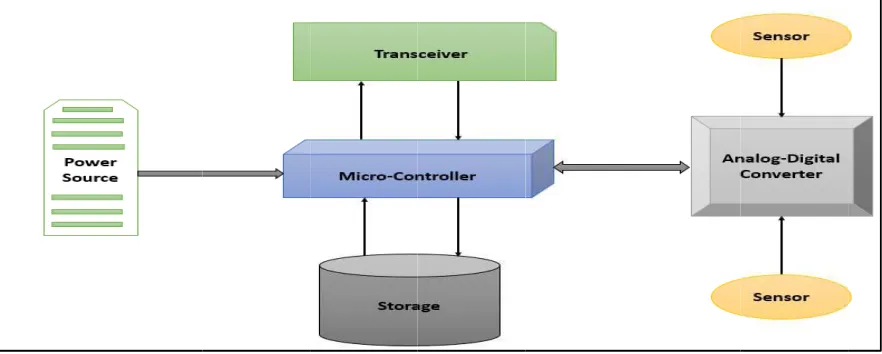
sensor-basedPA techniques can be used where we can get real time data. The Sensor is a device that can sense different types of physical parameters. Various sensor nodes are used to sense environmental and field variables. A simple sensor network consists of micro-controller, memory, analog to digital converter, transceiver & sensors, which arecapable of collecting sensory information, performing some kind of processing and communicating with other connected nodes in the network [2]. Sensor Network can be deployed for a wide range of applications. Currently its application has increased in agronomy. Observing crops for identifying environmental & field conditions and detecting the diseases also play an important role in successful farming. WSN technology can help us to decrease the work force, effort and time required for observing an agricultural environment. The application of WSN for crop field monitoring & controlling of resource utilization offers a tremendous possibility for massive profits for the farmers and society as a group [5].This survey paper reviews the existing works, finds their weaknesses and explores the scope of the future work in this field.
2. WIRELESS SENSOR NETWORK FOR
PRECISION AGRICULTURE (PA)
The Wireless Sensor Network (WSN) consists of distributed autonomous sensors to observe and control field & environmental parameters. It then submits the data to the remote server through the gateway node. The availability of smarter, smaller and inexpensive sensors solves the problem of monitoring of environmental parameters. The wireless sensors, connected with the applications, work in collaboration with the Wireless Node.
analy techn from netwo loadin variou comm collec obser param accor The senso In the classi Clust topolo 3.1 In thi anoth the B the d packe the re
yze the data i nology, monitor
off-line sen ork. Conseque ng and sharing us types of s munication sy ction and shari rve any small meters and rdingly.
Wireless Sens ors, analyzing
3.
e area of Prec ified into thre er tree-based ogy.
Star single is type of top her node throu Base Station. In
destination nod et to the Centr equirement, CS
in real-time. W ring & control sors to real ently, WSN i g the data. The sensors. Group ystem that p
ing defines a W change in the
provide th
sor Node con & the transmi
WSN TOPO
cision Agricul ee classes. - d multiple-ho
e-hop topology pology, one no ugh a central h nstead of send de, each Sens ral Server (CS S transmits the
With the adva lling system ha
time operati is applied for
data are collec p of sensor n ermits sponta WSN system.
e environment e appropriat
[image:2.612.86.527.198.375.2]nsists of vario ission module
Fig. 1: B
OLOGIES
lture, WSN to Star single-ho op topology
y
ode sends data hub/server, wh ding the packe sor Node (SN ). Thereafter, packet to the o
ancement of ave upgraded ional sensor
r retrieving, cted from the nodes and a aneous data
It permits to tal and field te warning
ous types of with a GPS
Basic Architectu
pologies are op topology, and Mesh
a packets to hich is called et directly to N) sends its
according to other node. system position [22]. A WSN small, large n transce 1shows has the tempor agricul
ure of Wireles
Tongto observi environ nodes, Server) system parame and m sensed web se specific accordi curve system action.
m and power ned either inth
N is a spatially low-weight w number of se eiver, sensor(s s the simple ar e capability to ral variables, w lture field.
s Sensor Node
onget. al. [24] ing the tempe nment. The env
one main no ), database, w m. In this sys
eters of the gr monitored by th
data to PC ter ervice record t c times. Fina ing to the cha
depicts any a m is activated, w
units. These he node mappin
y distributed n wireless nodes
nsors. A typi s), storage and rchitecture of th o sense, analyz which are retrie
] suggested a erature and hu vironment is c ode (Gateway) web service and
stem, the tem reenhouse env he sensor nod rminal. In PC t
the sensed val ally, the web anging values anomalous cha which instruct
e nodes are ng area or very
network of com that are equi ical node is m
d power sour he WSN nodes ze and share eved from envi
method of se umidity in a g comprised of so ), PC Termina d one real tim mperature and vironment can de. It then tra
erminal, the da lues of the par server draw of the variab anges, then th ts the user to t
efficiently y near to it
mparatively ipped with made of a rce. Figure s. The node
spatial and ironment & ensing and greenhouse ome sensor al (Central me warning d humidity be sensed ansmits the atabase and rameters at ws a curve
Shaik maint crop design sink system serial system proto 3.2
It is a server netwo layer termin nodes range nodes cluste centra enhan topolo deplo Arin
kh et. al. [25] p tain the moistu productivity. ned. The node
nodes. By u m transmits da l interface. A
m. The s col,''ProtoSens
Cluster tre
a three-layer, m r named as orks. Upper la consists of cl nal nodes. Am s is selected a e of the senso
s transmits dat er head. To tra al node, the low nce the quality
ogy diminishe oyment.
ndam Roy et al,In
proposed an ir ure level of th By using W es are classified
using ZigBee ata packets to
star single-hop system also se'' to commun
ee-based mult
multi-hop topol ‘central node ayer contains s luster head and mong those te as a cluster hea or nodes is lim
ta to the centra ansmit data into
wer level clust y of data pack es the energy
nternational Jour
F
rrigation contr he field for en SN nodes, th d into sensor, wireless tech a connected P p topology is o used a nicate among th
tiple-hop topo
logy consisting e’ and two o super cluster h d the lower la erminal nodes, ad in that laye mited, each o al node through
[image:3.612.89.527.63.223.2]o a super clust ter head act as kets. This type consumption
Fig. 3:
[image:3.612.107.512.529.703.2]nal of Advanced
Fig. 2: Star Sin
rol system to nhancing the he system is
actuator and hnology, the PC through a
used in this broadcast he nodes.
ology
g of a central or more-star head, middle ayer contains , one of the er. Since the f the sensor h the nearby ter head or a a repeater to e of network in the WSN
Cluster Tree-b
Research in Com
ngle –Hop Top
NesaSu clusters those s another transm transm single-h nodes topolog which multipl of the broadc cluster node a the sch than th In this were u method the sink in whic This m
based Multi –H
mputer Science, 10
pology
udha et al. [2 s. Each cluste sensor nodes, r node was th itted to the BS itted the data hop topology. was based o gy. Each node is known to th le Access (TD
nodes as the asted this inf . TDMA sche and those senso
hedule to save he threshold val
s paper, based used. The fir d, in which eac
k. The second ch nodes were method saved 10
Hop Topology
0 (4), July-Augus
26] arranged er contained si one node ac he base statio S through the packet to the . The overal on a cluster t e was identifie he BS. Accord DMA) scheduli cluster head a formation to a eduler assigned or nodes turne energy. If the lue, the BS wo d on TDMA s rst one was a ch node transm d method used
e grouped into 0% energy.
t 2019,9-25
sensor nodes ix sensor node ted as the ga on (BS). The cluster heads. e nearby nodes ll deployment
tree-based mu ed through a u ding to the Tim ing, BS selecte at any point o
all of the no d the time slot ed ON/OFF ac e collected dat ould inform the scheduling tw a direct comm mitted the data
data aggregati o clusters to sa
3.3
In me to ev transm
Gao e based fuzzy of so ZigBe config nodes wet s contro within These transm other analy the c
In W techn nodes Ardui Temp Frequ data ZigBe to co Ardui and p
Mesh topo
esh topology, e very other sen mit data from
et. al. [27] de d on WSN. The y logic. The sm oil fertility los
ee network guration. The s and the contr sensors, irrigat ol valves. Th n the cluster. e router nodes mit them to a h
nodes also. D yzed and accor controller secti Ref [24], [26 [27],[32 4. WI Wireless Sens niques and prot s are deployed ino Board, perature, e uency devices, from the fi ee/XBee/Bluet mmunicate am ino Board is u program is loa
ology
each sensor no nsor node, bu m the other
signed a smar e system was c mart control sy ss and water w
was adopted system was oller node. Sen ion pipes, spra he sensor nod
Some sensor collect data fr head node. He Data is logge rdingly the com
[image:4.612.91.526.136.292.2]ion for openin
Table 1: ference [25],[30] 6], [31] 2],[33],[34] IRELESS CO TECHNOL sor Network, tocols are used d. A node is
sensors (Hu etc.), ZigB battery, etc. S eld dependin tooth/Radio Fr mong the node used to connect aded within th
ode not only co ut also acts as nodes in th
rt irrigation co controlled acco ystem solved t
wastage in irr in the me designed by u nsor node cons ay irrigation a des act as term
nodes also ac rom the termin ead node gathe ed at fixed tim mmand is trans
ng and closing
Comparison o Star Single
OMMUNICAT OGY
several com d. In the field,
an embedded umidity, Mo Bee/XBee/Blue Sensors are use
g upon vario requency devic e and the gate t sensors and Z his micro contr
[image:4.612.81.531.509.597.2]ommunicates s a relay to he network.
Fig. 4: M
ntrol system ording to the the problems rigation. The esh network
using sensor sisted of soil-and irrigation
minal nodes ct as routers. nal nodes and ers data from me intervals,
smitted from g the valve.
of Reviewed lit e-hop Topolog √ X X TION mmunication many sensor device with oisture, and etooth/Radio ed to retrieve ous factors. ces are used eway device. Zigbee/XBee roller on the
Mesh Topology
Accord opened 3.4 The W summa the cor papers. most o implem is con reliabil high a topolog
terature accord gy Cluster Tr hop
basis o through station user (F these d occurs, through the use Differe protoco 4.1 W A Wir technol y
ding to the req d and closed to
Comparison WSN topologie arized in Table
rresponding ar . From this com of the reviewe ment WSN in f nnected to all lity of data tran amounts of da gy make it po
ding to Topolog ree Based Mult
Topology X √ X
of which, sen h Gateway, w . The retrieved Farmer, Admin data through so , then the base h the cellular n ers can take st ent types of ols are describe Wi-Fi based Wi
reless LAN is logies used0 i
quirement of maintain the w n of Wireless T es used in th e 1. The table c rticles and topo
mparison table ed literatures field scale. In m
l other nodes nsmission. Mo ata traffic. Al opular in WSN
gy Considered ti- Mes
sors will wor which in turn i
d data are store n, and Agricu oftware. If any e station sends network by usi teps for solvin f communica ed in this sectio ireless Sensor
one of the im in smart agric
water, the con water level of t
Technology he reviewed a
contains the re ology addresse e it can be con
used Mesh to mesh topology, s and thus e oreover, it can a
ll the benefits N based PA a
sh Topology
X X √
rk. Nodes are is connected t ed in the base ulture Expert) ytime any erro s the message ing GSM Mod ng the problem ation technolo on. Network mportant comm cultural system ntrol valve the field. articles are ferences of ed in these cluded that opology to , each node nsures the also handle s of mesh application.
connected to the base
station and can access r condition to the user dule so that m [18, 20]. ogies and
Arindam Roy et al,International Journal of Advanced Research in Computer Science, 10 (4), July-August 2019,9-25
© 2015-19, IJARCS All Rights Reserved 13
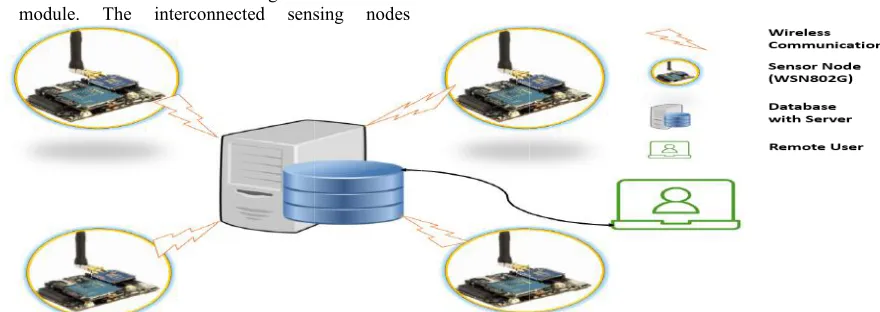
based smart wireless network (Fig. 5) consists of sensor nodes (WSN802G), gateway (wireless router), remote user and server with the database. The sensor nodes connect to the gateway through standard 802.11 b/g/n protocol [10,25]. In a first time, authentication of the sensors is done with a
[image:5.612.89.497.142.277.2]standard WPA2-PSK protocol in the gateway [10,18]. The gateway is further connected with the internet. The collected data are stored in remote server over the internet. User can access the data from the server through the internet.
Fig. 5: Wi-Fi based Wirweless Sensor network
This wireless technology [1] helps in real time monitoring of the agricultural field. The field and environmental parameters like water level, temperature, light, atmospheric pressure, humidity, etc. are collected dynamically and stored in server for further processing. The parameters are analyzed in the server to take farm management decisions about resource utilization. Proper decision helps to increase productivity and quality. The sensing modules used in this system can help to increase the battery life cycle as it uses low power (3.0 to 3.63v) sensor for data collection.
4.2 Bluetooth Based Wireless Sensor Network
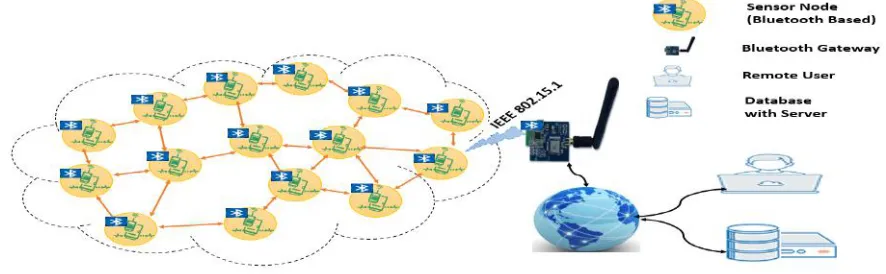
Wi-Fi based distributed wireless sensor network has some disadvantages like costly hardware for communication technology, time consuming installation and difficulties in maintenance. To overcome these disadvantages,Bluetooth based WSN can be used in PA. Bluetooth based system (Fig. 6) ensures dynamic, cost effective re-location and low power consumption [11, 22, 24].
Fig. 6:Bluetooth Based Wireless Sensor Network
A Bluetooth based WSN consists of sensor nodes, gateway, server and remote users. The sensing nodes are distributed over the field in an ad-hoc manner to collect data. Each node has three parts like memory for data logging, communication unit and battery. These nodes transfer data to the gateway node using Bluetooth (IEEE 802.15.1) at 2.4 GHz frequency. Further data are transferred to the base station (server) through the internet. The necessary analysis and decisions are made at the base station to monitor the environmental and field conditions [3]. The power consumption of this module is low as Bluetooth consumes very low power for transmission. The system is cost
effective as Bluetooth is a low-priced technology [5]. But it suffers from low communication range and poor data security.
4.3 Radio Frequency Based Wireless Sensor Network
[image:5.612.84.527.428.565.2]remot conne Senso throu mana server throu increa 4.4 Z Zigbe proto 2.4 G kBs o Zigbe shown 4.5 C This comm literat transm The resear comm
te user comm ection. Data c or nodes colle gh the gatewa agement are ta r module.. The gh the RF li ase the product
Zigbee Based W
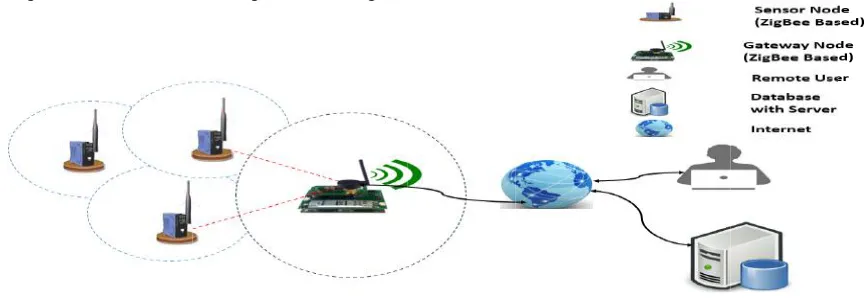
ee (IEEE 802 col for small s GHz frequency
over a range ee based smar n in Fig. 8. Th
Comparison o
section highl munication tech
tures used W mission, as the
limitation of rcher to use munication. Bu
municate with collection is a ect the data a ay. The decisi aken based on e decisions are ink. Precise c tivity.
Wireless Sens
.15.14) is a h scale applicatio y and provides
of 10 to 100 rt agricultural e sensors can b
f Communica
lights the ben hnologies used Wi-Fi and B ese two techno
these two tec RF device a ut ZigBee is v
the system us an important and transfer to
ions about cro n the collected
[image:6.612.88.529.183.328.2]sent to the con control decisio
Fig. 7:Radi
sor Network
high level com on. Zigbee[27] s transmission 0m. The archi monitoring sy be configured
Fig. 8:
ation Technolo
nefits and lim d in PA field. Bluetooth for ologies are easi chnologies enc and ZigBee very costly. So
sing internet part of PA. o the server op and field d data in the ntrolling unit
ons help to
io Frequency B
mmunication ] operates in n speed 250 itecture of a ystem [23] is
according to
: Zigbee Based
ogy
mitations of Most of the
field data ily available. courages the
for wireless o, RF device
The co and fre power. 2200m technol used i Spectru Spectru low-pri Based Wireless the star data ar Gatewa decisio data ov consum costly w
d Wireless Sens
can be number networ the dat limitati shows using t of usin ommunication equency range The battery li mAh at 3.3v
logy is IEEE in this proto um (FHSS um(DSSS), an iced technolog
s Sensor Netwo
r, mesh or peer re sent to the g ay sends these on making. Th
ver the interne mption is comp with respect to
sor Network
used for wirel rs of sensing rk configuratio ta collection. T ion in RF techn that there are v this technology ng this technolo
range of RF t e is 2.4 GHz
fe of each sens battery. The
802.11. The col are Freq S), Direct
d Diffuse Infr gy, which con
ork
r to peer topol gateway using e data to the he authenticate
et from the se paratively high o Wi-Fi, Blueto
less communic module arefix on needs to be This assumptio nology. The co very few work y. So, there is ogy in PA.
technology[21] . It consumes sor node is 5 m protocol us transmission quency Hoppin
Sequence rared. RF techn nsumes very l
ogies to collec the Zigbee ne
server for an ed user can ac erver. The rate her. Moreover ooth and RF tec
cation in PA fi xed for a parti done at the be on helps to ove omparison tabl ks done on data
a large scope
] is 1500m s very low months with
ed in RF techniques ng Spread
Spread nology is a ow power.
ct data. The twork. The nalysis and ccess these e of power r, Zigbee is chnology.
[image:6.612.91.523.447.596.2]In 20 monit archit enviro pressu are tr Wi-F In Ju irriga sensin statio They on so The statio were param irriga Arin Commun Techno Wi-Blueto Radio Fre ZigB 5. 012, Mandez toring system tecture has bee onmental tem ure, and soil m ransmitted to
i module.
uly 2008, Kim ation system u
ng station, we on. The system
estimated the oil moisture, te collected para on using Bluet
taken in the meters. The de ation control u
ndam Roy et al,In
nication ology
Fi E
ooth
equency Lo
Bee c
LITERATU
et al. [1] d m for agricul
en shown in Fi mperature, hu moisture and fie a central serve The intercon
Fig.
m et al. [6] d using WSN. Th eather station, m architecture h
requirement o emperature and ameters were tooth technolo e base station ecisions were unit. Water wa
[image:7.612.89.527.70.184.2]nternational Jour
Table 2: C
B
Easy to configu tran Low cost w
cons ong communic power c configured acc or peer to p
URE REVIEW
designed a W lture field. T ig. 9. The syste umidity, ligh eld water level er through the nnected sens
9: Concept of
developed a v he system com base station has been show of water for the
d environment transmitted ogy. The contr n based on th further transm as applied at t
nal of Advanced
Comparison of
enefits
uration , secure nsmission
with low powe sumption. cation range wi consumption. cording to star,
peer topologies W Wi-Fi based The system em collected ht intensity,
l. These data e WSN802G sing nodes
wireless monit
variable rate mposed of a and control n in Fig. 10. e field based al condition. to the base rol decisions he estimated mitted to the the specified
Research in Com
f Communicati
e data
er Lim
ith low Rec w mesh s. Shor
transm server for ana the mo has som / 802. wireles to whic
toring for Agri
position technol helped produc system transm life. In to cove But, th which c
mputer Science, 10
ion Technology Limitation Short battery mited commun range configuration P with adding new rt battery life w
cost
itted analogue stored the data alysis as per the odule senses te me limitations.
11, the powe ss modules. Mo ch data can get
iculture Enviro
n through the logy to transm in the pr ctivity, reducin m has some li ission range, p addition to tha er the field area his large numb can cause nois
0 (4), July-Augus
y
n
life [
nication
Problem w node with high
e data to the a so that the far e requirement. emperature an . Since the mo er consumptio oreover, it has t corrupted dur
onment [1]
sprinkler. The mit data and c
recise manag ng the enviro imitation like poor data secur
at, a large num a, as the range mber of nodes e and overlapp
t 2019,9-25 Reference [1,10,18,24,28] [3,5,11,22,25] [16,21,26] [23,27]
center hub. T rmers can acce Along with oth nd humidity. H odule is WSN8 on is higher some security ing transmissio
e system used control decisio gement with
onmental pollu slow data sp rity and shorten mber of nodes a
of Bluetooth i may create in ped data.
]
The central ess the data
her factors, However, it 802G Wi-Fi than other y issues due
on.
[image:7.612.84.524.299.455.2]Verm system shown tempe of the and a data t
In 20 crop system moist proce transm thresh farme alarm due t the da as it u Sarik detec enviro wirele propo diseas health These did n
Fig.
ma et al. [7] m based on W n in Fig. 11 erature and lig e crop field. It a computing un to the comput
11, K.Nirmal monitoring sy m gathered ture data and essing. ZigBe mission. An hold value set ers were notifi m system. The
o the packet l ata packet. Th uses costly Zig a et al. [9] tion system onmental temp ess sensor ne osed model is g
se based on en h and field con e two paramete not consider t
10: Conceptua
proposed a fi WSN. The sys . The system ght intensity u ’s composed o nit. The sensing ting unit throu
F
et al. [8] desig ystem to moni pH, humidity
transferred it ee technology alarm was t for each par ed about the f order of the oss, as the sys he replacement gbee technology
proposed a for the gra perature, humi etwork. The sy
given in Fig. 1 nvironmental p ndition were n ers are highly these paramet
al system layou
[image:8.612.88.539.60.229.2]field condition stem architectu m observed th understand the of sensing mod g module sent ugh the XBee
Fig. 11: Wirele
gned a real tim itor paddy cro y, and temp to the server y was used generated bas rameter in the field condition transmission w stem could no t cost of this sy
y.
Downy Mild ape field bas dity and wind ystem architec 2. The system parameters onl not observed in correlated. Bu ers. This syst
ut of in-field w
n monitoring ure has been he humidity,
requirement dule, RF unit the collected RF module.
ess Sensor Netw
me automated op field. The erature and r for further d for data
sed on the server. The through this was affected ot re-transmit ystem is high
dew disease sed on the speed using cture of the
detected the ly. The plant n the system. ut the authors tem did not
wireless sensor
The ob The fa graphic provide radio f limitati decisio
work for Crop
provide detecte sympto
network for si
bserved parame farmers could
cal user interfa ed a high range frequency mod ions - it cann on about the fie
Field Monitori
e a precise s ed the disease oms.
ite-specific irri
eters were stor access this ace loaded into
e of communic dule. In additio not analyze th eld parameters.
ing [7]
solution for th e after the ap
gation [6]
red in the comp information o the system. T cation with a c
on, the system he data and ta
.
he disease co ppearance of
puting unit. through a The system
ostly XBee m has some ake control
[image:8.612.86.533.341.471.2]
Mat WSN Moist monit
In 20 WSN very neigh on th also provi system modu Das consi unma relate
Arin
et al. [10] de N based on soil ture Sensor Ne tor and contr
013, Bang et a N for PA appl simple geome hboring space p heir range and helped with ding efficient m did not use ule. It causes no
et al. [12] des sting of senso anned aerial ve ed information
[image:9.612.70.510.73.206.2]ndam Roy et al,In
Fig. 12
esigned an irri l moisture leve etwork (WMSN rol the moistu
l. [11] propose lication. The r etric relation points. The sen
the degree of energy effic t information any scheduling oisy data and h signed an auto ors, camera, G ehicle (UAV). T
n like canopy
nternational Jour
2: Layout for M
igation contro el. In this syste N) technology ure level of
Fig. 13:
ed a deployme recommended
between a sen nsors were dep f connectivity. cient data co
coverage. Ho g algorithm for high-power con omated monito GPS device pi
This system ex y volume, m
nal of Advanced
Monitoring and Wireless Se
ol unit using em, Wireless y was used to the field to
Irrigation Con
ent model of model used nsor and its ployed based
This model ollection by owever, this r the sensing nsumption. oring system
voted on an xtracted crop morphological
Research in Com
d Detection of A ensor Network
enhanc conside affect t the sys
ntrol system usi
pattern system variabi modifie present data fr position to extr images further softwar inform from th stress,
mputer Science, 10
Agricultural D [9]
ce the crop p er environmen the water requi tem is shown i
ing WSN [10]
n, and yield and m was fixed at ility of the w ed accordingly ted in Fig. 14. romthe collect nal data was c act useful posi s of the field
mapped with re. A 3D map w ation. Further his mapped da leaf area, fruit
0 (4), July-Augus
Disease using
productivity. H ntal and field
irement of the in Fig. 13.
d leaf area ind a particular a whole field, th
y. A block di . The system f tion point thro cleaned with an
itional data. T d were collect the positional was generated r, a predictive ata to assess th
count etc.
t 2019,9-25
However, the parameters, w field. The arch
dex from this sy angle. Thus, to
he system ne iagram of this first collected ough GPS rec n extended Ka Then thermal a ted. These im information th in GIS softwar e model was he canopy volu
ey did not which may hitecture of
ystem. The o cover the eeds to be s system is position of eiver. This alman filter and spectral mages were
[image:9.612.96.514.298.466.2][image:10.612.104.531.63.231.2]
© 2015-19, IJARCS All Rights Reserved 18
Fig. 14: The data processing pipeline starts with the WSN [12]
In 2015, Pascual et al. [13] proposed a model, which could monitor temperature, relative humidity and soil moisture wirelessly using ZigBee protocol. Data were collected in a remote computing unit through XBee. The data were analyzed in MATLAB software. The system architecture
(Fig. 15) consisted of soil moisture, humidity and temperature sensor, XBee unit and Arduino. But, one main drawback of the system is its use of the costly transmission device (XBee).
Fig. 15: Sensor Node Block Diagram for Precision Agriculture [13]
Maurya et al. [14] proposed an energy efficient routing protocol to maximize the lifetime of the sensor network. Sensor nodes continuously sense temperature and soil moisture content of agricultural field and check whether the value of these parameters exceeds the desired threshold level or not. If the value exceeds the limit, then a data packet will be sent to the base station. Control decisions are taken based on the reception of this data packet. Thus, the system reduces the continuous transmission and consequently the power consumption for communication. The limitation of
the proposed protocol is that the base station stays idle in case the sensed value does not cross the threshold value for the parameters.
[image:10.612.96.524.330.511.2]Arindam Roy et al,International Journal of Advanced Research in Computer Science, 10 (4), July-August 2019,9-25
[image:11.612.96.524.55.271.2]
© 2015-19, IJARCS All Rights Reserved 19
Fig. 16: Functional block diagram of monitoring system [15]
The reviewed articles are summarized in Table 3 with the proposed schemes and their drawbacks.
Table 3: Summary of the Literature Review
Paper System Drawbacks
[6] Variable rate irrigation using Bluetooth Data overlapping, low transmission range, not secure as unlicensed band is used for data transmission [7] Field parameter monitoring system System cannot analyze data to control field parameters
[8] Paddy crop and fieldmonitoring system No mechanism to resend the lost packet [1] Wi-Fi based sensing module to collect
environmental and field data. High Power consumption
[9] Disease detection and monitoring system Only disease detection but no control mechanism
[10] Irrigation control system by using Wireless Moisture Sensor Network
(WMSN) Technology
No other environmental and field parameters are considered except soil moisture level
[11] A geometric relation between a sensor
and its surrounding space points No information about deployment strategy and scheduling algorithm [12] Automated monitoring system Device fixed at a particular angle and distance thus lacks in
monitoring the crop from other sides [13] Field & environmental parameters
monitoring and controlling system Since the model used XBee for communication, the system is not cost effective [14] An energy efficient network layer routing
protocol
Base station cannot retrieve any data until the values of parameters cross the threshold level. As a result, base
station remains idle for a long time [15] Monitoring system to notice the
environmental and field parameters. System only observed and stored the parameters and did not provide any control decision
6. CLASSIFICATION OF EXISTING SYSTEM
The literatures can be classified according to the design of experiments. There are two types of study found in literature, one is simulation based system and another is an implementation based system. Simulation based system can be further divided into three classes according to the type of simulator. Implementation based system is also classified
[image:11.612.88.519.336.614.2][image:12.612.86.518.81.245.2]
© 2015-19, IJARCS All Rights Reserved 20
Fig. 17: Classification of Existing System
In [13] the authors proposed a simulation based WSN for PA application. They used MATLAB 7.0 software for the simulation. In [28] the authors implemented a WSN for energy efficient data transmission among sensor nodes using the Tossim simulation tool. In [29] the authors proposed a simulation based WSN for PA application. They used theQualNet software for the simulation.
In [22] the authors implemented a WSN for collecting data and monitoring the field parameters using GSM and ubiquitous wireless sensor networks. In [7] the authors proposed an implementation based WSN for PA application. They used Ethernet with Radio Frequency for implementing the project in real life. In [23, 27] the authors implemented a WSN for soil moisture monitoring system in the field usingZigbee. In [21,26] the authors proposed an
implementation based WSN for PA application. They used Radio Frequency for the automated irrigation control system. In [3,5,11,22,24,25] the authors implemented a WSN for environmental parameter monitoring and data collection system in the field using Bluetooth. In [25, 28] the authors proposed an implementation based WSN for PA application. They used Wi-Fi for controlling the water level of the field.
This analysis helps to figure out the most frequently used hardware for PA applications. Bluetooth with Ethernet is the most common combination used in the reviewed literatures for data collection. RF with Ethernet module are used very rarely in these articles. The cost of RF module is lower than all other modules, so RF with Ethernet can be a cost-effective solution for future application.
7. COMPARISON STUDY OF REVIEWED
ARTICLES
The existing WSN approaches are compared in Table 4 based on their applications, characteristics, schemes, technology and drawbacks. Table 3 represents the papers with their proposed schemes and existing drawbacks in their system. Table 4 compares the reviewed articles based on their technical details. From the table, we can observe that WSN is applied in PA for irrigation control, crop monitoring, field &environmental parameter monitoring system etc. The major contributions of the reviewed literatures are classified based on their proposed system, technology, sensors, frequency band, range of communication, battery life, cost and power consumption. The limitation of each study is described in the “Remarks” column.
In the crop monitoring system proposed in [1, 23, 27] soil moisture, temperature, wind speed, wind direction, humidity, rain gauge, water and pH sensors were used. The sensor nodes communicated with each other and transmitted the data to the gateway through the Zigbee technology. Whereas in case of real time monitoring system [18, 25, 28] although the same type of sensors was used but data
transmission was done through the Wi-Fi technology. Due to the use of Wi-Fi, the module supports easy configuration and communication among deployment nodes. This technology also provides secure data transmission. But the power consumption is comparatively higher than other technology-based systems. Therefore, it is not suitable for covering large area with a significantly high number of nodes. On the other hand, although Zigbee technology provides secure data transmission with low power consumption, but it causes high cost. To provide the cost-effective module, Bluetooth technology is used [22, 24] in monitoring and data collection system. This technology is used with all types of major sensors as it is cost effective and requires low power consumption. The major drawbacks of these systems are low communication range and data overlapping. To overcome low communication range, RF technology was introduced in the automated irrigation control system [21, 26] for controlling the soil moisture. However, it also suffers from the reconfiguration problem while adding new nodes.
Arindam Roy et al,International Journal of Advanced Research in Computer Science, 10 (4), July-August 2019,9-25
© 2015-19, IJARCS All Rights Reserved 21
secure automated monitoring and controlling system considering all spatial and temporal variables involved in agricultural pursuit. Further research is also required to find the applicability of low-cost LORA technology in PA, to overcome the power consumption problem and low communication range.
[image:13.612.87.527.152.742.2]From this comparison, we can conclude that a low cost WSN with extended lifetime is required to monitor spatial and temporal variables and their interdependency
Table 4: Comparison Table for Reviewed Articles
Ref Sys Tech Sensor Freq Range Battery Cost Power Remarks
[1] Crop Monitori
ng System
ZigBee Soil moisture/ temperature, Wind speed,
wind direction, temperature,
humidity, rain gauge,
water and pH level
68 MHz 902 –
928 MHz 2.4 GHz
100-200 m than one Greater year
High Low Data Conflict in communicati
on between ZigBee and Gateway due
to large number of
nodes
[18] Real time monitori
ng system
Wi-Fi Temperature , humidity, water level,
soil moisture, light, and pressure.
2.4
GHz 100 m 2 – 3 hrs Low High Short battery life.
[21] Node deploym
ent in WSN
Radio Frequenc
y
Soil
moisture 315, 433, 868, 915 MHz
150 m 6-12
months Low Low Reconfiguration Problem with adding new node
[22] Monitori ng and data collectio n system
Bluetoot
h temperature, Air wind speed/directi
on, air humidity, air
pressure
2.4
GHz 10 m 1 Week Low Low communicatiShort range on and data overlapping
[23] Soil moisture monitori
ng system
Zigbee Temperature , Humidity
68 MHz 902 –
928 MHz 2.4 GHz
100-200 m
> 1 yr High Low Soil and crop Parameters
are not monitored
[24] Agricultu re environm
ent monitori
ng system
Bluetoot
h Temperature, Relative, Humidity,
Soil Moisture
PH, Light
2.4
© 2015-19, IJARCS All Rights Reserved 22
[25] Crop monitori
ng system
Wi-Fi Temperature , Humidity,
Pressure, Soil Moisture,
PH
2.4
GHz 100 m 2 – 3 hrs Low High The module supports easy configuratio nandcommu nication among the
deployed nodes
[26] Automat ed irrigation
control system
RF Temperature , Moisture
315, 433, 868, 915 MHz
150 m 6-12
months Low Low Field crop and parameters
are not considered
[27] Real time monitori
ng system
Zigbee Temperature , Humidity,
Gas
68 MHz 902 –
928 MHz 2.4 GHz
100-200 m than year Greater High Low energy and It saves provides
secure communicati
on
[28] Data collectio n system
Wi-Fi Water level, Soil moisture
2.4
GHz 100 m 1 – 2 hrs Low High The system is not effective for
large scale farming due
[image:14.612.85.530.486.702.2]to high power consumption Fig. 18 compares the wireless communication technologies
considered in reviewing literatures with respect to consumed power, communication range and cost. From these graphs, it is clear that Bluetooth is a low powered and low-cost technology used in PA application. But, the disadvantage of transmitting at unlicensed band and lower communication
range in Bluetooth encourages the researcher to use, low cost, low power consumption and long-range LORA module. With these comparisons it is clear that RF module is the most profitable technology used in PA application with respect to cost, power consumption and communication range.
Arindam Roy et al,International Journal of Advanced Research in Computer Science, 10 (4), July-August 2019,9-25
© 2015-19, IJARCS All Rights Reserved 23
[image:15.612.87.526.54.244.2](b)
Fig. 18: Comparison of Wireless Communication Technologies: (a) Comparison with respect to Power Consumption and Communication Range, (b) Comparison with respect to Cost
8. CHALLENGES OF SENSOR BASED
MONITORING IN PA
The development of WSN initiates new research movements in the Precision Agricultural domain. WSN with tiny, self-controlling sensor nodes, low cost equipment, and scalability makes it suitable for agricultural automation. However, there are several open issues related to the deployment of WSN that makes this automation a challenging task. Some of these challenges are listed below.
8.1 Power Consumption and Battery Life
The time required from sowing to harvesting is 3-4 months. The system of WSN needs to be sustained throughout this period for real time monitoring. During these periods, frequent battery replacement is not feasible and cost effective. Therefore, power consumption of the sensor network must be low to ensure extended battery life. Hence, high performance battery or renewable energy source such as small solar panels, rechargeable battery etc. is required. In case of multi-hop WSN the rate of power consumption is increased due to the large number of communication links. Therefore, new schemes must be developed to optimize the power consumption in order to increase the overall network lifetime.
8.2 Communication Range
WSN may suffer from several natural calamities due to the large field surroundings in the open air. In agricultural applications, most wireless sensor technologies support a relatively short communication range. Therefore, many sensors and router nodes need to be spread in a field. In the point-to-point WSN, the communication distance can reach 100 m in outdoor environments. The WSN communication range can be extended by adopting multi-tire, ad-hoc, decentralized, and mesh network topologies. Drones or UAV also can be used as a mobile router node to extend the communication range within a farm field. A drone can pass the collected data from the sensor nodes to the master node in multi-hop manner. However, using drones involves other challenges and limitations like cost, battery life. Security
etc. A good and effective system with high range communication requires algorithms to control error in transmitted data.
8.3 Deployment
Deployment means placing the actual sensors in a real-world environment. Proper deployment of the sensors is a critical area that needs to be addressed with proper care in order to increase network lifetime, reduce communication cost and communication delay and increase the overall effectiveness of the network. The system can be implemented using star topology with single-hop communication. The system architecture consists of base station and PC, as a server. The server can monitor and display the data. For large deployment of huge numbers of nodes, cluster tree based multi-hop communication may be more appropriate which needs further investigation.
8.4 Localization
The important function of a sensor network is to retrieve and forward data to the destination node. In real time, sensors are deployed from the airborne system without knowing the actual position in remote places. There may be no supporting transportation to reach that position. In this scenario, physical locations of the sensors need to be determined by localization algorithm. Hence, effective localization technique is required for the WSN.
8.5 Synchronization
In case of wireless networks, synchronization is very important for basic communication. The synchronization related problem depends upon the four parts: send time, access time, propagation time, and receive time. In agriculture environment, clock synchronization is required for analyzing the data and participating in the monitoring system to take correct control decision at right time.
8.6 Security
© 2015-19, IJARCS All Rights Reserved 24
transmission, some error can be generated or mixed up with the original data. To protect the data from various malicious activities, certain security issues need to be carefully handled.
8.6.1 Data Integrity
It ensures that data packets are correctly transferred from the sender to the destination and cannot be changed in the middle. It ensures the assurance of the accuracy and consistency of data over its entire life-cycle. This problem may be solved by using secure tunnel through VPN functionality.
8.6.2 Data Confidentiality
Confidentiality is the specific mechanism to ensure the protection of data from harmful intruders. It allows only the authorized users to access sensitive and protected data. During short- or long-range communication over the medium, confidentiality is one of the most important issues in network security which can be solved by the application of appropriate cryptographic mechanisms.
8.6.3 Data Authentication
Without proper authentication, the data may be hijacked, accessed or changed by any unauthorized person or authority. This problem may be solved by using a secret key to compute a message authentication code for all communicated data.
8.7 Real time
The health of crops and yield depends on climate conditions, like humidity, intensity of illumination, temperature, etc. Monitoring the weather conditions in hourly or daily basis are very laborious to the farmers. For these reasons, WSN deployed in the field needs to be activated at a particular time gap for real time monitoring of the spatial and temporal variability of the agricultural field. Thus, real-time monitoring systems need to be developed to enhance the crop productivity and plant growth and avoid disasters in farms.
8.8 Cost
The important part of designing WSN infield is the hardware and software cost. The sensor node designed for any agricultural application needs to be cost effective so that the farmers can easily afford it. The design cost of the module should be decided according to the country market. So designing a cost effective WSN is really a challenging task.
8.9 Storage &Data Management
The data management is an important part of PA. The large amount of data collected from several sensors in agricultural field needs to be stored for further analysis which is a challenging job. The modern cloud environment may serve this requirement for a high volume of storage in an efficient manner. The researcher should also pay attention to the (i) data collection schemes, (ii) data analysis method, (iii) sensor types, (iv) semantic sensor networking, (v) big data, and (vi) complex event processing
for effective data management. The integration of IoT and software-defined network holds a huge promise for an efficient new methodology involving the deployment, monitoring, and designing of a WSN.
9. CONCLUSION
This survey provides a useful insight into the applications, topology, communication technologies and protocols of WSN used in PA. WSN based PA is helpful for farmers to enhance the productivity and quality. It is more applicable than the traditional agricultural practice. The wireless monitoring and control improve the effectiveness and efficiency of resources used, which leads to the sustainable development. Wide ranges of sensors are available in the market, which are useful in the field of agriculture. With the introduction of the wireless sensor network, we can accumulate the data in the gateway and can process it to obtain some meaningful results with the help of these sensors. This survey helps to find out the type of sensors used in PA, topology to deploy the sensors over the field and communication technology for data transmission. The reviewed literatures are compared with respect to their key findings to figure out the future research areas. The challenges that need to be addressed for an effective PA application are also discussed in this survey.
10. FUTURE SCOPE
Data collection, management and control of resources, maintaining inter-dependability among spatial-temporal variability using wireless sensor network is a challenging task. From the literature review, it is clear that no literature considers all the major types of variability’s in the field and environment. Therefore, there is immense research scope to design a secure automated monitoring and controlling system considering all spatial and temporal variables involved in agricultural pursuit. Further research is also required to find the applicability of low-cost LORA technology in PA, to overcome the power consumption problem and low communication range.
11. REFERENCES
[1] G. R. Mendez, M. A. M. YunusandS. C. Mukhopadhyay, “A WiFi based smart wireless sensor network for monitoring an agricultural environment”, In Instrumentation and Measurement Technology International Conference (I2MTC), IEEE, 2012, pp. 2640-2645.
[2] C. Arun, and K. Lakshmi Sudha, “Agricultural management using wireless sensor networks-A survey”, In 2nd International Conference on Environment Science and Biotechnology (IPCBEE), Vol. 48(15), 2012.
[3] I. Mampentzidou ,E. Karapistoli, and A. Anastasios
Economides, “Basic guidelines for deploying wireless sensor networks in agriculture”, In Ultra Modern Telecommunications and Control Systems and Workshops (ICUMT), IEEE, 2012, pp. 864-869.
[4] M. Zhijun, Z. Chunjiang, W. Xiu, C. Liping, and X.Xuzhang ,“Field multi-source information collection system based on GPS for precision agriculture”, In Transactions of The Chinese Society of Agricultural Engineering,Vol. 4(2), 2003.
Arindam Roy et al,International Journal of Advanced Research in Computer Science, 10 (4), July-August 2019,9-25
© 2015-19, IJARCS All Rights Reserved 25
[6] Y. Kim, R. G., Evans, and W. M. Iversen, "Remote sensing and control of an irrigation system using a distributed wireless sensor network." IEEE transactions on instrumentation and measurement, Vol. 57(7), 2008, pp. 1379-1387.
[7] S. Verma, N. Chug, and D. V. Gadre, “Wireless sensor network for crop field monitoring”, In Recent Trends in Information, Telecommunication and Computing (ITC), IEEE,2010, pp. 207-211.
[8] K.N. Kumar, P. Ranjith, and R. Prabakaran, “Real time paddy crop field monitoring using Zigbee network”, In Emerging Trends in Electrical and Computer Technology (ICETECT), IEEE,2011, pp. 1136-1140.
[9] S. Datir, and S. Wagh, “Monitoring and Detection of Agricultural Disease use Wireless Sensor Network”, In International Journal of Computer Applications, Vol. 87(4), 2014, pp. 1-5.
[10]I. Mat, R.K.M. Mohamed, and N. H. Ahmad “Precision
agriculture applications using wireless moisture sensor network”, In 12th Malaysia International Conference on Communications (MICC), IEEE, 2015, pp. 777-780.
[11]B. Wang, X. Deng, W. Liu, L. T. Yang and H. C. Chao, “Confident information coverage in sensor networks for field reconstruction”, In IEEE Wireless Communications, Vol. 20(6), 2013, pp. 74-81.
[12]J. Das, G. Cross, C. Qu, A. Makineni, P. Tokekar, Y. Mulgaonkar, and V. Kumar, “Devices, systems, and methods for automated monitoring enabling precision agriculture”, In Automation Science and Engineering (CASE), IEEE,2015, pp. 462-469.
[13]R.L. Pascual, D.M.R.Sanchez, D.L.E. Naces, and W.A.
Nunez, "A Wireless Sensor Network using XBee for precision agriculture of sweet potatoes (Ipomoea batatas)." Humanoid, Nanotechnology, Information Technology, Communication and Control, Environment and Management (HNICEM), IEEE,2015, pp.1-4.
[14]S. Mauryaand V. K. Jain, “Threshold sensitive region-based hybrid routing protocol for precision agriculture”, In Wireless Communications and Networking Conference (WCNC), IEEE, 2016, pp.169-174.
[15]S. G. Galande, "Measurement of NPK, Temperature, Moisture, Humidity using WSN."InInternational Journal of Engineering Research and Applications (IJERA), Vol. 5(8), 2015, pp.84-89.
[16]P. Milindand P. C. Bhaskar, “Microcontroller Based Adaptive Irrigation System Using WSN for Variety Crops and Development of Insect Avoidance System for Better Yield”, In International Journal of Research in Engineering and Technology (IJRET)Vol. 3(07), 2014, pp. 308-312.
[17]G. Deepika and P. Rajapirian, “Wireless sensor network in precision agriculture: A survey”, In International Conference on Emerging Trends in Engineering, Technology and Science (ICETETS), IEEE, 2016, pp. 1-4.
[18]S. P. Goyal, and A. Bhise, "Zigbee Based Real-Time Monitoring System of Agricultural Environment." International Journal of Engineering Research and Applications, Vol. 4(2), 2014, pp. 06-09.
[19]M. Keshtgary and A. Deljoo, "An efficient wireless sensor network for precision agriculture." Canadian Journal on Multimedia and Wireless Networks, Vol. 3(1), 2012, pp.1-5. [20]D. Ilie-Ablachim, G.C. Pătru, I.-M. Florea, D. Rosner,
“Monitoring Device for Culture Substrate Growth Parameters for Precision Agriculture: Acronym: Monisen.” In Proceedings of the 15th RoEduNet Conference: Networking in Education and Research,2016, pp. 1–7.
[21]M. Million, Z. Marco, B. Antoine, A. Graham, G. Harry, C.Timothy, “Successful deployment of a wireless sensor network for precision agriculture in Malawi.”InternationalJournal Distributed SensorNetwork,Vol. 9(5), 2013, pp. 150703.
[22]T.D. Nguyen, T.T. Thanh, L.-L.Nguyen, H.T. Huynh, “On the design of energy efficient environment monitoring station and data collection network based on ubiquitous wireless sensor networks.” In Proceedings of the IEEE RIVF International Conference on Computing & Communication Technologies Research, Innovation, and Vision for the Future (RIVF),2015, pp. 163–168.
[23]R. Zhang, L. Chen, J. Guo, Z.Meng, G. Xu, “An energy-efficient wireless sensor network used for farmland soil moisture monitoring”. In Proceedings of the IET Conference on Wireless Sensor Network, Beijing, China, 2010, pp. 2–6. [24]Y. Tongtong, F. Wenjie, and L. Zheying, "Temperature and
humidity wireless sensing and monitoring systems applied in greenhouse." IEEE International conference on computer science and network technology (ICCSNT), 2011, pp. 857-861.
[25]Z. A. Shaikh, H. Yousuf, F.Nawaz, , M. Kirmani and S. Kiran, "Crop irrigation control using wireless sensor and actuator network (WSAN)." Information and Emerging Technologies (ICIET), International Conference on. IEEE, 2010, pp. 1-5.
[26]M. N. Sudha, M. L. Valarmathi, and A. S. Babu,"Energy efficient data transmission in automatic irrigation system using wireless sensor networks." Computers and Electronics in Agriculture, Vol. 78(2), 2011, pp.215-221.
[27]L. Gao, M. Zhang, and G. Chen, "An Intelligent Irrigation System Based on Wireless Sensor Network and Fuzzy Control." Journal of Networks (JNW), Vol. 8(5), 2013, pp.1080-1087.
[28]H. Sahota, R. Kumar, A. Kamal and J.Huang, "An energy-efficient wireless sensor network for precision agriculture." Computers and Communications (ISCC),IEEE, 2010,pp. 347-350.
[29]A. F. Murillo, M. Peña and D. Martínez. "Applications of WSN in health and agriculture." Communications Conference (COLCOM), 2012 IEEE Colombian. IEEE, 2012.
[30]P.Baronti, P. Pillai, V. W. Chook, S. Chessa, A. Gotta and Y. F. Hu, "Wireless sensor networks: A survey on the state of the art and the 802.15. 4 and ZigBee standards." Computer communications, Vol. 30(7), 2017, pp.1655-1695.
[31]X. Peng and G. Liu. "Intelligent water-saving irrigation system based on fuzzy control and wireless sensor
NETWORK." Digital In 2012 Fourth International
Conference on Digital Home, IEEE, 2012, pp.252-256. [32]G. Vellidis, M. Tucker, C. Perry, D. Reckford, C. Butts, H.
Henry, V. Liakos, R. W. Hill, and W. Edwards"A soil moisture sensor-based variable rate irrigation scheduling system." Precision agriculture, 2013,pp.713-720.
[33] B. Majone, F. Viani, E. Filippi, A. Bellin, A. Massa, G. Toller, F. Robol, and M. Salucci,"Wireless sensor network deployment for monitoring soil moisture dynamics at the field scale." Procedia Environmental Sciences, Vol. 19, 2013, pp.426-435.
[34]H. Dubois-Ferriere, R.Meier, L. Fabreand P. Metrailler,”Tiny Node: a comprehensive platform for wireless sensor network applications." Information Processing in Sensor Networks, 2006.The Fifth International Conference on. IEEE, 2006, pp. 358-365.


![Fig. 10: Conceptuaal system layouut of in-field wwireless sensor network for siite-specific irrigation [6]](https://thumb-us.123doks.com/thumbv2/123dok_us/675976.1074876/8.612.86.533.341.471/conceptuaal-layouut-field-wwireless-sensor-network-specific-irrigation.webp)
![Fig. 122: Layout for MMonitoring andWireless Sed Detection of Aensor Network Agricultural D[9] Disease using](https://thumb-us.123doks.com/thumbv2/123dok_us/675976.1074876/9.612.96.514.298.466/layout-mmonitoring-andwireless-detection-aensor-network-agricultural-disease.webp)
![Fig. 14: The data processing pipeline starts with the WSN [12]](https://thumb-us.123doks.com/thumbv2/123dok_us/675976.1074876/10.612.96.524.330.511/fig-data-processing-pipeline-starts-wsn.webp)
