Original Research Article
A study of thyroid dysfunction in dysfunctional uterine bleeding
Sujata Singh, Shradhanjali Sahoo, Pravat Chandra Das*
INTRODUCTION
DUB is one of the most frequently encountered condition in gynaecology and defined as abnormal bleeding from the uterus in absence of organic disease of genital tract and demonstrable extragenital cause.1
Schroeder in 1914 first described the term dysfunctional uterine bleeding. The underlying cause of DUB is still uncertain, but in most cases, it is associated with failure of ovulation and is a consequent of hormonal imbalance.
In gynae 20% women present with abnormal uterine bleeding.2 The underlying cause of DUB is still uncertain,
but in most cases, it is associated with failure of ovulation and is a consequent hormonal imbalance. Ovarian
dysfunction may be caused by either a primary defect or pathologic lesion within the ovary itself or it may be secondary to malfunction of another endocrine glands, notably the hypothalamus, pituitary and thyroid.3
DUB Affects 20-30% of women and accounts for 12% of gynaecology related complaints disturbances of thyroid function have long been linked to abnormal menstrual and were first described in 1840 by von Brandon.4,5
A relationship between the thyroid gland and the gonads is suggested by the far more frequent occurrence of thyroid disorders in women than in men and by the common appearance of goiter during puberty, pregnancy and the menopause.6 Thyroid disorders are ten times
more common in women than in men.7
ABSTRACT
Background: The objective of the study was to evaluate the prevalence of thyroid disorder in dysfunctional uterine bleeding and to assess the menstrual pattern in women with thyroid disorders.
Methods: The present study was conducted on 104 patients who presented with dysfunctional uterine bleeding in gynecology OPD/IPD Department of Obstetrics and Gynecology, SCBMCH, Cuttack, India.
Results: Among the 104 women 16 (15.3%) had hypothyroidism, 3 (2.8%) had hyperthyroidism and 75 (72.1%) were
euthyroid and 10(9.6%) subclinical hypothyroidisim. Menorrhagia was the most common menstrual disorder in hypothyroidism and oligomenorrhoea in hyperthyroidism. In the present study the age group of 41-50 year and multyparity (para-2) and commonest are menorrhagic 42 (40.38%). Menorrhagia in hypothyroidisim 15 (72.4%) cases and oligomenorrhoea in hyperthyroidisim 3 (10.3%).
Conclusions: Thyroid dysfunction should be considered as an important aetiological factor in menstrual disturbances and thyroid assessment should be done in all patients with menstrual irregularities. Therefore, to conclude any type of menstrual abnormality should be considered as a possible presenting symptom of thyroid dysfunction and it may even indicate subclinical abnormality, evaluation of thyroid would avoid unnecessary surgeries and exposure to hormones.
Keywords: Abnormal uterine bleeding (AUB), Dysfunctional uterine bleeding (DUB), Menorrhagia,
Oligomenorrhoea, Thyroid dysfunction
Department of Obstetrics and Gynecology, S.C.B. Medical College and Hospital, Cuttack, Odisha, India
Received: 28 December 2017
Accepted: 24 January 2018
*Correspondence:
Dr.Pravat Chandra Das,
E-mail: [email protected]
Copyright: © the author(s), publisher and licensee Medip Academy. This is an open-access article distributed under the terms of the Creative Commons Attribution Non-Commercial License, which permits unrestricted non-commercial use, distribution, and reproduction in any medium, provided the original work is properly cited.
According to aetiology DUB is classified as
• Primary: Pathology in endometrium or hypothalamo- pituitary-ovarian-endometrial-axis (ovulatory and anovulatory).
• Secondary: cause detected outside the hypothalmo- pituitary-ovarian-endometrial axis (endocrinopathies, hematological, vascular disease and liver disorders). Iatrogenic: caused by drugs, irregular hormone intake and/or IUCD.8
• Thyroid dysfunction is a cause of nonstructural AUB. Thyroid is closely linked with the process of ovarian maturation.9
Menorrhagia being the chief symptom in hypothyroidism, its treatment with thyroxine has been demonstrated by Menon.10 Some encouraging results have been shown by
Doifode and Fernandes, so avoiding unnecessary hormones and surgery.11 Thyrotoxicosis on the other
hand manifests chiefly with hypomenorrhoea.
The International Federation of Gynaecology and Obstetrics in November 2010, accepted a new classification system for causes of AUB in the reproductive years. The system based on the acronym PALM COEIN (polyps, adenomyosis, leiomyoma, malignancy and hyperplasia-coagulopathy, ovulatory disorders, endometrial causes, iatrogenic, not classified) was developed in response to concerns about the design and interpretation of basic science and clinical investigation that relates to the problem of AUB.12
METHODS
The present study was conducted in Department of obstetrics and Gynaecology SCB Medical College and Hospital.104 women attending the OPD/IPD who were clinically given the diagnosis of dysfunctional uterine bleeding during the period from January 2015-August 2016 were selected for the study after permission from ethical committee.
After informed consent detailed history of all patients was taken including the menstrual history.
Inclusion criteria
• Premenopausal women with excessive irregular bleeding
• Pubertymenorrhagia
• No organic disease of genital tract
• No IUCD
Exclusion criteria
• Patient suffering from organic diseases of genital tract
• Known case of hypothyrodisim
• Using steroidal hormones and IUCD.
Detailed obstetric history was taken. Past history was taken in detail including contraception history, history of drug or hormone intake, IUCD, any disease and any bleeding disorder. Detailed surgical and medical history with special reference to symptoms of 'thyroid dysfunctions e.g. excessive weight gain/loss, cold/heat intolerance, easy fatiguability /irritability, palpitations, hoarseness of voice, diarrhea etc, were enquired. General physical, systemic and local examination was done. The following investigations were done in all the patients: Complete haemogram, urine examination and TFT and ultrasonography were done. Thyroid stimulating hormone was measured by Dia Metra Kit in the department of Biochemistry SCB MCH, Cuttack 5 ml of venous blood was collected under all aseptic precautions. Serum was separated and stored in refrigerator at 2-8°C. The data was collected and statistically analysed.
It is immune enzymatic calorimetric method for quantitative determination of thyroid stimulating hormone. An antibody specific to beta chain of human TSH molecule is immobilized on micro well plates and other antibodies to the TSH molecule are conjugated with Horse-radish peroxide. TSH from the sample is bound to the plates. After a washing step HRP conjugate is added. After a second washing step, substrate was added. The enzymatic reaction will be proportional to the amount of TSH in the sample. The reaction will be terminated byadding stopping solution. The absorbance will be measured on a plate reader at 450 nm. This sensitive assay can detect TSH concentrations as low as 0.01μIU/L. The normal range is usually 0.45-4.5μIU/L.
Data obtained from the study was statistically analysed to derive significance and co-relation.
RESULTS
[image:2.595.311.545.591.665.2]In the present study the following tables give a descriptive analysis of the age distribution, the parity distribution, symptomatic distribution of DUB and its association with thyroid dysfunction.
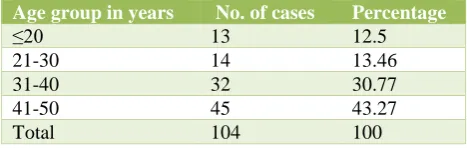
Table 1: Distribution of patients according to age.
Age group in years No. of cases Percentage
≤20 13 12.5
21-30 14 13.46
31-40 32 30.77
41-50 45 43.27
Total 104 100
The maximum no of patients in the study group belongs to the age group of 41-50 years i.e. 43.27%, between 31-40 years 30.77% cases were seen (Table 1).
Table 2: Distribution of cases according to parity.
Parity No. of cases Percentage
Unmarried 17 16.3
0 8 7.8
1 13 12.5
2 34 32.7
3 23 22.1
4 6 5.7
5 3 2.9
Total 104 100
[image:3.595.52.285.338.449.2]In the study of 104 patients who came with complaints of different bleeding pattern which was grouped in table -3, the commonest was menorrhagia 40.38%. Among others 25.96% presented with polymenorrhagia, 19.23% with acyclical bleeding, 3.85% had oligomenorrhoea, maximum patients were seen with complaints of menorrhagia followed by polymenorrhagia (Table 3).
Table 3: Distribution of patients according to bleeding pattern.
Type of bleeding No. of cases Percentage
Acyclical 20 19.23
Hypomenorrhea 01 0.96
Menorrhagia 42 40.38
Metrorrhagia 05 4.81
Oligomenorrhoea 04 3.85
Polymenorrhagia 27 25.96
Polymenorrhoea 05 4.81
Total 104 100
Maximum number of patients with DUB belonged to the category of profound hypothyroidisim (15.3%) having abnormal hormonal levels but clinically asymptomatic. 9.6% of cases had subclinical hypothyroidisim and 2.8% patients had hyperthyroidisim though they were clinically normal (Table 4).
Table 4: Distribution of patients according to thyroid function.
Thyroid status No. of cases Percentage
Euthyroid 75 72.1
Hypothyroid 16 15.3
Sub clinical hypothyroid 10 9.6
Hyperthyroid 3 2.8
Total 104 100
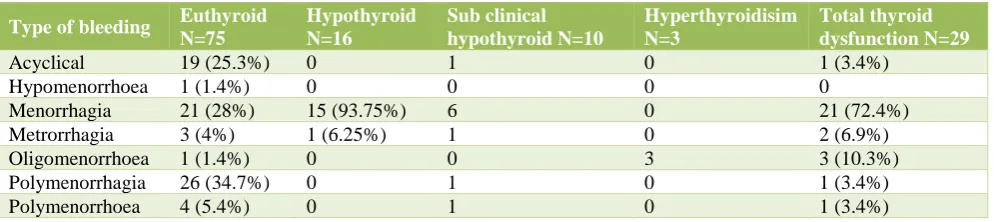
Thyroid dysfunction which was list common in patients presenting with acyclical bleeding, polymenorrhagia and polymenorrhoea i.e. 3.4% and absent in those with hypomenorrhoea.
Hyperthyroid patients presented exclusively with oligomenorrhoea. Thyroid dysfunction was most prevalent in patients presenting with menorrhagia (72.4%) followed by oligomenorrhoea (10.3%) (Table 5).
[image:3.595.51.550.500.611.2]Subclinical hypothyroid and hypothyroid patients had menorrhagia as their commonest bleeding pattern. In the present study in table-5 hypothyroid cases having menorrhagia no 15 (93.75%) and whereas hypothyroid with metrorrhagia 1(6.25%) (Table 5).
Table 5: Bleeding pattern in euthyroid and patients with thyroid dysfunction.
Type of bleeding Euthyroid
N=75
Hypothyroid N=16
Sub clinical hypothyroid N=10
Hyperthyroidisim N=3
Total thyroid dysfunction N=29
Acyclical 19 (25.3%) 0 1 0 1 (3.4%)
Hypomenorrhoea 1 (1.4%) 0 0 0 0
Menorrhagia 21 (28%) 15 (93.75%) 6 0 21 (72.4%)
Metrorrhagia 3 (4%) 1 (6.25%) 1 0 2 (6.9%)
Oligomenorrhoea 1 (1.4%) 0 0 3 3 (10.3%)
Polymenorrhagia 26 (34.7%) 0 1 0 1 (3.4%)
Polymenorrhoea 4 (5.4%) 0 1 0 1 (3.4%)
DISCUSSION
In present study patients were taken from all age groups which included less than 20 years, 21-30 years, 31-40 years and 41-50 years maximum no of patients 43.27% were found to be in the age group of 41-50 years followed by 31-40 years (30.77%).
It is more common in 4th to 5th decades of life or in
perimenopausal age group.12 Das and Chugh et al
reported that highest incidence of DUB was seen in 41-50 years (32.5%) of age group and then 31-40 years (28.2%).13 Sangeeta Pahwa et al, observed that majority
of patients were in the age group between 31-40 years (42%).14
In this study menorrhagia was the commonest bleeding
pattern seen in 40.38% cases followed by
polymenorrhagia in 25.96% of the cases. Mehrotia et al found an incidence of 54.2% of menorrhagia in their study.16 According to Talukdar et al, the dominant
menstrual problem in patient with AUB was menorrhagia in 44.44%.12
In the present study euthyroidism was seen in 72.1% and hypothyroidism was seen in 15.3%. 9.6% of cases had subclinical hypothyroidism and 2.8% patients had hyperthyroidism though they were clinically normal. In Sharma N et al study 64% patients were euthyroid, 22% hypothyroid and 14% hyperthyroid.9
Kaur et al observed in their study that 85% of patients with AUB was euthyroid, 14% hypothyroid and 1% hyperthyroid.17 According to Sowers et al 90.4% were
euthyroid, 6.2% hypothyroid and 3.2% hyperthyroid in perimenopausal age group.18
In present study Subclinical hypothyroid and hypothyroid patients had menorrhagia as their commonest bleeding pattern. Thyroid dysfunction was most prevalent in patients presenting with menorrhagia (72.4%) followed by oligomenorrhoea (10.3%). In the present study in Table 5 hypothyroid cases having menorrhagia no 15 (93.75%) and whereas hypothyroid with metrorrhagia 1(6.25%).
Doifode et al observed menorrhagia in hypothyroidism was 38 (63.33%) and which was same as present study.11
In hypothyroid patients Menon and Bharucha gave an incidence of 46.15% was menorrhagic.10 According to
Wilansky et al in patients of menorrhagia and hypothyroidism menorrhagia disappeared within 3-6 months and did not reappear in 1-3 years of follow up after thyroxine treatment.19
CONCLUSION
Thyroid dysfunction should be considered as an important etiological factor in menstrual disturbances and thyroid function tests must be done in women presenting with DUB; and also in those presenting with fatigue obesity, lethargy in addition to infertility, luteal phase defects, delayed puberty and recurrent abortions. Also, those presenting with thyroid dysfunction must be screened for menstrual disorders. As there is high incidence of thyroid diseases in our area. This would also avoid unnecessary hormonal treatment and surgery in DUB patients.
ACKNOWLEDGMENTS
Authors would like to thank HOD and Professor Dr. Lucy Das, Department of Obstetrics and Gynecology, SCBMCH, Cuttack, Odisha, India for his support during study. Authors would also like to thankfaculties of Dept.
of Biochemistry of the institution for their cooperation for the research programme.
Funding: No funding sources Conflict of interest: None declared
Ethical approval: The study was approved by the Institutional Ethics Committee
REFERENCES
1. Davey DA. Dewhurst. text book of obstetrics and Gynaecology for postgraduate DUB. Chapter 40. 5th
Edn. Wiley-Blackwell;1990:590-600.
2. Nesse R. Abnormal vaginal bleeding in
perimenopausal women. Am Family Physician. 1989;40:185.
3. Wilson JR, Beecham CT, Carrington ER. Obstetric
and Gynaecology, 5th edn. St. Louis.
Mosby;1975:80.
4. Cooper KG, Parkin DE, Garratt AM, Grant AM. A
randomised comparison of medical and
hysteroscopic management in women consulting a gynaecologist for treatment of heavy menstrual loss. Br J Obstet Gynecol. 1997;104:1360-6.
5. Krassas GE. Thyroid disease and female
reproduction. Fertil-Steril. 2000;74:1063e70.
6. Cunningham FG, Gant NF, Leveno KJ. William's Obstetrics. 21st Ed. McGraw Hill;2001:1344. 7. Berek JS, Adarshi EY and Hillard PA. In endocrine
disorders. Novaks Gynaecology. 15th Ed. William & Wilkins, Gopson paper Ltd., Noida;2012:1110. 8. Lopez J. Pathophysiology of dysfunctional uterine
bleeding. In: Purandare CN, Khadilkar S. Dysfunctional uterine bleeding-An update. First edition. New Delhi. Jaypee Brothers;2004:16-23. 9. Sharma N, Sharma A. Thyroid profile in menstrual
disorders. JK Sci. 2012;14(1):14-7.
10. Menon VK, Barucha KE. Menstrual dysfunction andthyroid disease. J Obstet Gynaecol India. 1995;45(4):521-6.
11. Doifode CD, Fernandes K. Study of thyroid dysfunction in patients with DUB. J Obstet Gynecol India. 2001;51(2):93-5.
12. Talukdar B, Mahela S. Abnormal uterine bleeding in
perimenopausal women: correlation with
sonographic findings and histopathological examination of hysterectomy specimen. J Mid-Life Health. 2016;7:73-7.
13. Das, Chughs. Dysfunctional uterine bleeding. J Obstet Gynaecol India. 1964:348-353.
14. Pawha S, Kaur GA. Thyroid dysfunction in DUB. JARBS. 2013;5(1):78-83.
15. Pilli GS, Sethi B, Dhaded AV, Mathur PR, Dysfunctional uterine bleeding. J Obstet Gynaecol India. 2001;52(3):87-9.
17. Kaur T, Aseeja V, Sharma S. Thyroid Dysfunction in dysfunctional uterine bleeding. Webmed Central Obstet Gynecol. 2011;2(9):002235.
18. Sowers M, Luborsky J, Perdue C, Araujo KL, Goldman MB, Harlow SD. Thyroid stimulating Hormone (TSH) concentrations and menopausal status in women at the mid-life. J Clin Endocrinol. 2003;58:340-7.
19. Wilansky DL, Greisman B. Early hypothyroidism in patients with menorrhagia. Am J Obstet Gynecol. 1989;160:673-7.