Volume 6, No. 1, Jan-Feb 2015
International Journal of Advanced Research in Computer Science
RESEARCH PAPER
Available Online at www.ijarcs.info
ISSN No. 0976-5697
m
n
j=1
i=1
n
m
j=1
i=1
n
j=1
Programming Development on Transportation Problem using c++ and Stepping Stone
for Evaluation
Adeoye Akeem .O.*
Department of mathematics/statistics Federal Polytechnic Offa Nigeria
Babalola John.B
Department of mathematics/statistics Federal Polytechnic Offa Nigeria
Igbinehi,E.M
Department of mathematics/statistics Federal Polytechnic Offa Nigeria
Emiola Olawale.K.S
Department of mathematics/statistics Federal Polytechnic Offa Nigeria
Abstract: The aim of this research is to develop a programm for three methods of solving transportation problems. C++ was used to write the programm on initial feasible solution and optimal solution using North West Corner Rule, Least Cost Rule and Vogel Approximation Method. Stepping stone is used to obtain the optimal solution. From the result of the analysis, we discovered that the Programming on Vogel Approximation Method gives the same result at optimal solution and at low number of iterations. Hence we conclude that programming on Vogel Approximation Method is the best method of finding initial feasible solution, optimal solution and for distribution of good.
Keywords: Optimal, Initial, Feasible, Cost and Solution.
I. INTRODUCTION
Transportation is the movement of people and commodities from one place to another. The progress of any recent organization depends on the effective utilization of transportation system. Moreover, moving from one place to another or distribution of goods and services always take place through transportation system. The transportation model depends on individual objectives and taste in terms of cost, safety, speed and comfortability [1],[4],[6].
Production is the creation of goods and services to satisfy human wants. According to the economic Philosopher Adams Smith (1976), production is not complete until the goods produced reach the final consumer. After production, it is mandate for manufacturers to discharge or distribute the products to the markets or various depots and this can be achieved through effective transportation system [2],[3],[5]. Transportation plays a dominant role in the world economy because the cost of transportation goes a long way in influencing the cost of finished products. That is the lower the transportation cost the cheaper the cost of products. This makes business organization, individuals and government to look for effective ways of solving transportation problems. From the discussion above one can easily come to the conclusion that the progress of any company is directly proportional to the efficiency of the transportation method of the company.
Transportation problem can be described as a way of distributing finished goods from different sources to numerous destinations at a minimum cost or rate. Suppose there are m warehouses, where commodities are stocked an n markets (Locations) where they are needed and supply available in the warehouses be S1,S2,S3 …Sm while the
demand at the market be d1,d2,d3…..dn. Let the unit cost of
shipping from warehouse i to market j be NCij. The transpiration problem wants to find an optimal shipping
schedule which minimizes the cost of transportation from the warehouse to the markets. The various ways by which a particular commodity can be distributed from source to destination is illustrated by the diagram below.
II. LINEAR PROGRAMMING FORMULATION
In order to formulate the transportation problem as a linear programing problem, we define Xij as the quantity
shipped from warehouse i to market j, i = 1,2,….m and j = 1, 2, …n. The number of decision variables is given by the product of m and n
The supply constraint guarantee that the total amounts shipped from any warehouse does not exceed its capacity. The demand constraint guarantee that the total shipped to market including the non-negative constraints, the total number of constraint is (m + n). The market demands of the warehouse is equal to the total demand at the market.
Si = dj
This implies that every available product at the warehouse will be shipped to meet the minimum demand at the markets. In this case, all the supply and the demand constraint would become strict equalities and we shall have a standard transportation problem given by
Min Z = CijXij
Subject to
Xij = Si i = 1, 2, ………m (supply)
Xij = di j = 1, 2, ………n (demand)
The above transportation problem can be expanded as follows.
Min Z = C11X11+C12X12+….C1nX1n+C21X21+….C2nX2n + …
CmiXmi + …CmnXmn
Subject to
X11 + X12 + …+ X1n = S1
X21 + X22 + …+ X2n = S2
… … … Xm1 + Xm2 + …+ Xmn = Sm
X11 + X21 + …+ Xm1 = d1
X12 + X22 + …+ Xm2 = d2
/ / / /
X1n + X2n + …+ Xmn = dn
S1 > 0, dj > 0 for i = 1,2, …m, j = 1,2,…n
III. METHOD OF SOLVING TRANSPORTATION
PROBLEM
The following are three methods employed in establishing an initial feasible solution, they are
a. North West Corner Rule Method b. Least Cost Rule Method
c. Vogel Approximation Method
IV. METHOD FOR ESTIMATING OPTIMAL
SOLUTION
After an Initial Feasible Solution to the distribution problem has been obtained through North West Corner Rule, Least Cost Rule and Vogel Approximation Method, alternative solution must be evaluated. There are two straight forward method for calculating the effect of alternative allocation. In this research a program develops will be used to find the initial feasible solution and optimal solution using stepping stone method.
A. Stepping Stone Method:
Procedure for stepping stone method
a. Choose the empty cell unused square to be evaluated.
b. Beginning with the selected empty cell, trace a closed path (Moving horizontally and vertically) from this empty cell via stone squares (used square) back to the original cell. Only one closed path exists for each empty cell in a given solution. Although the path may skip over non-empty (stone) or empty cells and may cross over itself. Corners of the closed path may occur only at the stone squares and the unused square (empty cell) being evaluated. c. Assign plus (+) and Minus (-) signs alternatively at
each corner square of the closed path, beginning with a plus sign at the empty cell. Assign these signs by starting in either a clockwise or anti-clockwise direction. The positive and negative signs represent the addition or subtraction of 1 unit to a cell.
d. Determine the net change in the costs as a result of the changes made in tracing the path. Summing the unit cost in each cell with a plus sign will give the addition to the cost. The decrease in cost is obtained by summing the unit cost in each cell with a negative sign.
e. If all the improvement indices are greater than or equal to zero stop. The solution obtained is optimal. Otherwise go to step 6.
f. Develop a new solution and go to step 1 to develop a new solution we shift a smaller quantity of the stone that has negative figure to the most negative cell of the improvement index.
g. Repeat the above steps until the solution is optimal. That is, the improvement index is greater than or equal to zero.
V. DESCRIPTION OF PROGRAM DEVELOPED
C++ is the programming language used to developed a programming for solving transportation problem using North West, Least Cost and Vogel Approximation Method procedures for solving initial feasible solution and stepping stone procedure for finding the optimal solution.
C++ is one of computer programming languages which is a High Level Language (HLL). It is an Object Oriented Programming (OOP) Language. It is also a scientifically oriented and it is used in handling mathematical problems. Some of the characteristics that make C++ different from other common languages are.
a. It bridges the gap between conventional High Level Language (HLL) and Machine Language (ML). b. It is more efficient than other High Level Language
(HLL)
c. It is more portable and convectional in nature d. It has more concise source code
e. It isolates its machine dependent feature to its library formation
VI. PROGRAM SOURCE CODE ON
TRANSPORTATION
#include <stdio.h> #include <stdlib.h> #include <math.h> #include <ctype.h> #include <dos.h> #include <time.h> #define MAXC 500 #define MAXR 500 #define MT 250000
/* GLOBAL VARIABLE DECLARATION */
int NOSUP, NODEM, CP, CT, INIT, IT,IPR, N9, MENUNEXT,cc;
int MOVEX[MT],
MOVEY[MT],OPT,MINI,MINJ,NOWI,NOWJ,INDIC;
float C[MAXR][MAXC],
FLOW[MAXR][MAXC],SUPPLY[MAXR], S1[MAXR]; float DEMAND[MAXC], D1[MAXC], U[MAXR], V[MAXC], EC[MAXR+1][MAXC+1];
float R[MAXR][MAXC]; float TCOST, CMIN,XMIN,CT2; int P[500][2*MAXC+5];// int ITERATE;
int ID,IDES,IF1,IOPTIMAL,ISOU,IX,IY,LT,NR; double CC,QT,TT,XINFCC;
char SW, ch;
char *plant[] =
"S21","S22","S23","S24","S25","S26","S27","S28","S29","
// printf("LABEL SOURCES AND PRESS ENTER "); printf("HOW MANY DESTINATIONS? ");
scanf("%d",&NODEM); MENUNEXT = 1;
//printf("LABEL DESTINATIONS AND PRESS ENTER ");
printf(" IS THE DATA CORRECT ? <Y/N>\n"); getchar();
void Increase(int I,int J); for(j=1;j<=NODEM;j++) ds+=DEMAND[j]; N9 = NODEM;
for(i=1;i<=NOSUP;i++) C[i][NODEM]=1E+20; DEMAND[NODEM]=diff;
if((fabs(S1[MINI] - D1[MINJ])>=0.00001) && (S1[MINI] < D1[MINJ]))
{
FLOW[MINI][MINJ] = S1[MINI];D1[MINJ]-= S1[MINI];S1[MINI]=0;
}
{
int i,A,j,k,icom,MINI,MINJ,imin1,jmin1,itt; float CMIN1,CMIN2,DIFF,DIFFT;
LB = NOSUP + NODEM;
{
void Seek_Path(int I, int J) { //Labels: e70, e160, e260
printf(" FROM SOURCE%d TO
Table 1:- Shows the sources and supply capacity of Seven Up Bottling Company
Table.2 Shows the destinations and their requirement of Seven Up Bottling Company PLC Ilorin.
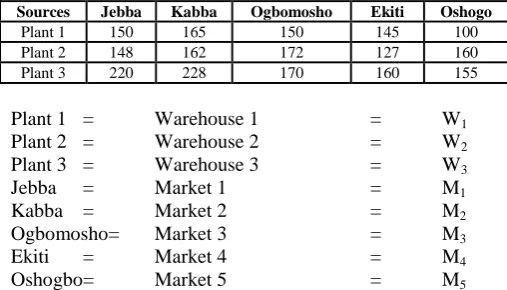
Table 3 Shows the unit cost of transportation in Naira (N) from sources to destinations.
Sources Jebba Kabba Ogbomosho Ekiti Oshogo
Plant 1 150 165 150 145 100
Table 4 Shows the combined cost matrix, supply capacity and demand
M1 M2 M3 M4 M5 Si data, the following result were obtained.
From the analysis of the data set, using the progam developed in this study North West Corner Rule was optimal at sixth iteration, Least Cost Rule at fourth iteration while Vogel Approximation method is optimal at second iteration. This indicate that Vogel Approximation Method is the best
IX. SUMMARY OF FINDING
X. CONCLUSION
Since program developed on Vogel Approximation has the advantages of obtaining initial feasible solution; easy to compute and easy to edit when error are committed in the process of data entering. Hence programming developed on Vogel Approximation Method using C++ is the best method of getting Approximate solution to transportation problem and best method of distributing the goods and services.
XI. REFERENCES
[1]. Abel Mizahr and Michael Sillivant (1979): Mathematics for Business and Social Sciences Published by John Willey & Sons Inc.
[2]. Aminu Y.A (1998): Operation Research, for Science and Management Studies, Best Way Publisher Ltd. Offa.
[3]. R.J Vanderbei, Linear Programming: Foundations and Extensions, Kluwer Academic Publishers, Boston, 1996.
[4]. S.J. Wright, Primal-Dual Interior-Point Methods, Society for Industrial and Applied Mathematics, Philadelphia, 1997.
[5]. Thomas H. Cormen, Charles E. Leiserson, Ronald L. Rivest, and Clifford Stein 2001 Introduction to Algorithms, Second Edition. MIT Press and McGraw-Hill.