The feedback session within the context of teacher training and
development: an analysis of discourse, role and function.
Diane Phillips
PhD, Institute of Education
University of London
Abstract
Lesson observation followed by feedback is commonly used within a wide range of teacher training and teacher development contexts. This study describes and compares the behaviour, as manifest in the discourse, within two sets of feedback sessions, and offers explanations for this behaviour. In the first type of feedback session trainers give feedback to trainees as part of a pre-service teacher training course. In the second, Directors of Studies give feedback to practising teachers, in the context of in-service teacher development.
The research methods employed led to analysis of data from both etic and ernic perspectives. The conversations in the feedback sessions were video recorded, transcribed and analysed using the methodology of Conversation Analysis, and an etic perspective gained. In addition, in order to obtain an ernic perspective, the perceptions of all the participants were obtained by means of interviews and questionnaires.
The findings of the study are as follows:
• Both sets of feedback session can be said to belong to the type of discourse described as 'talk at work'. They contain features typical of other conversations identified in the literature as institutional talk, and differ significantly from informal or non-institutional conversations.
• The details of the discourse and differences between the two types of feedback session are created as a result of the way the participants perceive their roles and the function of the sessions. In tum, these perceptions and the resulting discourse are, to a large extent, shaped by the institutions for which they work.
TABLE OF CONTENTS
Title page
Abstract
Acknowledgements
PART ONE: Introduction, Aims and Theoretical Background
Chapter 1 Introduction and Purpose of the Study
1.1 Background to observation and feedback 1.2 Two types of feedback session
1.2.1 The pre-service sessions 1.2.2 The in-service sessions 1.3 Aims and objectives of the study
Chapter 2 Genre and institutional talk
2.1 Genre
2.2 Genre within the work context 2.3 Institutional talk or 'talk at work' 2.4 Features of institutional talk
Chapter 3 Methodology and Theoretical Framework for Analysis
3.1 Methodological framework
3.1.1 IdentifYing the characteristics of genre 3.1.2 The methodological problems
3.1.3 Conversation Analysis and related approaches 3.1.4 The Case Study
3.2 Tools of investigation: a review
3.2.1 Observation, recording and transcribing 3.2.2 Questionnaires and interviews
3.3 Collection and selection of data
3.3.3 Questionnaires and interviews used in the study 51
3.3.4 Selection of data 57
3.4 Terminology 57
3.4.1 Terms used in Conversation Analysis 58
3.4.2 Discourse Acts 59
3.5 Summary of Chapter 3: 60
Methodology and theoretical framework for analysis
PART TWO: The Feedback Session as Institutional Talk: 64-207
Conversation Analysis
Chapter 4 The participants and the context 67
4.1 The participants: their background, role and power 67 4.1.1 The participants: their background, role and power 67
within the institutional context
4.1.2 The Participants: their background, role, and power 71 within the feedback session
4.2 The physical context within which the conversations take place 75 4.2.1 The physical context and institutional talk 75 4.2.2 The physical context: the feedback session 76
4.3 The temporal context 77
4.3.1 The temporal context and institutional talk 77 4.3.2 The temporal context and the feedback session 78 4.4 The setting, and orientation of the participants 82 4.4.1 The setting, and orientation of the participants: 82
institutional talk
4.4.2 The setting, and orientation of the participants: 83 the feedback session
Chapter 5 5.1 5.2 5.3 Chapter 6 6.1 6.2 6.3
Chapter 7 7.1
7.2
7.3
Overall structure and organisation of the talk
Overall structure and organisation of institutional talk Overall structure and organization of the talk:
the feedback session 5.2.1 Participation
5.2.2 Patterns of interaction
Overall structure and organisation of the talk: summary and conclusions
Conversation Management
Tum-taking
6.1.1 Tum-taking in institutional talk 6.1.2 Tum-taking in the feedback session Topic choice and topic management
87 87 90 91 92 94 95 95 95 97 101 6.2.1 Topic choice and management in institutional talk 101 6.2.2 Topic choice and management in the feedback session 102 Conversation management: summary and conclusions 111
Conversational patterning 113
Openings and closings 113
7.1.1 Openings and closings in institutional talk 113 7.1.2 Openings and closings in the feedback session 114
Formulating and summarising 118
ChapterS Discourse acts 124
8.1 Initiating Acts 126
8.1.1 Elicitations 126
a) Questions 127
b) Elicitations 137
8.1.2 Informatives 142
a) Reports 143
b) Assessments: 148
criticism 154
compliments 170
self-criticism 176
self-commendation 180
8.1.3 Directives: mandatives; advisives 183
8.1.4 Initiating Acts: summary and conclusions 185
8.2 Response 186
8.2.1 Continuers, and third-tum responses 186
a) Continuers 186
b) Third-tum responses 189
8.2.2 Silence as response 191
8.2.3 Response: summary and conclusions 193
Chapter 9 Particular features of the discourse 194
9.1 The use of on-record language and particular 194 politeness strategies
9.1.1 The use of on-record language and particular politeness 194 strategies in institutional talk
9.1.2 The use of on-record language and particular politeness 196 strategies within the feedback session
9.2 Lexical choice 197
9.2.1 Lexical choice in institutional talk 197
Chapter 10 The feedback session as institutional talk 200
10.1 Participants and context 201
10.2 Overall structure and organisation of the talk; conversation 202 management and conversational patterning 203
10.3 Discourse Acts 204
10.4 Particular features of the discourse 204 10.5 Features of institutional talk not found in the feedback session 204
10.6 Degree of formality 204
10.7 The feedback session as institutional talk: conclusions 206
PART THREE: The participants' perspective and conclusions 208-266
Chapter 11: Role and function 210
11.1 Methodological approach: the use of evidence from interviews 211 and questionnaires
11.2 Role 212
11.2.1 Orientation to the setting and recognition of set roles 212
11.2.2 Role and power 214
11.2.3 Role and the 'knowledge gap' 215
11.2.4 Role, power and knowledge: conclusions 219 11.3 Perception of the function of the feedback sessions 220
11.3. 1 Evaluation 221
11.3.2 Positive versus negative evaluation 222
11.3.3 Expectation and function 223
11.3.4 A direct comparison between pre-course and 229 in-course sessions conducted by the same assessor
Chapter 12: Talk and the institution 236 236 12.1 The influence of the institution on discourse
12.1.1 The influence of institution: a review of the literature 237 12.1.2 The influence of the institution on the discourse of the 239
feedback session
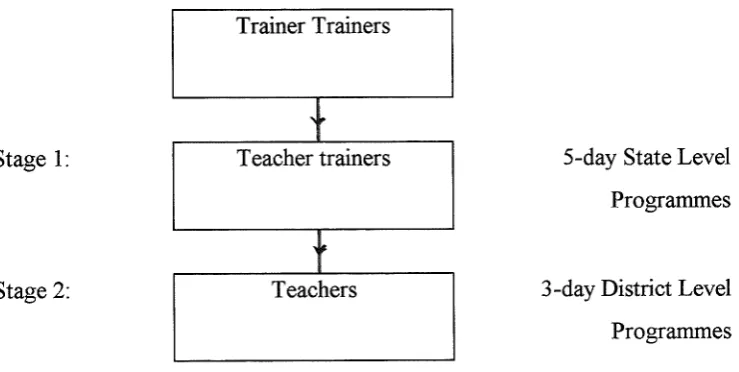
12.1.3 Ways in which knowledge and practice is passed on by 247 EL T institutions
12.1.4 Ways in which knowledge and practice is passed on to 252 the trainers and Directors of Studies in the study
12.1.5 The influence of the institution: conclusions 254 12.2 The reciprocal relationship between discourse and the institution 255 12.2.1 The reciprocal relationship between discourse and the 255
institution: a review of the literature
12.2.2 Reciprocity within the feedback session 258 12.2.3 The reciprocal relationship between discourse and 260
the institution within the feedback session: conclusions
Chapter 13: Overall conclusions 261
13.1 Summary of research findings 261
13.2 Evaluation of the methodology 261
13.3 Limitations of the study 262
13.4 Implications for further research and action 264
Bibliography 267
List of Figures
Figure 1 Linguistic focus - Sociological focus 28 Figure 2 Primary features of the discourse process 32
Figure 3 Taxonomy of Discourse Acts 57
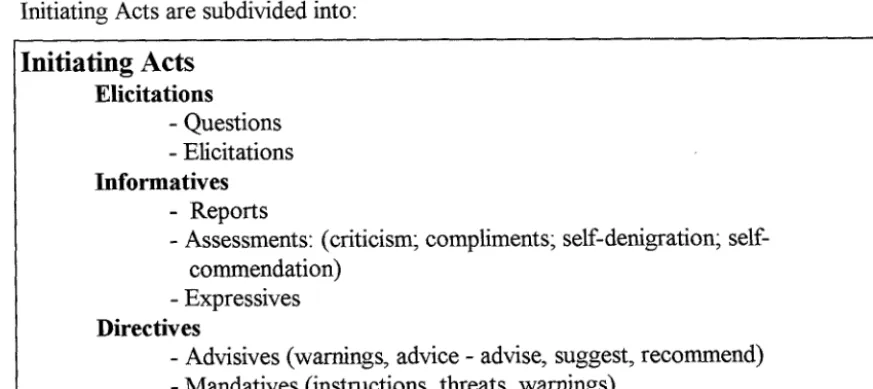
Figure 4 Initiating Acts 124
Figure 5 Cascade Model of Teacher Training 248
Appendices
Appendix 1 Transcript of Pre-service Feedback Session 1 277
Appendix 2 Transcript ofIn-Service Feedback Session A 287
Appendix 3 Pre-service sessions: 297
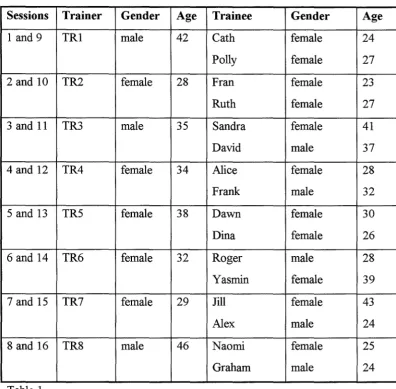
Table 1 Details of participants 298
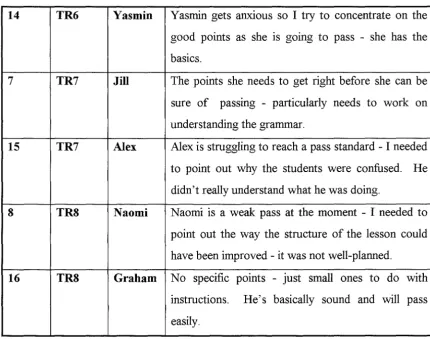
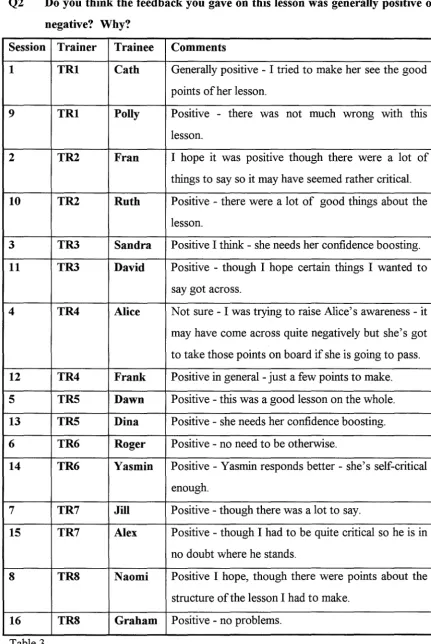
Table 2 Response to Interview Question 1 300 Table 3 Response to Interview Question 2 302 Table 4 Response to Interview Question 3 303 Table 5 Response to Interview Questions 4 and 5 304 Table 6 Response to Interview Question 6 307
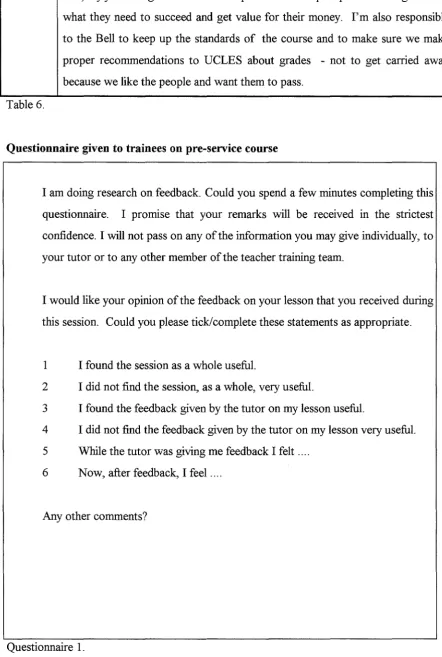
Table 7 Replies to questionnaires 309
Appendix 4 In-service sessions: 313
Table 8 Details of participants 313
Table 9 Response to Interview Question 1 315 Table 10 Response to Interview Question 2 316 Table 11 Response to Interview Question 3 317 Table 12 Response to Interview Questions 4 and 5 318 Table 13 Response to Interview Question 6 320
Table 14 Replies to questionnaires 322
ACKNOWLEDGEMENTS
First and foremost I would like to thank all the participants in the study who submitted themselves to scrutiny, and took time to answer my questions. Without them the research could not have been done.
I am also grateful to my colleagues at the Bell Educational Trust, The Bell Language School, Cambridge and The Bell Young Learners' Courses Department for their practical help and support; particular thanks go to Malcolm Hebden, Alison Shaw, Will Sykes, Marian Lock and Richard Rossner.
I would also like to thank my supervisor at the Institute of Education, David Block, who has given invaluable advice and encouragement, and Henry Widdowson and John
Norrish for their helpful comments.
Finally, thanks go to my husband Andrew and my children, Ben and Meredith, who never doubted that the work would one day be finished.
PART ONE
INTRODUCTION, AIMS AND THEORETICAL BACKGROUND
In Part One, in the first chapter, I introduce the context of the study, that of teacher training and development within the discipline of English Language Teaching, and I
explain my interest and involvement in the area. In Chapter 1 I also set out the aims and objectives of the study.
Chapter 2 is concerned with a discussion of genre. One of the aims of the research is to investigate whether the feedback session, conducted as part of teacher training and development, can be seen as a particular genre that can be included within the broader category of 'institutional talk'.
CHAPTER ONE: INTRODUCTION AND PURPOSE OF STUDY
1.1 Background to Observation and Feedback
Lesson observation followed by feedback is commonly used within a wide range of teacher training and teacher development contexts. It is a common practice within my area of experience and expertise, that of training and managing teachers of English as a Second (ESL) or Foreign Language (EFL) or, as it is increasingly known, English Language Teaching (ELT).
All recognised teacher training schemes in the UK that contain teaching practice (TP) for trainees use lesson observation, followed by feedback. Many schools and institutions also employ the practice as part of their on-going in-service monitoring, training, and development of the teachers they employ. The observation may form part of an appraisal scheme operated by the institution.
The procedure of observation is given further prominence in EL T schools and further education institutions and departments in the UK by the fact that, during an inspection, the British Council inspectors observe all teachers in order to determine whether a centre has reached the overall standard of teaching required in order to gain British Council accreditation.
My interest in the topic stems from a number of sources. As a teacher trainer I am interested in the effectiveness of lesson observation and feedback in developing teacher awareness and skills, and as a manager within an institution that provides English language teaching I have an interest in the usefulness of the practice as a management tool to monitor, maintain and further quality standards.
researched the language used to give positive and negative criticism by a number of trainers on initial training courses, and how such criticism was received by the trainees. I found that, overwhelmingly, the language used in speech act terms could be described as that of negative criticism but, despite this, the reaction by the majority of those receiving feedback was that it was a useful and positive experience. My conclusions were that the perception of the experience as negative or positive seemed to depend very much on the expectations of the trainees, and on the relationship between the person giving and the person receiving feedback.
I was interested to find out whether, in an in-service context, the language used by academic managers to give feedback to more experienced teachers, and the attitudes of the participants, are similar or different from those on a pre-service training course. I wished to explore further the influences brought to bear on the conversation by the participants' perceptions of their roles and their understanding of the purpose of the feedback session.
Several issues were raised by the MA research project which were not focused on in detail, as they were outside the remit of the study: for example, the power relationships between the participants; the overall organisation of the talk; the occurrence of certain patterns and sequences within the conversations. It struck me that the conversation could be seen as being very similar to many other institutional conversations and that it would be useful to compare the feedback session in a systematic manner with such institutional conversations as business meetings, doctors' consultancies, interviews, appraisals and even law court proceedings.
1.2 Two types of feedback session
In this study two types of feedback session are the focus of research:
• those taking place within a pre-service teacher training course • those taking place as part of in-service teacher development.
1.2.1 The pre-service sessions
The participants in the pre-service sessions were taking part in teacher training courses leading to the CTEFLA (Certificate for Teaching English as a Foreign Language to Adults). The courses were held at The Bell Language School, Cambridge, part of The Bell Educational Trust - a major provider of ELT courses and services. The trainers on the courses were employed by this schooL The awarding body for the qualification was UCLES (University of Cambridge Local Examinations Syndicate).
UCLES runs the most widely recognised courses which prepare teachers of EL T: the CTEFLA (Certificate in Teaching English as a Foreign Language to Adults), since 1996 known as CELTA (Certificate of English Language Teaching to Adults), and DELTA (Diploma in English Language Teaching to Adults), formally known as DTEFLA (Diploma in Teaching English as a Foreign Language to Adults). The UCLES pre-service certificate is the most common qualification held by native speaker, and increasingly non-native speaker, teachers of English as a foreign or second language. In 1997 5300 candidates world-wide completed the course successfully.
A major component of the course is that of teaching practice. Within teaching practice the manner in which trainee teachers perform during lesson observation and feedback constitutes an important element in the formal assessment of the candidates. Assessed teaching practice takes place in groups of 4-6 trainees, under the supervision of a trainer. Each trainee's lesson is observed by the other trainees and the trainer. A session then takes place in which all the trainees who have taught that day are given oral feedback. In addition, written feedback on the lesson is given to each trainee by the trainer.
before they take on this role can vary widely from institution to institution. None is directly provided before the course by the examining body itself UCLES now requires new trainers to have observed at least one course and to have been briefed and advised by a practising trainer in the scheme. However, none of the trainers who are the subject of this study undertook such formal training as they became trainers before such a requirement was made obligatory.
Throughout this study the participants in the pre-service sessions will be referred to as trainers and trainees.
1. 2. 2 The in-service sessions
The in-service sessions in this study are those in which academic managers (Directors of Studies) observe and give feedback to teachers on a one-to-one basis. All the Directors of Studies and teachers in this study were employed by the Bell Educational Trust, to work on short courses for children and teenagers (age range from 8-17) who were studying English in the UK. The participants in these sessions will be referred to as DOSs (Directors of Studies) and teachers.
1.3 Aims and objectives of the study
The three major aims ofthe study are as follows.
• To describe and analyse conversations taking place within two sets of feedback sessions and to examine to what extent they exhibit features of <institutional talk': to assess to what extent the feedback sessions contain features typical of other examples of talk at work, and how they differ from informal or non-institutional conversation. To determine to what extent the feedback session can be said to belong to the type of discourse described as <talk at work'.
• To examine to what extent the discourse of the feedback session is created as a result of:
i) the roles of the participants as perceived by the participants themselves, and others not participating in the conversation.
ii) the function of the session as perceived by the participants based on their own expectations, and/or created by the expectations of the institutions for which they work - expectations either consciously or unconsciously expressed.
• To evaluate whether the feedback session can be counted as an example of the way in which «discourse identities and institutional roles are ... instantiated through talk" (Boden 1994:77), and to what extent the relationship between the discourse and the institution can be described as reciprocal and self-perpetuating.
The specific objectives are:
• to review the literature of institutional language in order to identify features which have been put forward as distinguishing <institutional talk' from <normal social conversation', or <everyday talk-in-interaction';
• to describe, analyse and make generalisations about the language used in the two sets of feedback sessions;
• to assess how, and to what extent, the perceptions of the participants can be seen to shape the discourse;
• to examine whether, in recursive fashion, the discourse serves to reinforce the perception of the roles and functions so that they become further 'institutionalised' .
In the next chapter, Chapter 2, there IS an introduction to, and description of
'institutional talk', or 'talk at work'.
This is followed, in Chapter 3, by a description of the methodological framework, the tools of investigation and terminology used in the study. Details are also given about the collection and selection of data.
In Chapters 4-9 the data from the conversations is described and the research findings are given. At the beginning of each of these chapters there is a review of the literature which is concerned with institutional talk. This is followed by an analysis of, and examples from, the two sets of data.
In Chapter 10 the argument for including the feedback session within the type of discourse described as 'talk at work' is examined.
This is followed, in Chapter 11, by an examination of discourse, role and function within the feedback session.
Chapter 12 examines the relationship between the institution and the talk.
CHAPTER 2: GENRE AND INSTITUTIONAL TALK
As one of the aims of this study is to detennine to what extent the feedback session can be seen as belonging to a particular category of talk it is useful to begin by attempting to say what I mean by 'institutional talk' or 'talk at work' and how these terms relate to that of genre.
2.1 Genre
Genre is defined in The Longman Dictionary of Applied Linguistics as "a particular class of speech events which are considered by the speech community as being of the same type" (Richards, Platt et al. 1985). McCarthy and Carter (1994: 117) offer a similar definition: "a sequence and ordering of speech acts which together perform an activity recognised by members of the speech community". Kress maintains that genres are specific types of text (spoken or written) that arise from conventionalised social occasions: "genres have specific forms and meanings, deriving from and encoding the functions, purposes and meanings of social occasions" (Kress 1989: 19). He goes on to give some examples of genre: interview, essay, tutorial, sports commentary, novel, political speech, editorial, sermon, joke (Kress 1989: 19). Kress feels that "given the relative stability of social structures, forms of text produced in and by specific social institutions, that is the resultant genres, will attain a certain degree of stability and persistence over time" (Kress 1990:4).
McCarthy and Carter (1994:35-37) make a useful distinction between genre and a prototypical generic activity such as reporting. They go on to say that "some genres are likely to be marked by a blending of a number of generic activities" (McCarthy and Carter 1994: 37).
2.2 Genre within the work context
identified in 'professional settings', not only in written texts, as exemplified by Bhatia (1993), but also in oral texts.
When describing spoken texts, the concept of a characteristic discourse type or genre has often been used to describe a type of language use associated with a specific physical context, in particular that of the work place and the classroom (which for some of the participants is also a 'work place').
Earlier studies often looked at this type of 'institutional talk' as a means to a broader description of discourse, rather than because of a specific interest in institutional talk per se; for example, Sinclair and Coulthard's studies of classroom language (Sinclair and
Coulthard 1975). Coulthard and Ashby, in their study of doctor-patient interviews, admit that this specific type of conversation was chosen because it is "less complex" than other types of conversation, "the discourse structure is more obvious and repetitive" (Coulthard and Ashby 1976:70), and it is easier to collect naturally occurring data than from more spontaneous conversations. Within this article the authors rather tentatively suggest that "many information-seeking interviews will have similar structures to ... doctor-patient interviews and that the interview could well be a discourse type" (my italics) (Coulthard and Ashby 1976:70).
Over the past twenty years there has been increasing interest in how a number of encounters - the interview, the lesson, the seminar, the business meeting, the doctor's consultancy, law court proceedings - while identifiable as separate genres, have a number of significant characteristics in common. Several researchers have identified such specific 'work place-oriented' behaviour and language, and described their findings in works with such titles as: Social Anthropology of Work (Wallman 1979); Working with Language; a multidisciplinary consideration of language use in work contexts (Coleman 1989).
Contexts in the workplace that have been the subject of studies include: the medical consultation (Coulthard and Ashby 1976, Bergmann 1992, Heath 1992, Maynard 1992, Heritage and Sefi 1992, ten Have 1991); the hospital clinic or ward (Sharrock and Anderson 1987, Grainger 1990); the courtroom (pomerantz 1987, Harris 1989, Atkinson 1992, Drew 1992); the business meeting (Boden 1994); the interview (Button 1992, Gumpertz 1992); the seminar (Bashiruddin, Edge et aL 1990), and the classroom (Sinclair and Coulthard 1964, 1975, Kress 1989).
2.3 Institutional talk or 'talk at work'
Researchers and writers have attempted to find a term which describes this type of talk and which serves to distinguish it from 'ordinary conversation'. Heritage, in one of the earlier examinations of this topic, uses the term institutionalized activity; he cites medical consultations, news interviews, courtroom examinations and classroom interaction as examples of occasions where "nonconversational or quasi conversational activities are accomplished" (Heritage 1984:336). In 1992 he and Drew settled on the self-explanatory term talk at work as the title of a collection of articles on the subject (Drew and Heritage 1992). They also refer to institutional talk. Boden (1994) uses the term organizational talk.
2.4 Features of institutional talk
Kress identifies some of the linguistic features that characterise a particular genre: "how 'tum-taking' is constructed, how sequencing is done, who has the right to ask questions, and who doesn't, ... what sorts of linguistic forms of markers of politeness are unnecessary", and exemplifies: "So, how I would address you in an interview is different to how I would address you in a conversation or a chat." (Kress 1990:6).
In order to identify the specific features that differentiate an encounter such as an interview, or in the case of this study - the feedback session, from an everyday social conversation, a number of studies consider the wider social context - what is normal in the contemporary cultural setting - and then narrow the focus down to what is typical of the institution or workplace: "a concern with the structured social relations which comprise organizations and occupational practice" (Schegloff 1992: 103) and the related talk.
If the feedback session is to be included within the category of 'talk at work' it must be demonstrated that it shares most, if not all, of the features characteristic of other occasions for talk already identified in the literature as belonging to work-related genres. One of the aims of this study is to examine to what extent the two types of feedback session can be characterised as conversations which are typical of such 'institutional talk'. After the next chapter, Chapter 3, in which I outline the methodology and the framework for analysis I have selected to use in this study, there are six chapters (Chapters 4 - 9) in which this examination takes place. In each of these six chapters there are two parts:
• a review of the literature that has focused on encounters that can be described as 'talk at work', and the identification of features that are characteristic of such encounters; • a description and analysis of the conversations that make up the data in this study, in
Chapter 3 Methodology and Theoretical Framework for Analysis
In this chapter the discussion of the methodological approach taken in this study is divided into four parts:
3.1 the methodological framework employed; 3.2 the tools of investigation used;
3.3 a description of the collection and selection of data; 3.4 the terminology adopted.
3.1 Methodological framework
The methodological framework adopted in the study is that of Conversation Analysis. Although this approach has been used to analyse a wide range of conversation types it is especially useful in examining conversations which seem to fall within a particular genre. As the intention of this study is to identify discourse features of a specific category of talk - 'talk at work', and within that category, of a specific genre - the feedback session, Conversation Analysis would seem to be a suitable methodological framework to adopt.
This section (3.1) looks first at identifying the characteristics of genre, then at the problems that a study of language within a particular context poses. The advantages of using Conversation Analysis for such a study are detailed. Finally, the practical and theoretical advantages of using a Case Study approach to present the research findings are examined.
3.1.1 Identifying the characteristics of genre
usage one must be able to make such calculations both in production and interpretation. This ability is independent of idiosyncratic beliefs, feelings and usages" (Levinson 1983:53). Brown and Levinson (1978) claim that conversation is, above all, a social activity and as such it shares the characteristics and the structure of all social activities.
Participants in conversation do not operate within a cultural vacuum, however; they operate within a particular society, and norms of society seem to influence interpretation of what is heard and the choice of language used: the participants are operating within parameters that are accepted by, and acceptable to, the society in which they live. In an analysis of conversation, therefore, we must recognise the influence of factors determined by the fact that the participants are human and so act in ways common to all normal humans, and the fact that they live within a society that has particular cultural and sociological norms.
However, the intention of this study is to search beyond these influences and to tease out features that are a direct result of the fact that the participants are operating within a narrower context - that of teacher training and development - and to explore whether a particular institution within this context can have an influence on beliefs and attitude which are, in turn, exhibited in the language used. Kress claims that genres are characterised by particular linguistic features which are in tum the product of specific social institutions: "genres have specifiable linguistic characteristics which are neither fully determined nor largely under the control of individual speakers" (Kress 1990: 4). In this study I intend to test this claim. It is the identification of these specific linguistic features within the feedback session, and a description of the relationship between the language and the social context, which is the major focus of this study.
3.1.2 The methodological problems
«the question is whatever observations we initially make about how such features of social organization as these work and bear on interaction, how do we translate them into defensible, empirically based analyses that help us to get access to previously unnoticed details of talk-in-interaction, and appreciate their significance?" (Schegloff 1992: 106).
In one of the very first studies of 'talk at work', of doctor-patient interviews, Coulthard and Ashby, in 1976, claimed to provide «a linguistic tool that can be used to describe different interviews and provide objective evidence for differences or similarities which may have medical or sociological implications" (Coulthard and Ashby 1976:88). The linguistic tool they used is that of defining and describing the language in terms of the speech acts, moves, exchanges and transactions identified within the discourse. They linked these patterns to the roles played by the participants.
However, in a study of this nature, iflinks such as those claimed by Coulthard and Ashby are to be identified and justified, there are a number of questions to be answered and problems to be overcome which the methodology must resolve. In a study of conversation it must always be borne in mind that «there is a sense in which description presupposes interpretation" (Fairclough 1989: 109).
Schegloff (1992: 128) details two areas of concern In regard to description and interpretation.
First area of concern:
• "How can we show that what is so loomingly relevant for us was relevant for the
parties to the interactions we are examining and thereby implicated in their
production of the details of that interaction?" (Schegloff 1992: 128).
particular concern if the group being studied is of a different sociocultural background from that of the researcher. Pike (1964), in making the 'emic-etic' distinction, pointed out that the 'ernic', or culturally specific framework, used for interpreting and assigning meaning to experiences by people from a common sociocultural background, can differ in various ways from the wider 'etic' or interpretative framework of the researcher, who is an 'outsider'.
"An ernic perspective involves the study of individuals to determine how they themselves define reality and experience events" (Gall, Borg et al. 1996:608). Typically those being studied are asked such questions as "How did you feel ... ? What did you think when ... ? Why did you ... ?". On the other hand, "etic analyses and interpretations are based on the use of frameworks, concepts, and categories from the analytic language of the social sciences and are potentially useful for comparative research across languages, settings and cultures." (Watson-Gegeo 1988:579). A research methodology which reconciles both the ernic and etic perspective would seem to be advantageous.
Second area of concern:
• "How can we show that what seems inescapably relevant, both to us and to the
participants, about the 'context' of the interaction is demonstrably
consequential for some specifiable aspect of that interaction?" (Schegloff
1992:128)
In other words, how can we show that the participants are behaving differently within this context because of the specific nature of context. There is a danger that if the researcher expects a particular type of behaviour s/he will find it; that when a particular context is proposed it is inevitably taken as relevant and consequential for what occurs within that setting. As Schegloff warns: "invoking social structure or the setting of the talk at the outset can distract, or even blind us" (Schegloff 1992: 127).
both to the participants and society at large (Atkinson 1992). Others, such as in this study, are not so clear cut. This study aims to provide evidence of the relevance of the context to the participants. There is a need to demonstrate that the fact that the talk is taking place within a particular setting has consequences for the shape, form, content or character of the interaction. In order to do this two main approaches are utilised:
• a detailed description and analysis of conversations between participants within a specified context: interpretation based on patterns identified across a number of conversations within the study and in comparable studies conducted by other researchers in the field, and an in-depth analysis of selected conversations (an etie
interpretation) ;
• a description and analysis of information gleaned from - questionnaires filled in by the participants
- interviews conducted with participants.
In this way I hope to tap into the interpretation of events as given by the participants (an ernie interpretation).
3.1.3 Conversation Analysis and related approaches
The main approach adopted to describe and analyse the interaction within the feedback sessions in this study (the etic interpretation) is that recommended by Schegloff (1992) -that of Conversation Analysis. Schegloff feels -that it is the methodological approach of Conversation Analysis which can best address the two areas of concern which he poses above (pages 25 and 26).
Studies of people and the language they use have been made by researchers in the various fields of philosophy, anthropology, sociology and linguistics. Before justifYing my choice of approach by describing in detail the advantages of Conversation Analysis as a methodological framework for this study, it is useful to note, and attempt to define, some of the terms most commonly employed by writers and researchers engaged in the study oflanguage and society to describe their activity.
Similar surveys have been conducted by writers anxious to situate their focus of study and methodological approach within the context of similar disciplines; for example, Stubbs (1983), van Dijk (1985), Button and Lee (1987), Fairclough (1989, 1995), McCarthy (1991), Duranti and Goodwin (1992), and Drew and Heritage (1992). These different approaches can be seen to range along a continuum: from analyses of communication based on linguistic description, in which sociological aspects are barely mentioned, to those which focus almost exclusively on sociocultural relationships, with attention to communication between subjects as just one of the many factors considered. It is important to understand that these approaches overlap; the differences to a certain extent can be ascribed to a choice of emphasis or focus.
Linguistic focus <
--->
Sociological focusFigure 1.
philosopher Austin (1962) first put forward the view that in producing an utterance a speaker performs an action, and Searle (1965, 1969) went on to develop certain aspects of Austin's analysis into speech-act theory. Grice (1975) also espoused the view of language as social action; his formulation of conversational maxims made an influential contribution.
The approach adopted by those at the 'linguistic' end of the spectrum is based on identifying certain speech acts as performing particular functions, by examining the illocutionary and perlocutionary force of the utterance, and the speaker's use of implicature. The approach recognises the importance of sequence in interaction but, according to conversation analysts Drew and Heritage (1992), it does not pay enough attention to contextual, sociocultural considerations. Stubbs notes that 'linguists' take little or no account of the participants' view and have even "tended to dismiss users' accounts of their own behaviour or attitudes as haphazard, unreliable and naive". (Stubbs 1983:235). Labov and Fanshel also warned against a reliance on speech act theory, pointing out that it is not able to handle the more abstract types of social interaction such as "challenges, defenses, and retreats, which have to do with the status of the participants, their rights and obligations, and their changing relationships in terms of social organization" (Labov and Fanshel1977:58).
At the other end of the spectrum from the speech act theorists are those espousing an ethnographic approach to sociolinguistic research. Ethnographic studies have emphasised the role of the sociocultural context. "Ethnography is the study of people's behaviour in naturally occurring ongoing settings, with a focus on the cultural interpretation of behaviour" (Watson-Gegeo 1988:576). According to Gall et al (1996:608) "culture is the central concept in ethnographic research". Clearly integral to human culture is the way in which communication is effected through language.
The characteristics of ethnography which are of advantage to this study include the following:
• the approach is <holistic' in that "any aspect of a culture or a behaviour has to be described and explained in relation to the whole system of which it is a part" (Watson-Gegeo 1988:577);
• it is comparative: "the ethnographer first seeks to build a theory of the setting under study, then to extrapolate or generalize from that setting or situation to others studied in a similar way" (Watson-Gegeo 1988:581).
In her review of Ethnography in ESL, Watson-Gregeo is anxious to point out that "true ethnographic work is systematic, detailed, and rigorous, rather than anecdotal or impressionistic" (Watson-Gegeo 1988:588). However, in the opinion of Drew and Heritage (1992), ethnographers have not developed analyses which focus in sufficient detail on the organisation of specific sequences of language.
range of natural data. These regularities are identified through close observation of numerous conversations.
An approach which is very close to and, in the opinion of some, indistinguishable from Conversation Analysis is Discourse Analysis. McCarthy notes that ''what is often called conversation analysis within the American tradition can also be included under the
general heading of discourse analysis" (McCarthy 1991:6).
As Stubbs admits in the opening line of his book, Discourse Analysis: "The term discourse analysis is very ambiguous" (Stubbs 1983: 1). Discourse Analysis is clearly a product of interdisciplinary concerns. Van Dijk in his introduction to Discourse Analysis as a New Cross-Discipline (van Dijk 1985: 1-12) lists six main individual disciplines
which have influenced the development of discourse analysis: sociolinguistics, speech act theory, text grammars, psychology and artificial intelligence, sociology and anthropology. McCarthy (1991:7), while noting that discourse analysis "has grown into a wide-ranging and heterogeneous discipline" feels that there is general agreement among discourse analysts that they are concerned with "the description of language above the sentence level", and are interested in "the contexts and cultural influences which affect language in use" (McCarthy 1991: 7)
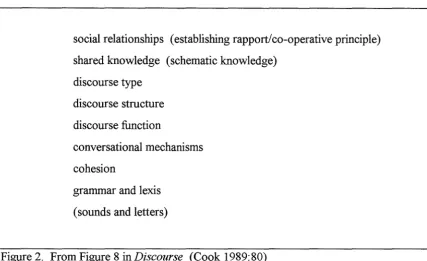
social relationships (establishing rapport! co-operative principle) shared knowledge ( schematic knowledge)
discourse type discourse structure discourse function
conversational mechanisms cohesion
grammar and lexis (sounds and letters)
Figure 2. From Figure 8 in Discourse (Cook 1989:80)
Those with linguistic orientation typically put emphasis on discourse as the expansion of language beyond the unit of the sentence. Their main concern is to examine the rules or procedures whereby a collection of juxtaposed utterances acquires internal coherence as a spoken or written text. Stubbs gives a definition of discourse analysis as an attempt "to study the organization of language above the sentence or above the clause" (Stubbs 1983: 1). Within this tradition belong the studies of van Dijk (1985), and the studies of a group at the University of Birmingham. The Birmingham group's model was arguably the first systematic attempt to provide a descriptive framework of Discourse Analysis. Their model, while based on speech act theory, puts more emphasis on the function of speech acts within the whole discourse, as exemplified in their studies of classroom and medical interaction (Sinclair and Coulthard 1975, Coulthard and Ashby 1976, Coulthard 1985, Coulthard and Montgomery 1981).
with language in use in social contexts" (Stubbs 1983: 1). He feels that it is this emphasis on context (in addition to co-text) which has distinguished discourse analysis.
The exact nature of discourse analysis, therefore, depends very much on individual researchers, and has been the subject of fierce argument. Between some who call themselves discourse analysts, there are clearly ideological, in addition to methodological differences, as witnessed by a series of critiques by Widdowson (1995a, 1995b) and Fairclough (1996) on each other's approach. Widdowson sums up the different points of view by claiming that "one tradition of discourse analysis has made statements about social attitudes and beliefs, the exercise of power, the influence of ideology, and so on, with scant reference to the linguistic data; and another tradition has made statements about the specifics of language in use without paying much attention to social factors." (Widdowson 1995: 159). He goes on to say that it should be possible to reconcile the two traditions.
research method of close observation of groups of people communicating in natural settings" (McCarthy 1991:6).
Conversation Analysis seems to be a methodology particularly suited to achieve the aims of this study if we feel with Schegloff that it "is at a point where linguistics and sociology .. meet" (Schegloff 1992: 104); it lies within the middle sector of the 'linguistics - sociology' spectrum, see Figure 1, page 28. Goodwin and Duranti sum up the advantages of the approach: "conversation analysis provides a thoroughgoing analysis of language as a mode of interaction which relies upon context for the interpretation of action that at the very same time shapes, expands and changes that context" (Goodwin and Duranti 1992:30).
As noted above (page 30), the Conversation Analysis approach was developed by ethnomethodologists: Sack's early studies of natural conversation derive from an ethnomethodological perspective. He was interested in discovering how a conversation's "structure and resources reflect speakers' social knowledge" (Sacks 1972:325) and advocated the use of "our knowledge of social structure" (Sacks 1972:327) to interpret everyday discourse. The first 'Conversation Analysts', such as Sacks, Jefferson and Schegloff, combined an ethnomethodological perspective with a study of the detail of language organisation and patterns, to develop the procedures that are at the heart of Conversation Analysis.
intention of this study is to focus both on the language and social factors within a particular context. The use of Conversation Analysis as a methodology would, therefore, seem appropriate. However, critics of Conversation Analysis point out that, although the approach focuses on the way conversation is structured according to the orientation of the participants to particular social structures, there has been a reluctance to take the analysis further: «conversation analysis has been resistant to making connections between such 'micro' structures of conversation and the 'macro' structures of social institutions and societies" (Fairclough 1989: 12). It is for this reason that in this study Conversation Analysis is supplemented by further means of investigation in order to gain a more complete picture, not only of the discourse, but also of the motivations of the participants, and of the influencing social factors (see Sections 3.2.2 and 3.5 for details concerning the use of questionnaires and interviews). In this way I hope to take account of Fairclough's criticism that Conversation Analysis "answers 'what?' questions but not 'how?' and 'why?, questions" (Fairclough 1989: 12)
structure as an essential context on which participants rely, in the turn-by-turn development of their interaction, and the way it is, at the same time, the product of the same interaction. In other words the participants are playing a role as they see it should be played and by so doing perpetuate these expectations and procedures. As one of the aims of this study is to investigate to what extent perceived roles and talk within the specific context of the feedback session are mutually reinforcing this methodology would seem the most useful approach to take.
Conversation Analysis, by means of rigorous and detailed observation, transcription, and analysis of language can be used as a basis for theorising because "from close looking at the world we can find things that we could not, by imagination, assert were there. We would not know that they were 'typical'" (Sacks 1984:25). There is a need to adopt a methodology that focuses on units large enough to encompass series of utterances, the sequences of activity as well as the component unit turn if it is accepted that 'conversational location', both in terms of 'local turn-by-turn organization' (Sacks, Schegloff et al. 1974) and in terms of overall 'conversational structure' (Schegloff and Sacks 1973) is crucial in determining how an utterance is understood. Levinson (1983) points out the importance of 'sequences of utterances' in assisting understanding and inference. It is for this reason that a methodology is needed that allows study of the feedback session in its entirety in order to get as complete a picture as possible. Fairclough (1989: 10) notes that one of the strengths of Conversation Analysis is that it works with extended samples of real conversation.
as the major methodological tool: for example, Boden and Zimmerman (1991); Drew and Heritage (1992). Over twenty years ago Coulthard and Ashby, in their studies of doctor-patient interviews, deliberately decided to study "situations in which institutional definitions constrain the purposes and goals of the interaction and the roles of the participants" (Coulthard and Ashby 1976). They started with the expectation that the discourse structure in the institutional setting would be "more obvious and repetitive", lacking the "variation and complexity" of non-institutional, or social, conversations. Later studies, however, have concentrated on institutional talk, not so much because they are an 'easier' type of conversation to study, but because of the interest in the characteristics of such talk as specific genre. A number of these studies are collected together in Talk and Work (Drew and Heritage 1992) and, in her work The Business of Talk, Boden proclaims "a new and rather insistent emphasis on the need to study
organizations as they happen" (Boden 1994:26). As one of the aims of this study is to demonstrate that the feedback session can be described as a 'work' context, and the resultant talk can be described as belonging to a body of 'institutional talk', then it would seem useful to employ the methodology of those researchers who have studied similar types of 'talk at work'.
ordinary conversation; even though they change from one occasion to another and from one moment to another, patterns can be identified. It will be useful to see whether distinctive patterns can be identified in the feedback session and so a comparative approach will be taken when describing discourse within the sessions. It will also be useful to compare and contrast the analyses of the two types of feedback session - pre-service and in-pre-service - to establish common features in both types of session, and to distinguish any notable differences.
3.1.4 The Case Study
Once a decision is made about how to describe and analyse the data gathered from the feedback sessions, it needs to be decided:
a) how much of the data collected needs to be analysed in order to make valid generalisations;
b) how this data can best be presented, in order to put forward a convincing case for any generalisations made and conclusions reached.
Advantages of the case study approach
The case study approach has particular benefits, both in terms of analysis and presentation. In their review of methods of research Gall et al offer the following as a definition of case study research: "the in-depth study of instances of a phenomenon in its natural context and from the perspective of the participants involved in the phenomenon" (Gall, Borg et al. 1996:545). Because the case study entails <'the intensive study of specific instances" (Gall, Borg et al. 1996:543) it can be claimed to be particularly appropriate for use with Discourse or Conversation Analysis where the entire conversation needs to be analysed in order to identify sequences and patterns of organisation that would not be evident from extracts. By using a case study approach an entire conversation can be described and analysed in detail; time and space would preclude such a detailed treatment of multiple conversations.
Yin also notes that the case study is a strategy which has a distinct advantage when "a how or why question is being asked about a contemporary set of events over which the investigator has little or no control" (Yin 1994:9). The conversations analysed by Conversation Analysts are authentic in terms of time and place. They are not 'experiments' that can be repeated under controlled laboratory conditions. For this reason it is not usually practically possible to get numerous suitable conversations from which statistically significant data can be derived.
In sum, the case study approach is useful for use with Conversation Analysis in that it enables focused attention on the details of language in entire conversations. It allows the researcher to present his or her observations alongside full transcripts of the conversations being studied. At the same time, the case study allows for a means of investigating the point of view of the participants, so that a more ethnographic perspective can be brought to bear.
Disadvantages of the case study approach
However, a number of criticisms have been levelled against the case study, notably that they lack rigour and provide little basis for scientific generalisation. It can be argued that the researcher needs to study multiple cases in order to test whether themes and patterns identified in one case study are typical. These are criticisms which are difficult to counter; although Yin (1994: 10) claims that "case studies, like experiments, are generalizable to theoretical propositions and not to populations and universes".
Section 3.5 Summary of Chapter 3: Methodology and framework for analysis, for details.
3.2 Tools of Investigation: a review
Clearly the tools of research chosen should be compatible with the methodological approach or approaches adopted. Researchers in the field of Conversation Analysis advocate obtaining data for analysis from recordings of naturally occurring conversations. However, other techniques may be successfully employed to supplement and complement this tool.
The usefulness to the study of the following is now discussed: • observation, recording and transcribing
• questionnaires • interviews
3.2.1 Observation, recording and transcribing
Observing and recording conversation, which is later transcribed and analysed, is the major research tool of Conversation Analysis. Observation and interpretation of behaviour by the researcher is compatible with an etic perspective.
As Gall et al point out: observational methods may yield more accurate data than self-report data. ''For example, educators have noted that teachers dominate classroom talk at the expense of student participation. But what are the actual percentages of teacher and student talk in classrooms? Self-reports by teachers or students are unlikely to yield an accurate answer to this question, but an analysis of observations recorded on audiotape or videotape could do so" (Gall, Borg et al. 1996:328).
In an attempt to record typical behaviour the observation should be in as natural circumstances as possible: in the place where, and at the time when, the conversation would normally take place - not in a laboratory, recording studio or other artificial setting. In this way, though natural behaviour is not guaranteed, the likelihood of untypical behaviour is reduced.
Recording can be by means of note-taking by an observer, and/or by means of audio or video equipment. Video is generally considered to be preferable as it is less obtrusive than a human observer, and it takes into account the paralinguistic features of gestures, body movement, eye-contact and facial expression which an audio recording alone cannot do. A video recording can also be played back repeatedly so that the conversation can be transcribed as accurately as possible, including a note of any pertinent paralinguistic features.
The disadvantage of any type of recording is that it might inhibit or alter the behaviour of those being studied. Stubbs (1983) outlines the biases in recording. He claims that "in extreme cases, observation itself may generate artificial behaviour. And, although the effects may be controlled, it is never possible to guarantee that there are no effects." (Stubbs 1983:227). However, many researchers who have had experience of this method agree with Coulthard and Ashby who claim that ''the kind of linguistic adjustments are, for our purposes, trivial ... the kind of patterning we are interested in is too basic and deep-seated to be altered" (Coulthard and Ashby 1976:73). Also, many of those being observed report that, after the first few minutes, they forgot about the presence of the camera.
However, in describing interaction through transcription there are theoretical and practical problems to overcome. A conversation is made up of a series of graded rather than discrete behaviours, many of which are taking place simultaneously. Any system for designating codes or signs to such behaviours must be subjective in nature: decisions have to be made as to what to describe on paper for purposes of analysis, and how such a description can be realised. As Stubbs points out: "There is no single correct transcription for a given utterance. A broad transcription and different narrow transcriptions can select different features for representation" (Stubbs 1983:229). He goes on to say that such decisions "take for granted interpretations and analyses of the data" (Stubbs 1983:229). As noted by Green, Franquiz et al. (1997: 172), the transcription "'re' -presents" data constructed by the researcher for a purpose. It is not just talk written down.
Roberts (1997: 168) notes ''the tension between accuracy, readability and representation", and Cook (1990) outlines the dilemma faced by researchers when deciding what degree of detail to describe when analysing recorded conversation. The following questions have to be considered.
• Is it necessary, or possible, to transcribe all the words spoken, by all participants, from the start to the finish of a complete conversation?
• Should the words be transcribed using standard orthography, by means of a system which approximates to the way the words are spoken; for example, gonna for going to and taking account of dialect, or by phonemic or phonetic transcription?
• Should standard punctuation be used, or a more detailed transcription that, for example, indicates the time of pauses in speech?
• Should sounds such as Uhuh and Mmm be included, and a note made of hesitations, 'false starts', or repeated sounds or words, for example: Erm I I don don't think I agree?
• Is it useful to indicate overlaps, when more than one person is speaking at the same time, and to note as precisely as possible the timing of each participant's utterance in relation to those of others?
such as face-touching, hand-wringing, eyebrow movement; tone and intonation of voice?
• Should information be included about the situation in which the conversation takes place: the type of room, the furniture arrangement; the lighting?
• Is it useful to include information about any conversations the participants may have had previous to the one under scrutiny; information about participant knowledge of the topics under discussion; even an assessment of the participants' knowledge of the world?
• Does the study require a description of the relationship between the participants, the relative power, an indication of the attitude one may have to the other?
The answers to these questions very much depend on the purpose to which the transcription is to be put and, from a practical point of view, to what extent it is physically possible, using the chosen method of observation, to encode the information. Studies have utilised a range of transcribing techniques. An example from one end of the spectrum would be the noting, in real time, of the words spoken by just one pupil in a class. Examples of transcriptions from the other end of the spectrum are to be found in Birdwhistell (1973), in which the words used are recorded in standard orthography, alongside which a very detailed note is made of paralinguistic features such as 'pinched nostrils', 'right sneer' and 'slow lick -lips'.
Birdwhistell's choice of transcription fitted the focus of the study - that of kinesics. Yule (1995), on the other hand, used a transcription which did not include facial gestures but which encoded intonation, alongside the words uttered, as this best demonstrated the thesis of his study. This is because he feels, as stated in an earlier publication, that "the speaker has available to him the full range of 'voice quality' effects (as well as facial expression, postural and gestural systems). Armed with these he can always override the effect of the words he speaks" (Brown and Yule 1983:4).
3.2.2 Questionnaires and Interviews
Both questionnaires and interviews ''typically enquire about the feelings, motivations, attitudes, accomplishments and experiences of individuals" (Gall, Borg et al. 1996:288). They can be used to gain insight into the participants' interpretation of actions and events, and are compatible with the emic perspective. Yin (1994) recommends both questionnaires and interviews as useful tools in case study research. They are "used extensively in research to collect information that is not directly observable" (Gall, Borg et al. 1996:288). For this reason information obtained from questionnaires and interviews can complement research findings gleaned from observation: the view offered by the participants can serve to reinforce or question assumptions made from Conversation Analysis.
Questionnaires ask the same questions of all the individuals in the sample and the respondents reply in writing. A number of writers on research methodology note the advantages and disadvantages of this tool, for example: Hopkins (1993: 136), Cohen and Manion (1994:92-94). They can be an efficient way of collecting data, particularly in terms of the researcher's time. Questionnaires are more impersonal in that the person responding is not meeting the questioner face-to-face. This may encourage confidences that would not be afforded in person. However, the respondents have a degree of control over the data-collecting process: they have choice about the extent to which they complete the answers. In addition, the researcher cannot probe more deeply into the respondents' opinions and feelings by using follow-up questions. Once the questionnaire has been distributed, it is not usually possible to modify the items, even if they prove not be clear to some respondents, or if they do not elicit responses which are useful or illuminating. As there is no opportunity for the researcher to clarify points of misunderstanding the questions have to be carefully worded to avoid misinterpretations and ambiguity. Often a pilot study will prove to be useful in order to modify the questionnaire before the main data-collecting process. Details of the questionnaires I used in this study, and reasons for their use, are given in Section 3.3.3, below.
questionnaires interviews have advantages and disadvantages as noted by Hopkins (1993: 126-7), and Cohen and Manion (1994:271-297). In an interview the researcher is more in control of the degree to which questions are answered than in a questionnaire. The process is more adaptable; skilled interviewers can follow up a respondent's answers to obtain more information and clarifY vague statements. Structured or guided interviews can be useful in that the more free-wheeling discussion can lead to interesting details missed in a written questionnaire. Interviewers can also build trust and rapport, making it sometimes possible to elicit information that the respondent may not give by any other data-collection method. In a study comparing information obtained by interview and questionnaire, Jackson and Rothey (1961) found that the interview yielded more complete information concerning negative aspects of the self
However, there are disadvantages associated with the interview. The information gained is more difficult to compare across participants - especially for statistical analysis. It is difficult to standardise the interview situation so that the interviewer does not influence the respondent to answer questions in a certain way, though it can be an advantage to be able to explore more open-ended topics. The interviewees cannot remain anonymous and the degree and type of response can vary depending on the rapport the interviewer has with the individual respondent. For these reasons the interview is more commonly used in qualitative research. Details of the interviews I used in this study, and the reasons for their use, are given in Section 3.3.3, below.
3.3 Collection and selection of data
In this section there is a description of:
3.3.1 the conditions under which the video recordings were made; 3.3.2 the transcription script used in the analysis of the conversations;
3.3.3 the questionnaires and interviews used with the participants, after the feedback seSSIOns.
3.3.1 Video Recording
The major tool of investigation I utilised in this study is that of the video recording. This method of recording data was chosen for the following reasons.
• It is a familiar piece of equipment to the participants in this study and not so inhibiting and obtrusive as a human recorder might be.
• With certain provisos, outlined in the discussion on transcription (Section 3.3.2 below), the camera is a more 'objective' recorder than the human observer who, because of time restraints, has to be selective about what to record.
• As the conversations are on tape they could be reviewed time and time again until I had as detailed a transcription as deemed necessary for an in-depth analysis. In this study the conversations were at least 20 minutes long and took many hours to transcribe.
• A visual, in addition to an audio recording, allowed me to 'hear' better what is being said. In this study this was an important factor as it is the detail of the language used which is of interest; it was crucial to get as complete a record of what was said as possible.