R E S E A R C H
Open Access
Stability analysis for coupled systems with
time-varying coupling structure
Jiqiang Feng
1*and Xiaojia Luan
2*Correspondence: [email protected] 1College of Mathematics and Statistics, Shenzhen University, Shenzhen, 518060, P.R. China Full list of author information is available at the end of the article
Abstract
The stability of coupled systems with time-varying coupling structure (CSTCS) is considered in this paper. The graph-theoretic method on a digraph with constant weight has been successfully generalized into a digraph with time-varying weight. In addition, we construct a global Lyapunov function for CSTCS. By using the graph theory and the Lyapunov method, a Lyapunov-type theorem and some sufficient criteria are obtained. Furthermore, the theoretical conclusions on CSTCS can successfully be applied to the predator-prey model with time-varying dispersal. Finally, a numerical example of CSTCS is given to illustrate the effectiveness and feasibility of our results.
Keywords: time-varying coupling structure; global stability; predator-prey model; graph theory
1 Introduction
During the past few decades, coupled systems (CSs) have been used to model a wide va-riety of systems in many fields, such as physics [–], biology [–] and social science []. The general CSs can be described as follows:
dxk(t) dt =fk
xk(t),t
+ l
h= akhHkh
xk(t),xh(t)
, k= , , . . . ,l,t≥, ()
wherefkandHkhare continuous functions, andakhrepresents the coupling strength. At the same time, it is of great importance to analyze the stability of CSs, because most ap-plications of CSs heavily depend upon their stability. There are lots of results on CSs with time-invariant coupling structure having been reported (see [, , , –] and the refer-ences therein). In [], the stability problem for a multi-group SIRS epidemic model was investigated. Guo et al. [] considered the stability of a stochastic neural networks with infinite delay and Markovian switching. In [, ], Li et al. used graph theory to explore the global stability for general coupled systems of ordinary differential equations. Follow-ing this pioneerFollow-ing work in [, ], many scholars have studied the dynamics of CSs by this technique and obtained a number of conclusions [–]. Moreover, the method has been extended to stochastic systems [–], discrete time systems [], and time delay systems [].
Generally speaking, the coupling structure of CSs is not constant. For example, in biomathematics, the dispersal rate of some species among different groups changes over time. When a natural disaster occurs, such as earthquakes and flood, some species will migrate to a safe place, then the dispersal rate of them will improve significantly. In epi-demiology, the transmission rate of infectious diseases is also time-varying. For instance, population migration across regions increases greatly during the high season, and then the transmission rate of infectious diseases will be higher. However, when some regions dis-continue with each other due to some reasons, the transmission rate of infectious diseases will be lower. All these facts can illustrate that time-varying coupling structure should not be neglected. Thus, we should take this time-varying coupled behavior into account, which can help us investigate the persistence of species and control infectious diseases. Conse-quently, it is essential for us to investigate the coupled systems with time-varying coupling structure (CSTCS). Unfortunately, as far as we know, few papers mentioned in the existing literature consider CSTCS.
Until now, many researchers, including us, have given some results of global stability of CSs. However, in our previous work we do not consider the time-varying coupling struc-ture. In this paper, in order to make up for the defect of our previous work and characterize CSs reasonably, we will devote ourselves to the investigation of CSTCS. Generally, com-pared with system (),akh(t)Hkh(xk(t),xh(t)) may more reasonably be used to describe the interactions within a group or among different groups in the course of the dispersal. How-ever, it is intricate to study the dynamics of CSTCS, since constructing a global Lyapunov function and estimating the symbol of its derivative are complex and technical under the circumstances of the time-varying coupling structure.
Motivated by the above discussions, in this paper, by introducing the time-varying cou-pling structure, we present a class of novel CSs that is CSTCS. Based on the graph theory and the Lyapunov method, a systematic method is established to construct a global Lya-punov function for CSTCS. Moreover, sufficient criteria ensuring the stability of CSTCS can be obtained. Furthermore, we consider a predator-prey model with time-varying dis-persal. Meanwhile, stability criteria for it are presented, respectively. Then a numerical example is given to illustrate the effectiveness of our results.
The paper is outlined as follows. In Section , we introduce several preliminaries and give the formulation of the CSTCS. In Section , sufficient criteria of the stability for CSTCS are obtained. The stability results for predator-prey model with time-varying dis-persal in Section . Finally, a numerical example is given in Section .
2 Preliminaries and model formulation 2.1 Mathematical preliminaries
For the sake of simplicity, the following notations are used in this paper. LetZ+={, , . . .},
L={, , . . . ,l},R
+= [, +∞),n=
l
k=nkfornk∈Z+, andRndenoten-dimensional Eu-clidean space. And we writeC,(Rn×R+;R+) for the family of all nonnegative functions
V(x,t) onRn×R
+that are continuously once differentiable atxandt.
In this paper, use (G,A) to represent the digraph withlvertices. LetV(G) denote the set
of vertices inG; without loss of generality, letV(G) =L.
Lemma Assume n≥.Let ckdenote the cofactor of the kth diagonal element of the
Lapla-cian matrix of(G,A).Then the following identity holds:
n
k,h=
ckakhFkh(xk,xh) =
Q∈Q
W(Q)
(s,r)∈E(CQ)
Frs(xr,xs).
Here,for any k,h∈L,Fkh(xk,xh)is an arbitrary function,Qis the set of all spanning
uni-cyclic graphs of(G,A),W(Q)is the weight ofQ,andCQdenotes the directed cycle ofQ.In particular,if(G,A)is strongly connected,then ck> for k∈L.
2.2 Model formulations
To begin with, we will establish CSTCS on a digraphGwithl(l≥) vertices. We assume that thekth vertex is described by
dxk(t) dt =fk
xk(t),t
, t≥, ()
wherexk= (xk,xk, . . . ,xknk)T∈Rnk, andfk:Rnk×R+→Rnk is a continuous function.
Secondly, we take the influence of coupling structure into account. Let akh(t) and
Hkh(xk,xh) be continuous functions, representing the time-varying coupling strength and coupling function of thehth vertex to thekth vertex, respectively. Hereakh(t)Hkh(xk,xh) = if and only if there exists no coupling influence from the hth vertex to the kth ver-tex for any t ≥. Hence, for the kth vertex, via replacing fk(xk(t),t) by fk(xk(t),t) + l
h=akh(t)Hkh(xk(t),xh(t)) we get the following CSTCS:
dxk(t) dt =fk
xk(t),t
+ l
h=
akh(t)Hkh
xk(t),xh(t)
, k∈L. ()
In the proofs of our main theorems, a Lyapunov function for system () is constructed by combining the Lyapunov functions of vertices with the coupling structure. In the sequel, the definition of a vertex Lyapunov function set is given as follows.
Definition The set{Vk(xk,t),k∈L}is called a vertex Lyapunov function set for system ()if the following conditions are satisfied for any k∈Land t≥.
V. There exist functionsVk(xk,t),bkh(t)andFkhsuch that
dVk(xk,t)
dt
∂Vk(xk,t)
∂t +
∂Vk(xk,t)
∂xk
fk
xk(t),t
+ l
h=
akh(t)Hkh
xk(t),xh(t)
≤ l
h=
bkh(t)Fkh
xk(t),xh(t)
–d k(t)
dk(t)
Vk
xk(t),t
,
V. Along each directed cycleCof the weighted digraph(G, (bkh(t))l×l),we have
(h,k)∈E(C) Fkh
xk(t),xh(t)
≤, ()
for allxk∈Rnk,xh∈Rnh.
We always suppose that all assumptions as regards the existence and uniqueness in The-orems . and . in [] are fulfilled, so system () has a unique global solution for any given initial valuex() =x, and we here denote the solution byx(t;x). Assume
further-more thatfk(,t) = andHkh(, ) = . Then system () has a trivial solutionx(t)≡.
3 Global stability analysis for CSTCS
In this section, we investigate the stability of the trivial solution of system (). Based on the graph theory and the Lyapunov method, we shall establish a theoretical framework for constructing a global Lyapunov function of system (). The method used in the proof of main results is motivated by [, ].
Throughout this section, we always assume that (G, (bkh(t))l×l) is strongly connected for anyt≥.
Theorem Suppose that system ()admits a vertex Lyapunov functions set {Vk(xk,t),
k∈L}.Then
V(x,t) = l
k=
dk(t)Vk(xk,t) ()
satisfiesV˙(x(t),t)≤for t≥.In other words,it is a Lyapunov function of system().
Proof By using () and condition V, we can derive that
dV(x(t),t)
dt =
l
k=
d(dk(t)Vk(xk(t),t)) dt
≤ l
k=
dk(t)Vk
xk(t),t
+dk(t) l
h=
bkh(t)Fkh
xk(t),xh(t)
–d k(t)
dk(t)
Vk
xk(t),t
= l
k=
l
h=
dk(t)bkh(t)Fkh
xk(t),xh(t)
. ()
By Lemma , we have
l
k=
l
h=
dk(t)bkh(t)Fkh
xk(t),xh(t)
=
Q(t)∈Q(t)
WQ(t)
(s,r)∈E(CQ(t))
Frs
xr(t),xs(t)
whereQ(t) is the set of all spanning unicyclic graph of (G, (bkh(t))l×l),W(Q(t)) is the weight ofQ(t), andCQ(t) denotes the directed cycle ofQ(t). Then, making use of condition V
and the fact thatW(Q(t))≥, we obtain
dV(x(t),t)
dt ≤
Q(t)∈Q(t)
WQ(t)
(s,r)∈E(CQ(t))
Frs
xr(t),xs(t)
≤.
The proof is complete.
With the help of some properties in graph theory, now some other simple conditions are discussed. Note that if (G, (bkh(t))l×l) is balanced for anyt≥, then
l
k=
l
h=
dk(t)bkh(t)Fkh
xk(t),xh(t)
=
Q(t)∈Q(t)
WQ(t)
(h,k)∈E(CQ(t))
Fkh
xk(t),xh(t)
+Fhk
xh(t),xk(t)
.
In this case, () can be replaced by
(k,h)∈E(CQ(t))
Fkh
xk(t),xh(t)
+Fhk
xh(t),xk(t)
≤. ()
Based on this, a corollary is showed below.
Corollary If(G, (bkh(t))l×l)is balanced for any t≥,the conclusion of Theoremholds
if()is replaced by().
Furthermore, if for every Fkh(xk(t),xh(t)) there exist functionsPk(xk(t)) andPh(xh(t)), such that
Fkh
xk(t),xh(t)
≤Pk
xk(t)
–Ph
xh(t)
, ()
then () follows naturally. Thus we obtain one more corollary below.
Corollary If(G, (bkh(t))l×l)is balanced for any t≥,the conclusion of Theoremholds
if()is replaced by().
Remark In Theorem , we apply the graph theory and the Lyapunov method to prove the stability of system (). Recently, the stability problem for coupled systems has been widely studied. In [], Li et al. used graph theory to explore the global-stability problem for coupled systems of differential equations on networks. In this work, ifakh(t) =akh, our conclusion will be consistent with the Theorem . in []. Hence, our work is a general-ization of the previous studies of CSs with time-invariant structure.
Thus it prompts us to establish a coefficient-type criterion for the stability analysis of sys-tem ().
Theorem Let p≥.The trivial solution of system()is stable if the following conditions hold for any k,h∈Land t≥.
A. There is a constantαk> such that
xTkfk(xk,t)≤–αk|xk|.
A. There exists a constantAkhsuch that
Hkh(xk,xh)≤Akh
|xk|+|xh|
.
A. The digraph(G,H(t)),whereH(t) = (Akhakh(t))l×l,is strongly connected and
–αkp+ p l
h=
Akhakh(t)≤–
gk(t)
gk(t)
, ()
where gk(t) is the cofactor of the kth diagonal element of the Laplacian matrix of (G,H(t)).
Proof For anyk∈L, define a functionVk(xk,t) =|xk|p. Making use of condition A, we get
dVk(xk(t),t) dt
=pxk(t)p–xTk(t)
fk
xk(t),t
+ l
h=
akh(t)Hkh
xk(t),xh(t)
≤p
–αkxk(t) p
+ l
h=
akh(t)xk(t) p–
Hkh
xk(t),xh(t) . ()
By using condition A and the inequality (see [], p.)
|a|p|b|q≤ p p+q|a|
(p+q)+ q p+q|b|
(p+q),
in whichp,q> , we have
l
h=
akh(t)xk(t) p–
Hkh
xk(t),xh(t)
≤p–
p
l
h=
Akhakh(t)xk(t) p
+
p
l
h=
Akhakh(t)xh(t) p
Substituting it into () yields
tion of system () is stable, which completes this proof.
Because the digraph is strongly connected andakh(t)≤, we can obtaingk(t)≤. Fur-thermore, we can compute that
gk(t) = –
Consequently, it easily follows that
–αkp+ p
Then the condition A is satisfied. Thus we have verified all conditions in Theorem . This
completes the proof.
re-where
G=
l
i=Ai –A · · · –A,k– –A,k+ · · · –Al –A
l
i=Ai · · · –A,k– –A,k+ · · · –Al ..
. ... ... ... ... ... ...
–Ak–, –Ak–, · · ·
l
i=k–Ak–,i –Ak–,k– · · · –Ak–,l –Ak+, –Ak+, · · · –Ak+,k–
l
i=k+Ak+,i · · · –Ak+,l ..
. ... ... ... ... ... ...
–Al –Al · · · –Al,k– –Al,k+ · · · li=lAli .
Then it is easy to get
gk(t) = l
i=,i=k
a(t)·a(t)· · ·ai(t)· · ·al(t)·G.
Thus
gk(t)
gk(t) =
l
i=,i=k
ai(t)
ai(t) .
Therefore, condition A holds. Then the proof is complete.
4 An application to the predator-prey model with time-varying dispersal In this section, we consider a predator-prey model, in which the dispersal rate of preys amongl(l≥) patches is time-varying, the details are as follows:
⎧ ⎨ ⎩
dxk
dt =xk(rk–bkxk–ekyk) + l
h=akh(t)(xh–αkhxk),
dyk
dt =yk(–γk–δkyk+εkxk), k∈L,
()
wherexkandykdenote the densities of preys and predators on the patchk, respectively. The parameters in the system () are nonnegative constants, and ek,εk, δk andbk are positive. The notations and useful definitions in this section are as follows:
rk: the intrinsic growth rate of the preys in the absence of predation in patchk,
γk: the death rate of the predators in patchk,
bk: the intra-specific competition rate of the preys in patchk,
δk: the intra-specific competition rate of the predators in patchk,
εkxk: the proportion of preys which are eaten and become predators,
ek: the predator response function for the predator with respect to that particular prey
in thekth patch.
Functionakh(t)≥ is the dispersal rate of preys from patchhto patchk. Constantαkh≥ is a boundary condition in the continuous diffusion case.
dispersal. In this paper, ifakh(t) =akh, system () turns into system (.) in []. Hence, system () is much more general since it considers a dispersal rate of preys which is not constant but time-varying.
Remark If we simplify system (), in other words, if we letrk=r,bk=b,ek=e,γk=γ,
δk=δ,εk=ε, andakh(t) =αkh= , then it is trivial to see that system () has a unique equilibrium:x∗=δδrb++eeγε,y∗=εδrb–+beγε. If conditionεr>bγ is satisfied, we can guarantee that (x∗,y∗)Tis a positive equilibrium. So it is reasonable to assume that there exists a positive
equilibriumE∗= (x∗,y∗, . . . ,x∗l,y∗l)Tfor system ().
LetD(t) = (akh(t)εkx∗h)l×l, andlk(t) be the cofactor of thekth diagonal element of the Laplacian matrix of (G,D(t)), respectively.
Theorem For any t≥,assume that the digraph(G,D(t))is strongly connected and the following inequality holds:
lk(t)≤, k∈L. ()
Then,as long as a positive equilibrium E∗exists,it is unique and globally asymptotically stable in the positive coneRl
+.
Proof Consider the Lyapunov functions
V(k)(xk) =εk
Making use of system (), we get
see thatxh=x∗hforh∈L. Then
Therefore, by the LaSalle invariance principle,E∗ is globally asymptotically stable. This also implies thatE∗is unique inRl
+.
Based on Theorem , by using the dispersal rate of preysakh(t),k,h∈L, we can get two more simple stability criteria for system ().
Theorem For any t≥,let(G,D(t))be strongly connected.If akh(t)≤,then as long as a positive equilibrium E∗exists,it is unique and globally asymptotically stable in the positive coneR+l. here, we omit it. This means that the conditions of Theorem could be achieved. This
completes the whole proof.
Theorem For any t≥,let(G,D(t))be strongly connected.When akh(t) =ak(t),k,h∈L,
the conclusion of Theoremholds if
l
Proof Similar to the proof of Theorem , we get
Furthermore, we can get
dV
dt ≤
l
k=
l
h=
lk(t)θkh(t)Fkh(xk,xh)≤.
It is now the same as the proof of Theorem . The proof is complete.
Remark In Theorem , we have presented the stability criterion for a predator-prey model in which the dispersal rateakh(t) is time-varying for anyk,h∈L. Li et al. [] dis-cussed a predator-prey model with time-invariant dispersal and achieved some results concerning the stability problem. In this paper, ifakh(t) =akh, the conclusion of Theorem is consistent with Theorem . in [], which means our work generalizes a global-stability result from time-invariant dispersal to time-varying dispersal.
Remark Biologically, time-varying dispersal, such as seasonal migration, is an extremely common phenomenon. As a result, the effect of time-varying dispersal on the species sur-vival has been an important topic in population biology. This paper provides a possibility that researchers could use it to make the adjustment for the prey dispersal network to pro-tect some species, which truly shows that the results in this paper are meaningful not only in theory but also in practice.
5 Numerical simulations
In this section, we will discuss a numerical example to illustrate the effectiveness and fea-sibility of Theorems and .
Letl= . Consider a predator-prey model in the form of system () with the following parameters:
rk= ., bk= ., ek= ., γk= .,
δk= ., εk= ., k= , , . . . , ,
rk= ., bk= ., ek= ., γk= ,
δk= ., εk= ., k= , , . . . , ,
αkh= , (k,h= , , . . . , ).
Firstly, we can make a calculation to getx∗k=,y∗k=,k= , , . . . , , which means that the positive equilibrium is
E∗=
,
,
,
, . . . ,
,
T
×
.
The time-varying dispersal coefficients for preys are the followings:a(t) =e–t,a(t) = t–,a
(t) =e–t a(t) = ()t,a(t) =e–t,a(t) =esint–t,a(t) = ()t,a(t) =e–t
akh(t)≤,k,h= , , . . . , . And by the definition ofD(t), we can obtain the coefficient-matrixD(t) for system () as follows:
D(t) =
⎛ ⎜ ⎜ ⎜ ⎜ ⎜ ⎜ ⎜ ⎜ ⎜ ⎜ ⎜ ⎜ ⎜ ⎝
e–t
t
–
e–t
()t
e–t
e
sint–t
()t
e–t
⎞ ⎟ ⎟ ⎟ ⎟ ⎟ ⎟ ⎟ ⎟ ⎟ ⎟ ⎟ ⎟ ⎟ ⎠ .
Obviously, (G,D(t)) is strongly connected for anyt≥. Until now, all conditions in
The-orem have been checked. Hence, we can get the conclusion that the positive equilibrium
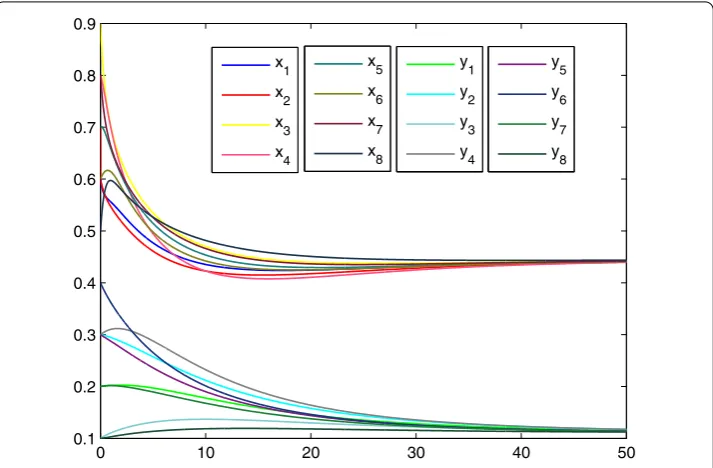
E∗is unique and globally asymptotically stable in the positive cone. The simulation result is shown in Figure .
Whenakh(t) =ak(t),k,h∈L, let the time-varying dispersal coefficients for preys be the following:a(t) = .,a(t) =esint,a(t) =e–t,a(t) =e–t,a(t) =t,a(t) =.+sint t,a(t) = ecost,a
(t) =e–t. Coefficient-matrixD(t) for system () can be obtained via the definition
ofD(t) as follows:D(t) = (aij)n×n, wherea=a=a=a=a=a=a=a= , a=a=a=a=a=a=a= ,a=a=a=a=a=a=a=esint, a=a=a=a =a=a =a=e–t,a=a=a=a=a=a=a=
e–t,a=a=a=a=a=a=a=
t,a=a=a=a=a=a=
a= .+sint t,a=a=a=a=a=a=a=ecost,a=a=a=a=a=
Figure 2 The solution of coupled predator-prey model with time-varying dispersal coefficient-matrix D2(t) whenl= 8.
a=a=e–t. And
i=,i=k
ai(t)
ai(t)
=cost–sint– –
t +
tcost– . –sint t(. +sint)
≤– +cost–sint–
t < .
It is obvious that (G,D(t)) is strongly connected for anyt≥. We can easily check that
all conditions of Theorem are satisfied. And the equilibriumE∗of system () with time-varying dispersal coefficient-matrixD(t) is shown in Figure . In fact, we can clearly see
from Figure that the equilibriumE∗is unique and globally asymptotically stable in the positive cone. The numerical simulation result verifies the effectiveness and feasibility of the proposed results.
Compared with the existing results on the stability of CSs [, ], our main contribu-tions are as follows.
. We generalize CSs with time-invariant coupling structure to CSTCS.
. We first study the global stability for CSTCS by combining the graph theory with the Lyapunov method.
. We apply these theoretical conclusions to a predator-prey model with time-varying dispersal.
Acknowledgements
The authors would like to thank the reviewers for your very helpful comments and suggestions. This work was supported by the National Natural Science Foundation of China (No. 61401283) and Educational Commission of Guangdong Province, China (No. 2014KTSCX113).
Competing interests
Authors’ contributions
All authors contributed equally to the writing of this paper. All authors read and approved the final manuscript.
Author details
1College of Mathematics and Statistics, Shenzhen University, Shenzhen, 518060, P.R. China.2School of Mathematical Sciences, University of Science and Technology of China, Hefei, 230026, P.R. China.
Publisher’s Note
Springer Nature remains neutral with regard to jurisdictional claims in published maps and institutional affiliations.
Received: 27 November 2016 Accepted: 22 May 2017
References
1. Pecora, L, Carroll, T: Master stability functions for synchronized coupled systems. Syst. Control Lett.80, 2109-2112 (1998)
2. Li, C, Xu, H, Liao, X, Yu, J: Synchronization in small-world oscillator networks with coupling delays. Physica A335, 359-364 (2004)
3. Zheng, S, Wang, S, Dong, G, Bi, S: Adaptive synchronization of two nonlinearly coupled complex dynamical networks with delayed coupling. Commun. Nonlinear Sci. Numer. Simul.17, 284-291 (2012)
4. Yuan, Y, Zhao, X: Global stability for non-monotone delay equations (with application to a model of blood cell production). J. Differ. Equ.252, 2189-12209 (2012)
5. May, R: Stability and Complexity in Model Ecosystems. Princeton University Press, Princeton (1973) 6. Thieme, H: Mathematics in Population Biology. Princeton University Press, Princeton (2003)
7. Bost, K, Cox, M, Payne, C: Structural and supportive changes in couples’ family and friendship networks across the transition to parenthood. J. Marriage Fam.64, 517-531 (2002)
8. Song, Q, Wang, Z: Stability analysis of impulsive stochastic Cohen-Grossberg neural networks with mixed time delays. Physica A387, 3314-3326 (2008)
9. Lynch, J, York, R: Stability of mode locked states of coupled oscillator arrays. IEEE Trans. Circuits Syst. I, Fundam. Theory Appl.42, 413-418 (1995)
10. Shu, H, Fan, D, Wei, J: Global stability of multi-group SEIR epidemic models with distributed delays and nonlinear transmission. Nonlinear Anal., Real World Appl.13, 1581-1592 (2012)
11. Muroya, Y, Enatsu, Y, Kuniya, T: Global stability for a multi-group SIRS epidemic model with varying population sizes. Nonlinear Anal., Real World Appl.14, 1693-1704 (2013)
12. Guo, Y, Su, H, Ding, X, Wang, K: Global stochastic stability analysis for stochastic neural networks with infinite delay and Markovian switching. Appl. Math. Comput.245, 53-65 (2014)
13. Guo, H, Li, MY, Shuai, Z: A graph-theoretic approach to the method of global Lyapunov functions. Proc. Am. Math. Soc.136, 2793-2802 (2008)
14. Li, YM, Shuai, Z: Global-stability problem for coupled systems of differential equations on networks. J. Differ. Equ.248, 1-20 (2010)
15. Li, MY, Shuai, Z, Wang, C: Global stability of multi-group epidemic models with distributed delays. J. Math. Anal. Appl. 361, 38-47 (2010)
16. Sun, R: Global stability of the endemic equilibrium of multigroup SIR models with nonlinear incidence. Comput. Math. Appl.60, 2286-2291 (2010)
17. Su, H, Qu, Y, Gao, S, Song, H, Wang, K: A model of feedback control system on network and its stability analysis. Commun. Nonlinear Sci. Numer. Simul.18, 1822-1831 (2013)
18. Zhang, C, Li, W, Su, H, Wang, K: Asymptotic boundedness for stochastic coupled systems on networks with Markovian switching. Neurocomputing136, 180-189 (2014)
19. Li, X, Fu, X: Stability analysis of stochastic functional differential equations with infinite delay and its application to recurrent neural networks. J. Comput. Appl. Math.234, 407-417 (2010)
20. Li, T, Song, A, Fei, S: Global synchronization in arrays of coupled Lurie systems with both time-delay and hybrid coupling. Commun. Nonlinear Sci. Numer. Simul.16, 10-20 (2011)
21. Zhang, C, Li, W, Wang, K: Graph-theoretic approach to stability of multi-group models with dispersal. Discrete Contin. Dyn. Syst., Ser. B20, 259-280 (2015)
22. Song, H, Chen, D, Li, W, Qu, Y: Graph-theoretic approach to exponential synchronization of stochastic
reaction-diffusion Cohen-Grossberg neural networks with time-varying delays. Neurocomputing177, 179-187 (2016) 23. Wang, J, Zhang, X, Li, W: Periodic solutions of stochastic coupled systems on networks with periodic coefficients.
Neurocomputing205, 360-366 (2016)
24. Li, W, Su, H, Wang, K: Global stability analysis for stochastic coupled systems on networks. Automatica47, 215-220 (2011)
25. Su, W, Chen, Y: Global asymptotic stability analysis for neutral stochastic neural networks with time-varying delays. Commun. Nonlinear Sci. Numer. Simul.14, 1576-1581 (2009)
26. Kao, Y, Wang, C: Global stability analysis for stochastic coupled reaction-diffusion systems on networks. Nonlinear Anal., Real World Appl.14, 1457-1465 (2013)
27. Cheng, P, Deng, F: Global exponential stability of impulsive stochastic functional differential systems. Stat. Probab. Lett.80, 1854-1862 (2010)
28. Di, C, Jiang, D, Shi, N: Multigroup SIR epidemic model with stochastic perturbation. Physica A390, 1747-1762 (2011) 29. Konishi, K: Time-delay-induced stabilization of coupled discrete-time systems. Phys. Rev. E67, 017201 (2013) 30. Chen, H, Sun, J: Stability analysis for coupled systems with time delay on networks. Physica A391, 528-534 (2012) 31. Hale, JK: Ordinary Differential Equations. Dover, New York (2009)
32. Mao, X, Yuan, C: Stochastic Differential Equations with Markovian Switching. Imperial College Press, London (2006) 33. Chen, F, Huang, A: On a nonautonomous predator-prey model with prey dispersal. Appl. Math. Comput.184, 809-822