Case – Prostatic abscess in an adolescent
Tze-Chen Chao; Stephen Shei-Dei Yang
Division of Urology, Taipei Tzu Chi Hospital, the Buddhist Tzu Chi Medical Foundation; School of Medicine, Budhist Tzu Chi University, Hualien, Taiwan
Cite as: Can Urol Assoc J 2018 November 20; Epub ahead of print. http://dx.doi.org/10.5489/cuaj.5542
Published online November 20, 2018
***
Introduction
Prostatic abscess is uncommon in adults and is infrequently noted in the pediatric population. The current recommended management for prostatic abscess larger than 1 cm is surgical drain-age with adequate antibiotics.[1] However, the appropriate management of a prostatic abscess remains under debate. Herein, we present the case of an case with a large prostate abscess and without a systemic disease who was successfully treated with antibiotics only and did not re-quire surgical drainage.
Case report
A 14-year-old adolescent male who presented with fever and low back pain for one week was transferred to our hospital. Urine culture at a previous hospital revealed the presence of
Escherichia coli, which was resistant to the fourth generation of cephalosporin and fluoroquin-olone. The patient denied a history of recent trauma, bladder or bowel symptoms, drug allergy, drug abuse, and any sexual or travel history. At the age of 4 years, he underwent hypospadias repair and had recurrent urinary tract infections (UTI) during the preschool years. The patient was a twin B with preterm labor who was born at 36 weeks of gestation and had developmental language and cognitive delays and repetitive and compulsive-like behaviors, which led to re-ceiving early intervention program in the preschool years. According to his twin brother, the patient had a habit of squeezing water into his urethra through condoms almost every day for years.
Discussion
To our knowledge, this is the first case of a large prostatic abscess in an adolescent who was successfully treated with antibiotics only. Prostatic abscess usually affects middle-aged men at an estimated rate of 0.2%–0.5%;1 however, it could occur at any age.2 The common pathogens of prostatic abscess are E. coli and Klebsiella pneumonia, whereas atypical pathogens are often presented in severely immunocompromized patients.3 The clinical symptoms of prostatic ab-scess include dysuria, urgency, frequency, sense of incomplete emptying, and suprapubic or perineal pain. Some patients only have systemic symptoms, such as fever or malaise.1 Risk fac-tors of prostatic abscess in adults include diabetes, chronic kidney disease, liver cirrhosis, liver abscess, human immunodeficiency virus infection, and acquired immune deficiency syndrome. Those who underwent chemotherapy, organ transplant, or previous genitourinary procedures also had a higher risk of prostatic abscess.1
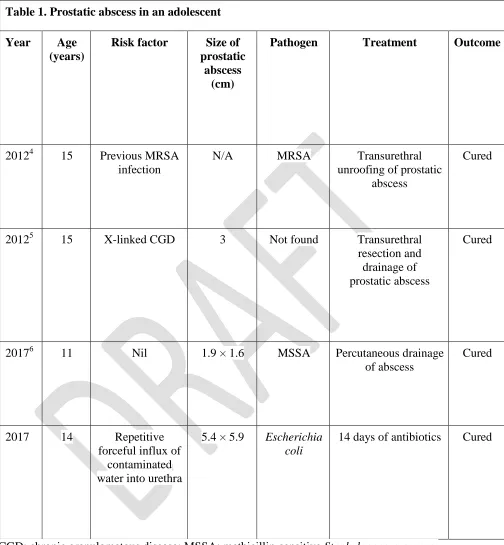
Only 3 cases of prostatic abscess in adolescents have been reported to date (Table 1). Predisposing factors in these 3 patients were previous MRSA infection4 and chronic granulom-atous disease.5 However, the most recent case had no identifiable risk factors.6 The possible risk factors of the presented case were the behavior of squeezing water into his urethra through condoms for masturbation and a history of recurrent UTIs. The repetitive forceful influx of contaminated water into the urethra may have caused prostate infection, which when not treat-ed ltreat-ed to the formation of multilocular abscess.
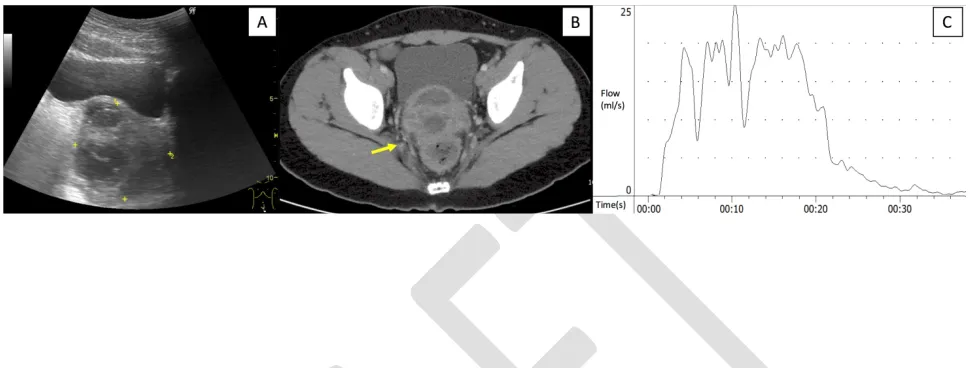
Currently, there is no standard treatment for prostatic abscess. In the previous case re-ports of adolescents with prostatic abscess, all patients underwent drainage or transurethral un-roofing of the prostatic abscess. The size of the abscess in the previous 3 cases was no >3 cm. Compared with this, the size of the abscess in our patient was the largest abscess reported to date (5.9 cm in the greatest dimension on abdominal CT scans) and the patient responded well to antibiotic treatment only. Reports suggest that surgical treatment is optimal when the patient has a slow response to antibiotics.2, 7 According to previous reports, antibiotics alone should only be used in stable patients with a small prostatic abscess <1 cm.1, 8 Oshinomi et al conclud-ed that antibiotics should be usconclud-ed in patients with diffuse type prostatic abscess and drainage or transurethral resection of the prostate was more suitable in patients with focal or multifocal type prostatic abscess.9 However, our report demonstrated that antibiotics alone as the first-line treatment are curative in an adolescent patient with prostatic abscess. There are 2 possible rea-sons to explain why our patient could be conservatively treated. First, the patient was diag-nosed and treated quite early. Second, he did not have comorbidities, such as diabetes mellitus or other factors contributing to immunocompromized status, which were common in adult cas-es with prostatic absccas-ess. Therefore, it is qucas-estionable whether large prostatic absccas-esscas-es should all be treated by aspiration or surgical drainage as the first-line treatment. We believe that with adequate antibiotics and optimal patient selection, adolescents with prostatic abscess can be conservatively treated.
Conclusion
References
1. Ackerman AL, Parameshwar PS, Anger JT. Diagnosis and treatment of patients with prostatic abscess in the post-antibiotic era. Int J Urol 2018;25:103-10
2. Wein AJ, Kavoussi LR, Partin AW, et al. Campbell-Walsh Urology. 4. 11ed 2016. p. 304-29.
3. Abdelmoteleb H, Rashed F, Hawary A. Management of prostate abscess in the absence of guidelines. Int Braz J Urol 2017;43:835-40.
4. Kiehl N, Kinsey S, Ramakrishnan V, et al. Pediatric prostatic abscess. Urology
2012;80:1364-5.
5. Agochukwu NQ, Rastinehad AR, Richter LA, et al. Prostatic abscess in a pediatric pa-tient with chronic granulomatous disease: report of a unique case and review of the litera-ture. J Pediatr Surg 2012;47:400-3.
6. Foster CE, Hulten KG, Janzen NK,, et al. Pediatric Prostatic Abscess Caused by Methi-cillin-Susceptible Staphylococcus aureus. Pediatr Infect Dis J 2017;36:426-7.
7. Grabe M, Bartoletti R, Johansen TEB, et al. Guidelines on urological infections: Euro-pean Association of Urology; 2015 Available from: http://www.uroweb.org.
8. Chou YH, Tiu CM, Liu JY, et al. Prostatic abscess: transrectal color Doppler ultrasonic diagnosis and minimally invasive therapeutic management. Ultrasound Med Biol
2004;30:719-24.
Figures and Tables
Fig. 1. (A) Abdominal sonography revealed a heterogeneous septated mass. (B) Contrast-enhanced computed tomography scan of the abdomen and pelvis revealed prostatic abscess with multiple loculations (arrow). (C) Uroflow revealed staccato pattern.
Table 1. Prostatic abscess in an adolescent Year Age
(years)
Risk factor Size of prostatic
abscess (cm)
Pathogen Treatment Outcome
20124 15 Previous MRSA infection
N/A MRSA Transurethral
unroofing of prostatic abscess
Cured
20125 15 X-linked CGD 3 Not found Transurethral
resection and drainage of prostatic abscess
Cured
20176 11 Nil 1.9 × 1.6 MSSA Percutaneous drainage
of abscess
Cured
2017 14 Repetitive forceful influx of
contaminated water into urethra
5.4 × 5.9 Escherichia coli
14 days of antibiotics Cured
CGD: chronic granulomatous disease; MSSA: methicillin-sensitive Staphylococcus aureus;