MONOTONE FINITE DIFFERENCE DOMAIN
DECOMPOSITION ALGORITHMS AND
APPLICATIONS TO NONLINEAR SINGULARLY
PERTURBED REACTION-DIFFUSION PROBLEMS
IGOR BOGLAEV AND MATTHEW HARDYReceived 16 September 2004; Revised 21 December 2004; Accepted 11 January 2005
This paper deals with monotone finite difference iterative algorithms for solving non-linear singularly perturbed reaction-diffusion problems of elliptic and parabolic types. Monotone domain decomposition algorithms based on a Schwarz alternating method and on box-domain decomposition are constructed. These monotone algorithms solve only linear discrete systems at each iterative step and converge monotonically to the ex-act solution of the nonlinear discrete problems. The rate of convergence of the mono-tone domain decomposition algorithms are estimated. Numerical experiments are pre-sented.
Copyright © 2006 Hindawi Publishing Corporation. All rights reserved.
1. Introduction
We are interested in monotone discrete Schwarz alternating algorithms for solving non-linear singularly perturbed reaction-diffusion problems.
The first problem considered corresponds to the singularly perturbed reaction-diff u-sion problem of elliptic type
−μ2uxx+uyy+f(x,y,u)=0, (x,y)∈ω, u=g on∂ω, ω=ωx×ωy= {0< x <1} × {0< y <1},
fu≥c∗, (x,y,u)∈ω×(−∞,∞), fu≡∂ f /∂u,
(1.1)
whereμis a small positive parameter,c∗>0 is a constant,∂ω is the boundary ofω. If f andgare sufficiently smooth, then under suitable continuity and compatibility condi-tions on the data, a unique solutionuof (1.1) exists (see [6] for details). Furthermore, forμ1, problem (1.1) is singularly perturbed and characterized by boundary layers (i.e., regions with rapid change of the solution) of widthO(μ|lnμ|) near∂ω(see [1] for details).
Hindawi Publishing Corporation Advances in Difference Equations Volume 2006, Article ID 70325, Pages1–38
The second problem considered corresponds to the singularly perturbed reaction-diffusion problem of parabolic type
−μ2uxx+uyy+f(x,y,t,u) +ut=0, (x,y)∈ω,t∈(0,T],
fu≥0, (x,y,t,u)∈ω×[0,T]×(−∞,∞), (1.2)
where ω= {0< x <1} × {0< y <1} and μis a small positive parameter. The initial-boundary conditions are defined by
u(x,y, 0)=u0(x,y), (x,y)∈ω,
u(x,y,t)=g(x,y,t), (x,y,t)∈∂ω×(0,T]. (1.3)
The functions f,g, andu0are sufficiently smooth. Under suitable continuity and com-patibility conditions on the data, a unique solutionuof (1.2) exists (see [5] for details). Forμ1, problem (1.2) is singularly perturbed and characterized by the boundary lay-ers of widthO(μ|lnμ|) at the boundary∂ω (see [2] for details). We mention that the assumption fu≥0 in (1.2) can always be obtained via a change of variables.
In solving such nonlinear singularly perturbed problems by the finite difference method, the corresponding discrete problem is usually formulated as a system of non-linear algebraic equations. One then requires a reliable and efficient computational algo-rithm for computing the solution. A fruitful method for the treatment of these nonlinear systems is the method of upper and lower solutions and its associated monotone itera-tions (in the case of unperturbed problems with reaction-diffusion equations see [8,9] and the references therein). Since the initial iteration in the monotone iterative method is either an upper or lower solution constructed directly from the difference equations without any knowledge of the exact solution (see [3,4] for details), this method elimi-nates the search for the initial iteration as is often needed in Newton’s method. This gives a practical advantage in the computation of numerical solutions.
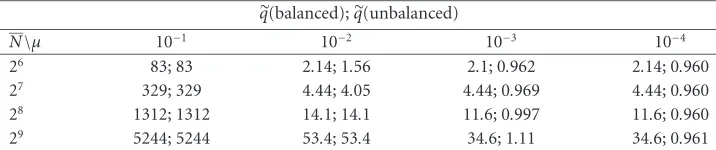
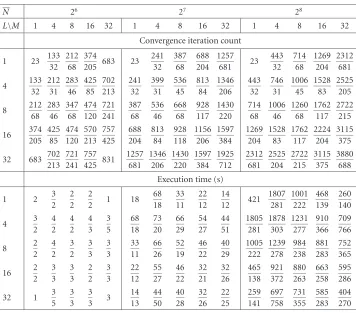
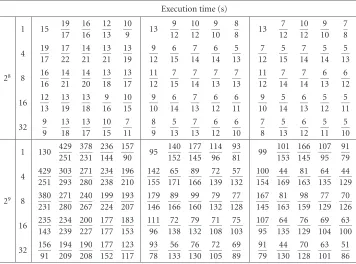
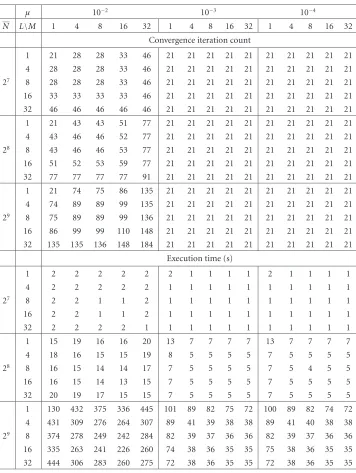
InSection 2, we introduce the classical nonlinear finite difference schemes for the nu-merical solution of (1.1) and (1.2). Iterative methods by which each of these schemes may be solved are presented in [3,4]. From an arbitrary initial mesh function, one may construct a sequence of functions which converges monotonically to the exact solution of the nonlinear difference scheme. Each function in the sequence is generated as the so-lution of a linear difference problem. InSection 3, we consider the elliptic problem and extend the monotone method to a box-decomposition of the computational domain. We show that monotonic convergence is maintained under the proposed decomposition and associated algorithm. Further, we develop estimates of the rate of convergence. The box-decomposition of the spatial domain is applied to the parabolic nonlinear difference scheme inSection 4. Numerical experiments are presented inSection 5. These confirm the theoretical estimates of the earlier sections. Suggestions are made regarding future parallel implementation.
2. Difference schemes for solving (1.1) and (1.2)
Onωand [0,T] introduce nonuniform meshesωh=ωhx×ωhyandωτ:
ωhx=xi, 0≤i≤Nx;x
0=0,xNx=1;hxi=xi+1−xi
, ωhy=yj, 0≤j≤Ny; y
0=0, yNy=1; hy j=yj+1−yj
, ωτ=tk=kτ, 0≤k≤Nτ,Nττ=T.
(2.1)
For approximation of the elliptic problem (1.1), we use the classical difference scheme on nonuniform meshes
ᏸhU+f(P,U)=0, P∈ωh,U=gon∂ωh, (2.2)
whereᏸhUis defined by
ᏸhU= −μ2Ᏸ2
x+Ᏸ2yU, (2.3)
andᏰ2
xU(P),Ᏸ2yU(P) are the central difference approximations to the second derivatives
Ᏸ2
xUij=xi−1Ui+1,j−Uijhxi−1−Uij−Ui−1,jhx,i−1 −1
, Ᏸ2
yUij=y j−1Ui,j+1−Uijhy j−1−Uij−Ui,j−1hy,j−1−1
,
xi=2−1hx,i−1+hxi, y j=2−1hy,j−1+hy j,
(2.4)
To approximate the parabolic problem (1.2), we use the implicit difference scheme ᏸhτU(P,t) + f(P,t,U)=τ−1U(P,t−τ), (P,t)∈ωh×ωτ,
ᏸhτU(P,t)≡ᏸhU(P,t) +τ−1U(P,t),
U(P, 0)=u0(P), P∈ωh, U(P,t)=g(P,t), (P,t)∈∂ωh×ωτ,
(2.5)
whereᏸhis defined in (2.3).
Consider the linear versions of problems (2.2) and (2.5) ᏸW+c(P)W(P)=F(P), P∈ωh, W(P)=W0(P), P∈∂ωh, c(P)≥c
0>0, P∈ωh,c0=const,
(2.6)
whereᏸ=ᏸhfor (2.2) andᏸ=ᏸhτfor (2.5). Now we formulate the maximum principle for the difference operatorᏸ+cand give an estimate of the solution to (2.6).
Lemma2.1. (i)IfW(P)satisfies the conditions
ᏸW+c(P)W(P)≥0(≤0), P∈ωh, W(P)≥0(≤0), P∈∂ωh, (2.7)
thenW(P)≥0(≤0),P∈ωh.
(ii)The following estimate of the solution to (2.6) holds true W ωh≤max W0 ∂ωh, F ωh/c0+βτ−1, W0
∂ωh≡max
P∈∂ωh
W0(P), F
ωh≡max
P∈ωh
F(P), (2.8)
whereβ=0for (2.2) andβ=1for (2.5).
The proof of the lemma can be found in [11].
3. Monotone domain decomposition algorithm for the elliptic problem (1.1)
We consider a rectangular decomposition of the spatial domain ¯ωinto (M×L) nonover-lapping subdomainsωml,m=1,...,M,l=1,...,L:
ωml=xm−1,xm×yl−1,yl, x0=0, xM=1, y0=0, yL=1. (3.1)
Additionally, we introduce (M−1) interfacial subdomainsθm,m=1,...,M−1 (ver-tical strips):
θm=θx
m×ωy=xmb < x < xem× {0< y <1}, θm−1∩θm= ∅, γb
m=x=xbm, 0≤y≤1, γme =x=xme, 0≤y≤1, xb
m< xm< xem, γ0m=∂ω∩∂θm,
θm−1
xm−1
ωm,l−1
xm ϑl−1
yb l−1
yl−1
ye l−1
ωml
ωm−1,l ωm+1,l
yb l
yl ye
l ϑl θm
xb
m−1 xem−1 xbm xem ωm,l+l
Figure 3.1. Fragment of the domain decomposition.
and (L−1) interfacial subdomainsϑl,l=1,...,L−1 (horizontal strips): ϑl=ωx×ϑy
l = {0< x <1} ×
yb
l < y < yel
, ϑl−1∩ϑl= ∅, ρb
l =0≤x≤1, y=ylb, ρel =0≤x≤1, y=yle, yb
l < yl< yle, ρl0=∂ω∩∂ϑl.
(3.3)
Figure 3.1illustrates a fragment of the domain decomposition.
Onωml,m=1,...,M,l=1,...,L;θm,m=1,...,M−1 andϑl,l=1,...,L−1, intro-duce meshes:
ωh
ml=ωml∩ωh, θ h
m=θm∩ωh, ϑhl =ϑl∩ωh,
xb
m,xm,xemmM=1−1∈ωhx,
yb
l,yl,ylelL=1−1∈ωhy,
(3.4)
withωhx,ωhyfrom (2.1).
3.1. Statement of domain decomposition algorithm. We consider the following domain decomposition approach for solving (2.2). On each iterative step, we first solve problems on the nonoverlapping subdomainsωhml,m=1,...,M,l=1,...,Lwith Dirichlet bound-ary conditions passed from the previous iterate. Then Dirichlet data are passed from these subdomains to the vertical and horizontal interfacial subdomainsθhm,m=1,...,M−1 andϑhl,l=1,...,L−1, respectively. Problems on the vertical interfacial subdomains are computed. Then Dirichlet data from these subdomains are passed to the horizontal inter-facial subdomains before the corresponding linear problems are solved. Finally, we piece together the solutions on the subdomains.
Step 2. On subdomainsωhml,m=1,...,M,l=1,...,L, compute mesh functionsVml(n+1)(P) (here the indexnstands for a number of iterative steps) satisfying the following difference problems
ᏸh+c∗Z(n+1)
ml = −G(n)(P), P∈ωhml, G(n)(P)≡ᏸhV(n)+ fP,V(n), Z(n+1)
ml (P)=0, P∈∂ωmlh , V(n+1)
ml (P)=V(n)(P) +Zml(n+1)(P), P∈ωhml.
(3.5)
Step 3. On the vertical interfacial subdomainsθhm,m=1,...,M−1, compute the diff er-ence problems
ᏸh+c∗Z(n+1)
m = −G(n)(P), P∈θmh,
Z(n+1) m (P)=
⎧ ⎪ ⎪ ⎪ ⎪ ⎨ ⎪ ⎪ ⎪ ⎪ ⎩
0, P∈γh0
m; Z(n+1)
ml (P), P∈γmhb∩ωhml,l=1,...,L; Z(n+1)
m+1,l(P), P∈γmhe∩ωhm+1,l,l=1,...,L, V(n+1)
m (P)=V(n)(P) +Zm(n+1)(P), P∈θ h m,
(3.6)
where we use the notation γh0
m =γ0m∩∂ωh, γhbm =γbm∩θhm, γhem =γem∩θhm. (3.7)
Step 4. On the horizontal interfacial subdomainsϑhl,l=1,...,L−1, compute the follow-ing difference problems
ᏸh+c∗ Z(n+1)
l = −G(n)(P), P∈ϑhl,
Z(n+1)
l (P)= ⎧ ⎪ ⎪ ⎪ ⎪ ⎪ ⎪ ⎪ ⎪ ⎨ ⎪ ⎪ ⎪ ⎪ ⎪ ⎪ ⎪ ⎪ ⎩
0, P∈ρhl0; Z(n+1)
ml (P), P∈ρhbl \θh∩ωhml,m=1,...,M; Z(n+1)
m,l+1(P), P∈
ρhe l \θh
∩ωh
m,l+1,m=1,...,M; Z(n+1)
m (P), P∈∂ϑh
l∩θhm,m=1,...,M−1,
V(n+1)
l (P)=V(n)(P) +Z(ln+1)(P), P∈ϑ h l,
(3.8)
where we use the notation
θh=
M−1
m=1
θhm, ϑh= L−1
l=1 ϑhl,
ρh0
l =ρ0l∩∂ωh, ρlhb=ρbl∩ϑ h
l, ρlhe=ρel∩ϑ h l.
Step 5. Compute the mesh functionV(n+1)(P),P∈ωhby piecing together the solutions on the subdomains
V(n+1)(P)= ⎧ ⎪ ⎪ ⎪ ⎪ ⎨ ⎪ ⎪ ⎪ ⎪ ⎩
V(n+1)
ml (P), P∈ωhml\
θh∪ϑh; V(n+1)
m (P), P∈θhm\ϑ h
,m=1,...,M−1;
V(n+1)
l (P), P∈ϑ h
l,l=1,...,L−1.
(3.10)
Step 6. Stopping criterion: If a prescribed accuracy is reached, then stop; otherwise go to Step 2.
Algorithm (3.5)–(3.10) can be carried out by parallel processing. Steps2, 3, and 4 must be performed sequentially, but on each step, the independent subproblems may be assigned to different computational nodes.
Remark 3.1. We note that the original Schwarz alternating algorithm with overlapping subdomains is a purely sequential algorithm. To obtain parallelism, one needs a subdo-main colouring strategy, so that a set of independent subproblems can be introduced. The modification of the Schwarz algorithm (3.5)–(3.10) can be considered as an additive Schwarz algorithm.
3.2. Monotone convergence of algorithm (3.5)–(3.10). Additionally, we assume that f from (1.1) satisfies the two-sided constraints
0< c∗≤fu≤c∗, c∗,c∗=const. (3.11)
We say thatV(P) is an upper solution of (2.2) if it satisfies the inequalities
ᏸhV+f(P,V)≥0, P∈ωh,V≥gon∂ωh. (3.12)
Similarly,V(P) is called a lower solution if it satisfies the reversed inequalities. Upper and lower solutions satisfy the following inequality
V(P)≤V(P), P∈ωh, (3.13)
since by the definitions of lower and upper solutions and the mean-value theorem, for δV=V−V we have
ᏸhδV+fu(P)δV(P)≥0, P∈ωh,
δV(P)≥0, P∈∂ωh, (3.14)
where fu(P)≡ fu[P,V(P) +Θ(P)δV(P)], 0<Θ(P)<1. In view of the maximum princi-ple inLemma 2.1, we conclude (3.13).
Theorem3.2. LetV(0)andV(0)be upper and lower solutions of (2.2), and let f(x,y,u) sat-isfy (3.11). Then the upper sequence{V(n)
}generated by (3.5)–(3.10) converges monotoni-cally from above to the unique solutionUof (2.2), and the lower sequence{V(n)}generated by (3.5)–(3.10) converges monotonically from below toU:
V(0)≤V(n)≤V(n+1)≤U≤V(n+1)≤V(n)≤V(0), inωh. (3.15)
Proof. We consider only the case of the upper sequence. LetV(n)be an upper solution. Then by the maximum principle inLemma 2.1, from (3.5) we conclude that
Z(n+1)
ml (P)≤0, P∈ωhml,m=1,...,M,l=1,...,L. (3.16)
Using the mean-value theorem and the equation forZml(n+1)(P), we obtain the difference equation forVml(n+1)
ᏸhV(n+1)
ml +fP,Vml(n+1)= −c∗−fu(,nml)(P)
Z(n+1)
ml (P)≥0, P∈ωhml, f(n)
u,ml(P)≡fuP,V (n)
(P) +Θ(mln)(P)Zml(n+1)(P), 0<Θ(mln)(P)<1, V(n+1)
ml (P)=V (n)
(P), P∈∂ωh ml,
(3.17)
where nonnegativeness of the right-hand side of the difference equation follows from (3.11) and (3.16).
Taking into account (3.16) andV(n)is an upper solution, by the maximum principle inLemma 2.1, from (3.6) and (3.8) it follows that
Z(n+1)
m (P)≤0, P∈θ h
m,m=1,...,M−1,
Z(n+1)
l (P)≤0, P∈ϑ h
l,l=1,...,L−1.
(3.18)
Similar to (3.17), we obtain the difference problems forVm(n+1)
ᏸhV(n+1)
m +fP,Vm(n+1)= −c∗−fu(,nm)(P) Z(n+1)
m (P)≥0, P∈θmh,
V(n+1) m (P)=
⎧ ⎪ ⎪ ⎪ ⎪ ⎨ ⎪ ⎪ ⎪ ⎪ ⎩
g(P), P∈γh0 m; V(n+1)
ml (P), P∈γhbm ∩ωhml,l=1,...,L; V(n+1)
m+1,l(P), P∈γhem∩ωhm+1,l,l=1,...,L,
and forVl(n+1) ᏸhV(n+1)
l +fP,Vl(n+1)= −c∗−fu(,nl)(P) Z (n+1)
l (P)≥0, P∈ϑhl,
V(n+1)
l (P)= ⎧ ⎪ ⎪ ⎪ ⎪ ⎪ ⎪ ⎪ ⎨ ⎪ ⎪ ⎪ ⎪ ⎪ ⎪ ⎪ ⎩
g(P), P∈ρlh0; V(n+1)
ml (P), P∈
ρhb l \θh
∩ωh
ml,m=1,...,M; V(n+1)
m,l+1(P), P∈
ρhe l \θh
∩ωh
m,l+1,m=1,...,M; V(n+1)
m (P), P∈∂ϑhl ∩θ h
m,m=1,...,M−1,
(3.20)
where nonnegativeness of the right-hand sides of the difference equations follows from (3.11) and (3.18). Now we verify that the mesh functionV(n+1)defined by (3.10) is an up-per solution. From the boundary conditions forVml(n+1),Vm(n+1)andVl(n), it follows that V(n+1)
satisfies the boundary condition in (2.2). Now from here, (3.17), (3.19), (3.20) and the definition ofV(n+1)in (3.10), we conclude that
G(n+1)(P)=ᏸhV(n+1)+ fP,V(n+1)≥0, P∈ωh\γh∪ρh,
γhb,e
ml =xi=xbm,e,yel−1< yj< ylb, γhbm,e= L
l=1 γhb,e
ml , y0e=0, yLb=1,
γh=M−1
m=1 γhb,e
m , ρh= L−1
l=1 ρhb,e
l .
(3.21)
To prove thatV(n+1)is an upper solution of problem (2.2), we have to verify only that the last inequality holds true on the interfacial boundariesγhb,e
ml andρhbl ,e,m=1,...,M−1, l=1,...,L−1.
We check this inequality in the case of the left interfacial boundaryγhb
ml, since the case withγhe
mlis checked in a similar way. From (3.5), (3.6), and (3.18), we conclude that the mesh functionWml(n+1)=V(n+1)
ml −Vm(n+1)satisfies the difference problem
ᏸh+c∗W(n+1)
ml =0, P∈θmlh =ωhml∩θmh, W(n+1)
ml (P)= ⎧ ⎨ ⎩
0, P∈γhb
ml=γmhb∩ωhml;
≥0, P∈∂θh ml\γhbml.
(3.22)
In view of the maximum principle inLemma 2.1, V(n+1)
ml (P)−Vm(n+1)(P)≥0, P∈θ h
ml. (3.23)
By (3.6),Vm(n+1)(P)=Vml(n+1)(P),P∈γhbml, and from (3.10) and (3.23), it follows that
−μ2Ᏸ2
yVml(n+1)(P)= −μ2Ᏸ2yV(n+1)(P), P∈γmlhb,
−μ2Ᏸ2
xVml(n+1)(P)≤ −μ2Ᏸx2V(n+1)(P), P∈γhbml.
Thus, using (3.17), we conclude G(n+1)(P)≥ᏸhV(n+1)
ml (P) +fP,Vml(n+1)≥0, P∈γmlhb. (3.25) Now we verify the inequalityG(n+1)(P)≥0 on the interfacial boundaryρhb
l , and the case withρhel is checked in a similar way. From (3.5), (3.8), (3.18), and (3.23), we conclude that the mesh functionWml(n+1)=V(n+1)
ml −Vl(n+1)satisfies the difference problem
ᏸh+c∗ W(n+1)
ml =0, P∈ϑhml=ωhml∩ϑhl,
W(n+1) ml (P)=
⎧ ⎨ ⎩
0, P∈ρhbml=xe
m−1< xi< xbm,yj=ylb
;
≥0, P∈∂ϑh ml\ρhbml.
(3.26)
By the maximum principle inLemma 2.1, V(n+1)
ml (P)−Vl(n+1)(P)≥0, P∈ϑ h
ml. (3.27)
By (3.8), Vl(n+1)(P)=V(n+1)
ml (P), P∈ρhbml∪ {(xem−1,ylb), (xbm,ylb)}, and from (3.10) and (3.27), it follows that
−μ2Ᏸ2
xVml(n+1)(P)= −μ2Ᏸx2V(n+1)(P), P∈ρhbml,
−μ2Ᏸ2
yVml(n+1)(P)≤ −μ2Ᏸ2yV(n+1)(P), P∈ρhbml.
(3.28)
Thus, using (3.17), we conclude G(n+1)(P)≥ᏸhV(n+1)
ml +f
P,Vml(n+1)≥0, P∈ρhbml. (3.29)
From (3.6), (3.8), and (3.27), the mesh function ˆWml(n+1)=V(n+1)
m −Vl(n+1)satisfies the difference problem
ᏸh+c∗ W(n+1)
ml =0, P∈τmlh =θhm∩ϑhl,
W(n+1) ml (P)=
⎧ ⎨ ⎩
0, P∈ρhb,e
ml =xbm< xi< xem,yj=ybl,e;
≥0, P∈∂τh ml\
ρhbml∪ρheml.
(3.30)
By the maximum principle inLemma 2.1, V(n+1)
m (P)−Vl(n+1)(P)≥0, P∈τhml. (3.31) By (3.8),Vl(n+1)(P)=V(n+1)
m (P),P∈ρhbml∪ {(xem,ylb), (xbm,ybl)}, and from (3.10) and (3.31), it follows that
−μ2Ᏸ2xV(n+1)
m (P)= −μ2Ᏸ2xV(n+1)(P), P∈ρhbml,
−μ2Ᏸ2
yVm(n+1)(P)≤ −μ2Ᏸ2yV(n+1)(P), P∈ρhbml.
Thus, using (3.19), we conclude G(n+1)(P)≥ᏸhV(n+1)
m +fP,Vm(n+1)≥0, P∈ρhbml. (3.33) From here and (3.29), we conclude the required inequality onρhbl \Pb,e
l ,Pbl,e= ∪Mm=1−1(xbm,e, yb
l). AtPbml=(xbm,ylb), we have V(n+1)
ml Pmlb =Vm(n+1)Pmlb =Vl(n+1)Pmlb , (3.34) and from (3.10), it follows that
−μ2Ᏸ2xV(n+1)Pb
ml=− μ 2
bxm
V(n+1)
m Pmlbx+−Vml(n+1)Pmlb hb+
xm −
V(n+1) ml
Pb
ml
−V(n+1) ml
Pbx−
ml
hbxm−
,
−μ2Ᏸ2
yV(n+1)Pmlb =−μ 2
b yl
V(n+1)
l Pbyml+−Vml(n+1)Pmlb hb+
yl
−V
(n+1)
ml Pmlb −Vml(n+1)Pbyml− hb−
yl
,
Pbx±
ml =xbm±hxmb±,ybl, Pmlby±=xbm,ylb±hbyl±,
b
xm=2−1hxmb−+hbxm+, byl=2−1hylb−+hbyl+,
(3.35) wherehb+
xm,hbxm−are the mesh step sizes on the left and right fromPmlb , andhbyl+,hbyl−are the mesh step sizes on the top and bottom fromPbml. From here, (3.17), (3.23) and (3.27), we conclude
G(n+1)(P)≥ᏸhV(n+1)
ml +fP,Vml(n+1)≥0, P=Pbml. (3.36) With a similar argument for mesh pointPle=(xem,ylb), we prove thatV(n+1)is an upper solution of problem (2.2) on the whole computational domainωh.
For arbitrary P∈ωh, it follows from (3.16), (3.18), and (3.13) that the sequence
{V(n)
(P)} is monotonically decreasing and bounded below by V(P), where V is any lower solution. Therefore, the sequence is convergent and it follows from (3.5)–(3.8) that limZml(n)=0, limZl(n)=0 and limZl(n)=0 asn→ ∞. Now by linearity of the operatorᏸh and the continuity of f, we have also from (3.5)–(3.8) that the mesh functionUdefined by
U(P)=nlim
→∞V
(n)
(P), P∈ωh, (3.37)
is an exact solution to (2.2). The uniqueness of the solution to (2.2) follows from esti-mate (2.8). Indeed, if by contradiction, we assume that there exist two solutionsU1and U2to (2.8), then by the mean-value theorem, the differenceδU=U1−U2satisfies the following difference problem
By (2.8),δU=0 which leads to the uniqueness of the solution to (2.2). This proves the
theorem.
Remark 3.3. Consider the following approach for constructing initial upper and lower solutionsV(0)andV(0). Suppose that a mesh functionR(P) is defined onωhand satisfies the boundary conditionR=gon∂ωh. Introduce the following difference problems
ᏸh+c
∗Zν(0)=νᏸhR+f(P,R), P∈ωh,
Z(0)
ν (P)=0, P∈∂ωh,ν=1,−1.
(3.39)
Then the functionsV(0)=R+Z1(0),V(0)=R+Z (0)
−1 are upper and lower solutions, respec-tively. The proof of this result can be found in [4].
Remark 3.4. Since the initial iteration in algorithm (3.5)–(3.10) is either an upper or a lower solution, which can be constructed directly from the difference equation without any knowledge of the solution as we have suggested in the previous remark, this algorithm eliminates the search for the initial iteration as is often needed in Newton’s method. This gives a practical advantage in the computation of numerical solutions.
3.3. Convergence analysis of algorithm (3.5)–(3.10). We now establish convergence properties of algorithm (3.5)–(3.10).
If we denote
Z(n+1)(P)=V(n+1)(P)−V(n)(P), P∈ωh, (3.40)
then from (3.5)–(3.10),Z(n+1)can be written in the form
Z(n+1)(P)= ⎧ ⎪ ⎪ ⎪ ⎪ ⎨ ⎪ ⎪ ⎪ ⎪ ⎩
Z(n+1)
ml (P), P∈ωhml\
θh∪ϑh; Z(n+1)
m (P), P∈θhm\ϑ h
,m=1,...,M−1;
Z(n+1)
l (P), P∈ϑ h
l,l=1,...,L−1.
(3.41)
Introduce the following notation
b,e
xm=2−1hbxm−,e−+hbxm+,e+, byl,e=2−1hbyl−,e−+hbyl+,e+, (3.42)
wherehbxm±,e±are the mesh step sizes on the left and right from pointsxb,e
m andhbyl±,e±are the mesh step sizes on the top and bottom from pointsybl,e, and
κb
xm≡ μ 2
c∗bxmhb+
xm, κ
e
xm≡ μ 2
c∗exmhexm−, qI=1≤maxm≤M−1
κb xm;κexm, κb
yl≡ μ 2
c∗bylhb+ yl
, κeyl≡ μ
2
c∗eylhe−
yl, q
II= max 1≤l≤L−1
κb
yl;κeyl.
Theorem3.5. For algorithm (3.5)–(3.10), the following estimate holds true Z(n+1)
ωh≤q Z(n) ωh, q=q+qI+qII, (3.44)
whereq=1−c∗/c∗.
Proof. Suppose that the sequence{V(n)}is generated by algorithm (3.5)–(3.10). Using (2.8), from (3.5) we get the following estimate onZml(n+1)
Z(n+1) ml ωh
ml≤ 1
c∗ G(n) ωh. (3.45) From here and (3.6) by (2.8), we conclude that
Z(n+1) m θh
m≤max
1
c∗ G(n) ωh; max1≤l≤L Z (n+1) ml γhb
ml; Z (n+1) m+1,l γheml
≤c1∗ G(n) ωh,
γhb
ml=γmhb∩ωhml, γmlhe=γhem∩ωhm+1,l.
(3.46)
Similarly, from here and (3.8), we can obtain the estimate Z(n+1)
l ϑh l ≤
1
c∗ G(n) ωh. (3.47) Thus, by the definition ofZ(n+1), we have
Z(n+1) ωh≤ 1
c∗ G(n) ωh. (3.48) From (3.17), (3.19) and (3.20) at the iterative stepn, and using the definition ofZ(n), we estimateG(n)as follows
G(n)(P)= −c∗−f(n)
u (P)Z(n)(P), P∈ωh, ωh=ωh\γh∪ρh, (3.49) whereγhandρhare defined in (3.21). By (3.11),
1 c∗ G
(n)
ωh≤q Z(n) ωh. (3.50) Now we estimateG(n)onγh. Onγhb
ml= {xi=xbm,yle−1< yj< ybl}, we representG(n)in the form
G(n) Pb
m=ᏸhVml(n)+f Pmb,Vml(n)− μ 2
bxmhb+ xm
V(n)
m Pmb+−Vml(n) Pmb+,
Pb
m=xbm,yj∈γmlhb, Pmb+=xbm+hbxm+,yj.
(3.51)
From (3.16) at the iterative stepnand the definition ofV(n), we have V(n)
From here, (3.17) and taking into account thatZml(n)(P)=Z(n)(P),P∈γhb
ml, we get the estimate
1
c∗ G(n) γhb ml≤
q+κbxm Z(n) ωh. (3.53)
Similarly, we can prove the estimate 1
c∗ G(n) γhe ml≤
q+κexm Z(n)
ωh. (3.54)
Thus, onγh, we conclude the estimate 1 c∗ G
(n) γh≤
q+qI Z(n) ωh. (3.55)
Onρhbml= {xe
m−1< xi< xbm,yj=ylb}, we representG(n)in the form G(n)Pb
l=ᏸhVml(n)+fPlb,Vml(n)− μ 2
b ylhbyl+
V(n)
l Pbl+−Vml(n)Plb+, Pb
l =xi,ybl∈ρhbml, Plb+=xi,ylb+hbyl+.
(3.56)
From (3.16) at the iterative stepnand the definition ofV(n), we have V(n)
ml
Pb+ l
−V(n) l
Pb+
l
≤V(n−1)Pb+ l
−V(n)Pb+ l
= −Z(n)Pb+ l
. (3.57)
From here and (3.17), and taking into account thatZml(n)(P)=Z(n)(P),P∈ρhb
ml, we get the estimate
1
c∗ G(n) ρhbml≤
q+κbyl Z(n)
ωh. (3.58)
Similarly, we can prove the estimate 1
c∗ G(n) ρhe ml≤
q+κeyl Z(n)
ωh. (3.59)
Onρhbml= {xbm< xi< xem,yj=ybl}, we representG(n)in the form
G(n)Pb
l=ᏸhVm(n)+fPlb,Vm(n)− μ 2
b ylhbyl+
V(n)
l Pbl+−Vm(n)Plb+, Pb
l =
xi,ybl∈ρhbml, Plb+=xi,ylb+hbyl+.
(3.60)
From (3.18) at the iterative stepnand the definition ofV(n), we have V(n)
From here and (3.19), and taking into account thatZm(n)(P)=Z(n)(P),P∈ρhb
ml, we get the estimate
1
c∗ G(n) ρhbml≤ q
+κbyl Z(n)
ωh. (3.62)
Similarly, we can prove the estimate 1
c∗ G(n) ρhe ml≤
q+κeyl Z(n)
ωh. (3.63)
AtPmlb =(xmb,ybl), we representG(n)in the form G(n)Pb
ml=ᏸhVml(n)+fPmlb ,Vml(n)
−bμ2
xmhbxm+
V(n)
m Pmlbx+−Vml(n)Pbxml+
− μ2
b ylhbyl+ V
(n)
l Pbyml+−Vml(n)Pbyml+, Pbx+
ml =
xb
m+hbxm+,ylb
, Pmlby+=xb
m,ybl+hbyl+
.
(3.64)
From (3.16) at the iterative stepnand the definition ofV(n), we have V(n)
mlPbxml+−Vm(n)Pbxml+≤V(n−1)Pmlbx+−V(n)Pbxml+
= −Z(n)Pbx+ ml
, V(n)
mlPmlby+−Vl(n)Pmlby+≤V(n−1)Pmlby+−V(n)Pmlby+
= −Z(n)Pby+ ml .
(3.65)
From here and (3.17), and taking into account thatZml(n)(Pmlb )=Z(n)(Pb
ml), we get the esti-mate
1 c∗G(n)
Pb
ml≤
q+κbxm+κbyl Z(n) ωh. (3.66)
By the same reasonings, the following estimate holds true 1
c∗G(n) Pe
m−1,l≤q+κxe,m−1+κbyl Z(n) ωh, Pme−1,l=xem−1,ybl. (3.67) Onρhbl , we conclude the estimate
1 c∗ G
(n) ρhb
l ≤
q+qI+qII Z(n) ωh. (3.68)
The same estimate holds true onρhel , and onρhwe get the estimate 1
c∗ G(n) ρh≤
From here, (3.50) and (3.55), we conclude the estimate 1
c∗ G(n) ωh≤
q+qI+qII Z(n)
ωh. (3.70)
and, using (3.48), we prove the theorem.
Remark 3.6. For the undecomposed algorithm, withM=1 andL=1, one hasωh=ωh in (3.50) which together with (3.48) gives estimate (3.44) withq=q.
Without loss of generality, we assume that the boundary condition in (1.1) is zero, that is,g(P)=0. This assumption can always be obtained via a change of variables. Let the initial functionV(0)be chosen in the form of (3.39) withR(P)=0, that is,V(0)is the solution of the following difference problem
ᏸh+c
∗V(0)=νf(P, 0), P∈ωh,
V(0)(P)=0, P∈∂ωh, ν=1,−1. (3.71)
Then the functionsV(0)(P),V(0)(P) corresponding toν=1 andν= −1 are upper and lower solutions, respectively.
Theorem3.7. Let the factorqin (3.44) satisfy the conditionq < 1. Suppose that the initial upper or lower solutionV(0)is chosen in the form of (3.71). Then for algorithm (3.5)–(3.10), the following estimate holds true
V(n)−U
ωh≤ c0(q)
n
(1−q) f(P, 0) ωh, c0=
3c∗+c∗
c∗c∗ , (3.72)
whereUis the solution to (2.2).
Proof. Using (3.44), we have V(n+k)−V(n)
ωh≤
n+k−1
i=n
V(i+1)−V(i) ωh=
n+k−1
i=n
Z(i+1) ωh
≤ q
1−q Z(n) ωh≤ (q)
n
1−q Z(1) ωh.
(3.73)
Taking into account that limV(n+k)=U ask→ ∞, whereUis the solution to (2.2), we conclude the estimate
V(n)−U
ωh≤ (q)
n
1−q Z(1) ωh. (3.74) From (3.48), (3.71) and the mean-value theorem
Z(1) ωh≤ 1
c∗ G(0) ωh≤ 1
c∗ ᏸhV(0) ωh+ 1 c∗ f
P ,V(0)
ωh
≤c1∗c∗ V(0) ωh+ f(P, 0) ωh+ 1
c∗ f(P, 0) ωh+ V(0) ωh.
From here and estimatingV(0)from (3.71) with (2.8), V(0)
ωh≤ 1
c∗
f(P, 0) ωh, (3.76)
we conclude the estimate onZ(1)in the form Z(1)
ωh≤c0 f(P, 0) ωh, (3.77)
wherec0is defined in (3.72). Thus, from here and (3.74), we prove (3.72). Remark 3.8. In the next section, we present sufficient conditions to guarantee the in-equalityq < 1 required inTheorem 3.7.
3.4. Uniform convergence of the monotone domain decomposition algorithm (3.5)– (3.10). Here we analyze a convergence rate of algorithm (3.5)–(3.10) applied to the dif-ference scheme (2.2) defined on the piecewise uniform mesh introduced in [7]. On this mesh, the difference scheme (2.2) convergesμ-uniformly to the solution of (1.1).
The piecewise uniform mesh is formed in the following manner. We divide each of the intervalsωx=[0, 1] andωy=[0, 1] into three parts each [0,σx], [σx, 1−σx], [1−σx, 1], and [0,σy], [σy, 1−σy], [1−σy, 1], respectively. Assuming thatNx,Nyare divisible by 4, in the parts [0,σx], [1−σx, 1] and [0,σy], [1−σy, 1] we use a uniform mesh withNx/4 + 1 and Ny/4 + 1 mesh points, respectively, and in the parts [σx, 1−σx], [σy, 1−σy] with Nx/2 + 1 andNy/2 + 1 mesh points, respectively. This defines the piecewise equidistant mesh in thex- andy-directions condensed in the boundary layers atx=0, 1 andy=0, 1:
xi=
⎧ ⎪ ⎪ ⎪ ⎨ ⎪ ⎪ ⎪ ⎩
ihxμ, i=0, 1,...,Nx/4; σx+i−Nx/4hx, i=Nx/4 + 1,..., 3Nx/4; 1−σx+i−3Nx/4hxμ, i=3Nx/4 + 1,...,Nx,
yj=
⎧ ⎪ ⎪ ⎪ ⎨ ⎪ ⎪ ⎪ ⎩
jhyμ, j=0, 1,...,Ny/4; σy+j−Ny/4hy, j=Ny/4 + 1,..., 3Ny/4; 1−σy+j−3Ny/4hyμ, j=3Ny/4 + 1,...,Ny,
(3.78)
wherehxμ,hyμandhx,hyare the step sizes inside and outside the boundary layers, respec-tively. The transition pointsσx, (1−σx) andσy, (1−σy) are determined by
σx=min4−1,μc∗−(1/2)lnNx, σy=min4−1,μc∗−(1/2)lnNy. (3.79)
assume that
σx=μc−(1/2)
∗ lnNx, hxμ=4μc∗−(1/2)Nx−1lnNx, Nx−1< hx<2Nx−1, σy=μc−(1/2)
∗ lnNy, hyμ=4μc−(1∗ /2)Ny−1lnNy, Ny−1< hy<2Ny−1.
(3.80)
The difference scheme (2.2) on the piecewise uniform mesh (3.80) convergesμ -uni-formly to the solution of (1.1):
max P∈ωh
U(P)−u(P)≤C
N−1lnN2, N=minNx,Ny, (3.81)
where constantCis independent ofμandN. The proof of this result can be found in [7]. Theorem3.9. Let the interfacial subdomainsθhm,m=1,...,M−1andϑhl,l=1,...,L−1 be located in thex- andy-directions, respectively, outside the boundary layers. Assumeμ≤
μ01, and the following condition
N≤α
c∗/2
μ0 , N=max
Nx,Ny, 0< α <1,α=const. (3.82)
If the initial upper or lower solutionV(0)is chosen in the form of (3.71), then the mono-tone domain decomposition algorithm (3.5)–(3.10) on the piecewise uniform mesh (3.80) convergesμ-uniformly to the solution of the problem (1.1):
V(n)−u
ωh≤CN−1lnN2+ c0(Q)
n
(1−Q)
f(P, 0) ωh,
Q=1−1−α2cc∗∗<1, c0=3c∗+c ∗ c∗c∗ ,
(3.83)
where constantCand the factorQare independent ofμandN.
Proof. Under the above assumption onN, the factorqin (3.44) satisfies the condition
q <1. Indeed, since the interfacial subdomains are located outside the boundary layers, where the step sizeshx andhy are in use, then using (3.80),qI andqII from (3.44) are estimated as follows
qI= μ2 c∗h2
x <
μ0N 2
c∗ , qII= μ2 c∗h2
y <
μ0N 2
c∗ . (3.84)
Thus,q < Q < 1, and we can applyTheorem 3.7. From here, (3.72) and (3.81), we
Remark 3.10. Such domain decompositions, in which the interfacial subdomains are out-side the boundary layers, are said to beunbalanced, since the distribution of mesh points among the nonoverlapping main subdomains is uneven. By contrast, abalanceddomain decomposition is one in which the mesh points are equally distributed among the main subdomains. For balanced decompositions, the first and last interfacial subdomains each overlap the boundary layer.
4. Monotone domain decomposition algorithm for the parabolic problem (1.2)
For solving the nonlinear difference scheme (2.5), we construct and investigate a paral-lel domain decomposition algorithm based on the domain decomposition of the spatial domainωintroduced inSection 3.
4.1. Statement of domain decomposition algorithm for solving (2.5). On each time levelt∈ωτ, we calculaten
∗iteratesV(n)(P,t),P∈ωh,n=1,...,n∗as follows.
Step 1. Initialization: on the meshωh, chooseV(0)(P,t),P∈ωhsatisfying the boundary conditionV(0)(P,t)=g(P,t) on∂ωh.
Forn=0ton∗−1do Steps2–5
Step 2. On subdomainsωhml,m=1,...,M,l=1,...,L, compute mesh functionsVml(n+1)(P, t),m=1,...,M,l=1,...,Lsatisfying the following difference problems
ᏸhτ+c∗Z(n+1)
ml = −G(n)(P,t), P∈ωhml, G(n)(P,t)≡ᏸhτV(n)(P,t) +fP,t,V(n)−τ−1V(P,t−τ),
Z(n+1)
ml (P,t)=0, P∈∂ωhml, V(n+1)
ml (P,t)=V(n)(P,t) +Zml(n+1)(P,t), P∈ωhml.
(4.1)
Step 3. On the vertical interfacial subdomainsθhm,m=1,...,M−1, compute the diff er-ence problems
ᏸhτ+c∗Z(n+1)
m = −G(n)(P,t), P∈θmh,
Z(n+1) m (P,t)=
⎧ ⎪ ⎪ ⎪ ⎪ ⎨ ⎪ ⎪ ⎪ ⎪ ⎩
0, P∈γh0
m; Z(n+1)
ml (P,t), P∈γhbm ∩ωhml,l=1,...,L; Z(n+1)
m+1,l(P,t), P∈γhem∩ωhm+1,l,l=1,...,L, V(n+1)
m (P,t)=V(n)(P,t) +Zm(n+1)(P,t), P∈θhm,
(4.2)
Step 4. On the horizontal interfacial subdomainsϑhl,l=1,...,L−1, compute the follow-ing difference problems
ᏸhτ+c∗ Z(n+1)
l = −G(n)(P,t), P∈ϑhl,
Z(n+1)
l (P,t)= ⎧ ⎪ ⎪ ⎪ ⎪ ⎪ ⎪ ⎪ ⎪ ⎨ ⎪ ⎪ ⎪ ⎪ ⎪ ⎪ ⎪ ⎪ ⎩
0, P∈ρh0
l ; Z(n+1)
ml (P,t), P∈ρlhb\θh∩ωhml,m=1,...,M; Z(n+1)
m,l+1(P,t), P∈
ρhe l \θh
∩ωh
m,l+1,m=1,...,M; Z(n+1)
m (P,t), P∈∂ϑh
l∩θhm,m=1,...,M−1,
V(n+1)
l (P,t)=V(n)(P,t) +Zl(n+1)(P,t), P∈ϑ h l,
(4.3)
where we use the notation from (3.8).
Step 5. Compute the mesh functionV(n+1)(P,t),P∈ωhby piecing together the solutions on the subdomains
V(n+1)(P,t)= ⎧ ⎪ ⎪ ⎪ ⎪ ⎨ ⎪ ⎪ ⎪ ⎪ ⎩
V(n+1)
ml (P,t), P∈ωhml\
θh∪ϑh; V(n+1)
m (P,t), P∈θhm\ϑ h
,m=1,...,M−1;
V(n+1)
l (P,t), P∈ϑ h
l,l=1,...,L−1.
(4.4)
Step 6. Set up
V(P,t)=V(n∗)(P,t), P∈ωh. (4.5)
4.2. Monotone convergence of algorithm (4.1)–(4.5). Additionally, we assume that f from (1.2) satisfies the two-sided constraints
0≤fu≤c∗, c∗=const. (4.6)
On a time levelt∈ωτ, we say thatV(P,t) is an upper solution with respect to a given functionV(P,t−τ) if it satisfies
ᏸhτV(P,t) +fP,t,V−τ−1V(P,t−τ)≥0, P∈ωh,
V(P,t)≥g(P,t), P∈∂ωh. (4.7) Similarly,V(P,t) is called a lower solution with respect toV(P,t−τ) if it satisfies the reversed inequalities. On each time level, upper and lower solutions satisfy the following inequality
V(P,t)≤V(P,t), P∈ωh. (4.8) The proof of this result is similar to that of (3.13).
Theorem4.1. LetV(P,t−τ)be given andV(0)(P,t),V(0)(P,t)be upper and lower solu-tions corresponding toV(P,t−τ). Suppose that f satisfies (4.6). Then the upper sequence
{V(n)
(P,t)}generated by (4.1)–(4.5) converges monotonically from above to the unique so-lutionᐂ(P,t)of the problem
ᏸhτV(P,t) +f(P,t,V)−τ−1V(P,t−τ)=0, P∈ωh,
V(P,t)=g(P,t), P∈∂ωh, (4.9)
and the lower sequence{V(n)(P,t)}generated by (4.1)–(4.5) converges monotonically from below toᐂ(P,t):
ᐂ(P,t)≤V(n+1)
(P,t)≤V(n)
(P,t)≤V(0)
(P,t), P∈ωh,
V(0)(P,t)≤V(n)(P,t)≤V(n+1)(P,t)≤ᐂ(P,t), P∈ωh. (4.10)
Proof. The proof of the theorem is similar to the proof ofTheorem 3.2and based on the maximum principle inLemma 2.1and the estimate (2.8) with β=1 for the difference
operatorᏸhτ.
Remark 4.2. In the case of algorithm (4.1)–(4.5), Remarks3.1–3.4hold still true at each time stept∈ωτ. We only mention that the difference problem in (3.39) becomes
ᏸhτZ(0)
ν =νᏸhτR(P,t) + f(P,t,R)−τ−1V(P,t−τ), P∈ωh,
Z(0)
ν (P,t)=0, P∈∂ωh,ν=1,−1.
(4.11)
4.3. Convergence analysis of algorithm (4.1)–(4.5). We now establish convergence properties of algorithm (4.1)–(4.5).
Introduce the following notation
υb
xm≡ μ
2
c∗+τ−1bxmhb+
xm, υ
e
xm≡ μ
2
c∗+τ−1exmhexm−, υb
yl≡ μ
2
c∗+τ−1bylhb+ yl
, υeyl≡ μ2
c∗+τ−1e ylheyl−, rI= max
1≤m≤M−1 υb
xm;υexm, rII= max 1≤l≤L−1
υb yl;υeyl,
(4.12)
where all the step sizes are defined in (3.42).
Similar toTheorem 3.5, on each time levelt∈ωτ, we have the following convergence property of algorithm (4.1)–(4.5).
Theorem4.3. For algorithm (4.1)–(4.5), the following estimate holds true Z(n+1)(t)
ωh≤r Z(n)(t) ωh, r=r+rI+rII,t∈ωτ, (4.13)
Proof. The proof of the theorem is similar to the proof ofTheorem 3.5and based on the maximum principle inLemma 2.1and the estimate (2.8) with β=1 for the difference
operatorᏸhτ.
Remark 4.4. In similar fashion to the proof ofTheorem 3.5, the proof ofTheorem 4.3 includes the resultr=rfor the undecomposed algorithm.
Without loss of generality, we assume that for the parabolic problem (1.2), the bound-ary conditiong(P,t)=0. This assumption can always be obtained via a change of vari-ables. Let on each time level the initial functionV(0)(P,t) be chosen in the form of (4.11) withR(P,t)=0, that is,V(0)(P,t) is the solution of the following difference problem
ᏸhτV(0)(P,t)=νf(P,t, 0)−τ−1V(P,t−τ), P∈ωh,
V(0)(P,t)=0, P∈∂ωh, ν=1,−1. (4.14)
Then the functionsV(0)(P,t),V(0)(P,t) corresponding toν=1 andν= −1 are upper and lower solutions, respectively.
Theorem4.5. In the domain decomposition algorithm (4.1)–(4.5), letV(0)(P,t)be chosen in the form of (4.14), and let f satisfy (4.6). Suppose that on each time level, the number of iteratesn∗satisfiesn∗≥2. Then the following estimate on convergence rate holds
max tk∈ωτ
V
tk−Utk ≤Dc∗+η(r)n∗−1,
η=c∗+τ−1rI+rII, (4.15)
wherer, rI andrII are defined inTheorem 4.3,U(P,t)is the solution to (2.5) and con-stantDis independent ofμandτ. Furthermore, on each time level the sequence{V(n)(P,t)} converges monotonically.
Proof. The difference problem forV(P,tk)=V(n∗)(P,tk) can be represented in the form
ᏸhτVP,tk+ fP,tk,V−τ−1VP,tk
−1=G(n∗)P,tk, P∈ωh,
VP,tk=gP,tk, P∈∂ωh. (4.16)
From here, (2.5) and using the mean-value theorem, we get the difference problem for W(P,tk)=V(P,tk)−U(P,tk)
ᏸhτ+ f(n∗)
u WP,tk=G(n∗)P,tk+τ−1WP,tk−1, P∈ωh,