© 2015, IRJET.NET- All Rights Reserved
Page 168
AN EFFICIENT VIDEO WATERMARKING USING COLOR HISTOGRAM
ANALYSIS AND BITPLANE IMAGE ARRAYS
G Prakash
1,TVS Gowtham Prasad
2,T.Ravi Kumar Naidu
31
MTech(DECS) student, Department of ECE, sree vidyanikethan engg college,tirupathi,Andhra Pradesh,India
2Assistant professor, Department of ECE, sree vidyanikethan engg college,tirupathi,,Andhra Pradesh,India
3
Assistant professor, Department of ECE, sree vidyanikethan engg college,tirupathi,Andhra Pradesh,India
---***---Abstract -
The paper presents video watermarking technology based on color histogram analysis and luminance value adjustment in according to watermark bitplane image arrays. The main objective of this approach is to minimize the error at high data hiding capacity in order to preserve the quality of video. By considering this, the watermarking process will be handled in luminance plane and frame selection is based on changes of RGB histogram bins. This technology is used to hide copyright information to protect original contents from video tampering,broadcasting and for other authentication.
Implementation of this method involves watermark bitplane image conversion, color histogram based changes detection in video scenes and luminance value adjustment. Before the watermark embedding, the original watermark pixels intensities will be converted into bitplanes. Then by using RGB space histogram variation between the successive two frames, the relevant frame will be selected. After selecting the frame, each bit of bitplane image will be embedded into luminance plane of corresponding frame. The desired pixels will be selected from the 8x8 non overlapping blocks of luminance plane. At each block, seven bits of bitplane image are hidden under the luminance values chosen by data hider. This process is continued for all remaining watermark bits. At watermark recovery, continue same process handled in embedding stage. The simulated results shows that watermarking using color histogram and luminance adjustment provides better performance interms of preserving original video quality and accuracy in recovered watermark during extraction. The performance measures such as smean square error and peak signal to noise ratio are evaluated to evaluate the system performance.
Key Words:
video watermarking, bit-plane images1. INTRODUCTION
The multimedia data which is available in the internet is all in the form of digital. If the data is in analog form then we cannot produce as it is. But the data which is in the form of digital can be reproduce as it is without any error. Due to the advancements in digital technology. So, the owners of content are suffering with illegal copying of their data. The traditional copyright protection methods like encryption etc. are not sufficient. Because, the content
can be protected only while during transmission. After receiving the data, if once the decrypted then the data cannot be protected. To overcome this problem watermarking technology is developed.
Robustness, fidelity and data payload are the three parameters of watermarking. There exists a complex trade off between these parameters. Robustness of watermark refers to the ability to withstand non-malicious distortions. Fidelity is the visual similarity between the stego image and its cover image. Data payload is the encoded message size of a watermark in an image. The simplest form of watermark has no payload. These three parameters are conflicting and tradeoff has to be found which is often tied to the targeted application.
Digital watermarking is an effective method to protect the authenticity by hiding the copyright information in the original content. Applications of digital watermarking include Digital rights management, copyright protection, authentication, tamper detection and localization, Broadcast monitoring, device control,, communication enhancement. Video contains large amount of redundant data.
Based on the embedding watermark, video watermarking can be classified into 3 types as follows.
1. Watermark embedding in compressed bit stream. 2. Watermark embedding in the quantization
© 2015, IRJET.NET- All Rights Reserved
Page 169
Section 2 describes the proposed video watermarking scheme in detail. Section 3 presents experimental results and examines the performance of the algorithm. The same bit plane image. The bit plane is changed if the scene changes. That means different video scene consist of different watermarks. The decomposition of watermark into bit plane images is as shown in figure1.2.1 Watermark Embedding
The proposed algorithm will embed the watermark into Y-channel of each video picture of same scene. Different bit planes are embedded into different video scenes. The watermark embedding is as follows.
By using scene change detection algorithm we
find different scenes in the video.
Separate the y-channel from the video pictures
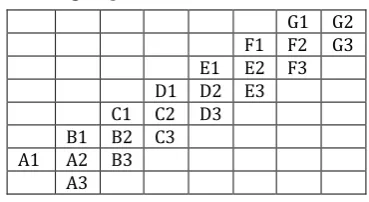
and divide it into non overlapping 8x8 blocks. Select the 7 triple groups of luminous values to embed the watermark. Mark the groups from A to G as shown in the TABLE-I. Each group consist of 3 luminous values. The order in its group represented by the number next to the letter.
Get 7 bits watermark from binary watermark image. In each 8x8 non overlapping block, embed 1 bit watermark frame to each selected luminous value in the order group A to group G. If m is the watermark bit and ‘A’ is the current group, then A2 should be absolute maximum of group A when m=0. If A2 is not maximum, then exchange the value of A2 with the maximum of group A. Similarly if the current watermark bit m=1, then A2 should be absolute minimum of group A. Otherwise exchange the value of A2 with the minimum of group A.
Figure 1: Bit decomposition of 8-bit watermarking image
signal [P0 is the least-significant bit (LSB) and P7 is the most-significant bit (MSB)].
Table 1: group of 8×8 luminous values
After embedding the 8x8 blocks with watermark bits, rebuilt the video by using watermarked video pictures.
2.2 Color histogram analysis
To detect the changes in successive video frames, color histogram is used. All frames are converted into RGB images. The color histogram can be computed by dividing color space into discrete image colors called bins and counting the number of pixels falling into each bin. By using color histograms and , the difference between two images and is calculated as follows.
It denotes the difference in the number of pixels of two images that fall into same bin. The above farmula can be written as
For each image of video calculate the using
equation (2). Compare the average of with the
predefined threshold value. If is greater than
the threshold value, it means new scene is detected. When the new scene is detected, a new watermark image is selected from the list of bit plane images. Same watermark is used in each frame with in motionless scene.
2.3 Watermark extracting
The proposed method is blind video watermarking. The original video is not required at the extraction process. Only the watermarked video is enough to retrieve the watermark. The extraction process is as follows.
For each video frame calculate the luminous value.
© 2015, IRJET.NET- All Rights Reserved
Page 170
The algorithm for extracting watermark is as follows
Suppose current group is A. ‘0’ will be extracted when A2 is maximum than other two coefficients. While ‘1’ will be extracted when A2 is minimum than other two coefficients A1 and A3. The entire watermark bits have been extracted.
General overview of the water marking method is shown in figure (2).
Figure 2: General overview of the watermarking method
3. Experimental results
In this experiment, the proposed algorithm is implemented under MATLAB-7.5 and above versions. The size of the uncompressed AVI video used is 256x256 and 7 watermark bits can be embedded into each 8×8 block, so the maximum capacity of each video frame in the proposed watermarking algorithm is 7168 watermark bits at most. Therefore, gray scale image of size 49×56 is chosen, and the watermark is shown in Figure 3.
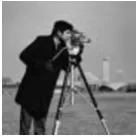
The screen shots of original video frames for five different videos and corresponding video frame after embedding watermark are presented in figure (4) and figure (5). The extracted watermark is shown in figure (6).
Figure 3: Original gray scale watermark image
The quality of watermarked video is compared with the quality of original video by calculating MSE and PSNR of the same video picture. The MSE, PSNR of different videos are presented in TABLE- II. PSNR is commonly defined via
the mean squared error (MSE), which for two m×n monochrome images I and K where one of the images is considered a noisy approximation of the other is equation (3)
(a) (b) (c) (d) (e) Figure 4: Original video frames of four different videos
(a) (b) (c) (d) (e)
Figure 5: Watermarked video frames
Figure 6: Extracted watermarks
The PSNR is defined as
Here represents maximum possible pixel value of
the image. is 255 when the pixels are represented
using 8 bits per sample. The is 2^B-1 when samples
© 2015, IRJET.NET- All Rights Reserved
Page 171
Table 2 : Average PSNR value of watermarked video
Video Average PSNR sufficient. VQM is used to measure the video quality. It can be calculated from the PSNR as follows
A video sequence of 200 frames is used to test under noise addition. The table below represents the quality of five different videos after noise attack.
Table 3: Quality of four different videos after noise attack
Video MSE PSNR VQM decrease. So, the proposed method is robust against frame dropping and noise attacks.
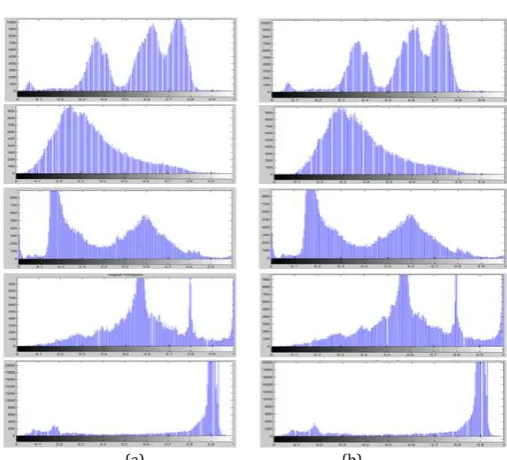
The histograms of original and watermarked frames are as shown in figure below
(a) (b)
Figure 7: (a)original frames (b) watermarked frames
4. CONCLUSION
The method implementation involves watermark bit plane image conversion, colour histogram based changes detection in video scenes and luminance value adjustment. Before the watermark embedding, the original watermark pixels intensities will be converted into 8-bit bit plane image. Then the relevant frame will be selected using RGB space histogram variation between the successive two frames. After the frame selection, an each bit of bit plane image will be embedded into luminance plane of corresponding frame. The desired pixels will be selected from the 8x8 non overlapping blocks of luminance plane. At each block, eight bits of bit plane image are hidden under the luminance values chosen by data hider. This process is continued for all remaining watermark bits. At watermark recovery, continue same process handled in embedding stage. The simulated results shows that watermarking using color histogram and luminance adjustment provides better performance in-terms of preserving original video quality and accuracy in recovered watermark during extraction
REFERENCES
[1] Venugopala,P.S;Sarojadevi,H.;Chiplunkar,N.N;Bhat,V, “Video watermarking by adjusting the pixel values and using scene change detection” Signal and Image Processing fifth International Conference , Page(s):259–264, 2014.
© 2015, IRJET.NET- All Rights Reserved
Page 172
Science and Engineering” Vol. 02, No. 09, , 2905-2909, 2010.
[4] Chaw-Seng woo,Thesis, ”Digital image watermarking
methods for copyright protection and
authentication”,March 2007.
[5] C. Xu, X. Ping, and T. Zhang, “Steganography in compressed video stream,” Proc 1st Int. Conf. Innov Comput., Inf. Control, , pp. 269–272, Sep. 2006.
[6] D. Y. Fang and L. W. Chang, “Data hiding for digital video with phase of motion vector,” in Proc. IEEE Int. Symp. Circuits Syst., pp. 1422–1425, May 2006.
[7] H. Aly, “Data hiding in motion vectors of compressed video based on their associated prediction error,” IEEE Trans. Inf. Forensics Security, vol. 6, no. 1, pp. 14–18, Mar. 2011.
[8] Y. Cao, X. Zhao, D. Feng, and R. Sheng, “Video steganography with perturbed motion estimation,” in Proc. 13th Int. Conf.IH, vol. 6958, , pp. 193–207, 2011. [9] G. B. Yang, J. J. Li, Y. L. He, and Z. W. Kang, “An
information hiding algorithm based on intra-prediction modes and matrix coding for H.264/AVC video stream,” In. J Electro Commun vol. 65, no. 4, pp. 331–337, Apr. 2011.