Volume 2008, Article ID 460628,9pages doi:10.1155/2008/460628
Research Article
OV-CDMA System: Concept and Implementation
Elie Inaty and Rafic Ayoubi
Department of Computer Engineering, Faculty of Engineering, University of Balamand, P.O. Box 100, Deir El-Balamand, El-Koura, Lebanon
Correspondence should be addressed to Elie Inaty,[email protected]
Received 7 September 2007; Revised 5 December 2007; Accepted 25 January 2008
Recommended by Stefan Kaiser
A new method is proposed to achieve a multirate overlapped code division multiple access system (OV-CDMA) based on a novel code overlapping procedure. The signal-to-interference ratio (SIR) performance has been investigated for such system. A channel model that allows multirate overlapped transmission is presented based on which a closed form solution for the SIR has been derived. In addition, a simple yet very efficient block diagram of the transmitter and the receiver architecture has been proposed for such a system. Based on the proposed block diagram, the encoder-decoder has been implemented using an FPGA. Numerical results show that the newly proposed OV-CDMA scheme outperforms the classical variable processing gain fast frequency hopping CDMA (VPG-FFH-CDMA) for different system scenarios. Finally, real-time measurements have been successfully obtained using a hardware prototype utilizing the simple Xilinx Spartan IIE (XC2S200E) FPGA.
Copyright © 2008 E. Inaty and R. Ayoubi. This is an open access article distributed under the Creative Commons Attribution License, which permits unrestricted use, distribution, and reproduction in any medium, provided the original work is properly cited.
1. INTRODUCTION
During the past few years, there has been a growing interest in the development of broadband wireless communication networks for multimedia applications. The communication services in such networks can be high- and low-speed data, video, and many others with different performance and traffic requirements [1–3].
Classical fast frequency hopping CDMA (FFH-CDMA) has been discussed in many works [4–6]. A multirate FFH-CDMA system using variable processing gain (PG) (VPG-FFH-CDMA) has been proposed in [3,7,8]. The intention was to guarantee the one-to-one correspondence between the PG and the source transmission rate. The drawback of this system is the drastic decrease in the transmitted signal power especially for higher rate users for which the PG becomes very small. The solution to this problem is the use of power control [9]; on the other hand, Kwong and Yang in [7, 8] considered the multilength frequency hopping codes. Using these codes, rate and QoS are now dynamically matched to users’ needs. The cutoffrate of the system is still limited by the physical constraints of the codes.
In this work, the general problem we considered is how much we can increase the transmission rates of different
classes of traffic beyond the nominal permitted rates. Our aim is to optimize performance to meet the quality of service (QoS) requirements given a fixed number of users in the network and a multimedia distribution. For an op-timized family of codes, we will show that it is possible to increase a class bit rate beyond the nominal rate without decreasing the PG of the desired user or allowing any time delay between the data symbols. Our system achieves a multirate transmission by introducing an overlap between the transmitted symbols, hence the name overlapped code division multiple access system (OV-CDMA). In addition, we will consider the im-plementation of the OV-CDMA system [10]. The control unit of the transmitter and the receiver has been accom-plished using FPGA. A pipeline technique is used to achieve a high-computational efficiency. A prototype is built and tested. We have been able to achieve a transmission rate ranging from 0.1 to 20 Mbps. It is imperative to mention that the five-channel case implemented in this paper can be easily modified to higher number of channels. This is the main advantage of FPGA [11].
where the block diagrams of the transmitter and the receiver are presented and discussed. In addition, the hardware im-plementation using FPGA is discussed inSection 5.Section 6 contains the numerical results and the measurements. Fi-nally, the conclusion is presented inSection 7.
2. OV-CDMA SYSTEM MODEL
Consider a multirate OV-CDMA communication system that supportsMusers inNdifferent classes, which share the
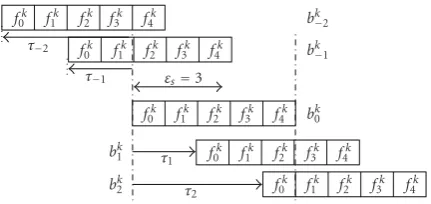
same medium [10]. The corresponding PGs for each class are given byG0> G1>· · · > GN−1. The nominal bit duration is given byTs =GsTcwithTc being the chip duration. The corresponding nominal rate isRn s = 1/Ts. When the data rate increases beyond Rn s, multibits can be coded during the time periodTs and transmitted together as revealed in Figure 1. In this figure, the PG isGs=5, which means that five channels are used in the coding process. When user k
transmits using rate Rs > Rn s, it introduces a bit overlap coefficient εsaccording to which the new rate is related to the nominal rate through the following:
Rs= Gs
Gs−εsRn s. (1)
InFigure 1, the overlapping coefficient isεs = 3; therefore, the new transmission rate isRs=(5/2)Rn s. This means that the new transmission rate is 2.5 times the transmission rate without overlap. At a given receiver, the decoder observes practically multicode which is delayed according to the transmission rate of the source as shown inFigure 1.
In this paper, we assume the following: (1) a chip and bit synchronous system and a discrete rate variation, (2) all users in the class-s,s∈ {0, 1,...,N−1}have the same bit overlap coefficient 0≤εs< Gs−1; thus each class is characterized by (Gs,εs), and (3) a unit transmission power for all the users.
2.1. Signal structure
We define a(ks)(t,f) and b
(s)
k (t) as the hopping pattern and
the baseband signal, respectively, where t andf represent the time and frequency dimensions. FromFigure 1, the bit stream can be seen to be serial-to-parallel converted to v
pulses. Assuming that the desired user is using the
class-m, which is characterized by a PGGm and an overlapping coefficient εm. Since the desired user nominal time period isTm = GmTc, we are interested only in modeling thekth interfering channel during a time period Tm. Because the bit bk
X from the v-bits is delayed by τX = X(Gs−εs)Tc,
this suggests that the channel model, as seen by the desired receiver, can be represented as a tapped delay line with tap spacing ofτ−1 = −(Gs−εs)Tc from left and τ1 = (Gs−
εs)Tc from right. The tap weight coefficientsbk
X ∈ {−1, 1}
depending on whether the transmitted bit is zero or one. The truncated tapped delay line model as seen by the desired receiver is shown in Figure 2. Accordingly, the transmitted signal is given by
Sk(t,f)=
Figure1: Coding method of the proposed OV-CDMA system with
Gs=5 andεs=3.
Figure2: OV-CDMA channel model.
Lemma 1. Given an interferer k with(Gs,εs)and the desired user with(Gm,εm)for alls,m∈ {0, 1,. . .,N−1}. At the de-sired receiver end, during the nominal time periodTm, the ob-served total number of taps in channelkis given by
NkGm,Gs,εs= user with(Gm,εm), the observed total number of transmitted codes from transmitterkthat undergo a total overlap with the desired correlator duringTmand excluding the normal bitbk
0is
The received signal at the input of the decoder is therefore given by
2.2. Decoder’s output
Without loss of generality, we assume that the correlation-matched filter is correlation-matched to the zeroth signal with class-m. The output of the matched filter correlator will be
Z0(m)=Γ+
whereΓis a zero-mean AWGN with varianceσ2
n = ΓTm/4.
The multiple access interference (MAI)Ik from userkthat
transmits data with rateRscan be written as
Ik= used at time t for the kth interferer and the desired user, respectively. Notice that a(ks)(i) = a
(s)
k (i+Ts). In addition,
we define a new performance parameter called the auto-interference I0 caused by the desired user’s signal and it is given by
3. OV-CDMA PERFORMANCE EVALUATION
Since the user may set a connection for a particular multi-media class and modify it dynamically, the indexsis a dis-crete random variable with a certain prior probability
p(ki)=Pr(userk chooses class-i)
k the multimedia
probabil-ity mass function (pmf) for userk.Ik, for all 0≤k≤M−1,
is assumed to be an independent random variable. Hence the variance of the decision variableZ0(m)is
varZ0(m)
I0 represent the interference power caused by an active userkusing class-sand the auto-interference power caused by the desired user due to overlapping, respectively, and they are given by
σ2
whereE(·) is the expectation operator over all possible values of the overlapping bitsbXk forX ∈ {−Xl,. . .,Xr}assuming
that Pr(bkX =1)=Pr(bXk = −1)=1/2.E(Ik/s) and the cross
terms generated from squaring the summation in E(I2
k/s)
become zeros because the average over the bit is zero, which enables us to write
If we defineRk(Gm,Gs,εs)=Rk(Tm,Ts,εs)/(T2
c/2) andR0(Gm,
εm) = R0(Tm,εm)/(Tc2/2), then we substitute into (12), the
SIR experienced by any active user that uses class-mis
SIRm= α where αis a random variable with a Rayleigh distribution assuming a Rayleigh fading channel. Thus the distribution of
α2is exponential [12].
3.1. Effective increase in the number of hits
Proposition 1. For one-coincidence sequences with nonrepeat-ing frequencies [13,14], the expected value of the increase in the number of hits caused by any active interferer with(Gs,εs)
on a desired user with(Gm,εm)is given by(19). In addition, the effective increase of the number of hits due to the auto-interference is
IH0
Gm,εm=0, (18)
whereXr,Xl,Xt, and|ΔG|are given throughout Lemmas1and 2, and F is the total number of available frequencies,
IHk
3.2. Average SIR
Assuming that the overlapping codes are independent virtual active users and one-coincidence sequences, we can compute the average correlations given in (13). In addition, if we assume that the multimedia pmf is the same for every user,
p(ks)=p(s), the average SIR for the desired user with (Gm,εm)
In (20), we have been able to separate the interference power into the normal MAI power caused by active users whenRs= Rn sand the one caused by virtual users that overlap with the desired user’s code whenRs> Rn s.
4. OV-CDMA SYSTEM IMPLEMENTATION
Throughout this paper, and without loss of generality, the analysis is based on the five-channel example presented in Figure 1. The problem of designing a transmitter that performs the overlapping operation is simplified to find a
0
Normalized transmission rate
Figure3: Average SIR versus the normalized transmission rate.
way to transmit more that one frequency channels during the same chip periodTcas shown inFigure 1.
4.1. OV-CDMA transmitter implementation
For example, during the first period Tc, the transmitter
should send channels f0k, f2k, and f4k at the same time. Classical FFH-CDMA transmitters use what is widely known as frequency synthesizer to generate one carrier frequency at each Tc seconds. It cannot generate multifrequency at the
same time. For this reason, we propose a new architecture based on multifrequency generators and a switching opera-tion that is performed by a central processing unit as revealed byFigure 4(a). The control unit will determine the switches which must be closed and the other which should be open. The result is summed and transmitted. This task can be easily accomplished using the desired user’s code as shown inFigure 4(b). The above five-by-five matrix of binary data represents the digital control code that must be used by the control unit for the five-channel example shown inFigure 1. Note that during the first chip duration, the switches are controlled by the first row of the matrix such that S1,S3, andS5are closed, and S2 andS4 are open. This enables us to transmit simultaneously channels f0k, f2k, and f4k. This matrix will be repeated every bit durationTn.
4.2. OV-CDMA receiver implementation
fk
0
fk
1
f2k
f3k
f4k
S1
S2
S3
S4
S5
Control unit User’s code sequence Data bit stream b∈ {0, 1}
(a)
1 0 1 0 1
0 1 0 1 0
1 0 1 0 1
0 1 0 1 0
1 0 1 0 1
Tc
Tn
(b)
Figure4: (a) Five-channel OV-CDMA transmitter, (b) OV-CDMA digital control unit.
Tc 0 ||2dt
Tc 0 ||2dt
Tc 0 ||2dt
Tc 0 ||2dt
Tc 0 ||2dt
E1,1
0
E3,1
0
E5,1
0
E2,2
0
E4,2
0
E1,3
0
E3,3
0
E5,3
0
E2,4
0
E4,4
0
E1,5
0
E3,5
0
E5,5
BPF
f0
BPF
f1
BPF
f2
BPF
f3
BPF
f4
t
Tc
Splitter
Reset everyTc
sec
Sum the elements of the 5×5 matrix every
5Tc(s)
Comparison with a threshold
0
1 Figure5: Five-channel OV-CDMA receiver.
frequency fk
i, which is one of the employed channels by the
desired user. An energy detector (ED) is used to measure the energy of the filtered signal. An analog-to-digital converter (ADC) is utilized in order to convert the analog information from the ED into digital one so that it can be accepted by the FPGA logic.
It is imperative to mention that we will use the same code logic used in the encoder side. This code replica is used to dispread the received signal and to obtain the transmitted data stream. The outputs of the ADCs are held inside the registers then shifted to the right at every time period Tc. After five consecutive cycles, a 5 × 5 matrix is
constructed. The contents of this matrix are added, then the result is compared to a predefined detection threshold. The compared data is the energy added after five consecutive
cycles. If the result is less than the threshold, it is estimated that 0 is transmitted; otherwise, it is judged that 1 is sent.
5. DIGITAL IMPLEMENTATION USING FPGA
M-I
Figure6: Logic block diagram of the decoder and the decision of the receiver.
Name Value
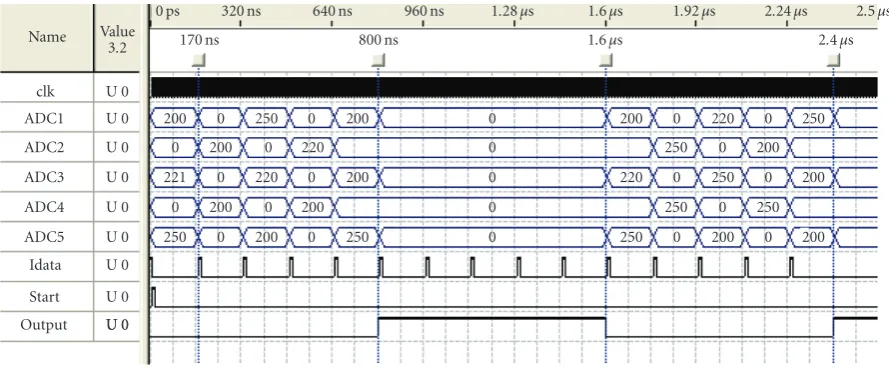
Figure7: Simulated timing diagram.
For anN-channel receiver, anN×Naddition is required every bit periodTn, which is composed ofNchip periodsTc;
in addition, eachTc seconds is composed of 16-bit stream.
The addition is performed in a tree fashion (seeFigure 6). Therefore, it takes log2(N) cycles to sum N numbers (N
channels). Since we needN×N addition, the summation should be performed N times; that is Nlog2(N) cycles. However, by using pipelining technique, we were able to reduce the number of cycles for an N × N addition to log2(N) + (N−1).
This high-speed implementation is achieved at the expense ofN−1 adders. In order to reduce the area occupied by the design, serial adders were used. Even though the summation of 16-by-16 bits requires 16 cycles, the clock fre-quency achieved is several times higher than that of a parallel adder.
As an example, consider an 8-channel receiver (Figure 6). Every chip periodTc eight 8-bit ADCs convert the received
analog signals into eight bits, which are extended into 16 bits and shifted serially into eight 16-bit shift registers. The serial outputs from every two shift registers are fed into a serial adder, which will perform the summation and generate the sum of one bit at a time. The output of each adder is connected to the input of another 16-bit shift register in order to store the results of the summation. Each module (M-I) in Figure 6corresponds to two shift registers at the input of an adder and another shift register connected to the output of the adder.
Table1: Implementation results.
Number of slices 138 out of 2352 5%
Number of slice flip flops 232 out of 4704 4%
Number of 4 input LUTs 86 out of 4704 1%
Max. clock frequency 100.675 MHz
from Stage 1 that corresponds to the older ADC conversion. At the same time, Stage 3 would be summing the results from Stage 2 of the previous data. After eight clock cycles, an output bit is generated based on a threshold comparison, and the accumulator register is cleared in order to start accumulating data for a new output bit. This process is repeated after each eight clock cycles.
Table 1summarizes the mapping results in terms of lo-gical resources and maximal clock period on a Xilinx Spartan IIE XC2S200E speed grade-7 FPGA. As shown inTable 1, for our 5-channel receiver, the utilization of the FPGA chip did not exceed 5%, which means that we can easily upgrade our design into cases including larger number of channels on the same Spartan IIE used. Moreover, the clock period achieved was less than 10 nanoseconds.
6. NUMERICAL RESULTS AND MEASURMENTS
For the purpose of comparing the performance of our newly proposed OV-CDMA system with existing multirate systems, Figure 3shows the SIR comparison between the OV-CDMA and the classical VPG-FFH-CDMA systems while varying the transmission rate. The transmission rate is normalized in the sense that it begins by zero when εs = 0 for the OV-CDMA system and whenGs = 40 for the VPG FFH-CDMA system. The normalized transmission rate increases by increasing εs or decreasing Gs for the OV-CDMA and the VPG-FFH-CDMA, respectively. Notice that, for either
M=10 orM=20 users, the SIR for the OV-CDMA system is always greater than that of the VPG-FFH-CDMA system.
InFigure 7, we present the simulated timing diagram for the OV-CDMA receiver in which the input signals ADC1, ADC2, ADC3, ADC4, and ADC5 to the FPGA are coming from the ADCs. This simulation is performed for an over-lapping coefficientεs =3. Each input is composed of eight parallel bits. Each output bit lasts for the whole period of five data reception, after which the new bit is output based on the last five data reception. The optimal detection threshold is obtained using the maximum likelihood detection scheme. After comparison with the threshold, the decision for the possible transmitted symbol is shown inOutput.
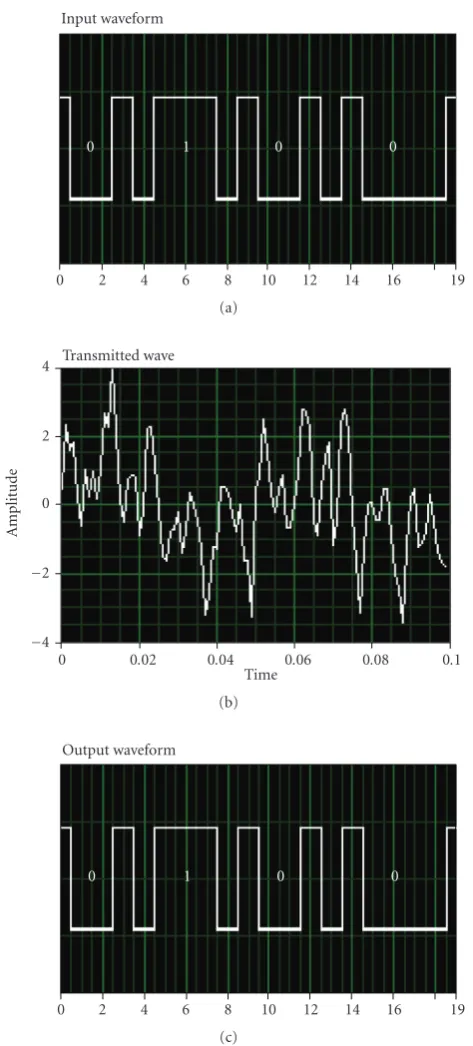
The test bed has been implemented using an educational FPGA board which is the Xilinx Spartan IIE XC2S200E speed grade-7. In addition, the setup includes a wireless local area network antenna of type CDM2502 working in the 2.4-2.5 GHz band. Using this test bed, we have been able to trans-mit and receive a digital signal successfully. Figures8(a)and 8(c)show the transmitted and the corresponding measured received information signals, respectively, in the presence of three interferers and using the five channels encoder-decoder presented previously. The results show clearly that the
0 2 4 6 8 10 12 14 16 19
0 1 0 0
Input waveform
(a)
0 0.02 0.04 0.06 0.08 0.1
−4
−2 0 2
4 Transmitted wave
A
m
plitude
Time (b)
0 2 4 6 8 10 12 14 16 19
0 1 0 0
Output waveform
(c)
Figure8: Measured signals: (a) binary input wave, (b) OV-CDMA coded signal, and (c) binary-decoded wave.
three transmitted bits are received successfully. In addition, Figure 8(b)is the measured OV-CDMA coded transmitted signal of the desired user.
0 5 10 15 20 25 30 35 40 5
10 15 20 25
SIR
(dB)
εs=overlapping coefficient,M=20 Measured
Analytical
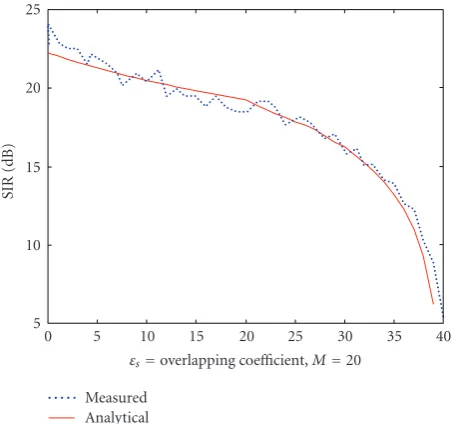
Figure9: System’s SIR (in dB) versus the overlapping coefficient
using real measurements and the analytical results obtained in (20).
1 2 3 4 5 6 7 8
Number of active users 10−6
10−5
10−4
10−3
10−2
10−1
Me
as
u
re
d
B
E
R
Figure10: Measured bit error rate.
shows the measured SIR and the simulated one using the derived equation in (17) versus the overlapping coefficient. We assume 20 active terminals. It is clear that there is a total agreement between the measured and the analytical results. On the other hand, using a transmission rate of 10 Mbits/s, Figure 10 presents measured BER versus the total number of active simultaneous users in the network. It is clear that our system guarantees a good performance in the presence of MAI.
7. CONCLUSION
In this paper, we have proposed a simple technique yet very efficient to implement a multirate/multiclass CDMA system based on a novel code overlapping procedure. A system model was presented and the SIR was derived. The
block diagram of the transmitter and the receiver were presented and discussed. Moreover, an efficient FPGA-based transceiver implementation was shown. This implementa-tion was efficient in terms of both speed and area. Using simple educational FPGA board of type Xilinx Spartan IIE (XC2S200E), the measurement results showed that the proposed system can achieve very good performance in the presence of MAI. Both simulation and measurements showed that it is possible to increase the transmission rate well beyond the nominal rate. On the other hand, simulation results reveal that our newly proposed OV-CDMA outperform the classical VPG-FFH-OV-CDMA.
ACKNOWLEDGMENTS
This paper was presented in part at the IEEE VTC 2004 and IEEE ISCAS 2006 conferences. This work was supported in part by the Lebanese CNRS under Grant CNRSL no. 4082.
REFERENCES
[1] T. D. C. Little and A. Ghafoor, “Network considerations for distributed multimedia object composition and communica-tion,”IEEE Network, vol. 4, no. 6, pp. 32–40, 1990.
[2] T. Ottosson and A. Svensson, “Multi-rate performance in DS/CDMA system,” Tech. Rep. 14, Department of Informa-tion Theory, Chalmers University of Technology, G¨oteborg, Sweden, March 1995.
[3] R. Wyrmas, W. Zhang, M. J. Miller, and R. Anjaria, “Multiple access options for multimedia wireless systems,” inProceedings of the 3rd Workshop on third Generation, pp. 289–294, Manchester, UK, April 1992.
[4] E. Geraniotis, “Multiple-access capability of frequency-hopped spread-spectrum revisited: an analysis of the effect of unequal power levels,”IEEE Transactions on Communications, vol. 38, no. 7, pp. 1066–1077, 1990.
[5] M. V. Hegde and W. E. Stark, “On the error probability of coded frequency-hopped spread-spectrum multiple-access systems,”IEEE Transactions on Communications, vol. 38, no. 5, pp. 571–573, 1990.
[6] S. Maric, “Construction of optimal frequency hopping sequences for minimizing bit errors in selective fading chan-nels characteristic to digital cellular systems,”IEE Proceedings Communications, vol. 142, no. 4, pp. 271–273, 1995.
[7] W. C. Kwong and G.-C. Yang, “Frequency-hopping codes for multimedia services in mobile telecommunications,”IEEE Transactions on Vehicular Technology, vol. 48, no. 6, pp. 1906– 1915, 1999.
[8] W. C. Kwong and G.-C. Yang, “New frequency-hopping codes for multimedia mobile communication systems,” in Proceed-ings of the IEEE Pacific Rim Conference on Communications, Computers and Signal Processing (PACRIM ’99), pp. 329–332, Victoria, BC, Canada, August 1999.
[9] P. Liu, P. Zhang, S. Jordan, and M. L. Honig, “Single-cell forward link power allocation using pricing in wireless networks,” IEEE Transactions on Wireless Communications, vol. 3, no. 2, pp. 533–543, 2004.
[11] E. Inaty and R. Ayoubi, “FPGA-based transmitter-receiver architecture of an overlapped CDMA system: design and sim-ulation,” inProceedings of the IEEE International Symposium on Circuits and Systems (ISCAS ’06), pp. 2797–2800, Kos island, Greece, May 2006.
[12] T. Rappaport,Wireless Communications, Principles and Prac-tice, Prentice Hall PTR, Upper Saddle River, NJ, USA, 2002. [13] L. D. Wronski, R. Hossain, and A. Albicki, “Extended
hyperbolic congruential frequency hop code: generation and bounds for cross- and auto-ambiguity function,”IEEE Trans-actions on Communications, vol. 44, no. 3, pp. 301–305, 1996. [14] L. Bin, “One-coincidence sequences with specified distance