Volume 2009, Article ID 720973,18pages doi:10.1155/2009/720973
Research Article
Block Interleaved Frequency Division Multiple Access for
Power Efficiency, Robustness, Flexibility, and Scalability
Tommy Svensson,
1Tobias Frank,
2Thomas Eriksson,
1Daniel Aronsson,
3Mikael Sternad (EURASIP Member),
3and Anja Klein
21Department of Signals and Systems, Chalmers University of Technology, SE-412 96 G¨oteborg, Sweden 2Communications Engineering Laboratory, Technische Universit¨at Darmstadt, 64283 Darmstadt, Germany 3Signals and Systems, Uppsala University, SE-751 21 Uppsala, Sweden
Correspondence should be addressed to Tommy Svensson,[email protected]
Received 1 February 2009; Revised 20 June 2009; Accepted 27 July 2009 Recommended by Cornelius van Rensburg
The multiple access solution in an IMT-Advanced mobile radio system has to meet challenging requirements such as high throughput, low delays, high flexibility, good robustness, low computational complexity, and a high power efficiency, especially in the uplink. In this paper, a novel multiple access scheme for uplinks denoted as B-IFDMA is presented. We show that this scheme is able to provide equal or better error rate performance than the Single-Carrier Frequency Division Multiple Access (SCFDMA) schemes IFDMA and LFDMA, when considering realistic channel estimation performance at the receiver and no reliable channel state information at the transmitter. We also show that B-IFDMA provides better amplifier efficiency than OFDMA and can provide better end-to-end energy efficiency than IFDMA and LFDMA. Moreover, the scheme shows a promisingly high robustness to frequency-offsets and Doppler spread. Thus, this scheme can be regarded as a promising solution for the uplink of future mobile radio systems.
Copyright © 2009 Tommy Svensson et al. This is an open access article distributed under the Creative Commons Attribution License, which permits unrestricted use, distribution, and reproduction in any medium, provided the original work is properly cited.
1. Introduction
Future mobile communication systems need to efficiently support fully packet-based services with largely different requirements on data rates, ranging from a few kbps to hundreds of Mbps, and largely varying Quality of Service (QoS) requirements. The systems need to flexibly support deployment in various propagation scenarios ranging from isolated hot spots to wide area cellular, including support for high speed trains. In addition, they need to support deployment in various spectrum allocation scenarios with system bandwidths up to 100 MHz at a carrier frequency of several GHz, cf. [1–5]. These system requirements imply that the multiple access solution in an IMT-Advanced mobile radio system has many challenges to meet.
It has been shown feasible to implement a fully syn-chronous network, [6,7]. Thus, resources can be allocated based on a chunk concept, where a chunk is a time-frequency resource unit. With multiple antennas, spatial reuse of
chunks is enabled and denoted as chunk layers [2,4,5,8,9]. The chunk concept is adopted in 3GPP Long Term Evolution (LTE), where a chunk is denoted as Resource Block. The chunk size is chosen in such a way that it experiences essentially flat fading in its time-frequency extent, also in largely frequency selective channels and for users at vehicular speeds.
channel conditions such as high Signal to Interference and Noise Ratios (SINR), and reasonably low speeds [10]. FA is especially suited for transmission of rather large data volumes and high instantaneous data rates for low service latency. However, the FA scheme must be accompanied by a robust diversity based transmission mode, since FA transmission without reliable CQI can deteriorate.
The diversity-based scheme, here denoted as non-frequency-adaptive (NFA) transmission, should efficiently support users in all other usage scenarios, such as low SINR, high user equipment (UE) velocities, small and delay critical packet transfers, broadcasting that cannot benefit from a retransmission scheme, as well as for multicast transmission to multiple users with widely varying channels. In these scenarios a diversity based scheme has the potential to be more robust, more spectrally efficient and also more energy efficient.
Various relaying concepts are also considered in future wireless systems, [2–5]. However, multihop relaying increases the end-to-end delay in the Radio Access Network (RAN). Thus, an important requirement of the multiple access solution is to support a very low delay. This require-ment also enables FA transmission at vehicular speeds even with a several GHz carrier frequency. It furthermore enables the use of retransmissions also for delay constrained services such as voice. However, such a low delay requirement implies a very short frame duration with very limited time diversity. Thus, the diversity for the NFA transmission scheme must come from the frequency domain and/or the spatial domain. Below we summarize important requirements that we have identified for the NFA multiple access scheme.
(i) Robustness to small-scale fading without time diver-sity.
(ii) Tuneable degree of frequency-diversity.
(iii) Need to support high energy efficiency in the trans-mitters and the receivers.
(iv) Robustness to carrier frequency offsets and large Doppler spread.
(v) Support for widely varying packet sizes. (vi) Enable efficient resource allocation. (vii) Be of use for in-band control signals.
(viii) Enable efficient coexistence with adaptive TDMA/ OFDMA.
(ix) Facilitate low complexity transmitter in UE.
To define a scheme that optimally fulfills all of these requirements at the same time is challenging, and a tradeoff is needed. In addition, the tradeoffwould look different in different deployment and usage scenarios. Thus a flexible scheme is desirable that can be adjusted towards a good tradeoffin each scenario.
In this paper, we present a novel multiple access scheme denoted as Block-Interleaved Frequency Division Multiple Access (B-IFDMA), which is intended to fulfill the above requirements and also to provide a good tradeoffbetween them for NFA transmission in uplinks. We have briefly
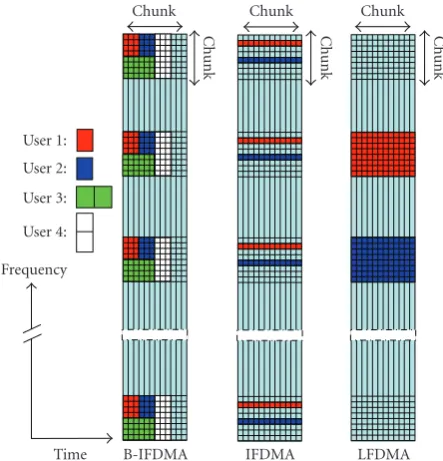
introduced the scheme in [12]. B-IFDMA is based on OFDMA. In B-IFDMA equidistantly frequency-separated blocks, each consisting of a few subcarriers, are allocated to each user. A Discrete Fourier Transform (DFT) pre-coding step is performed on each Orthogonal Frequency-Division Multiplexing (OFDM) symbol before transmission. In addition, a short TDMA component is introduced within the chunks. B-IFDMA is a generalization of DFT precoded OFDMA with interleaved subcarrier allocation, as described in [13], also denoted as Interleaved Frequency Division Multiple Access (IFDMA) in the original paper [14] or Single-Carrier Frequency Division Multiple Access (SC-FDMA) with distributed mapping [15,16]. (Some authors distinguish between DFT precoded OFDMA and the original IFDMA scheme as the frequency domain generation and the time domain generation approaches, and regard them as different schemes with different performance by assuming that spectrum shaping is made in the corresponding domain. Here we regard the two schemes as equivalent.) B-IFDMA is also a generalization of Localized Frequency Division Multiple Access (LFDMA) [17], also denoted as Localized DFTS-OFDM or SC-FDMA with localized mapping, [15, 16]. In this paper we use the acronym IFDMA for FDMA with distributed mapping and LFDMA for SC-FDMA with localized mapping. In contrast to ISC-FDMA, B-IFDMA can assign adjacent subcarriers in the blocks, and in contrast to LFDMA multiple noncontiguous subcarriers can be assigned, see illustration inFigure 1.
The IFDMA scheme has been considered in the uplink of the LTE standard, but LFDMA was adopted [15, 16] in LTE Release 8. In LTE, with rather flat fading Resource Blocks (RBs), link adaptation and multiuser diversity gains can be obtained whenever reliable CQI is available. Some frequency-diversity collected over multiple slots can be obtained when needed through frequency-hopping, but at the cost of higher delay and delay jitter. To maintain a low RAN delay in a multihop relaying scenario, frequency hopping is less attractive.
Our evaluations in this paper of the B-IFDMA scheme towards the identified requirements for NFA transmission are focused on the error rate performance,energy efficiency
androbustnessof the scheme compared to OFDMA, IFDMA and LFDMA. We investigate the properties of the scheme under close to real conditions such as realistic pulse shaping and realistic power amplifiers, correlated Multiple Input Multiple Output (MIMO) mobile radio channels, realistic channel estimation performance under constraints set by a low pilot overhead loss and a realistic frame structure. Such a system is hard to analyze theoretically, but for application in IMT Advanced systems such a property analysis is of interest. Thus, the performance investigations in this paper are performed with simulations.
User 1: User 2: User 3: User 4: Frequency
Time B-IFDMA IFDMA LFDMA
Chunk
Chunk
Chunk
Chunk
Chunk
Chunk
Figure 1: Illustration of B-IFDMA using M = 4 subcarriers andNt = 3 OFDM symbols per subcarrier block within a
time-frequency resource denoted as chunk. SC-FDMA with localized mapping (LFDMA) and SC-FDMA with distributed mapping (IFDMA) are shown for comparison. In B-IFDMA, high rate users are allocated more blocks within the chunks in either the time or the frequency direction. (A similar illustration is included in [12].)
amplifier efficiency than OFDMA and can provide better end-to-end energy efficiency than IFDMA and LFDMA. Moreover, the scheme shows a promisingly high robustness to frequency-offsets (CFOs) and Doppler spread (DS). Thus, this scheme can be regarded as a promising solution for the uplink of future mobile radio systems. (The B-IFDMA scheme has been adopted for the NFA uplink in the WINNER system concept [2,4,5]. A scheme similar to B-IFDMA denoted as Block Equidistant Frequency Division Multiple Access (B-EFDMA) has also been proposed for NFA downlinks [4,5,18]. The difference to B-IFDMA is that the DFT precoding step is not included, since the benefit of DFT precoding is lost in the multiple signal multiplexing in the downlink. The other benefits are similar as for B-IFDMA, including the possibility to time localize the transmission in the base station (BS) in low load situations, in order to save energy in both the BS and the UE. The B-EFDMA scheme has been adopted for the WINNER NFA downlink.)
This paper is organized as follows: we start inSection 2 with a detailed definition of B-IFDMA. Then, in Section 3 we investigate the error rate performance of B-IFDMA with perfect and nonperfect channel estimation at the receiver. These investigations show the capability of B-IFDMA to collect large diversity gains under realistic assumptions on channel estimation performance, also for rather low data rates, without using time-diversity. We proceed inSection 4 with the energy efficiency of B-IFDMA with respect to High Power Amplifier (HPA) performance and end-to-end energy efficiency. These investigations motivate the use of a DFT
precoding step, and the integration of the TDMA component within the B-IFDMA scheme. These results also motivate the regular subcarrier allocation in B-IFDMA. In Section 5we investigate the robustness of B-IFDMA to carrier frequency offsets and to Doppler spreads. These results show that B-IFDMA offers the possibility to combine robustness and provision of frequency diversity. InSection 6we summarize our investigation results, and we comment on the suitability of B-IFDMA to meet our identified list of requirements above on the NFA uplink scheme. InSection 7we conclude the paper.
2. System Model
As an introduction to B-IFDMA, the resource allocation for B-IFDMA is illustrated inFigure 1along with IFDMA and LFDMA for comparison, assuming the Frequency Division Duplex (FDD) chunk size in [19]. The scheme is defined in detail in the subsequent sections.
2.1. Signal Definition. In this section, a transmitter signal model for B-IFDMA is given, following the block diagram in Figure 2. In the following, all signals are represented by their discrete time equivalents in the complex baseband. Upper case bold letters denote matrices and lower case bold letters denote column vectors. Further on, (·)†denotes the pseudo-inverse and (·)H the Hermitian of a matrix and (·)T the transpose of a vector or a matrix, respectively. Finally, [·]l,m denotes the element of a matrix in the lth row and mth column.
An uplink transmission system with K users with user indexk,k=0,. . .,K−1 is considered. Letc(νk),ν∈Z, denote a sequence of data symbols of user k at symbol rate 1/Ts
taken from the alphabet of an arbitrary bit mapping scheme applied after channel encoding and bit interleaving.
At first, the data symbols c(νk) are grouped into data symbol vectors
d(ηk)=
d(ηk,0),. . .,d(
k)
η,Q−1
T
(1)
withQelementsdη(k,q)=cη·Q(k)+q,q=0,. . .,Q−1,η∈Z. For sake of simplicity, throughout this section it is assumed that the numberQis the same for all users. However, note that for B-IFDMA also different numbersQcan be assigned to the users, cf. [20]. Each data symbol vectord(ηk)is precoded by a DFT represented by aQ×QmatrixFQwith elements
FQ
p,q= 1
Q·e
−j(2π/Q)pq, p,q=0,. . .,Q−1. (2)
d(ηk)
Figure2: B-IFDMA transceiver, transmitter (top) and receiver (bottom). In case the same amount of resources are allocated per user, for each userkout ofKuplink user terminals,Qout ofN subcarriers are allocated by the subcarrier mapping matrixM(BIk). The allocated
subcarriers consist ofLblocks, each containingMadjacent subcarriers.
blocks and letQ=M·L. The block-interleaved mapping can be described by anN×QmatrixM(BIk)with elements M. After subcarrier mapping, OFDM modulation is applied. The OFDM modulation is performed by anN-point Inverse DFT (IDFT) represented by matrixFHNwith elements
Theηth B-IFDMA-modulated data vector
x(ηk)=
From (6), it follows that B-IFDMA can be considered as OFDMA with block-interleaved subcarrier allocation and DFT precoding of the data symbols before OFDMA modula-tion. For the special caseM =1, that is, for one subcarrier per block in the allocated OFDM symbols, B-IFDMA is equivalent to IFDMA [14,21]. For the special case L = 1, that is, for one block of subcarriers, B-IFDMA is equivalent to LFDMA [17]. Thus, B-IFDMA can be understood as a generalization of these schemes. In the appendix we show that a B-IFDMA signal can be efficiently generated in the time domain, that is, without the DFT operation.
2.2. Receiver Structure. In the following a B-IFDMA receiver is described for an uplink scenario, following the block
diagram inFigure 2. Let
h(ηk)=
denote theN×1 vector representation of a multipath channel of user k. Let further h(ηk,l), l = 0,. . .,Lp −1, denote the
Lpnonzero channel coefficients at sampling rateN/Tswith Lp ≤N. Before transmission over the channelh(ηk), a Cyclic Prefix (CP), with length at least Lp−1, is inserted in between
consecutive modulated data vectorsx(ηk). At the receiver, the CP is removed before demodulation. For the time interval
T required for transmission of vectorxη(k) and the CP, the channel is assumed to be time invariant. Moreover, perfect time and frequency synchronization is assumed. Thus, with H(k)denoting the circulant channel matrix with vectorh(k)
η in its first column [22], theηth received signal vectorrηafter removal of the CP is given by
rη=
denotes an Additional White Gaussian Noise (AWGN) vector with samplesnη,n,n=0,. . .,N−1 at sampling rateN/Ts.
At the receiver, after removal of the CP, anN-point DFT is applied to the received signalrη. Subsequently, the signal is user specifically demapped. After demapping, for each userk
the impact of the channel is compensated by an equalizer and the DFT precoding is compensated by aQ-point IDFT. In the following, a Frequency Domain Equalizer (FDE) [23,24] represented by aQ×Qdiagonal matrixE(k) is considered.
3. Error Rate Performance
In this section we investigate the error rate performance of B-IFDMA with various block sizes. The aim of these investigations is to show the capability of B-IFDMA to collect large diversity gains under realistic assumptions on channel estimation performance, also for rather low data rates, without using time-diversity. We start in Section 3.1 by investigating the diversity gains under the assumption of perfect channel estimation at the receiver. Then, in Section 3.2we quantify the channel estimation performance for various B-IFDMA block sizes. With these performance results at hand, we proceed inSection 3.3by discussing the tradeoffbetween these performance measures for different B-IFDMA block sizes, and we illustrate with quantitative examples.
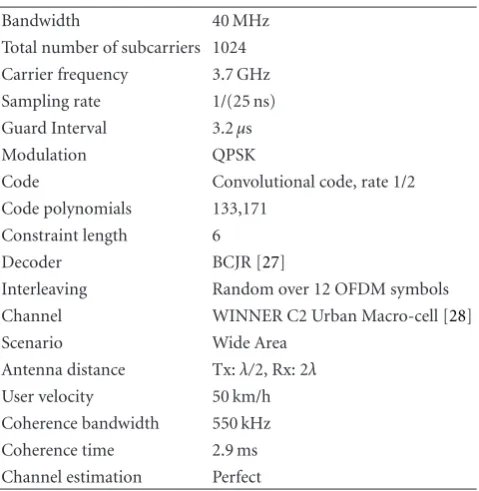
3.1. Diversity Gains. As discussed inSection 1robustness to small-scale fading based on frequency diversity and/or spatial diversity is needed to satisfy delay critical services, especially in bad channel conditions. Time diversity based schemes are less attractive in order to keep a short delay over the air inter-face. In this section, we investigate the uplink performance of B-IFDMA with Quadrature Phase Shift Keying (QPSK) modulated and Forward Error Correction (FEC) encoded transmission over a frequency-selective fading wide area mobile radio channel. We show results for single antenna transmission (SISO), two transmit antennas at the UE using Alamouti Space-Frequency Coding [25,26] with one receive antenna (MISO, Alamouti) and for two transmit antennas at the UE using Alamouti Space-Frequency Coding with two receive antennas at the base station (BS) applying Maximum Ratio Combining (MIMO, Alamouti and MRC). Each OFDM symbol is formed as described in Section 2 and a joint FEC encoding and interleaving is performed over the used OFDM symbols in the chunk. All simulation assumptions are listed inTable 1.
The coherence time Tc and the coherence bandwidth Bc of the mobile radio channel play an important role. In
the literature various different definitions for coherence time and coherence bandwidth are used, but inTable 1 they are calculated as follows. Let c0, f0, and v denote the speed
of light, the carrier frequency and the velocity of a mobile station, respectively. Let further fD,max = f0·(v/c0) denote
the maximum Doppler frequency for this mobile station. The coherence timeTccan be defined as
Tc= 1
2·fD,max =
1
BD
, (11)
whereBD=2·fD,maxis the well-known Doppler bandwidth.
The coherence bandwidthBccan be defined as
Bc=
1
Δτ, (12)
where Δτ denotes the time difference between the first and the last received propagation path of the mobile radio channel, usually denoted as the delay spread of the channel.
Table1: Simulation parameters. Bandwidth 40 MHz
Total number of subcarriers 1024 Carrier frequency 3.7 GHz Sampling rate 1/(25 ns) Guard Interval 3.2μs Modulation QPSK
Code Convolutional code, rate 1/2 Code polynomials 133,171
Constraint length 6 Decoder BCJR [27]
Interleaving Random over 12 OFDM symbols Channel WINNER C2 Urban Macro-cell [28] Scenario Wide Area
Antenna distance Tx:λ/2, Rx: 2λ
User velocity 50 km/h Coherence bandwidth 550 kHz Coherence time 2.9 ms Channel estimation Perfect
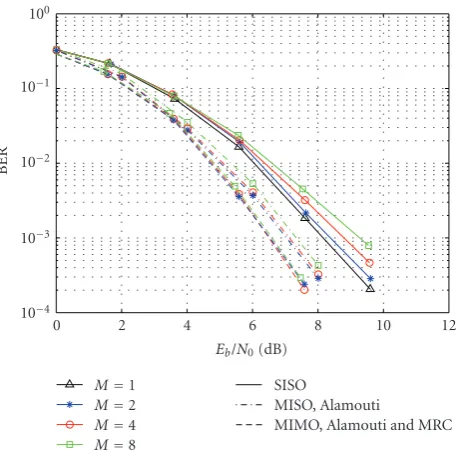
The Bit Error Rate (BER) performance of B-IFDMA for different numbers M of subcarriers per block is given in Figures3,4, and5. Perfect channel estimation is assumed and the pilot symbol overhead required for channel estimation is not considered. In these figures the 3 dB antenna gain in the 2 times 2 MIMO cases is removed to simplify the comparison of the diversity gains in the different scenarios.
When the distance of the subcarrier blocks is large compared to the coherence bandwidth, they receive almost independent fading, and thus the frequency diversity is improved. For large numbers Q of subcarriers per user, the distance between the subcarrier blocks is reduced and, thus, the frequency diversity gains are decreased. Regarding the simulation results for MISO and MIMO transmission it can be concluded that even for B-IFDMA exploiting spatial diversity, the differences in frequency diversity are still considerable.
From Figures 3,4, and 5 it can also be concluded that for a given data rate, that is, for a given number Q of subcarriers assigned to a user, the performance of B-IFDMA increases with decreasing numberMof subcarriers per block. The reason for that is that for a given number Q with decreasing number M, the number of subcarrier blocks L
10−4 10−3 10−2 10−1 100
BER
0 2 4 6 8 10 12
Eb/N0(dB) M=1
M=2
M=4
M=8
SISO
MISO, Alamouti
MIMO, Alamouti and MRC
Figure 3: Coded performance for B-IFDMA with instantaneous data rate 1.11 Mbps, that is,Q = 32 subcarriers per user with normalized antenna gain.
10−4 10−3 10−2 10−1 100
BER
0 2 4 6 8 10 12
Eb/N0(dB) M=1
M=2
M=4
M=8
SISO
MISO, Alamouti
MIMO, Alamouti and MRC
Figure 4: Coded performance for B-IFDMA with instantaneous data rate 2.22 Mbps, that is,Q = 64 subcarriers per user with normalized antenna gain.
3.2. Channel Estimation. In Section 3.1 we showed the simulated diversity gains for B-IFDMA with various param-eterizations under the assumption of perfect channel esti-mation. However, in general the less correlation among the subcarriers the better diversity but also the less correlation to be used in the channel estimation scheme over the subcarrier blocks. In addition, with pilot-aided channel estimation it
is important to keep the pilot overhead low. Thus, with a given pilot overhead, there is an inherent tradeoffto be made between attainable diversity gains and loss due to nonideal channel estimation performance. In this section, we first define in Section 3.2.1 what we mean by pilot overhead, and then inSection 3.2.2we show the attainable performance of memory-based and memory-less pilot-aided channel estimation schemes for various B-IFDMA block sizes.
3.2.1. Pilot Overhead. In pilot-aided channel estimation [29–31], the complex gain of the OFDM subcarriers is estimated at the receiver based on known time-frequency pilot symbols (also denoted as reference symbols) placed within each block. The channel equalization and payload data detection/decoding is then based on inferred complex channel gains at the payload symbol locations.
With pilot aided channel estimation, there is a pilot over-head loss in both signal-to-noise ratio (SNR) degradation due to the energy put on the pilots and in spectral efficiency due to the channel symbols occupied by the pilot symbols. Below we assume that the pilot symbols are inserted as subcarrier channel symbols with the same energy as the data carrying channel symbols (i.e., no pilot boosting). In this case the SNR loss and the spectral efficiency loss are the same. Assuming that there are P pilots per block and the block size equalsMsubcarriers timesNtOFDM symbols, the pilot
overhead loss becomesP/(M·Nt) and the SNR degradation
log10(M·Nt/(M·Nt−P)) dB.
Below in Section 3.2.2 we discuss the suitable pilot schemes and corresponding channel estimation performance under the assumption of a constant pilot overhead loss of 1/12 for the different block sizes, that is, 8.3% loss in spectral efficiency and 0.38 dB in SNR degradation.
3.2.2. Block Size Effect on Channel Estimation. Because of the variation of the complex gain with frequency (due to the multipath propagation) and with time (due to mobility), the channel at payload positions will in general differ from that at the pilot positions. The coherence time and coherence bandwidth as defined in (11) and (12), respectively give an estimate of the order of the needed sampling interval in time and frequency for the mobile radio channel according to the sampling theorem [32]. However, the channel has to be estimated based on received noisy pilot symbols, and in a packet oriented system the channel resources needed per packet transmission are not very large. Hence, due to the limited number of noisy pilots available for channel estimation, an oversampling factor is typically needed, that is, a more dense pilot pattern means better estimation performance.
Good channel estimation performance is achieved by mainly three different strategies.
(i)Use pilots from adjacent blocks, to enable interpo-lation over frequency. This strategy is possible and recommended in downlinks, but it cannot be used in uplinks, where adjacent blocks are either unused or used by other UEs. Blocks used by the UE itself are in general placed significant distances apart in frequency, with low inter-block channel correlation. They are therefore of limited use for channel estima-tion.
(ii)Use pilots from previous blocks. This can be done in general in downlinks. In uplinks, it becomes possible only if the UE uses the same blocks over multiple frames (persistent scheduling). In the investigation below, we illustrate the potential maximum esti-mation performance obtainable by using optimal Kalman smoothing that uses an unlimited amount of past payload symbols.
(iii)Use also data symbols for channel estimation, by iterative channel estimation. The pilot based channel estimate is then used as a first step. Decoded soft bits are then used in a second step to improve the channel estimates. Iterative channel estimation has been found to be beneficial for the IMT Advanced scenarios and pilot schemes, see [7,33]. It improves upon pilot-based estimates by 1-2 dB in realistic cases. The almost constant offset makes it possible to roughly estimate the accuracy of iterative schemes if the accuracy of the initializing pilot-based estimate is known. We therefore focus here on pilot-based noniterative schemes.
The channel estimation performance is investigated below for two schemes:
(i)Block Least Squares Estimation (Block-LSE): least squares estimation based on present but not past pilot data, also often called 2D-Wiener filtering [29,30]; (ii) Kalman smoothing [34,35], using present and past
pilots from every second time-slot backwards in time. Blocks from odd numbered past time-slots are not used. In half-duplex FDD uplinks they would be used by other UEs. In Time Division Duplex (TDD) sys-tems, they would be used for downlink transmissions. The time-slots (half frames) are assumed to have duration 12 OFDM symbols as in [4,5,36].
The block sizes used in the investigations and the related pilot positions are illustrated byFigure 7. The choice of these block sizes is related to the frame structure in the FDD mode of [4,5]. In order to maintain a low radio access delay and to support also high speed trains, one slot (half frame) consists of only 12 OFDM symbols, [4,5].
Here we consider uplinks, so neither method uses pilot information from subcarriers outside of the blocks. The results for the two estimation methods for the various block sizes are shown in Figure 8, for UE velocity 50 km/h at
10−4 10−3 10−2 10−1 100
BER
0 2 4 6 8 10 12
Eb/N0(dB) M=1
M=2
M=4
M=8
SISO
MISO, Alamouti
MIMO, Alamouti and MRC
Figure 5: Coded performance for B-IFDMA with instantaneous data rate 4.44 Mbps, that is,Q = 128 subcarriers per user with normalized antenna gain.
10−4 10−3 10−2 10−1 100
BER
0 2 4 6 8 10 12
Eb/N0(dB) Q=32,M=1
Q=64,M=2
Q=128,M=4
SISO
MISO, Alamouti
MIMO, Alamouti and MRC
Figure6: Coded performance for B-IFDMA with the same number ofL=32 blocks per user and with normalized antenna gain.
3.7 GHz carrier frequency as well as all other parameters as in Table 1. Please refer to [37] for further details on the channel estimation methods and for additional results for other UE velocities and block sizes.
B-IFDMA 1×1
B-IFDMA 2×1
B-IFDMA 2×2
IFDMA (Kalman)
IFDMA (Block-LSE)
B-IFDMA 1×2
LFDMA
Figure 7: The pilot patterns used for the investigated block allocations that use combinations of a basic block of 4 subcarriers by-3-OFDM-symbols, with one pilot and 11 payload symbols (i.e., pilot overhead 1/12): B-IFDMA 1×1 (M = 4,Nt = 3), 1×2
(M=4,Nt=6), 2×1 (M=8,Nt=3), 2×2 (M=8,Nt=6),
IFDMA (M = 1,Nt = 12), and LFDMA (M = 8,Nt = 12).
Time axis is horizontal and frequency axis is vertical in this figure. The pilot positions within blocks have been determined by global optimization of the channel estimation performance of the Block-LSE (Wiener) method, and they differ from those specified for uplinks in [4,5].
at the receiver, with a variance given by the estimation error variance. Therefore, inFigure 8we show the channel estimation results in terms of SNR offset due to channel estimation errors at the receiver. This performance measure makes the results directly comparable to the SNR gains and losses due to different choices of number of subcarriersM
per block in Figures 3, 4, and 5, as discussed further in Section 3.3.
It is evident that significant performance gains can be obtained by using Kalman smoothing which takes blocks in previous time-slots into account. Note that in the investigated case assuming half-duplex FDD, every second of the past timeslots cannot be used. The performance gain increases for slower UE velocities as shown in [37]. Full duplex FDD UEs would also benefit from the more dense slot and thus more dense pilot structure in time.
3.3. Performance Tradeoffs. By analyzing the results in Sec-tions3.1and3.2, we can quantify the tradeoffbetween fre-quency diversity gains and channel estimation performance for different B-IFDMA subcarrier block sizes. To this end, we adopt the parameters of the FDD wide area mode in the IMT Advanced capable system concept in [4,5].
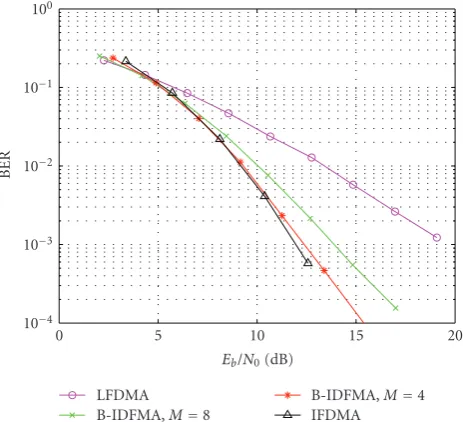
In Figure 9, we show such an example of combined diversity and channel estimation performance for the SISO case with Block-LSE channel estimation and Q = 32 subcarriers assigned per user. As seen, despite the better channel estimation with LFDMA, at this rather low number of Q; IFDMA and B-IFDMA are substantially better than
−4 −3.5 −3 −2.5 −2 −1.5 −1 −0.5 0
SENR
(dB)-SNR
(dB)
0 2 4 6 8 10 12 14 16
SNR (dB) B-IFDMA 1×1 (M=4,Nt=3)
B-IFDMA 2×1 (M=8,Nt=3)
B-IFDMA 1×2 (M=4,Nt=6)
IFDMA (M=1,Nt=12)
B-IFDMA 2×2 (M=8,Nt=6)
LFDMA (M=8,Nt=12)
Figure 8: Performance degradation in dB due to imperfect channel estimation versus ideal SNR. The vertical axis shows the difference between actual perceived signal-to-estimation-error-plus noise ratio (SENR, in dB) and ideal SNR (in dB). The horizontal axis shows the ideal SNR, that is, assuming perfect channel state information. For example, the value−3 on the vertical axis means that a bit-error-rate curve generated in an idealized setting where perfect channel estimation is assumed should be displaced 3 dB to the right to correctly represent performance when the influence of channel estimation is taken into consideration. Solid curves represent (optimal) smoothed Kalman filter performance. Dashed curves represent Wiener filter performance, where no previous measurements are used by the estimator.
LFDMA. The reason is the low frequency diversity obtained with the adjacent subcarriers in LFDMA. With increasing
Q, B-IFDMA approaches IFDMA, and B-IFDMA becomes better than IFDMA when the diversity gains saturates in IFDMA. The reason for this is the better channel estima-tion performance for B-IFDMA, cf.Figure 8. In particular, making the same comparison as inFigure 9but withQ=64 subcarriers, B-IFDMA is better than IFDMA for bothM=4 andM = 8. At BER 10−3, B-IFDMA withM = 4 is 0.5 dB
better and B-IFDMA with M = 8 is 0.2 dB better than IFDMA. Note also that due to the block lengthNt =6 used
in B-IFDMA, this performance is achieved with an average data rate over the chunk that is half compared to IFDMA and LFDMA, which is useful for transmission of small packets.
Below we exemplify the diversity versus channel estima-tion tradeofffor B-IFDMA, assuming different block lengths
Ntfor both Block-LSE and Kalman channel estimation. Since
the pilot overhead is the same for all considered schemes, this loss is not included.
Example 1. Referring toTable 2, under the assumption that
10−4 10−3 10−2 10−1 100
BER
0 5 10 15 20
Eb/N0(dB) LFDMA
B-IDFMA,M=8
B-IDFMA,M=4 IFDMA
Figure 9: Coded SISO performance for B-IFDMA, IFDMA and LFDMA with nonperfect channel estimation, and Q = 32 subcarriers assigned per user. The Block-LSE channel estimation performance results fromFigure 8are used. B-IFDMA uses block of sizes (M=4,Nt=6) or (M=8,Nt=6).
Figure 3that at BER 10−3in the SISO case when going from M = 8 toM = 4 subcarriers per block, that is, changing from number of subcarrier blocksL=4 toL=8, there is a diversity gain of 1.9 dB, that is, a reduction in required SNR from around 12.4 to 10.5 dB. This gain should be compared to the loss in channel estimation performance inFigure 8due to the fewer number of subcarriers per block. With block lengthNt=3, the channel estimation loss at the intermediate
SNR 11 dB is−1.2 dB forM = 8 and −1.7 dB forM = 4 subcarriers per block with Kalman filtering. That is, there is an overall gain of 1.9−0.5 = 1.4 dB including channel estimation for usingM=4 subcarriers compared toM=8. With Block-LSE, the corresponding overall gain is 1.9−0.8=
1.1 dB. With the longer blocks havingNt =6 (double mean
data rate over the slot for a given number of blocksL) the cor-responding gains when going fromM=8 toM=4 are 1.9−
0.4=1.5 dB (Kalman) and 1.9−0.5=1.4 dB (Block-LSE).
Example 2. InTable 2, we also show the corresponding case with Q = 64 subcarriers per user based on the results in Figures4and8. Here the two cases withM =8 andM =
4 subcarriers per block perform very similar, that is, the diversity gain withL=16 blocks compared toL=8 blocks is almost completely lost due to the worse channel estimation performance.
Similar tradeoffcomparisons can be made for the MISO with Alamouti case and the MIMO with Alamouti and MRC case based on the diversity results inFigure 6and the channel estimation performance results inFigure 8, since the results on channel estimation performance in Figure 8are directly applicable to uplinks with multiple UE antennas. Pilots are then placed at different time-frequency positions
for different antennas, and these positions are not used by payload data at the other antennas to limit interference. Therefore, the pilot overhead increases, but the channel estimation accuracy stays unchanged. Due to the additional spatial diversity gains, fewer blocksLare typically needed, down toL=2 to 4.
4. Energy Efficiency
In this section we aim to quantify the end-to-end energy efficiency of B-IFDMA. The aim of these investigations is to motivate the use of a DFT precoding step, and the advantage of the TDMA component within the B-IFDMA scheme. To this end, we start inSection 4.1by characterizing the envelope properties of B-IFDMA in terms of popular envelope variation metrics. These metrics are commonly used in the literature to characterize the signal envelope variations and to give an indication of the efficiency of a generic High Power Amplifier (HPA). These results also motivate the regular subcarrier allocation in B-IFDMA. In order to give a quantitative measure of the energy efficiency with a representative HPA, we continue in Section 4.2 by showing the HPA efficiency with different B-IFDMA parameterizations and different HPA operation modes for a real HPA. These investigations enable us to quantify the energy efficiency gains of DFT precoded schemes compared to OFDMA. In addition, they allow us to characterize the gains with time-localized transmission, and to quantify the end-to-end energy efficiency with various B-IFDMA parameterizations.
4.1. Envelope Properties. It is well known that for increasing envelope fluctuations of the transmit signal, the cost of a typical commercial HPA in the UE increases and the power efficiency decreases. Thus, especially in the uplink, the provision of low envelope fluctuations is important for the transmitted signal. In this section we investigate the envelope properties of B-IFDMA, and we predict the efficiency of the HPA based on an amplifier model. For that purpose, a signal model including oversampling, pulse shaping and windowing is assumed, all according to [38]. The oversampling factor is S = 8 and the pulse shaping filter is chosen such that an OFDM-like rectangular spectrum of the B-IFDMA signal is provided. Furthermore, a Raised-Cosine window with a roll-offregion that is 5% of the symbol duration is applied.
Table2: Overall performance comparison of SISO B-IFDMA withQ=32 orQ=64 subcarriers per user andM=4 orM=8 subcarriers per block withN=1024 subcarriers in the system.
Gain Nt=3 Nt=6
(dB) Kalman Block-LSE Kalman Block-LSE
B-IFDMAQ=32,M=4 versusM=8 (L=8 versusL=4)
Diversity, BER 10−3 1.9 1.9 1.9 1.9
Channel est. 11 dB −0.5 −0.8 −0.4 −0.5
Total 1.4 1.1 1.5 1.4
B-IFDMAQ=64,M=4 versusM=8 (L=16 versusL=8)
Diversity, BER 10−3 0.7 0.7 0.7 0.7
Channel est. 10 dB −0.5 −0.8 −0.4 −0.5
Total 0.2 −0.1 0.3 0.2
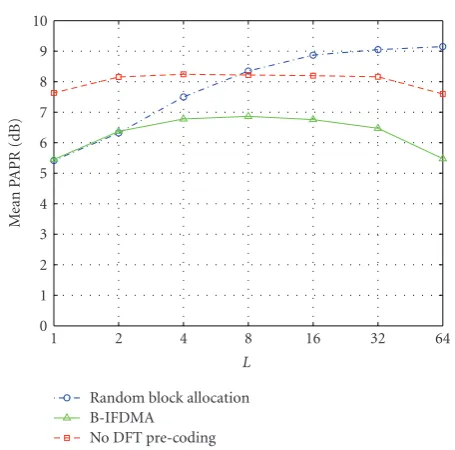
1.2–1.5 dB lower than the mean PAPR of the corresponding scheme without DFT precoding. Compared to a scheme with random allocation of the subcarrier blocks with DFT precoding, the PAPR gain of B-IFDMA is greater than 3 dB for a numberL=64 subcarrier blocks, that is, for the special case of IFDMA. The gain decreases to ≈0.7 dB for L = 4 subcarrier blocks. ForL = 2, the regular and the random allocation of the subcarrier blocks are equivalent except for the distance of the subcarrier blocks and, thus, the mean PAPR is similar.
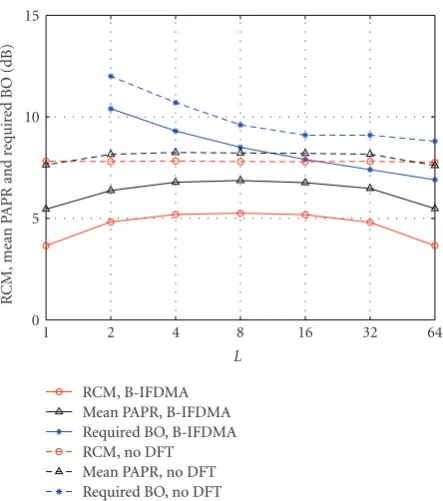
Figure 11analyzes the envelope of the B-IFDMA transmit signal based on different metrics. In addition to the PAPR, the well-known Raw Cubic Metric (RCM) as defined in [40, equation (15)], which is related to the 3GPP Cubic Metric (CM) in [41], is regarded. The motivation for the CM and RCM are the fact that the primary cause of distortion is the third order nonlinearity of the amplifier gain characteristic. Moreover, the HPA power efficiency is predicted. For that purpose, a nonlinear amplifier is assumed that produces increased out-of-band radiation due to nonlinear distortions dependent on the envelope of the input signal. The power efficiency of the given HPA depends on the power back-off(BO) that is required to meet a given spectral mask for the transmit signal. Thus, for investigation of the impact of the envelope fluctuations on the power efficiency, also the required BO is analyzed. In the following, for the HPA, the well-known Rapp model [39] with Rapp-parameterp=2 is used which represents the model of a power amplifier with high nonlinearities. The spectrum requirement mask is rep-resentative for IMT Advanced systems, and is given in [38].
The results for the different metrics are summarized in Figure 11. Again, N = 1024 subcarriers is assumed in the system, with Q = 64 subcarriers per user and QPSK modulation. A scheme without DFT precoding is regarded as a reference. It can be concluded that, regardless of the numberLof subcarrier blocks, for B-IFDMA, the envelope fluctuations are significantly lower compared to the scheme without DFT precoding. The mean PAPR and the RCM have a minimum forL= QandL =1, that is, for LFDMA and for IFDMA, where B-IFDMA can be interpreted as a single-carrier scheme and have a maximum forL = 8. However,
0 1 2 3 4 5 6 7 8 9 10
M
ean
P
APR
(dB)
1 2 4 8 16 32 64
L
Random block allocation B-IFDMA
No DFT pre-coding
Figure10: Mean PAPR of B-IFDMA transmit signals withQ =
64 as a function of number of blocks L compared to the corresponding schemes without DFT precoding and schemes with random allocation of the subcarrier blocks.
even at the maximum, the envelope fluctuations of B-IFDMA are considerably lower than for a corresponding scheme without DFT precoding. In difference to the mean PAPR and the RCM, the required BO increases with decreasing number
Lof subcarrier blocks. The reason for that is that in addition to the envelope of the signal also the shape of the spectrum changes and the side-lobes are increased. However, for the special case ofL=1, that is, for LFDMA, the side-lobes are significantly reduced. Thus, in this case, the spectral mask is less relevant, and results forL=1 are omitted.
0 5 10 15
R
C
M,
mean
P
APR
and
requir
ed
B
O
(dB)
1 2 4 8 16 32 64
L
RCM, B-IFDMA Mean PAPR, B-IFDMA Required BO, B-IFDMA RCM, no DFT Mean PAPR, no DFT Required BO, no DFT
Figure11: Results for the analysis of the envelope fluctuations of B-IFDMA transmit signals with Q = 64 (with DFT) compared to signals without DFT precoding for different numbers L of subcarriers per block using different metrics.
0 10 20 30 40 50 60
Ov
er
al
l
e
ffi
ciency
(%)
15 20 25 30 35 40
Pout(dBm) VDC=22 V
VDC=17 V VDC=11 V
VDC=8 V VDC=6 V
Figure12: Illustration of overall efficiency as a function of output power for different amplifier drive voltagesVDCusing the HPA in
[42], whereVDC=22 V is the highest possible drive voltage.
4.2. Gain with Time Localized Transmission. InSection 4.1, we characterized the envelope properties of B-IFDMA according to different metrics. In this section we make an analysis of the energy efficiency of B-IFDMA with a real
amplifier. The aim of this investigation is to correlate the HPA energy efficiency with the prediction by the metrics in Section 4.1. The aim is also to show and quantify the gain by optimizing the operation point of the power amplifier, in order to motivate the benefit of the TDMA component within the B-IFDMA scheme.
4.2.1. HPA Efficiency. The efficiency of an HPA is best described by theoverall efficiency, defined as
ηA= POut PDC+PIn
, (13)
wherePInis the power at the input of the HPA, andPOutis
the resulting output power.PDCis the power at the DC input
of the amplifier, computed as the product between the DC voltage and the DC current,PDC =VDC·IDC. For a given VDC, the efficiency is a function mainly of the desired output
power; the general trend is that the efficiency is higher for high output powers. However, by varying the drive voltage
VDC, the efficiency curve of the amplifier can be changed.
InFigure 12, we illustrate the overall efficiency as a function of output power for different drive voltagesVDC, when the
input signal is anunmodulated carriersignal, using the HPA in [42].
Figure 12 shows that the efficiency of the amplifier is highest when its output power is close to the maximum attainable output power, that is, when it is driven close to saturation. However, due to the signal dynamics and other system considerations such as power control, it is in general not possible to drive the amplifier in its most efficient mode at all times. In situations when we need a lower average output power, we can see that by lowering the (constant) drive voltage we can get an improved efficiency, but the overall efficiency is still lower than when its output power is close to the maximum attainable output power. (The optimal way of driving the amplifier would be to jointly vary the drive and Radio Frequency (RF) power for maximum efficiency [42], but this is not generally regarded as practical to implement today.)
We have evaluated the overall efficiency of several different amplifiers, when driven at different constantVDC
and with differentmodulatedsignals. The constantVDCdrive
voltage has been chosen for maximum overall efficiency, and the following modulated input signals have been used: OFDM, IFDMA, LFDMA and B-IFDMA with different numbers of blocks (L) and pulse shaped as inSection 4.1.
To compute the overall efficiency of the HPA, we use the measured characteristics of the HPA in terms of requiredPDC
for a givenPInand desiredPOutof each signal sample, and
As can be seen, we have the following.
(i) Due to the different amplitude distributions of these signals, they lead to different power efficiencies. (ii) In accordance with the envelope metric results in
Section 4.1, and compared to the TDMA-OFDM system, the various DFT-precoding based schemes perform better both with respect to the overall efficiency and with respect to the maximum output power (not shown inTable 3). This can potentially be used for increasing the cell size and/or larger data rates at a given path loss, provided regulations on maximum transmit power are not violated. The bet-ter HPA efficiency also implies less heat dissipation in the UE, which simplifies the design and can cut other supporting component costs.
(iii) The difference in efficiency of the various DFT precoded schemes is very small, including the B-IFDMA scheme. In particular, these differences are smaller than predicted by the envelope metric results inSection 4.1.
The results in Table 3 were obtained using the class E Laterally Diffused Metal Oxide Semiconductor (LDMOS) amplifier in [42]. However, to verify the qualitative conclu-sions we have also repeated the experiments with a class D LDMOS and a class E Gallium Nitride (GaN) amplifier. We have also studied other designs in the literature, for example, [43], and other classes of operation, such as class A, AB, or B. The overall conclusion is that the qualitative results are the same as above regardless of the amplifier.
4.2.2. Efficient HPA Operation. From the results inTable 3we see that there is a gain to be made if the power amplifier as often as possible can operate close to its optimal operation point. However, in order to limit the Multiple Access Interference (MAI) from different users in a multicarrier based uplink due to imperfections in transmitter hardware, synchronization and Doppler spread, it is important to have some kind of power control to limit the difference in received power spectral density from different users. Thus, if all users were allocated the same number of subcarriers, with a constraint on maximum received power spectral density, there would be situations when the HPA has to operate at a low and suboptimal transmit power level. In these scenarios HPA efficiency would benefit from an increase in the number of allocated subcarriers in a given OFDM symbol, because then the UE could transmit during a shorter time, that is, on a lower number of OFDM symbols, for a given average data rate. One possibility to do this would be to decrease the subcarrier separation in an IFDMA scheme, but that would imply a larger channel estimation overhead due to the low correlation among the subcarriers as shown inSection 3.2. With a short frame duration, aiming at low delays, this overhead would be prohibitive. In addition, it would limit the possibility for coexistence with adaptive TDMA/OFDMA as discussed in [9].
In order to quantify the HPA efficiency with and without time localized transmission, we assume that the choices are to
either (a) transmit at full power 25% of the time, and turn off the transmitter for 75% of the time, or (b) to transmit at 25% of full power all the time. Thus, in scenario (b) the amplifier is backed-off 6 dB compared to scenario (a). In a BS, the amplifier is usually optimized for a high output power, while in the UEs the amplifier works at a low power level most of the time, for example, 21–46 dBm for BSs and 21–24 dBm for UEs depending on the deployment scenario ranging from local area to wide area, [19].
As seen inTable 3maximum overall efficiency is obtained when operating the HPA close to the maximum output power level. Thus scenario (a) leads to higher efficiency in all cases. For example, assume the same number of well separated blocks L. If the options are to use IFDMA in the full duration of a chunk with 32 subcarriers at a constant output power level of 18 dBm, we get an overall HPA efficiency of 29% (Table 3row 2, column 5), whereas if we use B-IFDMA withQ = 128 subcarriers andM = 4 subcarriers per block (i.e., L = 32 blocks) one quarter of the frame duration and an instantaneous output power level of 24 dBm, we get an overall HPA efficiency of 41% (Table 3 row 5, column 4). The corresponding difference is smaller when the average transmit power is closer to the maximum efficiency. For example, at 24 dBm average transmit power the corresponding overall efficiencies are 43% (Table 3row 2, column 4) for IFDMA and 45% (Table 3 row 5, column 3) for B-IFDMA. Thus, there is a large benefit to introduce a TDMA component in the B-IFDMA scheme in order to allow a shorter transmit duration than a full frame with a larger instantaneous data rate, except in case the required overall data rate is already close to the maximum supported. With time-localized transmission and reception, we also introduce the additional possibility of micro-sleep mode within scheduled frames. The feasibility and potential of micro-sleep mode is discussed in [12].
4.3. End-to-End Energy Efficiency. By combining the results in Sections4.1and4.2with the results inSection 3, we can quantify the end-to-end energy efficiency for different B-IFDMA parameterizations. Below we illustrate this tradeoff, by building on the examples inSection 3.3, assuming a target BER of 10−3.
Example 3(revisited). Similar to the mean PAPR results for
Q = 64 subcarriers in Figure 10, the mean PAPR for B-IFDMA withQ= 32 subcarriers is very similar forM =4 (L=8) andM =8 (L=4). In addition, not shown in this paper, the mean PAPR values of B-IFDMA have been found to correlate well with the overall HPA efficiency values. Thus, with SISO usingQ=32 subcarriers, the scheme withL=8 blocks withM=4 subcarriers each seems to provide the best tradeoffalso considering end-to-end energy efficiency.
Table3: Overall efficiencyηAin % of the HPA in [42] with constant drive voltage operation withVDCchosen for maximum overall efficiency
for different input signals, all using QPSK symbol constellations and a system withN=1024 subcarriers.
ConstVDC Max efficiency Max efficiency−6 dB 30 dBm 24 dBm 18 dBm
TDMA- 40% @ 34% @ 39% @ 39% @ 29% @
OFDM 26 dBm 20 dBm 30 dBm 24 dBm 18 dBm
IFDMA 49% @ 43% @ 49% @ 43% @ 29% @
Q=32 30 dBm 24 dBm 30 dBm 24 dBm 18 dBm
B-IFDMA 47% @ 38% @ 45% @ 41% @ 29% @
Q,M=32, 4 28 dBm 22 dBm 30 dBm 24 dBm 18 dBm
B-IFDMA 46% @ 38% @ 45% @ 41% @ 29% @
Q,M=64, 4 28 dBm 22 dBm 30 dBm 24 dBm 18 dBm
B-IFDMA 46% @ 38% @ 45% @ 41% @ 29% @
Q,M=128, 4 28 dBm 22 dBm 30 dBm 24 dBm 18 dBm
LFDMA 48% @ 38% @ 47% @ 42% @ 29% @
Q=32 28 dBm 22 dBm 30 dBm 24 dBm 18 dBm
by the required power backoffto satisfy a spectrum mask, the results for required BO inFigure 11apply. In this case, the end-to-end energy efficiency seems to be around 0.5 dB better withL=16, that is, forM=4 subcarriers per block.
In the next example, we now make a comparison between B-IFDMA and IFDMA with the same data rate, also taking the end-to-end energy efficiency into account.
Example 5. Let us compare the two options to use IFDMA in SISO at thesame data rate, for example, B-IFDMA using
M = 1,L = 32, andNt = 12 havingQ = 32 subcarriers
for the user with B-IFDMA using M = 4, L = 32, and
Nt = 3 having Q = 128 subcarriers. The data rate is
the same since in both cases M ·Nt ·L = 384 symbols
are transmitted per slot. To generate the same RF energy, IFDMA would operate with 6 dB less transmit power during 4 times longer duty cycle. Thus, this scenario is especially relevant for the case when the required uplink data rate is below the maximum achievable for the UE at the given channel conditions. Consider the diversity gains inFigure 6, the channel estimation performance inFigure 8and the HPA efficiency for this case inTable 3. Using the corresponding HPA efficiency values as discussed inSection 4.2.2, the end-to-end energy efficiency comparison is shown inTable 4for target BER 10−3. As seen inTable 4, there is an overall gain
for B-IFDMA withM =4 over the IFDMA case. The gain is more than 2 dB at low output power levels, but there is a substantial gain also at operation closer to the maximum output power level. This gain is achieved without considering additional potential sleep mode gains enabled by the short blocks, as mentioned inSection 4.2.2.
5. Robustness
In this section, the robustness of B-IFDMA to carrier frequency offsets (CFOs) and to Doppler spreads (DSs) is analyzed for the uplink dependent on the signal parameters. The aim of this investigation is to show that the block based
Table 4: End-to-end energy efficiency comparison of SISO B-IFDMA using block sizeM=4,Nt =3 andQ=128 subcarriers
per user at two different HPA output power levels versus B-IFDMA using block sizeM=1,Nt=12 andQ=32 subcarriers per user at −6 dBm lower HPA output power level. IFDMA uses 4 times longer blocks.L=32 in both cases and there areN=1024 subcarriers in the system.
Gain 30 dBm 24 dBm
(dB) Kalman Block-LSE Kalman Block-LSE B-IFDMAM=4,Nt=3,Q=128 versusM=1,Nt=12,Q=32
Diversity, BER 10−3 0.24 0.24 0.24 0.24
Channel est. 9 dB −0.15 0.1 −0.15 0.1 HPA efficiency 0.2 0.2 2.07 2.07 Total 0.29 0.54 2.16 2.41
subcarrier allocation in B-IFDMA enables the possibility to combine robustness and provision of frequency diversity.
In mobile radio applications, CFOs are typically caused by oscillator imperfections due to low cost hardware com-ponents or Doppler shifts due to the mobility of the users. The CFOs result in a shift of the spectra of the different users’ signals. Hence, the orthogonality of the subcarriers is destroyed and inter-carrier interference (ICI) occurs.
In general, two types of ICI can be distinguished. Re-garding a particular user’s signal, on the one hand, due to the shift of the spectrum, interference between the subcarriers of this user occurs. In the following this is denoted as self-interference (SI). On the other hand, in addition self-interference between the subcarriers of different users occurs. This case is in the following denoted as multiple access interference (MAI).
10−4 10−3 10−2 10−1
BER
0 2 4 6 8 10
Es/N0 M=1
M=2
M=4
M=8
M=16
M=32
M=64
Δf=0
Figure13: Performance forΔf(CFOk) =10% maximum relative CFO for different numbersMof subcarriers per block, assumingN =
1024 subcarriers andQ=64 subcarriers per user.
10−4 10−3 10−2 10−1
BER
0 2 4 6 8 10
Es/N0 M=1
M=2
M=4
M=8
M=16
M=64
Δf=0
Figure14: Performance for Doppler Spread withΔf(CFOk) = 15% relative carrier frequency offset per path for different numbersMof subcarriers per block, assumingN =1024 subcarriers andQ=64 subcarriers per user.
ICI occurs. Similar to the effects of CFOs, also for DSs two types of ICI, namely SI and MAI can be distinguished.
For uplink transmission, the CFOs and the DS for the received signals of different users are different. Thus, if CFOs and DS are known at the receiver, compensation of SI is possible, whereas compensation of MAI can only be obtained by application of joint detection techniques that require a high computational effort.
For the analysis of the robustness of B-IFDMA to CFOs, let
Δf(CFOk) = Δf (k) CFO
Δf (14)
denote the relative CFO of userknormalizing the CFOΔfCFO(k)
of userkto the subcarrier bandwidthΔf. The relative CFO
f(CFOk) is modeled as a random variable that is uniformly dis-tributed in [−Δf(CFO,maxk) ,ΔfCFO,max(k) ] withΔf(CFO,maxk) denot-ing the maximum relative CFO of userk that occurs. The CFOs fCFO(k) are assumed to be known at the receiver. Thus,
SI can be perfectly compensated by reversing the CFO fCFO(k).
For the compensation of the MAI, joint detection techniques are required. For this investigation, it is assumed that, due to the high complexity, the compensation of MAI at the receiver is not feasible. In order to analyze the robustness to CFOs independently of the diversity effects, a B-IFDMA transmission over an AWGN channel is regarded.
For the analysis of the robustness of B-IFDMA to DSs, let
Δf(DSk)=Δf (k) DS
Δf (15)
denote the relative DS of userk normalizing the DS ΔfDS(k)
of user k to the subcarrier bandwidth Δf. Similar to the modelling of the CFOs, also the DS Δf(DSk) is modelled as a random variable. Assuming that for the different prop-agation paths the angle of arrival is uniformly distributed in [0, 2π], the relative Doppler shift is Jakes distributed in [−Δf(D,maxk) ,ΔfD,max(k) ], whereΔf(D,maxk) denotes the maximum Doppler shift normalized to the subcarrier bandwidthΔf. At the receiver, SI is combatted by application of a linear Minimum Mean Square Error (MMSE) receiver, cf. [44]. For the compensation of the MAI, again, joint detection techniques are required and it is assumed that, due to the high complexity, the compensation of MAI at the receiver is not feasible. In order to separate the effect of the Doppler spread from frequency selective fading effects that are also caused by multipath propagation, a Doppler spread channel according to [44] is regarded, that is, the different propagation paths are assumed to arrive at the receiver at the same time. The channel is distorted by AWGN and the received signals from the different propagation paths suffer from mutually independent relative Doppler shifts.
Figure 13depicts the performance results without coding for the robustness investigations to CFOs assuming N =
1024 subcarriers in the system,Q=64 subcarriers per user,
K=16 users andΔf(CFOk) =10% for all users. FromFigure 13
subcarriers per block the robustness of B-IFDMA to CFOs is significantly improved.
Figure 14depicts the performance results for the robust-ness investigations to DS assuming the same parameters as inFigure 13andΔf(D,maxk) =15% for all users. The value for
Δf(D,maxk) represents the maximum relative Doppler shift for a system withΔf =10 kHz and a carrier frequency of 5 GHz with a user velocity of 315 km/h and, thus, represents a high mobility scenario, for example, for high speed trains.
From the results inFigure 14 it can be concluded that also the robustness of B-IFDMA to DS increases with an increasing numberM of subcarriers per block. The reason is the same as for the improved robustness to CFOs. Again, already for small numbersMa significant robustness gain is provided. The increased robustness to CFOs and DSs of B-IFDMA withM >1 makes B-IFDMA suitable for high speed users and systems with limited frequency synchronization.
6. Discussion of Results
In this section we summarize and comment on the investiga-tions made in Secinvestiga-tions3,4, and5. InSection 1, we identified the following important requirements for the diversity based multiple access scheme, which should complement the FA multiple access scheme in an IMT Advanced capable system. Below we comment on the suitability of B-IFDMA to meet these requirements.
(i)Robustness to small-scale fading without time diversity. The results inSection 3showed that B-IFDMA can be defined based on a rather few number of subcarriers per block also with realistic channel estimation performance. Thus, also at rather low data rates, that is, rather few subcarriers assigned to a user per slot, a large frequency diversity can be obtained.
(ii)Tuneable degree of frequency-diversity. As shown in Sections3.3 and 4.3 rather small blocks, also with a sub-slot duration, can provide a good error rate performance. Thus, for a given data rate additional blocks can be allocated either well-separated in frequency to provide additional frequency-diversity, or adjacent in time or frequency (i.e., in same chunk cf.Figure 1), if enough diversity is already obtained from the frequency and/or spatial domain.
(iii)Need to support high energy efficiency in the transmit-ters and the receivers. We showed inSection 4that B-IFDMA including pulse shaping can provide similar HPA efficiency as IFDMA and LFDMA, which is substantially better than for TDMA-OFDM without DFT precoding. In addition, whenever the UE is not power limited, in Section 4.3 a substantial overall gain of more than 2 dB is shown with time localized transmission in a fraction of the time slot, also when including realistic channel estimation performance and disregarding potential sleep mode gains. (These results are valid also for a downlink scenario using the B-EFDMA scheme.)
(iv)Robustness to carrier frequency offsets and large Doppler spread. This property was evaluated in Section 5and the conclusion is that already for small numbers of subcarriers per block a significant robust-ness gain against carrier CFOs as well as against Doppler spreads is provided compared to IFDMA. This property could provide a significant gain in certain scenarios, like for deployment in frequency bands using a several GHz carrier frequency. Another scenario is to support high-speed trains, and/or to deploy a system with rather narrow subcarrier bandwidth.
(v)Support for widely varying packet sizes. Due to the good error rate performance of B-IFMDA with few number of subcarriers, transmission of rather small blocks perform well by using the TDMA component. Large packets can use the full chunk duration. The benefit of configuration flexibility motivates the introduction of a small basic block consisting of, for example,M = 4×Nt = 3 (subcarriers ×OFDM
symbols) in B-IFDMA as a building block to enable adaptive block allocation in different deployment and usage scenarios, as illustrated inFigure 1, see [5,45] for further discussion.
(vi)Enable efficient resource allocation. As discussed in [45] just a few different block allocations should be sufficient in a cell. The regular block allocation is beneficial for low addressing overhead, and it was shown inSection 4.1to also be beneficial for lowering the envelope variations.
(vii)Be of use for in-band control signals. This is possi-ble due to the efficient support for small packets as discussed above. In addition, the short TDMA component in B-IFDMA is useful to support precise timing of control messages for FA transmission, cf. [9].
(viii)Enable efficient coexistence with adaptive TDMA/ OFDMA. Since B-IFDMA also is based on OFDM with the same parameters, these two schemes are compatible. With well-separated regular block allocations in frequency, adaptive TDMA/OFDMA resources can be interlaced as shown, for example, in [9, Figure 2].
(ix)Facilitate low complexity transmitter in UEs. The good envelope properties of B-IFDMA enables the use of a less complex HPA and predistortion unit. In the appendix we show that a B-IFDMA signal can be efficiently generated in the time domain, that is, without the DFT operation.
7. Conclusions
investigations, we have shown that B-IFDMA is able to provide equal or better error rate performance than IFDMA and LFDMA, when considering realistic channel estimation performance at the receiver and no reliable channel state information at the transmitter, also for rather low data rates, and without using time diversity.
We also showed that B-IFDMA provides better amplifier efficiency than OFDMA and can provide better end-to-end energy efficiency than IFDMA and LFDMA. These investigations motivated the use of the DFT precoding step, and the integration of the TDMA component within the B-IFDMA scheme. These results also motivated the use of a regular subcarrier allocation in B-IFDMA.
Then, we showed that B-IFDMA offers the possibility to combine robustness against carrier frequency offsets and Doppler spread with provision of frequency diversity. This property could provide a significant gain in certain scenarios, like for deployment in frequency bands using a several GHz carrier frequency. Another scenario is to support high-speed trains, and/or to deploy a system with rather narrow subcarrier bandwidth.
Finally, we argued for that B-IFDMA has the capability to fulfill and provide a good tradeoffbetween the requirements envisioned for the robust transmission mode in the uplink of future IMT Advanced capable wireless systems.
Appendix
Time Domain Representation
In this appendix, the samples of the B-IFDMA time domain signal are analyzed. For sake of simplicity, throughout this appendix, the indexηis omitted. Combining the precoding, the user specific block-interleaved subcarrier mapping and the OFDM modulation, the elementsx(nk),n=0,. . .,N−1, Equation (A.1) is illustrated inFigure 15.
The sequenced((nk)+μL) modQin (A.1) can be interpreted as a compression of the sequence of data symbols d(qk), q = 0,. . .,Q−1, in time by factorN/Q, a subsequentN/Q-fold repetition and, finally, a cyclic shift of theNelements of the resulting sequence byn+μL, as illustrated in [46, Figure 3]. Thus, B-IFDMA can be considered as a superposition ofM
single carrier signals weighted by different complex numbers
Θ(nμ,k).
Figure15: B-IFDMA time domain modulation.
The expression ej(2π/N)kM in (A.2) represents a user specific frequency shift bykM. ForM = 1 the expression
Θ(nμ,k)reduces to
and (A.1) simplifies to compression and repetition of the data symbols, subsequent user specific frequency shift and a normalization toQ/N. This is equivalent to the generation of an IFDMA signal [14] which is a single carrier signal, that is, a serially modulated carrier. Note that also for the special caseM=Q, an expression is obtained that is equivalent to a single carrier signal because for this case the expression from (A.1) is equivalent to the time domain samples of an LFDMA signal that are described in [47].
Since the coefficients by (A.2) are independent from the data symbols, they can be calculated offline. Thus, (A.1) also represents an alternative implementation for B-IFDMA modulation that does not requireNandQto be powers of 2 as it would be the case for an implementation of B-IFDMA modulation according to (6), if the Fast Fourier Transform (FFT) algorithm is used.
Similar to the modulation, also the B-IFDMA demod-ulation can be reformulated as follows. The elements ρ(qk),
q=0,. . .,Q−1 of the demodulated B-IFDMA signal