Performance of non-laboratory staff for
diagnostic testing and specimen collection in
HIV programs: A systematic review and
meta-analysis
Lara VojnovID1*, Miriam Taegtmeyer2, Caroline Boeke1, Jessica Markby1, Lindsay Harris1, Meg Doherty3, Trevor Peter1, Nathan Ford3
1 Clinton Health Access Initiative, Boston, Massachusetts, United States of America, 2 Liverpool School of
Tropical Medicine, Pembroke Place, Liverpool, United Kingdom, 3 World Health Organization, Geneva, Switzerland
Abstract
Background
In most high HIV burden countries, many HIV patients do not have reliable access to required diagnostic laboratory tests. Task shifting of clinical tasks to lower cadres of health care workers and lay counselors has been successful in scaling up treatment for HIV and may also be an effective strategy in expanding access to essential diagnostic testing.
Methods
We screened major electronic databases between 1 January 2005 to 26 August 2018 to identify studies assessing ease of use and accuracy of task shifting of HIV-related diagnos-tic testing and/or specimen collection to non-laboratory health staff. Two independent reviewers screened all titles and abstracts for studies that analyzed diagnostic accuracy, patient impact, ease-of-use, or cost-effectiveness. Studies were assessed for quality, bias, and applicability following the QUADAS-2 framework. We generated summary estimates using random-effects meta-analyses.
Results
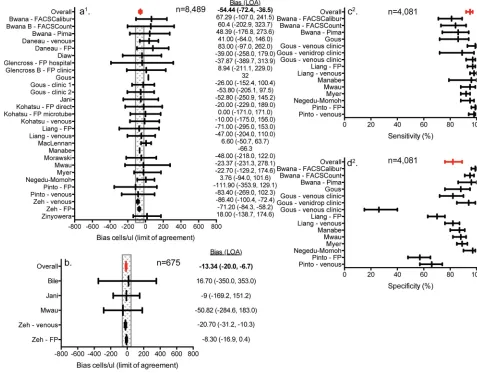
We identified 42 relevant studies. Overall, point-of-care CD4 testing performed by non-labo-ratory staff had a mean bias of -54.44 (95% CI: -72.40 –-36.48) compared to conventional laboratory-based. Though studies were limited, the diagnostic accuracy of point-of-care ala-nine transaminase enzyme (ALT) and hemoglobin testing performed by non-laboratory staff was comparable to conventional laboratory-based testing by laboratory professionals. Point-of-care testing and/or specimen collection were generally found to be acceptable and easy to use for non-laboratory staff.
a1111111111
Citation: Vojnov L, Taegtmeyer M, Boeke C,
Markby J, Harris L, Doherty M, et al. (2019) Performance of non-laboratory staff for diagnostic testing and specimen collection in HIV programs: A systematic review and meta-analysis. PLoS ONE 14(5): e0216277.https://doi.org/10.1371/journal. pone.0216277
Editor: Tendesayi Kufa, National Institute for
Communicable Disease Control and Prevention, SOUTH AFRICA
Received: January 25, 2018
Accepted: April 17, 2019
Published: May 2, 2019
Copyright:©2019 Vojnov et al. This is an open access article distributed under the terms of the
Creative Commons Attribution License, which permits unrestricted use, distribution, and reproduction in any medium, provided the original author and source are credited.
Data Availability Statement: All relevant data are
within the paper and its Supporting Information files.
Funding: This work was supported by Unitaid and
DFID. The funding bodies had no role in the design of the study and collection, analysis, and interpretation of data nor in writing the manuscript.
Competing interests: The authors have declared
Conclusions
Task shifting of testing using point-of-care technologies to non-laboratory staff was compa-rable to laboratory professionals operating the same technology in the laboratory. Some var-iability was observed comparing the performance of point-of-care CD4 testing by non-laboratory staff to conventional non-laboratory-based technologies by non-laboratory professionals indicating potential lower performance was likely technological rather than operator caused. The benefits of task shifting of testing may outweigh any possible harms as task shifting allows for increased decentralization, access of specific diagnostics, and faster result delivery.
Background
In most high HIV burden countries in sub-Saharan Africa, many HIV patients currently do not have reliable access to required diagnostic laboratory tests. This is in part because these countries have limited health human resource capacity, including laboratory professionals. The successful scale up and management of antiretroviral therapy in Africa and other low- and middle-income settings has depended critically on a public health approach that relies on decentralization of treatment to primary health care facilities and lesser-trained health workers in primary care services to deliver HIV testing and antiretroviral therapy to the majority of HIV positive patients [1]. This approach has supported the delivery of HIV testing and antire-troviral therapy at scale in resource-limited settings: of the estimated 19.4 million people with HIV receiving antiretroviral therapy, nearly 14 million are living in Africa [2,3]. Providing greater access to antiretroviral therapy and diagnostic testing are critical to achieve UNAIDS 90-90-90 targets by 2020 [4].
Task shifting describes the process of capacitating lesser-trained health workers to provide specific services previously delivered by specialists with higher levels of training. The severe shortage of health care workers including doctors, nurses, and laboratory professionals in high HIV burden countries led a number of countries in sub-Saharan Africa to pioneer task shifting and allow lay providers to conduct HIV rapid testing and nurses to deliver antiretroviral ther-apy, significantly expanding access to services [5–8]. Lay provider HIV testing was recom-mended in the 2015 WHO consolidated guidelines on HIV testing services following a systematic review of the evidence demonstrating non-inferiority [6,7,9]. Furthermore, nurse-led antiretroviral therapy delivery was endorsed by the World Health Organization in 2007 [8], with safety and efficacy subsequently validated through randomized trials since 2010 [10].
effectiveness [12]. A number of existing diagnostic technologies have been developed that can be used outside of sophisticated and specialized laboratory systems and allow for greater decentralization and wider access to diagnostic testing [13]. Rapid diagnostic tests for HIV and syphilis diagnosis and liver function testing as well as point-of-care technologies for CD4, HIV nucleic acid (viral load and early infant diagnosis), creatinine, and hemoglobin testing exist, with more in development [13]. In several countries, lower cadre health workers have been successfully trained to collect sputum and/or whole blood specimens and to conduct a range of discrete laboratory tests, including HIV/syphilis rapid tests as well as CD4 cell count measurements, TB, malaria, chemistry, liver function and hematology assays [14–55].
We undertook this systematic review in order to summarize the available evidence on task shifting of specimen collection and performing common laboratory tests using point-of-care technologies as part of monitoring routine HIV care and treatment.
Methods
Search strategy and study selection
This review was carried out according to the Preferred Reporting Items for Systematic Reviews and Meta-Analyses (PRISMA) [56]. The protocol was reviewed and approved by WHO. PubMed, Medline and EMBASE databases were searched from 1 January 2005 to 26 August 2018 in parallel to identify peer-reviewed original research. An initial search was performed on April 23rd, 2015 and an updated search on August 27th, 2018 –search terms were the same and the results combined. Search terms were developed using the MeSH term formats as follows: HIV-positive patients (population), non-laboratory professionals (operators), task shifting (intervention), and outcomes (accuracy, retention, cost-effectiveness, and acceptability) (S1 Fig). Conference abstracts within the search dates from the Conference on Retroviruses and Opportunistic Infections (CROI), International Conference on AIDS and STIs in Africa (ICASA), International AIDS Society (IAS), and AIDS Conference and bibliographies were also screened and reviewed for possible inclusion. Two reviewers (LV, CB, JM, LH) working independently screened all titles and abstracts for eligibility. Studies were included if they com-pared the diagnostic accuracy, patient impact, acceptability, or cost-effectiveness of non-labo-ratory staff performing HIV-related diagnostic testing and/or specimen collection compared to laboratory professionals. Bibliographies of all included studies were also reviewed to identify unpublished, non-peer reviewed work for possible inclusion. Non-English studies were excluded. Data were extracted from each included study including sample size, sample type, test setting, end-user cadre, comparator, study dates, and outcomes of diagnostic accuracy metrics and acceptability. Studies were assessed for quality, bias and applicability following the QUADAS-2 quality appraisal tool [57].
Data analysis
Two reviewers (LV, CB/JM) independently performed the statistical analysis to ensure accuracy. Graphic representations were completed in GraphPad Prism v6.0 (La Jolla, Califor-nia, USA) and analyses were completed in Stata 13 (College Station, Texas, USA).
Results
Study characteristics
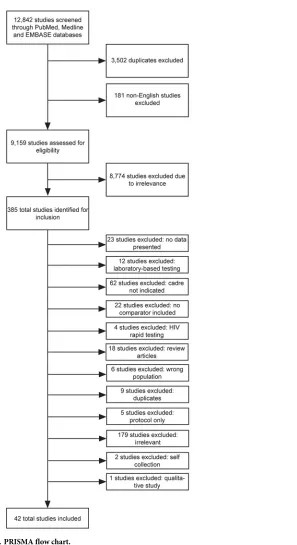
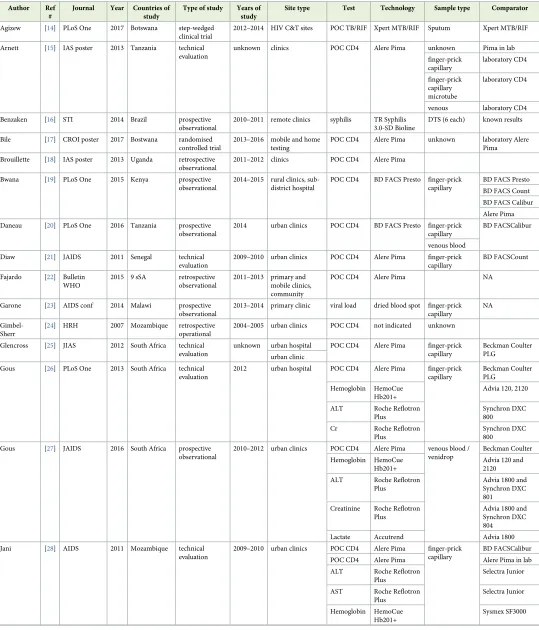
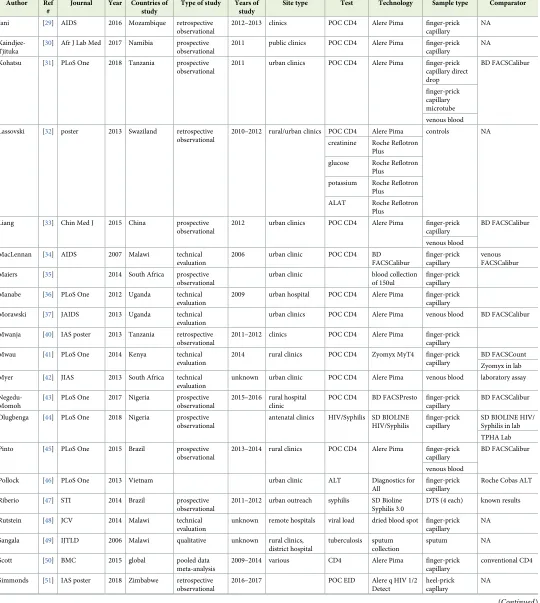
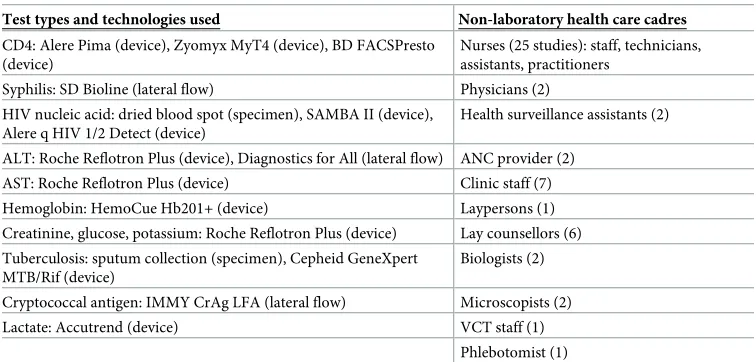
Of 12,842 titles screened, 42 eligible studies were included for review (Fig 1) [14–55]. Approxi-mately 13,686 data points were included in the diagnostic accuracy analysis and 43 different analyses. The included studies spanned 20 countries (Table 1). Most studies (86%) were car-ried out in Africa, three were performed in Brazil, and one each in Vietnam and China. Testing and specimen collection were performed at a mix of health care facilities: urban hospitals, urban clinics, urban outreach, remote hospitals, and rural clinics. Ten different point-of-care test types with 14 different technology assays were included performed by 11 non-laboratory health care cadres (Table 2); five studies analyzed specimen collection. Sixty-four percent of studies looked at POC CD4 with 85% of those studies reviewing the accuracy of the Alere Pima technology. Nurses were included as index test end-users in 60% of studies. All studies were observational or diagnostic accuracy studies, except for one randomized controlled trial and one meta-analysis. Studies were conducted between 2006 and 2018.
Overall, there was moderate risk of bias across the studies (S2 Fig). Patient, health care facility, and health care cadre inclusion and exclusion criteria were unclear or not stated in several studies. Studies often had variable study objectives and test types making compari-sons across studies difficult. Only four diagnostic accuracy studies directly compared the technical performance of the point-of-care technology between non-laboratory staff and lab-oratory professionals. Twenty-six studies compared the accuracy of point-of-care CD4 test-ing performed by non-laboratory staff to laboratory CD4 assays performed by laboratory staff.
Diagnostic accuracy of point-of-care testing performed by non-laboratory
staff
The primary outcome observed across the majority of studies focused on the diagnostic accu-racy performance of point-of-care testing when performed by non-laboratory staff. The mean bias measurement was most often included across studies [19–21,25,26,28,31,32,34,36,37,39,
Two studies reviewed the performance of cryptococcal antigen lateral flow assays when used by non-laboratory staff [53,54]. The sensitivity and specificity of non-laboratory staff cor-rectly identifying cryptococcal antigen were 100% in both studies. Additionally, syphilis testing by non-laboratory staff using the dual HIV/syphilis rapid diagnostic test had an agreement of 0.666 (0.358–0.974) and a specificity of 99.9% (95% CI: 99.8–100%) compared to when
Fig 1. PRISMA flow chart.
Table 1. Study characteristics of included studies in meta-analysis.
Author Ref #
Journal Year Countries of study
Type of study Years of study
Site type Test Technology Sample type Comparator
Agizew [14] PLoS One 2017 Botswana step-wedged clinical trial
2012–2014 HIV C&T sites POC TB/RIF Xpert MTB/RIF Sputum Xpert MTB/RIF
Arnett [15] IAS poster 2013 Tanzania technical evaluation
unknown clinics POC CD4 Alere Pima unknown Pima in lab
finger-prick
Benzaken [16] STI 2014 Brazil prospective observational
2010–2011 remote clinics syphilis TR Syphilis 3.0-SD Bioline
DTS (6 each) known results
Bile [17] CROI poster 2017 Bostwana randomised controlled trial
2013–2016 mobile and home testing
POC CD4 Alere Pima unknown laboratory Alere Pima
Brouillette [18] IAS poster 2013 Uganda retrospective observational
2011–2012 clinics POC CD4 Alere Pima
Bwana [19] PLoS One 2015 Kenya prospective observational
2014–2015 rural clinics, sub-district hospital
POC CD4 BD FACS Presto finger-prick capillary
BD FACS Presto
BD FACS Count
BD FACS Calibur
Alere Pima
Daneau [20] PLoS One 2016 Tanzania prospective observational
2014 urban clinics POC CD4 BD FACS Presto finger-prick capillary
BD FACSCalibur
venous blood
Diaw [21] JAIDS 2011 Senegal technical
evaluation
2009–2010 urban clinics POC CD4 Alere Pima finger-prick capillary
BD FACSCount
Fajardo [22] Bulletin WHO
POC CD4 Alere Pima NA
Garone [23] AIDS conf 2014 Malawi prospective observational
2013–2014 primary clinic viral load dried blood spot finger-prick capillary
NA
Gimbel-Sherr
[24] HRH 2007 Mozambique retrospective operational
2004–2005 urban clinics POC CD4 not indicated unknown
Glencross [25] JIAS 2012 South Africa technical evaluation
unknown urban hospital POC CD4 Alere Pima finger-prick capillary
Beckman Coulter PLG
urban clinic
Gous [26] PLoS One 2013 South Africa technical evaluation
2012 urban hospital POC CD4 Alere Pima finger-prick capillary
Gous [27] JAIDS 2016 South Africa prospective observational
2010–2012 urban clinics POC CD4 Alere Pima venous blood / venidrop
Jani [28] AIDS 2011 Mozambique technical evaluation
2009–2010 urban clinics POC CD4 Alere Pima finger-prick capillary
BD FACSCalibur
POC CD4 Alere Pima Alere Pima in lab
Table 1. (Continued)
Author Ref #
Journal Year Countries of study
Type of study Years of study
Site type Test Technology Sample type Comparator
Jani [29] AIDS 2016 Mozambique retrospective observational
2012–2013 clinics POC CD4 Alere Pima finger-prick capillary
NA
Kaindjee-Tjituka
[30] Afr J Lab Med 2017 Namibia prospective observational
2011 public clinics POC CD4 Alere Pima finger-prick capillary
NA
Kohatsu [31] PLoS One 2018 Tanzania prospective observational
2011 urban clinics POC CD4 Alere Pima finger-prick capillary direct
Lassovski [32] poster 2013 Swaziland retrospective observational
2010–2012 rural/urban clinics POC CD4 Alere Pima controls NA
creatinine Roche Reflotron
Liang [33] Chin Med J 2015 China prospective observational
2012 urban clinics POC CD4 Alere Pima finger-prick capillary
BD FACSCalibur
venous blood
MacLennan [34] AIDS 2007 Malawi technical evaluation
2006 urban clinic POC CD4 BD
FACSCalibur
finger-prick capillary
venous FACSCalibur
Maiers [35] 2014 South Africa prospective observational
urban clinic blood collection
of 150ul
finger-prick capillary
Manabe [36] PLoS One 2012 Uganda technical evaluation
2009 urban hospital POC CD4 Alere Pima finger-prick capillary
Morawski [37] JAIDS 2013 Uganda technical evaluation
urban clinics POC CD4 Alere Pima venous blood BD FACSCalibur
Mwanja [40] IAS poster 2013 Tanzania retrospective observational
2011–2012 clinics POC CD4 Alere Pima finger-prick capillary
Mwau [41] PLoS One 2014 Kenya technical evaluation
2014 rural clinics POC CD4 Zyomyx MyT4 finger-prick capillary
BD FACSCount
Zyomyx in lab
Myer [42] JIAS 2013 South Africa technical evaluation
unknown urban clinic POC CD4 Alere Pima venous blood laboratory assay
Negedu-Momoh
[43] PLoS One 2017 Nigeria prospective observational
2015–2016 rural hospital clinic
POC CD4 BD FACSPresto finger-prick capillary
BD FACSCalibur
Olugbenga [44] PLoS One 2018 Nigeria prospective observational
antenatal clinics HIV/Syphilis SD BIOLINE HIV/Syphilis
Pinto [45] PLoS One 2015 Brazil prospective observational
2013–2014 rural clinics POC CD4 Alere Pima finger-prick capillary
BD FACSCalibur
venous blood
Pollock [46] PLoS One 2013 Vietnam urban clinic ALT Diagnostics for
All
finger-prick capillary
Roche Cobas ALT
Riberio [47] STI 2014 Brazil prospective observational
2011–2012 urban outreach syphilis SD Bioline Syphilis 3.0
DTS (4 each) known results
Rutstein [48] JCV 2014 Malawi technical evaluation
unknown remote hospitals viral load dried blood spot finger-prick capillary
NA
Sangala [49] IJTLD 2006 Malawi qualitative unknown rural clinics, district hospital
tuberculosis sputum collection
sputum NA
Scott [50] BMC 2015 global pooled data
meta-analysis
2009–2014 various CD4 Alere Pima finger-prick
capillary
conventional CD4
Simmonds [51] IAS poster 2018 Zimbabwe retrospective observational
2016–2017 POC EID Alere q HIV 1/2
Detect
heel-prick capllary
NA
compared to laboratory technicians [44]. Furthermore, nursing staff successfully tested exter-nal quality assurance panels using syphilis rapid tests with a sensitivity and specificity over 90% [16,47].
Three studies compared the performance of alanine aminotransferase (ALT) and hemoglo-bin enumeration tests operated by non-laboratory staff with conventional laboratory-based technologies operated by laboratory professionals [26–28]. Non-laboratory staff operated both tests comparably to conventional laboratory-based technologies operated by laboratory profes-sionals (Fig 3a and 3b). A semi-quantitative, visual point-of-care ALT assay performed by nurses had a sensitivity and specificity of 87% and 77%, respectively, compared to a
Table 1. (Continued)
Author Ref #
Journal Year Countries of study
Type of study Years of study
Site type Test Technology Sample type Comparator
Tsibolane [62] unpublished 2014 South Africa retrospective observational
2014 urban/rural clinics POC CD4 Alere Pima finger-prick capillary
NA
Wake [63] JAIDS 2018 South Africa prospective observational
2016–2018 HIV clinics POC CrAg CrAg LFA finger-prick capillary
POC CrAG
Williams [54] Clin Infect Dis
2015 Uganda prospective observational
2013–2014 POC CrAg CrAg LFA finger-prick
capillary
POC CD4 Alere Pima finger-prick capillary
Zinyowera [38] unpublished Zimbabwe prospective observational
Zinyowera [39] JAIDS 2010 Zimbabwe technical evaluation
unknown urban clinic POC CD4 Alere Pima finger-prick capillary
Known results: proficiency panels with already known results
https://doi.org/10.1371/journal.pone.0216277.t001
Table 2. Test types, technologies used, and non-laboratory health care cadres in included studies.
Test types and technologies used Non-laboratory health care cadres
CD4: Alere Pima (device), Zyomyx MyT4 (device), BD FACSPresto (device)
Nurses (25 studies): staff, technicians, assistants, practitioners
Syphilis: SD Bioline (lateral flow) Physicians (2)
HIV nucleic acid: dried blood spot (specimen), SAMBA II (device), Alere q HIV 1/2 Detect (device)
Health surveillance assistants (2)
ALT: Roche Reflotron Plus (device), Diagnostics for All (lateral flow) ANC provider (2)
AST: Roche Reflotron Plus (device) Clinic staff (7)
Hemoglobin: HemoCue Hb201+ (device) Laypersons (1)
Creatinine, glucose, potassium: Roche Reflotron Plus (device) Lay counsellors (6)
Tuberculosis: sputum collection (specimen), Cepheid GeneXpert MTB/Rif (device)
Biologists (2)
Cryptococcal antigen: IMMY CrAg LFA (lateral flow) Microscopists (2)
Lactate: Accutrend (device) VCT staff (1)
Phlebotomist (1)
conventional laboratory-based technology operated by laboratory professionals [46]. Finally, one study reviewed the performance of creatinine and lactate testing by non-laboratory staff at two separate clinics [27]. Creatinine testing had mean bias values of -4.5 umol/L (95% CI: -2.09 –-6.42) and -5.5 umol/L (95% CI: -4.49 –-6.42), while lactate testing had mean bias values of 0.01 mmol/L (95% CI: -0.1–0.13) and 1.1 mmol/L (95% CI: 1.04–1.18).
Quality of testing
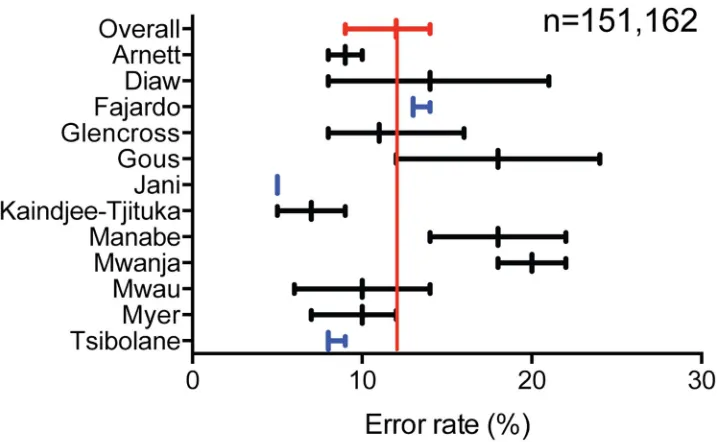
We further sought to understand the proportion of test errors (device and operator) encoun-tered when technologies were used and specimens collected by non-laboratory staff. Only error rates from point-of-care CD4 technologies were reported in the included studies [15,20,21,25,30,36,40–42]. The proportion of error rates across studies for point-of-care CD4 was 12% (95% CI: 9–14%) (Fig 4). Unfortunately, error rates for conventional
laboratory-Fig 2. Forest plots of point-of-care CD4 diagnostic accuracy performance by non-laboratory staff. (a) point-of-care CD4 testing by non-laboratory
staff compared to conventional laboratory-based testing by professional laboratory staff; (b) point-of-care CD4 testing by non-laboratory staff compared to point-of-care CD4 testing by professional laboratory staff; the shaded box represents +/- 50 cells/ul in (a) and (b). (c) sensitivity of correctly classifying patients below a CD4 threshold of 350 cells/ul; (d) specificity of correctly classifying patients above a CD4 threshold of 350 cells/ul.
based technologies operated by laboratory professionals were not included in any study, pre-venting comparison; however, the proportion of point-of-care CD4 errors was below 10% for two of the three studies where programmatic, routine point-of-care CD4 testing was per-formed [22,29,52]. The remaining nine studies reported point-of-care CD4 error rates from diagnostic accuracy evaluations and had significantly smaller sample sizes. Furthermore, addi-tional studies found error rates using the Cepheid Xpert MTB/RIF were 17% (95% CI: 11– 25%) and Alere q Detect early infant diagnosis were 9.24% when operated by non-laboratory staff [14,51].
Acceptability of testing by non-laboratory staff
Eight studies assessed the acceptability and ease-of-use for testing operated by non-laboratory staff [15,16,23,24,30,35,38,49]. The measures of acceptability were heterogenous making
Fig 3. Forest plots of point-of-care ALT and hemoglobin diagnostic accuracy performance by non-laboratory staff. (a) point-of-care ALT testing
by non-laboratory staff compared to conventional laboratory-based testing by professional laboratory staff; (b) point-of-care hemoglobin testing by non-laboratory staff compared to conventional laboratory-based testing by professional laboratory staff.
https://doi.org/10.1371/journal.pone.0216277.g003
Fig 4. Error rates for point-of-care CD4 technologies operated by non-laboratory staff. Red forest plot and line
indicate the overall pooled error rate. Blue forest plots indicate studies focused on program-wide, routine testing.
summary statistics challenging. One study observed an ease-of-use score for task-shifting point-of-care CD4 testing between 1.7–3 using a scale of 1–5 (5 being very difficult) and health care worker trust in the test was measured at between 82–100% [15]. Another study found an odds ratio of 1.9 (1.1–3.3) for more rational use of higher-level clinical staff time with the introduction of point-of-care CD4 testing operated by lower-level staff instead [24]. Further-more, 94.7% (95% CI: 92.9–95.9%) of lay health workers rated the point-of-care CD4 technol-ogy favorably [30]. Point-of-care viral load testing was found to be easy, or very easy, to use by all non-laboratory staff, while 85% of questionnaire respondents indicated that point-of-care viral load testing was suitable or very suitable for non-laboratory staff [38]. Ninety percent of non-laboratory staff identified that a syphilis rapid diagnostic test was easy to use [16], while antenatal care staff scored the dual HIV/syphilis rapid diagnostic test 2.41 (out of 3) for ease of use and 2.27 (out of 3) for ease of interpretation [44].
Acceptability specimen collection by non-laboratory staff
Additionally, 58% of non-laboratory staff indicated that preparing dried blood spot specimens for viral load was very easy, while 43% indicated that the specimen collection was easy [23]. Eighty-five percent of respondents indicated that dried blood spot preparation was suitable for non-laboratory staff. A 98% success rate of finger-prick blood specimen collection by nurses was observed in South Africa [35]. Finally, one study found that sputum collection in ANC wards for tuberculosis testing was acceptable, but there were some concerns over staff avail-ability, waiting times, and overload [49].
Discussion
This review provides evidence of the ease-of-use, acceptability, and accuracy of task shifting to support access to specific laboratory tests in HIV programs. The introduction of point-of-care technologies as well as easy to use and/or stable specimen collection technologies, such as dried blood spot filter paper, accordingly allow for task shifting and decentralization of these clinical tasks. This review found that non-laboratory staff operated point-of-care testing com-parably to laboratory professionals operating the same point-of-care test in the laboratory (mean bias +/-<15 cells/ul). Some variability, however, was observed comparing the perfor-mance of point-of-care CD4 testing by non-laboratory staff to conventional laboratory-based technologies by laboratory professionals (mean bias +/-<55 cells/ul). These results are consis-tent with the fact that test variability can be expected even within the same technology and health care cadre; however, indicative that weaker performance may have been caused by the technology rather than the health care worker cadre performing the testing. Comparable per-formance was also seen with syphilis, cryptococcal diagnosis as well as ALT and hemoglobin testing, though the number of studies and sample sizes were small for each.
Several studies reviewed the acceptability and ease-of-use of point-of-care technologies and specimen collection from the perspective of non-laboratory staff. All found that point-of-care testing and specimen collection were easy to perform and acceptable for non-laboratory staff. Furthermore, the acceptability of task shifting from the perspective of health workers is evi-denced by widespread implementation of point-of-care testing and specimen collection per-formed by non-laboratory staff [59,60]. Dried blood spot sample collection for early infant diagnosis, for example, has been significantly decentralized and task-shifted to non-laboratory staff across sub-Saharan Africa and Southeast Asia [59,61,62]. A recent systematic review reported that within 12 studies, 90% of patients accepted point-of-care CD4 testing in primary health care and community settings [63].
Diagnostic assays have differing complexity and may vary in their suitability and potential placement based on health care facility infrastructure, human resource capacity, result inter-pretation, device and third-party equipment requirements, and reagent stability [13]. For example, rapid diagnostic tests or lateral flow assays generally do not require cold storage of reagents, electricity, specialized laboratory skills such as precise measurements using a pipet, daily calibration of devices, or centrifugation of specimens. Alternatively, there are device-based technologies that require some electricity, while others may require consistent electric-ity, temperature controlled rooms, precise measurements of specimens or reagents, or even plasma separation of whole blood using third-party procured centrifuges. Such technology characteristics and requirements may limit decentralization, the extent of task shifting, and thus patient access to testing.
While this review focused on HIV-related tests and specimen collection, the same princi-ples, impact, and benefits, will likely apply beyond HIV programs. Task shifting of syphilis, hemoglobin, malaria, and/or hepatitis testing in antenatal facilities, for example, using rapid or point-of-care technologies by midwives could significantly expand access to these critical diag-nostics. Additional tests, specimens, and program areas should be considered for task shifting as is feasible and beneficial, primarily to the patients and clinical delivery of optimal care.
As with task shifting of HIV treatment, the success of laboratory task shifting for supporting HIV care will rely on careful and transparent test and product selection processes, training, and quality monitoring and mentorship. Understanding patient volumes, testing needs, and health care facilities’ characteristics, such as available infrastructure and human resource capacity, will allow for appropriate selection of testing technologies that best fit each health care facility. Significant decentralization of any service, including task shifting of testing, will require careful training of health care facility staff prior to implementation. Furthermore, this approach should be supported by national policy, and this should stipulate the need for ade-quate training and supervision. Continuous monitoring and mentorship will ensure that chal-lenges and corrective actions are quickly and appropriately managed. Ensuring these processes are implemented with task shifting into the national testing policies will support improved access to quality diagnostic testing and clinical patient management.
non-HIV testing laternal flow assays and device-based assays could not be made. Furthermore, search terms and engines may not have been exhaustive and could have missed studies eligible for inclusion. While retrospective studies provided compelling evidence, only one randomized control trials was included in the systematic review. Included studies had variable study objec-tives, different test types utilized, and various health care cadres, making comparisons and a meta-analysis difficult. Furthermore, most diagnostic accuracy studies had small sample sizes and, therefore, correspondingly wide confidence intervals that prevented strong conclusions. Finally, whilst it is critical to understand that diagnostic accuracy does not suffer with task shifting to non-laboratory staff, a primary objective of task shifting is to provide great access to faster test results, better overall quality care, and a more efficient system. However, no studies provided data on the timing and retention of patients along the cascade of care or cost-effec-tiveness of task-shifting specimen collection and/or testing.
Additional studies to more carefully determine the cause of diagnostic accuracy variability would be useful. For example, the level of variability expected within and between technolo-gies. Furthermore, while studies have observed significant patient impact when implementing point-of-care CD4 technologies [64], it would be useful to better understand and weigh the benefits and harms of decentralization and task shifting with possible loss in testing quality, if observed.
An expert panel considered the findings of this review during the revision of the2016 WHO guidelines on the use of antiretroviral drugs for treating and preventing HIV infection. These updated guidelines recommend, as good practice, that trained supervised non-labora-tory staff, including laypersons, can undertake blood finger prick for sample collection [12]. Incorporating task shifting for diagnostic testing and specimen collection into national policy will allow for greater decentralization and increased access of testing services as well as further support decentralized antiretroviral therapy management.
Supporting information
S1 Fig. Search terms for task shifting for sample collection and diagnostic test.
(DOCX)
S2 Fig. QUADAS-2 quality assessment summary of included studies.
(TIF)
Author Contributions
Conceptualization: Lara Vojnov, Meg Doherty, Trevor Peter, Nathan Ford.
Data curation: Lara Vojnov, Jessica Markby, Lindsay Harris.
Formal analysis: Lara Vojnov, Caroline Boeke, Jessica Markby.
Investigation: Lara Vojnov.
Methodology: Lara Vojnov.
Supervision: Trevor Peter.
Writing – original draft: Lara Vojnov.
Writing – review & editing: Lara Vojnov, Miriam Taegtmeyer, Caroline Boeke, Jessica
References
1. Gilks CF, Crowley S, Ekpini R, Gove S, Perriens J, Souteyrand Y et al. (2006) The WHO public-health approach to antiretroviral treatment against HIV in resource-limited settings. Lancet 368: 505–510. https://doi.org/10.1016/S0140-6736(06)69158-7PMID:16890837
2. Joint United Nations Programme on HIV/AIDS (UNAIDS) (2017) Ending AIDS: Progress towards the 90-90-90 targets.
3. World Health Organization (2015) Global Health Sector Response to HIV, 2000–2015. Focus on Inno-vations in Africa. Geneva:
4. Joint United Nations Programme on HIV/AIDS (UNAIDS) (2014) 90-90-90: An ambitious treatment tar-get to help end the AIDS epidemic.
5. Ferradini L, Jeannin A, Pinoges L, Izopet J, Odhiambo D, Mankhambo L et al. (2006) Scaling up of highly active antiretroviral therapy in a rural district of Malawi: an effectiveness assessment. Lancet 367: 1335–1342.https://doi.org/10.1016/S0140-6736(06)68580-2PMID:16631912
6. Flynn DE, Johnson C, Sands A, Wong V, Figueroa C, Baggaley R (2017) Can trained lay providers per-form HIV testing services? A review of national HIV testing policies. BMC Research Notes 10: 20. https://doi.org/10.1186/s13104-016-2339-1PMID:28057054
7. Kennedy CE, Yeh PT, Johnson C, Baggaley R (2017) Should trained lay providers perform HIV testing? A systematic review to inform World Health Organization guidelines. AIDS Care 1–7.
8. World Health Organization (2007) Task shifting. Global Recommendations and Guidelines. Geneva.
9. World Health Organization (2015) Consolidated guidelines on HIV testing services: 5Cs: consent, confi-dentiality, counselling, correct results and connection. Geneva.
10. Kredo T, Adeniyi F, Bateganya M, Pienaar E (2014) Task shifting from doctors to non-doctors for initia-tion and maintenance of antiretroviral therapy. Cochrane Database Syst Rev CD007331.
11. World Health Organization (2015) World Health Statistics. Geneva.
12. World Health Organization (2016) Consolidated Guidelines on the Use of Antiretroviral Drugs for Treat-ing and PreventTreat-ing HIV Infection: Recommendations for a Public Health Approach.
13. UNITAID (2015) HIV/AIDS Diagnostic Technology Landscape, 5th edition.
14. Agizew T, Boyd R, Ndwapi N, Auld A, Basotli J, Nyirenda S, et al. (2017) Peripheral clinic versus central-ized laboratory-based Xpert MTB/RIF performance: Experience gained from a pragmatic, stepped-wedge trial in Botswana. PLoS ONE 12(8): e0183237.https://doi.org/10.1371/journal.pone.0183237 PMID:28817643
15. Arnett N, Chang K, Schmitz M, Lemwayi R, Rwehumbiza P, Mwasekaga M et al. (2013) Healthcare workers’ acceptance and performance of point-of-care CD4 testing in Dar es Salaam, Tanzania. 7th IAS Conference on HIV Pathogenesis and Treatment; Kuala Lumpur, Malaysia.
16. Benzaken AS, Bazzo ML, Galban E, Pinto IC, Nogueira CL, Golfetto L et al. (2014) External quality assurance with dried tube specimens (DTS) for point-of-care syphilis and HIV tests: experience in an indigenous populations screening programme in the Brazilian Amazon. Sexually Transmitted Infections 90: 14–18.https://doi.org/10.1136/sextrans-2013-051181PMID:24031029
17. Bile E, Pamela J. (2017) Accuracy of HIV and CD4 field testing in the Botswana combination prevention program. Conference on Retroviruses and Opportunistic Infections; Seattle, WA, USA.
18. Brouillette AM, Chien E, Nyegenye W, Tenywa T, Grosz J (2013) Using finger-prick blood collection samples for the Pima POC CD4 device increases access to CD4 testing. 7th IAS Conference on HIV Pathogenesis and Treatment; Kuala Lumpur, Malaysia Abstract WEPE607.
19. Bwana P, Vojnov L, Adhiambo M, Akinyi C, Mwende J, Prescott M, et al. (2015) The BD FACSPresto Point of Care CD4 Test Accurately Enumerates CD4+ T Cell Counts. PLoS ONE 10(12): e0145586. https://doi.org/10.1371/journal.pone.0145586PMID:26720601
20. Daneau G, Gous N, Scott L, Potgieter J, Kestens L, Stevens W (2016) Human Immunodeficiency Virus (HIV)-Infected Patients Accept Finger Stick Blood Collection for Point-Of- Care CD4 Testing. PLoS ONE 11(8): e0161891.https://doi.org/10.1371/journal.pone.0161891PMID:27556894
21. Diaw PA, Daneau G, Coly AA, Ndiaye BP, Wade D, Camara M et al. (2011) Multisite evaluation of a point-of-care instrument for CD4(+) T-cell enumeration using venous and finger-prick blood: the PIMA CD4. J Acquir Immune Defic Syndr 58: e103–11. PMID:21909029
22. Fajardo E, Metcalf C, Piriou E, Gueguen M, Maman D, Chaillet P et al. (2015) Errors generated by a point-of-care CD4+ T-lymphocyte analyser: a retrospective observational study in nine countries. Bull World Health Organ 93: 623–630.https://doi.org/10.2471/BLT.14.146480PMID:26478626
24. Gimbel-Sherr S, Micek M, Gimbel-Sherr K, Koepsell T, Hughes JP, Thomas K et al. (2007) Using nurses to identify HAART eligible patients in the Republic of Mozambique: results of a time series analy-sis. Hum Resour Health 5: 7.https://doi.org/10.1186/1478-4491-5-7PMID:17328804
25. Glencross DK, Coetzee LM, Faal M, Masango M, Stevens WS, Venter WF et al. (2012) Performance evaluation of the Pima™point-of-care CD4 analyser using capillary blood sampling in field tests in South Africa. J Int AIDS Soc 15(1): 3.https://doi.org/10.1186/1758-2652-15-3PMID:22284546
26. Gous N, Scott L, Potgieter J, Ntabeni L, Enslin S, Newman R et al. (2013) Feasibility of performing multi-ple point of care testing for HIV anti-retroviral treatment initiation and monitoring from multimulti-ple or single fingersticks. PLoS ONE 8: e85265.https://doi.org/10.1371/journal.pone.0085265PMID:24376873
27. Gous N, Scott L, Potgieter J, Ntabeni L, Sanne I, Stevens W (2016) Implementation of Multiple Point-of-Care Testing in 2 HIV Antiretroviral Treatment Clinics in South Africa. J Acquir Immune Defic Syndr 71: e34–e43.https://doi.org/10.1097/QAI.0000000000000872PMID:26484742
28. Jani IV, Sitoe NE, Chongo PL, Alfai ER, Quevedo JI, Tobaiwa O et al. (2011) Accurate CD4 T-cell enu-meration and antiretroviral drug toxicity monitoring in primary healthcare clinics using point-of-care test-ing. AIDS 25: 807–812.https://doi.org/10.1097/QAD.0b013e328344f424PMID:21378535
29. Jani IV, Quevedo JI, Tobaiwa O, Bollinger T, Sitoe NE, Chongo P et al. (2016) Use of mobile phone technology to improve the quality of point-of-care testing in a low-resource setting. AIDS 30: 159–161. PMID:26731762
30. Kaindjee-Tjituka F, Sawadogo S, Mutandi G, Maher A, Salomo N, Mbapaha C et al. (2017) Task-shifting point-of-care CD4+ testing to lay health workers in HIV care and treatment services in Namibia. Afr J Lab Med 6(1): a643.
31. Kohatsu L, Bolu O, Schmitz ME, Chang K, Lemwayi R, Arnett N, et al. (2018) Evaluation of Specimen Types for Pima CD4 Point-of-Care Testing: Advantages of Fingerstick Blood Collection into an EDTA Microtube. PLoS ONE 13(8): e0202018.https://doi.org/10.1371/journal.pone.0202018PMID: 30138398
32. Lassovski M, Kyembe L, Maphalala G, de La Tour R, Faraglia F, Jouquet G et al. Decentralization of Laboratory Services for HIV Patients’ Care in Rural Clinics in Shiselweni, Swaziland.
33. Liang J, Duan S, Ma YL, Wang JB, Su YZ, Zhang H, et al. (2015) Evaluation of PIMA Point-of-care CD4 Analyzer in Yunnan, China. Chin Med J 128:890–5.https://doi.org/10.4103/0366-6999.154283PMID: 25836608
34. Maclennan C, van Oosterhout JJ, White S, Drayson M, Zijlstra E, Molyneux M (2007) Finger-prick blood samples can be used interchangeably with venous samples for CD4 cell counting indicating their poten-tial for use in CD4 rapid tests. AIDS 21: 1643–1645.https://doi.org/10.1097/QAD.0b013e32823bcb03 PMID:17630562
35. Maiers TJ, Gous N, Nduna M, McFall SM, Kelso DM, Fisher MJ et al. (2015) An investigation of finger-stick blood collection for point-of-care HIV-1 viral load monitoring in South Africa. S Afr Med J 105: 228–231. PMID:26294832
36. Manabe Y, Wang Y, Elbireer A, Auerbach B, Castelnuovo B (2012) Evaluation of Portable Point-of-Care CD4 Counter with High Sensitivity for Detecting Patients Eligible for Antiretroviral Therapy. PLoS ONE 7: e34319.https://doi.org/10.1371/journal.pone.0034319PMID:22536323
37. Morawski B, Meya D, Boulware D (2013) Accuracy of pima point-of-care CD4 analyzer in routine use in public health clinics in Uganda. J Acquir Immune Defic Syndr 63: e113–5. PMID:23760094
38. Mtapuri-Zinyowera S, Mangwanya D, Simbi R, Goel N, Magbanua JP, Gumbo P et al. Task shifting training for point-of-care technologies: the SAMBA experience in Zimbabwe.
39. Mtapuri-Zinyowera S, Chideme M, Mangwanya D, Mugurungi O, Gudukeya S, Hatzold K et al. (2010) Evaluation of the PIMA point-of-care CD4 analyzer in VCT clinics in Zimbabwe. J Acquir Immune Defic Syndr 55: 1–7.https://doi.org/10.1097/QAI.0b013e3181e93071PMID:20622679
40. Mwanja A, Brown L, Mtumbuka E, Shayo C, Vojnov L (2013) The introduction of a POC CD4 technology increases patient access to and the impact of CD4 testing. 7th IAS Conference on HIV Pathogenesis and Treatment: Abstract WEPE608.
41. Mwau M, Kadima S, Mwende J, Adhiambo M, Akinyi C, Prescott M et al. (2014) Technical performance evaluation of the MyT4 point of care technology for CD4+ T cell enumeration. PLoS ONE 9: e107410. https://doi.org/10.1371/journal.pone.0107410PMID:25229408
42. Myer L, Daskilewicz K, Mcintyre J, Bekker LG (2013) Comparison of point-of-care versus laboratory-based CD4 cell enumeration in HIV-positive pregnant women. J Int AIDS Soc 16: 18649.https://doi. org/10.7448/IAS.16.1.18649PMID:24044627
monitoring HIV infected individuals in Nigeria. PLoS ONE 12(5): e0178037.https://doi.org/10.1371/ journal.pone.0178037PMID:28542359
44. Olugbenga I, Taiwo O, Laverty M, Ngige E, Anyaike C, Bakare R, et al. (2018) Clinic- based evaluation study of the diagnostic accuracy of a dual rapid test for the screening of HIV and syphilis in pregnant women in Nigeria. PLoS ONE 13(7): e0198698.https://doi.org/10.1371/journal.pone.0198698PMID: 29990336
45. Pinto IC, Sabidoo´ M, Pereira AB, Mello MB, de Melo Xavier Shimizu A, Protti BL, et al. (2015) Field Evaluation of a Point-of-Care CD4 Analyzer for Monitoring HIV Patients in the Interior of the Amazon Region, Brazil. PLoS ONE 10(4): e0121400.https://doi.org/10.1371/journal.pone.0121400PMID: 25905775
46. Pollock N, Mcgray S, Colby D, Noubary F, Nguyen H, Nguyen T et al. (2013) Field evaluation of a proto-type paper-based point-of-care fingerstick transaminase test. PLoS ONE 8: e75616.https://doi.org/10. 1371/journal.pone.0075616PMID:24098705
47. Ribeiro LV, Sabido´ M, Galba´n E, Guerra JA, Mabey D, Peeling RW et al. (2015) Home-based counsel-ing and testcounsel-ing for HIV and syphilis—an evaluation of acceptability and quality control, in remote Amazo-nas State, Brazil. Sexually Transmitted Infections 91: 94–96. https://doi.org/10.1136/sextrans-2014-051625PMID:25305212
48. Rutstein SE, Kamwendo D, Lugali L, Thengolose I, Tegha G, Fiscus SA et al. (2014) Measures of viral load using Abbott RealTime HIV-1 Assay on venous and fingerstick dried blood spots from provider-col-lected specimens in Malawian District Hospitals. Journal of Clinical Virology 1–7.
49. Sangala WT, Briggs P, Theobald S, Squire SB, Kemp J (2006) Screening for pulmonary tuberculosis: an acceptable intervention for antenatal care clients and providers? Int J Tuberc Lung Dis 10: 789–794. PMID:16848342
50. Scott L, Campbell J, Westerman L, Kestens L, Vojnov L, Kohastsu L et al. (2015) A meta-analysis of the performance of the Pima™CD4 for point of care testing. BMC Medicine 13: 168.https://doi.org/10. 1186/s12916-015-0396-2PMID:26208867
51. Simmonds F, Chadambuka A, Mutede B, Mahomva A, Cohn J. (2018) Task shifting for point-of-care early infant diagnosis testing: Comparison of error rates between nurses and specialized laboratory trained personnel. 22nd International AIDS Conference: Abstract THPEE763.
52. Tsibolane Y, Van Turha L, Maharaj K, Rose A, Boeke C, Peter T et al. Point-of-Care CD4 technology implementation in Free State, South Africa associated with better patient health outcomes. manuscript under review.
53. Wake R, Jarvis J, Harrison T, Mashamaite S, Govender N. (2018) Point of care cryptococcal antigen screening: pipetting finger-prick blood improves performance immunomycologics lateral flow assay. J Acquir Immune Defic Syndr 78:574–578. PMID:29771787
54. Williams D, Kiiza T, Kwizera R, Kiggundu R, Velamakanni S, Meya D, et al. (2015) Evaluation of Finger-stick Cryptococcal Antigen Lateral Flow Assay in HIV-Infected Persons: A Diagnostic Accuracy Study. Clin Infect Dis 61(3):464–7.https://doi.org/10.1093/cid/civ263PMID:25838287
55. Zeh C, Rose C, Inzaule S, Desai M, Otieno F, Humwa F, et al. (2017) Laboratory-based performance evaluation of PIMA CD4+ T- lymphocyte count point-of-care by lay-counselors in Kenya. J Immunol Methods 448: 44–50.https://doi.org/10.1016/j.jim.2017.05.006PMID:28529048
56. Moher D, Liberati A, Tetzlaff J, Altman D (2009) Preferred Reporting Items for Systematic Reviews and Meta-Analyses: The PRISMA Statement. PLoS Med 6: e1000097.https://doi.org/10.1371/journal. pmed.1000097PMID:19621072
57. Whiting PF, Rutjes AW, Westwood ME, Mallett S, Deeks JJ, Reitsma JB et al. (2011) QUADAS-2: a revised tool for the quality assessment of diagnostic accuracy studies. Ann Intern Med 155: 529–536. https://doi.org/10.7326/0003-4819-155-8-201110180-00009PMID:22007046
58. Higgins J, Thompson S, Deeks J, Altman D (2003) Measuring inconsistency in meta-analyses. BMJ 327(7414): 557–60.https://doi.org/10.1136/bmj.327.7414.557PMID:12958120
59. Habiyambere V, Ford N, Low-Beer D, Nkengasong J, Sands A, Perez Gonzalez M et al. (2016) Avail-ability and Use of HIV Monitoring and Early Infant Diagnosis Technologies in WHO Member States in 2011–2013: Analysis of Annual Surveys at the Facility Level. PLoS Med 13: e1002088.https://doi.org/ 10.1371/journal.pmed.1002088PMID:27551917
60. Jani IV, Peter TF (2013) How point-of-care testing could drive innovation in global health. N Engl J Med 368: 2319–2324.https://doi.org/10.1056/NEJMsb1214197PMID:23758238
62. Sherman GG, Stevens G, Jones SA, Horsfield P, Stevens WS (2005) Dried blood spots improve access to HIV diagnosis and care for infants in low-resource settings. J Acquir Immune Defic Syndr 38: 615– 617. PMID:15793374
63. Pham MD, Agius PA, Romero L, McGlynn P, Anderson D, Crowe SM, et al. (2016) Acceptability and feasibility of point-of-care CD4 testing on HIV continuum of care in low and middle income countries: a systematic review. BMC Health Serv Res 16(a): 343.https://doi.org/10.1186/s12913-016-1588-y PMID:27484023