R E S E A R C H
Open Access
An association between primitive and
non-primitive BCH codes using monoid rings
Asma Shaheen Ansari
*and Tariq Shah
Abstract
BCH codes are one of the most important classes of cyclic codes for error correction. In this study, we generalize BCH codes using monoid rings instead of a polynomial ring over the binary fieldF2. We show the existence of a non-primitive binary BCH codeCbnof lengthbn, corresponding to a given lengthnbinary BCH codeCn. The value ofbis investigated for which the existence of the non-primitive BCH codeCbnis assured. It is noticed that the codeCnis embedded in the codeCbn. Therefore, encoding and decoding of the codesCnandCbncan be done simultaneously. The data transmitted byCncan also be transmitted byCbn. The BCH codeCbnhas better error correction capability whereas the BCH codeCnhas better code rate, hence both gains can be achieved at the same time.
Keywords: BCH code, Non-primitive BCH code, Monoid ring, Error correction, Code rate
Mathematical subject classification: 11T71, 94B15, 94B20, 94B60
1 Introduction
The BCH codes form a large class of error-correcting cyclic codes that are constructed using finite fields. One of the key features of BCH codes is that during code design, there is a precise control over the number of symbol errors correctable by the code. In particular, it is possi-ble to design binary BCH codes that can correct multiple bit errors. Another advantage of BCH codes is the ease with which they can be decoded, namely, via an algebraic method known as syndrome decoding. This simplifies the design of the decoder for these codes using small low-power electronic hardware.
Cyclic codes were initially considered by Prange (see [1, 2]). After him progress in the theory of cyclic codes for random as well as burst-error correction has been motivated by many coding theorists. The correspondence of cyclic codes with ideals was observed independently by Peterson [3], and Kasami [4]. Though most of the con-ventional error-correcting codes are principal ideals in the factor ring of a polynomial ring in one indeterminate. In [5], instead of one indeterminate, the authors have given the necessary and sufficient conditions for an ideal to have a single generator while, in [6], they have described all
*Correspondence: [email protected]
Department of Mathematics, Quaid-i-Azam University, Islamabad, Pakistan
finite commutative principal ideal ringsZm[x1,···,xn]
J , where
Jis an ideal generated by univariate polynomials.
The extension of a BCH code embedded in a semigroup ring is considered in [7]. A great amount of information regarding rings construction and its corresponding poly-nomial codes is given in [8]. In [8], Sections 9.1 and 9.2 are devoted to error correcting codes in ring construction closely related to semigroup rings. Particularly, Section 9.1 deals with error-correcting cyclic codes of lengthlwhich are in fact the ideals in the group ringF[G], whereFis a field andGis a finite torsion group of orderl. However, in [9] and [10], the authors have mentioned about exten-sions of BCH codes in many ring constructions, where the outcomes can be considered as the special case of semigroup rings.
Through monoid rings, in a sequence of papers [11–17], several classes of cyclic codes over a finite uni-tary commutative ring are constructed. The purpose of these constructions is to address the error correction and the code rate trade off in a smart way. However, for a par-ticular interest in [18], it is established that, there does not exist a binary BCH code of length (n+ 1)nin the
factor ringF2x;12Z≥0/
x12 (n+1)n
−1
generated by
generalized polynomialg
x12
∈ F2
x;12Z≥0
of degree 2r corresponding to the length n binary BCH code in
F2[x]/(xn−1)having generator polynomialg(x) ∈F2[x]
of degreer. But, there does exist a binary cyclic code of length(n+1)nsuch that the lengthnbinary BCH code is embedded in it. Besides this, the existence of a binary cyclic(n+1)3k−1,(n+1)3k−1−3krcode, wherek
is a positive integer, corresponding to a binary cyclic (n,n−r)code is established in [15] by the use of monoid ringF2
x;31kZ≥0 .
In both papers [18] and [15], the authors cannot show the existence of binary BCH codes corresponding to the length n binary BCH code in F2[x]/ (xn−1). In this
study, we address this issue and construct a binary BCH code using monoid ringF2
x;abZ≥0
, wherea,bare inte-gers such thata,b > 1. We show the existence of non-primitive binary BCH code Cbn of length bn using an irreducible polynomialp
xab
∈ F2
x;abZ≥0
of degree
br, corresponding to a given length nbinary BCH code
Cn generated byrdegree primitive polynomialp(xa) in
F2
x;aZ≥0
. It is noticed that the binary BCH codeCnis embedded in non-primitive BCH codeCbn. In this way a link between a primitive and non-primitive BCH code is attained. The length of the binary BCH Cbn is well controlled and has better error correction capability as compared to the length(n+1)nbinary cyclic codeC(n+1)n initiated in [18].
This paper is organized in the following way: Section 2 contains a brief introduction to the monoid rings and a description of binary BCH codes as ideals in the factor ring F2
x;aZ≥0
n = F2
x;aZ≥0
/ ((xa)n−1), a case parallel to Ham(r, 2). Section 3 gives the con-struction technique of a non-primitive BCH code Cbn
of length bn in the factor ring F2
x;abZ≥0
bn =
F2
x;abZ≥0
/xab bn
−1
, corresponding to a given
lengthn primitive BCH codeCn obtained in Section 2. Moreover, a link has been established between the binary BCH codes Cn and Cbn. In Section 4, decoding of the
binary BCH code Cn through the decoding of binary
BCH code Cbn is explained. Section 5 concludes the study.
2 BCH codeCnas ideal inF2[x;aZ≥0]/((xa)n−1)
Let(S,∗)be a commutative monoid andF2be the binary
field. The set of all finitely non-zero functions f from
S into F2 is denoted by F2[S]. The set F2[S] is a ring
with respect to binary operations addition and multipli-cation defined as: (f +g)(s) = f(s)+g(s)and(fg)(s) =
t∗u=s
f(t)g(u), where the symbol t∗u=s
indicates that the
sum is taken over all pairs(t,u)of elements ofSsuch that
t∗u= s, and it is understood that in the situation where
sis not expressible in the formt∗ufor anyt,u ∈S, then (fg)(s)=0.F2[S] is known as themonoid ring of S over F2.
The representation ofF2[S] will beF2[x;S] wheneverSis
an additive monoid. As there is an isomorphism between
additive semigroup S and multiplicative semigroup
{xs : s ∈ S}, so a non-zero element f of F2[x;S] is
uniquely represented in the canonical form n i=1
f(si)xsi =
n i=1
fixsi, where fi = 0 and si = sj for i = j. Of
course, the monoid ringF2[x;S] is a polynomial ring in
one indeterminate if S = Z≥0 (the set of non-negative
integers).
The concept of degree and order are not generally defined in monoid rings. However, if we consider S to be a totally ordered monoid, we can define degree and order of an element of monoid ring F2[x;S] in the
fol-lowing manner: if f =
n i=1
fixsi is the canonical form
of the non-zero element f ∈ F2[x;S] , where s1 < s2 < . . . < sn, then sn is called the degree off writ-ten as deg(f) = sn and s1 is the order of f written as ord(f)=s1.
A polynomial ring F2[x] is initially a monoid ring F2[x;S], where S is an additive monoid Z≥0. It can be
observed thatF2[x]⊂F2
x;abZ≥0
only whena=1. This forces us to first define cyclic codes using monoid ring
F2x;aZ≥0and then define cyclic codes using monoid
ring F2
x;abZ≥0
. As F2
x;aZ≥0
⊂ F2
x;abZ≥0
, also
F2
x;aZ≥0
⊂ F2[x] for all a ≥ 1. Where both the
monoids aZ≥0 and abZ≥0 are totally ordered, so degree
and order of elements in F2
x;aZ≥0
and F2
x;abZ≥0
are defined. The indeterminate of polynomials in monoid ringsF2
x;aZ≥0
andF2
x;abZ≥0
are respectively given by xa and xab, and they behave like an indeterminate x in F2[x]. The arbitrary elements in F2
x;aZ≥0
and
F2
x;abZ≥0
aref (xa)=1+(xa)+(xa)2+. . . (xa)nand
f
xab
=1+
xab
+xab 2
+. . .xab n
and we call them generalized polynomials.
The construction of a BCH code in the factor ring
F2
x;aZ≥0
nis similar to that of a BCH code inF2[x]n, asF2x;aZ≥0⊂ F2[x] . For this, letCnbe a binary BCH code based on the positive integers c,d,q = 2 and n
such that 2 ≤ d ≤ n with gcd(n, 2) = 1 and n =
2s− 1, wheres is the degree of a primitive polynomial in F2
x;aZ≥0
. Consequently, the length nbinary BCH code Cn has generator polynomial of degree rgiven by
g(xa) = lcm{mi(xa):i=c,c+1,. . .,c+d−2}, where
mi(xa) are minimal polynomials of ξi for i = c,c + 1,. . .,c+d−2. Whereξis the primitiventh root of unity in
F2s, ansdegree Galois field extension ofF2. Sincemi(xa)
divides(xa)n−1 for eachi, it follows thatg(xa)divides (xa)n−1. This impliesCn=
g(xa)is a principal ideal in the factor ringF2
x;aZ≥0
In the following example, primitive BCH code of length 15 is discussed using monoid ringF2
x; 2Z≥0
.
Example 1.Let px2 = x24+x2+1be a prim-itive polynomial in F2[x; 2Z0] ,then we have a primitive BCH code of length n = 24−1 = 15.Letξ be a primi-tive root in GF24,satisfying the relationξ4+ξ+1=0.
Using this relation we haveξ15 = 1,that isξis the prim-itive 15th root of unity. Since gx2 = lcm{mi
x2,i = c,c+1,. . .,c+d−2};therefore, first we calculate mi
x2.
By ([19], Theorem 4.4.2),ξ,ξ2,ξ4,ξ8have same minimal polynomial m1x2= px2.Similarly we get m3x2=
x24+x23+x22+x2+1,m5x2=x22+x2+1 and m7
x2=x24+x23+1.
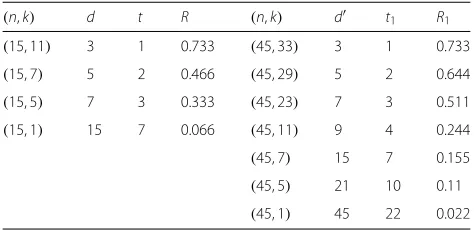
The BCH code with designed distance d=3has genera-tor polynomial gx2=m1
x2=x24+x2+1.It has a minimum distance of at least 3 and corrects up to 1 error. Since the generator polynomial is of degree 4, it is therefore a(15, 11)code having code rate R = 0.733.BCH codes of length 15 with different design distances are discussed in Table 1.
3 BCH codes as ideals inF2
x;abZ≥0
bn
In this section, we investigate the values of b for which there exists a BCH code of lengthbn inF2
x;abZ≥0
bn,
corresponding to a length n binary BCH code Cn in
F2
x;aZ≥0
n. For this, let Cn be a binary BCH code in F2
x;aZ≥0
n constructed in previous section. Now using the following map p(xa) = p0 + p1xa + . . .+
pn−1(xa)n−1→p0+p1
xab b
+. . .+pn−1
xab b(n−1)
=
p
xab
, we convert the s degree primitive polynomial
p(xa)inF
2
x;aZ≥0
to absdegree polynomialpxab
in
F2
x;abZ≥0
. This converted polynomial is never primi-tive; therefore, the corresponding BCH code will also be non-primitive. However, the non-primitive BCH code can be constructed only whenpxab
is irreducible. Hence, for the construction of a non-primitive BCH code in
F2
x;abZ≥0
bn, we choose only such a primitive irre-ducible polynomialp(xa)inF
2
x;aZ≥0
for which there
is an irreducible polynomialp
xab
inF2
x;abZ≥0
.
Table 1BCH codes of length 15
d (n,k) t R
3 (15, 11) 1 0.733
5 (15, 7) 2 0.466
7 (15, 5) 3 0.333
15 (15, 1) 7 0.066
Table 2Irreducible polynomialspxab
against primitive polynomialsp(xa)
deg pxa pxab
2 (xa)2+(xa)+1 xa3
6
+xa3
3
+1
3 (xa)3+(xa)+1 xa7
21
+xa7
7
+1
4 (xa)4+(xa)+1 xa3
12
+xa3
3
+1,xa5
20
+xa5
5
+1
6 (xa)6+(xa)+1 xa3
18
+xa3
3
+1,xa7
42
+xa7
7
+1
8 (xa)8+(xa)4+(xa)3 xa3
24
+xa3
12
+xa3
9
+xa3
6
+1, +(xa)2+1
xa5
40
+xa5
20
+xa5
15
+xa5
10
+1
9 (xa)9+(xa)4+1 xa7
63
+xa7
28
+1
10 (xa)10+(xa)3+1 xa3
30
+xa3
9
+1 .
. .
. . .
. . .
Particularly forb= 2 or 2l, there neither exists a prim-itive BCH code nor a non-primprim-itive BCH code, since we know thatpx2=(p(x))2inF2[x] , the same result holds
inF2
x;a2Z≥0
. Similarly, fors = 5, 7, 11, 13, 17,. . .and there multiples we do not find anybfor which we have an irreducible polynomial inF2
x;abZ≥0
.
For instance, see Table 2 for the list of irreducible polynomials of degree bs in F2
x;abZ≥0
correspond-ing to primitive irreducible polynomial of degree s in
F2x;aZ≥0.
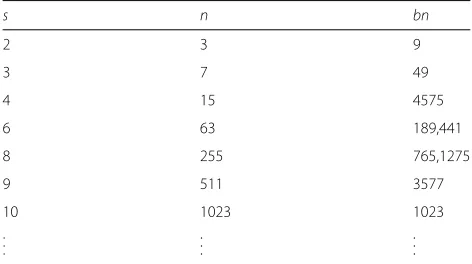
Table 2 explains that fors=2 and 3 we haveb=3 and 7 and fors=4 and 6 we haveb=(3, 5)and(3, 7), respec-tively, and similarly we have for their multiples. From this, we have the list of BCH codes of lengthnandbn, where
bndivides 2bs−1, mentioned in Table 3.
The above discussion can be summed up with the fol-lowing result.
Proposition 2.Let p(xa) ∈ F2
x;aZ≥0
be a primitive irreducible polynomial of degree s∈ {2l, 3l, 4l, 6l},where l ∈ Z+. Then the corresponding bs degree generalized
Table 3BCH codes of length n and bn w.r.t s
s n bn
2 3 9
3 7 49
4 15 4575
6 63 189,441
8 255 765,1275
9 511 3577
10 1023 1023
. . .
. . .
polynomial pxab ducible polynomial for b∈ {3, 7,{3, 5},{3, 7}}, respectively.
Proof. Let p(xa) = 1+ xa + . . . + (xa)s be a prim-itive irreducible polynomial in F2
x;aZ≥0
, where s ∈
{2l, 3l, 4l, 6l}, where l ∈ Z+ such thatα is its root and α2s−1 = 1. Then the corresponding generalized
polyno-mialp
element in F2bs and M is a positive integer such that
M(b(2s−1))=2bs−1. This impliesβb(2s−1)=1. Hence
p
xab
is not primitive. But,p
xab
is irreducible overF2
forb ∈ {3, 7,{3, 5},{3, 7}}, respectively by ([20], Theorem 5.1 and Example 5.4) where the indeterminatexab behaves
as indeterminatex.
Theorem 3.Let n = 2s−1be the length of primitive tive irreducible polynomial of degree s such that pxab
is irreducible polynomial of degree bs.
1) Then, for positive integersc,d,bnsuch that 2≤d≤bnand bn is relatively prime to 2, there exists a non-primitive binary BCH codeCbnof length
bn,where bn is order of an elementα∈F2bs. 2) The non-primitive BCH codeCbnof length bn is
defined as
Equivalently, Cbnis the null space of the matrix
H=
Proof. 1) Since it is given that thebs degree polynomialp
is not primitive, so the BCH code constructed through it is also not primitive. Hence the length of the coden=2bs−1.
of distinct polynomials amongmi BCH code of lengthbn overF2with designed
distanced. BCH code Cbnis an interleaved code of degree b, capable
of correcting a single error burst of length b or less (see [21], Theorem 11.1).
The following example illustrates the construction
of a non-primitive BCH code of length bn through
F2
1= 0.Using this relation, we can compute all the distinct powers ofαin GF(212),see Table 4 (it is clear thatαhas order 45). Here, we have bn = n = 3×15 = 45.To calculate the generating polynomial gx23
, we first
cal-culate the minimal polynomials which are : m1
Table 4Distinct powers ofαGF212
Which gives the following generating polynomials of BCH codes of length 45 with design distance d=3, 5, 7, 9, 15, 21
0.733, 0.644, 0.511, 0.244, 0.155, 0.11, 0.022, respectively. Where the code(45, 33) is also capable of correcting any single error burst of length 3 or less by Remark 4.
Table 5 gives comparison between minimum distance, code rate and error correction capability of codesC15,C45
inF2
Now, we are in position to develop a link between a primitive (n,n − r) binary BCH code Cn and a non-primitive (bn,bn − r) binary BCH code Cbn, where r
and r are, respectively, the degrees of their generating polynomialsg(xa)andg
xab
.
From Theorem 3(1), it follows that the generalized
polynomial gxab
. It follows that
isomorphism theorem for rings gives
F2x;abZ≥0/ non-primitive BCH and primitive BCH codes. Whereas the embeddingCn→Cbnis defined as:
Table 5Comparison of codes C15 and C45
The above discussion shapes the following.
Theorem 6.Let Cnbe a primitive binary BCH code of
length n =2s−1generated by r degree polynomial g(xa) in F2
x;aZ≥0
,then:
1) There exists a bn length binary non-primitive BCH codeCbngenerated by br degree polynomialg
xab
inF2
x;abZ≥0
;and
2) The binary primitive BCH codeCnis embedded in the binary non-primitive BCH codeCbn.
Also, we can deduceg(xa)fromgxab
by substituting
xaforyb.
Example 7. Following Examples 1 and 5:
The BCH codes with designed distance d = 3have gen-erator polynomials g(x2)=m1(x2)=1+(x2)+(x2)4and
g
x23
=1+
x23
3
+x23 12
with the same error correc-tion capability and code rate. The only difference is that the degree, data bits, code length, and check sum of the code C45is three times that of code C15.
Whereas, on lettingx23
= y in the generating polyno-mial of(45, 29)code, that is x2=y3,we get
g
x23
= x23
16
+x23
13
+x23
12
+x23
7
+x23
3
+x23
+1
g(y) = (y)16+(y)13+(y)12+(y)7+(y)3+(y)+1
gy3 = y316+y313+y312+y37+y33+y3+1
gx2 = x216+x213+x212+x27+x23+x2+1
= (x2)13+(x2)12+(x2)7+(x2)3+1∈F2
x; 2Z≥0
15.
Where the generating polynomial(x2)4+(x2)+1divides
(x2)13+(x2)12+(x2)7+(x2)3+1.Hence, the correspond-ing vector is in (15, 11). So(15, 11) code is embedded in
(45, 29)code.
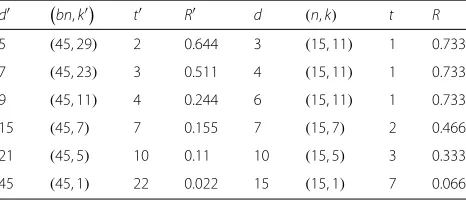
Similarly, in Table 6, we have shown that which code in F2x; 2Z≥015 with designed distance d is embedded in a code in F2
x;23Z≥0
45with designed distance d.
Table 6Embedding of codes C15 in C45
d bn,k t R d (n,k) t R
5 (45, 29) 2 0.644 3 (15, 11) 1 0.733
7 (45, 23) 3 0.511 4 (15, 11) 1 0.733
9 (45, 11) 4 0.244 6 (15, 11) 1 0.733
15 (45, 7) 7 0.155 7 (15, 7) 2 0.466
21 (45, 5) 10 0.11 10 (15, 5) 3 0.333
45 (45, 1) 22 0.022 15 (15, 1) 7 0.066
The corresponding code vectors of the generating polynomials
g(x2) = (x2)8+(x2)7+(x2)6+(x2)4+1and
g
x23
= x23 38
+x23 37
+x23 36
+x23 34
+x23 30
+x23 23
+x23 22
+x23 21
+x23 19
+x23 15
+x23 8
+x23 7
+x23 6
+x23 4
+1are
v = (100010111000000)
v = (100010111000000 100010111000000 100010111000000).
Clearly v is properly contained in v;in fact, it is repeated three times after a particular pattern. Hence, the generat-ing matrix Gof gx23
will contain the generating matrix
G of g(x2)such that G= ⊕31G.
The following lemma explains the relation between the minimal polynomials of the narrow sense BCH codesCn andCbn.
Lemma 8.Let d,dbe the design distances of the narrow sense BCH codes Cnand Cbn, respectively. Then the
expo-nents of the minimal polynomials mi(xa),i = 1, 3,. . .,
d −1 of the code Cn are equal to the exponents of the
following minimal polynomials mb
xab
,m3b
xab
,. . .,
mb(d−1)
xab
of the code Cbn with the same number of
non-zero terms. The remaining minimal polynomials of the code Cbnhave exponents three times the exponents of the
minimal polynomials mi(xa),i=1, 3,. . .,d−1of the code
Cnwith same number of non-zero terms.
Proof is straightforward and easily follows from Examples 1 and 2.
4 General decoding principle
As the binary BCH codeCn is embedded in the binary non-primitive BCH codeCbn, we only describe the decod-ing principal for the codeCbn. We use the decoding proce-dure which follows the same principle as of the primitive binary BCH code.
Takea ∈ F2bnas a received vector. We obtain the syn-drome matrix ofa,S(a)=aHT. In this way, we calculate a table of syndromes which is useful in determining the error vectoresuch thatSa = S(e). So, the decoding of received vectorahas done as the transmitted vector
v = a−e. We adopt the algebraic method for findinge
from the syndrome vectorSa.
Let Cbn be the binary non-primitive BCH code with lengthbn and designed distance d. LetH be the (d −
the syndrome of a vector a ∈ F2bn as S(a) = aHT.
code corrects up toterrors, where t =
We first obtain a solution for the error positions
i1,. . .,im. We define the error locator polynomial On multiplying this equation byeiαji, we get
f0eiαji+f1eiα(j+1)i+. . .fm−1eiα(j+m−1)i+eiα(j+m)i =0,
LetSdenote the coefficient matrix in the above linear system. It can be verified by direct computation thatS = VDVT, where
where V is a Vandermonde matrix. Since α is a
non-primitivebnth root of unity inF2bs andi1,. . .im are dis-tinct integers in{0,. . .,bn−1}, we haveαi1,. . .,αim are
all distinct. Hence, detV = 0. Further,ei1,. . .,eim are all
non-zero and hence detD= 0. Therefore, detS = 0 and linear system (2) have a unique solution.
We have assumed that the number of positions where an error has occurred ism ≤ t. If the actual number of error positions is less thanm, then for any choice of dis-tinct positionsi1,. . .im, the coefficientsei1,. . .,eimcannot
be all zero. So, detD= 0. Hence,mis the greatest posi-tive integer≤tsuch that system (2) has a unique solution. Therefore, we find the value ofmby taking successively
m = t,t−1,. . .in system (2) until we have a value for which system (2) has a unique solution, which gives us the error locator polynomial fxab
ing thus found the error vectore, we decode the received vectoraas the codewordv=a−e.
To compute the syndrome of a binary BCH code, we haveS2 = (S1)2,S6 = (S3)2and so on. We can compute
the syndrome more easily by using the division algorithm. Ifm(xab)is the minimal polynomial ofα, thenS1=a(α)
can be obtained by finding the remainder on dividing
a
The decoding of the code Cn from the decoding of the code Cbn can be obtained as; take x
The above discussion can be sumed up in the following steps.
Step I:For binary non-primitive BCH codeCbnwith designed distanced,leta
xab
be the received polynomial withm errors, wherem≤t2.
Step II:Compute the syndromes and find the value ofm,such that the system (2) has a unique solution.
Step III:Step II gives us the error locator polynomial
f
xab
.Now, find the roots off
xab
through which
we obtain the error polynomialexab
.
Step IV:We decode the received polynomialaxab
asvxab
=axab
−exab
.
Step V:The code vectorv inCncan be dragged out from the decoded code vectorvinCbnby putting
xab =yin corresponding code polynomialv
xab
. This givesv
xab
=v(y).Again by replacingy by
yb, we getv(y)=v(yb)=v(xa).
Step VI:Dividev(xa)by(xa)n−1, the remainder
v(xa)will be inF2[x;aZ≥0]n,and the generator polynomialg(xa)dividesv(xa).Then, its corresponding vectorv∈Cn.
Illustration
Let C45 be a (45, 29) binary non-primitive BCH code
with design distance d = 4. Assume that a
x23
=
1+
x23
+x23 3
+x23 7
+x23 11
+x23 12
+x23 13
+
x23
16
+x23 44
is the received polynomial. The error positionm =2 and the syndromes areS1= a(α)=α2, S2=(S1)2=α4,S3=a(α3)=α30andS4=(S2)2=α8.
The error locator polynomial is given byf
x23
= f0+
f1
x23
+x23 2
. Then, we have the following system of equations forf0andf1.
α2 α4
α4 α30 f0 f1
=
α30
α8
,
f0 f1
=
α30 α14 α
4 α14 α4 α14 α
2 α14
α30
α8
=
α10
α2
.
Hence, the error locator polynomial isf
x23
= α10+
α2x23+x232. Trying successively x = 1,α,α2,. . .,
we find that α11andα44 are the roots. Hence, the error polynomial ise(x23)=
x23
11
+(x23)44. Thus, we decode
a
x23
as v
x23
= a
x23
+ e
x23
= x23 16
+
x23
13
+x23 12
+x23 7
+x23 3
+x23
+1. Now, letting
x23 =y, this givesy3=x2, we get
v(y3) =y316+y313+y312+y37+y33+y3+1
vx2=x216+x213+x212+x27+x23+x2+1.
After dividingvx2byx215−1, we obtain the remain-derv(x2)as
v(x2)=(x2)13+(x2)12+(x2)7+(x2)3+(x2)+1∈C15,
whereC15is primitive binary BCH code(15, 11)and it is
due to the reason that the generator polynomialg(x2) =
(x2)4+(x2)+1 dividesv(x2).
5 Conclusions
These are the following pronouncements of the study.
1) The existence of a non-primitive BCH code in
F2
x;abZ0bnof lengthbn based on a primitive BCH code of lengthn has been explained.
2) The construction technique ofbn length
non-primitive BCH code is given in such a manner that the binary BCH codeCnis embedded in the binary BCH codeCbnand thus the the transmitted data configurated throughCncan be received through binary BCH codeCbn.
3) The binary BCH codeCbnhas higher code rate and error correction capability than binary BCH codeCn along with a burst error correction capability.
This work can further be extended over the Galois field
F2mand has applications in cognitive radio. Further, these
results can be generalized to data mining.
Competing interests
Non-financial academic competing interest. This manuscript would be part of the author’s P.h.D thesis.
Acknowledgements
The authors would like to thank the anonymous referees for their valuable comments and suggestions which improved the presentation of the paper.
Received: 11 August 2015 Accepted: 13 January 2016
References
1. E Prange,Cyclic error-correcting codes in two symbols. (Air force Cambridge research center, Cambridge, 1957). AFCRC-TN-57-103
2. E Prange,The use of coset equivalence in the analysis and decoding of group codes. (Air force Cambridge research center, Cambridge, 1959). AFCRC-TR-59-164
3. WW Peterson, Encoding and error-correction procedures for the Bose-Chaudhuri codes. IRE Trans. IT-6, 459–470 (1960)
4. T Kasami, Systematic codes using binary shift register sequences. J. Info. Processing Soc. Japan.1, 198–200 (1960)
5. J Cazaran, AV Kelarev, Generators and weights of polynomial codes. Archiv. Math.69(6), 479–486 (1997)
6. J Cazaran, AV Kelarev, On finite principal ideal rings. Acta Math. Univ. Comenianae.68(1), 77–84 (1999)
7. J Cazaran, AV Kelarev, SJ Quinn, D Vertigan D, An algorithm for computing the minimum distances of extensions of BCH codes embedded in semigroup rings. Semigroup Forum.73(3), 317–329 (2006) 8. AV Kelarev,Ring Constructions and Applications. (World Scientific, River
9. AV Kelarev, An algorithm for BCH codes extended with finite state automata. Fundamenta Informaticae.84(1), 51–60 (2008) 10. AV Kelarev, Algorithms for computing parameters of graph-based
extensions of BCH codes. J. Discret. Algorithm.5(6), 553–563 (2007) 11. AA Andrade, T Shah, A Khan, A note on linear codes over semigroup
rings. TEMA Tend. Mat. Apl. Comput.12(2), 79–89 (2011) 12. T Shah, AA Andrade, Cyclic codes through BX;abZ≥0
a
b ∈Q+,b=a+1
and Encoding. Discret. Math. Algoritm. Appl.4(4) (2012). doi:10.1142/S1793830912500590
13. T Shah, AA Andrade, Cyclic codes throughB[X] ,BX; 1
kp,Z≥0 and
BX;p1kZ≥0 : a comparison. J. Algebra Appl.11(4) (2012). doi:10.1142/S0219498812500788
14. T Shah, Amanullah, AA Andrade, A method for improving the code rate and error correction capability of a cyclic code. Comput. Appl. Math.
32(2), 261–274 (2013)
15. T Shah, Amanullah, AA Andrade, A decoding procedure which improves code rate and error corrections. JARAM.4(4), 37–50 (2012)
16. T Shah, A Khan, AA Andrade, Encoding through generalized polynomial codes. Comp. Appl. Math.30(2), 349–366 (2011)
17. T Shah, A Khan, AA Andrade, Constructions of codes through semigroup ringBX;1
22,Z≥0 and encoding. Comput. Math. Appl.62, 1645–1654 (2011)
18. T Shah, M Khan, AA Andrade, A decoding method of annlength binary BCH code through(n+1)nlength binary cyclic code. Anais da Academia Brasileira de Ciê,ncias.85(3), 863–872 (2013)
19. SR Nagpaul, Sk Jain,Topics in Applied Abstract Algebra(Thomson, Brooks/Cole, USA, 2005)
20. S Gao, D Panario,Tests and constructions of irreducible polynomials over finite fields, foundations of computational mathematics. (Foundations of Computational Mathematics, Cucker F, Shub M, eds.) (Springer, 1997), pp. 346–361
21. WW Peterson, EJ Weddon Jr.,Error correcting codes, 2nd edittion. (MIT Press, Cambridge, 1972)
Submit your manuscript to a
journal and benefi t from:
7Convenient online submission 7Rigorous peer review
7Immediate publication on acceptance 7Open access: articles freely available online 7High visibility within the fi eld
7Retaining the copyright to your article