R E S E A R C H
Open Access
Maximum a posteriori (MAP)-based tag
estimation method for dynamic
framed-slotted ALOHA (DFSA) in RFID systems
Jinchul Choi and Chaewoo Lee
*Abstract
Radio frequency identification (RFID) is a non-contact technology that uses radio frequency electromagnetic fields to transfer data from a tag attached to an object, for the purposes of automatic identification and tracking. One of the common problems that arise in any RFID deployment is the collision between tags which reduces the efficiency of the RFID system. Dynamic framed-slotted ALOHA (DFSA) is one of the most popular approaches to resolve the tag collision problem. In DFSA, each tag randomly selects one of the time slots of a frame and transmits its data at the slot. Unless the tag successfully transmits its data to a reader, it will try again in the next frame. It is widely known that the optimal performance of framed-slotted ALOHA is achieved when the frame size (i.e., number of time slots) is equal to the number of tags to be identified. So, a reader dynamically adjusts the next frame size according to the number of tags. Thus, it is important to accurately estimate the number of tags. In this article, we propose an accurate maximum a posteriori (MAP)-based tag estimation method with low computational complexity. The idea behind our method is to more accurately determine the most potential number of tags which draws the observed results on the basis of both a posteriori probability anda prioriprobability. Simulation results show that our method improves the accuracy of tag estimation and the speed of tag identification.
Introduction
Radio frequency identification (RFID) systems that iden-tify tagged objects via near/far-field wireless communica-tions to realize ubiquitous computing are drawing much attention. The operation of RFID systems often involves a situation in which numerous tags are simultaneously placed in the interrogation zone of a single reader. The tags may collide with each other, leading to retransmis-sion of tag data that brings about a waste of bandwidth and an increase in the total delay. To resolve the tag col-lision problem, a number of tag anti-colcol-lision algorithms have been proposed [1]. The primary concern in the algo-rithms is how to read multiple tags as fast and as reliably as possible.
Tag anti-collision algorithms are mainly grouped into tree-based [2] and ALOHA-based [3] algorithms. Tree-based algorithms work by repeatedly splitting the group of colliding tags into two disjoint subsets. The subsets
*Correspondence: [email protected]
Graduate School of Information and Communication, Ajou University, Suwon 443-749, South Korea
become smaller and smaller until the number of tags within a subset reduces to one, in which case the tag would be uniquely identified. However, as the number of tags increases, the performance of tree-based algorithms decreases. This is because the colliding tags are succes-sively grouped into two subsets, and each subset may still contain many tags resulting in collisions. The tree-based algorithms have been studied extensively in the literature [4-6].
ALOHA-based algorithms are mostly referred to as Framed-Slotted ALOHA (FSA) [7,8]. In FSA, time is divided into frames of multiple slots and the reader begins its interrogation round by announcing the frame size (i.e., the number of time slots) to the tags. Each tag selects one of the time slots at random and transmits its data at the slot. Unless the tag successfully transmits its data to the reader, it will try again in the next frame. According to [9], the expected throughputUof FSA withNtags andLslots in a frame is given by
U(N,L)= N
L
1− 1
L
L−1
. (1)
It is obvious from the above equation that the through-put depends on the appropriate choice of frame size
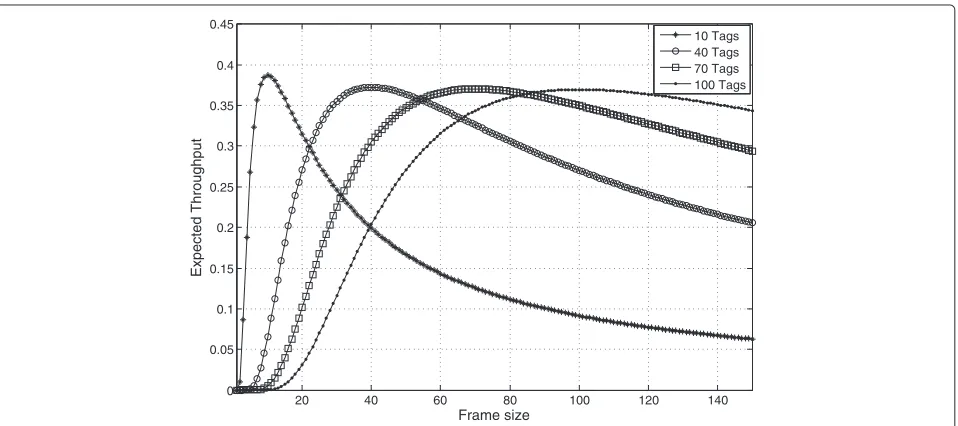
L, given the number of tags N in the interrogation range. Figure 1 shows the well-known upper bound of the throughput of e−1 that is characteristic for slotted ALOHA and also applies to FSA. The maximum through-put occurs when the frame size equals to the number of tags, i.e.,L = N. Thus, for high performance, it is desir-able that the frame size is dynamically adjusted according to the number of unread tags; the mechanism is referred to as Dynamic Framed-Slotted ALOHA (DFSA) [3]. How-ever, DFSA necessitates the reader accurately estimating the number of unread tags to decide an appropriate frame size. To deal with this, various methods to estimate the number of unread tags have been studied in the literature [9-20].
In this article, we propose an accurate and simple max-imum a posteriori (MAP)-based tag estimation method for DFSA in RFID systems. In the proposed scheme, we derive a probability mass function (PMF) that describes the relative probability of detection results occurring at a given number of tags and then, based on the derived PMF and the prior tag distribution (if it is postulated), determine the most potential number of tags which draws the detection results observed in a read cycle as the optimal estimate. However, this method may result in a heavy computational load due to the wide search range of tag quantity. To deal with this problem, we propose a simple iterative algorithm based on Newton’s method. In our simulations, comparison with several con-ventional tag estimates shows that the proposed itera-tive algorithm has lower computational complexity and less error.
The rest of the article is organized as follows. We ana-lyze several important tag estimation methods in the fol-lowing section. In Section “The proposed tag estimation mechanism”, we propose an MAP-based tag estimation with low computational complexity. Simulation results are shown in Section “Numerical results”. Finally, we give our concluding remarks in Section “Conclusion”.
Related study
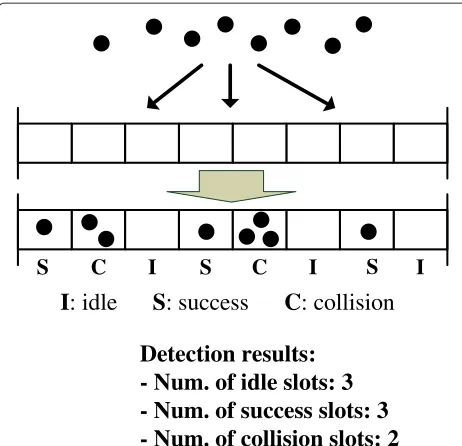
In DFSA, the reader begins its interrogation by first announcing the frame size to all tags within its radio range. Then, each tag randomly selects one of the available time slots and transmits its information at the selected slot. For a given time slot, only three possible outcomes can happen: idle channel, successful transmission, or col-lision, as shown in Figure 2. The channel is idle if no tag transmits its information at the time slot. A successful transmission means that only one tag sends its informa-tion. If two or more tags transmit at the same time slot, the reader suffers from collision and no tag can be read. Based on the detection results, the reader dynamically adjusts the frame size for next read cycle (frame). As mentioned in Introduction section, since the system throughput, which is defined as the ratio between success slots and the frame size, can be maximized when the frame size equals to the number of unread tags, a number of studies have focused on accurate tag estimation [9-20].
The lower bound method [10] is obtained through the observation that a collision involves at least two different tags. Suppose that after carrying out an FSA in which the frame size is set toF, the reader can observesiidle slots, sssuccess (or singly occupied) slots, andsccollision slots, wheresi+ss+sc = F. Then, the lower bound method
20 40 60 80 100 120 140
0 0.05 0.1 0.15 0.2 0.25 0.3 0.35 0.4 0.45
Frame size
Expected Throughput
10 Tags 40 Tags 70 Tags 100 Tags
I
S
Detection results:
- Num. of idle slots: 3
- Num. of success slots: 3
- Num. of collision slots: 2
C
I
S
C
I
S
I
: idle
S
: success
C
: collision
Figure 2An example of the detect results from an FSA when the frame size is set to 8.Tags are randomly allocated to slots within a frame (above). This result in some slots remaining empty and others contain one or more tags (below).
simply estimates the number of tags as 2sc. On the other hand, the Schoute method evaluates the expected num-ber of tags per collision slot as 2.39 on the basis of the results in [9]. The authors of [11,12] proposed tag esti-mation methods based on the Schoute method for RFID anti-collision using FSA. According to these studies, if the frame size is assumed to be the number of tags, the expected value of collision tags is 2.39sc. Although the lower bound and the Schoute methods are simple and easy to implement, their assumptions are difficult to confirm in practice. Thus, using the expected value to estimate tag quantity may cause significant error and increase read delay [13].
In [14], the authors proposed tag estimation methods on the basis of approximations to the binomial distribution. Considerntags are to be read and a frame ofFtime slots. For a given time slot, the number of tags allocated to the slot is binomially distributed withnBernoulli trials and 1/Foccupied probability. Thus, the probability of finding
rtags in the slot is given by
If the frame size F is sufficiently large, (2) can be approximated by a Poisson distribution with mean n/F.
Accordingly, the probabilities of idle, successful transmis-sion, and collision for the slot is given by
pi=B(0)=
Then, assuming the detection results observed in a read cycle is close to their expectations, the three binomial mean estimators, i.e., zero estimator (ZE), singleton esti-mator (SE), and collision estiesti-mator (CE), can respectively derive their tag estimatesnZE,nSE andnCE by solving the
In [15,16], the authors proposed the Lottery Frame (LoF) scheme to reduce the multiple-reading by multi-ple readers with overlapping interrogation regions. LOF adopts the ZE of [14] and dynamically adjusts the system load factor (the ratio of the tag quantity to the frame size) to eliminate the multiple-reading.
In [17], the authors derive the mean values of idle and success slots using a binomial distribution and combine them into a single equation for the number of tags. Solving both (4a) and (4a) for the number of tagsn, then the Chen method’s estimate denoted bynChenis given by
nChen=(F−1)
E[ss] E[si]
. (6)
an FSA. Though the Chen method and the three binomial estimators are simple, some cases (i.e., si = 0,ss = 0, sc=0) need special treatment and their accuracies are not satisfactory since the outcomes observed in a read cycle seldom correspond with their expectations [18].
The Vogt method [19,20] uses the distance between the detection result (si,ss,sc) and the expected value vector to estimate the number of tagsnfor which the distance becomes minimal using the exhaustive search. The Vogt method’s estimate denoted bynVogtis given by
nVogt=minn ⎛ ⎝EE[[ssis]]
E[sc] ⎞
⎠−
⎛ ⎝ssis
sc ⎞ ⎠
. (7)
The Vogt method improves the accuracy of tag esti-mation compared with the lower bound and the Chen methods. However, the Vogt method requires rather large computational load because it works with no information about the search space.
The Eom method [18] estimates the number of tags by properly determining the number of tags per collision slot. Assuming that the frame size is sufficiently large, it formu-lates the number of tags per collision slot as two types of equations, one of which consists of the observed detection results (see (8a)) and the other consists of the expected values (see (8b)). Then, it combines them into an iterative algorithm and regards the corresponding convergence as the number of tags per collision slot. The Eom method’s two iterative equations are as follows.
βk= F
γk−1·sc+ss
(8a)
γk= 1−e
−1
βk
βk−1
1−
1+β1 k
e−β1k
(8b)
where βk and γk denote the ratio of the frame size to the tag quantity and the number of tags per collision slot after thekth iteration, respectively. According to [18], the sequence in 8 tends to converge for a reasonable thresh-old. Then, the Eom method’s estimate denoted bynEomis given by
nEom =γk∗·sc+ss (9)
whereγk∗denote the limit value at thek∗th iteration (start-ing fromβ1= ∞,γ1=2). The Eom method gives a rather accurate estimate when the frame size is large. However, as the frame size decreases, its estimate error increases.
In general, a reader in an RFID system usually reads tags only once in a frame. In this context, Bayesian tag estimate which is available with few observation samples can be an appropriate approach. In [21], Rivest proposes a
Bayesian transmission strategy for an FSA broadcast sys-tem. Based on Rivest’s work, Floerkemeier also applies the Bayesian transmission strategy to a framed aloha RFID system in [22,23]. These works mainly concern about how to minimize the posterior expected value of a risk function (i.e., the posterior expected risk), such as using Bayesian rule to update the probability distribution of tag quantity and adjusting the frame size. However, the tag estimation method has not been discussed in these references.
On the other hand, in [24], using different risk (or loss) functions, the authors propose three Bayesian tag estimation methods: Bayesian mean-square, Bayesian absolute-error, and Bayesian posterior-probability estima-tion method. According to their simulaestima-tions, the accuracy of Bayesian posterior-probability estimate (BPE) is the best among their methods. BPE is the same form as the maximum likelihood estimation (MLE) in [13], thus their accuracies are identical. Although BPE and MLE have bet-ter estimate performance than other existing methods, there is substantial room for improvement in estimation accuracy because they are only grounded on a posterior probability.
In this article, we propose an accurate MAP-based tag estimation method with low computation complexity. The idea behind our method is to more accurately deter-mine the most potential number of tags which draws the observed results on the basis of both a posteriori proba-bility anda prioriprobability. Furthermore, we propose a simple iterative algorithm based on Newton’s method and reduce computational complexity.
The proposed tag estimation mechanism The MAP-based tag estimate
Consider an RFID system in which the tag anti-collision problem is avoided by the DFSA algorithm. Suppose there is a detection results= {si,ss,sc}observed in a read cycle, coming from a distribution with an unknown PMF f0 depending on the number of tags. It is however surmised that function f0 belongs to a certain family of distribu-tionsf(s|θ ),θ ∈, wheredenotes the domain of the distributable number of tags, so thatf0 = f(s|θ0). The valueθ0is unknown and is referred to as thetrue valueof parameterθ. We want to find an estimateθˆwhich would be as close to the true valueθ0as possible.
Now assume that a distribution g over θ exists. This allows us to treat θ as a random variable as in Bayesian statistics. Then, the posterior distribution ofθ is given by
f(θ|s)= f(s|θ )g(θ )
i∈
f(s|i)g(i) (10)
Our method estimates θ0 by finding a value ofθ that maximizesf (θ|s). Thus, the optimal estimate ofθ can be derived as the mode of the posterior distribution of this random variable:
The denominator of the posterior distribution does not depend onθ and therefore plays no role in the optimiza-tion. Consequently, (11) can be simplified as
θMAP=arg max
θ∈
f(s|θ )g(θ ). (12)
Now we will derive the PMF ofs occurring when the number of tags is given by θ, i.e., f(s|θ ). All the time slots in a read cycle only belong to one of three possible outcomes such as idle, success, or collision slot. Thus we can conclude that the three outcomes are mutually exclu-sive and collectively exhaustive (MECE). Then,f (s|θ ) is simplified by Bayes’ theorem and the property of MECE:
f(s|θ ) =Pr(si,ss,sc|θ )
Next we need to derive the conditional probability dis-tributions Pr(si|θ ) and Pr(ss|si,θ ). Pr(si|θ ) means the probability thatθ tags select their respective slots among
Fslots leaving exactlysi idle slots. Assuming thatθ = n, using (2) and (3) we have that θ tags select their respective slots among (F−si) slots with exactlyssslots being singly occupied. Since the
(F−si)slots belong to either success or collision slots, the probability that one of the slots is singly occupied is ps
ps+pc.
According to (12), using both a prior distributiong(θ ) and a posteriori distribution f(s|θ ), we can determine the best estimateθˆ which is the most potential number of tags. From a statistical point of view, the method of MAP estimation is considered to be more robust (with some exceptions) and yields estimates with good statis-tical properties [25]. Furthermore, the proposed MAP-based tag estimate is very suitable for estimation under few observation samples [26].
The MAP-based tag estimate requires empirical data about tag detection and a prior distribution over tag quan-tityθto obtain an optimal estimate. A prior distribution is often the purely subjective assessment of an experienced expert. Nevertheless, there are several ways to collect the prior. One reasonable approach is to make the prior a nor-mal distribution with expected value equal to the present tag quantity, with variance equal to the variance of the past several tag quantities. This approach has a property in common with many priors, namely, that the poste-rior from one problem (present tag quantity) becomes the prior for another problem (next tag quantity) [27]. Other approach is to choose a conjugate prior when they can, to make calculation of the posterior distribution easier. The details of how to collect a prior distribution are shown in [28].
search range. Consequently, our method needs to search |θMAP−θ| +2 times whereθ =ln(si/F) /ln(1−1/F).
On the other hand, if we need to use a uniform prior dis-tribution due to non-informative prior, we can reduce the complexity more. In next section, we propose an iterative algorithm to determine the estimate in less computa-tional complexity when informative prior is not given or a uniform prior distribution is used.
Iterative algorithm to reduce computational complexity LetSbe a vector of three random variables with a prob-ability distribution with the function f depending on a parameterx. Assuming that the prior distribution ofxis uniform, the function
L(x|s)=f(s|x)=Pr(S=s|x) (17)
considered as a function ofx, is called the likelihood func-tion (of x, given the outcome s of S) [25]. Let l(x) be a probability distribution with the likelihood function L depending on a parameterx. From (16) and (17), we have
l(x) = F! clude that all the tags were read. On the other hand, if both
si andss are zero, we can conclude that all the tags were collided with each other. As the number of tags increases, the chances of this happening grow higher. The estimate from our method must be the maximum number of tags that the RFID system can read. Thus we only consider a read cycle wheresc≥1 andsi+ss ≥1, hencex≥2 and F≥2.
Suppose{x∈R|2≤x≤N} whereN is the maximum number of tags that the RFID system can tolerate. It is obvious thatlis continuous on the interval becauseF=0. Thus the maximum value is undoubtedly one amongl(2),
l(N)or the extreme values ofl. Since the values ofl(2)and
l(N) can be simply obtained from (18), we focus on the extreme values.
Ifl(x), i.e.,∂∂xl(x), exists,lhas a local maximum or min-imum at some numbercin [ 2,N] whenl(c)=0 [30]. To find the first-order derivative oflit is easier to differenti-ate the logarithm of the function rather than the function itself, hence we first take the natural logarithm on both sides. Then, after implicit differentiation we have
l(x)=l(x)· ∂
∂xlnl(x). (19)
Forl(x)=0,∂∂xlnl(x)should be zero becausel(x) >0 for allx. Thus we will focus on the roots of ∂∂xlnl(x). It is not easy to obtain the roots using elementary algebra, so we apply a numerical approach in finding the roots of general polynomial equation. Let
h(x) = ∂
It is also obvious thath(x)is continuous on the inter-val. Thus, we can use Newton’s method which gives better approximations to the roots of a real-valued function [31]. As proved in the Appendix, h(x) has only a single root. Assume that there exists a rootq∈[ 2,N] whereh(q)=0. According to Newton’s method, ifh(q)=0, the sequence {qk}∞k=0defined by the iteration Nevertheless, it is desirable to choose one as close as pos-sible to the root to reduce the iteration times. To give a better initial estimate, we use the Chen method [17] mentioned in Section “Related study”. In addition, the real number of tags is at leastss+2sc. Thus, we set the initial
After determining an initial value forx0using (23), we start the iteration based on
xk+1=xk− h(xk) h(xk)
to update tag estimatexk until the difference betweenxk andxk−1is less than a thresholdTH, i.e.,
xk−xk−1 < TH. (25)
Letx∗ be the converged value ofxk. According to the proof in the Appendix,h(x)is strictly decreasing and has only a single root, i.e., x∗. Note that l(x) = l(x)h(x) and l(x) > 0 on the interval [ 2,N]. Since h(x) ≥ 0 wherex≤ x∗, we can conclude that functionl monoton-ically increases on the interval [2,x∗]. On the contrary, l
monotonically decreases on the interval [x∗,N] because
h(x) ≤ 0 wherex≥ x∗. Consequently,lattains the max-imum value atx∗. We determine, therefore, the estimate
ˆ
θ =[x∗] that maximizes the likelihood of detection results observed in a read cycle.
Computational complexity analysis
Among conventional tag estimates, the simpler ones are the lower bound method, the Schoute method, the three binomial mean estimators (i.e., ZE, SE, CE) and the Chen method. Their estimate can be simply obtained. On the other hand, to obtain the value of conditional probabil-ity Pr(θ|s) fromθ = ss+2scto θ = N, MLE needs to enumerate the conditional probabilityN −ss −2sc+1 times. Similarly, the Vogt method needs to searchN−ss− 2sc+1 times over the search tag range to find extremum. The Eom method uses an iterative algorithm and has less complexity than the Vogt method or MLE. However, a more detailed complexity analysis is likely intractable [18]. Unlike the methods above, by narrowing the search range of tag quantity, BPE reduces its computational complexity. According to [24], BPE needs to search |nBPE−n|+2 wherenBPEdenote the Bayesian tag estimate andn=ln(si/F) /ln(1−1/F).
When we need to use a uniform prior distribution, we can use a simple iterative algorithm based on Newton’s method. According to [32], using Newton’s method, the computational complexity of calculating a root of a func-tion a(x) with c-digit precision, provided that a good initial approximation is known, is OlogcF(c)where
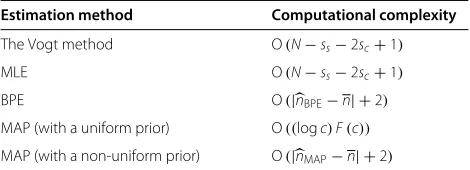
F(c)is the cost of calculatinga(x)/a(x)withc-digit pre-cision. On the other hand, when an informative prior distribution is postulated, the complexity of our method is similar to that of BPE. The computational complexity of the primary estimates is listed in Table 1.
Numerical results
Computer simulations are performed to check and extend the analytical results of the previous section. We consider a single reader and a number of tags under error-free channel environment. The prior distribution for tag quan-tity is assumed a normal distribution with meanμ and varianceσ2. We set the frame size and the tag quantity of
Table 1 Computational complexity
Estimation method Computational complexity
The Vogt method O(N−ss−2sc+1)
MLE O(N−ss−2sc+1)
BPE O(|nBPE−n| +2)
MAP (with a uniform prior) O((logc)F(c)) MAP (with a non-uniform prior) O(|nMAP−n| +2)
each read cycle to generate from the prior normal distri-bution and obtain detection resultSfrom the read cycle. Then, we perform the proposed tag estimation method. Finally, we obtain the average estimate after completing 1,000 cycles. In our method,THis set to 0.001.
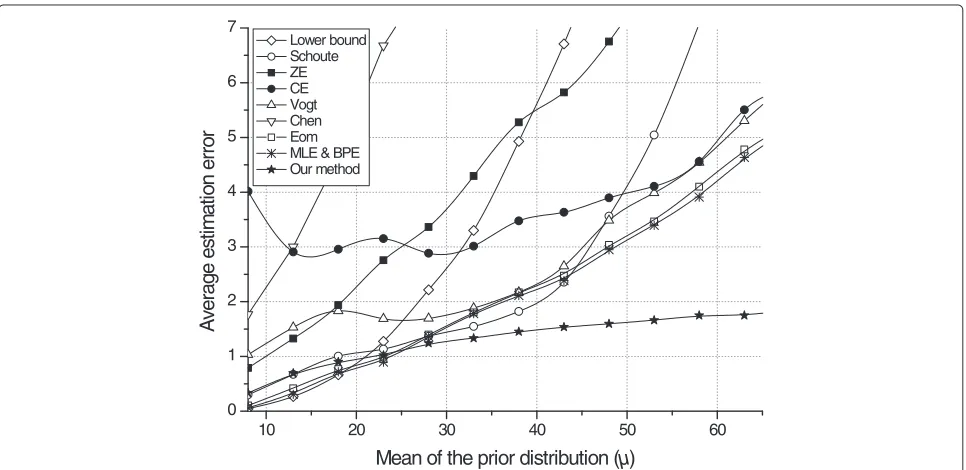
Figures 3 and 4 show the average estimation error which is defined as the average difference between the real num-ber and the estimated numnum-ber of tags. For the simulation, we set the frame size to 128 or 32 and vary the meanμ from 8 to 256 or from 2 to 64, respectively. The variance σ2is set to 0.05μor 0.1μ, respectively. Note that when a uniform prior distribution is considered, our method is actually MLE [13] and has the same results as MLE and BPE. Thus, we do not give the estimation results of our method which incorporates a uniform prior distribution in our simulations. In addition, the performance of SE [14] is insufficient and we do not give its results.
When the number of tags is considerably less than the frame size, Lower bound method is the most efficient among the methods. However, as the number of tags increases, its estimation errors increase steeply. Among the existing methods, BPE and MLE which have the similar curves to the Eom method show reasonable per-formance. On the other hand, the accuracies of other estimates such as ZE, CE, Chen, Schoute and Vogt meth-ods are not satisfactory. Figures 3 and 4 present that the proposed method provides more precise estimation than the other methods except the region in which the number of tags is comparatively less than the frame size.
50 100 150 200 250 0
2 4 6 8 10
Lower bound Schoute ZE CE Vogt Chen Eom MLE & BPE Our method
A
ver
age es
tim
at
ion er
ror
Mean of the prior distribution (µ)
Figure 3Difference between the real number and the estimated number of tags when the frame size is set to 128 whereσ2=0.05μ.
of our iterative algorithm is less than that of BPE. When a non-uniform prior distribution is postulated, the com-plexity of our method is a little bit high than that of BPE. Nevertheless, our method gives more accurate estimate than BPE and MLE as shown in Figures 3 and 4.
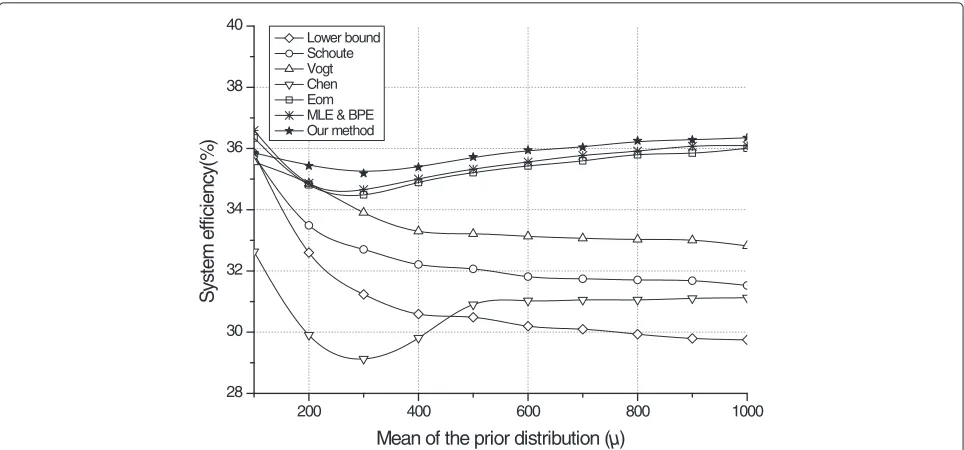
To evaluate the performance of DFSA in which each tag estimation method is employed, we measure the number of time slots used to detect all the tags when the next
frame size is set to the number of unread tags estimated by each method. In our method, the mean value for the next prior distribution is adjusted according to its cur-rent estimate. An initial frame size and the minimum size are respectively set to 64 and 8, and the mean μvaries from 100 to 1000. In Figure 6, we compare the RFID sys-tem efficiency, which is defined as the ratio of the number of success slots to the number of slots used to detect all
10 20 30 40 50 60
0 1 2 3 4 5 6 7
Lower bound Schoute ZE CE Vogt Chen Eom MLE & BPE Our method
A
ver
age est
im
a
tion er
ro
r
Mean of the prior distribution (µ)
50 100 150 200 250 0
5 10 15 20 25 30
C
o
m
put
at
ional
com
p
le
xi
ty
Mean of the prior distribution
BPE (F=32)
Our method (with a uniform prior, F=32) Our method (with a non-uniform prior, F=32) BPE (F=128)
Our method (with a uniform prior, F=128) Our method (with a non-uniform prior, F=128)
Figure 5Simulation results for estimate computational complexity whereσ2=0.1μ.
the tags. Figure 6 shows that our tag estimation method gives the highest system efficiency compared to the others. It also demonstrates that the performance of DFSA can be nearly improved to the maximum efficiency of Slotted ALOHA (about 36.8%) using our tag estimation method.
Conclusion
In this article, we have proposed an accurate MAP-based tag estimation method for DFSA in RFID systems and
improved the proposed method to reduce computational complexity. The proposed method can be used to obtain a point estimate of an unobserved tag quantity on the basis of empirical detection data and an informative prior. From our theoretical derivation and simulation results, we draw the conclusions as follows.
The proposed MAP-based tag estimation improves the accuracy of tag estimation and requires less time slots to read out all tags than the other existing methods. When
200 400 600 800 1000
28 30 32 34 36 38 40
Lower bound Schoute Vogt Chen Eom MLE & BPE Our method
S
yst
em
ef
fici
ency(
%
)
Mean of the prior distribution (µ)
an informative prior is not postulated or a uniform prior is used, our method can reduce computational complexity using the proposed iterative algorithm. Nevertheless, our method produces the same estimates as MLE and BPE. When the precise number of tags is not given, which is usual in practice, our method can achieve accurate esti-mation performance. Therefore, our method can become a suitable candidate for such a mechanism and can be use-ful for engineers to implement the DFSA algorithm in a real RFID system.
Appendix
Proof thath(x)has only a single root
The functionhis continuous on the closed interval [ 2,N]. According to the intermediate value theorem [30], if
h(2)h(N) < 0 and his a strictly monotonic function,h
has only a single root in the interval. To prove thathhas only a single root, we show thath(2) >0,h(N) <0, and
h(x) < 0. Note that we only consider a read cycle where
sc≥1,si+ss≥1, henceF≥2.
The proof consists of three steps. In the first step, we prove using contradiction thath(2) >0. Let
t=1− 1
F.
From (11), we have
h(2) =(si+ss)lnt+
We subtractss
2−sc(F−1)from each side of the
inequal-The right-hand side of (28) is at most one because ss
2sc(F−1) ≥0. If the left-hand side of (28) is larger than one, it can be concluded that inequality (28) is invalid. Now we show that the left-hand side of (28) is larger than one. Given anyF, the left-hand side of (28) is minimized when
sc = 1 because lnt < 0. Substituting sc with one, the
m(F)has following properties.
(i) m(2) >1. (ii) lim
F→∞m(F)=1becauseFlim→∞
1+F−11 F=e. (iii) Assumingm is a continuous function, we have
m(F)= −
ln1− 1F+F−11 . Sincem(F) <0 whereF≥2,m(F)is strictly decreasing. Since frame sizeF is finite in practice, taken the three properties together, we havem(F) >1. This contradicts the
can be approximated to zero. Thus, we have
lim is continuous on the interval. Thus we have
In the first step, we have proved that−Flnt > 1, thus we haveFlnt < −1. Sincetx−1 < 1,Flnt+tx−1is less than zero. It can, therefore, be concluded thatn(x) >0, i.e.,n(x)is strictly increasing. Next we show thatn(2)is positive at allF. Letx be two andF be the function n’s variable and allowed to vary freely. Letr(F)be a function that describes the value ofn(2)at varyingF. Then, we have
r(F)= {(F+1)lnt+2}lnt+ 1
Ft. (33)
r(F)has following properties.
(i) r(2) >0. (ii) lim
F→∞r(F)=0.
(iii) Assumingr is a continuous function, we have r(F)= F(F2−1)Flnt+1+lnt+21Ft. The Taken three properties together, it can be concluded that
r(F) > 0, i.e., n(2) > 0. Consequently, we have that
n(x) > 0. Therefore, we can conclude thath(x) < 0 on the interval [ 2, N].
From the preceding three steps, it can be concluded that
h(x) has only a single root in the interval [ 2, N] where
sc≥1 andsi+ss≥1.
Competing interests
The authors declare that they have no competing interests.
Acknowledgements
This research was supported by the Basic Science Research Program through the National Research Foundation of Korea (NRF) funded by the Ministry of Education, Science and Technology (2012R1A1A2007605).
Received: 5 March 2012 Accepted: 17 July 2012 Published: 23 August 2012
References
1. D Shih, P Sun, DC Yen, S Huang, Taxonomy and survey of RFID anti-collision protocols. Comput. Commun.29(11), 2150–2166 (2006) 2. DR Hush, C Wood, inProc. of IEEE Int. Symp. Information Theory. Analysis of
tree algorithm for RFID arbitration, (1998), pp. 107–107
3. S Lee, S Joo, C Lee, inProc. of Mobiquitous. An enhanced dynamic framed slotted aloha algorithm for RFID tag identification, (2005) pp. 98–113 4. C Law, K Lee, KY Siu, inProc. of Mobicom. Efficient memoryless protocol
for tag identification, (2000), pp. 75–84
5. M Nanjundaiah, V Chaudhary, inProc. of AINA. Improvement to the protocol specification for 900MHz class 0 radio frequency identification tag. vol. 2, 2005, pp. 616–620
6. J Myung, W Lee, J Srivastava, Adaptive binary splitting for efficient RFID tag anti-collision. IEEE Commun. Lett.10(3), 144–146 (2006)
7. EPCglobal Inc., Radio-frequency Identification Protocols Class-1 Generation-2 UHF RFID Protocol for Communications at 860MHz-960MHz Ver. 1.0.9 (2005). Available at http://www.epcglobalinc.org/
standards technology/specifications.html
8. ISO/IEC 18000-6, Parameters for Air Interface Communications at 860 MHz to 960 MHz Information Technology–Radio Frequency Identification for Item Management, ISO/IEC 18000-6, Part 6 (2004). Available at http:// www.iso.org/iso/home/store/catalogue tc/catalogue detail.htm? csnumber=46149
9. FC Schoute, Dynamic frame length ALOHA. IEEE Trans. Commun.31(4), 565–568 (1983)
10. Z Wang, D Liu, X Zhou, X Tan, J Wang, H Min, Anti-collision Scheme Analysis of RFID System. Auto-ID Labs White Paper (2007). Available at http://www.autoidlabs.org/single-view/dir/article/6/281/page.html 11. J Cha, J Kim, inProc. of ICPADS,Novel anti-collision algorithms for fast
object identification in RFID system. vol. 2, 2005, pp. 63–67
12. C Floerkemeier, inProc. of PerCom. Transmission control scheme for fast RFID object identification, (2006), pp. 457–462
13. W Chen, An accurate tag estimate method for improving the performance of an RFID anticollision algorithm based on dynamic frame length ALOHA. IEEE Trans. Autom. Sci. Eng.6(1), 9–15 (2009)
14. M Kodialam, T Nandagopal, inProc. of Mobicom. Fast and Reliable Estimation Schemes in RFID Systems, (2006) pp. 322–333 15. C Qian, H Ngan, Y Liu, inProc. of PERCOM. Cardinality estimation for
large-scale RFID systems, (2008), pp. 30–39
16. C Qian, H Ngan, Y Liu, L Ni, Cardinality estimation for large-scale RFID systems. IEEE Trans. Parallel Distrib. Syst.22(9), 1441–1454 (2011) 17. W Chen, G Lin, An efficient anti-collision method for tag identification in a
RFID system. IEICE Trans Commun.E89-B(12), 3389–3392 (2006) 18. J Eom, T Lee, Accurate tag estimation for dynamic framed-slotted ALOHA
in RFID systems. IEEE Commun. Lett.14(1), 60–62 (2010)
19. H Vogt, inProc. of ICSMSC. Multiple object identification with passive RFID tags. vol. 3, 2002, pp. 6–9
20. H Vogt, inProc. of ICPC. Efficient object identification with passive RFID tags, (2002), pp. 98–113
21. R Rivest, Network control by bayesian broadcast. IEEE Trans. Inf. Theory. 33(3), 323–328 (1987)
22. C Floerkemeier, inProc. of IEEE PerCom. Transmission control scheme for fast RFID object identification, (2006), pp. 1–6
23. C Floerkemeier, inProc. of IEEE RFID. Bayesian transmission strategy for framed ALOHA based RFID protocols, (2007), pp. 228–235
24. H Wu, Y Zeng, Bayesian tag estimate optimal frame length for anti-collision Aloha RFID system. IEEE Trans. Autom. Sci. Eng.7(4), 963–969 (2010)
25. JM Mendel,Lessons in Estimation Theory for Signal Processing, Communications, and Control. (Prentice Hall, New York, 1995)
26. JO Berger,Statistical Decision Theory and Bayesian Analysis. (Springer, New York, 1985)
27. J Berger, J Bernardo, D Sun, The formal definition of reference priors. Annal. Stat.37(2), 905–938 (2009)
29. E Jaynes,Probability Theory: The Logic of Science. (Cambridge University Press, Cambridge, MA, 2003)
30. HJ Keisler,Elementary Calculus: An Infinitesimal Approach, 2nd ed. (Prindle Weber & Schmidt, Boston, 1986)
31. P Deuflhard,Newton Methods for Nonlinear Problems: Affine Invariance and Adaptive Algorithms, 1st ed. (Springer Press, New York, 2004)
32. J Borwein, P Borwein,Pi and the AGM: A Study in Analytic Number Theory and Computational Complexity. (Wiley Interscience, 1987)
doi:10.1186/1687-1499-2012-268
Cite this article as:Choi and Lee:Maximum a posteriori (MAP)-based tag estimation method for dynamic framed-slotted ALOHA (DFSA) in RFID
systems.EURASIP Journal on Wireless Communications and Networking2012
2012:268.
Submit your manuscript to a
journal and benefi t from:
7 Convenient online submission
7 Rigorous peer review
7 Immediate publication on acceptance
7 Open access: articles freely available online
7 High visibility within the fi eld
7 Retaining the copyright to your article