Cite as: Can Urol Assoc J 2013;7(5-6):e281-6. http://dx.doi.org/10.5489/cuaj.1003 Published online May 13, 2013.
Abstract
Introduction: Laparoscopic partial nephrectomy (LPN) is frequently used to manage cT1a renal masses. While data on safety and long-term oncological outcomes of LPN for T1a tumours are widely available, it is limited for >T1a lesions. We report our experience with LPN for >4 cm renal masses from a Canadian tertiary centre. Methods: Between January 2003 and July 2011, 52 consecu-tive LPN for >4 cm renal masses were performed. Demographic, pathological and clinical data were obtained from a prospectively maintained database.
Results: The mean patient age was 60 years (62% male). Median tumour size was 4.8 (range: 4.2-11) cm. The median surgical time was 145 minutes, and the median estimated blood loss was 100 mL. The median warm ischemia time was 24 minutes. Four (7.7%) cases required conversion to open surgery. One case was converted to total nephrectomy for clinical and pathological evidence of T3 disease. The surgical margin was positive in 1 case (1.9%). Four (7.7%) patients developed a urine leak postoperatively; 3 of them managed with a ureteric stent. Four (7.7%) patients developed postoperative bleeding requiring selective angioembolization. The median hospital stay was 4 days. There was no statistically signifi-cant difference between preoperative and postoperative estimated glomerular filtration rate and mean arterial blood pressure (p = 0.5, p = 0.1, respectively).
Conclusion: This series demonstrates that LPN although technically challenging has acceptable short-term surgical outcomes. Long-term assessment of oncological outcomes is required. Laparoscopic partial nephrectomy >4 cm renal tumours should not be considered a standard of care, but excellent results can be achieved in well-selected patients and in experienced hands with no impact in renal function or blood pressure.
Background
Renal cell carcinoma (RCC) is the most common malignancy of the kidney and represents 2% to 3% of all adult
malig-nancies.1 The estimated number of new cases of kidney
cancer in Canada for 2012 was 5600.2 Surgical excision is
considered the standard treatment of organ-confined renal neoplasms. Historically, renal masses ≥4 cm were treated by radical nephrectomy. Partial nephrectomy (PN) is now considered the standard of care for the treatment of small renal masses (<4 cm in diameter) with similar oncological outcomes and better preservation of renal function when compared with radical nephrectomy.3-6 A growing body of
literature has shown excellent cancer-specific outcomes in patients with T1b (4.1-7.0 cm) renal masses managed with elective partial nephrectomy when compared with radical nephrectomy.7-10 Based on this, the American Urological
Association (AUA) has recommended partial nephrectomy for all T1 renal masses.10
Laparoscopic partial nephrectomy (LPN) is now fre-quently used to manage renal masses <4 cm in diameter. LPN and open partial nephrectomy (OPN) provide similarly excellent oncologic outcomes for localized RCC.11-14 Several
specific operative modifications developed to improve the laparoscopic techniques and the increased experience of laparoscopic surgeons during the last decade have resulted in a significantly reduced complication rate of LPN that is close to that of OPN.15-17 This technique has been shown
to have shorter operative times, less estimated blood loss (EBL), decreased analgesic usage, earlier discharge from hos-pital and shorter convalescence when compared with OPN. LPN data for >T1a lesions are limited. Gill and colleagues published their series about the intermediate oncological outcomes for LPN for pT1b-T3 tumours >4 cm. They found equivalent oncologic efficacy and superior renal functional outcomes compared with laparoscopic radical nephrectomy for the same group of patients.18 Lifshitz and colleagues
com-pared LPN for T1a and T1b tumours showing no difference in warm ischemia time (WIT) or EBL, but increased post-operative complications for larger tumours.19 A survey of 6
European centres showed that LPN for masses >4 cm is fea-sible in experienced hands; however, longer WIT and higher complication rates may be expected compared with OPN.20
Fahad A. Alyami, MD; Ricardo A. Rendon, MD, FRCSC
Department of Urology, Dalhousie University, Halifax, NS
We present our short- and mid-term surgical outcomes and the effect on renal functional and blood pressure for laparoscopic partial nephrectomy for >4 cm renal masses from a tertiary Canadian institution.
Methods
After obtaining approval from the local Research Ethics Boards, we identified 52 patients from a prospectively main-tained database of patients undergoing laparoscopic urologi-cal surgery. We retrospectively reviewed these 52 patients who underwent an elective LPN for >4 cm renal masses from January 2003 to July 2011 by a single surgeon in a ter-tiary Canadian centre. During the same period, 223 LPN for T1a renal masses, 233 laparoscopic radical nephrectomies and 63 laparoscopic nephroureterectomies were performed. All patients underwent preoperative imaging with contrast-enhanced computerized tomography (CT) and/or magnetic resonance imaging. Clinical variables including age, sex and symptoms at diagnosis were recorded. All images were re-reviewed and tumour characteristics were recorded, includ-ing maximum tumour diameter, tumour location (central or peripheral), R.E.N.A.L nephrometry score21 and tumour
consistency (solid or cystic). A central tumour was defined as one which touches or encroaches upon the renal col-lecting system and/or renal hilum; all other masses were defined as peripheral. Degree of endophytic component was recorded as the percentage of the tumour which was within the normal contour of the kidney. Tumours were defined as having a cystic component if there was a vis-ible area of fluid within the renal mass. The 2010 TNM clinical stage,22 preoperative and postoperative serum
cre-atinine and blood pressure, WIT, EBL, operative complica-tions (within 90 days), conversion rates to open surgery and or total nephrectomy and pathological data on the surgical specimen were collected. Preoperative blood pressures and serum creatinine were obtained in the preoperative assess-ment clinic 4 weeks before the procedure. Postoperative blood pressures and creatinine were performed 6 weeks from surgery. The Dindo Clavien Classification was used to classify the postoperative complications.23 Statistical analysis
was performed using the Student t-test for continuous vari-ables (preoperative and postoperative blood pressure and creatinine); p < 0.05 was considered statistically significant. The primary endpoint was midterm surgical outcomes of laparoscopic partial nephrectomy for >4 cm renal masses. The secondary endpoint was the effect of laparoscopic par-tial nephrectomy for >4 cm renal masses on the renal func-tion and blood pressure postoperatively.
Operative technique
Briefly, the patient is placed in the flank position at a 70° angle. The surgical table is extended at the level of the tenth rib. A 5- or 6-trocar transperitoneal approach is employed. A fifth trocar is used for the endo-satinsky clamp and a sixth trocar is used for liver retraction during some right-sided procedures. The kidney and renal hilum are dis-sected to allow for optimal exposure and mobilization. The mass is demarcated using electrocautery. A laparoscopic satinsky clamp (Aesculap Inc., Center Valley, PA) is then applied en-bloc to the renal vessels. The mass is then excised using sharp dissection. The renal defect is closed using a 0-Quill self-retaining suture (Quill SRS suture, Angiotech Pharmaceuticals, Vancouver, BC). An advantage to the barbed suture is that it does not require continuous trac-tion to maintain tension; also, the two needles allows for a more efficient repair of large renal defects. An initial bite in the centre of the defect is run continuously to both ends to achieve closure. The suture is definitively secured using two Hem-o-lock pledgets on each end while applying counter-traction. The Hem-o-lock pledgets are placed outside of the renal capsule. The hilar clamp is removed and the defect is monitored to ensure hemostasis. If necessary, bleeding vessels are controlled with a 2-0 vicryl suture stitched in a figure of eight fashion. A biologic hemostatic agent, FloSeal or TISSEEL (Baxter Corp., Deerfield, IL) may be applied to the renal defect. A 2-0 Vicryl interrupted suture is then placed over a Surgicel Nu-knit bolster (Ethicon, Inc., San Angelo, TX). Tension on the sutures is maintained using Hem-o-lock pledgets. In the case of collecting system violation, a water-tight closure with absorbable sutures is performed. No frozen sections are performed during the procedures.
Results
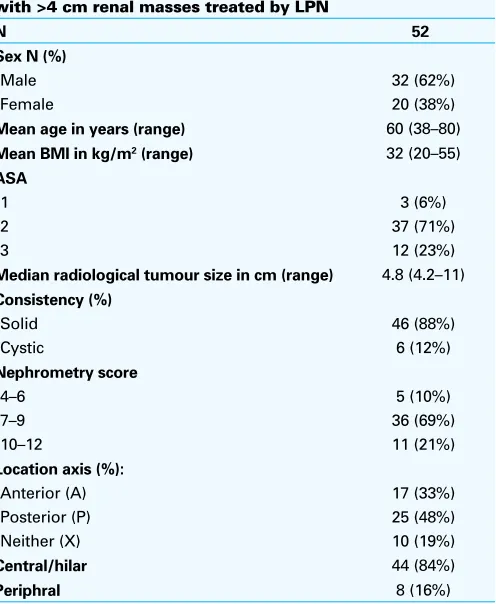
In total, 52 consecutive patients underwent LPN for >4 cm renal masses. We tallied their demographic and preoperative information (Table 1).
Operative findings
Intraoperative complications
One patient (1.9%) had a splenic injury and required con-version to open surgery and underwent a splenctomy. An elderly patient (1.9%) with known history of severe chronic obstructive pulmonary disease developed high CO2 absorp-tion identified intraoperatively which required conversion to OPN.
Postoperative complications
Seven patients (13%) developed renal bleeding identified by hematuria and or a drop in their hemoglobin (Hb) in the first 6 weeks postoperatively. Four (7.7%) of these patients required angioembolization after CT angiography showed active bleeding. Four patients (7.7%) developed a urine leak and 3 of them were managed with a double J stent. The fourth patient was managed conservatively. One patient (1.9%) developed a port site hernia. This was identified early and managed surgically. One patient (1.9%) had a postoperative ileus which resolved within 3 days from sur-gery (Table 3).
Pathological findings
The surgical margin was positive in 1 (1.9%) case. This finding was managed expectantly. Fat invasion was identi-fied in 2 (4%) cases and vascular invasion was identiidenti-fied in 1 (1.9%) case. The pathological stage was downstaged to pT1a in 6 patients (11%) and upstaged to pT3a in 2 (4%) patients (Table 4).
Preoperative and postoperative MAP and GFR
There was no statistically significant difference between pre-operative and postpre-operative mean arterial blood pressure (MAP) (92 vs. 90 mmHg, p = 0.1) and mean glomerular filtration rate (GFR) (78 vs. 74 mL/min/1.73 m2, p = 0.5)
respectively.
Discussion
Evidence of long-term morbidity and mortality associated with radical nephrectomy led to interest in nephron-spar-ing surgery for small renal masses.24 Partial nephrectomy
is now the standard of care for most T1 renal masses.10,11
While data on safety and long-term oncological outcomes of LPN for T1a renal masses is widely available, it is limited for larger lesions. LPN remains underutilized particularly in large, technically challenging and complex tumours. At our institution, the evolution of the surgical technique and growing experience with advanced laparoscopic procedures has allowed us to expand our selection criteria beyond the small, polar and mostly exophytic single renal masses. In this study we assess the feasibility of LPN in larger and more complex cases.
Simmons and colleagues compared outcomes for LPN (n = 35) vs. laparoscopic radical nephrectomy (n = 75) in T1b tumours (4.9 vs. 5.3 cm, p = 0.03, respectively). There were no differences in EBL, complication rates or positive surgical margins.18 Porpiglia and colleagues described LPN
for T1b masses in 63 patients. The median tumour size was 4.7 cm, requiring a mean WIT of 25.7 minutes. Intraoperative
Table 1. Demographic and preoperative data for patient with >4 cm renal masses treated by LPN
N 52
Sex N (%)
Male 32 (62%)
Female 20 (38%)
Mean age in years (range) 60 (38–80)
Mean BMI in kg/m2 (range) 32 (20–55)
ASA
1 3 (6%)
2 37 (71%)
3 12 (23%)
Median radiological tumour size in cm (range) 4.8 (4.2–11)
Consistency (%)
LPN: Laparoscopic partial nephrectomy; BMI: body mass index; ASA: American Society of Anesthesiologists.
Table 2. Operative data for patient with >4 cm renal masses treated by LPN
Intraoperative parameters
Median surgical time (min) 145 (92–253)
Median room time (min) 195 (135–340)
Median WIT (min) 24 (8–55)
Median EBL (mL) 100 (30–1800)
Median LOS (days) 4 (3–8)
Conversion to open PNx 4 (7.7%)
Conversion to total Nx 1 (1.9%)
hemorrhage was encountered in 7.3% of cases and postop-erative complications occurred in 14.6%.20 Lifshitz and
col-leagues compared T1a (n = 149) and T1b (n = 35) tumours undergoing LPN. They found no differences in operative time, WIT, EBL or intraoperative complications between T1a and T1b tumours. However, postoperative complica-tions were more common in the T1b group (26 vs. 12%, p = 0.001).19 In another series. Porpiglia and colleagues
compared outcomes for LPN for ≤4 cm (67 patients) vs. >4 cm (33 patients) tumours. More pelvicalyceal repairs and longer WIT were found for the >4-cm masses (WIT; 19 vs. 28 min). The complication rate was comparable between the two groups.25 These studies illustrate that LPN can be
safely performed for larger renal masses; however, deeper resection and more complex reconstruction may contribute to higher complications and longer WIT than that observed for smaller masses.
Warm ischemia times during LPN are usually significantly longer than during OPN. The median WIT in this series was 24 minutes (8-55 min). During the last 30 cases, the median WIT was 22 minutes and the maximum WIT was 32 minutes. This median WIT compares favourably with that reported in the literature.18-20 Several studies have reported that
pro-longed WIT may lead to some degree of renal function loss, but there is no consensus as to the maximum duration of renal WIT that would avoid a clinically significant decrease in renal function.26,27 Historic duration of safe WIT has been
thought to be 20 to 30 minutes. Our findings demonstrate that WIT decreases with experience and high volume.
Urologists have historically decided on treatment of renal masses based on their own experience and tumour location, size and hilar proximity. These factors have helped urologists integrate technically challenging laparoscopic procedures into their practices. These descriptions, however, suffer from a lack of standardization between surgeons. In response to these challenges, Kutikov and colleagues developed the RENAL nephrometry score to quantify anatomic character-istics of renal tumours and improve standardization.21 The
RENAL nephrometry score has been shown to be useful for
characterizing tumors and as a predictive tool for compli-cations, ischemia time, blood loss, and outcomes after par-tial nephrectomy. Briefly, the RENAL nephrometry score is based on Renal mass diameter, Endophyticity/exophyticity,
Nearness to the sinus/collecting system, Anterior/posterior
location, and Location relative to the polar line and hilar structures. We reported the RENAL nephrometry score for all the patients in our series. Most of our patients (90%) were classified into moderate and high complex accord-ing to the RENAL score. These findaccord-ings may explain the 7.7% rate of urine leaks and the 13% postoperative bleeding seen in this series. Central tumours more commonly pose a higher level of surgical complexity and have larger blood vessels encountered during resection, and often require pelvicaliceal repair. In the present series, 44 (84%) of the renal masses were central or hilar with different degrees of endophytic component. Frank and colleagues compared the outcomes of LPN in T1a renal masses in central (n = 154) and peripheral (n = 209) tumours.28 Central masses required
longer operative times (3.5 vs. 3.0 h, p = 0.008), WIT (33.5 vs. 30 min, p < 0.001), more often required pelvicaliceal repair (100 vs. 63.6%, p < 0.001), and experienced more early postoperative complications (6 vs. 2%, p = 0.05). For the last 25 cases, we used a fibrin sealant agent (Tisseel) in all patients whose collecting systems were entered. Since then we have not observe any urine leaks.
The rate of operative complications and conversion to open surgery is an important consideration for any mini-mally invasive surgery. In this series, 4 (7.7%) cases were converted to open partial nephrectomy. One case was con-verted to total nephrectomy for intraoperative evidence of extensive T3 disease. Seven (13%) of our patients developed
Table 3. Postoperative complications rate for patient with >4 cm renal masses treated by LPNmetastatic RCC
Complications N Dindo Clavien
classification grade
Port site hernia 1 (1.9%) Grade 3b=1
Ileus 1 (1.9%) Grade 1
Overall postoperative
complication rate 13 (25%) LPN: Laparoscopic partial nephrectomy.
postoperative bleeding identified by a drop in their hemo-globin (the RENAL nephrometry scores for them were 9p, 9p, 8p, 9p, 8x, 9a and 9x). Our protocol includes perform-ing CT angiography to assess for active bleedperform-ing if there is significant hematuria or a drop in hemoglobin. Four patients were managed with angioembolization, 2 managed with blood transfusion only and 1 managed conservatively. All 4 patients had bleeding postoperatively during the same admission. In Gill’s study of 58 patients with T1b masses treated with LPN, the complication and a conversion rate were 7% and 2%, respectively.29 The Cleveland Clinic group
reviewed 425 patients stratified into groups based on tumour size of <2, 2 to 4, and >4 cm who had LPN.29 Fifty-eight
patients had lesions >4 cm. Intraoperative complications occurred in 9%, 8% and 7% of patients in groups 1, 2 and 3, respectively. The conversion rates to OPN were 1%, 2% and 2% in groups 1, 2 and 3, respectively. The overall postoperative complication rates were 11%, 24%, and 24% in groups 1, 2, and 3, respectively (p = 0.03). In the pres-ent series, the overall complication rate was 25 % and this rate may be explained by our judicious reporting of all the complications using Dindo Clavien Classification.23 In the
Porpiglia and colleagues’ study, the incidence of positive surgical margins was 3.9% for the ≤4-cm group and no positive surgical margins in ≥4-cm group (p = 0.3).24 In the
current series, 1 (1.9%) patient had a positive margin. Only 6 patients (11%) were downstaged to pT1a and 2 patients (4%) upstaged to pT3a.
In this series there was no statistically significant difference between preoperative and postoperative GFR (78 vs. 74 mL/ min/1.73 m2,p = 0.5). This finding supports the theory that
LPN for renal tumours provides better preservation of renal function in comparison to LRN. Simmons and colleagues recently compared patients treated with LRN (n = 75) or LPN (n = 35) for T1b-T3 renal lesions.18 They found the
post-operative decrease in the eGFR was less in the LPN group than in the LRN group at 13 and 24 mL/min, respectively (p = 0.03). There was no statistically significant difference between preoperative and postoperative systolic and dia-stolic blood pressure also (92 vs. 90 mmHg, p = 0.1).
What is unique about our study is that we only includ-ed masses >4 cm in size as seen in preoperative imaging. Most series published to date, including patients with higher stage renal masses, are populated by a large number of patients who turned to be pT3a, but they were cT1a to start. Reporting the outcomes in these patients may be misleading as surgical decisions are based on clinical and not patho-logical staging. Additionally the masses in our patients were not only complex due to the size, but also due to a large component of central and hilar lesions (84%). In addition, 90% of the masses in this series were moderate and high complex according to the R.E.N.A.L nephrometry score.
Another advantage of this study is that the location of the renal masses and their complications were reported objec-tively using the most accepted reporting tools. The main limitation of our study is that data are from a single surgeon at single centre.
Conclusion
This series demonstrates that LPN, although technically challenging, has acceptable short-term surgical outcomes. Long-term assessment of oncological outcomes is required. Laparoscopic partial nephrectomy of >4 cm renal tumours cannot be considered a standard of care, but excellent results can be achieved in well-selected patients and in experienced hands with no impact in renal function or blood pressure.
Competing interests: None declared.
This paper has been peer-reviewed.
References
1. Lipworth L, Tarone RE, McLaughlin JK. The epidemiology of renal cell carcinoma. J Urol 2006;176:2353-8. http://dx.doi.org/10.1016/j.juro.2006.07.130
2. Canadian Cancer Statistics, National Cancer Institute of Canada, 2012.
3. Fergany AF, Hafez KS, Novick AC. Long-term results of nephronsparing surgery for localized renal cell carcinoma: 10-year followup. J Urol 2000;163:442-5. http://dx.doi.org/10.1016/S0022-5347(05)67896-2
4. Lesage K, Joniau S, Fransis K, et al. Comparison between open partial and radical nephrectomy for renal tumors: perioperative outcome and health-related quality of life. Eur Urol 2007;51:614-20. http:// dx.doi.org/10.1016/j.eururo.2006.10.040
5. Thompson RH, Boorjian SA, Lohse CM, et al. Radical nephrectomy for pT1a renalmasses may be associated with decreased overall survival compared with partial nephrectomy. J Urol 2008;179:468-71. http:// dx.doi.org/10.1016/j.juro.2007.09.077
6. Becker F, Siemer S, Hack M, et al. Excellent long-term cancer control with elective nephron-sparing surgery for selected renal cell carcinomas measuring more than 4 cm. Eur Urol 2006;49:1058-63. http://dx.doi. org/10.1016/j.eururo.2006.03.003
7. Mitchell RE, Gilbert SM, Murphy AM, et al. Partial nephrectomy and radical nephrectomy offer similar cancer outcomes in renal cortical tumors 4 cm or larger. Urology 2006;67:260-4. http://dx.doi.org/10.1016/j. urology.2005.08.057
8. Patard JJ, Shvarts O, Lam JS, et al. Safety and efficacy of partial nephrectomy for all T1 tumors based on an international multicenter experience. J Urol 2004;171:2181-5. http://dx.doi.org/10.1097/01. ju.0000124846.37299.5e
9. Leibovich BC, Blute ML, Cheville JC, et al. Nephron sparing surgery for appropriately selected renal cell carcinoma between 4 and 7 cm results in outcome similar to radical nephrectomy. J Urol 2004;171:1066-70. http://dx.doi.org/10.1097/01.ju.0000113274.40885.db
10. AUA Guideline for Management of the Clinical Stage 1 Renal Mass. American Urological Association Education and Research, Inc., 2009. http://www.auanet.org/content/media/renalmass09.pdf. Accessed April 24, 2013.
11. Lane BR, Gill IS. 5-Year outcomes of laparoscopic partial nephrectomy. J Urol 2007;177:70-4. http:// dx.doi.org/10.1016/j.juro.2006.08.093
12. Gill IS, Kavoussi LR, Lane BR, et al. Comparison of 1,800 laparoscopic and open partial nephrectomies for single renal tumors. J Urol 2007;178:41-6. http://dx.doi.org/10.1016/j.juro.2007.03.038 13. Permpongkosol S, Bagga HS, Kavoussi LR, et al. Laparoscopic versus open partial nephrectomy for the
14. Marszalek M, Meixl H, Polajnar M, et al. Laparoscopic and open partial nephrectomy: a matched-pair com-parison of 200 patients. Eur Urol 2009;55:1171-8. http://dx.doi.org/10.1016/j.eururo.2009.01.042 15. Nguyen MM, Gill IS. Halving ischemia time during laparoscopic partial nephrectomy. J Urol
2008;179:627-32; discussion 632. http://dx.doi.org/10.1016/j.juro.2007.09.086
16. Turna B, Frota R, Gill IS, et al. Risk factor analysis of postoperative complications in laparoscopic partial nephrectomy. J Urol 2008;179:1289-94; discussion 1294-5. http://dx.doi.org/10.1016/j. juro.2007.11.070
17. Simmons MN, Gill IS. Decreased complications of contemporary laparoscopic partial nephrectomy: use of a standardized reporting system. J Urol 2007;177:2067-73; discussion 2073. http://dx.doi. org/10.1016/j.juro.2007.01.129
18. Simmons MN, Weight CJ, Gill IS. Laparoscopic radical versus partial nephrectomy for tumors >4 cm: intermediate-term oncologic and functional outcomes. Urology 2009;73:1077-82. http://dx.doi. org/10.1016/j.urology.2008.11.059
19. Lifshitz DA, Shikanov SA, Deklaj T, et al. Laparoscopic partial nephrectomy for tumors larger than 4 cm: a comparative study. J Endourol 2010;24:49-55. http://dx.doi.org/10.1089/end.2009.0348 20. Porpiglia F, Fiori C, Piechaud T, et al. Laparoscopic partial nephrectomy for large renal masses: results of
a European survey. World J Urol 2010;28:525-9. http://dx.doi.org/10.1007/s00345-010-0518-6 21. Kutikov A, Uzzo RG. The R.E.N.A.L. nephrometry score: a comprehensive standardized system for
quan-titating renal tumor size, location and depth. J Urol 2009;182:844-53. http://dx.doi.org/10.1016/j. juro.2009.05.035
22. Kidney. In: Edge SB, Byrd DR, Compton CC, editors, et al: AJCC Cancer Staging Manual. 7th ed. New York, NY: Springer; 2010:479-89.
23. Dindo D, Demartines N, Clavien PA. Classification of surgical complications: a new proposal with evalua-tion in a cohort of 6336 patients and results of a survey. Ann Surg 2004;240:205-13. http://dx.doi. org/10.1097/01.sla.0000133083.54934.ae
24. Huang WC, Levey AS, Serio AM, et al . Chronic kidney disease after nephrectomy in patients with renal corti-cal tumours: a retrospective cohort study. Lancet Oncol 2006;7:735-40. http://dx.doi.org/10.1016/ S1470-2045(06)70803-8
25. Porpiglia F, Fiori C, Bertolo R, et al. Does tumour size really affect the safety of laparoscopic partial nephrectomy? BJU Int 2010;108:268-73. http://dx.doi.org/10.1111/j.1464-410X.2010.09788.x 26. Colombo JR Jr, Haber GP, Gill IS. Laparoscopic partial nephrectomy in patients with compromised renal
function. Urology 2008;71:1043-8. http://dx.doi.org/10.1016/j.urology.2007.11.022 27. Lane BR, Novick AC, Gill IS, et al. Comparison of laparoscopic and open partial nephrectomy for tumor in
a solitary kidney. J Urol 2008;179:847-51. http://dx.doi.org/10.1016/j.juro.2007.10.050 28. Frank I, Colombo JR, Rubinstein M, et al. Laparoscopic partial nephrectomy for centrally located renal
tumors. J Urol 2006;175:849-52. http://dx.doi.org/10.1016/S0022-5347(05)00346-0 29. Simmons MN, Chung BI, Gill IS. Perioperative efficacy of laparoscopic partial nephrectomy for tumors
larger than 4 cm. Eur Urol 2009;55:199-207. http://dx.doi.org/10.1016/j.eururo.2008.07.039