Objective: Todevelopment and validation of a reversed-phase high-performance liquid chromatography (RP-HPLC) for the determination of modafinil in bulk and pharmaceutical dosage forms.
Methods: A simple, precise, rapid, and accurate RP-HPLC method was developed for the estimation of modafinil in bulk and pharmaceutical dosage forms. Xterra RP 18 (250 mm × 4.6 mm, 5 µ particle size) with a mobile phase consisting of methanol:water 70:30 V/V was used. The flow rate 1.0 ml/min and the effluents were monitored at 260 nm. The retention time and recovery time was 12 minutes. The detector response was linear in the concentration of 10-50 µg/ml. The respective linear regression equation being Y=452.1x+65237. The limit of detection and limit of quantification were 4.547 and 1.377 mcg, respectively. The method was validated by determining its accuracy, precision, and system suitability.
Result: The objective of the present work is to develop simple, precise, and reliable HPLC method for the analysis of modafinil in bulk and
pharmaceutical dosage forms. This is achieved using the most commonly employed Xterra RP 18 (250 mm × 4.6 mm, 5 μ particle size) column
detection at 260 nm. The present method was validated according to ICH guidelines.
Conclusion: In this study, a simple, fast and reliable HPLC method was developed and validated for the determination of modafinil in pharmaceutical formulations.
Keywords: Modafinil, Reversed-phase high-performance liquid chromatography, Estimation, ICH guidelines, Tablets.
INTRODUCTION
Modafinil belongs to the class narcoleptics. The chemical name is 2-[(Diphenylmethyl)-sulfinyl] acetamide. This is a1-adrenergic agonist. Clinical evaluation in hypersomnia and narcolepsy. It is not official in any of the pharmacopoeia. It is listed in the Merck Index 13th edition [1] and Martindale the complete drug reference 36th edition [2]. Literature survey revealed estimation of modafinil by several techniques such as simultaneous estimation by high-performance liquid chromatography (HPLC) [3], determination of modafinil in human plasma by solid-phase and liquid-liquid extraction by HPLC [4-6] determination of modafinil in human urine by HPLC [7], determination of related substance in modafinil [8], and determination of modafinil by a chiral chromatography [9] methods have been reported. In this study, an attempt was made to develop rapid and economical spectrophotometric and reversed-phase HPLC (RP-HPLC) method for estimation of modafinil in bulk and pharmaceutical formulation with better sensitivity, precision, and accuracy using Xterra RP 18 column and UV-detector.
Structure [10]
Experimental
equipped with automatic injector with injection volume 20 µl, and 2693
pump. Xterra RP 18 (250 × 4.6 mm, 5 μ particle size was used. The HPLC
system was equipped with Empower Software.
Chemicals and solvents
Modafinil was provided as gift sample by Orchid Pharma Ltd., Alathur, India. The solvents which are used methanol and water of HPLC grade were purchased from Merck Specialities Pvt. Ltd., Mumbai, India. Commercial tablets of modafinil were purchased from local market. HPLC grade water obtained from Milli-Q water purification system was used throughout the study [7].
Selection of mobile phase
• Trail 1 - The method is carried out with the mobile phase acetonitrile
and water in the ratio of 70:30 at the 260 nm. In this method, broad peak is found
• Trail 2 - The method is carried out by the mobile phase acetonitrile
and water in a ratio of 50:50 at 260 nm. In this method, sharp and narrow peak is not came, so we change the mobile phase
• Trail 3 - The method was then carried out with the mobile phase
water and methanol in the ratio of about 90:10 at 260 nm. This method does not obey the HPLC parameters
• Trail 4 - The method was then carried out with the mobile phase
methanol and water in the ratio of about 70:30 at 260 nm. This method gives the sharp and narrow peak and it’s obey the HPLC parameters, so we select this mobile phase for HPLC.
Preparation of the mobile phase and diluents
vacuum pump and degassed by sonication to expel the dissolved gases in solvent system.
Preparation of system suitability solution (standard solution)
About 25 mg of modafinil standard powder was weighed and added into 25 ml volumetric flask and diluted with methanol to make the concentration 100 mcg/ml. 5 ml of this standard stock solution was pipette out and transferred into 50 ml volumetric flask and diluted with methanol to make the concentration 10 mcg/ml.
Preparation of sample solutions
About 20 tablets were accurately weighed, and the average weight was calculated. The tablets are grinded to a fine powder with the help of mortar and pestle. Then, the amount of powder equivalent to the average weight of a tablet was transferred to a volumetric flask, diluted with diluents, and shaken for about 10 minutes then filtered through filter paper. The filtered solution was further diluted in the mobile phase to make the final concentration of working sample equivalent to 10 mcg/ml.
Chromatographic condition
The samples were introduced by an injector with a 20-μl loop. The
analysis was performed under isocratic conditions using a flow rate 1 ml/min at ambient temperature. Chromatograms were recorded at
λ=260 nm using a detector PDA Shimadzu UV-VIS. METHODS
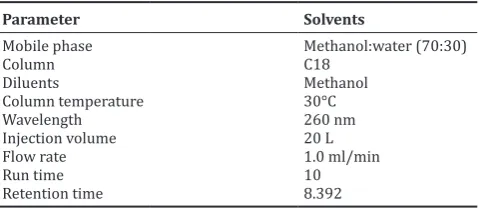
The HPLC system was stabilized for 30 minutes by passing mobile phase, detector was set at 260 nm, flow rate of 1.0 ml/min to get a stable baseline. One blank followed by six replicates of a single standard solution was injected to check the system suitability. Six replicates of each standard solution 10, 20, 30, 40, and 50 µg/mL were injected. Calibration graph was plotted by the concentration of modafinil on X-axis and peak area on Y-axis and linearity curve was shown in Fig. 2. The amount of drug present in the sample was computed by calibration graph. Chromatographic conditions for estimation of modafinil were described in Table 1.
RESULTS AND DISCUSSION
The objective of the present work is to develop simple, precise and reliable HPLC method for the analysis of modafinil in bulk and pharmaceutical dosage forms. This is achieved using the most
commonly employed Xterra RP 18 (250 mm × 4.6 mm, 5 μ particle size)
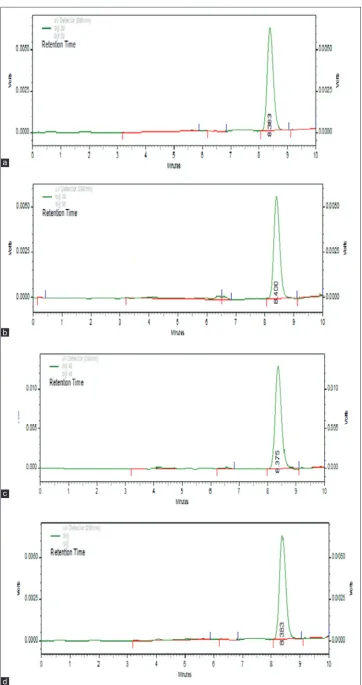
column detection at 260 nm. The representative chromatogram indicating modafinil is shown in Fig. 1.
Parameter fixation
In developing this method, a systemic study of effects of various parameters was conducted by varying one parameter at a time and controlling all other parameters. The following studies were conducted for this purpose.
Stationary phase characteristics
Based on nature and solubility characteristics of RP mode of HPLC was selected azithromycin for chromatography. Among different RP-HPLC
stationary phases tried Xterra RP 18 (250 × 4.6 mm, 5 μ particle size
was found to be optimum).
Mobile phase characteristics
To get sharp peak with baseline separation from interfering peaks carried out a number of experiments by varying the composition of solvents and mobile phase flow rate. To have an ideal separation of the drug under isocratic conditions, HPLC grade methanol and water were used in the ratio of 70:30 (v/v) was proved to be the most suitable of all the combinations since the chromatographic peak obtained was better defined and resolved and almost free from tailing.
Fig. 2: Linearity curve of modafinil Fig. 1: Typical chromatogram of modafinil
are presented in Table 3. Satisfactory recoveries ranging from 97.13%, 98.73%, 99%, 97.13%, and 97.53% were obtained by the proposed method. This indicates that the proposed method was accurate.
present in the formulation of modafinil in the determinations under optimum conditions were investigated. Chromatographic parameters maintained are specific for modafinil.
Limit of detection (LOD) and limit of quantification (LOQ)
The detection limit of the method was investigated by injecting standard solutions of modafinil into the HPLC column. By using the signal-to-noise method the peak-to-peak noise around the analyte retention time is measured, and subsequently, the concentration of the analyte that would yield a signal equal to certain value of noise to signal ratio is estimated. A signal-to-noise ratio (S/N) of 3 is generally accepted for estimating LOD and signal-to-noise ratio of 10 is used for estimating LOQ. This method is commonly applied to analytical methods that
Concentration Area
Table 3: Recovery analysis of Modafinil
Drug Sample no. Amount
present µg/ml Amount added µg/ml Amount found µg/ml Amount recovered µg/ml Recovered % SD RSD % SE
Modafinil 1. 15 15 29.57 14.57 97.13
2. 15 15 29.81 14.81 98.73
3. 15 15 29.85 14.85 99 0.89 0.91 0.40
4. 15 15 29.57 14.57 97.13
5. 15 15 29.63 14.63 97.53
SD: Standard deviation, RSD: Relative standard deviation, SE: Standard error
Drug Sample no. Amount present (µg/ml) Amount found (µg/ml) Percentage
obtained Average % SD RSD % SE
Modafinil 1. 30 29.57 98.56
2. 30 29.81 99.36 99.14 0.50 0.51 0.29
3. 30 29.85 99.5
SD: Standard deviation, RSD: Relative standard deviation, SE: Standard error
Drug Sample no. Amount present (µg/ml) Amount found (µg/ml) Percentage
obtained Mean % SD RSD % SE
Modafinil 1. 30 29.81 99.36
2. 30 29.63 98.76 98.89 0.41 0.42 0.24
3. 30 29.57 98.56
SD: Standard deviation, RSD: Relative standard deviation, SE: Standard error
Drug Sample no. Amount added (µg/ml) Amount present (µg/ml) Percentage
obtained Average % SD RSD % SE
Modafinil 1. 30 29.79 99.3
2. 30 29.40 98
3. 30 29.38 97.93 98.45 1.17 1.19 0.52
4. 30 30.01 100
5. 30 29.12 97.06
Table 2: Linearity results of modafinil
Table 4: Intra-day analysis of modafinil
Table 5: Interday analysis of modafinil
d c b a
CONCLUSION
In this study, a simple, fast and reliable HPLC method was developed and validated for the determination of modafinil in pharmaceutical formulations. As these proposed methods have the lowest LOQ values and the wider linear range is a more sensitive method. From the results obtained, we concluded that the suggested methods showed high sensitivity, accuracy, reproducibility, and specificity. Moreover, these methods were simple and inexpensive, and these can be employed for the routine quality control of modafinil in pharmaceutical formulations [11].
ACKNOWLEDGMENTS
The authors wish to thank Orchid Pharma Ltd., Alathur, India, for providing the gift sample of modafinil.
REFERENCES
1. Budavari S. The Merk Index. 13th ed. Whitehouse Station, NJ: Merk & Co., Inc.; 2001. p. 1112.
2. Sweetman SC, editor. Martindale, The Complete Drug Reference.
sulfone in human plasma utilizing liquid-liquid extraction and high-performance liquid chromatography. J Chromatogr B Analyt Technol Biomed Life Sci 2002;767(2):269-76.
7. Schwertner HA, Kong SB. Determination of modafinil in plasma and
urine by reversed phase high-performance liquid-chromatography. J Pharm Biomed Anal 2005;37(3):475-9.
8. Nageswara Rao R, Shinde DD, Kumar Talluri MV. Development and validation of a reversed phase liquid chromatographic method for
separation and determination of related-substances of modafinil in
bulk drugs. Talanta 2007;73(3):407-14.
9. Cass QB, Ferreira Galatti T. A method for determination of the
plasma levels of modafinil enantiomers, (+/-)-modafinic acid and modafinil sulphone by direct human plasma injection and
bidimensional achiral-chiral chromatography. J Pharm Biomed Anal 2008;46(5):937-44.
10. Available from: http://www.caymanchem.com.
11. Swetha K, Mohideen S, Satyanarayana T, Raju CH, Kumar PS,
Shyamala M. Determination and validation of modafinil in