P1
Short-term Morbidity Following Laparoscopic Radical Nephrectomy and Laparoscopic Nephroureterectomy: A Retrospective Study Using the NSQIP Database
Ravin J. Bastiampillai, Luke T. Lavallee, Kelsey Witiuk, Ranjeeta Mallick, Rodney H. Breau, Ilias Cagiannos.
University of Ottawa, Ottawa, ON, Canada.
Background: The purpose of this study is to characterize and compare short-term complications following laparoscopic radical nephrectomy (RN) and laparoscopic nephroureterectomy (NU). Although there have been studies looking at each of these procedures separately, very few have compared short term morbidity between the two, given their similar anatomical and technical considerations.
Methods: We conducted a historical cohort , looking at patients undergoing laparoscopic RN or laparoscopic NU from 2006-2012. Baseline information and short term 30-day postoperative data was collected from The National Surgical Quality Improvement Program (NSQIP) database by trained study nurses through medical record reviews and direct patient contacts (inter-rater accuracy was greater than 95%). The associations between patient and surgical factors with short term surgical outcomes were then verified by calculating relative risks and by using univariate and multivariable models. Results: During the study period, 4904 patients met the inclusion crite-ria. Of these patients, 4159 (85%) received a laparoscopic RN while 745 (15%) received a laparoscopic NU. Overall, 651 (13%) experienced at least one short-term postoperative complication; of these, laparoscopic NU was associated with more complications than laparoscopic RN (21% and 13%, respectively). The most common complications overall were: bleeding requiring blood transfusions in 318 (6.5%), urinary tract infections in 97 (2.0%), wound infections in 85 (1.7%), unplanned intubations in 56 (1.1%), and pneumonia in 45 (0.9%). After adjusting for possible confound-ers, increased patient age (RR 1.01, 95% CI 1.01-1.02), ASA classification >3 (RR 1.34, 95% CI 1.10-1.63), higher preoperative creatinine (RR 1.11, 95% CI 1.06-1.17), bleeding requiring >4 units of blood within 72 hours preoperatively (RR 1.93, 95% CI 1.29-2.86), operative time >6 hours (RR 2.17, 95% CI 1.71-2.75), and laparoscopic NU versus RN (RR 1.41, 95% CI 1.16-1.72) were each independently associated with having at least one postoperative complication.
Conclusions: Postoperative complications within 30 days are common after laparoscopic NU and laparoscopic RN. Despite having technical similari-ties, laparoscopic NU carries a significantly higher risk of developing short term complications than laparoscopic RN. Knowing baseline patient and surgical factors that predispose patients to complications, along with what these complications are, allows for clinicians to better counsel their patients on what to expect during the short term postoperative period.
P2
Cost-effectiveness of Extended Duration Venous Thromboembolism Prophylaxis in High-risk Urological Oncology Surgery
Janet Baack Kukreja¹, Helen R. Levey¹, Emelian Scosyrev², Maureen Kiernan¹, Claudia Berrondo¹, Jean Joseph¹, Ahmed Ghazi¹, Hani Rashid¹, Ann Dozier¹, Bruce Friedman¹, James G. Dolan¹, Edward M. Messing¹. ¹University of Rochester, Rochester, NY, USA, ²Novartis, East Hanover, NJ, USA.
Background: To determine the incremental cost-effectiveness of a clinical protocol for in hospital and extended duration prophylaxis (EDP) in patients
deemed to be high-risk for a venous thromboembolism (VTE) following major urologic oncology surgery compared with prophylaxis not according to clinical protocol and no EDP.
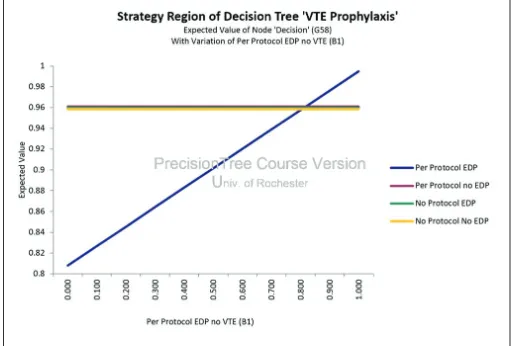
Methods: A decision-analytic model was developed to compare costs and outcomes associated with four different prophylaxis strategies using inpatient hospital costs associated with VTE events and outpatient phar-macoprophylaxis with low molecular weight heparin (LMWH) for 28 days after surgery if the risk of bleeding was low. This model replicated clinical outcomes from a cohort study of 309 patients done from June 2011 to March 2014 in which VTE incidence and complications within 365 days and hospital costs were used to complete the cost-effectiveness analysis from a health system perspective. Patients were grouped according to strat-egies: (1) per protocol in-hospital prophylaxis with EDP (N=88), (2) per protocol in-hospital prophylaxis without EDP (N=42), (3) not per protocol in-hospital prophylaxis with EDP (N=80), (4) not per protocol in-hospital prophylaxis without EDP (N=99) (Fig. 1).
Results: Strategy 1, per protocol prophylaxis and EDP, was the dominant strategy when the probability of preventing VTE with LMWH prophylaxis for 4 weeks is >90%. This was also the cheapest strategy, thus leading to cost savings.
Conclusions: Perioperative prophylaxis along with LMWH for 4 weeks post-operatively should be recommended in patients undergoing major urologic oncology surgerieswho are at high risk for developing VTE.
P3
Multispectral Photoacoustic Imaging of Renal Masses: Preliminary Ex-vivo Results
Lorraine M. Liang¹, Bhargava K. Chinni¹, Jerome J. Gilles¹, Guan Wu¹, Edward M. Messing¹, Navalgund A. Rao², Vikram S. Dogra¹.
¹University of Rochester, Rochester, NY, USA, ²Rochester Institute of Technology, Rochester, NY, USA.
Background: The detection of small renal masses has increased due to widespread abdominal imaging, but current imaging modalities
can-Moderated Poster Session 1: Oncology I
Thursday, November 13, 2014
3:15 – 5:00 p.m.
not differentiate between benign and malignant masses. Multispectral Photoacoustic Imaging (MPI) is a hybrid technology that combines pulsed laser and ultrasound sensor to create a contrast image that has been able to differentiate between malignant and benign tissues in breast, thyroid and prostate cancers.
This modality has shown differences in the optical absorption values of deoxyhemoglobin and oxyhemoglobin between malignant and benign tissue taken from human thyroid and prostate ex vivo.
The objective in this study is to validate if ex vivo MPI can differentiate between RCC and benign renal masses.
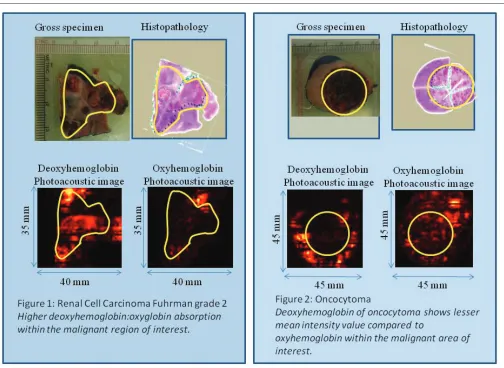
Methods: Patients scheduled to undergo partial or radical nephrectomy with suspicion for renal cell cancer were consented for our study. Immediately following nephrectomy, MPI was performed on excised kid-ney specimens. Chromophore photoacoustic images that represent opti-cal absorption of deoxyhemoglobin (760nm), oxyhemoglobin (850nm), lipid (930nm) and water (970nm) were obtained. RCC, oncocytoma and normal regions were marked by the pathologist on histopathology slides and digital images of marked histopathology slides were co-registered with chromophore photoacoustic images. Mean intensity values (MIV), corresponding to the optical absorption of each chromophore, were then determined for RCC, oncocytoma and normal tissue regions (Fig. 1). Results: We collected tissue from 14 patients. Of these, 9 specimens contained renal cell carcinoma (RCC), 3 contained oncocytoma and 2 specimens contained only normal renal parenchyma, although those
patients had RCC and AML in their overall specimens. Our preliminary results show that there is a difference in MIV of deoxyhemoglobin and oxyhemoglobin between RCC and oncocytoma. Sensitivity and specificity of our imaging system were found to be 78%, 100% respectively. Conclusions: Our preliminary results of ex vivo human kidney study sug-gest that MPI can differentiate between RCC and oncocytoma based upon higher deoxyemoglobin content in cancerous nodules. MPI is a hybrid noninvasive functional imaging modality that requires further exploration.
P4
Robotic-assisted Versus Open Radical Prostatectomy: A Matched Analysis of Positive Surgical Margins and Biochemical Recurrence Andres F. Correa, Elen Woldemichael, Stephen V. Jackman, Joel B. Nelson.
University of Pittsburgh, Pittsburgh, PA, USA.
Background: A positive surgical margin after radical prostatectomy for clinically localized disease is an independent predictor of disease recurrence. Studies comparing positive surgical margins and biochemi-cal recurrence between open radibiochemi-cal prostatectomy (ORP) and robot-assisted radical prostatectomy (RARP) have conflicting results. The com-mon criticism of these analyses is the inclusion of patients with different clinical characteristics between the groups, contemporary versus historic populations, a lack of standardized pathological review or definition of recurrence. In this study, the incidence of positive surgical margins and
biochemical recurrence was compared in a group in patients undergoing ORP or RARP during in the same time period by experienced surgeons at a single institution with uniform pathological review and definition of biochemical recurrence.
Methods: From January of 2009 to May of 2012, 301 patients who underwent RARP for clinically localized prostate cancer were matched based on preoperative PSA, clinical stage and highest biopsy Gleason grade with 602 patients undergoing ORP during that same time period. All margins were assessed by the same group of genitourinary patholo-gists. Biochemical recurrence was defined as PSA ≥ 0.2 ng/mL. Patients treated with neoadjuvant androgen deprivation therapy were excluded from the analysis.
Results: The postoperative pathological tumor characteristics were equiv-alent for both groups with regard to Gleason score, pathological stage and D’Amico risk category. The incidence of positive surgical margins was significantly higher for the RARP compared to ORP (31.9% vs 4.4%, P<0.001). When stratified by risk categories, positive margins rates were significantly higher in the RARP group vs. the ORP group: 26.3% vs. 2.6%, 30.4% vs. 4.1% and 54.3% vs. 10% for low, intermediate and high risk groups respectively (all p<0.001). Positive margins were signifi-cantly higher in the RARP group for all Gleason scores and pathologi-cal stages. Biochemipathologi-cal recurrence rates between ORP and RARP at 12 month minimum follow-up were 0% vs. 5.3% (p<0.001), 4.7% vs. 9.9% (p=0.0375), and 24.3% vs. 45.7% (p=0.0258) for low, intermediate and high risk categories.
Conclusions: In this matched analysis, positive margins were significantly higher in patients undergoing RARP as were biochemical recurrence rates. These findings were observed in all risk categories.
P5
Intermittent Androgen Deprivation (IAD) with the Gonadotrophin−releasing Hormone Antagonist Degarelix in Men With Biochemical Relapse of Prostate Cancer
E. David Crawford¹, Neal Shore², Thomas Keane³, Laurent Boccon-Gibod4,
Kurt Miller5, Anders Neijber6, Dennis Marshall7, Anne Falkenberg8.
¹University of Colorado, Aurora, CO, USA, ²Carolina Urologic Research Center, Myrtle Beach, SC, USA, ³Medical University of South Carolina, Charleston, SC, USA, 4CHU Hospital, Bichat-Claude Bernard, Paris,
France, 5Charité–Universitätsmedizin Berlin, Berlin, Germany, 6Ferring
Pharmaceuticals, Copenhagen, Denmark, 7Ferring Pharmaceuticals,
Parsippany−Troy Hills, NJ, USA, 8Ferring Pharmaceuticals, St Prex,
Switzerland.
Background: IAD may offer equivalent disease control to continual andro-gen deprivation (CAD) with a better quality of life and fewer side effects. We compare intermittent degarelix treatment to CAD in maintaining PSA suppression.
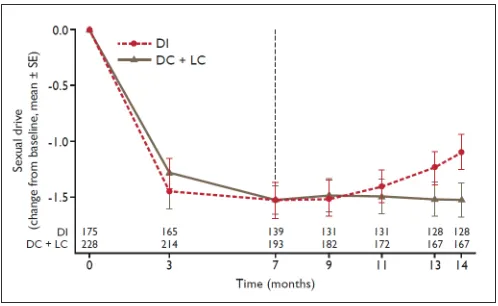
Methods: Eligible men (rising PSA levels after prior definitive therapy and testosterone >150ng/dL) were randomized to intermittent degarelix (DI; n=177), continuous degarelix (DC; n=50) or continuous leuprolide (LC; n=182). After 7 months of treatment, patients in the DI arm entered a 7 month off treatment period (degarelix restarted if PSA >2ng/mL). Men in the DC or LC arms continued on degarelix or leuprolide, respec-tively. Primary endpoint: proportion of patients with PSA ≤4.0ng/mL at 14 months.
Results: At month 14, PSA >4 ng/mL had occurred in 2.4%, 1.3% and 0% of patients in the DC, LC and DI arms, respectively. Non inferiority was established (lower CI limit 0.19%; limit 12.5%). 35 (26%) patients in the DI arm received additional degarelix doses during Months 7-14). In the DI arm, testosterone >50ng/dL occurred in 116 (85%) patients (median time 112 days; range 28-196 days). Men in the DI arm had significantly improved sexual drive vs CAD patients (Month 14; p=0.0271, Fig. 1). Adverse events were similar between the treatment arms.
Conclusions: Intermittent use of degarelix is non inferior to CAD in main-taining PSA suppression in a regimen of 7 months on- and 7 months off treatment.
P6
Gonadotrophin-releasing Hormone Antagonist (GnRH) Degarelix Versus Luteinising Hormone-releasing Hormone (LHRH) Agonists: Safety Outcomes From Pooled Patient Data From Multiple Clinical Trials
E. David Crawford¹, Neal Shore², Thomas Keane³, Laurent Boccon-Gibod, Kurt Miller5, Dennis Marshall6, Anne Falkenberg7.
¹University of Colorado, Aurora, CO, USA, ²Carolina Urologic Research Center, Myrtle Beach, SC, USA, ³Medical University of South Carolina, Charleston, SC, USA, 4CHU Hospital, Bichat-Claude Bernard,
Paris, France, 5Charité–Universitätsmedizin Berlin, Berlin, Germany, 6Ferring Pharmaceuticals, Parsippany−Troy Hills, NJ, USA, 7Ferring
Pharmaceuticals, St Prex, Switzerland.
Background: LHRH agonists and the GnRH antagonist, degarelix, are used to treat men with hormone-dependent advanced prostate cancer. Differences exist in disease control parameters between these agents; analysis of pooled data from phase III comparative trials allows further investigation of treatment outcomes.
Methods: Individual patient data were pooled from up to 6 prospective, comparative randomised trials (sponsored by Ferring Pharmaceuticals) of degarelix vs. LHRH agonists (n=2328). Events were analysed using Kaplan Meier plots, a log-rank test for homogeneity and the Cox proportional hazard model.
Results: Baseline characteristics including age and cardiovascular disease (CVD) history were balanced. 1491 patients received degarelix and 837 a LHRH agonist. Overall probability of a urinary tract event, musculo-skeletal event or joint related signs/symptoms was significantly lower in degarelix-treated patients (Table 1). In patients with CVD history, the risk of a subsequent CV event or death was significantly lower in degarelix patients. The number need to treat (NNT) was 12. Mortality was lower in the overall population and in men with CVD history when treated with degarelix (NNT = 28).
Conclusions: These analyses demonstrates that, during the first year of treatment, men treated with degarelix had a reduced risk of disease-related adverse events. There was also a lower risk of death, likely due to the higher incidence of CV events in LHRH agonist patients.
P7
Further Characterization of the Effects of Prior or No Prior Docetaxel Therapy on Castration-resistant Prostate Cancer (CRPC) Patients With Symptomatic Bone Metastases Receiving Radium-223 Dichloride in the Phase 3 ALSYMPCA Trial Christopher Pieczonka¹, Oliver Sartor², Nicholas Vogelzang³, Peter Hoskin4, Sten Nilsson5, Robert Coleman6, Christopher Parker7, Mona
Wahba8, Ingvild Haugen9, Neal Shore10.
¹Associated Medical Professionals of NY, PLLC, Syracuse, NY, USA, ²Tulane Cancer Center, New Orleans, LA, USA, ³Comprehensive Cancer Centers of Nevada, Las Vegas, NV, USA, 4Mount Vernon Hospital Cancer
Centre, Northwood, United Kingdom, 5Karolinska University Hospital,
Stockholm, Sweden, 6Weston Park Hospital, Sheffield, United Kingdom, 7The Royal Marsden NHS Foundation Trust and Institute of Cancer
Research, Sutton, United Kingdom, 8Bayer HealthCare, Whippany, NJ,
USA, 9Algeta ASA (Bayer), Oslo, Norway, 10Carolina Urologic Research
Center, Myrtle Beach, SC, USA.
Background: In ALSYMPCA, radium-223 dichloride (Ra-223), a first-in-class alpha-emitting pharmaceutical, significantly prolonged overall survival (OS) and time to first symptomatic skeletal event (SSE) versus placebo (pbo) in CRPC patients (pts) with symptomatic bone metastases (mets) (Parker, NEJM 2013). Among 921 randomized pts, 526 (57%) had prior docetaxel (D+) and 395 (43%) had no prior docetaxel (D-). Pt characteristics and Ra-223 safety from ALSYMPCA docetaxel subgroups are presented.
Methods: ALSYMPCA pts had progressive, symptomatic CRPC with ≥ 2 bone mets, had no known visceral mets, and had D+ or were unfit for docetaxel, declined docetaxel, or docetaxel was unavailable (D-). Pts were randomized 2:1 to 6 injections of Ra-223 (50 kBq/kg IV) q4wk or matching pbo. Baseline characteristics between subgroups were com-pared. OS and SSE data were analyzed using a log-rank test. A post hoc safety analysis of pts who received chemotherapy after Ra-223 or pbo was performed.
Results: Baseline characteristics were similar between subgroups. Median OS was significantly prolonged with Ra-223 versus pbo, regardless of docetaxel use (D+, HR = 0.70; D-, HR = 0.69). Ra-223 reduced risk of SSEs versus pbo, regardless of docetaxel use (D+, HR = 0.62; D-, HR = 0.74). Frequencies of grade 3 or 4 hematologic and nonhematologic adverse events (AEs) were low. Among Ra-223 pts, D- pts, versus D+ pts, had lower rates of grade 3 or 4 anemia (11% vs 14%), neutropenia (1% vs 3%), and thrombocytopenia (3% vs 9%) (Table 1). In a post hoc analysis of 147 pts who received chemotherapy after Ra-223 or pbo (of whom 66/93 Ra-223 and 39/54 pbo pts received docetaxel), grade 3 or 4 anemia and neutropenia were similar between Ra-223 and pbo pts; 3 Ra-223 pts had thrombocytopenia (Table 1).
Conclusions: Ra-223 significantly prolonged OS with a favorable safety profile in CRPC pts with symptomatic bone mets, regardless of docetaxel use. D+ pts had slightly higher rates of grade 3 or 4 hematologic AEs with Ra-223. The incidence of selected hematologic AEs remained low in pts receiving chemotherapy post Ra-223. Ra-223 is an option for pts with CRPC and symptomatic bone mets, regardless of prior docetaxel use.
P8
Contemporary Series Utilizing Minimally Invasive Techniques for Enucleation vs. Traditional Partial Nephrectomy
Michael Hanzly, Jr., Terrance Creighton, Hyung Kim, Thomas Schwaab. Roswell Park Cancer Institute, Buffalo, NY, USA.
Background: Consideration of the amount of surrounding parenchyma that should be removed during nephron sparing surgery (NSS) is neces-sary in order to obtain oncologic control of a kidney tumor. Enucleation, were the tumor is essentially “shelled out” of the surrounding parenchyma while maintaining the pseudo capsule, is utilized as a technique for NSS. However disease extension beyond the pseudo capsule oncologically compromises the procedure. Excision of renal tumors with a surrounding rim of normal parenchyma is another method, however, this removes precious nephrons in the process. Our knowledge as to which tech-nique is more beneficial from an oncologic standpoint has been debated among surgeons, but little is known about utilizing minimally invasive techniques. We hypothesized that traditional partial nephrectomy would provide better oncologic control than enucleation.
Methods: We queried our prospectively maintained kidney cancer data-base for all minimally invasive partial nephrectomies. We then subdivided the cohort into those patients who had enucleation versus traditional partial nephrectomy of their renal tumor. Traditional partial nephrectomy is defined as excision of the tumor with an additional margin of healthy peritumor renal parenchyma. Enucleation is defined as tumor excision without a visible rim of parenchymal tissue around the capsule. The demographics and operative characteristics of each cohort were com-pared and oncologic outcomes were analyzed including; margin status, disease free interval and disease free survival.
Results: Out of 1028 patients who underwent minimally invasive NSS, 265 met criteria where technique of tumor excision was clearly men-tioned. Simple enucleation was performed on 153 patients while 112 had traditional partial nephrectomy. Positive margin rate was signifi-cantly higher in patients who underwent enucleation verses those that had traditional partial nephrectomy (11% vs. 4%, p≤0.05). Median warm ischemia times were lower in the enucleation versus partial cohorts (15 vs. 18.5 minutes). Disease free interval for the enucleation cohort was 13.5 months, but was 37 months for the traditional partial nephrectomy cohort. One patient in the enucleation cohort and three patients in the traditional partial nephrectomy cohort developed disease recurrence at 13.1 months and 41months respectively.
Table 1. P6
Degarelix (n) LHRH agonist (n) HR 95% CI p value
Mortality (overall) 1263 657 0.47 0.25-0.90 0.023
Joint-related signs and
symptoms 1263 657 0.64 0.42-0.98 0.041
Urinary tract event 974 483 0.50 0.39-0.66 <0.001
Musculoskeletal event 974 483 0.55 0.40-0.76 <0.001
CV event or death (in men
with history of CV event) 463 245 0.44 0.26-0.74 0.002
Table 1. P7
No Docetaxel Prior to Enrollment Chemotherapy Post-study Drug Treatment No. (%) Pts With Hematologic
Grade 3/4 AEs*
Ra-223 n = 253
Pbo n = 130
Ra-223 n = 347
Pbo n = 171
Ra-223 n = 93
Pbo n = 54
Anemia 27 (11) 15 (12) 50 (14) 24 (14) 7 (8) 5 (9)
Neutropenia 2 (1) 1 (1) 11 (3) 1 (1) 1 (1) 1 (2)
Thrombocytopenia 7 (3) 1 (1) 31 (9) 5 (3) 3 (3) 0
Conclusions: We found that patients undergoing simple enucleation had a higher positive margin rate yet shorter warm ischemia time when com-pared to those undergoing traditional partial nephrectomy. Preservation of functional renal parenchyma while maintaining oncologic principles is an ongoing challenge as we advance in MIS NSS.
P9
Management of Clinically Localized Stage T1 Renal Tumors in a Multicenter Canadian Cohort
Luke T. Lavallee¹, Simon Tanguay², Michael A. Jewett³, Antonio Finelli³, Lori Wood4, Ilias Cagiannos¹, Christopher Morash¹, Anil Kapoor5, Ricardo
A. Rendon4, Ronald B. Moore6, Louis Lacombe7, Jun Kawakami8, Stephen
E. Pautler9, Darrel E. Drachenberg10, Peter C. Black11, Zhihui Liu², Rodney
H. Breau¹.
¹The University of Ottawa, Ottawa, ON, Canada, ²McGill University, Montreal, QC, Canada, ³University of Toronto, Toronto, ON, Canada,
4Dalhousie University, Halifax, NS, Canada, 5McMaster University,
Hamilton, ON, Canada, 6University of Alberta, Edmonton, AB, Canada, 7Universite de Laval, Quebec, QC, Canada, 8University of Calgary,
Calgary, AB, Canada, 9University of Western Ontario, London, ON,
Canada, 10University of Manitoba, Winnipeg, MB, Canada, 11University
of British Columbia, Vancouver, BC, Canada.
Background: The objective of this study is to determine the practice pat-terns of Canadian physicians using a nationwide, multicenter database of patients treated for renal tumors.
Methods: The Canadian Kidney Cancer Information System (CKCis) was queried retrospectively to determine the use of; active surveillance, focal ablation, nephron sparing surgery and minimally invasive surgi-cal techniques for managing cT1 renal tumors. Descriptive statistics were performed to characterize practice patterns. Associations between patient, tumor, and hospital factors with management approaches were determined.
Results: From 1988 to 2013, 1464 patients were treated for cT1 renal tumors at 13 participating centers and had data entered in the CKCis database. Median follow up time was 1.95 years. Median patient age was 62.4 years and 918 (63%) patients were male. Most patients (1055; 72%) were surgically treated, and the majority of those (718; 68%) received partial nephrectomy. Among the 934 (64%) patients with T1a tumors, 514 (80%) received partial nephrectomy, compared to 147 (44%) of T1b
patients. Among partial nephrectomies performed, a minimally invasive approach was used in 264 (51%) T1a tumors, compared to 34 (23%) T1b tumors. A minority of patients received radiofrequency ablation (45; 3.1%), cryoablation (6; 0.4%), and active surveillance (95; 6.5%). Unadjusted and adjusted analyses indicate a lower relative risk of partial nephrectomy performed for clinical T1 tumors; using minimally invasive vs. open surgical approach (RR 0.63 95% CI 0.58-0.69), in the presence of eGFR<30 (RR 0.40 95%CI 0.20-0.83), and for stage T1b vs. T1a tumors (RR 0.56 95%CI 0.50-0.64) (adjusted results shown). The presence of hypertension (RR 0.99 95%CI 0.90-1.08), diabetes (1.03 95%CI 0.91-1.17), and cardiac disease (RR 1.02 95%CI 0.90-1.15) did not appear to influence the relative risk of partial nephrectomy in clinical T1 tumors. Conclusions: A high proportion of patients with cT1 renal tumors receive nephron sparing surgery via minimally invasive techniques at Canadian academic centers.
P10
Evaluation of Kidney Cancer Tumor Margins using Molecular Chemical Imaging
Patrick J. Treado¹, Shona Stewart¹, Serena Augustine¹, Heather Kirschner¹, Jeffrey Cohen², Amonu Opong².
¹ChemImage Corporation, Pittsburgh, PA, USA, ²Allegheny General Hospital, Pittsburgh, PA, USA
Background: Cancer accounts for one in every eight deaths worldwide. One of the reasons cancer is seldom managed effectively is recurrence of disease, often resulting from incomplete excision of a tumor during the initial surgery. At present, histological evaluation is performed in order to identify tumor margins. Because this occurs post-surgery, approximately one in four patients who undergo tumor resection surgery will require re-operation in order to excise the malignant tissue completely. We are developing a tool to provide diagnostic information to surgeons in real-time and without the use of reagents. Molecular Chemical Imaging (MCI) combines molecular spectroscopy and digital imaging for non-invasive, reagentless evaluation of anatomical structures and tumor margins in human tissues.
Methods: We collected molecular images in the visible and near infra-red (Vis/NIR) spectral regions from partial and whole kidneys obtained from patients who had undergone surgical resection (N = 13). Spectra were extracted from regions of tumor and non-tumor, and a Partial Least
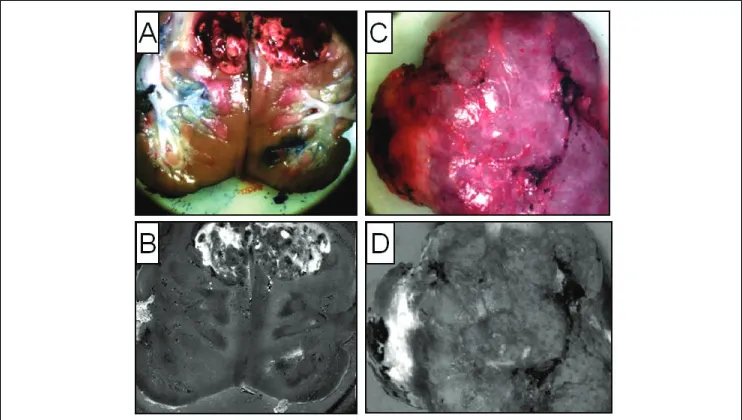
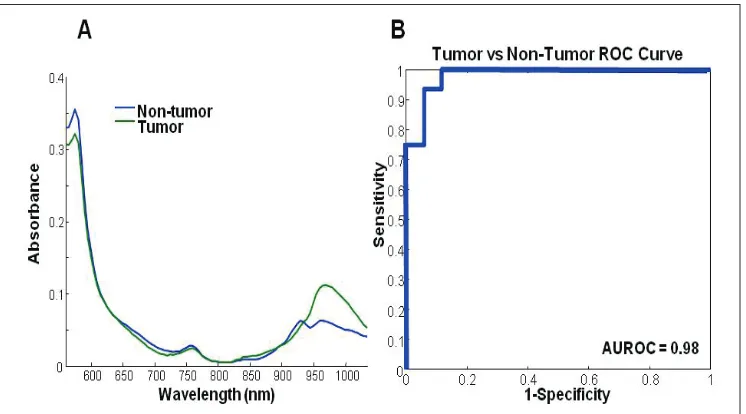
Squares Discriminant Analysis (PLS-DA) algorithm was employed to gen-erate score images indicating regions of tumor and non-tumor. Results: Representative results are depicted in Figures 1 and 2. Fig. 1A shows a color image of a dissected, explanted kidney with a tumor. Fig. 1B is the corresponding Vis/NIR MCI score image, where bright features in the image represent a higher probability of cancer. Similarly, Fig. 1C shows a color image of an intact kidney with a tumor in the left, central portion. The corresponding score image (Fig. 1D) shows the location of tumor.
The average spectra for tumor and non-tumor (Fig. 2A), show significant differences between 900 and 1035 nm. The effectiveness of PLS-DA to distinguish between kidney tumor and non-tumor is illustrated in a receiver operator characteristic curve (Fig. 2B) to be 94% sensitivity and 94% specificity.
Conclusions: Initial findings demonstrate that MCI differentiates, with high performance, tumor from normal tissue in explanted kid-neys. Development of an MCI-based tool for detecting tumor margins intraoperatively will directly impact and improve patient health by ensur-ing complete excision of a cancer durensur-ing initial surgery, thus limitensur-ing the need for resurgery and reducing the chance of tumor recurrence.
P11
Variations in the Treatment of Advanced Prostate Cancer (APCa) With Androgen Deprivation Therapy (ADT) Across Large Urology Group Practices
Evan R. Goldfischer¹, Raymond S. Lance², Lisa Berge³, Jennifer Pappadakis³, Kathy Spiegel³.
¹Premier Medical Group, Poughkeepsie, NY, USA, ²Urology of Virginia, Virginia Beach, VA, USA, ³Actavis, Parsippany, NJ, USA.
Background: Androgen deprivation therapy (ADT) with LHRH agonists is widely utilized for the treatment of advanced prostate cancer (APCa). Recommendations for LHRH agonists includes measurement of serum testosterone levels in men on ADT experiencing rising serum PSA levels to ensure progression is not due to inadequate androgen suppression and presumed castrate resistant prostate cancer, while imaging studies can identify the site of disease recurrence. Guidelines are not specific as to the frequency of serum and imaging testing while on ADT. The objective
of this study was to elucidate the variations in monitoring patients on ADT amongst providers in large urology group practices.
Methods: A retrospective analysis of 407 patients with APCa who ini-tiated continuous LHRH monotherapy during from January 2006-July 2011 was conducted amongst nine large urology group practices in the United States.
Results: The mean age at diagnosis was 73.2 years with a mean PSA of 48.2ng/dL. The average duration of ADT was 26.6 months. Gleason Score was 3+3 (26%), 3+4 (20.3%), 4+3 (14.2%), and 8-10 (32.9%) in patients. 51.0 % and 18.3% of testosterone levels were >20ng/mL and >50ng/mL, respectively. Imaging for metastatic disease (CT scan, MRI, bone scan) was performed on 26.2 % of patients. Timing of imaging studies did not correlate with PSA levels or PSA doubling time. On average, 39.3% received vitamin D and 38.6% received calcium.
Conclusions: The current study identified dramatic variations in treatment patterns among large urology practices in managing APCa on ADT. In general, recommendations for testosterone measurements were not being followed. In patients where testosterone was measured, a relatively high percentage had levels above castrate levels. An opportunity exists to improve managing bone health by co-administration of Vitamin D and calcium.
Fig. 2. P10.
Table 1. P11. Frequency of Measurements in Patients Receiving ADT
Testosterone Measurements
PSA Measurements No. of patients with at least
one measurements 104 (25.5% ) 396 (97.2%) Mean No. of measurements 2.5 (2.1) 5 (2.81)
Median No. of measurement 2 4
P12
Sunitinib Dosing Schedules for Metastatic Renal Cell Carcinoma Patients With Renal Failure on Hemodialysis
Taehyoung Lee, Luke Witherspoon, Anil Kapoor. McMaster University, Hamilton, ON, Canada.
Background: Treatment of metastatic renal cell carcinoma (mRCC) in patients with end-stage renal disease (ESRD) has not been well studied. The relationship between ESRD and RCC is multifaceted. Chronic renal failure appears to be a risk factor for RCC, with multiple studies show-ing increased incidence of RCC in patients with chronic kidney disease and those on hemodialysis (HD). Compounding this issue, a retrospec-tive study of 10,886 patients with RCC showed that a large proportion went on to require dialysis (16.4%) or renal transplantation (21.8%) after partial or radical nephrectomy. These studies highlight the importance of understanding the efficacy and toxicity of treatment with sunitinib in patients with ESRD. Furthermore, the pharmacokinetic effect of HD on sunitinib still remains unclear. We describe a single-center experience of mRCC treatment with sunitinib at a novel q post-HD dosing interval in patients undergoing HD to minimize the pharmacokinetic alterations of HD on sunitinib therapy.
Methods: A single-center, retrospective analysis of HD patients under-going sunitinib therapy for mRCC was performed. All patients receiving sunitinib therapy and undergoing concomitant HD from 2006 to 2014 were included in the analysis. Progression-free survival was the primary outcome of interest, while secondary outcome measures included overall survival and adverse events.
Results: A total of five patients with ESRD on HD, receiving systemic therapy for mRCC were identified. Three patients met the inclusion crite-ria. The mean age was 69. All patients received sunitinib 50mg at q post-HD interval with one patient requiring dosage adjustment. One patient initially experienced complete resolution of metastatic lesions prior to reemergence of the lesions 8 months later. Another patient experienced disease progression while on sunitinib therapy. Only mild adverse events were observed in our series, including Grade 1/2 fatigue and Grade 1 constipation. Mean progression-free survival was 5.5 months, and one patient had no disease progression. Overall survival in one patient was 5 months, and the other two patients remain alive.
Conclusions: We introduce a novel dosing interval involving the admin-istration of sunitinib after HD, either 3 or 6 times weekly at 25-50mg, in attempt to minimize the pharmacokinetic alterations of sunitinib sec-ondary to HD. The dosing interval was not only well tolerated, but also induced effective oncologic response.
P13
The 17-gene Genomic Prostate Score Assay: Initial Commercial Experience of 2,500 Patients
Emily Burke, Bela Denes, Megan Rothney, Athanasios Tsiatis, Jeffrey Lawrence, Phillip Febbo.
Genomic Health, Redwood City, CA, USA.
Background: The Oncotype DX® Prostate Cancer Assay (Genomic Health Inc. Redwood City, CA) is a biopsy-based predictor of prostate cancer (PCa) aggressiveness and has been clinically validated to predict the likelihood of adverse pathology at time of diagnosis (Klein Eur Urol. 2014). Here we report the clinical laboratory experience from the first 2,500 patients tested.
Methods: 2,500 samples that passed pathology review and RT-PCR quality measures were included. The Genomic Prostate Score (GPS, scale 0-100) was calculated based on the validated algorithm of 12 cancer-related and 5 reference genes. NCCN® clinical risk group classification was provided by submitting physicians. All submitted biopsy samples were centrally reviewed at GHI for Gleason score (GS). Descriptive statistics for the GPS were obtained.
Results: The mean GPS for the cohort was 24.5 (median 23, range 0-97). 1,966 submitted samples (78.6%) were GS 3+3 (mean GPS 22.6, range 0-97) and 534 samples were GS 3+4 (mean 31.2, range 0-80). By age, 77 patients (3.1%) were ≤50y, 650 (26.0%) 51-60y, 1,176 (47.0%) 61-70y,
and 597 (23.9%) >70y, with a mean GPS result of 20.8 (range 0-64), 21.7 (range 0-79), 24.8 (range 0-97), and 27.3 (range 0-77), respectively. Of patients with NCCN risk classification provided (n=2,356), 28.9% (n=680) patients were classified as very low, 39.9% (n=940) low, and 31.2% (n=736) low-intermediate risk, and had a mean GPS of 22.3 (range 0-67), 22.8 (range 0-97), and 28.7 (range 0-85), respectively. Overall, use of the GPS changed the risk group in 26.0% (613/2,356) of patients with pre-assigned NCCN risk assessment. Amongst NCCN low risk patients, GPS changed risk estimation in 48.2% of patients; decreasing risk estimation from low to very low in 38.3% and increasing risk estimation from low to intermediate in 9.9% of cases.
Conclusions: The GPS results generated by our clinical laboratory from the first 2,500 biopsy samples displayed a wide range within each GS, age, and NCCN risk group, demonstrating a wide spectrum of underlying tumor biology within currently used clinical risk assessment categories. The risk group reclassification by the GPS is consistent with the results from the UCSF validation cohort. Use of the GPS provided improved risk stratification for men with newly diagnosed PCa, allowing physicians and their patients to make informed treatment decisions with more confidence regarding the initial management of their disease.
P14
Can we afford Prostate MRI, Is it Worth it? - A Decision Analysis comparing cost effectiveness of Systematic Transrectal Ultrasound Guided Biopsy and MRI-Ultrasound Fusion Prostate Biopsy in the Initial and Repeat Biopsy Setting.
Meenakshi Davuluri¹, Andrew Toler¹, Andrij Wojtowycz², Gennady Bratslavsky³, Srinivas Vourganti³.
¹SUNY Upstate Medical University, Syracuse, NY, USA, ²SUNY Upstate Medical University, Department of Radiology, Syracuse, NY, USA, ³SUNY Upstate Medical University, Department of Urology, Syracuse, NY, USA. Background: Over 1 million transrectal ultrasound (TRUS) guided prostate biopsies are performed annually in the United States. However, system-atic TRUS biopsy has poor sensitivity and can miss clinically significant cancers. Initial reports of MRI-US fusion have demonstrated improved cancer detection rate, accuracy and overall diagnostic power. However, the cost effectiveness of these methods which incorporate prostate MRI has yet to be determined.
P15
Post Cystectomy Ureteral Stricture Management: A Single Institution Ten-year Experience
Lorraine M. Liang, Hani H. Rashid, Edward M. Messing, Guan Wu. University of Rochester, Rochester, NY, USA.
Background: Post-cystectomy ureteral stricture affects 3-15.5% of patients. Percutaneous and endoscopic interventions have success rates of 40-60%, compared to 80-100% for surgical repairs.
We report the results of our conservative and operative (open and robotic) management of nonmalignant strictures over a ten year period. Methods: We retrospectively reviewed the charts of 55 patients with 64 nonmalignant ureteral strictures at our institution between 2004 and 2013. Results: There were 32 strictures after 273 open cystectomies (11.7%) and 23 strictures after 201 robotic cystectomies (11.4%) at our institution from April 2004 to August 2013. There were 30 left (55%), 16 right (29%) and 9 bilateral(16%) ureteral strictures.
Six patients (11%) refused intervention.
Nine patients (18%) underwent primary radiologic or endourologic ret-rograde stent placement. Forty (82%)had percutaneous nephrostomy or nephroureteral stents placed with attempted conversion to indwelling ureteral stent (Dretler).
Nine strictures (18%) were unable to be cannulated using the above methods. Two of these patients had ureteral perforation and subsequent sepsis from extravasation.
Balloon dilation was attempted in 17 patients (35%) with subsequent removal of the Dretler in seven (42%). Eighteen patients (37%) experi-enced one or more episodes of sepsis, stent clogging or stent dislodge-ment related to indwelling nephrostomy tubes or Dretlers that required emergent intervention.
Nineteen patients (39%) failed conservative management.
Ten patients (20%) underwent reimplantation (5 open and 5 robotic) of their strictured ureters. The success rate of surgical reimplantation in our series is 100% with a mean followup of 41 weeks (median 47 weeks) when we exclude 3 patients who still have Dretlers in place postopera-tively. Two patients experienced major surgical complications including vascular and bowel injury. Another patient expired 8 weeks after surgery. Three patients (6%) underwent nephrectomy due to loss of renal func-tion secondary to ureteral stricture. The average interval between initial recognition of stricture to reimplantation was 48 weeks, while the average delay to surgery in these patients was 67 weeks.
Five (10%) renal units were lost despite conservative management with indwelling stents or nephrostomy tubes.
Conclusions: There are many options for management of post-cystectomy anastamotic stricture. Our study reveals that percutaneous procedures and indwelling stents have a low rate of success and moderate complication rate. Robotic or open reimplantation are viable options with similar suc-cess rates. It is likely that a shorter delay to definitive management would be beneficial in preserving renal function.
P16
Infectious Complications After Prostate Biopsy: Regional Infection Rates Should Drive Preventive Measures
Ardalan Ahmad, Igor Sorokin, Himanshu Aggarwal, Ashish Bosukonda, Amina Khalid, Badar Mian.
Albany Medical College, Albany, NY, USA.
Background: Recently, hospital antibiograms have reported quinolone-resistant E. coli in 25% of cases and the reported increased rate of infec-tious complications following transrectal needle prostate biopsy (TRUS− Bx) have prompted recommendations for pre−biopsy rectal cultures. We sought to examine the true extent of infectious complications in our patients before and after the emergence of quinolone resistance. We also sought to determine whether regional antibiogram differences should be considered in determining appropriate pre-biopsy antibiotic prophylaxis. Methods: 829 consecutive patients undergoing TRUS-Bx over the recent 2−year period were compared with 375 patient undergoing TRUS-Bx in 2009. All patients received prophylactic quinolone plus Bactrim DS for 24 hours (or gentamicin if indicated) and an enema prior to procedure. Electronic patient records including office notes, ER visits, admissions, phone messages, scanned records and prescriptions written within 30
days after the procedure were reviewed. Infectious complication was defined as any admission, ER visit, office call or additional antibiotic prescription.
Results: Four (0.5%) patients were hospitalized; one each for quinolone-resistant and quinolone-sensitive E.Coli, and two with negative cultures. Another 16 (1.9%) patients received additional outpatient oral antibiot-ics for suggestive sympotms, often without urine culture (7 for fever or UTI; 1 each for perineal pain, dribbling, frequency etc). Overall, urine cultures were positive in 9 patients after biopsy, with 3 (0.4%) being quinolone-resistant. The rate of infection complications and sepsis the pre-2010 group was 1.3% and 0.3%, respectively, and were similar to the recent cohort.
Conclusions: In our patient population, the clinically evident infec-tious complication rate (especially the quinolone−resistant) appears to be lower than the recent reports and seems to be stable over time. Recommendations such as antibiotic coverage or pre−biopsy rectal cul-tures for all patients undergoing TRUS−Bx are not universally applicable. We believe that frequent review of the local infection rates and resistance patterns should inform the discussion regarding prophylactic measures.
P94
Dorsal Lumbotomy Incision for Open Partial Nephrectomy: A Single Institution Experience
Lauren E. Ginsburg, Nicholas J. Farber, Andres F. Correa, Timothy D. Lyon, Ronald L. Hrebinko.
University of Pittsburgh, Pittsburgh, PA, USA.
Background: Dorsal lumbotomy is a muscle sparing incision uncom-monly utilized for open partial nephrectomy. We present our single-surgeon experience with dorsal lumbotomy for partial nephrectomy over a one-year period.
Methods: 27 patients underwent partial nephrectomy through dorsal lum-botomy incision from September 2012 through April 2014. We recorded and analyzed patient demographics, tumor size, RENAL nephrometry score, blood loss, operative time, and pathologic characteristics. Early postoperative outcomes including hospital length of stay (LOS) and nar-cotic requirement were examined.
Results: Overall 27 patients (mean age 62.8, 44 % male, 55 % female, mean BMI 28.5) were included in the study group accounting for 12.9 % of partial nephrectomies performed by this surgeon over the study period. RENAL nephrometry score ranged from 4p to 7p with an average tumor diameter of 2.4 cm. Mean operative time was 75 minutes, and mean EBL was 257 ml. There were no intraoperative complications and one patient required a blood transfusion. Pathology revealed malignant histology in 56% of cases, most commonly clear cell carcinoma. Three positive margins occurred, all oncocytoma. Average length of stay was 1.6 days and total average narcotic requirement while in the hospital was 52 mg (PO morphine equivalents). There were 6 postop complications, five of which were clavien grade I-II and one which was clavien grade III. Conclusions: A dorsal lumbotomy incision for open partial nephrectomy is a feasible option for small posterior renal masses and can be safely and effectively performed by an experienced surgeon. The major downsides of this approach are limited access to the renal hilum and risk of injury to the iliohypogastric nerve. We found it to be associated with short operative time, hospital stay and low postoperative narcotic requirement. In care-fully selected patients, dorsal lumbotomy is a viable surgical approach to partial nephrectomy with low morbidity.
P95
Accurate Prediction of Functional Renal Parenchyma Following Nephron Sparing Surgery Utilizing 3-Dimensional Imaging Michael Hanzly, Jr., Sergei Kurenov, Terrance Creighton, Gina Tundo, Eric Kauffman, Thomas Schwaab.
Roswell Park Cancer Institute, Buffalo, NY, USA.
Methods: We queried our prospectively populated, IRB-approved kid-ney cancer database. Patients with a normal contralateral kidkid-ney who underwent NSS with WIT <15 minutes for larger (>T1b) tumors were included. A single reviewer (SK) was blinded to radiology and pathology reports and reconstructed the functional renal parenchyma on pre- and postoperative imaging utilizing novel 3D imaging software (Amira). The calculated amount of functional parenchyma preserved was correlated to eGFR at the patient’s last follow-up.
Results: Out of 1028 patients, 12 patients met the inclusion criteria. Mean age, BMI and nephrometry score were 66.7 years, 36.1 kg/m2 and 8.6.
Median Charlson Score, ASA classification and pre- and postoperative eGFR were 4, 3, 87.5 and 81.9.The calculated functional pre- and post-operative renal parenchyma using the 3D imaging software were 236.9 cm3 and 158.3 cm3. Univariate analysis correlated a change in eGFR with
postoperative renal parenchyma volume (p<0.005). Comparison of tumor volume using the 3-D software correlated with to postoperative eGFR (p<0.005) (Fig. 1). Linear regression demonstrated approximately a 0.06% change in eGFR for each 1cm3 of tumor tissue excised, however signifi-cance could not be established due to small sample size ( (Fig. 1, Fig. 2). Conclusions: Preliminary integration of 3D imaging software allows accu-rate prediction of post-NSS renal parenchyma. These findings should be validated in a prospective fashion, but may be implemented into future preoperative counseling.
P96
Do Patient Characteristics at Admission Predict Average Length of Stay in the Hospital Following Radical Cystectomy
Helen R. Levey, Janet Baack Kukreja, Emil Scosyrev, Jacob Gantz, Phillip Rappold, Justin Budnik, Edward Messing.
University of Rochester, Rochester, NY, USA.
Background: Surgical patients need to know at the time of admission their expected length of stay (LOS) in the hospital after an operation. The purpose of this study was to identify preoperative patient characteristics that could help predict the LOS after open radical cystectomy (RC). Methods: After IRB approval, we retrospectively reviewed 114 open radi-cal cystectomy patients not on an enhanced recovery protocol, who were treated from Jan. 2009 to April 2013. The primary outcome was LOS. Variables analyzed included age, sex, marital status, type of urinary diver-sion, American Society of Anesthesiology (ASA) score, body mass index (BMI), transurethral resection (TUR) stage, comorbidities (diabetes (DM), hypertension(HTN), hyperlipidemia (HLD), cardiovascular (CVD), pul-monary, and renal disease) smoking status, use of systemic neo-adjuvant chemotherapy and history of radiation. Association of these variables with median LOS was examined in a multivariable analysis (Fig. 1).
Results: Median age was 70 years. 84% of patients were men, 68% were married, 86% had an ileal loop for urinary diversion, median ASA score was 3, median BMI was 27.8, 27% had TUR stage at least T2, 26% had history of CVD (mostly heart surgery with or without MI), 25% had pulmonary disease (mostly COPD), 25% had kidney disease, 23% had DM, 21% HLD, 55% had HTN, 25% were current smokers, 54% former smokers, 25% received neo-adjuvant chemotherapy, and 21% had history of radiotherapy. Overall median LOS was 8 days (IQR: 6-13 days). In these analyses, only history of CVD was a significant predictor of LOS, extending median LOS by approximately 1.42 days (95% CI: 0.56, 4.47).
Conclusions: Patients undergoing open RC can expect to stay in the hos-pital 6 to 13 days, with an overall median of 8 days. The actual LOS for a given patient is difficult to predict at admission. Baseline characteristics including demographic variables and past medical history do not appear to be significantly predictive of the LOS, with the exception of history of CVD, which may add an average of one and a half days in the hospital. Fig. 1. P95.
Fig. 2. P95.
Table 1. P96. Association of baseline characteristics with median LOS after cystectomy: multivariable linear quantile regression model
Variable
Adjusted difference in median LOS
(days)
95% LCL
95% UCL
Age (per 1 year increase) 0.06 -0.07 0.13
Sex (men vs. women) -0.72 -7.60 0.59
Marital status 1.45 -0.09 4.80
Diversion (other vs. ileal
loop) 1.18 -0.99 5.90
ASA (per 1 point increase) 0.41 -0.68 2.74 BMI (per 1 point increase) 0.04 -0.14 0.16 TUR stage (T2 vs. <T2) 0.08 -1.36 2.45 Cardiovascular disease (any
vs. none) 1.42 0.56 4.47
Pulmonary disease (any vs.
none) 0.22 -2.39 1.33
Cerebrovascular disease
(any vs. none) -1.02 -2.93 4.06
Renal disease (any vs. none) 0.75 -0.85 2.00
Diabetes (any vs. none) 0.16 -2.36 1.66
Hyperlipidemia (any vs.
none) 0.07 -1.54 1.07
Hypertension (any vs. none) -1.79 -3.61 -0.51 Smoking (never=0,
former=1, current=2) -0.13 -1.57 1.06
Neo-adjuvant chemotherapy
(any vs. none) -0.70 -2.77 0.33
Prior radiation (any vs.
P97
Is There a Necessity For Lymph Node Dissection in Patients With Biopsy Proven Gleason 6 Disease? Analysis of the SEER Database Michael Daugherty, Oleg Shapiro.
SUNY Upstate Medical University, Syracuse, NY, USA.
Background: The surgical management of prostate cancer has changed over time with the development of PSA screening, the advent of robotic prostatectomy, and the development of chemotherapeutics. With the increased utilization of the robot in performing radical prostatectomy, lymph node dissection (LND) is frequently performed after the prostate specimen has been removed or not at all. In patients with preoperative Gleason 6 disease, there is debate over the necessity of performing lymph node dissection. We question the routine use of LND in all patients and that this should be reserved in select patients with preoperative Gleason 6 disease, as a LND is not a benign procedure with potential morbidity. Methods: SEER-18 registries database was queried for all patients diag-nosed with prostate cancer between the years 2004 and 2010. Patients were excluded that had unknown histology, unknown preoperative Gleason score and unknown postoperative Gleason score. Patients were included that had a preoperative Gleason score of 6 and were subdivided into groups that underwent LND and those that did not. Patients were also identified that had Gleason score upgrade following final pathology. Chi-square analysis was used to compare patient and tumor characteristics. Results: There were 10,224 patients with preoperative Gleason 6 disease. Of these, 3,844 patients had LND during surgery; 6,380 patients did not have any LND. Only 44 (1.14%) patients with LND had N+ disease. 1,848 (48.1%) and 2666 (41.8%) patients had a Gleason upgrade on final pathology, in the LND and no LND cohorts, respectively. 43 out of the 44 patients with N+ disease had known preoperative PSA values. The median preoperative PSA was 8.3 and the mean PSA was 11.3 of those patients with N+ disease.
Conclusions: LND is still being performed in a large number of patients with preoperative Gleason 6 disease. Even in this large patient cohort only a small percentage is found to have N+ disease. This percentage appears less likely than the rate of severe complications of LND as this has been cited at a range of 0-5%. As a result, LND should be reserved for only select patients with preoperative Gleason 6 disease, most likely with patients that have an elevated preoperative PSA value greater than 8.
P98
Local Coverage Determination Policy and the Use of Stereotactic Body Radiation Therapy for Prostate Cancer
Bruce L. Jacobs¹, Robert Sunderland², Jonathan Yabes¹, Joel B. Nelson¹, Amber E. Barnato¹, Justin E. Bekelman².
¹University of Pittsburgh, Pittsburgh, PA, USA, ²University of Pennsylvania, Philadelphia, PA, USA.
Background: Medicare relies heavily on private contractors to implement local coverage determinations (LCDs), which are decisions on a local level whether or not to cover a service based on whether it is “reason-able and necessary”. LCDs’ effectiveness at governing the adoption of new technologies remains unclear. We sought to evaluate the impact of LCDs on the early adoption of stereotactic body radiation therapy (SBRT) for prostate cancer.
Methods: Using SEER-Medicare data, we identified men aged 65 years or older diagnosed with non-metastatic prostate cancer in 2008 and 2009 and treated with SBRT, intensity-modulated radiotherapy (IMRT), and robotic prostatectomy. We identified LCDs using the Medicare Coverage Database to determine the coverage of SBRT at the state level. The primary exposure was LCD policy; we categorized LCDs as favorable (SBRT cov-ered), neutral (SBRT covered in the context of a clinical trial or registry), unfavorable (SBRT not covered), or not specified (i.e., a carrier LCD for SBRT was not in effect in the region at the time of SBRT delivery). We fit a multivariable multinomial logistic regression model and generated predicted probabilities to examine the relation between LCD policy and SBRT use.
Results: The highest use of SBRT occurred in areas where LCDs were not specified (Table 1). Use of SBRT was high when governed by favor-able and neutral LCDs and lowest when governed by unfavorfavor-able LCDs. Compared with favorable LCDs, areas with LCDs that were not specified were associated with a higher use of SBRT compared with IMRT (odds ratio [OR] 1.56; 95% CI, 1.07-2.25) and robotic prostatectomy (OR 1.84; 95% CI, 1.25-2.69).
Conclusions: It appears that LCDs, when present, regulate the early adop-tion of SBRT, but, when absent, are associated with increased SBRT adoption. One explanation may be that early adopters gravitate towards unregulated areas. Our study suggests that variation in LCD policies pro-motes differential access to new technologies.
Table 1. P98. Treatment according to local coverage determination type for SBRT Local coverage determination policy
for SBRT Number (%) of SBRT patients*
Adjusted§ % (95% CI)
receiving SBRT SBRT vs. IMRT p value
Favorable 35 (11) 0.92 (0.46-1.38) 1 1
Neutral 75 (24) 0.83 (0.46-1.21) 1.12 (0.74-1.70) 0.75 (0.49-1.16)
Unfavorable <16 (<5) 0.36 (0.04-0.68) 0.50 (0.21-1.20) 0.31 (0.13-0.76)
Not specified >190 (>60) 1.54 (0.95-2.13) 1.56 (1.07-2.25) 1.84 (1.25-2.69)
Abbreviations: CI, confidence interval; IMRT, intensity-modulated radiotherapy; OR, odds ratio; SBRT, stereotactic body radiation treatment