For Review Only
Updating guidance for preventing and treating cryptococcal disease in low and middle income countries: how evidence
and decisions interface
Journal: Cochrane Database of Systematic Reviews
Manuscript ID ED000130
Wiley - Manuscript type: Editorial
Date Submitted by the
Author: 15-Oct-2018
Complete List of Authors: Migone, Chantal; World Health Organization, Department of HIV and Global Hepatitis Programme
Ford, Nathan; World Health Organization, Department of HIV and Global Hepatitis Programme
Garner, Paul; Liverpool School of Tropical Medicine, Centre for Evidence Synthesis in Global Health
Eshun-Wilson, Ingrid; Centre for Evidence-based Health Care, Division of Epidemiology and Biostatistics, Department of Global Health, Faculty of Medicine and Health Sciences, Stellenbosch University
Keywords: Infectious disease, Public health, Global health
For Review Only
Updating guidance for preventing and treating cryptococcal disease in low- and
middle-income countries: how evidence and decisions interface
Chantal Migone, Nathan Ford, Paul Garner, Ingrid Eshun-Wilson
ED000130
Cryptococcal meningitis causes an estimated 15% of all AIDS-related deaths globally.[1] The disease largely affects people with advanced HIV disease, mostly in low- and middle-income countries (LMICs). The high death rate in part relates to limited access to diagnostic tests for the disease and the high cost and limited availability of treatments.
In 2017 the World Health Organization (WHO) convened a guideline panel to update
recommendations on preventing, diagnosing, and managing cryptococcal disease in HIV-infected people. These guidelines were published in March 2018.[2] This guideline update was supported by three Cochrane Reviews.[3,4,5] The recommendations put forward are presented in Table 1, and the research gaps identified through the guideline process are summarized in Table 2. The process helps ensure evidence-informed standards are set for a variety of healthcare contexts, and it illustrates how guidelines panels draw on reliable systematic reviews in intricate and precise ways.
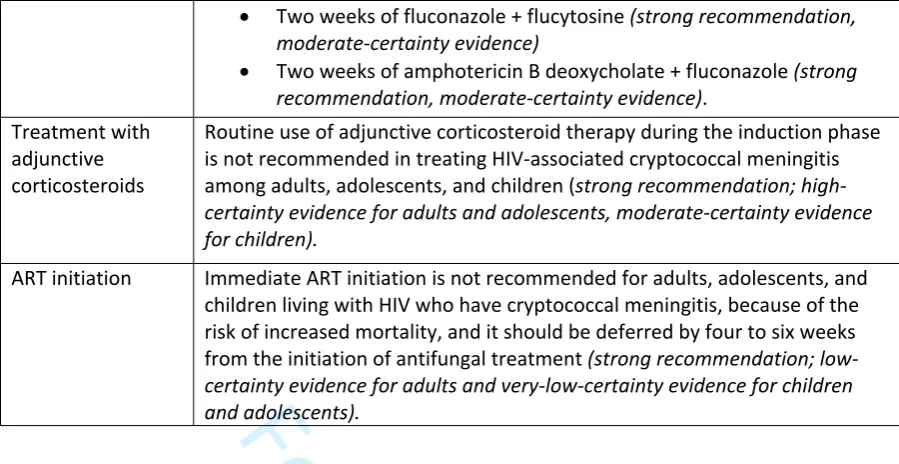
Table 1: Summary of WHO recommendations on preventing, diagnosing, and managing of cryptococcal disease in HIV-infected people (March 2018) [2]
WHO recommendation
Screening for cryptococcal antigen (CrAg) followed by pre-emptive
antifungal therapy among CrAg-positive people to prevent the development of invasive cryptococcal disease is recommended before initiating or
reinitiating antiretroviral therapy (ART) for adults and adolescents living with HIV who have a CD4 cell count < 100 cells/mm3(strong recommendation;
moderate-certainty evidence) and may be considered at a higher CD4 cell count threshold of < 200 cells/mm3 (conditional recommendation;
moderate-certainty evidence).
When CrAg screening is not available, fluconazole primary prophylaxis should be given to adults and adolescents living with HIV who have a CD4 cell count < 100 cells/mm3 (strong recommendation; moderate-certainty
evidence)and should be considered at a higher CD4 cell count threshold of < 200 cells/mm3(conditional recommendation; moderate-certainty evidence).
Treatment
For Review Only
Two weeks of fluconazole + flucytosine (strong recommendation, moderate-certainty evidence)
Two weeks of amphotericin B deoxycholate + fluconazole (strong recommendation, moderate-certainty evidence).
Treatment with adjunctive corticosteroids
Routine use of adjunctive corticosteroid therapy during the induction phase is not recommended in treating HIV-associated cryptococcal meningitis among adults, adolescents, and children (strong recommendation; high-certainty evidence for adults and adolescents, moderate-high-certainty evidence for children).
ART initiation Immediate ART initiation is not recommended for adults, adolescents, and children living with HIV who have cryptococcal meningitis, because of the risk of increased mortality, and it should be deferred by four to six weeks from the initiation of antifungal treatment (strong recommendation; low-certainty evidence for adults and very-low-low-certainty evidence for children and adolescents).
Table 2: Research needs for preventing, diagnosing, and managing cryptococcal disease in people with HIV, as identified through the WHO guideline process
Research area Research gaps and ongoing research
Prevention of cryptococcal meningitis
Cost-effectiveness of CrAg screening at CD4 cell count thresholds > 100 cells/mm3 in ambulatory settings
The value of CrAg screening of ART-experienced patients with low CD4 cell counts
Evaluation of the value of screening with second-generation CrAg lateral-flow assays that can give a high or low cryptococcal antigen titre result Discontinuation
of maintenance therapy
The optimal timing for discontinuing maintenance treatment among people with localized non-meningeal disease (such as pulmonary disease) or isolated serum cryptococcal antigen positivity
The optimal regimen and timing for discontinuing maintenance treatment for these populations
Treatment Phase III trial of dose, one-time injection in combination with high-dose fluconazole (1200 mg daily) and flucytosine for the induction phase of cryptococcal meningitis treatment
The optimal treatment of localized non-meningeal disease
The optimal treatment of cryptococcoma
Cryptococcal antigen (CrAg) can be detected in serum or plasma weeks to months before the symptoms of meningitis develop. One strategy for preventing cryptococcal meningitis in people with advanced HIV disease is to test for CrAg in serum or plasma and then treat people testing CrAg-positive with fluconazole. Earlier WHO guidelines (from 2013) recommended CrAg screening at a CD4 cell count threshold of < 100 cells/mm3, an approach that research indicates is
cost-effective.[6,7,8,9]
For Review Only
cryptococcal antigenaemia among people with a CD4 cell count ≤ 100 cells/mm3 was 6.5% (95%
confidence interval (CI) 5.7% to 7.3%) and 2.0% (95% CI 1.2% to 2.7%) among people with a CD4 cell count of 101 to 200 cells/mm3.[10] Of the CrAg-positive cases identified at a CD4 cell count ≤ 200
cells/mm3, 18.6% (95% CI 15.4% to 22.2%) were identified among individuals with a CD4 cell count of
101 to 200 cells/mm3. This finding, in combination with results from the REMSTART trial that
mortality was reduced as a result of CrAg screening of people with a CD4 cell count < 200 cells/mm3,[11] led the guideline development group to recommend an expanded CD4 cell count
threshold for CrAg screening at a CD4 cell count of < 200/mm3 (Table 1).[2]
Given that CrAg testing is not available in many LMICs, an alternative strategy is to provide
fluconazole prophylaxis to people with advanced HIV, without testing for CrAg status. The panel also debated this strategy. A Cochrane systematic review of antifungal prophylaxis in people living with HIV regardless of CrAg status found a 70% reduction in mortality from cryptococcal disease in those with low CD4 cell counts (relative risk of mortality due to cryptococcal disease
0.29, 95% CI 0.11 to
0.72),
but overall mortality was not reduced.[3] On top of this, there may be increased risk of fluconazole-resistant Candida strains emerging with this strategy (relative risk 1.25, 95% CI 1.00 to 1.55), but no impact was demonstrated on resistant Candida disease occurrence. This blanket strategy did not increase the risk of other serious adverse events.[3]In the light of this evidence, the WHO guideline panel made a second recommendation that primary prophylaxis with fluconazole should be given to adults and adolescents presenting with advanced HIV disease in situations where CrAg testing is not available or if results are delayed.[2] The importance of avoiding long delays in CrAg testing is supported by data from the REALITY trial reporting that cryptococcal disease and mortality peak in the first four weeks in people presenting with a CD4 cell count < 100 cells/mm3.[12]
The guideline panel also considered the treatment of HIV-associated cryptococcal meningitis, a formidable problem in LMICs. The conventional two-week induction treatment regimen with amphotericin B deoxycholate (AmBd) and flucytosine (5FC) often causes side effects from drug toxicity, and these effects are difficult to manage in low-resource settings. On top of this, these antifungal agents are expensive and often not available.[13,14] As a result, healthcare providers often use inferior treatment regimens. In order to decrease cost and toxicity of antifungal drugs, studies have investigated shorter induction regimens.[15] TheCochrane Review of randomized trials comparing antifungal induction therapies for treating HIV-associated cryptococcal meningitis
For Review Only
The panel noted that it is better to use liposomal amphotericin B than AmBd, mainly because the liposomal form seems to have similar efficacy but is less toxic.[16,17] Access to liposomal
amphotericin B remains extremely limited in LMICs because it is expensive, and it was therefore not included in the WHO recommendation.
The Cochrane Review also provided evidence showing that use of the adjuvant corticosteroid dexamethasone increased the risk of serious adverse events, although the higher rate of mortality was not statistically significant (relative risk of death 1.15, 95% CI 0.93 to 1.42).[4] The WHO guidelines recommend against the routine use of adjunctive corticosteroid therapy (Table 1).[2] There has been uncertainty about how soon antiretroviral therapy (ART) should be started in people with HIV-associated cryptococcal meningitis, because of the risks of immune reconstitution
inflammatory syndrome (IRIS) and death when ART is initiated within four weeks of starting antifungal therapy. A Cochrane systematic review compared the outcomes of ART initiation within four weeks of starting antifungal treatment compared with delayed initiation of ART (four weeks or more after starting antifungal treatment) in this population.[5] Four trials with a total 294 adult participants were included in the review. The findings of the review suggested a 42% increased risk of mortality among people who initiate ART within four weeks of cryptococcal meningitis diagnosis (risk ratio 1.42, 95% CI 1.02 to 1.97) However, it is unclear if this higher mortality risk is related to cryptococcal meningitis-IRIS. Based on these findings the WHO guideline panel recommended that clinicians should defer ART by four to six weeks from starting antifungal treatment. Although clear data are lacking, the consensus was that for ART-experienced people, ART switches should be similarly deferred by four to six weeks.
To reduce HIV-associated mortality there needs to be better access to ART, and new diagnostics, preventative therapies, and therapeutics. The updated WHO guidelines offer a range of approaches for preventing and managing cryptococcal meningitis, and these can be adapted according to the resources and logistical capabilities of LMICs. Poor access to first-line antifungal drugs in many LMICs is likely to remain a major barrier; 5FC is currently not registered in any country in Africa despite being included in the WHO list of essential medicines.[14,18] Thus it is important that people in the field advocate for country registration of recommended first-line antifungal drugs and their inclusion on national lists of essential medicines, as well as lobbying for drug price reductions. The high cost of liposomal amphotericin B has been another major barrier, although a preferential price was recently announced for LMICs, which is a positive step towards improving access.[19] Education of healthcare providers regarding the development of national guidance on managing cryptococcal disease as well as supportive supervision and prescribing decision-making aids will also help ensure appropriate options are used and adapted to current healthcare needs and resources available.
Authors
Chantal Migone
Department of HIV and Global Hepatitis Programme, World Health Organization, Geneva, Switzerland
For Review Only
Department of HIV and Global Hepatitis Programme, World Health Organization, Geneva, Switzerland
Paul Garner
Centre for Evidence Synthesis in Global Health, Liverpool School of Tropical Medicine, Liverpool, UK
Ingrid Eshun-Wilson
Centre for Evidence-based Health Care, Stellenbosch University, Cape Town, South Africa
Provenance and peer review
This editorial was commissioned and was not peer-reviewed.
References
1. Rajasingham R, Smith RM, Park BJ, Jarvis JN, Govender NP, Chiller TM, et al. Global burden of disease of HIV-associated cryptococcal meningitis: an updated analysis. Lancet Infectious Diseases
2017;17:P873-81. https://doi.org/10.1016/S1473-3099(17)30243-8
2. World Health Organization. Guidelines on the diagnosis, prevention and management of cryptococcal disease in HIV-infected adults, adolescents and children: supplement to the 2016 consolidated guidelines on the use of antiretroviral drugs for treating and preventing HIV infection. Geneva (Switzerland): World Health Organization; 2018 March. Available at
www.who.int/hiv/pub/guidelines/cryptococcal-disease.
3. Awotiwon AA, Johnson S, Rutherford GW, Meintjes G, Eshun-Wilson I. Primary antifungal prophylaxis for cryptococcal disease in HIV-positive people. Cochrane Database of Systematic Reviews 2018;(8):CD004773. https://doi.org/10.1002/14651858.CD004773.pub3
4. Tenforde MW, Shapiro AE, Rouse B, Jarvis JN, Li T, Eshun-Wilson I, et al. Treatment for HIV-associated cryptococcal meningitis. Cochrane Database of Systematic Reviews 2018;(7):CD005647.
https://doi.org/10.1002/14651858.CD005647.pub3
5. Eshun-Wilson I, Okwen MP, Richardson M, Bicanic T. Early versus delayed antiretroviral treatment in HIV-positive people with cryptococcal meningitis. Cochrane Database of Systematic Reviews
2018;(7):CD009012. https://doi.org/10.1002/14651858.CD009012.pub3
6. World Health Organization. Rapid advice: diagnosis, prevention and management of cryptococcal disease in HIV-infected adults, adolescents and children. Geneva (Switzerland): World Health Organization; 2011 December. Available at www.who.int/hiv/pub/cryptococcal_disease2011
7. World Health Organization. Guidelines for managing advanced HIV disease and rapid initiation of antiretroviral therapy. Geneva (Switzerland): World Health Organization; 2017 July. Available at
For Review Only
8. Jarvis JN, Harrison TS, Lawn SD, Meintjes G, Wood R, Cleary S. Cost effectiveness of cryptococcal antigen screening as a strategy to prevent HIV-associated cryptococcal meningitis in South Africa.
PLOS One 2013;8(7):e69288. https://doi.org/10.1371/journal.pone.0069288
9. Ramachandran A, Manabe Y, Rajasingham R, Shah M. Cost-effectiveness of CRAG-LFA screening for cryptococcal meningitis among people living with HIV in Uganda. BMC Infectious Diseases
2017;17(1):225. https://doi.org/10.1186/s12879-017-2325-9
10. Ford N, Shubber Z, Jarvis JN, Chiller T, Greene G, Migone C, et al. CD4 cell count threshold for cryptococcal antigen screening of HIV-infected individuals: a systematic review and meta-analysis.
Clinical Infectious Diseases 2018;66(suppl 2):S152-9. https://doi.org/10.1093/cid/cix1143
11. Mfinanga S, Chanda D, Kivuyo SL, Guinness L, Bottomley C, Simms V, et al. Cryptococcal meningitis screening and community-based early adherence support in people with advanced HIV infection starting antiretroviral therapy in Tanzania and Zambia: an open-label, randomised controlled trial. Lancet 2015;385(9983):2173-82. https://doi.org/10.1016/S0140-6736(15)60164-7
12. Hakim J, Musiime V, Szubert AJ, Mallewa J, Siika A, Agutu C, et al. Enhanced prophylaxis plus antiretroviral therapy for advanced HIV infection in Africa. New England Journal of Medicine
2017;377(3):233-45. https://doi.org/10.1056/NEJMoa1615822
13. Loyse A, Dromer F, Day J, Lortholary O, Harrison TS. Flucytosine and cryptococcosis: time to urgently address the worldwide accessibility of a 50-year-old antifungal. Journal of Antimicrobial Chemotherapy 2013;68(11):2435-44. https://doi.org/10.1093/jac/dkt221
14. Kneale M, Bartholomew JS, Davies E, Denning DW. Global access to antifungal therapy and its variable cost. Journal of Antimicrobial Chemotherapy 2016;71(12):3599-606.
https://doi.org/10.1093/jac/dkw325
15. Molloy SF, Kanyama C, Heyderman RS, Loyse A, Kouanfack C, Chanda D, et al. Antifungal combinations for treatment of cryptococcal meningitis in Africa. New England Journal of Medicine
2018;378(11):1004-17. https://doi.org/10.1056/NEJMoa1710922
16. Hamill RJ, Sobel JD, El-Sadr W, Johnson PC, Graybill JR, Javaly K, et al. Comparison of 2 doses of liposomal amphotericin B and conventional amphotericin B deoxycholate for treatment of AIDS-associated acute cryptococcal meningitis: a randomized, double-blind clinical trial of efficacy and safety. Clinical Infectious Diseases 2010;51(2):225-32. https://doi.org/10.1086/653606
17. Leenders AC, Reiss P, Portegies P, Clezy K, Hop WC, Hoy J, et al. Liposomal amphotericin B (AmBisome) compared with amphotericin B both followed by oral fluconazole in the treatment of AIDS-associated cryptococcal meningitis. AIDS 1997;11(12):1463-71.
www.ncbi.nlm.nih.gov/pubmed/9342068
18. World Health Organization. WHO model list of essential medicines. 20th edition. Geneva (Switzerland): World Health Organization; 2017 August. Available at
For Review Only
19. Gilead Sciences. Gilead Sciences announces steep discounts for Ambisome to treat cryptococcal meningitis in low- and middle-income countries. Available at gilead.com/news/gilead-sciences-announces-steep-discounts-for-ambisome
Acknowledgments
The World Health Organization retains copyright and all other rights in the manuscript of this Editorial as submitted for publication.
Declaration of interests
The authors have completed the ICMJE form for disclosure of potential conflicts of interest (forms available on request). Chantal Migone supported the development of the cryptococcal disease guidelines at the World Health Organization and supported the systematic review of cryptococcal antigen screening. Nathan Ford co-ordinated the development of the cryptococcal disease guidelines at the World Health Organization. NF also led the systematic review of cryptococcal antigen
screening and is a co-author on the Cochrane Reviews on the treatment of cryptococcal meningitis. Paul Garner is Co-ordinating Editor of Cochrane Infectious Diseases, which published the Cochrane Reviews on cryptococcus and HIV. PG also runs a development grant committed to increasing the number of decisions in low- and middle-income countries based on reliable systematic reviews. Ingrid Eshun-Wilson led and contributed to all three Cochrane Reviews on cryptococcus and HIV.
Funding