R E S E A R C H
Open Access
On the capacity of state-dependent Gaussian
cognitive interference channel
Shahab Ghasemi-Goojani and Hamid Behroozi
*Abstract
A Gaussian cognitive interference channel with state (G-CICS) is studied. In this paper, we focus on the two-sender, two-receiver case and consider the communication situation in which two senders transmit a common message to two receivers. Transmitter 1 knows only messageW1, and transmitter 2, referred to as the cognitive user, knows both
messagesW1andW2and also the channel’s states sequence non-causally. Receiver 1 needs to decode onlyW1while
receiver 2 needs to decode both messages. In this paper, we investigate the weak and moderate interference case where we assume that the channel gainasatisfies|a| ≤1. In addition, inner and outer bounds on the capacity region are derived in the regime of high state power, i.e., the channel state sequence has unbounded variance. First, we show that the achievable rate by Gelfand-Pinsker coding vanishes in the high state power regime under a condition over the channel gain. In contrast, we propose a transmission scheme (based on lattice codes) that can achieve positive rates, independent of the interference. Our transmission scheme can achieve the capacity region in a high signal-to-noise ratio (SNR) regime. Also, regardless of all channel parameters, the gap between the achievable rate region and the outer bound is at most 0.5 bits.
1 Introduction
In the exchange of information among many nodes, the interference between different transmitter and receiver pairs is unavoidable. In the classical interference channel (IC), this interference exists between two different trans-mitters and receivers. In [1], Carleial, using superposition coding, obtains general bounds on the capacity region of discrete memoryless interference channels. By using rate splitting at transmitters and sequential decoding at desti-nations, Han and Kobayashi establish the best achievable rate region known to date [2]. Unfortunately, the prob-lem of characterizing the capacity region of a general IC has been open for more than 30 years. Except for very strong Gaussian IC, strong Gaussian IC, the sum capacity of the degraded Gaussian IC and very weak interference, characterizing the capacity region of a Gaussian IC is still an open problem [3-6]. Etkin et al., by deriving new outer bounds, show that an explicit Han-Kobayashi ver-sion scheme can achieve capacity region within 1 bit for all channel parameters [7].
The cognitive interference channel, where one user has full non-causal knowledge of the other user’s message,
*Correspondence: [email protected]
Electrical Engineering Department, Sharif University of Technology, Tehran, Iran
is studied in [8-10]. This setup is also referred to as the interference channels with degraded message sets.
Recently, interference channels with state have received considerable attention. In general, channels with ran-dom states can model a time-varying wireless channel as well as interfering signals. The two-user state-dependent Gaussian interference channel where the state informa-tion is non-causally known at both encoders is studied in [11]. By proposing an active interference-cancellation mechanism, which is a generalized dirty-paper coding (DPC) [12] technique, some achievable rate regions for this channel are obtained. A Gaussian IC with the same state at both links which is scaled differently at two receivers is studied in [13]. For the very strong interfer-ence regime, as well as for the weak regime, the sum capacity is obtained under certain conditions on chan-nel parameters [13]. In [14], a state-dependent Gaussian Z-interference channel model in the regime of high state power is investigated. By utilizing a layered coding scheme, inner and outer bounds on the capacity region are derived.
In [15], a model of cognitive state-dependent interfer-ence channels is studied, in which one of the transmitters knows both messages and also the states of the channel in
a non-causal manner while the other transmitter knows only one of the messages and does not know the chan-nel states. Each of the two decoders try to decode only its intended message. By using a generalized binning prin-ciple, inner and outer bounds on the capacity region are established.
In this paper, we study the Gaussian cognitive interfer-ence channel with a state (G-CICS) with two transmitters and two receivers (see Figure 1). In this model, transmitter 1 knows only message 1 while transmitter 2 (the cogni-tive transmitter) knows both messages 1 and 2. The state sequence is known only at transmitter 2, and transmitter 1 does not know the state channel. The common mes-sage known to both transmitters, i.e., mesmes-sage 1, needs to be decoded at both receivers instead of at receiver 1 only. This model is investigated in [16], in which by using superposition coding, rate splitting, and Gelfand-Pinsker binning scheme, inner bounds are established. It is shown that the inner bounds are coincided with the outer bounds for a degraded semi-deterministic channel and channels that satisfy a less noisy condition. The Gaussian channels are also studied where inner and outer bounds are derived. The main result of this paper is designing a novel trans-mission scheme for the Gaussian interference channel with state where we aim to recover a common mes-sage at two decoders. To reach this goal, we treat this channel as two state-dependent Gaussian multiple-access channels (MACs) and try to simultaneously recover the common message at both decoders. Prior to this work, different types of the state-dependent two-user MAC are investigated in the literature (See e.g., [17-24]). In [17], a two-user state-dependent multi-access channel in which the state is known only at the encoder (that sends both messages) is investigated. By generalizing the Gelfand-Pinsker model, the capacity region for both non-causal and causal state information is characterized. If the state
information is non-causally known only at the encoder that sends the common message, then the capacity region for the Gaussian scenario in some cases is character-ized in [18]. In [19-21], the state-dependent two-user multi-access channel in which the states of the chan-nel are known non-causally at one of the encoders and only strictly causally at the other encoder is consid-ered. By generalizing the framework of [21], the capacity region of this model is fully characterized in [19], and the optimal schemes for achieving the capacity region are also studied. In [22-24], the two-user multiple-access channel with state is considered in which the states are known causally or strictly causally at both encoders or only at one encoder. For the causal state, it is shown that the capacity region is fully achievable. If the state is known strictly causally at both the encoders or only at one encoder, then the capacity region at some cases is characterized.
The capacity region of relay channel with state is inves-tigated in [25-32]. The relay channel and the cooperative relay broadcast channel controlled by random parame-ters are studied in [25]. It is shown that when the state is non-causally known to the transmitter and intermediate nodes, the decode-and-forward can achieve the capacity region under some cases. The relay channel with the state known non-causally at the relay is investigated in [26] and [27]. Using Gelfand-Pinsker coding, rate splitting, and decode-and-forward, a lower bound on channel capac-ity is obtained for this channel, and it is shown that for the degraded Gaussian channels, the lower bound meets the upper bound and thus the capacity region is achiev-able. The relay channel when the state is available only at the source is studied in [28-30]. By obtaining lower and upper bounds, it is shown that in a number of special cases the capacity region is achievable. A partially cooperative relay broadcast channel (PC-RBC) with state is studied
in [31] where two situations including the availability of the state non-causally at both the source and the relay and only at the source are analyzed. The relay interference channel with a cognitive source where only the source knows (non-causally) the interference from the interferer is considered in [32], and some achievable rate regions are obtained.
All achievable rate regions in [16] are based on ran-dom coding. In this paper, we use the lattice-based coding scheme (especially lattice alignment) to establish capac-ity regions for this channel. A comprehensive study on the performance of lattices is presented in [33]. Perfor-mance of lattice codes over the additive white Gaussian noise (AWGN) channel is studied in [34]. A dirty paper AWGN channel in which the interference is known non-causally or non-causally at the transmitter is investigated in [35]. In [36], it is shown that the lattice coding strat-egy may outperform the DPC in a doubly dirty MAC. In [37], we also show that if the noise’s variance satisfies some constraints, then the capacity region of an addi-tive state-dependent Gaussian interference channel with two independent channel states is achieved when the state power goes to infinity. In [38], a Gaussian relay channel with a state is considered in which the additive state is either added at the destination and known non-causally at the source or experienced at the relay and known at the destination. It is shown that a scheme based on nested lat-tice codes can achieve the capacity region within 0.5 bits. In [39], by using nested lattice codes, the generalized degrees of freedom for the two-user cognitive interference channel are characterized where one of the transmitters has knowledge of a linear combination of the two informa-tion messages. Using lattice codes for the state-dependent Gaussian Z-interference channel, some rate regions are established in [40].
Here, we evaluate the performance of lattice-based cod-ing schemes on obtaincod-ing achievable rate regions for the G-CICS. Similar to [14,36], we assume that the chan-nel state has unbounded variance. This is referred to as a high state power regime. In addition, we consider the weak and moderate interference cases, i.e., the chan-nel gain is smaller than one; |a| ≤ 1. First, we show that the achievable rate region by random coding van-ishes in a high state power regime under a condition over the channel gain. Then, by using a lattice-based coding scheme, we obtain an achievable rate region for the G-CICS. As Figure 1 shows, we can see that the G-CICS can be treated as two state-dependent MACs with a common message: one from encoders 1 and 2 to decoder 1, and the other from encoders 1 and 2 to decoder 2. For both these MACs, the capacity region is completely characterized in [19]. However in the G-CICS, we need to decode the common message simultaneously at both decoders. Since these two MACs are different,
we cannot apply the proposed scheme in [19] for this channel.
The main challenge of this paper is designing a scheme that can achieve a rate region close to the outer bound for the state-dependent Gaussian interference channel with a common message (setW2=0 in Figure 1). Although this channel can be treated as two state-dependent MACs with a common message, these two MACs are different, and since the common message should be recovered simul-taneously at both decoders, the known schemes in the literature cannot be directly applied. To solve this prob-lem, we use lattice codes and obtain a linear combination of the common message, sent by two transmitters, at the decoders. Note that lattice codes are among the best codes in finding the linear combination of messages [41]. As we will show, at high signal-to-noise ratios (SNRs), the achievable rate region meets the outer bound, and regard-less all channel parameters, the achievable rate region is within 0.5 bits.
The paper is organized as follows: We present the chan-nel model in Section 2. The achievable rate region by random coding is presented at Section 3. Section 4, by using lattice codes, establishes an achievable rate region for the G-CICS. Using numerical examples, achievable rate regions of our proposed scheme and random cod-ing are compared in Section 5. Section 6 concludes the paper.
2 System model
Throughout the paper, random variables and their realiza-tions are denoted by capital and small letters, respectively. xstands for a vector of lengthn,(x1,x2,. . .,xn). Also,. denotes the Euclidean norm, and all logarithms are with respect to base 2.
In this paper, we consider a G-CICS in which two trans-mitters send a common message W1 to two receivers, and transmitter 2 wishes to communicate a message W2 to receiver 2 only. The channel is also corrupted by an independent and identically distributed (i.i.d.) state sequence. We investigate the asymmetric cogni-tive scenario, as [15,16], where the state is non-causally known at transmitter 2 and is unknown at transmitter 1 and at the receivers. The system model is depicted in Figure 1. The interference channel is described by
unidirectional cooperation. Both encoders wish to send a messageW1 to both the decoders overnchannel uses while encoder 2 also wants to communicate a messageW2 to decoder 2. The channel outputs at receivers 1 and 2 at time instantjare given, respectively, by
Y1,j = X1,j+aX2,j+aSj+Z1,j,
Y2,j = aX1,j+X2,j+Sj+Z2,j,
where Z1,j ∼ N(0,N) and Z2,j ∼ N(0,N) are inde-pendent Gaussian random variables, and the normally distributed state variableSj ∼ N(0,Q)is independent of
Z1,jandZ2,j. Both the noise variables and the state vari-able are i.i.d. over channel uses. The state sequenceSj
n j=1 is non-causally known only at transmitter 2. In this paper, similar to [42,43], we assume that the channel gains are rational,a = pq ∈ Q. The channel inputsXi’s (i ∈ {1, 2}) are average-power limited toP>0, i.e.,
1
and two decoding functions
g1:Y1n→W1, g2:Y2n→W1×W2
such that the transmitted codewordXisatisfies the power constraint, given by (1). We define the probability of error as
A rate pair(R1,R2)of non-negative real values is achiev-able if there exists a sequence of2nR1, 2nR2,ncode such that limn→∞P(en) →0. The capacity region is defined as the convex closure of the set of all achievable rate pairs
(R1,R2).
3 Achievable rate region by random coding In this Section, we evaluate achievable rate regions by random coding for the G-CICS in the regime of high state power. In [16], by using random coding, two inner bounds for the G-CICS are provided when|a| ≤ 1. By evaluating the inner bound 1 of Proposition 3 in [16]
and replacing S→aS, b→a, c→ 1a, we can see that this inner bound when the channel gain tends to zero vanishes, and thus, we cannot achieve any positive rate region by such scheme. The following theorem presents the second inner bound. To achieve this region, the Gelfand-Pinsker coding and rate splitting in transmitter 2 is used.
Lemma 1.[16]For the Gaussian cognitive interference channel with state non-causally known at transmitter 2, if|a| ≤ 1, then an inner bound on the capacity region in
Proof. See Proposition 4 in [16].
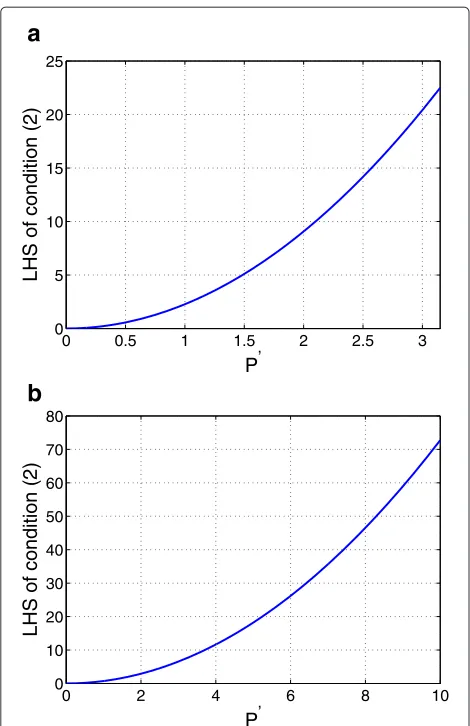
Now from Lemma 1, we can see that if
α2−2αP +α2P + α2
a2N>0, (2)
0 0.5 1 1.5 2 2.5 3 0
5 10 15 20 25
P’
LHS of condition (2)
0 2 4 6 8 10
0 10 20 30 40 50 60 70 80
P’
LHS of condition (2)
a
b
Figure 2LHS of (2) versus the parameterPunder which the achievable rate region by random coding is zero.(a)System parameters areP=5 dB anda=0.15.(b)System parameters are P=10 dB anda=0.1.
depends onP andP whereP +P =1−ρ212 −ρ22sP, we must varyP over interval 0 ≤P ≤1−ρ212 −ρ22sP, and then, by equatingP =1−ρ212 −ρ22sP−P, we can plot the left-hand side of the condition in (2).
4 Lattice alignment 4.1 Lattice definitions
Here, we provide some necessary definitions on lattices and nested lattice codes. The reader can find more details in [34,41,44].
Definition 1.(Lattice): Ann-dimensional latticeis a set of points in Euclidean spaceRnsuch that, ifx,y∈ , thenx+y ∈ , and ifx ∈ , then−x ∈ . A lattice
can always be written in terms of a generator matrix G∈Zn×nas
= {x=zG:z∈Zn},
whereZrepresents integers.
Definition 2.(Quantizer): Thenearest neighbor quan-tizerQ(.)associated with the latticeis
Q(x)=arg min
l∈x−l.
Definition 3.(Voronoi region): The fundamental Voronoi regionof a latticeis a set of points inRnclosest to the zero codeword, i.e.,
V0()= {x∈Rn:Q(x)=0}.
Definition 4.(Moments): σ2() which is called the second momentof latticeis given by
σ2()= 1 n
V() x2dx
V()dx
, (3)
and thenormalized second momentof latticeis
G()= σ 2()
V()dx
2 n
= σ2()
V2n ,
whereV = V()dxis the Voronoi region volume, i.e., V =Vol(V).
Definition 5.(Modulus): Themodulo-operationwith respect to latticeis defined as
xmod=x−Q(x)
that maps x into a point in the fundamental Voronoi region.
For all x,y ∈ Rn and ⊆ 1, the modulo lattice operation satisfies the following properties
xmod+y mod= x+ymod, (4)
[ax] mod= [a[x] mod] mod, (5) a∈Zn
β[x] mod= [βx] modβ, β ∈Rn, (6)
Q1(x)
mod= Q1([x] mod)
mod. (7)
Definition 6.(Quantization goodness or Rogers-good): A sequence of lattices(n)⊆Rnisgood for mean-squared
error (MSE) quantizationif
lim n→∞G
(n)= 1 2πe.
Definition 7.(AWGN channel coding goodness or Poltyrev-good): Let Z be a length-i.i.d Gaussian vector, Z ∼N0,σZ2In. The volume-to-noise ratio of a lattice is given by
μ (, )= (Vol(V)) 2/n
σ2
Z ,
where σZ2 is chosen such that Pr{Z∈/V} = , andIn is an n× nidentity matrix. A sequence of lattices (n) is Poltyrev-goodif
lim n→∞μ
(n), =2πe, ∀ ∈(0, 1)
and, for a fixed volume-to-noise ratio greater than 2πe, Pr{Z∈/Vn}decays exponentially inn.
Poltyrev showed that sequences of such lattices exist [47]. The existence of a sequence of lattices (n) which is good in both senses (i.e., simultaneously are Poltyrev-good and Rogers-Poltyrev-good) has been shown in [46].
Definition 8.(Nested lattices): A latticeis said to be nested in lattice1if ⊆ 1. is referred to as the coarse lattice and1as the fine lattice.
Note that ifa∈Z, then alwaysa⊆.
Definition 9.(Nested lattice codes): A nested lattice code is the set of all points of a fine lattice (1n) that is within the fundamental Voronoi regionV of a coarse lattice(n),
C= {1∩V}.
Definition 10. (Rate): Therateof a nested lattice code is
R= 1
nlog|C| = 1 nlog
Vol(V) Vol(V1)
. (8)
In the following, we present a key property of dithered nested lattice codes.
Lemma 2. The Crypto Lemma[34,48]. LetVbe a ran-dom vector with an arbitrary distribution overRn. IfDis
independent ofVand uniformly distributed overV, then (V+D)modis also independent ofV and uniformly distributed overV.
Proof. See Lemma 2 in [48].
Before presentation of our proposed scheme, we prove the following lemma that plays an important role in the proof of achievable rate region by lattice codes.
Lemma 3.Suppose thatand1are two lattices such that⊆1. Then, the modulo operation is commutative, i.e.,
[[x]mod1]mod=[[x] mod] mod1. (9)
Proof. We start with manipulating the left-hand side of (9):
[[x] mod1] mod = [x] mod1−Q([x] mod1)
= x−Q1(x)−Qx−Q1(x)
= x−Q1(x), (10)
where the last equality follows from the fact that⊆1. For the RHS of (9), we have:
[[x] mod] mod1 = [x] mod−Q1([x] mod)
= x−Q(x)−Q1(x−Q(x)) = x−Q(x)
−Q1(x)+Q(x) (11)
= x−Q1(x), (12)
where (11) is based on the fact that ⊆ 1. Now, by comparing (10) and (12), the proof of the lemma is complete.
4.2 Our proposed scheme
In this section, we obtain an achievable rate region using lattice codes for the G-CICS. If we use the common encoding and decoding as it is explained in [34], then sim-ilar to random coding, we cannot achieve the capacity region within a constant gap. Thus, we require to intro-duce a new scheme for this channel. For presenting this scheme, we use two modulo operations at the decoder. Then using Lemma 3, we interchange modulo operations. As we will see, this scheme can achieve the capacity region at high SNRs and within 0.5 bits regardless of all channel parameters. In the following, we present our scheme in more detail.
A method to obtain a rate region is achieving two cor-ner points of that region. Then, by time sharing between two corner points, we can achieve a rate region. Suppose thatV1andV2are two lattice codewords that carry the information for user 1 and 2, respectively. We use DPC or a lattice scheme to decode V2 at decoder 2 and a scheme which estimates linear combination of the com-mon message at both decoders to decode V1 for both users. In the following, we explain both schemes in more details.
First, suppose that latticeis a Rogers-good lattice and has the following second moment:
σ2()=P.
• Sending the private message,V2(for decoder 2):
channel with state, which aims to sendV2to decoder 2. This channel can be characterized as the following:
Y2=X2+S+Z2. (13)
Since transmitter 1 has no message to send, we setX1=0. Now, we can use a DPC or lattice scheme to achieve the capacity of this channel. By using a lattice coding scheme, transmitter 2 sends the following signal:
X2 = [V2−αS+D2] mod,
where dither sequenceD2 is uniformly distributed over the Voronoi region. Thus, based on the crypto lemma, the power constraint is met. Now, by using lattice decod-ing and choosdecod-ing α = P+PN, we achieve the following
• Encoding the common message,V1:
To estimate the common messageV1, we first assume that 0≤a ≤1. Then, by a simple changing at encoding, we extend our scheme to−1≤a≤0. Suppose thatV2= 0, and we intend to sendV1to both decoders. Consider the following nested lattices:
⊆q1,
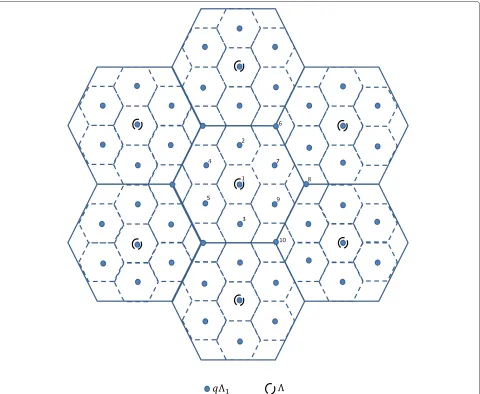
where the coding lattice, 1, is Poltyrev-good while the shaping lattice, , is both Rogers-good and Poltyrev-good. For instance, a lattice partition chain is visualized in Figure 3 for the two-dimensional case. Without loss of generality and due to a reason which will be determined later, we assume that=q(1+a) 1. Based on this lat-tice chain, we construct the following codebook for each node:
Ci= {1∩V}, i=1, 2.
For the lattice chain shown in Figure 3, we haveCi = {1, 2,. . ., 9, 10}. Now, using a one-to-one mapping at encoderi, we map messageW1to a lattice codewordV1 of codebook Ci and send the following signals over the channel:
X1 = [V1+D1] mod, (15)
X2 = [V1−αS+D2] mod, (16)
whereD1andD2are two independent dithers which are uniformly distributed on the Voronoi regionV. Note that
by the crypto lemma, we know that the power constraint is satisfied. Now, we explain decoding at decoder 1 and 2.
• Decoding the common message,V1, at decoder 1
Decoder 1, upon receivingY1,
Y1=X1+aX2+aS+Z1,
performs the following operations to estimateV1:
Yd1 =
Equation (17) follows from (6), and (18) is based on Lemma 3. Equation (19) is based on applying (4) while (20) follows from Lemma 3. By using mini-mum Euclidean distance lattice decoding [34,49], which finds the closest point toYd1inq1, we estimateV1 (7). Thus, the estimation ofV1is correct if
Figure 3Example of a lattice partition chain.The blue circles and the dashed circles denote the lattice points associated with latticeq1and lattice, respectively.
Note that to decode(1+a)qV1mod, since we have used a quantizer associated with latticeq1, we may map some points of latticeq1to(1+a)qV1mod. That’s by finding some points ofq1, since we used a one-to-one mapping, we can recover(1+a)qV1mod.
Therefore, (23) shows that the estimation ofV1is incor-rect if the effective noiseZeff leaves the Voronoi region surrounding the codeword(1+a)qV1, i.e.,
Pe=Pr(Zeff∈/qV1).
Now from [34,47], the error probability vanishes asn→
∞if
μ= (Vol(qV1)) 2 n
2πeVarZ∗eff >1, (24)
whereZ∗eff∼N(0, Var(Zeff)). Since1is Poltyrev-good, the condition of (24) is satisfied. Now, from (8) forR1, we have
R1 = 1 nlog
Vol(V) Vol(V1)
= 1 2log
σ2() G() (Vol(V1))
2 n
≤ 1 2log
σ2() G()2πeVarZ∗eff
(25)
= 1 2log
σ2()) VarZ∗eff
(26)
= 1 2log
P VarZ∗eff
= 1 2log
1 a2+1 +
P N
where (25) follows from (24), and (26) is based on Rogers goodness of.
Now, we haveV1=(1+a)qV1 modand must try to decodeV1. In the following lemma, we show that it is possible to decode it correctly.
Lemma 4.Suppose1andare two lattices such that ⊆1. Forx,y∈1,x=yand a∈Z, we have
[ax] mod=aymod,
if=a1.
Proof.By using definition of modulo operation, we have
[ax] mod−ay mod is not an element of lattice, and therefore, we get
[ax] mod−aymod=0.
Now, we return to our problem where we aim to esti-mate V1. Since = q(1+a) 1, according to the
Thus, there exists only a codeword that can satisfyV1=
(1+a)qV1
modand it is the transmitted codeword. Therefore, we can achieve the following corner point at decoder 1:
• Decoding the common message,V1, at decoder 2:
Decoding at decoder 2 is exactly the same as decoder 1. Thus, we can achieve the following corner point
(R1,R2)=
Therefore, by using time sharing between the two cor-ner points, given in (14) and (27), we can achieve the following rate region:
It is easy to see that the following rate region is also achievable (since it is inside the region given by (29)):
R2+R1≤
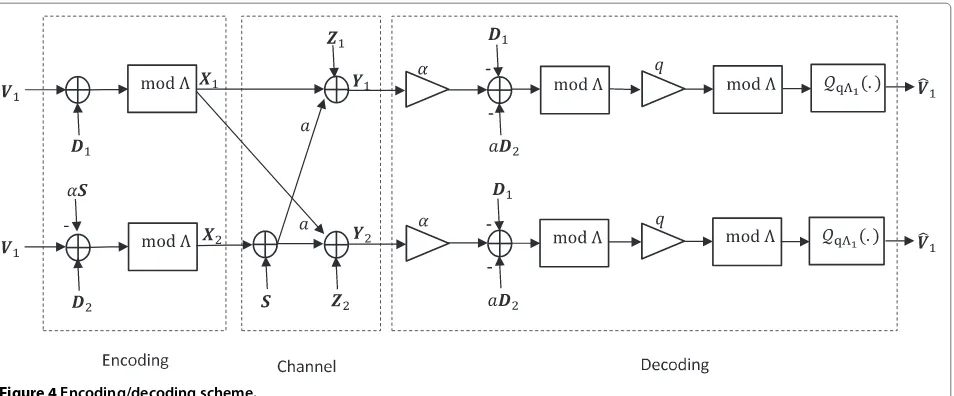
This transmission scheme is depicted in Figure 4.
Remark 1.In order to extend our scheme to the case that−1 ≤ a ≤ 0, we must modify our encoding as the following:
X1 = [−V1+D1] mod, (31)
X2 = [V1−αS+D2] mod. (32)
By comparing (31) with (15), we can see that at encoder 1, instead of sendingV1, we transmit−V1. At the decoder, desired lattice point correctly.
4.2.1 Rate-region outer bound
For comparison, an outer bound on the capacity region of the G-CICS is provided. This outer bound is similar to the bound provided in [16] obtained using a different approach.
Lemma 5.For the Gaussian cognitive interference chan-nel with state non-causally known at transmitter 2, if the power of the state goes to infinity (Q → ∞), an outer
where the union is taken over all parameters0≤ρ21and ρ2s≤1such thatρ212 +ρ22s≤1.
Proof.We have
n(R1+R2) = h(W1,W2)
= h(W1,W2|Y2)+I(W1,W2;Y2)
Figure 4Encoding/decoding scheme.
where (34) is based on Fano’s inequality. For the second term, we have
I(W1,W2;Y2)
= h(Y2)−h(Y2|W1,W2)
= h(Y2)+h(S|W1,W2,Y2)−h(Y2,S|W1,W2)
≤ h(Y2)+h(S|X1,Y2)
−h(Y2|X1,X2,S)−h(S) (35)
= h(Y2)−h(S)+h(S|X1,Y2)−h(Z2)
≤ n
2log
N+√aP+√P+√Q2 Q
+n 2log
1+P
1−ρ212 −ρ22s N
, (36)
where ρ21 = E[X2X1] EX2
2
EX2 1
, ρ2s = E[X2S] EX2
2
E[S2], and (35) follow from the fact that Sis independent of(W1,W2). Equation (36) follows from the fact that Gaussian dis-tribution maximizes differential entropy for a fixed sec-ond moment and Cauchy-Schwarz inequality. For the asymptotic case of strong interference, i.e., Q → +∞, we get
R1+R2≤ 1 2log
1+ P
1−ρ212 −ρ22s N
.
4.3 Capacity results
By comparing the outer region (33) and the achievable region in (29), we conclude that the outer region is indeed tight at high SNRs for the weak and moderate interference case in the high state power regime. Thus, we have the following Corollary.
Corollary 1.At high SNRs and in a high state power regime, the capacity region of the state-dependent Gaussian cognitive interference channel for the weak and moderate interference case is given by the set of all rate pairs satisfying
R1+R2≤ 1 2log
1+ P
N
−o(1), (37)
where o(1)→0asNP → ∞.
We now calculate the maximum gap between the outer bound, given in (33), and the achievable rate-region, given by (30). We have
1 2log
1+ P
N
−
1 2log
1 a2+1+
P N
+
≤ 1 2log
2− 1
a2+1
≤ 1
2, (38)
where (38) is based on the fact that the maximum gap occurs at a21+1+ NP = 1 fori = 1, 2. Thus, we have the following result.
Theorem 1. The capacity region of the state-dependent Gaussian cognitive interference channel for the weak and moderate interference case in the high state power regime is achievable within 0.5 bits.
5 Numerical results
0 0.2 0.4 0.6 0.8 1 1.2 1.4 1.6 0
0.2 0.4 0.6 0.8 1 1.2 1.4 1.6 1.8
R
1 R 2
Random Code (a=0.8) Lattice Code (a=0.8) Random Code (a=0.5) Lattice Code (a=0.5) Random Code (a=0.3) Lattice Code (a=0.3)
0.35 0.4 0.45
1.28 1.3 1.32 1.34 1.36
Figure 5Rate-region outer bound and achievable rate regions of random coding and lattice-based coding scheme for different channel gains.System parameters area=0.3, 0.5, 0.8 andSNR=10 dB.
also provided. For simplicity, we use the following outer bound in our simulations:
R1+R2≤ 1 2log
1+ P
N
.
In Figure 5, we provide a comparison of the achiev-able rate regions and the outer bound atSNR = 10 dB for a = 0.3, 0.5, 0.8 (note that |a| ≤ 1). We observe
that the achievable rate region of our lattice-based cod-ing scheme is significantly larger than that of random coding. By increasing the channel gain, a, the achiev-able rate by lattice codes is within 0.5 bits of the outer bound.
In Figure 6, we compare the achievable rate regions when the channel gain is fixed at a = 0.5 and SNR varies. The values of theSNRs areSNR= 5, 15, 25 dB. As
0 0.5 1 1.5 2 2.5 3 3.5 4
0 0.5 1 1.5 2 2.5 3 3.5 4 4.5
R
1
R
2Outer Bound
Lattice Code
Random Code
SNR=15 dB
SNR=25 dB
SNR=5 dB
we observe, for high SNRs, the achievable rate region by lattice codes coincides with the outer bound.
6 Conclusions
In this paper, the state-dependent Gaussian cognitive interference channel in the weak and moderate interfer-ence case and in the high state power regime is studied. First, we showed that the achievable rate by random cod-ing, which is based on Gelfand-Pinsker codcod-ing, vanishes under a condition over the channel gain. Then, we showed that a scheme that is based on lattice codes can achieve the capacity region at high SNRs and within 0.5 bits of the outer bound for all channel parameters.
Competing interests
The authors declare that they have no competing interests.
Authors’ information The authors are members of IEEE.
Acknowledgments
This work has been supported in part by the Iran NSF under Grant No. 88114.46. The material in this paper was presented in part at the 2nd Iran Workshop on Communication and Information Theory (IWCIT 2014), Tehran, Iran.
Received: 30 June 2014 Accepted: 27 October 2014 Published: 22 November 2014
References
1. AB Carleial, Interference channels. IEEE Trans. Inf. Theory24(1), 60–70 (1978)
2. TS Han, K Kobayashi, A new achievable for the interference channel. IEEE Trans. Inf. Theory27(1), 49–60 (1981)
3. H Sato, The capacity of the Gaussian interference channel under strong interference. IEEE Trans. Inf. Theory27(6), 786–788 (1981)
4. AB Carleial, A case where interference does not reduce capacity. IEEE Trans. Inf. Theory21(5), 569–570 (1975)
5. I Sason, On achievable rate regions for the Gaussian interference channel. IEEE Trans. Inf. Theory53(12), 1345–1356 (2004)
6. A Motahari, A Khandani, Capacity bounds for the Gaussian interference channel. IEEE Trans. Inf. Theory55(2), 620–643 (2009)
7. RH Etkin, DNC Tse, H Wang, Gaussian interference channel capacity to within one bit. IEEE Trans. Inf. Theory54(12), 5534–5562 (2008) 8. W Wu, S Vishwanath, A Arapostathis, Capacity of a class of cognitive radio
channels: interference channels with degraded message sets. IEEE Trans. Inf. Theory53(11), 4391–4399 (2007)
9. I Maric, A Goldsmith, G Kramer, S Shamai (Shitz), On the capacity of interference channels with one cooperating transmitter. Eur. Trans. Telecomm.19, 405–420 (2008)
10. A Jovicic, P Viswanath, Cognitive radio: an information-theoretic perspective. IEEE Trans. Inf. Theory55(9), 3945–3958 (2009)
11. L Zhang, J Jinhua, C Shuguang, Gaussian interference channel with state information. IEEE Trans. Wireless Commun.12(8), 4058–4071 (2013) 12. M Costa, Writing on dirty paper. IEEE Trans. Inf. Theory29(3), 439–441
(1983)
13. R Duan, Y Liang, S Shamai (Shitz), inProc. IEEE ISIT. On the capacity region of Gaussian interference channels with state (Istanbul, Turkey, 7–12 Jul 2013), pp. 1097–1101
14. R Duan, Y Liang, A Khisti, S Shamai (Shitz), inProc. IEEE Inf. Theory Workshop (ITW). State-dependent Gaussian Z-channel with mismatched side-information and interference (Sevilla, Spain, 9–13 Sept 2013) 15. A Somekh-Baruch, S Shamai (Shitz), S Verdu, inProc. IEEE Int. Symp.
Information Theory (ISIT). Cognitive interference channels with state information (Toronto, Canada, 6–11 Jul 2008), pp. 1353–1357 16. R Duan, Y Liang, S Shamai (Shitz), Bounds and capacity theorems for
cognitive interference channels with state. IEEE Trans. Inf. Theory. [http://arxiv.org/abs/1207.0016]. June 2012, revised Oct 2013
17. A Somekh-Baruch, S Shamai (Shitz), S Verdu, Cooperative multiple access encoding with states available at one transmitter. IEEE Trans. Inf. Theory 54(1), 4448–4469 (2008)
18. A Zaidi, L Vandendorpe, SP Kotagiri, JN Laneman, inProc. IEEE ISIT. Multiaccess channels with state known to one encoder: another case of degraded message sets (Seoul, South Korea, Jun 28–Jul 3 2009), pp. 2376–2380
19. A Zaidi, P Piantanida, S Shamai (Shitz), Capacity region of cooperative multiple-access channel with states. IEEE Trans. Inf. Theory 59(10), 6153–6174 (2013)
20. A Zaidi, P Piantanida, S Shamai (Shitz), inProc. IEEE ISIT. Wyner-Ziv type versus noisy network coding for a state-dependent MAC (Cambridge, MA, 1–6 Jul 2012), pp. 1682–1686
21. A Zaidi, P Piantanida, S Shamai (Shitz), inProc. IEEE ISIT. Multiple access channel with states known noncausally at one encoder and only strictly causally at the other encoder (Saint Petersburg, Russia, Jul 31–Aug 5 2011), pp. 2801–2805
22. A Zaidi, S Shamai (Shitz), On cooperative multiple access channels with delayed CSI at transmitters. IEEE Trans. Inf. Theory60(10), 6204–6230 (2014)
23. A Zaidi, S Shamai (Shitz), inProc. IEEE ISIT. Asymmetric cooperative multiple access channels with delayed CSI (Honolulu, HI, June 29–Jul 4 2014), pp. 1186–1190
24. A Zaidi, S Shamai (Shitz), inProc. IEEE ISIT. On cooperative multiple access channels with delayed CSI (Istanbul, Turkey, 7–12 Jul 2013), pp. 982–986 25. A Zaidi, L Vandendorpe, P Duhamel, inIEEE Int. Commun. Conf. (ICC).
Lower bounds on the capacity regions of the relay channel and the cooperative relay-broadcast channel with non-causal side-information (Glasgow, Scotland, 24–28 June 2007), pp. 6005–6011
26. A Zaidi, SP Kotagiri, JN Laneman, L Vandendorpe, Cooperative relaying with state available non-causally at the relay. IEEE Trans. Inf. Theory 56(5), 2272–2298 (2010)
27. A Zaidi, SP Kotagiri, JN Laneman, L Vandendorpe, inProc. IEEE Information Theory Workshop(ITW). Cooperative relaying with state at the relay (Porto, Portugal, 5–9 May 2008), pp. 139–143
28. A Zaidi, S Shamai, P Piantanida, L Vandendorpe, Bounds on the capacity of the relay channel with noncausal state at source. IEEE Trans. Inf. Theory 59(5), 2639–2672 (2013)
29. A Zaidi, L Vandendorpe, Lower bounds on the capacity of the relay channel with states at the source. Eurasip J. Wireless Commun. Netw. 2009, 1–23 (2009)
30. A Zaidi, S Shamai (Shitz), P Piantanida, L Vandendorpe, inProc. IEEE ISIT. Bounds on the capacity of the relay channel with noncausal state information at source (Austin, TX, 13–18 June 2010), pp. 639–643 31. A Zaidi, L Vandendorpe, inProc. IEEE ISIT. Rate regions for the
partially-cooperative relay broadcast channel with non-causal side information (Nice, France, 24–29 June 2007), pp. 1246–1250
32. A Zaidi, L Vandendorpe, inIEEE Int. Commun. Conf. (ICC). Achievable rates for the Gaussian relay interferer channel with a cognitive source (Dresden, Germany, 14–18 June 2009), pp. 1–6
33. R Zamir, inProceedings of the 4th Annual Workshop on Information Theory and its Applications (ITA 2009). Lattices are everywhere (San Diego, CA, 8–13 Feb 2009), pp. 392–421
34. U Erez, R Zamir, Achieving 1/2 log(1 +SNR) on the AWGN channel with lattice encoding and decoding. IEEE Trans. Inf. Theory50(22), 2293–2314 (2004)
35. U Erez, S Shamai (Shitz), R Zamir, Capacity and lattice strategies for canceling known interference. IEEE Trans. Inf. Theory51(14), 3820–3833 (2005)
36. T Philosof, R Zamir, U Erez, AJ Khisti, Lattice strategies for the dirty multiple access channel. IEEE Trans. Inf. Theory57(8), 5006–5035 (2011) 37. S Ghasemi-Goojani, H Behroozi, inProc. Tenth International Symposium on
Wireless Communication Systems (ISWCS). On the transmission strategies for the two-user state-dependent Gaussian interference channel (Ilmenau, Germany, 27–30 Aug 2013)
38. Y Song, N Devroye, inInformation Theory and Applications Workshop. Structured interference-mitigation in two-hop networks (UCSD, San Diego, 6–11 Feb 2011)
40. S Ghasemi-Goojani, H Behroozi, inProc. IEEE ISITA. State-dependent Gaussian Z-interference channel: new results (Melbourne, Australia, 26–29 Oct 2014)
41. B Nazer, M Gastpar, Compute-and-forward: harnessing interference through structured codes. IEEE Trans. Inf. Theory57(10), 6463–6486 (2011) 42. A Jafarian, S Vishwanath, Achievable rates for k-user Gaussian interference
channels. IEEE Trans. Inf. Theory58(7), 4367–4380 (2012)
43. O Ordentlich, U Erez, On the robustness of lattice interference alignment. IEEE Trans. Inf. Theory59(5), 2735–2759 (2013)
44. JH Conway, NJA Sloane,Sphere Packings, Lattices and Groups. (Springer-Verlag, New York, 1992)
45. R Zamir, M Feder, On lattice quantization noise. IEEE Trans. Inf. Theory 42(4), 1152–1159 (1996)
46. U Erez, S Litsyn, R Zamir, Lattices which are good for (almost) everything. IEEE Trans. Inf. Theory51(16), 3401–3416 (2005)
47. G Poltyrev, On coding without restrictions for the AWGN channel. IEEE Trans. Inf. Theory40(9), 409–417 (1994)
48. GD Forney, inProc. 41st Ann. Allerton Conf. On the role of MMSE estimation in approaching the information theoretic limits of linear Gaussian channels: Shannon meets Wiener (Monticello, IL, 1–3 Oct 2003), pp. 430–439
49. HE Gamal, G Caire, MO Damen, Lattice coding and decoding achieve the optimal diversity multiplexing tradeoff of MIMO channels. IEEE Trans. Inf. Theory.50(6), 968–985 (2004)
doi:10.1186/1687-1499-2014-196
Cite this article as:Ghasemi-Goojani and Behroozi:On the capacity of
state-dependent Gaussian cognitive interference channel.EURASIP Journal on Wireless Communications and Networking20142014:196.
Submit your manuscript to a
journal and benefi t from:
7Convenient online submission 7Rigorous peer review
7Immediate publication on acceptance 7Open access: articles freely available online 7High visibility within the fi eld
7Retaining the copyright to your article