R E S E A R C H
Open Access
Performance analysis of low-complexity dual-cell
random beamforming transmission with user
scheduling
Jun Zhu
1*and Hong-Chuan Yang
2Abstract
In this paper, we study three low-complexity random beamforming transmission schemes for dual-cell multiuser multi-input-single-output systems. Among them, selfish random beamforming and interference-aware random beamforming need no information exchange between cells, while random beamforming with limited coordination (LC-RB) selects the beamforming vector and users with the help of a small amount of overhead signaling. We develop the exact analytical expressions of the ergodic sum-rate for the resulting systems, based on which, we compare the performance of the proposed schemes in dual-cell environment. We show through selected numerical examples that LC-RB achieves tremendous performance gain over the other schemes, especially when users are populated along the cell boundary, while only requiring beam index sharing between base stations. Furthermore, we propose an adaptive implementation strategy for the more general scenario, where users are arbitrarily distributed within the cell.
Keywords:network-MIMO, coordinated beamforming, codebook, sum-rate analysis and wireless communications
1. Introduction
In order to meet the increasing demand for high data rate multimedia wireless services, future wireless systems are evolving toward universal frequency reuse, where neighboring cells may utilize the same radio spectrum. Such scenario also applies to the emerging femtocell systems. As such, the performance of future wireless systems will be mainly limited by intercell interference [1]. In parallel, multiple antenna techniques (MIMO) can improve the spectral efficiency of wireless commu-nication systems and provide significant throughput gains. In addition, multiple antennas can also be exploited to suppress intercell interference through coordination among multiple base stations (BSs) [2]. Therefore, the resulting coordinated multicell transmis-sion, also known as network-MIMO, has drawn signifi-cant research attention recently.
With conventional network-MIMO approach, multiple coordinated BSs effectively constitute a ‘super-BS’,
which transforms several interfering channels into a MIMO broadcast channel [3-5]. The optimal dirty paper coding (DPC) [6] and sub-optimal linear precoders have been studied for network-MIMO scenario [7-12]. With some simplified network models, analytical results have appeared in [13-15]. These coordination strategies require, however, the complete channel state informa-tion and sometimes, even the user data to be shared among coordinating BSs, which introduce huge load of overhead signaling [16]. Note that, although BSs are usually connected with wired connections with each other through the switching center, these connections are already fully loaded with the increasing amount of multimedia data traffics. Recently, an adaptive strategy was proposed which cancels intercell interference between scheduled user using joint beamforming only when the interference was significant [17]. But user selection was not considered there.
Unlike previous works in the literature, we focus on more practical coordinated beamforming transmission schemes for dual-cell MIMO systems based on random beamforming in this paper. For MIMO systems with random beamforming, in order to achieve good * Correspondence: [email protected]
1
Department of Electrical and Computer Engineering, The University of British Columbia, Vancouver, BC, V6T 1Z4, Canada
Full list of author information is available at the end of the article
performance, proper user selection is essential. That also applies to coordinated beamforming transmission. To limit the amount of overhead signal between BSs and minimize the additional burden to the back haul con-nections, we consider the user selection schemes that exchange no or limited amount of control information to achieve coordinated beamforming. Specifically, we present and study selfish random beamforming (SRB), interference-aware random beamforming (IA-RB), both of which require no information exchange between cells, and random beamforming with limited coordination (LC-RB), where only the selected beam index is shared among BSs. We would like to point out that some of these schemes have already been discussed in certain standard activities, such as 3GPP framework [18]. Instead of asymptotic analysis according to most of the literature, which assumes that the number of users is very large, our contribution is to accurately quantify their performance through statistical analysis. We firstly derive the exact analytical expression for the sum-rate of the resulting systems assuming that all the users are located along the cell boundary and average intercell interference power at mobile users can be considered approximately identical. Selected numerical examples show that LC-RB can offer significant sum-rate capacity gain with low system complexity. During the sum-rate performance analysis, we develop the exact statistics of users’SINRs based on some new statistic results of pro-jection norm squares, which can be broadly applied into the performance analysis of other related systems.
We then extend the study to the more practical sce-nario, where the users are randomly distributed within the whole cell, and average intercell interference power can no longer be regarded as identical, due to the differ-ent distances from the neighboring BS to the users. In this case, we propose an adaptive coordinated beam-forming scheme and evaluate its performance and com-plexity. Specifically, the BS can decide whether to perform LC-RB to mitigate the intercell interference, or just to perform SRB, based on the distance information gathered from the mobile users. Note that our scheme differs from the adaptive scheme in [17] in that we con-sider user selection in each cell. Selected numerical examples show that LC-RB can offer significant sum-rate capacity gain with low system complexity.
The rest of the paper is organized as follows. In the next section, the system and channel models are intro-duced. Section 3 presents the proposed transmission strategies. The sum-rate performance analysis of the proposed systems is given in Section 4 (for identical interference power case) and in Section 5 (for non-iden-tical interference power case). In Section 6, we investi-gate the adaptive implementation strategy for the general case. The paper concludes in Section 7. This
paper generalizes the conference version in [19] by con-sidering the analysis of all three schemes and extending the design to non-identical interference power case.
2. System and channel models
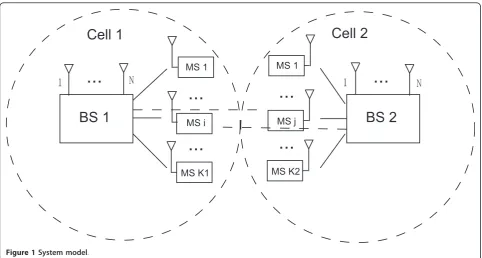
The system under consideration as shown in Figure 1 consists two base stations, utilizing the same radio spec-trum to serve their selected users. Both base stations are equipped withNantennas, which facilitates beamform-ing transmission, whereas each user has only a sbeamform-ingle receive antenna due to its size or complexity constraint. The work in this paper relies on the fundamental assumption that only one user in each cell is served in each time slot. The general multi-user scheduling per cell case will be included in the future work. The user set in cell 1 is denoted by I ={1, 2, . . . , i, . . . , K1},
and that in cell 2 by J ={1, 2, . . . , j, . . . , K2}. The
channel vectors are defined as following,
h1iis theN× 1 channel vector from the base station 1 to theith user in cell 1, i.e.i∈I.
h2iis theN× 1 channel vector from the base station 2 to theith user in cell 1, i.e.i∈I.
h1jis theN× 1 channel vector from the base station 1 to thejth user in cell 2, i.e.j∈J.
h2jis theN× 1 channel vector from the base station 2 to thejth user in cell 2, i.e. j∈J.
We assume that, with proper power control mechan-ism, the users experience homogeneous Rayleigh fading with respect to their target BS. Thus, each component ofh1iandh2jis modeled as independent and identically distributed (i.i.d) complex Gaussian random variables with zero mean and unit variance. When mobile users are randomly populated in their specific cell coverage area, the average received interference power is dynamic, due to the various distances from the neigh-boring BS to the users. Each component of the
interfer-ence channel vector h1j and h2i is modeled as
independent complex Gaussian random variables with zero mean and varianceδj(resp.δi) with respect to userj (resp.i). As will be seen in later section, we will focus
mostly on the interference channel from BS2 to the
selected user in cell 1, denoted byh2i*. We assume that
each component of h2i* is modeled as i.i.d. complex
Gaussian random variables with zero mean and a com-mon variance δi* . For the special case that the mobile
users are distributed along the cell boundary, and thus all the users have approximately the same distance with the neighboring BS, we can assume each component of
h1jand h2iis modeled as i.i.d. complex Gaussian ran-dom variable with zero mean and varianceδ, i.e.δi=δj
=δfor all iandj.
user in its coverage area.1 The codebook is assumed to consist ofBunit-norm vectors of lengthN, randomly gen-erated from an isotropic distribution [20]. With their wired connection to the switching center, the BSs can exchange a limited amount of control information for coordinated beamforming transmission. Specifically, the BS can communicate the utilized beamforming vectors to each other and to the users using the index of the code-book. Assume that the channel keeps constant in a feed-back cycle. With the proper design of the beamforming vectors and user selection, the inter-cell interference can be controlled. The specific design and selection scheme proposed in this work will be discussed in the following secions. For the multitransmit antenna case under consid-eration, the received signal at theith user in cell 1 andjth user in cell 2 can be written as
yi=
P1hT1iw1s1+
P2hT2iw2s2+ni,i∈I,
yj=
P2hT2jw2s2+
P1hT1jw1s1+nj,j∈J.
(1)
respectively, where si(i = 1, 2) are data symbols to selected users and wi(i = 1, 2) are the corresponding beamforming vectors. We generally have||wi||2 = 1,i= 1, 2. P1 and P2 are the corresponding transmit powers
for cell 1 and 2, ni and nj are the additive Gaussian noise.
3. Transmission strategies
In this section, we present the fundamental principles and the mode of operations of several
reduced-complexity dual-cell beamforming transmission strate-gies. For analytical tractability, we focus on dual-cell scenario.
3.1. Selfish random beamforming (SRB)
This scheme assumes that the system is completely una-ware of the intercell interference. BS1 and BS2 just
per-form the conventional random beamper-forming separately. BS1 (resp. BS2) randomly selects a vector, denoted byw1
(resp.w2) from its codebook as beamforming vector and
transmits a pilot symbol with this vector. Every user in the coverage area of BS1 (resp. BS2) will estimate and
feed back its received signal-to-noise ratio (SNR), which will be proportional the projection power of users chan-nel vector on to the beamforming direction, i.e. |hT1iw1|2(resp.|hT2jw2|2). Note that users will not need
to estimate its channel vector in this process and each only needs to feed back a real number for user selection. BS1(resp. BS2) will select the user achieving the largest
SNR among all users, i.e. user i* (resp. j*), where i∗ = arg maxi|hT1iw1|2(resp.j∗= arg maxj|hT2jw2|2). With
conventional random beamforming strategy, transmis-sion will then start without any mechanism for control-ling the interference from the other base station. Therefore, we can determine the SINRs of the selected users as
γ1=
P1maxi|hT1iw1|2
P2|hT2i∗w2|2+N0
,γ2=
P2maxj|hT2jw2|2
P1|hT1j∗w1|2+N0
, (2)
BS 1
...
...
MS K2 MS 1
Cell 1
Cell 2
BS 2
...
MS j
...
...
MS K1 MS 1
MS i
...
whereN0 denotes the Gaussian noise power.
3.2. Interference-aware random beamforming (IA-RB)
The operations of this scheme shares a lot in common with the SRB scheme. The only difference is that every user in the coverage area of BS2 (BS1 would follow
exactly the same operations) will estimate and feed back its received signal-to-noise and interference ratio (SINR), with signal power proportional to |hT2jw2|2 and
Then, the BSs will select the user that achieves the largest SINR. Note that as long as the two BSs do not transmit their pilot symbols simultaneously, the users will not need to estimate their channel vectors to deter-mine SINR. Again each user will only feed back a real number for user selection. And the achieved SINRs of the two selected users can be presented as
γ1= max
3.3. Random beamforming with limited coordination (LC-RB)
The scheme differs from SRB and IA-RB as it achieves coordinated beamforming transmission with limited overhead signaling. Without loss of generality, we assume that BS1 starts its user selection for
beamform-ing transmission first. In particular, BS1performs exactly
the same as SRB to complete the beam and user selec-tion for first cell.
The selected user by BS1, referred as useri*, will
esti-mate its MISO channel from the interfering base station BS2, denoted byh2i*. With this channel state
informa-tion, user i* will determine the beamforming vector that leads to the smallest amount of interference to itself and should be used by BS2, and feed its index back.
Mathe-matically speaking, the beamforming vector w2 should
satisfy |hT2i∗w2|2= minl|hT2i∗wl|2.
BS1will inform BS2the desired beamforming vector to
use through the wired backhaul connection. BS2 will
broadcast training symbol using the selected beamform-ing vector for its own user selection. Every user in the coverage area of BS2 will estimate and feedback its
received SINR. BS2 will select the user that achieves the
maximum SINR among all users to serve, i.e. user j* wherej*=arg maxjg2,j.
Based on the above mode of operation, we can deter-mine the SINRs of the selected users with LC-RB, as
γ1=
According to the transmission schemes described above, it has been observed that all the strategies can be smoothly extended into the general multi-cell cases. For instance, SRB and IA-RB can be directly applied in multi-cells, due to its non-coordination between BSs. And for LC-RB, all the participating cells can work sequentially in order to complete the scheduling. Indeed, a 3-cell or 7-cell setup will be more practical, however, despite the number of interfering sources and geometric distributions, the strategies keep similar from the inter-ference control perspective.
It is also worth noting that the similar design have been considered in the standard activities for LTE Advanced and IEEE 802.16 m [21]. In this work, we complement those simulation studies of such designs with the exact sum-rate capacity analysis.
4. Sum-rate analysis for identical average interference power case
This section provides the sum-rate analysis assuming that the average interference power is identically dis-tributed, i.e. δi =δi = δ. Essentially, we consider the scenario that mobile users are distributed along the cell boundary. Meanwhile, the transmitted signal ener-gies for both cells have been defined as Es1 =P1T, Es2
=P2T, in whichT denotes the transmit time duration.
Notice that in our later work, without loss of general-ity, we all assume P1 = P2 = 1. That is why all the
power term has been dismissed in the later derivations.
4.1. Common analysis
We first present some statistical results on the ordered projection norm squares, which will be broadly applied in the later analysis. Noting that each component of vectors discussed in this section is modeled as i.i.d. complex Gaussian random variable with zero mean and unit variance.
fal:K(x) =
K!
(K−l)!(l−1)!(1−e
−x)K−le−lx,x≥0. (6)
We now consider the project norm square of vectorh ontoBnormalized vectors,wj,j=1,...,B, i.e.bj= |hTwj|
2
, j= 1, 2,...,B, and focus again on thelth largest one among totallyB projection norm square, i.e.bl:B. Since
wjare not necessarily orthogonal with one another, the projection norm squares no longer constitute a set of independent random variables. To overcome such diffi-culty, we rewritebl:Bas
bl:B= rankl{|
hT
||hT||wj|
2} · ||hT||2 =u·v. (7)
It can be shown that | h T
||hT||wj|
2 follows i.i.d. beta
dis-tribution with parameters 1 and N- 1 [23], with PDF given by:
fβ(x) = (N−1)(1−x)N−2,x∈(0, 1). (8) Nowubecomeslth largest one ofBi.i.d. beta random variables, whose PDF can be obtained as
fu(x) =
B!(N−1) (B−l)!(l−1)!·
B−l
i=0
B−l i
(−1)B−l−i· A
j=0
A j
(−x)A−j,x∈(0, 1), (9)
whereA=(N- 1)(B- 1 -i) +N- 2.
Noting thatv=||h||2follows a modified χ(22N) distri-bution, with PDF given by:
fv(x) = 1 (N−1)!x
N−1e−x,x≥0,
(10)
the PDF of bl:B could be obtained as the product of two random variables [24]. After several steps of compu-tation, we have
fbl:B(z) =
B!
(B−l)!(l−1)!(N−2)!·
B−l
i=0
B−l
i
(−1)B−l−i· A
j=0
A j
zN−1(−1)A−jI(A−j−N
m;−z),x≥0,
(11)
where
I(a;b) =
1
0
xaeb/xdx= (−b)a
−πcsc((2 +πaa))b−b1 +(−aa)+(−b)
−aeb
1 +a +
(−a,−b)b
1 +a
. (12)
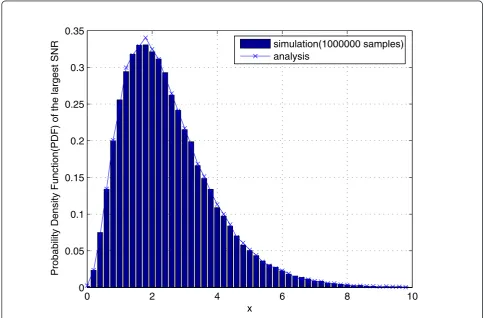
Note that this result can be broadly applied in other related analysis. In Figure 2, we plot the PDF of b1:B,
0 2 4 6 8 10
0 0.05 0.1 0.15 0.2 0.25 0.3 0.35
x
Probability Density Function(PDF) of the largest SNR
simulation(1000000 samples) analysis
and find that it matches perfectly with the simulation results.
4.2. Sum-rate analysis
In this part, we analyze the ergodic sum-rate perfor-mance of the beamforming transmission schemes under consideration. The sum-rate of the proposed dual-cell random beamforming system can be calculated as
R= SINR of the selected users in cell 1 and 2, respectively. We now derive the exact statistics of the selected users’ SINRs.
1) SRB: Due to the symmetry, let us consider the received SINR of selected user by BS1, as given in (2),
which can be rewritten as
γ1= ni follows the chi-square distribution with 2 degrees of freedom, whose common PDF is represented as
fni(x) =
After carrying out the integration with proper substi-tutions, we have
2) IA-RB: Again due to symmetry, we consider PDF of the received SNR at the selected user by BS2, which was
given in (4) as the maximum ofK2 independent random
variables, defined as
Note thatpterm follows i.i.d. χ(2)2 distribution over
J, with PDF
fp(x) =e−x, (19)
and qjterm are i.i.d. with χ(2)2 distribution over J,
but with varianceδ2, whose PDF is the same as (15). Following the similar steps as for SRB, we can obtain the PDF of γj,fγj(·), as
Finally, the PDF ofg2is obtained as,
fγ2(x) =K2[Fγj(x)]
K2−1f
γj(x). (22)
3) LC-RB: Based on the notation introduced in pre-vious subsection, the first user’s SINR, can be written as,
γ1= special case of the general result in (6) and (11), as
fa1:K1(x) =K1(1−e−
respectively. Note that the element of vector h∗2i has varianceδhere.
Consequently, the PDF of g1 can be calculated in
terms of PDFs of a1:K1 andbB:B, as
The statistics of the received SINR at the selected user by BS2is exactly the same as that of IA-RB scheme
pre-sented previously, with PDF given in (22).
4.3. Numerical examples
results in this paper have been verified through Monte-Carlo simulation.
For comparison purpose, we also provide the simula-tion results of one of the popular convensimula-tional coordi-nated beamforming techniques with user selection, with CSI exchange between cells, which is called coordinated zero-forcing beamforming (CZF). Specifically, the CZF option relies on a simple multiuser scheduling method, i.e. to select the user with the largest channel vector norm square. After the full CSI sharing between two cells, the new ‘super-BS’uses zero-forcing method to transform the interference channel into a MIMO broad-cast channel [3-5]. Suppose that h1i* and h2j* are the
two selected user’s channel vectors respectively in cell 1 and 2. Then, the beamforming vectorw1needs to satisfy
the orthogonality condition hH1j∗w1= 0 to cancel its
interference for cell 2.
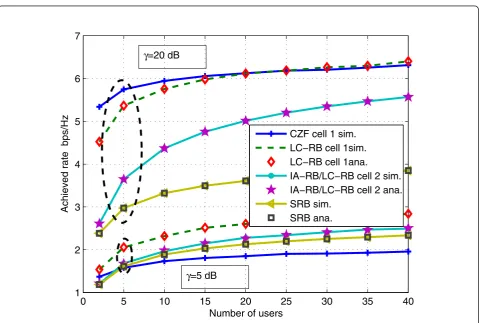
In Figure 3, we compare the single-cell achieved rates for three schemes under consideration as functions of the common number of users K=K1=K2. The radius
of each cellRis 1 km, the path loss exponent is 3.7, and both BSs are equipped withN= 4 antennas. Both analy-tical-and simulation-based curves have been provided. It
will be firstly observed that at high SNR regime (20 dB), CZF provides the best rate performance, due to its interference cancelation. And the cell 1 for LC-RB out-performs all the others, and can nearly approach CZF, especially when the volume of users is large enough. More specifically, under LC-RB, rate for cell 1 performs better than that for cell 2, owing to the effective inter-ference control from BS2 to cell 1. When the channel
SNR is low (5 dB) and the system is noise limited, LC-RB is still the best, while CZF performs the worst, since interference effect is trivial now.
5. Extension to non-identical average interference power case
As stated before, the identical average intercell interfer-ence power assumption only applies to the case that users are distributed along the cell boundary. In this section, we extend to the more general scenario, where users are randomly distributed in the cell coverage.
5.1. SINR analysis
1) SRB: For the non-identical interference case, the first selected user’s SINR can still be as given in (17). On the other hand,nis are no longer identically distributed. The
0 5 10 15 20 25 30 35 40
1 2 3 4 5 6 7
Number of users
Achieved rate bps/Hz
CZF cell 1 sim. LC−RB cell 1sim. LC−RB cell 1ana.
IA−RB/LC−RB cell 2 sim. IA−RB/LC−RB cell 2 ana. SRB sim.
SRB ana.
γ=20 dB
γ=5 dB
PDF ofnibecomes
After applying (27) into (17), we can obtain the PDF ofg1as
2) IA-RB: For non-identical interference case, γj in (18) are independent but not identically distributed. Spe-cifically, the PDF ofqjbecomes (15), but with parameter
δjinstead of commonδ. Applying similar strategies as in (20) and (21), we can obtain the PDF and CDF of γj for non-identical interference case as
fγj(x) = 1
respectively. Therefore, we can obtain the PDF of g2,
as,
where I(·; ·) was defined in (12). Applying (24) and (32) into (26), we can obtain the PDF of first selected user’s SINR. Give the expression of fγ1 after the substi-tution. That would make it easier to follow. Similar to identical interference case, the SINR PDF of the second selected user shares exactly the same expression as that of IA-RB scheme as given in (31).
5.2. Numerical examples
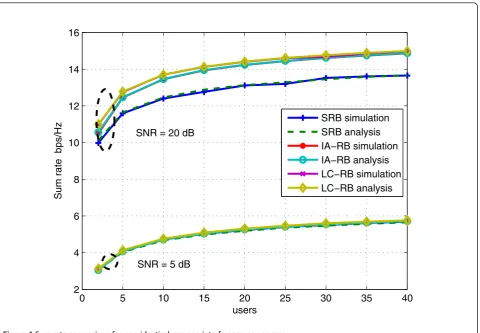
Figure 4 plots the sum-rate of three dual-cell transmis-sion schemes for non-identical interference power case. It can be observed that LC-RB and IA-RB offer compar-able performance gain over SRB at high SNR regime (20 dB), and the three share almost the same performance at low SNR regime (5 dB), owing to the tremendous noise effects. Moreover, the analysis results match
perfectly with simulation results, which verifies our ana-lytical approach. We also find the sum-rate gaps between LC-RB and the other two schemes are smaller than those for the identical interference power case. It attributes to the fact that the intercell interference for the user can be ignorable when the distance between the selected user and its neighboring BS is large,
The observation is further confirmed in Figure 5, where we examine the effect of interference strength, characterized by the distance from the selected user of cell 1 to BS2. At high SNR regime (SNR = 15 dB) and
the system performance is interference limited. The smaller the distance is, the larger the gap between RB and SRB gets, which shows the effectiveness of LC-RB on intercell interference control. And at medium and low SNR regime (SNR = 5, 0 dB) when the overall system suffers from severe Gaussian noise, LC-RB and SRB share almost the same performance. The fact leads to the idea of adaptive implementation, to further reduce the coordination overhead while maintaining the same sum-rate performance, which will be presented in the next section.
6. Adaptive implementations
As stated above, there is a tradeoff between sum-rate performance versus coordination overhead between LC-RB and SRB scheme, especially when the interfer-ence is severe, i.e. the selected user is close to the neighboring BS. Specifically, if the neighboring BS is far away from the selected user, the BS may decide only to perform SRB without coordination. Later simu-lation results will address that through adaptive imple-mentation, we have managed to further reduce the coordination load with only little rate performance loss for compensation. Noting that the decision-making process only depends on the distance information from the BS to the selected mobile user, the adaptive scheme is easy to implement. Note that the distance information is assumed to be shared between BSs dur-ing scheduldur-ing.
6.1. Mode of operations
With adaptive implementation, the selected user of cell 1 will firstly estimate its distance to the neighboring BS based on the average interference power. If the distance is larger than a threshold, denoted bydTH, and as such,
the interference can be viewed as negligible, the user will suggest BS1 to perform SRB. Otherwise, BS1 will
perform LC-RB so as to control the intercell interfer-ence. Note that only in the later case, the selected user of BS1 needs to estimate the channel from the
6.2. Coordination overload
We now quantify the average signaling overhead for coordinated beamforming with adaptive implementation. For the adaptive implementation, there are two styles of signaling message between the two BSs, depending coor-dination is needed or not. Specifically, if d >dTH, BS1
sends one bit of information to BS2 to indicate no coor-dination is needed, else if d<dTH, BS1 sends the index
ofw2 in the codebook, plus one bit of coordination
indi-cator, which leads to 1 + log2 B bits of overhead
signaling.
Based on these observations, we can easily calculate the coordination overloadcfor the adaptive implemen-tation, as
c= PR
πR2(log2B+ 1) + (1−
PR
πR2), (33)
where PRis the area in BS1 that the coordination is
needed, which can be calculated using some geometric analysis as
PR=πR2θ1
π +πd2TH θ2 π −
1 2(R
2sin(2θ
1) +d2THsin(2θ2)),(34)
and
θ1= arccos (
5R2−d2 TH
4R2 ),θ2= arccos (
d2 TH+ 3R2
2R2 ).(35)
6.3. Numerical examples
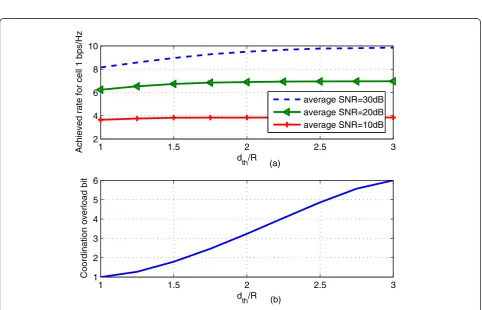
Figure 6 presents the throughput of cell 1 and coordina-tion overhead with the adaptive implementacoordina-tion, as the function of the normalized threshold dTH, for various
channel conditions. From Figure 6a, we can see that as dTH increases, the throughput of cell increases as the
system will invoke more coordination. Note that if dTH
=3R, the adaptive implementation is equivalent to the conventional LC-RB, and it reduces to SRB whendTH=
R. We also notice that the performance improvement
with larger threshold is more significant for high SNR range when the system is more interference limited. From Figure 6b, we can see that the coordination over-load is also increasing as the threshold increases.
There-fore, the threshold dTH can be used to balance the
tradeoff of throughput gain versus overhead signaling, especially when the system is within high SNR regime (e.g., 20 dB). And in medium and low SNR regime (e.g.,
0 5 10 15 20 25 30 35 40
2 4 6 8 10 12 14 16
users
Sum rate bps/Hz
SRB simulation SRB analysis IA−RB simulation IA−RB analysis LC−RB simulation LC−RB analysis SNR = 20 dB
SNR = 5 dB
1.4 1.6 1.8 2 2.2 2.4 2.6 2.8 3 2
3 4 5 6 7 8 9 10 11
d/R
Sum rate bps/Hz
SRB SNR=0 dB SRB SNR=5 dB SRB SNR=15 dB LC−RB SNR=0 dB LC−RB SNR=5 dB LC−RB SNR=15 dB
Figure 5Sum-rate comparison as function of normalized distance thresholdd/R(K = 10).
1 1.5 2 2.5 3
2 4 6 8 10
d
th/R
Achieved rate for cell 1 bps/Hz
(a)
average SNR=30dB average SNR=20dB average SNR=10dB
1 1.5 2 2.5 3
1 2 3 4 5 6
d
th/R
Coordination overload bit
(b)
10 dB and below), we incline to only apply SRB, since the rate will not enhance much, even when the coordi-nation overload is getting higher.
7. Conclusion
In this paper, we studied the ergodic capacity of dual-cell MISO broadcast channels with low-complexity ran-dom beamforming. In particular, we derived the exact analytical expressions of the ergodic sum-rate for three schemes with the help of some new statistical results and compared their performance in dual-cell environ-ment. We showed through selected numerical examples that the LC-RB scheme achieves tremendous perfor-mance over SRB and IA-RB for any volume of active users, with only a beam index sharing between cells. Moreover, we have extended the scenario to the more practical case, where users are arbitrarily distributed within the overall cell coverage and proposed an adap-tive coordination scheme. The generalization of the pro-posed schemes for multiuser parallel transmission is under investigation.
Endnotes
1
Other codebook such as Grassmannian codebook may lead to better performance. But for analytical tractability, we limit ourself to random codebook.
Acknowledgements
This work was supported in part by startup funds from the University of Victoria and in part by a Discovery Grant from NSERC. Part of the work in this paper has been presented in IEEE Global Communications Conference 2010 (Globecom’10).
Author details
1Department of Electrical and Computer Engineering, The University of
British Columbia, Vancouver, BC, V6T 1Z4, Canada2Department of Electrical
and Computer Engineering, University of Victoria, Victoria, BC, V8W 3P6, Canada
Competing interests
The authors declare that they have no competing interests.
Received: 26 January 2011 Accepted: 1 December 2011 Published: 1 December 2011
References
1. JG Andrews, W Choi, RW Heath Jr, Overcoming interference in spatial multiplexing MIMO cellular networks. IEEE Wirel Commun Mag.14(6), 95–104 (2007)
2. S Shamai (Shitz), O Somekh, BM Zaidel,Multi-Cell Communications: An Information Theoretic Perspective. Joint Workshop on Communications and Coding (JWCC), Florence, Italy (2004)
3. F Boccardi, H Huang, Zero-Forcing Precoding for the MIMO Broadcast Channel Under Per-Antenna Power Constraints, inProceedings of IEEE SPAWC,Cannes, 1–5 (2006)
4. K Karakayali, R Yates, G Foschini, R Valenzuela, Optimum Zero-Forcing Beamforming with Per-Antenna Power Constraints, inProceedings of IEEE International Symposium on Information Theory,Nice, France, 101–105 (2007) 5. W Yu, T Lan, Transmitter optimization for the multi-antenna downlink with
per-antenna power constraints. IEEE Trans Signal Process.55(6), 2646–2660 (2007)
6. M Costa, Writing on dirty paper. IEEE Trans Inform Theory39(3), 439–411 (1983)
7. S Shamai (Shitz), BM Zaidel, Enhancing the cellular downlink capacity via co-processing at the transmitting end, inProceedings of IEEE Vehicular Technology Conference, Rhodes, Greece, 1745–1749 (2005)
8. H Zhang, H Dai, Cochannel interference mitigation and cooperative processing in downlink multicell multiuser MIMO networks. EURASIP J Wirel Commun Netw.2, 222–235 (2004)
9. SA Jafar, G Foschini, AJ Goldsmith, Phantomnet: Exploring optimal multicellular multiple antenna systems. EURASIP J IIN-Appl Signal Process, Special issue on MIMO Commun Signal Process.2004, 591–605 (2004) 10. K Karakayali, GJ Foschini, RA Valenzuela, Network coordination for spectrally
efficient communications in cellular systems. IEEE Wirel Commun Mag. 13(4), 56–61 (2006). doi:10.1109/MWC.2006.1678166
11. GJ Foschini, K Karakayali, RA Valenzuela, Coordinating multiple antenna cellular networks to achieve enormous spectral efficiency. IEE Proc.153(4), 548–555 (2006). doi:10.1049/ip-com:20050423
12. J Zhang, R Chen, JG Andrews, A Ghosh, RW Heath Jr, Networked MIMO with clustered linear precoding. IEEE Trans Wirel Commun.8(4), 910–1921 (2009)
13. H Huang, S Venkatesan, Asymptotic downlink capacity of coordinated cellular network, inProceedings of the IEEE Asilomar Conference on Signals, Systems, and Computers, Pacific Grove, CA, 850–855 (2004)
14. D Aktas, MN Bacha, JS Evans, SV Hanly, Scaling results on the sum capacity of cellular networks with MIMO links. IEEE Trans Inform Theory52(7), 3264–3274 (2006)
15. S Jing, DNC Tse, J Hou, JB Soriaga, JE Smee, R Padovani, Multi-cell downlink capacity with coordinated processing. EURASIP J Wirel Commun Netw. 2008(2008). Article IE 586878
16. O Simeone, O Somekh, HV Poor, S Shamai, Downlink macrodiversity with limited backhaul capacity. EURASIP J Wirel Commun Netw.2009(2009). Article IE 840814
17. J Zhang, JG Andrews, Adaptive spatial intercell interference cancellation in multicell wireless networks.28(9), 1455–1468 (2010)
18. Samsung, Inter-Cell Interference Mitigation Through Limited Coordination.
3GPP TSG RAN WG1, Jeju, Korea (2008)
19. J Zhu, H-C Yang, Low-complexity Coordinated Beamforming Transmission for Multiuser MISO Systems and its Performance Analysis, inProceedings of IEEE Global Communications Conference (Globecom 2010),Miami, FL (2010) 20. B Hassibi, TL Marzetta, Multiple-antennas and isotropically random unitary inputs: the received signal density in closed form. IEEE Trans Inform Theory 48(6), 1473–1484 (2002). doi:10.1109/TIT.2002.1003835
21. Alcatel-Lucent, UE PMI feedback signalling for user pairing/coordination.
3GPP TSG RAN WG1, Prague, Czech Republic (2008)
22. M Sharif, B Hassibi, On the capacity of MIMO broadcast channels with partial side information. IEEE Trans Inform Theory51(2), 506–522 (2005). doi:10.1109/TIT.2004.840897
23. CK Au-Yeung, DJ Love, On the performance of random vector quantization limited feedback beamforming in a MISO system. IEEE Trans Wirel Commun.6(2), 458–462 (2007)
24. AG Glen, LM Leemis, JH Drew, Computing the distribution of the product of the two continuous random variables. ELSEVIER Comput Stat Data Anal. 44(3), 451–464 (2004). doi:10.1016/S0167-9473(02)00234-7
doi:10.1186/1687-1499-2011-191