R E S E A R C H
Open Access
Optimality of beamforming condition for multiple
antenna systems with mean feedback
Wen Zhou
1*, Hongyang Chen
2and Wong Hing Lam
3Abstract
The necessary and sufficient condition for beamforming optimality for multiple-input multiple output (MIMO) systems with mean feedback has been derived and thoroughly investigated in this article. The condition is an inequality that contains parameters of the number of antennas, transmission power, and the singular values of channel mean matrix. When the beamforming optimality condition is satisfied, the Shannon capacity of MIMO system can be achieved by beamforming and hence scalar codes can therefore be used to achieve the maximum capacity. The channel is modeled as the sum of a scattering matrix of i.i.d zero mean, unit variance complex Gaussian random variables, and a mean matrix having its rankr≥1. The beamforming condition inequality performance versus system parameters of signal-to-noise ratio and Ricean factor have thoroughly been
investigated by numerical results. Computer simulations show that the beamforming strategy can be adopted on a relatively relaxed beamforming condition without the loss of capacity performance.
Keywords:Multiple-input multiple output (MIMO), beamforming, mean feedback, rank
1. Introduction
In the long-term evolution advanced (LTE-A) [1] of the 3rd Generation Partnership Project, multiple-input multi-ple output (MIMO) has been considered as a key technol-ogy in the physical layer. Telatar [2] and Foschini [3] first formulated the system capacity of the MIMO systems assuming independent and identically distributed fading at different antennas. Having acquired the perfect channel state information (CSI) in the MIMO systems, the trans-mitter performs a linear transform by multiplying the eigenvector of channel matrix and allocating the power of each data stream by waterfilling algorithm, its system capacity can be obtained. When the transmitter has only partial CSI such as the statistical information of the chan-nel, acquiring the optimal transmission covariance matrix and deriving the condition for beamforming optimality are two major obstacles. A few studies on this aspect have been presented [4-11]. For one issue, to achieve maximum system capacity, the optimal transmission of covariance matrix is essential to the optimal transmitter. For another, by verifying whether the beamforming optimality condi-tion is satisfied, we can determine whether the transmitter
can adopt the beamforming strategy. If so, the operation at the transmitter will be simplified significantly since exhaustive searching for the optimal power allocation is no longer needed and therefore the scalar codes instead of vector codes can be adopted.
Usually, there are two kinds of feedback mechanisms, namely, the mean and the covariance feedbacks [4,6-10]. Visotsky and Madhow [4] first resolved the transmitter optimization and derived the optimality condition for beamforming under two cases of mean and covariance feedbacks for the consideration of the multiple-input sin-gle-output system. Later, Jafar and Goldsmith [6] extended Visotsky and Madhow’s work to MIMO systems, with the assumption that the rank of channel mean matrix is one for channel mean feedback. In [8], the optimal transmis-sion directions and the condition for beamforming optim-ality have been derived to maximize theeffective capacity. The concept of effective capacity[12] was proposed to measure the quality of service. Jorswiecket al. [8] mainly focused on the case of covariance and the mean feedbacks were not considered. Liet al. [10] studied the transmitter optimization and beamforming optimality conditions for double-scattering MIMO channels. The channel model was characterized as a matrix product of transmitter,
* Correspondence: [email protected]
1Department of Electronic Engineering, Shantou University, Shantou, China
Full list of author information is available at the end of the article
receiver, and scattering correlation matrices and the covar-iance feedback was used.
This paper focuses on the derivation of beamforming optimality condition under the mean feedback. In gen-eral, the rank of the covariance matrix of the transmis-sion signal is larger than one. By limiting the covariance matrix of the transmitting signal to be one, all power at the transmitter is allocated to a single data stream and therefore the MIMO system is reduced to a single-input single-output system. Correspondingly, this kind of trans-mission strategy is termed as beamforming strategy. Usually, the rank of optimal transmission covariance matrix of achieving the maximum system capacity is not equal to 1, i.e., the beamforming strategy is not necessa-rily the optimum strategy. Only if the system settings satisfy a certain condition, then the beamforming strategy achieves the maximum system capacity and it is optimal. Corresponding condition is referred to as the beamform-ing optimality condition. In this study, the rank of chan-nel mean matrix is generalized and it is not limited to be 1. Therefore, this study is an extension of [6]. The condi-tion for the beamforming optimality is an inequality that contains parameters such as the number of antennas, transmission power, and the singular values of channel mean matrix. The inequality is derived and also thor-oughly investigated by numerical method. We also com-pare the ergodic capacities of the beamforming strategy, optimum strategy, and the equal power allocation method. We also provide a list of conditions under which the beamforming strategy can be adopted.
The rest of the paper is organized as follows. Section 2 describes the MIMO system model. Section 3 derives the necessary and sufficient condition for beamforming optim-ality under mean feedback. The ergodic capacities for beamforming and optimum strategies have been presented in Section 4. Numerical results and computer simulation are discussed in Section 5, followed by conclusion in Section 6.
2. System model
Consider the multiple antenna systems equipped with
NT transmitter antennas and NR receiver antennas.
Assuming that the MIMO channel is flat fading, the received signal is given by
y = Hx + w, (1)
wherex∈ NT is the transmitted signal,y∈ NR is the
received signal, H∈ NR×NT is the channel matrix, ℂ
stands for the complex number field, w∈ NR is the
complex additive white Gaussian noise vector having i.i.
d elements with zero means and s2 variances. The
transmitted signalx satisfies a power constraint,E(XTX)
≤P, whereE(·) denotes the expectation operation and (·)
T
stands for conjugate. The channel matrixHis normal-ized and expressed by
H =A1Hµ+A2Hw
=
K
K+ 1Hµ+
1
K+ 1Hw,
(2)
where K is the Ricean factor. The matrix Hμ is a
deterministic mean matrix which represents the LOS component and satisfies
Tr(HµHH
µ) =NRNT, (3)
whereTr(·)denotes the trace operation, (·)Hstands for the Hermitian operation. The matrix Hw is a complex Gaussian matrix representing scattering component, which has independent circularly complex Gaussian ele-ments with zero means and unit variances. It is assumed that the receiver has perfect each realization of Hand the transmitter has only the mean informationHμ and Ricean factor K. The input distribution that maximizes the mutual information is always circularly complex Gaussian [2]. The MIMO system capacity is therefore given by
C= max
Q:Tr(Q)≤PC(Q), (4)
where
C(Q) =E
log|INR+
HQHH
σ2 |
, (5)
Qis the transmission covariance matrix. The MIMO
system signal-to-noise ratio (SNR) is defined as the SNR at each receiver antenna and it is given by
SNR = P
σ2. (6)
3. The condition for beamforming optimality under mean feedback
The necessary and sufficient condition for optimality of beamforming for MIMO systems under mean feedback is derived in Section 3.1. The issue about numerical eva-luation for the condition is also addressed in Section 3.2.
3.1. Derivation of beamforming optimality condition
We start with the results presented in [13]. Venkatesan
et al. [13] have proved that the optimal transmit covar-ianceQhas the same eigenvectors as the channel mean matrixHμ. Let
Hµ=UμμVH
be the singular value decomposition (SVD) of channel mean matrixHμ, and
Q=UQQUQH (8)
be the spectral decomposition ofQ. We have
UQ=Vμ. (9)
Substituting (7)-(9) into (5) and noting that the statis-tics of matrix after multiplication ofHwwith a unitary matrix remains unchanged, we have
C= max above formula yields
C= max
impose a constraint of being unit rank on the covariance matrixQto derive the condition of beamforming optim-ality. Without loss of generality, assume that
Q= diag{λQ1,λ
can be further expressed as
C= max
As the functionC is concave with respect to p, the necessary condition for beamforming optimality is ∂C/
∂p|p = 0≤ 0. DifferentiatingC(p) with respect topand
noting that the derivative of the function log |A+xB| atx= 0 istr(A-1B), we have
The second term on the right-hand side of (14) can be further written as
Tr
Proceeding with the derivation of (14), we have
|∂C/∂p|p=0
NRbyNRmatrix with theith diagonal element being 1,
||·||Fstands for Frobenius norm. Since the sum of {bj} is
To further derive the above formula, we consider the following matrix inversion lemma [14].
Lemma 1: For the matrix B=A +xyH, where x and
y are two vectors, the inversion of B is
B−1=A−1−A−
1xyHA−1 1 +yHA−1x.
Proceeding with the derivation of (17), the second term on the right-hand side of (17) can be further expressed as
Since Di= diag(0,...,1,...,0) with the ith diagonal
ele-ment being 1, we have
Tr is found that
E
Tr
= 0 for j> 2, the formula (21) achieves the maximum value and so does (16). Thus, manipulating (16), (17), and (21), the necessary condition for beamforming optimality is given by
F(P,σ2,NT,NR,μ,K)≤0, (22)
And the functionF(·) is referred to as the beamform-ing function.
Finally, the necessary condition expressed by (22) is also the sufficient condition because the second derivative ofC
(p) is equal to or less than 0, i.e., ∂ 2C(p)
∂p2 ≤0. The suffi-ciency proof is the same as that in [6]. Thus, it is con-cluded that the necessary and sufficient condition for beamforming optimality is given by the inequality (22). When the condition (22) is satisfied, we can adopt the beamforming strategy at the transmitter to achieve the maximum capacity of MIMO systems under mean feed-back. The beamforming strategy includes three steps:
Step 1: The transmitter obtains the mean feedbackHμ
from the receiver and performs SVD to retrieve the eigen-vectorVμ, as in Equation 7.
Step 2: The optimal power allocation matrix is set as Q,BF=|diag{P, 0, ..., 0} |NT×NT.
Step 3: Assuming the original user data
x='xi,i= 1, 2, ...,NT (
is coded by i.i.d Gaussian code and therefore each data stream xi is i.i.d Gaussian dis-tributed. Then, the transmitter performs linear
transfor-mation to obtain the transmitted signal x, i.e.,
x=1/2Q,BFVμx’.
3.2. Numerical evaluation for beamforming optimality condition
Let z1|L21|2 and z2=L•12F, the probability density
function (PDF) ofz1is given by
fz1(x) =
(K+ 1)e−(K+1)x, forx≥0;
0, else. (24)
Let z3 =z2 - z1, then the PDF ofz3 can be obtained from the transform of the PDF of a non-central Chi-squared distributed random variable and it is given by
fz3(x) =
where Γ(·) is the Gamma function. As the Jacobian determinant of (z1, z3) with respect to (z1, z2) is 1, the
Therefore, with formulas (25) and (27), the necessary condition for beamforming optimality given by (22) can be evaluated by numerical method.
4. Ergodic capacities for beamforming and optimum strategies
This section presents the ergodic capacities for beam-forming and optimum strategies. First, when the condi-tion (22) for optimality of beamforming is satisfied, we can adopt the beamforming strategy to achieve the maxi-mum capacity of MIMO systems. Substituting the beam-forming transmitter power allocation matrix into (10), we have the capacity for beamforming,CBF, given by
CBF=E
optimum strategy means that the optimal transmitter covariance matrix of maximizing the system capacity of (10) is determined by numerical optimization method. A few algorithms have been proposed to search the opti-mal covariance matrix [15,16]. Specifically, the optiopti-mal transmission strategy also includes three steps. Steps 1 and 3 are the same as that of beamforming strategy. Merely, the optimal power allocation matrix∑Q,OPTis acquired by numerical searching method in Step 2. Once∑Q,OPTis found, the ergodic capacity for optimum strategy is obtained by substituting it into formula (10).
5. Numerical and simulation results
condition and ergodic capacity. The condition of beam-forming optimality expressed by (22) is evaluated by numerical method. The ergodic capacity for beamform-ing strategy given by (28) is evaluated by computer simulation. For the sake of comparison, we also present the ergodic capacities for equal power allocation and optimum strategy, respectively. Table 1 lists the singular values of channel mean matrix for different antenna pairs.
5.1. The effects of Ricean factor and antenna pair on the beamforming functionf
Figure 1 shows the beamforming function F versus
Ricean factor K, for different values of SNRs. The
antenna pair is (2, 2) and the corresponding matrix ∑μ
is given by Table 1. Observe that F decreases whenK increases from -10 to 20 dB at a fixed SNR. For SNR = 5 dB, F decreases from 2.76 to 1.68 whenK increases from -10 to 5 dB. Further increasingKonly marginally decreases F. Similar behaviors can be found for the other two cases. Increase of SNR results in increase of
F. It is found that the beamforming optimality condition is satisfied as F≤ 0 when K > -2.6 dB for the case of SNR = -5 dB. It does not hold for the other two cases.
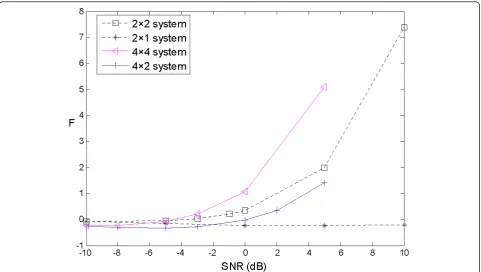
Figure 2 depicts the beamforming functionFfor
sev-eral antenna pairs. Observe that F increases with
increasing SNR. For 4 × 4 system, F increases rapidly when SNR is larger than 0 dB. Similar behaviors can be found for 2 × 2 and 4 × 2 systems. However, for 2 × 1
system, the beamforming function Fremains around 0
for SNR ranging from -10 to 10 dB. The SNR thresholds forF= 0 are approximately equal to -3, 0.2, and -4.5 dB for 2 × 2, 4 × 2, and 4 × 4 systems, respectively. Thus, it is observed that the beamforming optimality condition tends to hold for relatively low SNR and small number of receiver antennas.
5.2. Capacity comparisons among several transmission strategies
Figure 3 depicts the 2 × 1 system ergodic capacities of the beamforming, the optimum strategy, and the equal power allocation, respectively. Observe that the capa-city for optimum strategy has about 0.8 dB gain over that of equal power allocation when achieving the same ergodic capacity. The capacity for beamforming strategy is nearly the same as that of optimum strategy for SNR ranging from -5 to 20 dB. Note that the beamforming optimality condition holds for SNRÎ [-5 dB, 20 dB].
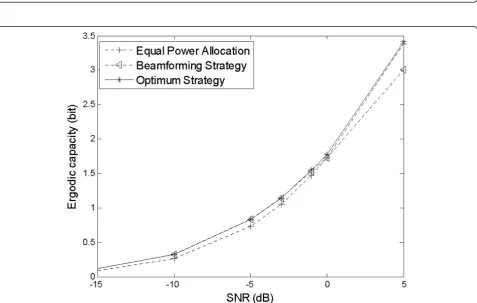
Figure 4 depicts the ergodic capacities of the three cases for 2 × 2 system. Observe that the capacity for beamforming strategy is nearly the same as that of opti-mum strategy for SNR ranging from -15 to 0 dB. How-ever, the beamforming strategy is inferior to the optimum strategy when SNR is larger than 0 dB. The equal power allocation is inferior to the optimum strat-egy when SNR < 0 dB. However, it is marginally the
same as that of the optimum strategy at SNR≥ 0 dB.
Therefore, it is clear that the transmitter can adopt the beamforming strategy for SNR < 0 dB and the equal power allocation method for SNR≥0 dB. Note that the beamforming optimality condition only holds for SNR < -3 dB. But, the simulation results show that beamform-ing strategy is nearly optimal for SNR < 0 dB. Mean-while, the beamforming function Fis equal to 0.32 at SNR = 0 dB.
Figure 5 compares the 4 × 2 system ergodic capacities for the beamforming strategy, the optimum strategy, and the equal power allocation, respectively. Observe that the capacity for beamforming strategy is almost the same as that of optimum one for SNR < 2 dB. The equal power allocation is much inferior to both the beamforming and optimum strategies. Note that beam-forming function Fis about equal to 0 at SNR = 0.2 dB and 0.33 at SNR = 2 dB.
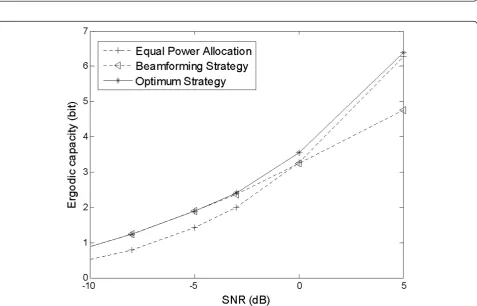
As in Figure 6, it is clear that the transmitter can adopt the beamforming strategy for SNR < -3 dB and the equal power allocation method for SNR > 0 dB. Note that beamforming function F is equal to 0.22 at SNR = -3 dB. Combining the results with those of Figures 3 and 4, it is found that the beamforming strat-egy achieves nearly the same capacity with that of the optimum strategy, if Fis approximately less than 0.3. So, it is concluded that the beamforming strategy can be adopted to achieve the same capacity with the optimum strategy on a relatively relaxed constraint ofF≤0.3.
6. Conclusions
The beamforming optimality condition for MIMO sys-tems under channel mean feedback has been derived. The rank of channel mean matrix, r, is not limited to one and satisfies 1 ≤ r ≤ min(NT, NR). The condition
has also been examined using a few examples with dif-ferent channel mean matrices and antenna pairs. Numerical results show that the beamforming optimality condition tends to hold for relatively low SNR and small number of receiver antennas. Three transmission strate-gies including the beamforming strategy, the optimum
Table 1 The channel mean matrix,∑μ, in (7) for different antenna pairs
Antenna pair (2, 1) (2, 2) (4, 2) (4, 4)
strategy, and the equal power allocation method, have been evaluated by computer simulation. Simulation results imply that the proposed beamforming strategy
can achieve nearly the same capacity as that of the opti-mum strategy on a relatively relaxed constraint ofF ≤ 0.3.
Figure 1The beamforming functionFversus Ricean factorKfor SNR = -5 dB, 0 dB, and 5 dB, respectively.
Figure 3The 2 × 1 system ergodic capacity versus SNR for the beamforming strategy, the optimum strategy, and the equal power allocation, respectively.
Figure 4The 2 × 2 system ergodic capacity versus SNR for the beamforming strategy, the optimum strategy, and the equal power
Figure 5The 4 × 2 system ergodic capacity versus SNR for the beamforming strategy, the optimum strategy, and the equal power allocation, respectively.
Figure 6The 4 × 4 system ergodic capacity versus SNR for the beamforming strategy, the optimum strategy, and the equal power
Abbreviations
CSI: channel state information; MIMO: multiple-input multiple output; PDF: probability density function; SNR: signal-to-noise ratio; SVD: singular value decomposition.
Acknowledgements
This study was supported by the Scientific Research Foundation of Shantou University of China (Grant no. NTF11004). In addition, the authors would like to thank the anonymous reviewers for their beneficial comments on this manuscript.
Author details
1Department of Electronic Engineering, Shantou University, Shantou, China 2Institute of Industrial Science, The University of Tokyo, Tokyo, Japan 3Department of Electronic and Electrical Engineering, The University of Hong
Kong, Pokfulam, Hong Kong
Competing interests
The authors declare that they have no competing interests.
Received: 24 June 2011 Accepted: 10 November 2011 Published: 10 November 2011
References
1. 3GPP TS36.913 V9.0.0: Requirements for further advancements for E-UTRA (LTE-Advanced) (December 2009)
2. IE Telatar,Capacity of Multi-Antenna Gaussian Channels(AT&T Bell Laboratories, 1995), BL0112170-950615-07TM
3. GJ Foschini, MJ Gans, On the limits of wireless communications in a fading environment when using multiple antennas. Wirel Personal Commun.6(3), 315–335 (1998)
4. E Visotsky, U Madhow, Space-time transmit precoding with imperfect feedback. IEEE Trans Inf Theory47(6), 2634–2639 (2001)
5. A Narula, MJ Lopez, MD Trott, GW Wornell, Efficient use of side information in multiple-antenna data transmission over fading channels. IEEE J Sel Areas Commun.16(8), 1423–1436 (1998). doi:10.1109/49.730451
6. SA Jafar, A Goldsmith, Transmitter optimization and optimality of beamforming for multiple antenna systems. IEEE Trans Wirel Commun.3(4), 1165–1175 (2004). doi:10.1109/TWC.2004.830822
7. JC Roh, BD Rao, Multiple antenna channels with partial channel state information at the transmitter. IEEE Trans Wirel Commun.3(2), 677–688 (2004). doi:10.1109/TWC.2003.821144
8. EA Jorswieck, R Mochaourab, M Mittelbach, Effective capacity maximization in multi-antenna channels with covariance feedback. IEEE Trans Wirel Commun.9(10), 2988–2993 (2010)
9. CB Chae, D Mazzarese, N Jindal, RW Heath, Coordinated beamforming with limited feedback in the MIMO broadcast channel. IEEE J Sel Areas Commun. 26(8), 1505–1515 (2008)
10. X Li, S Jin, X Gao, MR McKay, K-K Wong, Transmitter optimization and beamforming optimality conditions for double-scattering MIMO channels. IEEE Trans Wirel Commun.7(9), 3647–3654 (2008)
11. S Srinivasa, SA Jafar, The optimality of transmit beamforming: a unified view. IEEE Trans Inf Theory53(4), 1558–1564 (2007)
12. D Wu, R Negi, Effective capacity: a wireless link model for support of quality of service. IEEE Trans Wirel Commun.2(4), 630–643 (2003)
13. S Venkatesan, SH Simon, RA Calenzuela, Capacity of a Gaussian MIMO channel with nonzero mean, inProceedings of IEEE VTC, Orlando, 1767–1771 (2003)
14. TK Moon, WC Stirling,Mathematical Methods and Algorithms for Signal Processing(Prentice Hall, 2000)
15. LW Hanlen, AJ Grant, Optimal transmit covariance for MIMO channels with statistical transmitter side information, inProceedings of IEEE ISIT, 1818–1822 (2005)
16. E Jorswieck, H Boche, Optimal transmission with imperfect channel state information at the transmit antenna array. Wirel Personal Commun.27(1), 33–56 (2003). doi:10.1023/A:1026048118953
doi:10.1186/1687-1499-2011-160
Cite this article as:Zhouet al.:Optimality of beamforming condition for multiple antenna systems with mean feedback.EURASIP Journal on Wireless Communications and Networking20112011:160.
Submit your manuscript to a
journal and benefi t from:
7 Convenient online submission
7 Rigorous peer review
7 Immediate publication on acceptance
7 Open access: articles freely available online
7 High visibility within the fi eld
7 Retaining the copyright to your article