© 2015, IRJET.NET- All Rights Reserved Page 1739
SOIL STRUCTURE INTERACTION OF RC FRAMED IRREGULAR BUILDING
WITH SHEAR WALLS.
Sachin Hosamani
1, R.J.Fernandes
21
Final year student (M.tech-CAD structures), Civil Engineering Department, SDM college of Engineering and
Technology Dharwad, Karnataka, India
2
Asst.Professor, Civil Engineering Department, SDM college of Engineering and Technology Dharwad, Karnataka,
India
---***---Abstract -
Earthquake has a high potential to causea wide-spread damages in densely populated areas which causes heavy loss of human life and high economic losses. This cause of damage is due to lack of knowledge of the engineers and hence resulting in improper design of structures. The vertical load resisting system which is the main criteria in case of low rise buildings is not recommended for high rise buildings. As a result the inclusion of shear walls becomes imperative in case of high rise buildings. Shear walls are the lateral load resisting system which resist large horizontal forces. Conventional analyses of the buildings is done by taking the base of the structure to be fixed but in the real life the scenario will be different as compared to a fixed end condition because the soil beneath the foundation will make vary the earthquake forces and thus varying the lateral forces acting on the structure. Hence the effect of shear walls which when placed at different locations is studied in this paper. The effect of shear walls and also the soil structure interaction is studied for different heights of buildings to study the difference in parameters like time period, spectral acceleration co-efficient (Sa/g), base shear, storey shear, storey displacement and storey drift when considered against conventional fixed analyses. Study shows the base shear value increases building with shear wall 02 i.e shear walls placed at the centre along with corners.
Key Words:
Soil structure interaction, Shear wall,
Spectral acceleration co-efficient, Natural period, Base
shear.
1. INTRODUCTION
The structural engineer who designs earthquake-resistant structures needs to know as to how exactly the soils respond during an earthquake; not only is this important
for the foundation design itself, but the nature of soil overlaying bedrock may have a crucial modifying
© 2015, IRJET.NET- All Rights Reserved Page 1740 showed that SSI will increase the time periods of vibration
modes of lower orders, and longer time periods will be seen due to stiffness of foundation soil. Also it was shown that the SSI effect enhances the collapse resistance capacity of the Shanghai Tower. The response of asymmetric wall-type building system for altered position of stiffness and strength eccentricity, torsional investigation which when subjected to El Centro 1940 earthquake was studied by H. Shakib and G.R.Atefatdoost [3]. The decrease in strength reduction factors in case of soft soils when soil structure interaction is taken in to account, and therefore when fixed-base condition was considered strength reduction factors for interacting systems lead to non-conservative design forces was shown by M. ESER et al. [4]. Pandey A.D et al. [5] studied in case of changing topography, with increasing time, response reduction factor decreased.
In the present work, a parametric study is carried out for determining natural period of RC frame irregular building with shear walls placed at different locations for varying building heights and comparison is carried out for building incorporating effect of soil structure interaction to building with fixed base.
1.1 SOIL STRUCTURE INTERACTION
Soil-structure interaction analysis is carried out on 4, 6, 8, 12, and 16 storeyed buildings with and without shear wall resting on isolated foundation.
To study the effect of shear wall, shear walls of same size were placed at the core and all four sides in the exterior frames of building at corners. For incorporating the effect of soil flexibility, four soil types classified based on shear wave velocity are considered in the study.
Structural Idealization- Multi-storey reinforced concrete Framed buildings of 4, 6, 8, 12, and 16 storeys with and without shear wall are considered in present analysis. Buildings with vertical irregularity is considered. Shear walls of same size were symmetrically placed in both directions of the building in plan at the core and all four corners of building to study the effect of shear walls. The column size for six storey building is 0.3x0.3(m) and the corresponding shear wall thickness is 0.15m and the column size for nine storey building is 0.4x0.4(m) and the corresponding shear wall thickness is 0.2m and similarly the column size for 15 storey building is 0.6x0.6(m) and the corresponding shear wall thickness is 0.25m. The storey height considered is 3m and the bay length taken is 4m. The beam size for all buildings is taken as 0.25x0.3(m) and the thickness of slab is taken 0.12m. The live load at the floor level is taken to be 3kN and that at the roof level is 1.5KN. The concrete material property taken is M30 and steel grade chosen is Fe 415.
2. METHODOLOGY
The conventional method of analysis of a foundation of a structure is to consider the foundation as a fixed one rather a flexible foundation because in the real condition the soil will influence the structure to respond due to its ability to deform. Hence it is imperative to consider soil as a flexible one. The study will be done in the following ways: 1.) The effects of soil structure interaction base over the conventional fixed base of the building structures. 2.) The effects of shear wall and there effects depending on the different locations. 3.) To study parameters such as time period, spectral acceleration coefficient, base shear, storey shear, displacements, and drifts. 4.) To compare the above said parameters for conventional fixed case against flexible base.
3. MODELLING AND ANALYSIS
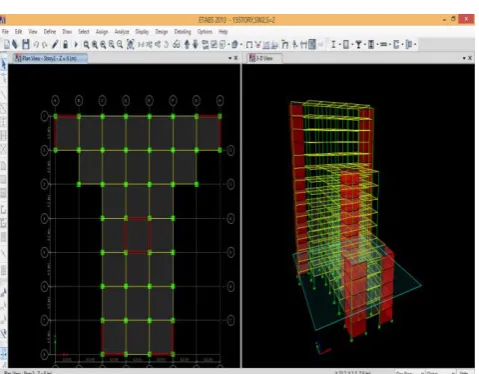
In the present study, vertical irregular three dimensional building of varying storey and of plan size 31.5mx31.5m is considered with the beam size 0.25mx0.3m and column size varying from 0.3mx0.3m to 0.6mx0.6m. The buildings of various storey have been considered like 6,9 and 15 storey to compare the analysis results for fixed base and flexible base condition. The slab is taken to be of 0.15m thick and is considered to be modelled as membrane. Here the building is first modelled as fixed end conditions and then the springs are assigned based on the size of footing in the fixed case, to counter act for soil structure interaction. The shear walls are provided in two ways i.e with the shear walls at the four corners and the other with shear walls at four corners along with shear wall at the centre. The shear walls of different dimensions are used with 0.15m thickness in case of six storey building, 0.20m thickness in case of nine storey building, and 0.25m thickness in case of fifteen storey building and analysed for different load cases as per code specification in ETABS software.
© 2015, IRJET.NET- All Rights Reserved Page 1741 Fig-2: Springs assigned at the base of the footing.
4. RESULTS
Following are the graphs which are produced after analyzing in the software, the graphs shown here are only of 15 storey building and similar work is carried out for 6 and 9 storey building. The results and the graphs shown are of Spectral acceleration co-efficient, Base shear, Storey shear, Storey displacement and Storey drift for soft soil S3. The notations used here are:
1) S1-hard soil (S=1) 2) S2-medium soil(S=2) 3) S3-soft soil(S=3) 4) Sa/g-spectral acceleration coefficient 5) BF-bare frame 6) SW1- shear wall 01-shear wall at the four corners 7) SW2-shear wall 02-shear wall at four corners and at the center.
Chart-1: Graphical representation of Spectral acceleration co-efficient (Sa/g) for soft soil(S3) pertaining to fixed and flexible base of 6 9and 15storey building.
Chart-2: Graphical representation of Base shear(kN) form soft soil(S3) pertaining to fixed and flexible base of 6 9 and 15storey building.
Chart-3:Graphical representation of storey shear pertaining to 15 storey fixed base.
© 2015, IRJET.NET- All Rights Reserved Page 1742 Chart-5:Graphical representation of storey displacement
pertaining to 15 storey fixed base.
Chart-6:Graphical representation of storey displacement pertaining to 15 storey flexible base.
Chart-7:Graphical representation of storey drift pertaining to 15 storey fixed base.
Chart-8:Graphical representation of storey drift pertaining to 15 storey flexible base.
5. CONCLUSIONS
In the present study the reinforced irregular building is analysed for different storeys and positioning of shear walls at different locations by including and not including soil structure interaction. The results lead to following conclusions.
1. Fundamental natural period of the flexible building system is more when compared to conventional fixed base. It also increases with the soft soil i.e with flexibility and increase in storeys and decreases with adding of shear walls.
2. Fundamental natural period of shear walls placed at four corners is more compared to that when shear wall placed at the center along with corners. 3. The adding of shear walls which is required for stiffness in lateral direction, increases the stiffness but also increases Spectral acceleration coefficient value.
4. Spectral acceleration coefficient is found lower in case of bare frames then that compared to shear wall buildings. It is maximum for shear walls placed at center along with four corners.
5. The shear wall 02 building has maximum response acceleration coefficient causing higher base shear values.
6. The base shear and Spectral acceleration coefficient values are smaller in case of flexible base compared to fixed case which is highly expected.
7. It was seen in old and conventional fixed base the base shear value was increasing with increase in flexibility of soil but where as it is decreasing in case of flexible base.
© 2015, IRJET.NET- All Rights Reserved Page 1743
ACKNOWLEDGEMENT
I am thankful to my guide, Asst. Professor, R.J.Fernandes in Civil Engg. Department for his support and guidance.
REFERENCES
[1] B. R. Jayalekshmi and H. K. Chinmayi “Effect of Soil Flexibility on Seismic Force Evaluation of RC Framed Buildings with Shear Wall: A Comparative Study of IS 1893 and EUROCODE8” march 2014.
[2] Mengke Li , Xiao Lu , Xinzheng Lu, Lieping Ye “Influence of soilestructure interaction on seismic collapse resistance of super-tall buildings” June 2014. [3] H. Shakib, G.R.Atefatdoost “Effect of Soil-Structure Interaction on Torsional Response of Asymmetric Wall Type Systems”2011.
[4] M. ESER, C. AYDEMIR, and I. EKIZ “Effects of Soil Structure Interaction on Strength Reduction Factors” 2011. The Twelfth East Asia-Pacific Conference on Structural Engineering and Construction.
[5] Pandey A.D, Prabhat Kumar, Sharad Sharma “Seismic soil-structure interaction of buildings on hill slopes .Volume 2, No 2, 2011.
[6] Jui-Liang Lin; Keh-Chyuan Tsai; and Eduardo Miranda “Seismic History Analysis of asymmetric buildings with soil–structure interaction”, Journal of structural engineering © asce / february 2009 .
[7] Er. Puneet Sharma, Er. Ankit, Er. Ismit Pal Singh “Soil Structure Interaction Effect on an Asymmetrical R.C. Building with Shear Walls” Volume 11, Issue 3 Ver. VII (May- Jun. 2014)
[8] Hamza Gullu and Murat Pala “On the resonance effect by dynamic soil–structure interaction: a revelation study” springer science 2014.
[9] Jinu Mary Mathew, Cinitha A, Umesha P K, Nagesh R Iyer and Eapen Sakaria “seismic response of rc building by considering soil structure interaction”. volume 1, number 3, 2014.
[10]IS 1893(part I) :2002- criteria for earth quake resistant design of structures.