Cite as: Can Urol Assoc J 2017;11(7):E271-6. http://dx.doi.org/10.5489/cuaj.4381 Published online July 11, 2017
Abstract
Introduction: We aimed to compare the efficacy of two different sling tensioning approaches, and to report our experience, includ-ing safety and impact on quality of life (QoL) of the Virtue® male
sling for the treatment of postprostatectomy incontinence (PPI). Methods: From our prospectively maintained database, we retro-spectively identified all men treated with the Virtue male sling for PPI between March 2009 and February 2014 by two urologists in two institutions. Baseline demographic data and the sling ten-sioning method were abstracted from the database. Likewise, the Patient Global Impression of Improvement (PGI-I) scale, severity of incontinence, and clinical outcomes were also abstracted. Results: 48 patients were treated with the Virtue quadratic male sling. Sling tensioning was done using cystoscopy in the first 18 patients (Group 1), while per-operative retrograde leak point pres-sure (RLPP) meapres-surement was done in the last 30 patients (Group 2). The median (interquartile range [IQR]) followup from the day of surgery was 22 (15‒41) months. At the last followup visit, 7 (39%) patients in Group 1 were cured or improved of their PPI, compared to 21 (70%) patients in Group 2 (p=0.03). The final median (IQR) RLPP in these patients was 41 (37–48) cm H2O.
Transient pain was the most common adverse event, occurring in 23 (48%) of patients. Twenty-one (70%) patients in Group 2 were “much better” or “very much better” with their device, compared to 7 (39%) in Group 1 (p=0.0008).
Conclusions: The Virtue male sling is a valuable treatment option for PPI. Per-operative RLPP measurement significantly improves cure and satisfaction rates.
Introduction
Postprostatectomy incontinence (PPI) accounts for the major-ity of cases of iatrogenic urinary incontinence. The reported
incidence varies from 1‒30%, depending on who reports the
incontinence (patient or physician), timing from diagnosis,
and degree of bother.1-3 The artificial urinary sphincter (AUS)
has long been considered the gold standard to treat PPI.4-6
Male slings were introduced in the late 1990s as a treat-ment alternative. Reports have shown them to be safe and effective while being considered less invasive than the AUS.
Moreover, Kumar et al7 demonstrated that many patients
would prefer a non-mechanical device, such as a male sling, as opposed to a mechanical one, such as the AUS, due to ease of use. Male slings include bone-anchored slings (which have been withdrawn from the market), adjustable retro-pubic or transobturator slings, retrourethral transobturator
slings, and quadratic slings, such as the Virtue® male sling
(Coloplast, Humlebaek, Denmark). The success rate of these
slings ranges from 40‒91%.8
The Virtue quadratic sling is a device for treating PPI con-sisting of a large pore-knitted monofilament polypropylene mesh with two pre-attached inferior (transobturator) exten-sions and two superior (prepubic) extenexten-sions. One of the challenges with male slings is evaluating adequate tension-ing of the sltension-ing and the degree to which the sltension-ing should be tightened intraoperatively. Surgeons may maximally tighten the sling or may visualize urethral compression using cystos-copy; however, these may not accurately or objectively reflect the true urethral resistance to flow. Retrograde leak point pressure (RLPP) measurement offers an objective measure of urethral resistance to flow and has been validated as a useful measurement of urethral resistance in male anti-incontinence
surgeries.9 Comiter et al demonstrated that each set of arms
of the Virtue quadratic sling contributed to increasing the
urethral resistance measured intraoperatively by the RLPP.10
As the surgical use of the Virtue quadratic sling and other slings has become increasingly popular, it is important to evaluate the safety and efficacy of these devices. The objec-tives of this study were to report our experience with the Virtue quadratic sling and to report its efficacy, safety, and impact on quality of life (QoL). Additionally, we compared the impact of the two different sling tensioning approaches (cystoscopy vs. RLPP) on the PPI cure/improvement rates.
Michael W. Sourial, MD, FRCSC
1; Patrick O. Richard, MD, FRCSC, MSc
1,2; Julie Morisset, MD, FRCSC
3;
Mazen Jundi, MD, FRCSC
3; Le Mai Tu, MD, FRCSC, MSc
1Methods
Patient selection and evaluation
This was an institutional review board-approved retrospect-ive study. All men who underwent surgery with implanta-tion of the Virtue quadratic male sling between March 2009 and February 2014 were identified from our prospectively maintained database. Individuals were followed until they experienced device failure, death, loss to followup, or data cutoff (November 30, 2015).
All slings were implanted by two urologists (LMT, JM) with significant experience in the treatment of PPI. Eligible subjects had stress urinary incontinence (SUI) (defined as bothersome stress incontinence that failed conservative man-agement and for which patient desired to undergo a surgical intervention intended to relieve symptoms) as a result of open or laparoscopic radical prostatectomy. Exclusion cri-teria included: 1) previous implant to treat SUI; 2) external beam radiotherapy (EBRT), cryosurgery, or brachytherapy within six months of implantation; 3) postvoid residua (PVR) >150 mL; and 4) unsettled bladder neck or urethral con-ditions (e.g., vesicourethral anastomotic stricture) likely to require further transurethral procedures.
Preoperative evaluation included detailed medical and surgical history and physical exam, pads per day (ppd), aver-age of 24-hour x three-day pad weight, urethrocystoscopy, urodynamic study including uroflowmetry, cystometry, PVR, and Valsalva leak point pressure (VLPP) measurement, and informed consent with other therapeutic options explained to the patient. Followup visits were at two, six, and 12 months, then yearly, and included an average of 24-hour x three-day pad weight, ppd, evaluation of postoperative pain. A uroflowmetry and PVR was also performed at 12 months. At each postoperative visit, the Patient Global Impression on Improvement (PGI-I) score (Appendix 1) was used to measure subjective QoL.
Data
The subjects demographic characteristics (age, prior rad-ical prostatectomy approach, prior history of radiation treat-ments, prior bladder neck pathologies [e.g., vesicourethral anastomotic strictures, etc.], and status of urethral mobility/ coaptation), urinary incontinence severity (ppd, average of 24-hour x three-day pad weight), urodynamic studies results, sling tensioning method (cystoscopy vs. RLPP), postopera-tive complications, and PGI-I scores were abstracted from the database.
Severity of incontinence was categorized as mild (0‒2
ppd or 24-hour pad weight <100 g), moderate (3‒5 ppd or
24-hour pad weight 100‒400 g), or severe (>5 ppd or 24-hour
pad weight >400 g). Postsling urinary incontinence status was
defined as cured if the patients wore no pads, improved if he
wore between 0‒1 ppd or ≥50% daily pad reduction, and not
improved if he had <50% daily pad reduction.
Sling placement
The Virtue quadratic male sling was placed according to the
technique described by Comiter et al.10 The ventral bulbous
urethra and pubic rami were exposed through a 5 cm verti-cal perineal incision, leaving the bulbospongiosus muscle intact. The urethra was slightly detached from the perineal body to allow proximal urethral repositioning upon sling tensioning. The transobturator arms were then attached to the introducer and passed from medial to lateral behind the ischio-pubic rami through the obturator foramen. The transobturator arms were then pulled through a small stab incision in the groin. A stab incision was made 2 cm above
the pubic symphysis and 2‒3 cm lateral to the midline on
either side, aiming to have the mesh and extensions laying adequately on the bulbospongious urethra. The introducer was passed from the pubic incision, anterior to the pubic bone, and out through the perineal incision lateral to the urethra on each side, using the index finger as a guide to safely bring the introducer out. The prepubic arms were attached to the introducer and pulled out through the inci-sion on each side.
Sling tensioning – Cystoscopic technique
The quadratic sling tension was adjusted by pulling both the transobturator and prepubic arms to assure proper urethral compression by performing intraoperative cystoscopy. Upon confirming good urethral coaptation, the arms were then secured in place with hemostats.
Sling tensioning – RLPP measurement
The quadratic sling tension was adjusted using RLPP
mea-surement.10 RLPP was measured as the height of the water
column (cm H2O) at which sling resistance was overcome
and fluid flow commenced. To calculate it, a 1 L bag of saline was connected to the catheter via cystoscopy tubing with the drip chamber half full. The bladder was first emp-tied and to ensure that the system was properly functioning, bladder pressure was measured and recorded. The catheter was then drawn back to the fossa navicularis and the column
of water was placed at 60 cm H2O. The transobturator arms
Sling fixation
Prior to sling placement, a 1-0 polypropylene suture was placed through the inferior aspect of the periosteum of the symphysis pubis. We used those sutures to fixate each pre-pubic arm, securing them to the periosteum and soft tissue
overlying the bone (1‒1.5 cm) lateral to the urethra on each
side. The transobturator arms were fixed in place with 1-0 polypropylene suture placed through the soft tissue adjacent to the proximal bulbar urethra. The hemostats and plastic sleeves were removed, and the final RLPP after sling fixation was measured at this point and recorded.
A long clamp was then passed from the perineal incision to the ipsilateral groin stab wound and the sling arm was grasped and pulled back through to the perineal incision. The excess was cut. All wounds were profusely irrigated with bacitracin antibiotic solution. The perineal and four-arm incisions were closed. The Foley catheter was replaced in the bladder and removed the following morning. Oral antibiotics were given for five days.
Objectives
The primary objective of the study was to compare the impact of two different tensioning methods (cystoscopy vs. RLPP) on the objective and subjective improvement of con-tinence using the Virtue quadratic male sling. Subjective
improvement was measured using the the PGI-I score.11-14
Secondary objectives were to report the midterm efficacy, safety, and impact on QoL of the Virtue quadratic male sling.
Statistics
Continuous variables were reported as medians (interquar-tile range [IQR]), while categorical variables were described with proportions. The baseline characteristics and surgical outcomes of the subjects who had tensioning performed using cystoscopic guidance and those who had it done using the RLPP method were compared using the Wilcoxon rank-sum test for continuous variables and the chi-squared or Fisher’s exact test for proportions, where appropriate. A mul-tivariate logistic regression model was generated to test for an association between the type of sling adjustment method (cystoscopy vs. RLPP) and the odds of obtaining an improve-ment of the SUI (either improved or cured), while adjusting for preoperative PPI (moderate/severe vs. mild). The odds ratios (OR) are presented with their 95% confidence intervals (CI). Lastly, proportions were used to report the safety and patient satisfaction. All data were recorded and statistical analyses were conducted using SAS v.9.4 (SAS Institute Inc., Cary, NC, U.S.). All tests were two-sided and p values <0.05 were considered statistically significant.
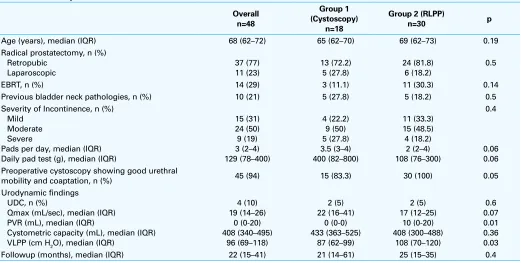
Table 1. Baseline patient characteristics
Overall
Age (years), median (IQR) 68 (62–72) 65 (62–70) 69 (62–73) 0.19
Radical prostatectomy, n (%)
Previous bladder neck pathologies, n (%) 10 (21) 5 (27.8) 5 (18.2) 0.5
Severity of Incontinence, n (%) Mild
Moderate Severe
Pads per day, median (IQR) Daily pad test (g), median (IQR) Preoperative cystoscopy showing good urethral
mobility and coaptation, n (%) 45 (94) 15 (83.3) 30 (100) 0.05
Urodynamic findings UDC, n (%)
Qmax (mL/sec), median (IQR) PVR (mL), median (IQR)
Cystometric capacity (mL), median (IQR) VLPP (cm H2O), median (IQR)
Followup (months), median (IQR) 22 (15–41) 21 (14–61) 25 (15–35) 0.4
Results
During the study period, 48 men were treated with the Virtue quadratic male sling. Cystoscopy was used to measure sling tensioning in the first 18 patients (Group 1), while RLPP measurement was performed in the last 30 patients (Group
2). Overall median (IQR) followup was 22 (15‒41) months:
21 (14‒61) months for Group 1, compared to 25 (15‒35)
months for Group 2. Baseline characteristics are shown in Table 1.
Overall, at the time of their last visit, 28 (58%) patients were either improved or cured of their PPI following surgery at the last followup visit. Seven (39%) patients in Group 1 were cured or improved of their PPI, compared to 21 (70%) patients in Group 2 (p=0.03). Even after adjusting for baseline PPI, men in Group 2 were more likely to have demonstrated an improvement or a cure of their PPI than men in Group 1 (OR 3.5; 95% CI 1.02–12.1). Postoperative
median (IQR) ppd for Group 1 vs. Group 2 was 1.5 (0‒3) vs.
0 (0‒1) (p=0.002); and three (1‒5) vs. one (0-1) (p=0.004) at
the two-month and last followup visit, respectively.
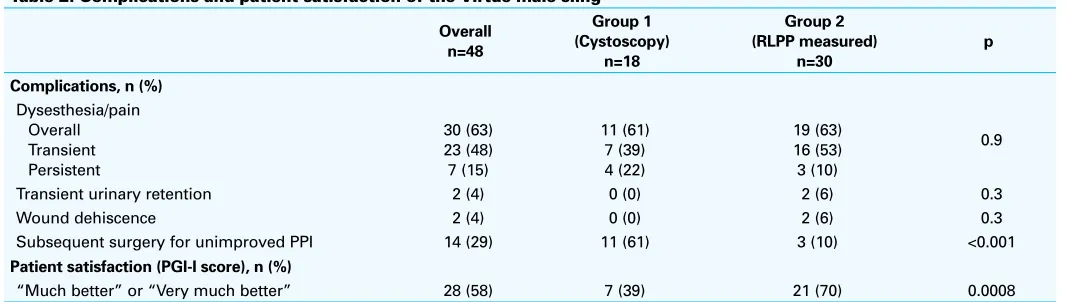
The most common complication was pain or dysesthesia (Table 2). This occurred transiently (diminishing/disappearing at the two-month followup visit) in the majority of patients (48%). Two (4%) patients had a wound dehiscence (one in the groin incision, the other in the perineal incision), both of which were debrided and primarily closed. There were no mesh erosions or infections in our series. Eleven (61%) patients in Group 1 compared to three (10%) patients in Group 2 had subsequent surgical treatments for their unim-proved PPI (p<0.001).
The PGI-I score was used to measure patient satisfaction. Of the patients in Group 1, seven (39%) reported being either “much better” or “very much better” at the time of their last followup visit compared to 21 (70%) patients in Group 2 (p=0.0008).
Discussion
PPI accounts for the majority of male iatrogenic SUI, with resultant impairment of QoL. Various male slings have emerged over the last decade as alternatives to the AUS for the treatment of PPI. The design of the Virtue quadratic male sling overcomes drawbacks of other male slings through the absence of bone screws, which may lower perineal pain, and a combination of horizontal urethral compres-sion by the transobturator arms, in addition to the vertical support of prepubic arms allowing a longer zone of
ure-thral coaptation. Comiter et al10 demonstrated that both the
transobturator and prepubic components of the quadratic sling each contributed to increasing urethral resistance as measured by intraoperative RLPP. Additionally, the surgical procedure does not require opening of the bulbospongiosus muscle, facilitating implantation and decreasing the risk of urethral erosion.
Comiter et al12 published the first clinical outcomes trial
on the Virtue male sling. The objective success rate with sling fixation was 79.2% at 12 months, with success being defined as “>50% decrease in 24-hour pad weight.” The cure rate, defined as a pad weight <1.3 g, was 46% at 12 months.
McCall et al15 recently published their series on 32 patients
with a median followup of 55 months. There were 21 (68%) patients who were considered procedure failures (defined as the inability to reduce patient’s preoperative pad use, sling explant for complications, and need for AUS due to contin-ued incontinence), and they have consequently abandoned implantation of the sling. There were 14 (44%) cases of postoperative urinary retention. Their technique to assess for adequate sling tensioning, however, was not fully elucidated. Furthermore, no RLPP values were reported in their series.
More recently, Ferro et al11 reported on their outcomes in 29
patients. They tension the arms maximally and fix them to the periosteum with a prolene suture (without measuring RLPP). In their series, 82.7% of patients used no pads per day and
Table 2. Complications and patient satisfaction of the Virtue male sling
Overall
Transient urinary retention 2 (4) 0 (0) 2 (6) 0.3
Wound dehiscence 2 (4) 0 (0) 2 (6) 0.3
Subsequent surgery for unimproved PPI 14 (29) 11 (61) 3 (10) <0.001
Patient satisfaction (PGI-I score), n (%)
“Much better” or “Very much better” 28 (58) 7 (39) 21 (70) 0.0008
17.3% used one pad per day at 12 months after placement of the sling, an excellent short-term outcome.
In our series, although we initially set the RLPP at 60 cm
H2O for sling tensioning, re-measurement of RLPP after sling
fixation with polypropylene sutures and hemostats removed
yielded a median RLPP of 41 cm H2O. Series on other male
slings, such as the Argus® male sling, have reported that
RLPP values of 45 cm H2O or higher were associated with
higher erosion rates, and suggested aiming for a value of
37 cm H2O.16 The “ideal” RLPP value for the Virtue male
sling is still unknown. We believe that although the sling
is initially tensioned at 60 cm H2O, this does not reflect
the true measure of urethral compression, but rather it is
the final RLPP remeasured aftersling fixation with sutures.
With a median RLPP value of 41 cm H2O, 13 (43%) patients
were completely cured (0 ppd) of their incontinence, with an additional eight (27%) showing improvement of their incontinence, comparable to the patient-reported cure and
improvement rates of other male slings in the literature.8,12
Furthermore, there were only two cases (6%) of transient urinary retention.
One of the challenges is to firmly fixate the sling at the desired RLPP value. In our experience, we have found that fixating the prepubic arms to the symphysis pubis periosteum with a prolene suture on either side increases the final RLPP measurement (i.e., closer to the initially set value of 60 cm
H2O) and that this helps firmly anchor the sling in place as
opposed to merely fixating it to the periurethral soft tissue. Transient pain or dysesthesia occurred slightly more fre-quently in the group with RLPP measurement. There are two hypotheses to explain this phenomenon. One is that there is inflicted trauma to the superficial perineal nerve, a branch of the pudendal nerve, as demonstrated by Senechal
et al.17 This trauma is reduced per-operatively by maximally
reducing electrocautery usage and by using careful blunt dissection, especially lateral to the bulbourethral muscle. The second hypothesis is that the dysesthesia/pain is caused by the compression of the Virtue male sling on the peri-neal neurovascular bundles. It has been our experience that most of these patients will complain of very mild, improving dysesthesia at the two-month followup visit, typically not bothersome, nor requiring any analgesics.
Limitations of this study include its small sample size and its retrospective nature. Additionally, the more favour-able results with the RLPP group may be due in part to an improved ability of the surgeon to perform this procedure over time. Both surgeons, however, are very experienced with slings and we believe the learning curve had minimal impact on the results. This is, to our knowledge, the largest single-centre series to date, and the only one reporting on outcomes based on two different approaches to adequate-ly tension the sling. Future studies should aim to find the
“ideal” RLPP for the Virtue male sling, and find ways to improve sling fixation at the desired RLPP value.
Conclusion
The Virtue male sling is a safe and effective treatment option for men with PPI. Intraoperative RLPP measurement allows an objective estimation of our surgical tensioning and sig-nificantly improves cure/improvement rates. The ideal RLPP, however, remains to be defined for the Virtue male sling. Complications, including pain or dysesthesia, are usually transient, and the majority of patients are satisfied with the sling.
Competing interests: The authors report no competing personal or financial interests.
This paper has been peer-reviewed.
References
1. Augustin H, Pummer K, Daghofer F, et al. Patient self-reporting questionnaire on urological morbidity and bother after radical retropubic prostatectomy. Eur Urol 2002;42:112-7. https://doi.org/10.1016/ S0302-2838(02)00259-2
2. Lepor H, Kaci L, Xue X. Continence following radical retropubic prostatectomy using self-reporting instru-ments. J Urol 2004;171:1212-5. https://doi.org/10.1097/01.ju.0000110631.81774.9c 3. Walsh PC, Marschke P, Ricker D, et al. Patient-reported urinary continence and sexual function after anatomic
radical prostatectomy. Urology 2000;55:58-61. https://doi.org/10.1016/S0090-4295(99)00397-0 4. Kim SP, Sarmast Z, Daignault S, et al. Long-term durability and functional outcomes among patients
with artificial urinary sphincters: A 10-year retrospective review from the University of Michigan. J Urol 2008;179:1912-6. https://doi.org/10.1016/j.juro.2008.01.048
5. Gousse AE, Madjar S, Lambert MM, et al. Artificial urinary sphincter for postradical prostatectomy uri-nary incontinence: Long-term subjective results. J Urol 2001;166:1755-8. https://doi.org/10.1016/ S0022-5347(05)65668-6
6. Lai HH, Hsu EI, Teh BS, et al. 13 years of experience with artificial urinary sphincter implantation at Baylor College of Medicine. J Urol 2007;177:1021-5. https://doi.org/10.1016/j.juro.2006.10.062 7. Kumar A, Litt ER, Ballert KN, et al. Artificial urinary sphincter vs. male sling for postprostatectomy incontinence—what do patients choose? J Urol 2009;181:1231-5. https://doi.org/10.1016/j. juro.2008.11.022
8. Welk BK, Herschorn S. The male sling for postprostatectomy urinary incontinence: A review of contem-porary sling designs and outcomes. BJU Int 2012;109:328-44. https://doi.org/10.1111/j.1464-410X.2010.10502.x
9. Choe JM, Battino BS, Bell TE. Retrograde perfusion sphincterometry with a flexible cystoscope: Method of troubleshooting the AMS 800. Urology 2000;56:317-9. https://doi.org/10.1016/S0090-4295(00)00570-7
10. Comiter CV, Nitti V, Elliot C, et al. A new quadratic sling for male stress incontinence: Retrograde leak point pressure as a measure of urethral resistance. J Urol 2012;187:563-8. https://doi.org/10.1016/j. juro.2011.09.152
11. Ferro M, Bottero D, D’Elia C, et al. Virtue male sling for postprostatectomy stress incontinence: A prospective evaluation and midterm outcomes. BJU Int 2017;119:482-8. https://doi.org/10.1111/bju.13672 12. Comiter CV, Rhee EY, Tu LM, et al. The virtue sling—a new quadratic sling for postprostatectomy
inconti-nence—results of a multinational clinical trial. Urology 2014;84:433-8. https://doi.org/10.1016/j. urology.2014.02.062
14. Kahlon B, Baverstock RJ, Carlson KV. Quality of life and patient satisfaction after artificial urinary sphincter. Can Urol Assoc J 2011;5:268-72. https://doi.org/10.5489/cuaj.09137
15. McCall AN, Rivera ME, Elliott DS. Long-term followup of the Virtue quadratic male sling. Urology 2016;93:213-6. https://doi.org/10.1016/j.urology.2016.03.012
16. Hubner WA, Gallistl H, Rutkowski M, et al. Adjustable bulbourethral male sling: Experience after 101 cases of moderate-to-severe male stress urinary incontinence. BJU Int 2011;107:777-82. https://doi.org/10.1111/j.1464-410X.2010.09619.x
17. Senechal C, Limani K, Djeffal C, et al. [Perineoscrotal pain after InVance suburethral sling: Cadavre anatomi-cal study]. Prog Urol 2008;18:456-61. https://doi.org/10.1016/j.purol.2008.03.013
Correspondence: Dr. Le Mai Tu, Division of Urology, Department of Surgery, Faculté de Médecine et Science de la Santé, Université de Sherbrooke, Centre Hospitalier Universitaire de Sherbrooke, Sherbrooke, QC, Canada; [email protected]
Appendix 1. Patient Global Impression in Improvement score
Check the number that best describes how your postoperative condition is now, compared with how it was before you had surgery
Very much better 1
Much better 2
A little better 3
No change 4
A little worse 5
Much worse 6