MP-11.01
Validation of perioperative blood transfusion as a surgical quality indicator of radical cystectomy for urothelial bladder cancer Siemens, D. Robert1; Doiron, R. Christopher1; Wei, Shelly1; Booth, Chris1 1Urology, Queen’s University, Kingston, ON, Canada
Introduction and Objectives: Perioperative blood transfusion (PBT) has been evaluated as a quality-of-care indicator in both oncologic and non-oncologic surgical cases. Previous single-centre studies of perioperative blood transfusion at the time of radical cystectomy (RC) have suggested a potential association with long-term cancer survival. Here, we describe factors associated with PBT at RC in routine clinical practice and evalu-ate its association on survival to explore its utility as a quality indicator of surgical care.
Methods: Electronic records of treatment and surgical pathology reports were linked to the population-based Ontario Cancer Registry to identify all patients with bladder cancer who underwent RC and PBT between 2000 and 2008. Hospital discharge records were used to identify PBT. Modified Poisson regression model was used to determine the factors associated with PBT. A Cox proportional hazards regression model was used to explore the association between PBT and overall (OS) and cancer-specific (CSS) survival.
Results: Among the 2593 patients with RC from 2000-2008, 62% received an allogenic red blood cell transfusion. The frequency of PBT decreased over the study period (from 68% in 2000 to 54% in 2008; p<0.001). Factors associated with receiving PBT included age (80+ years RR 1.25, 95% CI 1.14-1.39), sex (female RR 1.40, 95% CI 1.33-1.48), greater comorbid-ity (RR 1.11, 95% CI 1.03-1.20), T stage (T4 tumour RR 1.24, 95% CI 1.12-1.36), and surgeon volume (lowest quartile RR 1.18, 95% CI 1.08-1.28). Use of PBT was associated with inferior early outcomes including median length of stay (11 days vs. 9 days; p<0.001), 90-day readmission rate (38% vs. 29%; p<0.001) and 90-day mortality (11% vs. 4%; p<0.001). OS (32% vs. 47%; p<0.001) and CSS (38% vs. 54%; p<0.001) at five years were lower among patients with PBT. These differences in long-term survival persisted on multivariate analysis (OS HR 1.33, 95% CI 1.20-1.48; CSS HR 1.39, 95% CI 1.23-1.56). This observational study is limited by unmeasured confounding variables that could not be corrected for in our adjusted analyses.
Conclusions: Although rates are decreasing, these data suggest very high utilization rate of PBT at time of RC in routine clinical practice. PBT is asso-ciated with substantially worse early outcomes and long-term survival. This association persists despite adjustment for disease-, patient- and provider-related factors, suggesting that PBT is an important and valid indicator of surgical care of bladder cancer.
MP-11.02
Impact of pathology review on clinical management of patients with bladder cancer in a contemporary era
Traboulsi, Samer1; Brimo, Fadi2; Yang, Yutong2; Maedler, Chelsea2; Tanguay,
Simon1; Aprikian, Armen-G.1; Kassouf, Wassim1
1Urology, McGill University Health Centre, Montreal, QC, Canada; 2Pathology, McGill University Health Centre, Montreal, QC, Canada
Introduction and Objectives: Treatment decisions in bladder cancer depend heavily on the pathology report. The TNM and World Health Organization (WHO) classifications standardized the reporting of lesions, however, dis-crepancy between pathological reports and review is still considerable. We
evaluated the implications of stage and grade discrepancy and other prog-nostic factors on the risk category in bladder cancer and its subsequent influence on treatment strategy.
Methods: 98 consecutive pathology specimens from transurethral resections in patients with suspected bladder tumours obtained from outside hospitals were reviewed at our institution by a genitourinary pathologist. Patients were classified into risk groups according to the pathology reports obtained before and after review. A management course was proposed according to the local institutional practices and main urological guidelines.
Results: Overall, 33/98 (33.7%) of reviews had significant changes associ-ated with management implications, mainly due to changes in risk category. On review, 12 patients were recommended radical cystectomy instead of conservative management, two radical cystectomies due to downstag-ing from T2 to T1. Six patients who remained T1after review were, however, advised for early cystectomy as a treatment option since they were reclas-sified from high-risk to very high-risk non-muscle invasive bladder cancer secondary to high-risk features, such as carcinoma in situ or lymphovascular invasion found on review. 10 patients initially staged as T2, were strongly advised for neoadjuvant chemotherapy before cystectomy after demon-strating lymphovascular invasion or high-risk variant histology on review. Conclusions: Review by a genitourinary pathologist remains important, as it defines more clearly the tumour risk category and influences the man-agement of bladder cancer patients. A complete initial pathological report may potentially further decrease the discrepancy between initial and review reports.
MP-11.03
Effect of metformin on recurrence and progression in patients with non-muscle invasive bladder cancer
Traboulsi, Samer1; Bachir, Bassel G.1; Yafi, Faysal A.1; Tanguay, Simon1;
Aprikian, Armen-G.1; Kassouf, Wassim1
1Urology, McGill University Health Centre, Montreal, QC, Canada
Introduction and Objectives: Non-muscle invasive bladder cancer (NMIBC) is characterized by high recurrence rates and significant progression rates. A large proportion of diabetics are treated with metformin, an effective antidiabetic with a good safety profile. Metformin is postulated to have antineoplastic activity due to its inhibitory activity on mammalian target of rapamycin (mTOR). We assessed the effects of metformin on bladder cancer recurrence and progression in patients with NMIBC.
Methods: A retrospective analysis of patients with NMIBC was performed between 1975 and 2014. All benign histology and non-urothelial tumours were excluded from the analysis. Standard methodology, using univari-ate and multivariunivari-ate analysis, was conducted on various clinicopathologic variables, as well as on the use of metformin.
Results: Overall 1480 patients with a median age of 69.5 years were included. The use of metformin was not associated with recurrence-free survival. However, patients on metformin had a significantly decreased rate of grade progression on multivariate analysis (HR 0.37, CI 0.16-0.90; p=0.027). The use of metformin was significantly associated with stage progression on multivariate analysis (HR 0.4, CI 0.19-0.84; p=0.015). Conclusions: The use of metformin may have protective effects in patients with NMIBC. Prospective validation of these findings is warranted.
MP-11.04
Effect of piece and tumour size from resected renal parenchyma post-laparoscopic partial nephrectomy on renal function Chan, Ernest1; Boyle, Shawna2; Luke, Patrick P.3
1Schulich School of Medicine and Dentistry, Western University, London,
ON, Canada; 2Urologic Oncology Branch, National Institutes of Health,
Bethesda, MD, United States; 3Urology and Transplantation, London
Health Sciences, London, ON, Canada
Introduction and Objectives: There is interest in predicting loss of renal function post-partial nephrectomy (PN). The relative impact of piece and tumour size with regards to alteration in renal function post-PN is con-troversial.
Methods: We performed a retrospective review of patients who underwent laparoscopic PN between October 2002 and May 2011. Only patients with complete data with regards to pre- and postoperative renograms, and tumour sizes from imaging and pathology reports were included (58/280). Using measurements from the resected specimen pathology reports, volumetric estimates for tumour size and piece size were gen-erated based on ellipsoid and conoid formulas, respectively. Resected parenchyma (RP) was calculated by subtracting the tumour size from its corresponding piece size. Ipsilateral renal function (IRF) was calculated by multiplying the percentage of contribution from the MAG3 renogram by the total estimated glomerular filtration rate (eGFR). The effect of tumour size, piece size, and RP on IRF was assessed at three days and 6-12 weeks postoperatively.
Results: Increasing tumour size and RP were determined to be sig-nificantly associated with decreased postoperative IRF at three days (p=0.002, R2=0.162; p=0.014, R2=0.096) and at 6-12 weeks
postopera-tively (p=0.008, R2=0.188; p=0.03, R2=0.116). Not surprisingly, piece
size was associated with decreased postoperative IRF only if the tumour was endophytic (p=0.019; R2=0.701). Clamp time was not significantly
associated with decreased postoperative IRF.
Conclusions: Increasing RP and tumour size were associated with decreased IRF in patients undergoing laparoscopic PN. In endophytic tumours, piece size predicted IRF loss, which may have implications on surgical technique (enucleation, clamp time) when trying to minimize renal functional loss in these cases.
MP-11.05
Can early dynamic phase of 18 F-FDG PET/CT better predict grade and T-stage of urinary bladder cancer compared to post-diuretic phase imaging: A prospective study
Mete, Uttam1; Sharma, Abhishek2; Sood, Ashwani2; Kakkar, Nandita3;
Mittal, B.R.2
1Urology, Post Graduate Institute of Medical Education & Research,
Chandigarh, India; 2Nuclear Medicine, PGIMER, Chandigarh, India; 3Pathology, PGIMER, Chandigarh, India
Introduction and Objectives: To find out the correlation of standard-ized uptake value (SUVmax) calculated during early dynamic and delayed post-diuretic phase of 18 F-FDG PET/CT studies with the grade and T-stage of urinary bladder cancer.
Methods: 39 patients with bladder carcinoma had undergone 18 F-FDG PET/CT. The SUVmax of the bladder tumours during early dynamic imag-ing of the pelvis (initial two minutes and at 10 minutes indicatimag-ing perfu-sion phase), at the rate of two minutes/frame starting from the time of injection and at delayed imaging (60 minutes post-injection, indicating metabolic activity) were calculated. All patients had undergone surgery within the following three months. The SUVmax of both the phases were compared to the grade and T-stage of the tumours.
Results: SUV max of the early dynamic imaging of various grades and stages was different from the SUVmax at 60 minutes. High-grade tumours showed a trend towards higher SUVmax both at two2 minutes (5.4 ± 1.4 vs. 4.7± 1.6; p=0.144) and at 10 minutes (8.7 ± 2.2 vs. 7.5 ± 2.7; p=0.160). This difference was statistically significant for stage T1 tumours (6.8 ± 0.8 vs. 5.5 ± 1.2; p=0.04). Non-invasive Ta tumours had signifi-cantly less SUVmax than higher-stage tumours during the early dynamic imaging at two minutes (SUVmax for Ta, T1, T2, T3, and T4 were 3.3 ± 2.6, 6.2 ± 1.2, 4.4 ± 1.0, 6.4 ± 1.3, and 5.9 ± 1.3, respectively). No
such difference was noted in delayed imaging (SUVmax for Ta, T1, T2, T3, and T4 were 13 ± 4.6, 14.9 ± 6.8, 18.3± 15.5, 19.9 ± 3.6, and 10.3 ± 1.5, respectively).
Conclusions: Statistically significant low SUVmax at early dynamic phase imaging was noted for low-grade tumours compared to high-grade lesions. This difference was not noted at standard imaging done at 60 minutes. Ta tumours had very low SUVmax compared to non-Ta tumours. Compared to delayed imaging, early dynamic imaging better predicts the T-stage, grade, and aggressiveness of the bladder tumours.
MP-11.06
Nutritional preoperative factors and risk of complications for subjects undergoing radical cystectomy: A systematic review Allaire, Janie1; Ben-Zvi, Tal2; Lamarche, Benoit1; Fradet, Yves1,2; Lacombe,
Louis1,2; Fradet, Vincent1,2
1Centre de recherche du CHU de Québec, Université Laval, L’Hôtel-Dieu
de Québec, Quebec, QC, Canada; 2Urology, Université Laval, Hôtel Dieu
de Québec, Quebec, QC, Canada
Introduction and Objectives: Radical cystectomy (RC) with urinary diver-sion is the standard surgical treatment of muscle invasive bladder cancer, but is associated with a high complications rate. Reports of RC complica-tions have drawn much attention during recent years. While nutritional status influences the cancer patients’s ability to resist and respond to surgi-cal stress, few nutritional factors have been identified to predict the risk of developing complications after RC. We conducted a systemic review to identify preoperative nutritional factors reported in the litterature and their effects on RC complications.
Methods: We searched MEDLINE and EBSCO publications dating from January 2005 to November 2015. All English language cohort and case-control studies evaluating preoperative nutritional status and the risk of complications or mortality after RC in bladder cancer subjects were selected. Two reviewers performed the study selection. We used the Quality Assessment Tool for Quantitative Studies for the objective assessment of studies.
Results: Low serum albumin values increases the risk of mortality. High body mass index appears to increase the risk of developing venous throm-boembolism after RC in bladder cancer patients. No other significant predictor of complications has been identified.
Conclusions: To date, only serum albumin values and body mass index have been isolated as nutritional factors impacting RC complications. A large heterogenity in study structure, results, and reporting methods was found in the urological litterature and hampers. Prospective studies, using standardized methods of defining and reporting complications, are required in order to identify modifiable nutritional preoperative risk factors of morbidity, mortality, and complications post-RC.
MP-11.07
Impact of epidural analgesia for open radical cystectomy with ileal conduit on bowel function and length of stay: A retrospective study in 61 patients
Gratton, Matthieu1; D’aragon, Frédérick2; Carrier, Guillaume1; Ouellet,
Simon1; Jeldres, Claudio1; Sabbagh, Robert1
1Urology, Université de Sherbrooke, Sherbrooke, QC, Canada;
Anesthesiology, Université de Sherbrooke, Sherbrooke, QC, Canada Introduction and Objectives: To assess the effect of perioperative analge-sia on postoperative outcomes in adult patients undergoing open radical cystectomy with ileal conduit.
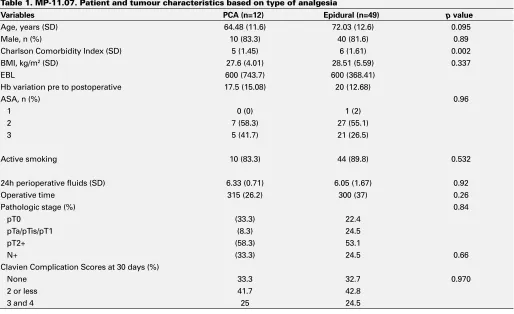
relied on Fisher test or Chi-square comparison between the group and uni- or multivariate analysis relied on logistic regression models. Results: A total of 61 patients were identified, 49 in the EA group and 12 in the PCA group. No differences were recorded for body mass index (BMI), American Society of Anesthesiologists (ASA) score, estimated blood loss, received perioperative fluid, operative time, pathologic staging and Clavien scores at 30 days. In univariate analysis, no statistically significant differ-ences were recorded in the TNT (3.5 vs. 4.5 days; p=0.071), TND (6 vs. 6 days; p=0.435), LOS (10.0 vs. 12.5; p=0.270) and TSM (95.0 vs. 131.5; p=0.081) between both groups. However, a trend toward shorter TNT, TND, and LOS was observed in the EA group with a lower TSM. Sample size may have underpowered our analysis. A subanalysis of the impact of HT vs. LTL on the same four postoperative issues showed no differences. Conclusions: Type of analgesia was not associated with TNT, TND, LOS, or TSM. However, a favourable trend was recorded toward EA use regard-ing the studied outcomes. Sample size limitation may have resulted in underpowered analyses.
1. Maffezzini M, Campodonico F, Canepa G, et al. Current periop-erative management of radical cystectomy with intestinal urinary reconstruction for muscle-invasive bladder cancer and reduction of the incidence of postoperative ileus. Surgl Oncol 2008;17:41-8. http://dx.doi.org/10.1016/j.suronc.2007.09.003
2. Mazul-Sunko B, Gilja I, Jelisavac M, et al. Thoracic epidural anal-gesia for radical cystectomy improves bowel function even in tradi-tional perioperative care: A retrospective study in eighty-five patients. Acta Clin Croat 2014;53:319-25.
3. Mafezzini M, Gerbig G, Campodonico F, et al. Multimodal periop-erative plan for radical cystectomy and intestinal urinary diversion. I. Effect on recovery of intestinal function and occurrence of com-plications. Urology 2007;69:1107-11. http://dx.doi.org/10.1016/j. urology.2007.02.062
4. Werawat Ganon T, Charuluxanun S. Patient-controlled intrave-nous opioid analgesia vs. continuous epidural analgesia for pain after intra-abdominal surgery. Cochrane Database Syst Rev 2005; 25:CD004088.
5. Taqi A, Hong X, Mistraletti G, et al. Thoracic epidural analgesia facil-itates the restoration of bowel function and dietary intake in patients undergoing laparoscopic colon resection using a traditional, nonac-celerated, perioperative care program. Surg Endosc 2007;21:247-52. http://dx.doi.org/10.1007/s00464-006-0069-5
6. Freise H, Fischer LG . Intestinal effects of thoracic epidural anes-thesia. Curr Opin Anaesthesiol 2009;22:644-8. http://dx.doi. org/10.1097/ACO.0b013e32832eb7e8
Table 1. MP-11.07. Patient and tumour characteristics based on type of analgesia
Variables PCA (n=12) Epidural (n=49) p value
Age, years (SD) 64.48 (11.6) 72.03 (12.6) 0.095 Male, n (%) 10 (83.3) 40 (81.6) 0.89 Charlson Comorbidity Index (SD) 5 (1.45) 6 (1.61) 0.002 BMI, kg/m2 (SD) 27.6 (4.01) 28.51 (5.59) 0.337
EBL 600 (743.7) 600 (368.41) Hb variation pre to postoperative 17.5 (15.08) 20 (12.68)
ASA, n (%) 0.96
1 0 (0) 1 (2)
2 7 (58.3) 27 (55.1) 3 5 (41.7) 21 (26.5)
Active smoking 10 (83.3) 44 (89.8) 0.532 24h perioperative fluids (SD) 6.33 (0.71) 6.05 (1.67) 0.92 Operative time 315 (26.2) 300 (37) 0.26 Pathologic stage (%) 0.84 pT0 (33.3) 22.4
pTa/pTis/pT1 (8.3) 24.5 pT2+ (58.3) 53.1
N+ (33.3) 24.5 0.66 Clavien Complication Scores at 30 days (%)
None 33.3 32.7 0.970 2 or less 41.7 42.8
3 and 4 25 24.5
Table 2. MP-11.07. Postoperative outcomes
Variables PCA (n=12) Epidural (n=49) p value
7. Toren P, La dak S, Ma C, et al. Comparison of epidural and intra-venous patient controlled analgesia in patients undergoing radical cystectomy. Can J Urol 2009;16:4716-20.
MP-11.08
Total penile glans resurfacing to maximize penile form and function in superficial penile cancer: MI-PECANS
O’Kelly, Fardod1; Lundon, Dara1; Lonergan, Peter1; Sweeney, Paul2; Cullen,
Ivor3; Hegarty, Paul1
1Urological and Reconstructive Surgery, Mater Misericordiae University
Hospital, Dublin, Ireland; 2Urological Surgery, Mercy University Hospital,
Cork, Ireland; 3Urological Surgery, University Hospital Waterford,
Waterford, Ireland
Introduction and Objectives: The treatment of malignant penile lesions has traditionally been with radical surgery (2 cm margins). Radical sur-gery has demonstrated excellent local control rates, although associated with significant psychological morbidity and sexual dysfunction. Total glans resurfacing results in a good cosmetic appearance and maximum phallic length, with preservation of sexual and urinary function, without compromising oncological control. The objective of this study was to investigate the role of a minimally invasive approach to superficial penile cancer in preserving both function and appearance, and whether this led to inferior oncological control.
Methods: A consecutive series referred for the treatment of penile malig-nancy were prospectively analyzed over 12 months. After clinical stag-ing and gradstag-ing, those patients offered glans-preservstag-ing surgery were analyzed for oncological and functional outcomes.
Results: 28 patients were referred with penile malignancies over a 24-month period, of which 17 (63%) underwent total glans resurfac-ing. The median (range) age of the patients at presentation was 54.8 years. There was complete graft take in 94.2% patients. There were no recurrences and only one patient required further surgical intervention. All patients stated that the sensation at the tip of their penis was either no different or better after surgery. 81% felt that their sex life had been improved. Overall patient satisfaction was high, all scoring 5 on the visual analogue scale.
Conclusions: Careful tumour risk assessment and appropriate patient choice is necessary. The need for close observation is also essential, as the long-term recurrence rates for these techniques are still unknown. However, the advances in penile preserving surgery, in conjunction with other techniques, such as dynamic sentinel lymph node biopsy, has trans-formed the approach to management of penile cancer and reduced the physical and psychological morbidity associated with treatment. 1. Hegarty PK, Shabbir M, Hughes B, et al. Penile-preserving surgery
and surgical strategies to maximize penile form and function in penile cancer: Recommendations from the United Kingdom expe-rience. World J Urol 2009;27:179-87. http://dx.doi.org/10.1007/ s00345-008-0312-x
2. Pietrzak P, Corbishley C, Watkin N. Organ-sparing surgery for inva-sive penile cancer: Early followup data. BJU Int 2004;9:1253-7. http://dx.doi.org/10.1111/j.1464-410X.2004.05153.x
3. Shabbir M, Muneer A, Kalsi J, et al. Glans resurfacing for the treat-ment of carcinoma in situ of the penis: Surgical technique and outcomes. Eur Urol 2011;59:532-6. http://dx.doi.org/10.1016/j. eururo.2010.09.039
MP-11.09
Uretero-ileal anastomotic strictures in patients undergoing cystectomy and urinary diversion for benign and malignant disease
Remondini, Taylor E.1; Carlson, Kevin V.2; Baverstock, Richard J.2 1Cumming School of Medicine, University of Calgary, Calgary, AB,
Canada; 2Vesia (Alberta Bladder Centre), Division of Urology, University
of Calgary, Calgary, AB, Canada
Introduction and Objectives: Cystectomy with urinary diversion is per-formed for benign (neurogenic bladder, radiation cystitis, interstitial cys-titis) or malignant (muscle-invasive bladder cancer) disease. Uretero-ileal anastomotic strictures are an uncommon, but challenging complication
of this surgery. We herein review our stricture rates and our experience with their management.
Methods: We retrospectively identified patients who underwent cystec-tomy by two urologists (RJB, KVC) in Calgary, Alberta, via an established database. Postoperative complications within hospital, within 90 days of the surgery and beyond 90 days were reviewed. Statistical analysis of nominal data was assessed using Pearson’s Chi-square test for association, where p<0.05 was considered significant.
Results: Of 126 patients, 115 (91.3%) received ileal conduits while 11 (8.7%) received ileal neobladders. Of these patients, 14 (11.1%) had past exposure to pelvic radiation: two received brachytherapy for prostate can-cer, while 12 received external beam radiotherapy (EBRT). Uretero-ileal anastomotic strictures were observed in 8.7% of patients. Interventions included nephrostomy with antegrade stenting (36.4%), endoscopic laser incision (27.3%), and surgical re-implantation (36.4%). Of patients that had past radiation exposure, 21.4% went on to have strictures, while 7.1% of those with no radiation history had strictures (p=0.074). Patients that had EBRT prior to surgery were more likely to develop uretero-ileal anastomotic strictures than patients that had no exposure (OR 4.42, 95% CI 0.99-19.62; p=0.036).
Conclusions: We report an uretero-ileal anastomotic stricture rate of 8.7%. These patients may require multimodal management, including open surgical re-implantation. Our data confirms a relationship between pelvic EBRT exposure and stricture incidence.
MP-11.10
How a single educational intervention can increase the referral for and usage of neoadjuvant chemotherapy in bladder cancer cases
Remondini, Taylor E.1; Carlson, Kevin V.2; Baverstock, Richard J.2 1Cumming School of Medicine, University of Calgary, Calgary, AB,
Canada; 2Vesia (Alberta Bladder Centre), Division of Urology, University
of Calgary, Calgary, AB, Canada
Introduction and Objectives: Following a multidisciplinary round in May 2013, we advanced our efforts to ensure patients were provided the option of neoadjuvant chemotherapy (NAC) for its potential survival advantage in muscle-invasive bladder cancer (MIBC) cases. We, herein, review our use of NAC and experience with complications of its use and effect on early surgical outcomes.
Methods: We retrospectively identified MIBC patients who received cys-tectomy by two urologists (RJB, KVC) in Calgary, Alberta. Referral rates to medical oncology, NAC use, reasons for refusal or denial of NAC, compli-cations during its administration, pathological outcomes, and postopera-tive complications within 90 days of surgery were reviewed. Statistical analysis of nominal data was assessed using Pearson’s Chi-square test for association, where p<0.05 was considered significant.
Conclusions: We, herein, demonstrate that a single, multidisciplinary edu-cational intervention dramatically increased both referral for and usage of NAC for MIBC. However, our data suggest that these patients are put at risk of significant complications during NAC administration without apparent early oncologic benefit. Long-term followup will be required to determine if a survival advantage is realized.
MP-11.11
Complications, predictors and outcomes of percutaneous renal biopsies
Patel, Premal1; Kaler, Kamaljot S.2; Pruthi, Deepak1; Kirkpatrick, Iain3;
Rampersad, Christie4; Radulovic, Dejana3; McGregor, Thomas B.1 1Section of Urology, University of Manitoba, Winnipeg, MB, Canada; 2Department of Urology, University of California Irvine, Orange, CA,
United States; 3Division of Diagnostic Imaging, University of Manitoba,
Winnipeg, MB, Canada; 4College of Medicine, University of Manitoba,
Winnipeg, MB, Canada
Introduction and Objectives: There has been a renaissance of percuta-neous renal biopsies (PRBs) in the management of patients with renal masses. Our study looks at our initial experience with PRBs and looks to define predictors of complications and outcomes.
Methods: A prospective database of patients undergoing PRBs at St. Boniface General Hospital was developed in September 2013. Patient age, gender, tumour laterality and size, R.E.N.A.L. nephrometry score, biopsy complications, biopsy pathology results, and if applicable, final surgical pathology was extracted from patient charts. For our analysis, we included patients with masses less than 10 cm in size, as well as masses that were amendable to R.E.N.A.L. nephrometry scoring. From January 2012 to October 2015, 105 patients underwent percutaneous renal biopsies and 72 met our inclusion criteria.
Results: Mean patient age was 66.1 (range 45-89) with 43 males and 29 females. 61 (85%) patients had no complications with the remaining complications being Clavien-Dindo Grade 1. Of the 72 biopsies, 43 (60%) were malignant, 19 (26%) were insufficient for diagnosis, and 10 (14%) were found to be benign. With regard to predictors of adequate tissue for a diagnostic biopsy, we found no association with age, gender, later-ality, tumour size, skin-to-tumour distance, and R.E.N.A.L nephrometry score (subscore and total score analysis). Within our followup period, 25 patients underwent surgery. 22 (88%) of these patients had adequate tissue on initial biopsy for a diagnosis, which were all found to be congruent with final surgical pathology.
Conclusions: PRBs are safe, as demonstrated by our centre’s minimal complication rate. Our study highlights the utility of a preoperative biopsy in patient management, as 11 (15%) of our cohort avoided unnecessary surgical intervention for a benign tumour.
MP-11.12
Catamnestic followup of renal cell carcinomas among atomic bomb survivors according to radiation exposure status
Ikeda, Kenichiro1; Teishima, Jun1; Hayashi, Tetsutaro1; Goto, Keisuke1;
Matsubara, Akio1
1Urology, Hiroshima University, Hiroshima, Japan
Introduction and Objectives: More than 65 years have passed since expo-sure to the atomic bomb (A-bomb) in Hiroshima. There are many reports on radiation carcinogenesis in many carcinomas and several prospective cohort studies were conducted. So far, however, there have been few reports on the prognosis of A-bomb survivors vs. patients not exposed to A-bomb radiation (non-exposed). In this study, we evaluated differences in the prognosis of primary renal malignancies in A-bomb survivors and the non-exposed.
Methods: Of 479 patients who underwent nephrectomy at our hospital from March 1991 to December 2011, with renal cell carcinoma diag-nosed in the resected specimen, 255 patients with evaluable cases in the postoperative course and birth month before June1946, which included prenatal exposure to A-bomb radiation, were included. We retrospec-tively evaluated overall survival (OS), cancer-specific survival (CSS), and disease-free survival (DFS) rates. Patient clinicopathological findings were also analyzed.
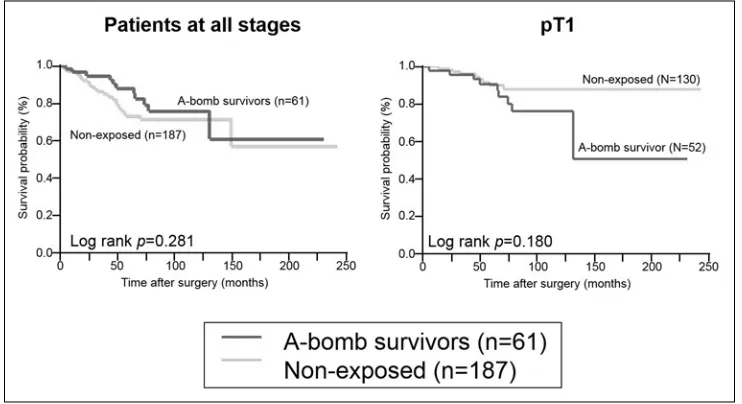
Results: Of these 255 patients, 35 (13.7%) patients were A-bomb survi-vors. Mean age, sex, stage groupings, and histological classification and grade were similar between the A-bomb survivors and the non-exposed. Clinical T1 (cT1) patients were observed significantly more frequently among A-bomb survivors (32/35, 91.4%) than among the non-exposed (125/220, 56.8%; p<0.001). At a median followup of 47 months, OS rates at five and 10 years were 92.8% and 87.7%, respectively, in the A-bomb survivors and 74.6% and 69.3%, respectively, in the non-exposed (p=0.053). CSS rates at five and 10 years were 92.8% and 92.8%, respec-tively, in A-bomb survivors and 81.9% and 80.3%, respecrespec-tively, in the non-exposed (p=0.137). DFS rates at five and 10 years were 92.7% and 92.7%, respectively, in A-bomb survivors and 86.7% and 83.7%, respec-tively, in the non-exposed (p=0.192). OS rates was also compared in cT1, there was no significant difference in A-bomb survivors and non-exposed
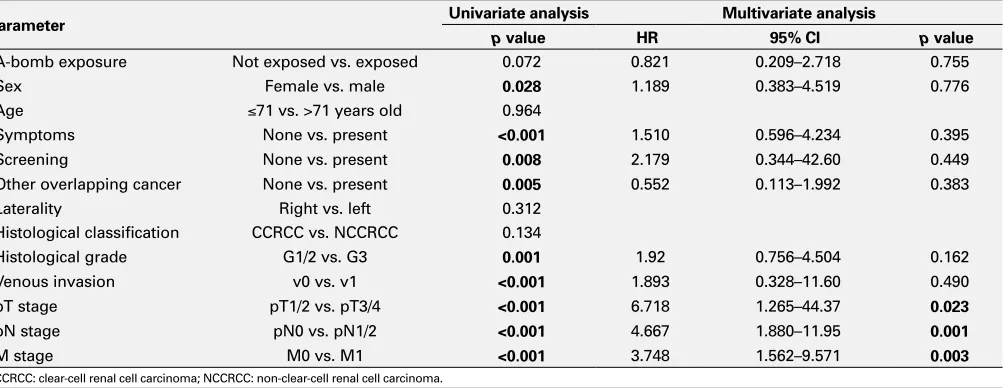
(p=0.690). Multivariate analysis of prognosis showed that female and cT1 among A-bomb survivors were significantly different from non-exposed. Conclusions: Renal cell carcinoma in A-bomb survivors, cT1 is the time of diagnosis was significantly higher than non-exposed. However, OS was no difference between the two.
MP-11.13
Accuracy of kidney cancer diagnosis and histological subtype within cancer registry data
Himmelman, Jeffrey G.1,2,3; Merrimen, Jennifer2,3,4; Thompson, Kara2,3;
Theriault, Chris2,3; Wood, Lori A.2,3,5
1Urology, Dalhousie, Halifax, NS, Canada; 2Dalhousie, Halifax, NS,
Canada; 3Queen Elizabeth II Health Sciences Centre, Halifax, NS, Canada; 4Pathology, Dalhousie, Halifax, NS, Canada; 5Medicine, Dalhousie,
Halifax, NS, Canada
Introduction and Objectives: Cancer registries are the mainstay for Canadian population-based cancer statistics. Each province captures this data in provincial registries, including the Nova Scotia Cancer Registry (NSCR).The goal of this study was to describe data from the NSCR about method of diagnosis and kidney cancer (KC) pathology and compare it to the actual pathology reports to determine the accuracy of diagnosis and histological subtype assignment.
Methods: This retrospective analysis included patients with KC in the NSCR with an ICD-10-CM code C64.9 seen or treated in the largest provincial district from 2006-2010. From the NSCR, method of diagno-sis and pathological diagnodiagno-sis was recorded. From pathology reports, pathological diagnosis based on World Health Organization (WHO) classification was recorded.1 All non-clear cell KC (non-ccKC) diagnosis
from NSCR were compared to the actual pathology report for descriptive comparison and reasons for discordance.
Results: 723 patients make up the study cohort. 81.3% of patients were diagnosed on nephrectomy, 11.1% on radiography, 6.9 % biopsy, and 0.7% autopsy. By NSCR data, 52.8% had clear cell, 20.5% KC not other-wise specified (NOS), 12.7% papillary, 4% chromophobe, and many other non-ccKC. By pathology reports, 69.6% had clear cell, 15% papillary, 5% chromophobe, only 2.7% KC NOS. The large number of other non-ccKC will be presented. There was a discordance rate of 15.4% between NSCR data and diagnosis from pathology report.
Conclusions: Registry data may not be accurate for the true incidence of KC, since 11.1% were based on radiology alone. Clear cell KC made up 52.8% of registry diagnosis, but 69.6% on pathology report review. Although papillary and chromophobe incidence did not vary a lot, other types of non-ccKC did. This registry data did not differentiate
between papillary type I and II. Non-ccKC should not be considered one entity. One must be aware of the gaps in registry data for KC statistics. 1. Eble JN, Sauter G, Epstein JI, and Sesterhenn IA. 2004. Pathology
and genetics of tumours of the urinary system and male genital organs. IARC Press.
MP-11.14
Factors affecting surgical wait times for renal masses Ouellet, Simon1; Sabbagh, Robert1; Jeldres, Claudio1 1Urology, Université de Sherbrooke, Sherbrooke, QC, Canada
Introduction and Objectives: Surgical wait times (SWT) can result in distress for both the patient and the clinician. We assessed the factors predicting a longer SWT defined by the time from diagnosis of a renal mass to nephrectomy.
Methods: We retrospectively reviewed all surgically managed cases of renal masses at our institution between 2006 and 2012. Patients were classified into two groups; SWT <3 and ≥3 months based on the median SWT for the whole cohort. We compared clinicopathologic data between the groups. A multivariate analysis was performed to determine the vari-ables associated with SWT ≥3 months. Statistics relied on Student-t test, Chi-square, and multivariate analysis on logistic regression model. Significance level was set at 0.05.
Results: A total of 350 patients were identified (180 with SWT <3 months and 170 with ≥3 months). No significant differences were recorded between the groups for age, gender, distance from hospital to home, body mass index (BMI), diabetes, hypertension, and smoking status. For SWT <3 months vs. ≥3 months, radiologic tumour size was 6.9 vs. 4.1 cm; p<0.01; T2-stage tumour or higher was 54 vs. 16%; p< 0.01; and use of laparoscopic partial nephrectomy was 12 vs. 51% ; p< 0.01). For SWT <3 months vs. ≥3 months, additional abdominal investigations after the initial diagnosis were performed with ultrasound (6 vs. 9%; p=0.42), computed tomography (CT) scan (65 vs. 81%; p=0.01), magnetic reso-nance imaging (MRI) (5 vs. 13%; p=0.01]), positron emission tomography (PET) scan (3 vs. 4%; p=0.78), and renal biopsy (2 vs. 8%; p=0.01). In multivariate analysis, factors associated with having a SWT ≥3 months were presence of diabetes (OR 2.9 (1.1-7.9)), smaller tumour size (OR 10.5 (10.3-10.7)), the use of additional investigations with MRI (OR 6.6 (1.4- 33.3)), or renal biopsy (OR 11.0 (1.3-100.0)).
Conclusions: Tumour size is the most important factor influencing the SWT; smaller tumours resulted in longer SWT. Other factors associated with having a SWT ≥3 months were presence of diabetes, and the use of additional investigation with MRI or renal biopsy.
Table 2. MP-11.12. Univariate and multivariate Cox regression analyses of clinicopathological factors for the prediction of cancer-specific survival in 248 RCC patients
Parameter Univariate analysis Multivariate analysis
p value HR 95% CI p value
A-bomb exposure Not exposed vs. exposed 0.072 0.821 0.209–2.718 0.755 Sex Female vs. male 0.028 1.189 0.383–4.519 0.776 Age ≤71 vs. >71 years old 0.964
Symptoms None vs. present <0.001 1.510 0.596–4.234 0.395 Screening None vs. present 0.008 2.179 0.344–42.60 0.449 Other overlapping cancer None vs. present 0.005 0.552 0.113–1.992 0.383 Laterality Right vs. left 0.312
Histological classification CCRCC vs. NCCRCC 0.134
Histological grade G1/2 vs. G3 0.001 1.92 0.756–4.504 0.162 Venous invasion v0 vs. v1 <0.001 1.893 0.328–11.60 0.490 pT stage pT1/2 vs. pT3/4 <0.001 6.718 1.265–44.37 0.023
pN stage pN0 vs. pN1/2 <0.001 4.667 1.880–11.95 0.001
M stage M0 vs. M1 <0.001 3.748 1.562–9.571 0.003
MP-11.15
Epidural use in cystectomy is not associated with improved short- or long-term outcomes in routine clinical practice
Doiron, R. Christopher1; Booth, Christopher M.2,3,4; Jaeger, Melanie5; Wei,
Xuejiao4; Siemens, D. Robert1,2,4
1Department of Urology, Queen’s University, Kingston, ON, Canada; 2Department of Oncology, Queen’s University, Kingston, ON, Canada; 3Department of Public Health Sciences, Queen’s University, Kingston,
ON, Canada; 4Division of Cancer Care and Epidemiology, Queen’s
University, Kingston, ON, Canada; 5Department of Anesthesia, Queen’s
University, Kingston, ON, Canada;
Introduction and Objectives: Use of perioperative thoracic epidural is a core component of surgical care pathways in cystectomy and ERAS protocols. Furthermore, there is evidence that use of neuraxial analgesia attenuates cancer recurrence in patients undergoing surgical resection of their malignancy. In this contemporary, population-based study, we report epidural use in patients undergoing cystectomy in routine clinical practice. We evaluate factors associated with use of regional anesthe-sia and the effect on short- and long-term outcomes.
Methods: All patients undergoing cystectomy in the province of Ontario between 2000 and 2008 were identified using the Ontario Cancer Registry (OCR) and were linked to treatment and pathology records. OHIP billing codes were used to identify all patients who received a perioperative epidural. Multivariate logistic regression analysis was used to describe factors associated with epidural use, while a Cox proportional hazards model describes associations with survival.
Results: Over the eight-year study period, 1628 patients underwent cystec-tomy — 54% (n=887) received an epidural, while 46% (n=741) did not. Higher surgeon, anesthesiologist, and hospital volume were all associated with increased epidural use (p<0.001). There was no difference between the groups in lengeth of stay, 30- and 90-day readmission rates, or 30- and 90-day mortality. In multivariate Cox proportional hazards analysis, epi-dural was not associated with improved five-year cancer-specific survival (HR 1.02, 95% CI 0.87-1.19; p=0.804) or five-year overall survival (HR 0.91, 95% CI 0.80-1.03; p=0.136)).
Conclusions: Only 54% of cystectomy patients received an epidural in routine clinical practice. Those treated at higher-volume centres were more likely to receive an epidural. There was no difference in short- or long-term outcomes between the groups.
MP-11.16
Diabetes and kidney cancer outcomes: A propensity score analysis Nayan, Madhur1; Finelli, Antonio1; Juurlink, David N.2; Austin, Peter C.3;
Kulkarni, Girish S.1; Hamilton, Robert J.1
1Division of Urology, Departments of Surgery and Surgical Oncology,
Princess Margaret Cancer Centre, University Health Network and the University of Toronto, Toronto, ON, Canada; 2Department of Internal
Medicine, Sunnybrook Health Sciences Centre, University of Toronto, Toronto, ON, Canada; 3Department of Biostatistics, Institute for Clinical
Evaluative Sciences, Toronto, ON, Canada
Introduction and Objectives: Pre-existing diabetes has been associated with poor outcomes in various malignancies. However, there have been conflicting findings regarding the association between diabetes and out-comes in renal cell carcinoma.
Methods: We performed a retrospective review of 893 patients undergo-ing nephrectomy for unilateral, M0, renal cell carcinoma between 2000 and 2014 at a tertiary academic centre. Inverse probability of treatment weights (IPTW) were derived from a propensity score model based on
various clinical, surgical, and pathological characteristics. We used Cox proportional hazard models to evaluate the association between diabetes and disease-free survival (DFS), cancer-specific survival (CSS), and overall survival (OS) in the sample weighted by the IPTW. Furthermore, to evalu-ate whether severity of diabetes was associevalu-ated with survival outcomes, we performed separate analyses where IPTW were computed based on the probability of having diabetes that was controlled by medication. Results: Of the 893 patients, 158 (18%) had diabetes. Of these, 122 (77%) patients required medications for diabetes control while the remaining 36 (23%) had diet-controlled diabetes. Median followup was 47 months (interquartile range (IQR) 21-80). Diabetes at the time of surgery was not significantly associated with DFS (HR 1.12, 95% CI 0.62-2.00), CSS (HR 0.63, 95% CI 0.27-1.50), or OS (HR 1.23, 95% CI 0.79-1.91). We found similar results when we compared diabetics controlled with medication vs. non-diabetics or diet-controlled diabetics.
Conclusions: We found no significant association between diabetes and survival outcomes in patients undergoing nephrectomy for M0 renal cell carcinoma.
MP-11.17
Assessing an intravesical administered second-generation antisense oligonucleotide targeting Heat Shock Protein 27 in bladder: A phase 1 clinical trial
So, Alan I.1; Frees, Sebastian1; Beraldi, Eliana1; Fazli, Ladan1; Chi, Kim1;
Black, Peter C.1; Gleave, Martin E.1
1Urologic Sciences, University of British Columbia, Vancouver, BC,
Canada