VIRTUAL SCREENING OF INDONESIAN HERBAL DATABASE TO FIND SIRTUIN 1 ACTIVATORS
USING THE DOCKING METHOD
OLIVIA ALDISA, AZMINAH, LINDA ERLINA, HAYUN, ARRY YANUAR*
Department of Pharmaceutical Chemistry, Faculty of Pharmacy, Universitas Indonesia, Depok, Indonesia. Email: [email protected] Received: 21 April 2017, Revised and Accepted: 13 July 2017
ABSTRACT
Objective: Chemical compounds in plants often have benefits and efficacy that can be useful for medicine. Biochemistry and biomedicine research
aims to develop new drugs for degenerative human diseases such as cancer, cardiovascular diseases, and diabetes mellitus. Humans have a protein that is the key for metabolic sensors in a variety of metabolic pathways, Sirtuin 1 (SIRT1). Currently, only resveratrol, fisetin, and quercetin, which are compounds from natural ingredients, have been tested as activators of SIRT1 even though there are many chemical compounds in plants that could potentially be SIRT1 activators. Four crystal forms act as SIRT1 activators: 4ZZH, 4ZZI, 4ZZJ, and 5BTR.
Methods: In this study, we employed the docking of new molecular compounds from an Indonesian herbal database as SIRT1 activators. Virtual
screening was done using AutoDock Vina. AutoDock Vina was validated beforehand to obtain the best grid box; based on this research, the best grid box for AutoDock Vina is 60 × 60 × 60.
Results: The top 10 ranked compounds were obtained for each crystal form and for the same compounds of the four crystal forms, which are
alpha-carotene, Cassiamin C, casuarinin, and lutein.
Keywords: Sirtuin 1 activator, Indonesian natural products, Human degenerative disease, Docking, Grid box, Virtual screening.
INTRODUCTION
Indonesia has the second largest natural tropical forests in the world, which have many natural resources of flora and fauna. The Ministry of Environment and Forestry of the Republic of Indonesia stated that about 30,000 species of plants grow in Indonesia. Chemical compounds in plants often have benefits and efficacy that can be useful for public health, but there are only about 28 standardized herbal medicines and six phytopharmaca. Resveratrol and quercetin are examples of chemical compounds found in plants that can activate Sirtuin 1 (SIRT1) in the human body, providing many benefits. Sirtuins (SIRT1-7), the mammalian homologs of the SIR2 gene in yeast, have emerging roles in age-related diseases, such as cardiac hypertrophy, diabetes, obesity, and cancer [1]. Seeing the abundance of the chemical compounds derived from plants that grow in Indonesia, the researcher wanted to screen the compounds from plants in Indonesia that are in the herbal database, HerbalDB, using an in silico method to find new compounds that could potentially be SIRT activators.
In this study, the researcher examined the mechanism between the protein SIRT1 and the activators using in silico methods and searched for these compounds from plants growing in Indonesia that have the potential to be SIRT1 activators using virtual screening. The in silico method was used to examine the interaction of the molecular binding. This method was also used to save costs and the time needed to do research. The researcher obtained some chemical compounds from Indonesian plants that can be developed as SIRT1 activators, therefore indirectly providing information and knowledge in the search for new drugs to treat a variety of diseases that can be cured by stimulating the activity of SIRT1.
SIRT1, the founding member of the mammalian family of seven nicotinamide adenine dinucleotide (NAD)-dependent sirtuins, is composed of 747 amino acids that form a catalytic domain and extended N- and C-terminal regions [2]. Sirtuins catalyze the deacetylation
of modified lysine residues in protein substrates coupled with the breakdown of NADþ into nicotinamide and 2’-O-acyl-adenosine diphosphate (ADP)-ribose [2].
SIRT1 is a Class III histone deacetylase protein that requires NAD+ as a cosubstrate; it is found in the bodies of mammals, including humans [3]. SIRT1 deacetylates important residues from histone that play an important role in the regulation of transcription, including H3-K9, H4-K16, and H1-K26, as well as several non-protein targets such as histone p53, FOXO1/3, proliferator-activated receptor-γ coactivator-1α, and nuclear factor-κB [3]. With target proteins, SIRT1 is able to regulate the delivery of a number of important signals in the body such as DNA repair and apoptosis, muscle differentiation and fat, neurogenesis, mitochondrial biogenesis, homeostasis glucose and insulin hormone secretion, stress response, and circadian rhythm [3]. Each macromolecule crystal form is differentiated with ligands that hobbled camel, this causes the difference in the macromolecule crystal form and subsequently. In humans, there are seven homolog sirtuins (SIRT1, SIRT2, SIRT3, SIRT4, SIRT5, SIRT6, and SIRT7), which are divided by function and location. SIRT1 is located in the nucleus and cytosol; SIRT2 is located in the cytosol; SIRT3, SIRT4, and SIRT5 are located in the mitochondria; SIRT6 is located in the nucleus; and SIRT7 is located in the nucleoli [4]. Of the seven sirtuins owned by the genome of mammals, SIRT1 consists of orthologous proteins and protein SIRT2 deacetylase-dependent on NAD+ [5]. Some data indicate that sirtuin is a metabolic sensor that directly connects the cellular metabolic status (via NAD+) with the chromatin structure and the regulation of gene expression (via histones deacetylation, transcription factors, and transcription cofactor) [6]. SIRT1 has a vital role in metabolism, development, and reproduction, as well as influencing many biologically complex phenomena, such as aging and disease [7].
Research Article
© 2017 The Authors. Published by Innovare Academic Sciences Pvt Ltd. This is an open access article under the CC BY license (http://creativecommons. org/licenses/by/4. 0/) DOI: http://dx.doi.org/10.22159/ajpcr.2017.v10s5.23121
and environmental signals can modulate the deacetylase activity of SIRT1 through changes in the cellular NAD+ levels, alterations in the expression of the SIRT1 protein, or post-translational modifications/ interactions on the SIRT1 protein.
Resveratrol can be found in raspberries, blueberries, nuts, and the skin of wine, initially known to have antioxidant and antifungal efficacy. One of the compounds that can activate SIRT1 in the body so that resveratrol can regulate as antiplatelets, anti-inflammatory, anticancer, anti-mutagenic, and protect the body from the disease atherosclerotic. Besides resveratrol, quercetin is one of the chemical compounds in plants that can activate SIRT1. Quercetin can be found in capers, lovage, apples, tea, oranges, onions, and green plants. Quercetin is known to have anti-inflammatory and anticancer activity [8].
At this moment, only five compounds have been recognized by the US Food and Drug Administration (FDA) or have proven activity against SIRT1 in vivo and in vitro, namely, resveratrol, fisetin, quercetin, SRT-2104, and SRT-1720. SRT-2104 and SRT-1720 are synthetic compounds of SIRT1 activators, whereas fisetin, resveratrol, and quercetin are compounds from natural materials.
Bioinformatics uses a computational approach to solving biological problems. Bioinformatics includes the management of biological information obtained from various studies that produce large amounts of complex data, such as the mapping of the human genome [9]. Tethering molecular (molecular docking) is a method of screening compounds based on their structure using computing technology. The Belay molecular method aims events to replicate the interaction of a ligand molecule with its target protein in in vitro tests [10]; molecular tethering technology can be applied to multiple levels of drug discovery. Three main objectives, namely, to predict the bond model of the known ligand is active, to search for new ligands through virtual screening, and to predict the binding affinity of some active compounds [11]. Virtual screening is the process of evaluating a compound structure using software to find candidate compounds that have potential as drugs. Theoretically, the application of the methods of virtual screening is limited to the structures of the compounds that can be counted and to compounds known to have ties with other compounds. Gross domestic product (GDP) is a collection of data structure of macromolecular biological that has more than 32,500 protein structures. GDP contains information about identifying a target; the names of proteins; organism sources, such as the production status of sequences and clones; gene expression; the crystallization of references associated with the database (PubMed and DOI); and the link associated with the research project [12].
The HerbalDB (http://herbaldb.farmasi.ui.ac.id/) database contains a list of compounds in various types of medicinal plants in Indonesia in the form of two and three dimensions.
The Directory of Useful Decoys, Enhanced (DUD-E) is a database that serves to assist the evaluation and optimization of a virtual screening method (screening in silico). A decoy is a negative control that has physicochemical compatibility with the positive control regarding molecular weight, the logP calculation, and the amount of torsion and hydrogen bonding (donor and acceptor). In DUD-E, the ligand serves as a positive control and the decoy as a negative control can be created with the features that generate decoys found on the DUD-E site if the target used is not yet available in DUD-E.
PyMOL is visualization software that is very effective for understanding structure through molecular modeling and can produce a three-dimensional (3D) image and a macromolecule of small molecules such as proteins. The program is also able to visualize the structure of single or ligands that were moored [13].
Visual molecular dynamics (VMD) is a molecular visualization program that displays and creates animations, and analyzes biomolecular
systems using 3D graphics and built-in scripting. VMD is designed for modeling, visualization, and the analysis of biological systems such as proteins, acids, nucleic lipid bilayer collection, and so on. VMD can be used to view molecules in general as VMD can read the standard files of the Protein Data Bank (PDB) and shows the structures contained therein.
PyRx software is used to perform virtual screening. Its purpose is to find drugs, and it can be used to screen compounds to target a potential drug.
Open Babel software is designed to process chemical data and is useful for changing the format of a file from one format to another so that the file can be used for molecular modeling, chemical informatics, and bioinformatics.
AutoDock software was built to perform a procedure to predict the interaction of a compound’s small molecule with a target molecule [14]. The results of tethering using AutoDock form poses and free energy (ΔG) for each of the poses, and the obtained value of the constants of inhibition (Ki) is defined as the concentration inhibition rate of reaction with the inhibitor half the rate of a reaction without the inhibitor to a substrate concentration.
AutoDock Vina is a new program for molecular docking and virtual screening. AutoDock Vina can reach speeds of less than two-fold compared with AutoDock 4.0. In addition, AutoDock Vina can also improve accuracy and can automatically calculate the results of the mapping grid and cluster transparently for the user.
The root mean square deviation (RMSD) is a method for interpreting a model of protein and the quality of the position of a ligand in the results of docking. The quality of the position greatly affects far or near or conformational change in the molecule. Ideally, changes in this position are within <2 Å. If a molecule has a value of RMSD >2 Å, this indicates that there was a far enough shift of molecules.
METHODS
Hardware devices in the form of a computer were used. The computer consisted of four gigabytes of random access memory, a Quad-core processor (Intel® CoreTM, US), a graphics card (NVIDIA Ge Force GTX 295, US), the operating system Microsoft Windows 7 Professional 64-bit (Microsoft, US), a monitor (AOC, China), a central processing unit (CPU) (Asus, US), mouse (Logitech, China), and keyboard (Simbadda, Indonesia). The computer is connected to the Internet and has an uninterrupted power supply. The software used was PyMOL (DeLano Scientific LLC, Italy), VMD, AutoDock Tools (The Scripps Research Institute, U.S.), AutoDock 4.0 (The Scripps Research Institute, U.S.), Open Babylon, and PyRx.
There are four residual areas of amino acids on SIRT1, namely, the region N-terminal (1-180), the allosteric area (181-243), the catalytic area (244-512), and the area C-terminal (513-747). The compound that is used as a SIRT1 activator will bind on the district’s allosteric area, while inhibitor compounds will bind on the catalytic area. The 3D structure of SIRT1 was downloaded from the Research Collaboratory for Structural Bioinformatics PDB (http://www.rscb.org/pdb) with a 5BTR identity, and 4ZZH, 4ZZI, and 4ZZJ homotetramers with the sizes of 3.2 Å; 3.1 Å; 2.73 Å; and 2.74 Å.
The ligands used were obtained from the database of medicinal plants in Indonesia, HerbalDB, which were accessed from http://herbaldb. farmasi.ui.ac.id in the form of three-dimensions consisting of 1410 compounds of plants.
The positive control compounds obtained from the search results activator compounds of SIRT1 from journals or earlier research with parameter activator compounds have been approved by the FDA or have at least gone through clinical phase Stage 2. From the lookup Aldisa et al. Asian J Pharm Clin Res, Vol 10, Suppl 5, 2017,
results, five positive control compounds were obtained and 250 decoys (negative control) generated results using DUD-E.
RESULTS AND DISCUSSION
The separation of chain A on the 4ZZJ crystal structure and 5BTR was done using Python. Then, the ligands that were bound in each of the crystal and water molecules were removed. Search site center bonds (grid center) used site area bonds (grid box) and ligands from each crystal as a model. The site area is an area that restricts search conformation ties from ligands. In the process of crystal analog 4ZZH, 4ZZI, 4ZZJ, and 5BTR redocking, three grid box sizes, namely, 40 × 40 × 40, 50 × 50 × 50, and 60 × 60 × 60 were used. In addition, a used grid center that is different for each crystal analog and automatically created with the features of the center to the ligand was located in the AutoDock program.
Based on the docking results, selected results of the binding of showed that the best one that have energy lowest ties. The best re-docking results from each of the sizes of the grid box were later calculated using an RMSD calculator on VMD features. From the results of the calculation of RMSD re-docking, all had an ideal RMSD (<2 Å), except for 5BTR, because the conformation of the ligands varied greatly compared to its initial position. The size of the 5BTR binding pocket is large enough so that the conformation of the initial ligands is in the optimum position when the three ligands (resveratrol molecule) bind, but it is not the optimal position for binding with one ligand so that changes the position far enough.
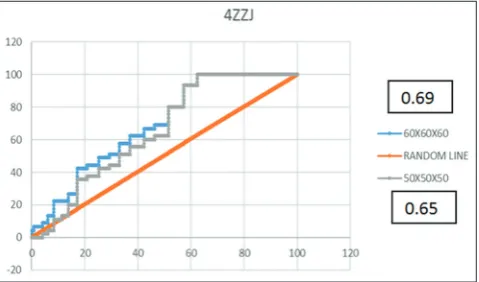
Validation using AutoDock Vina produced an energy bond value between positive control and negative control with the macromolecule SIRT1 (4ZZH, 4ZZI, 4ZZJ, and 5BTR). This result came from the calculation of the enrichment factor (EF) and receiver operating characteristics (ROC). EF is a method of calculation to determine the accuracy of the virtual method screening. The value of EF is the value of approaching or above a random value (>1). Based on the results of screening three times in AutoDock Vina, the value of the EF grid box with a size of 60 × 60 × 60 obtained the largest results. Therefore, validation using the grid box of 40 × 40 × 40 was not done. The number of active and inactive compounds will be configured for a calculation of the formula and described in the form of the curve. The ideal ROC parameters are a value of >0.5, which means the ROC line is located above the random line. The results of the calculation and comparison of the value of the ROC validation result (Figs. 1-3) show that the grid box size of 60 × 60 × 60 has a ROC value higher than the value of the ROC grid box size of 50 × 50 × 50. It was concluded that the size of the optimum grid box is 60 × 60 × 60.
AutoDock Vina was run with the parameter grid box of 60 × 60 × 60 with units of the unit and the value of the grid box size compared to Angstrom units becomes 22.5 × 22.5 × 22.5 because the 1-unit equivalent with 0.375 Å, grid center, and exhaustiveness were arranged on 8. From the results of the virtual screening, 20 compounds were found that had a binding affinity or ∆G lowest. A compound ∆G him most low is the compound that could potentially (greatest hits) act as a SIRT1 activator with the crystal molecules 4ZZH, 4ZZI, 4ZZJ, and 5BTR.
Superposition was done on four of the 20 compounds ranked among the greatest hits the same on all four crystal macromolecule analog SIRT1 (4ZZH, 4ZZI, 4ZZJ, and 5BTR), namely, alpha-carotene, cassiamin C, casuarinin, and lutein. Based on previous research, the activation of SIRT1 results in functions that contribute to antiaging, anti-inflammatory, antidiabetes, and antiobesity [6,15]. Through the lookup results above, the compounds that could potentially act as a SIRT1 activator also have the same efficacy of being anti-inflammatory, anti-diabetes, and anti-aging.
Each crystal analog has different ligands. Ligand 4ZZH is 4TO, ligand 4ZZI and 4ZZJ test 4TQ, and ligand 5BTR is resveratrol.
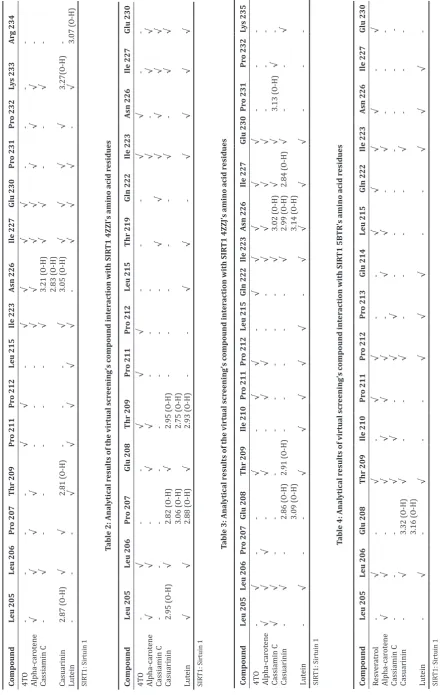
Glu230 are amino acids on the domain N-terminal located on SIRT1, which is the key to enabling SIRT1 through activator compounds, according to the previous research [16]. With differences in the structure of each ligand, there are different bonds between each ligand and the active residues of SIRT1. Overall, almost all ligands bind to the important residues: Leu206, Thr209, Pro211, Pro212, Ile223, Asn226, Ile227, and Glu230. Bond energy (kcal/mol) to alpha-carotene, cassiamin C, casuarinin, and lutein in a row (−5.7; −7.5; −6.6; −6.9) against 4ZZH (−11.4; −11.4; −12.3; −10.7) against 4ZZI (−8.9; −8.7; −8.8; −8.9) against 4ZZJ, and (−8.7; −11.5; −10.4; −10.3) against 5BTR. The binding energy of Cassiamin C was lower than the cocrystal ligand on 4ZZH (4TO). If the cocrystal ligand on 4ZZI and 4ZZJ (4TQ) and the cocrystal ligand on 5BTR (resveratrol/ STL-702) are compared, the four greatest hits compounds (alpha-carotene, Cassiamin C, casuarinin, and lutein) have lower bond energy. The four greatest hits compounds have been known to have efficacy as anti-inflammatory, antidiabetes, and antiaging actors, but no research has been done that specifically examined the activity of the compounds against SIRT1; this research needs to be done Fig. 1: Receiver operating characteristics curve of 4ZZH docking
result using AutoDock Vina
Fig. 2: Receiver operating characteristics curve of 4ZZJ docking result using AutoDock Vina
in vitro so that the activity of the compounds against SIRT1 can be discovered. Through virtual screening, only the strength of the bonds of ligands with macromolecules can be shown; the movement of the molecules cannot be described, therefore that also needs to be studied to understand the molecular dynamics of the movement and the interaction of the molecules. The data of the results of the binding on the four compounds with the greatest hits of each crystal analog are presented in Tables 1-4.
CONCLUSION
From the validation and virtual screening, the following results were obtained:
• The optimum parameters using ligands and decoys from the data warehouse DUD-E using the AutoDock Vina software is the grid box size of 60 × 60 × 60
• The virtual screening of SIRT1 using AutoDock Vina obtained 10 compounds that had the highest ratings for 4ZZH with energy bonds ([−7.5] – [−6.9] kcal/mol): (1) Cassiamin C, (2) isoarborinol, (3) cryptochrome, (4) roxbughine B, (5) cycleadrine, (6) beta-sitosterol 3-O-beta-D-glucopyranoside, (7) isochondodendrine, (8) leucadenone A, (9) limacine, and (10) lutein
• The virtual screening of SIRT1 using AutoDock Vina obtained 10 compounds that had the highest ratings for 4ZZI with energy bonds ([−12.3] – [−11.4] kcal/mol): (1) Casuarinin, (2) Br-xanthone A, (3) yuehchukene, (4) antheraxanthin, (5) occidentoside, (6) australone A, (7) mutatoxanthin, (8) alpha-carotene, (9) gibberellin A20, and (10) sojangol
• The virtual screening of SIRT1 using AutoDock Vina obtained 10 compounds that had the highest ratings for 4ZZJ with energy bonds ([−9.8] – [−9.0] kcal/mol): (1) Actinodaphnine, (2) gibberellin A15, (3) 1S,3R-Casbene, (4) 14-deoxy-11-oxoandrographolide, (5) liriodenine, (6) picrinine, (7) casuarictin, (8) ellagic acid, (9) gibberellin A20, and (10) leucopelargonidin
• The virtual screening of SIRT1 using AutoDock Vina obtained 10 compounds that had the highest ratings for 5BTR with energy bonds ([−12.4] – [−10.4] kcal/mol): (1) Woodfordin A, (2) woodfordin B, (3) cassiamin C, (4) diosgenin, (5) roxburghine B, (6) leucadenone C, (7) artonin D, (8) leucadenone A, (9) beta-sitosterol 3-O-beta-D-glucopyranoside, and (10) casuarinin.
REFERENCES
1. Alhazzazi TY, Kamarajan P, Verdin E, Kapila YL. SIRT3 and cancer: Tumor promoter or suppressor? Biochim Biophys Acta 2011;1816(1):80-8.
2. Dai H, Case AW, Riera TV, Considine T, Lee JE, Hamuro Y, et al.
Crystallographic structure of a small molecule SIRT1 activator-enzyme complex. Nat Commun 2015;6(3):7645.
3. Hubbard BP, Sinclair DA. Small molecule SIRT1 activators for the treatment of aging and age-related diseases. Trends Pharmacol Sci 2014;35:146-54.
4. Morris BJ. Seven sirtuins for seven deadly diseases of aging. Free Radic Biol Med 2013;56:133-71.
5. Frye RA. Phylogenetic classification of prokaryotic and eukaryotic Sir2-like proteins. Biochem Biophys Res Commun 2000;273(2):793-8. 6. Li X. SIRT1 and energy metabolism. Acta Biochim Biophys Sin
(Shanghai) 2013;45(1):51-60.
7. Haigis MC, Sinclair DA. Mammalian sirtuins: Biological insights and disease relevance. Annu Rev Pathol 2010;5:253-95.
8. Allard JS, Perez E, Zou S, de Cabo R. Dietary activators of Sirt1. Mol Cell Endocrinol 2009;299(1):58-63.
9. Baxevanis AD, Ouellette BF. Bioinformatics: A practical guide to the analysis of genes and proteins. Methods of Biochem Analysis. New York: John Wiley & Sons; 2001.
10. Motiejunas D, Wade RC. Comprehensive Medicinal Chemistry II. Comprehensive Medicinal Chemistry II. New York: Elsevier; 2007. 11. Leach AR, Shoichet BK, Peishoff CE. Prediction of protein-ligand
interactions. Docking and scoring: Successes and gaps. J Med Chem 2006;49(20):5851-5.
12. Velankar S, Kleywegt GJ. The protein data bank in Europe (PDBe): Bringing structure to biology. Acta Crystallogr D Biol Crystallogr 2011;67:324-30.
13. DeLano WL. PyMOL’s User’s Guide. San Carlos, CA: DeLano Scientific LLC; 2004. p.66. Available from: http://www.pymol. sourceforge.net/newman/userman.pdf.
14. Yanuar A, Mun’im A, Lagho AB, Syahdi RR, Rahmat M, Suhartanto H. Medicinal plants database and three-dimensional structure of the chemical compounds from medicinal plants in Indonesia. Int J Comput Sci Issues 2011;8(5):180-3.
15. Sebastián C, Satterstrom FK, Haigis MC, Mostoslavsky R. From sirtuin biology to human diseases: An update. J Biol Chem 2012;287(51):42444-52.
16. Hubbard BP, Gomes AP, Dai H, Li J, Case AW, Considine T, et al.