How elements up to 118 were reached and how to go beyond
Christoph E.Düllmann1,2,3,4,
1Institute of Nuclear Chemistry, Johannes Gutenberg University, 55128 Mainz, Germany 2GSI Helmholtzzentrum für Schwerionenforschung, 64291 Darmstadt, Germany 3Helmholtz Institute Mainz, 55099 Mainz, Germany
4Australian National University, Canberra, ACT 2601, Australia
Abstract.The new superheavy elements with Z=113, 115, 117, and 118 were recently accepted into the
pe-riodic table and have been named. Elements with Z≥112 are predominantly produced in48Ca-induced fusion reactions on actinide targets. This pathway is exhausted at Z=118 due to the lack of target materials with suffi
-ciently high proton number to reach elements with Z≥119. Search experiments for yet heavier elements were performed at GSI Darmstadt and FLNR Dubna. The reactions50Ti+249Bk, which leads to Z=119, as well as 64Ni+238U,58Fe+244Pu,54Cr+248Cm, and50Ti+249Cf, leading to Z=120, have been studied. Despite a total duration of these experiments of more than one year, neither succeeded in the identification of a new element. To obtain improved guidance for better-informed search experiments, nuclear reaction studies appear necessary and have recently started. Also technical advances will be an important pillar to this end. At GSI, work towards a new continuous-wave linear accelerator is ongoing and is briefly described.
1 Introduction
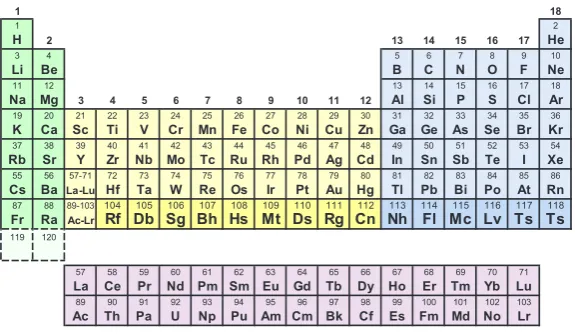
Recently, new elements with Z=113, 115, 117, and 118 were officially accepted [1, 2] and were named in Novem-ber 2016 [3]. With this, the periodic table of the elements (cf. Fig. 1) is complete to the end of the 7th period.
Fig. 2 shows the corresponding cut-out of the chart of nuclei (with decay properties updated according to [4]), where all known or claimed nuclei are indicated in col-ored boxes, overlaying the calculated shell correction en-ergy landscape according to a macroscopic-microscopic model [5]. Also indicated (by white/black boxes for yet unknown isotopes) are the hypothetical decay chains orig-inating from the 3n and 4n compound nucleus (CN) evapo-ration channels following complete fusion of50Ti+249Bk leading to299119∗(red bordered boxes),50Ti+249Cf lead-ing to 299120∗ (light blue bordered boxes), and 54Cr + 248Cm, 58Fe +244Pu, and64Ni +238U, which all lead to 302120∗(dark blue bordered boxes). Decay modes of
un-known isotopes were assumed based on [6–8].
2 The search for new elements beyond Og
For the heaviest currently known elements with Z= 112-118, employing fusion-evaporation reactions induced by doubly-magic neutron-rich 48Ca on targets of
92U-98Cf [10] is well established, having been confirmed in multi-ple laboratories (e.g., [11–16]) and would, therefore, also appear to be a natural choice for attempts to synthesize yet heavier elements. Cross sections stay relatively constant
e-mail: [email protected]
at a level of 0.5-10 pb over an extended region, suggest-ing that the accumulated data set provide a good basis for theoretical models to predict values for elements 119 and 120. The one caveat is that the corresponding target ma-terials would have to be 99Es and 100Fm, which are not available in quantities that suffice to make targets for such synthesis experiments. Current technology for the produc-tion of transuranium isotopes, e.g., at the ORNL’s High Flux Isotope Reactor (HFIR) is capable of producingµg and pg amounts of long-lived99Es and100Fm isotopes, re-spectively [17], which is orders of magnitude less than the experiments discovering and studying the heaviest known elements required. Still, fusion reactions with actinide tar-gets are generally expected to provide the highest cross sections for the synthesis of new elements with Z≥119. Thus, reactions induced by beams heavier than48Ca will be needed. Five of the most commonly suggested reac-tions giving access to Z≥119 have been studied mentally and are listed in Table 1. None of these experi-ments have led to the conclusive discovery of a new ele-ment, though.
A total of more than one year of accelerator beam-time proved insufficient for the discovery of a new el-ement, whereas any of the known elements would have been synthesized in significant amounts given the current sensitivity levels of such experiments. This suggests that either cross sections are significantly lower for all of the actinide-based reactions using beams heavier than 48Ca, or that some aspects relevant for performing a successful search experiment are not understood well enough. Likely, it is a combination of both. One such crucial aspect is
EPJ Web of Conferences 163, 00015 (2017) DOI: 10.1051/epjconf/201716300015
1 18
1 2
H 2 13 14 15 16 17 He
3 4 5 6 7 8 9 10
Li Be B C N O F Ne
11 12 13 14 15 16 17 18
Na Mg 3 4 5 6 7 8 9 10 11 12 Al Si P S Cl Ar
19 20 21 22 23 24 25 26 27 28 29 30 31 32 33 34 35 36
K Ca Sc Ti V Cr Mn Fe Co Ni Cu Zn Ga Ge As Se Br Kr
37 38 39 40 41 42 43 44 45 46 47 48 49 50 51 52 53 54
Rb Sr Y Zr Nb Mo Tc Ru Rh Pd Ag Cd In Sn Sb Te I Xe
55 56 57-71 72 73 74 75 76 77 78 79 80 81 82 83 84 85 86
Cs Ba La-Lu Hf Ta W Re Os Ir Pt Au Hg Tl Pb Bi Po At Rn
87 88 89-103 104 105 106 107 108 109 110 111 112 113 114 115 116 117 118
Fr Ra Ac-Lr Rf Db Sg Bh Hs Mt Ds Rg Cn Nh Fl Mc Lv Ts Ts 119 120
57 58 59 60 61 62 63 64 65 66 67 68 69 70 71
La Ce Pr Nd Pm Sm Eu Gd Tb Dy Ho Er Tm Yb Lu
89 90 91 92 93 94 95 96 97 98 99 100 101 102 103
Ac Th Pa U Np Pu Am Cm Bk Cf Es Fm Md No Lr
Fig. 1. Periodic Table of the Elements. The known superheavy elements with Z=104-118 are highlighted. The positions of the elements with Z=119 and 120, which are yet unknown and would form the beginning of the 8th period, are also indicated.
Fig. 1. Chart of nuclei of the heaviest elements. The underlying contour plot shows calculated shell correction energies [5]. Known nuclei are indicated by colored boxes, new nuclei occurring in the hypothetical 3n/4n decay chains produced in complete fusion of different target/projectile combinat-ions leading to Z=119 and Z=120 are indicated by white and black boxes. See text for more details. Taken from [9].
Figure 1. Periodic Table of the Elements. The known superheavy elements with Z=104-118 are highlighted. The positions of the
elements with Z=119 and 120, which are yet unknown and would form the beginning of the 8thperiod, are also indicated.
1 18
1 2
H 2 13 14 15 16 17 He
3 4 5 6 7 8 9 10
Li Be B C N O F Ne
11 12 13 14 15 16 17 18
Na Mg 3 4 5 6 7 8 9 10 11 12 Al Si P S Cl Ar
19 20 21 22 23 24 25 26 27 28 29 30 31 32 33 34 35 36
K Ca Sc Ti V Cr Mn Fe Co Ni Cu Zn Ga Ge As Se Br Kr
37 38 39 40 41 42 43 44 45 46 47 48 49 50 51 52 53 54
Rb Sr Y Zr Nb Mo Tc Ru Rh Pd Ag Cd In Sn Sb Te I Xe
55 56 57-71 72 73 74 75 76 77 78 79 80 81 82 83 84 85 86
Cs Ba La-Lu Hf Ta W Re Os Ir Pt Au Hg Tl Pb Bi Po At Rn
87 88 89-103 104 105 106 107 108 109 110 111 112 113 114 115 116 117 118
Fr Ra Ac-Lr Rf Db Sg Bh Hs Mt Ds Rg Cn Nh Fl Mc Lv Ts Ts
119 120
57 58 59 60 61 62 63 64 65 66 67 68 69 70 71
La Ce Pr Nd Pm Sm Eu Gd Tb Dy Ho Er Tm Yb Lu
89 90 91 92 93 94 95 96 97 98 99 100 101 102 103
Ac Th Pa U Np Pu Am Cm Bk Cf Es Fm Md No Lr
Fig. 1. Periodic Table of the Elements. The known superheavy elements with Z=104-118 are highlighted. The positions of the elements with Z=119 and 120, which are yet unknown and would form the beginning of the 8th period, are also indicated.
Fig. 1. Chart of nuclei of the heaviest elements. The underlying contour plot shows calculated shell correction energies [5]. Known nuclei are indicated by colored boxes, new nuclei occurring in the hypothetical 3n/4n decay chains produced in complete fusion of different target/projectile combinat-ions leading to Z=119 and Z=120 are indicated by white and black boxes. See text for more details. Taken from [9].
Figure 2.Chart of nuclei of the heaviest elements. The underlying contour plot shows calculated shell correction energies [5]. Known nuclei are indicated by colored boxes, new nuclei occurring in the hypothetical 3n/4n decay chains produced in complete fusion of
different target/projectile combinations leading to Z=119 and Z=120 are indicated by white and black boxes. See text for more details.
Taken from [9].
Table 1.Fusion reactions employed to search for elements beyond Z=118.
Compound Beamtime Cross section Ref. nucleus invested limita
50Ti+249Bk 299119∗ 4.5 months b [18]
64Ni+238U 302120∗ 4 months ≥90 fb [19]
58Fe+244Pu 302120∗ 2 months ≥400 fb [20]
54Cr+248Cm 302120∗ >1 month ≥580 fb [21]
50Ti+249Cf 302120∗ >1 month b [18]
a63.2% confidence level ("one-event limit") bunder final analysis
that of the optimum beam energy, which indeed seems to be understood insufficiently, as is detailed elsewhere [18]. One has to bear in mind that some of the predic-tions of the nuclear half-lives of the produced isotopes, es-pecially in the case of Z=120, suggest these to be in the order of microseconds, i.e., comparable to the flight-time through the used separators. This may imply that losses due to decay-in-flight might have negatively affected
ex-periments. Still, the predominant reason for the lack of finding any new element seems to be insufficient sensitiv-ity. Preparations for improved experiments are ongoing at several laboratories. Thus, it appears appropriate to re-flect on which aspects should get most attention to perform the best possible experiments, thus maximizing the likeli-hood of success. Obvious, purely technical aspects include higher primary beam intensities, targets that can withstand
EPJ Web of Conferences 163, 00015 (2017) DOI: 10.1051/epjconf/201716300015
1 18
1 2
H 2 13 14 15 16 17 He
3 4 5 6 7 8 9 10
Li Be B C N O F Ne
11 12 13 14 15 16 17 18
Na Mg 3 4 5 6 7 8 9 10 11 12 Al Si P S Cl Ar
19 20 21 22 23 24 25 26 27 28 29 30 31 32 33 34 35 36
K Ca Sc Ti V Cr Mn Fe Co Ni Cu Zn Ga Ge As Se Br Kr
37 38 39 40 41 42 43 44 45 46 47 48 49 50 51 52 53 54
Rb Sr Y Zr Nb Mo Tc Ru Rh Pd Ag Cd In Sn Sb Te I Xe
55 56 57-71 72 73 74 75 76 77 78 79 80 81 82 83 84 85 86
Cs Ba La-Lu Hf Ta W Re Os Ir Pt Au Hg Tl Pb Bi Po At Rn
87 88 89-103 104 105 106 107 108 109 110 111 112 113 114 115 116 117 118
Fr Ra Ac-Lr Rf Db Sg Bh Hs Mt Ds Rg Cn Nh Fl Mc Lv Ts Ts 119 120
57 58 59 60 61 62 63 64 65 66 67 68 69 70 71
La Ce Pr Nd Pm Sm Eu Gd Tb Dy Ho Er Tm Yb Lu
89 90 91 92 93 94 95 96 97 98 99 100 101 102 103
Ac Th Pa U Np Pu Am Cm Bk Cf Es Fm Md No Lr
Fig. 1. Periodic Table of the Elements. The known superheavy elements with Z=104-118 are highlighted. The positions of the elements with Z=119 and 120, which are yet unknown and would form the beginning of the 8th period, are also indicated.
Fig. 1. Chart of nuclei of the heaviest elements. The underlying contour plot shows calculated shell correction energies [5]. Known nuclei are indicated by colored boxes, new nuclei occurring in the hypothetical 3n/4n decay chains produced in complete fusion of different target/projectile combinat-ions leading to Z=119 and Z=120 are indicated by white and black boxes. See text for more details. Taken from [9].
Figure 1. Periodic Table of the Elements. The known superheavy elements with Z=104-118 are highlighted. The positions of the
elements with Z=119 and 120, which are yet unknown and would form the beginning of the 8thperiod, are also indicated.
1 18
1 2
H 2 13 14 15 16 17 He
3 4 5 6 7 8 9 10
Li Be B C N O F Ne
11 12 13 14 15 16 17 18
Na Mg 3 4 5 6 7 8 9 10 11 12 Al Si P S Cl Ar
19 20 21 22 23 24 25 26 27 28 29 30 31 32 33 34 35 36
K Ca Sc Ti V Cr Mn Fe Co Ni Cu Zn Ga Ge As Se Br Kr
37 38 39 40 41 42 43 44 45 46 47 48 49 50 51 52 53 54
Rb Sr Y Zr Nb Mo Tc Ru Rh Pd Ag Cd In Sn Sb Te I Xe
55 56 57-71 72 73 74 75 76 77 78 79 80 81 82 83 84 85 86
Cs Ba La-Lu Hf Ta W Re Os Ir Pt Au Hg Tl Pb Bi Po At Rn
87 88 89-103 104 105 106 107 108 109 110 111 112 113 114 115 116 117 118
Fr Ra Ac-Lr Rf Db Sg Bh Hs Mt Ds Rg Cn Nh Fl Mc Lv Ts Ts
119 120
57 58 59 60 61 62 63 64 65 66 67 68 69 70 71
La Ce Pr Nd Pm Sm Eu Gd Tb Dy Ho Er Tm Yb Lu
89 90 91 92 93 94 95 96 97 98 99 100 101 102 103
Ac Th Pa U Np Pu Am Cm Bk Cf Es Fm Md No Lr
Fig. 1. Periodic Table of the Elements. The known superheavy elements with Z=104-118 are highlighted. The positions of the elements with Z=119 and 120, which are yet unknown and would form the beginning of the 8th period, are also indicated.
Fig. 1. Chart of nuclei of the heaviest elements. The underlying contour plot shows calculated shell correction energies [5]. Known nuclei are indicated by colored boxes, new nuclei occurring in the hypothetical 3n/4n decay chains produced in complete fusion of different target/projectile combinat-ions leading to Z=119 and Z=120 are indicated by white and black boxes. See text for more details. Taken from [9].
Figure 2.Chart of nuclei of the heaviest elements. The underlying contour plot shows calculated shell correction energies [5]. Known nuclei are indicated by colored boxes, new nuclei occurring in the hypothetical 3n/4n decay chains produced in complete fusion of
different target/projectile combinations leading to Z=119 and Z=120 are indicated by white and black boxes. See text for more details.
Taken from [9].
Table 1.Fusion reactions employed to search for elements beyond Z=118.
Compound Beamtime Cross section Ref. nucleus invested limita
50Ti+249Bk 299119∗ 4.5 months b [18]
64Ni+238U 302120∗ 4 months ≥90 fb [19]
58Fe+244Pu 302120∗ 2 months ≥400 fb [20]
54Cr+248Cm 302120∗ >1 month ≥580 fb [21]
50Ti+249Cf 302120∗ >1 month b [18]
a63.2% confidence level ("one-event limit") bunder final analysis
that of the optimum beam energy, which indeed seems to be understood insufficiently, as is detailed elsewhere [18]. One has to bear in mind that some of the predic-tions of the nuclear half-lives of the produced isotopes, es-pecially in the case of Z=120, suggest these to be in the order of microseconds, i.e., comparable to the flight-time through the used separators. This may imply that losses due to decay-in-flight might have negatively affected
ex-periments. Still, the predominant reason for the lack of finding any new element seems to be insufficient sensitiv-ity. Preparations for improved experiments are ongoing at several laboratories. Thus, it appears appropriate to re-flect on which aspects should get most attention to perform the best possible experiments, thus maximizing the likeli-hood of success. Obvious, purely technical aspects include higher primary beam intensities, targets that can withstand
such intensities over extended periods [22, 23], more ef-ficient separators, more sensitive detection systems with dead-time free data acquisition [24, 25] that allow safe identification of single decay chains from new elements, and longer irradiation times. As detailed in [18], where the system 50Ti+249Cf is employed to illustrate the
cur-rent situation, optimum beam energies suggested by dif-ferent theoretical frameworks differ by significantly larger amounts than can be covered in a single experiment. This highlights the need for a well-informed choice of the irra-diation energy. Performing searches that are significantly more sensitive than those summarized in Tab 1 at multi-ple beam energies (which were all obtained at one single energy each) would consume years of beamtime.
In this situation, performing complementary experi-ments studying these fusion reactions, which yield infor-mation that guides future new element search efforts, ap-pears well justified. For this, we recall that the forma-tion of a superheavy nucleus is parametrized as the product of three individual steps, each characterized with its own probability: σER = σcap·PCN·Wsur with σER the
evapo-ration residue (ER) cross section, σcap the capture cross
section, PCNthe compound nucleus formation probability,
and Wsurthe exit channel survival probability. The
forma-tion of superheavy elements is significantly suppressed by the quasifission (QF) process, in which two colliding nu-clei reseparate on a fast time-scale before coalescing into a compound nucleus, see [26], and Fig. 4 for a schematic of the relevant processes.
With QF being the complementary process to com-pound nucleus formation, PQF =1-PCN, where PQF can
reach large values. The QF process thus profits from high rates for systems where PCN is small, e.g., SHE
forma-tion. Its study thus gives access to phenomena relevant for SHE formation, but in comparatively very short ex-periments. Observables include mass angle distributions [27] or mass energy distributions [28]. Combined with the corresponding experimental data, which can be recorded in short experiments, this will allow for the testing of dif-ferent models, thus providing guidance concerning which ones deliver the most trustworthy predictions. Better in-formed selection of, e.g., the optimum irradiation energy will be invaluable. First steps in this direction have been made recently [26, 29]. A combined effort encompass-ing theoretical as well as experimental work will provide an improved basis for the certainly coming future efforts to discover new elements with Z>118 and to thus open a new row in the Periodic Table of the Elements.
2.1 R&D activities towards a new cw linac
Superheavy element research is a pillar of the GSI research program for many decades and has led to high-visibility results. These include the discovery of six new elements [30] and chemical investigations for the first classifica-tion of new elements in the periodic table [31]. Tech-nical advancements recently facilitated further milestone successes, including synthesis of elements up to Ts [12– 14, 32], extensive systematic nuclear structure studies of
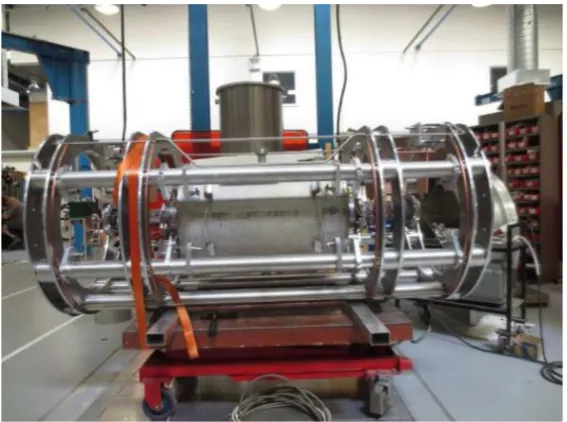
mass even-Z isotones (N constant) and mass odd-Z isotopes (constant odd-Z) in the “high-cross section” region Z=102-106 around N=152 (see [33] for a recent example) as well first such studies in Mc decay chains [13], high-precision mass measurements of single atoms of the heav-iest elements [34, 35], laser spectroscopic studies of their electron shell [36], as well as advances in chemical stud-ies up to the heavstud-iest studied elements [37], resulting in a worldwide unique breadth and depth of the research pro-gram. Beams for all these studies are provided by the UNI-LAC linear accelerator, a pulsed machine that provides up to three types of projectiles from different ion-sources to several experiments in quasi-parallel operation. The max-imum duty cycle is 25%. This offers unique possibilities to significantly enhance beam availability by the installa-tion of a continuous-wave (cw) heavy-ion linac for highly intense beams, as has been suggested, e.g., in [38]. With the foundation of the Helmholtz Institute in Mainz, Ger-many, the R&D towards such a machine has started [39]. With its continuous beam, a cw machine would be ideal for a steady irradiation at significantly higher intensities than are presently available and will thus allow advancing the GSI programs in superheavy element research, materials research and biophysics. In the field of SHE, this would provide for experiments at higher sensitivity, as well as for in-depth studies of nuclei produced with higher cross sec-tions thanks to higher production rates, Currently, a first “crossed H-bar”(CH) type cavity has been built to demon-strate the performance of this novel accelerating structure and is in the commissioning phase. Fig. 5 shows a photo-graph of the cavity embedded by two sc solenoids mounted on a common support structure, which will be placed in-side the cryostat.
Details on the cw linac demonstrator as well as a possi-ble layout of the full machine are given in [40]. Next steps, which have started, include the installation of a string of cavities.
References
[1] P. J. Karol et al., Pure Appl. Chem. 88, 139 (2016). [2] P. J. Karol et al., Pure Appl. Chem. 88, 155 (2016). [3] L. Öhrström, and J. Reedijk, Pure Appl. Chem. 88,
1225 (2016).
[4] U. Forsberg et al., Nucl. Phys. A 953, 117 (2016). [5] Z. Patyk, R. Smolanczuk, and A. Sobiczewski, Nucl.
Phys. A 626, 337c (1997).
[6] I. Muntian, Z. Patyk, and A. Sobiczewski, Phys. At. Nucl. 66, 1015 (2003).
[7] I. Muntian et al., Acta Phys. Pol. B 34, 2073 (2003). [8] R. Smola´nczuk, J. Skalski, and A. Sobiczewski, Phys.
Rev. C 52, 1871 (1995).
[9] Ch. E. Düllmann, EPJ Web Conf. 131, 08004 (2016). [10] Y. T. Oganessian, and V. K. Utyonkov, Nucl. Phys. A
944, 62 (2015).
[11] S. Hofmann et al., Eur. Phys. J. A 32, 251 (2007). [12] S. Hofmann et al., Eur. Phys. J. A 48, 62 (2012). [13] D. Rudolph et al., Phys. Rev. Lett. 111, 112502
(2013).
EPJ Web of Conferences 163, 00015 (2017) DOI: 10.1051/epjconf/201716300015
over extended periods [22, 23], more efficient separators, more sensitive detection systems
with dead-time free data acquisition [24, 25] that allow safe identification of single decay
chains from new elements, and longer irradiation times. As detailed in [18], where the
system
50Ti+
249Cf is employed to illustrate the current situation, optimum beam energies
suggested by different theoretical frameworks differ by significantly larger amounts than
can be covered in a single experiment. This highlights the need for a well-informed choice
of the irradiation energy. Performing at multiple beam energies searches that are
significantly more sensitive than those summarized in Tab. 2 (which were all obtained at
one single energy each) would consume years of beamtime.
In this situation, performing complementary experiments studying these fusion reactions,
which yield information that guides future new element search efforts, appears well
justified. For this, we recall that the formation of a superheavy nucleus is parametrized as
the product of three individual steps, each characterized with its own probability:
s
ER=
s
cap·P
CN·W
surwith
s
ERthe evaporation residue (ER) cross section,
s
capthe capture cross
section, P
CNthe compound nucleus formation probability, and W
surthe exit channel survival
probability. The formation of superheavy elements is significantly suppressed by the
quasifission (QF) process, in which two colliding nuclei reseparate on a fast time-scale
before coalescing into a compound nucleus, see [26], and Fig. 4 for a schematic of the
relevant processes.
Fig. 4: Schematic of the relevant processes in nucleus-nucleus collisions aimed at synthesizing the heaviest elements. Proj: projectile; Targ: target; Cap: captured system; CN: compound nucleus; ER: evaporation residue; FF: fusion-fission; QF: quasifission; PCN: probability for the captured system to form a compound nucleus; PQF: probability for the captured system to fission. Obviously, PQF=1-PCN.
With QF being the complementary process to compound nucleus formation, P
QF= 1 - P
CN,
where P
QFcan reach large values. The QF process thus profits from high rates for systems
where P
CNis small, e.g., SHE formation. Its study thus gives access to phenomena relevant
for SHE formation, but in comparatively very short experiments. Observables include mass
angle distributions [27] or mass energy distributions [28]. Combined with the
corresponding experimental data, which can be recorded in short experiments, this will
allow testing different models, thus providing guidance concerning which ones deliver the
most trustworthy predictions. Better informed selection of, e.g., the optimum irradiation
energy will be invaluable. First steps in this direction have been made recently [26, 29]. A
combined effort encompassing theoretical as well as experimental work will provide an
Figure 3. Schematic of the relevant processes in nucleus-nucleus collisions aimed at synthesizing the heaviest elements. Proj: pro-jectile; Targ: target; Cap: captured system; CN: compound nucleus; ER: evaporation residue; FF: fusion-fission; QF: quasifission; PCN: probability for the captured system to form a compound nucleus; PQF: probability for the captured system to fission. Obviously,
PQF=1-PCN.
improved basis for the certainly coming future efforts to discover new elements with Z>118
and to thus open a new row in the Periodic Table of the Elements.
3 R&D activities towards a new cw linac
Superheavy element research is a pillar of the GSI research program for many decades and
has led to high-visibility results. These include the discovery of six new elements [30] and
chemical investigations for the first classification of new elements in the periodic table
[31]. Technical advancements recently facilitated further milestone successes, including
synthesis of elements up to Ts [12-14, 32], extensive systematic nuclear structure studies of
odd-mass even-Z isotones (N constant) and odd-mass odd-Z isotopes (constant Z) in the
“high-cross section” region Z=102-106 around N=152 (see [33] for a recent example) as
well first such studies in Mc decay chains [13], high-precision mass measurements of single
atoms of the heaviest elements [34, 35], laser spectroscopic studies of their electron shell
[36], as well as advances in chemical studies up to the heaviest studied elements [37],
resulting in a worldwide unique breadth and depth of the research program.
Beams for all these studies are provided by the UNILAC linear accelerator, a pulsed
machine that provides up to three types of projectiles from different ion-sources to several
experiments in quasi-parallel operation. The maximum duty cycle is 25%. This offers
unique possibilities to significantly enhance beam availability by the installation of a
continuous-wave (cw) heavy-ion linac for highly intense beams, as has been suggested,
e.g., in [38]. With the foundation of the Helmholtz Institute in Mainz, Germany, the R&D
towards such a machine has started
[39].
With its continuous beam, a cw machine would be
ideal for a steady irradiation at significantly higher intensities than are presently available
and will thus allow advancing the GSI programs in superheavy element research, materials
research and biophysics. In the field of SHE, this would
provide for experiments at higher
sensitivity, as well as for in-depth studies of nuclei produced with higher cross sections
thanks to higher production rates,
Currently, a first “crossed H-bar” (CH) type cavity has been built to demonstrate the
performance of this novel accelerating structure and is in the commissioning phase. Fig. 5
shows a photograph of the cavity embedded by two sc solenoids mounted on a common
support structure, which will be placed inside the cryostat.
Fig. 5. Superconducting cw linac demonstrator comprising a CH cavity embedded by two sc solenoids on a support frame (taken from [40]).
Figure 4. Superconducting cw linac demonstrator comprising a CH cavity embedded by two sc solenoids on a support frame (taken from [40]).
[14] J. Khuyagbaatar et al., Phys. Rev. Lett. 112, 172501 (2014).
[15] L. Stavsetra et al., Phys. Rev. Lett. 103, 132502 (2009).
[16] D. Kaji et al., J. Phys. Soc. Jpn. 86, 034201 (2017). [17] J. B. Roberto et al., Nucl. Phys. A 944, 99 (2015). [18] Ch. E. Düllmann et al., (in preparation) (2016). [19] S. Hofmann, J. Phys. G 42, 114001 (2015).
[20] Y. T. Oganessian et al., Phys. Rev. C 79, 024603 (2009).
[21] S. Hofmann et al., Eur. Phys. J. A 52, 180 (2016).
[22] S. N. Dmitriev, and A. G. Popeko, J. Radioanal. Nucl. Chem. 305, 927 (2015).
[23] E. Jäger et al., J. Radioanal. Nucl. Chem. 299, 1073 (2014).
[24] I. H. Lazarus et al., IEEE Trans. Nucl. Sci. 48, 567 (2001).
[25] J. Khuyagbaatar et al., Phys. Rev. Lett. 115, 242502 (2015).
[26] D. J. Hinde et al., EPJ Web Conf. 131, 04004 (2016). [27] R. du Rietz et al., Phys. Rev. C 88, 054618 (2013). [28] M. G. Itkis et al., Nucl. Phys. A 944, 204 (2015). [29] H. M. David et al., (in preparation) (2016).
EPJ Web of Conferences 163, 00015 (2017) DOI: 10.1051/epjconf/201716300015
over extended periods [22, 23], more efficient separators, more sensitive detection systems
with dead-time free data acquisition [24, 25] that allow safe identification of single decay
chains from new elements, and longer irradiation times. As detailed in [18], where the
system
50Ti+
249Cf is employed to illustrate the current situation, optimum beam energies
suggested by different theoretical frameworks differ by significantly larger amounts than
can be covered in a single experiment. This highlights the need for a well-informed choice
of the irradiation energy. Performing at multiple beam energies searches that are
significantly more sensitive than those summarized in Tab. 2 (which were all obtained at
one single energy each) would consume years of beamtime.
In this situation, performing complementary experiments studying these fusion reactions,
which yield information that guides future new element search efforts, appears well
justified. For this, we recall that the formation of a superheavy nucleus is parametrized as
the product of three individual steps, each characterized with its own probability:
s
ER=
s
cap·P
CN·W
surwith
s
ERthe evaporation residue (ER) cross section,
s
capthe capture cross
section, P
CNthe compound nucleus formation probability, and W
surthe exit channel survival
probability. The formation of superheavy elements is significantly suppressed by the
quasifission (QF) process, in which two colliding nuclei reseparate on a fast time-scale
before coalescing into a compound nucleus, see [26], and Fig. 4 for a schematic of the
relevant processes.
Fig. 4: Schematic of the relevant processes in nucleus-nucleus collisions aimed at synthesizing the heaviest elements. Proj: projectile; Targ: target; Cap: captured system; CN: compound nucleus; ER: evaporation residue; FF: fusion-fission; QF: quasifission; PCN: probability for the captured system to form a compound nucleus; PQF: probability for the captured system to fission. Obviously, PQF=1-PCN.
With QF being the complementary process to compound nucleus formation, P
QF= 1 - P
CN,
where P
QFcan reach large values. The QF process thus profits from high rates for systems
where P
CNis small, e.g., SHE formation. Its study thus gives access to phenomena relevant
for SHE formation, but in comparatively very short experiments. Observables include mass
angle distributions [27] or mass energy distributions [28]. Combined with the
corresponding experimental data, which can be recorded in short experiments, this will
allow testing different models, thus providing guidance concerning which ones deliver the
most trustworthy predictions. Better informed selection of, e.g., the optimum irradiation
energy will be invaluable. First steps in this direction have been made recently [26, 29]. A
combined effort encompassing theoretical as well as experimental work will provide an
Figure 3. Schematic of the relevant processes in nucleus-nucleus collisions aimed at synthesizing the heaviest elements. Proj: pro-jectile; Targ: target; Cap: captured system; CN: compound nucleus; ER: evaporation residue; FF: fusion-fission; QF: quasifission; PCN: probability for the captured system to form a compound nucleus; PQF: probability for the captured system to fission. Obviously,
PQF=1-PCN.
improved basis for the certainly coming future efforts to discover new elements with Z>118
and to thus open a new row in the Periodic Table of the Elements.
3 R&D activities towards a new cw linac
Superheavy element research is a pillar of the GSI research program for many decades and
has led to high-visibility results. These include the discovery of six new elements [30] and
chemical investigations for the first classification of new elements in the periodic table
[31]. Technical advancements recently facilitated further milestone successes, including
synthesis of elements up to Ts [12-14, 32], extensive systematic nuclear structure studies of
odd-mass even-Z isotones (N constant) and odd-mass odd-Z isotopes (constant Z) in the
“high-cross section” region Z=102-106 around N=152 (see [33] for a recent example) as
well first such studies in Mc decay chains [13], high-precision mass measurements of single
atoms of the heaviest elements [34, 35], laser spectroscopic studies of their electron shell
[36], as well as advances in chemical studies up to the heaviest studied elements [37],
resulting in a worldwide unique breadth and depth of the research program.
Beams for all these studies are provided by the UNILAC linear accelerator, a pulsed
machine that provides up to three types of projectiles from different ion-sources to several
experiments in quasi-parallel operation. The maximum duty cycle is 25%. This offers
unique possibilities to significantly enhance beam availability by the installation of a
continuous-wave (cw) heavy-ion linac for highly intense beams, as has been suggested,
e.g., in [38]. With the foundation of the Helmholtz Institute in Mainz, Germany, the R&D
towards such a machine has started
[39].
With its continuous beam, a cw machine would be
ideal for a steady irradiation at significantly higher intensities than are presently available
and will thus allow advancing the GSI programs in superheavy element research, materials
research and biophysics. In the field of SHE, this would
provide for experiments at higher
sensitivity, as well as for in-depth studies of nuclei produced with higher cross sections
thanks to higher production rates,
Currently, a first “crossed H-bar” (CH) type cavity has been built to demonstrate the
performance of this novel accelerating structure and is in the commissioning phase. Fig. 5
shows a photograph of the cavity embedded by two sc solenoids mounted on a common
support structure, which will be placed inside the cryostat.
Fig. 5. Superconducting cw linac demonstrator comprising a CH cavity embedded by two sc solenoids on a support frame (taken from [40]).
Figure 4. Superconducting cw linac demonstrator comprising a CH cavity embedded by two sc solenoids on a support frame (taken from [40]).
[14] J. Khuyagbaatar et al., Phys. Rev. Lett. 112, 172501 (2014).
[15] L. Stavsetra et al., Phys. Rev. Lett. 103, 132502 (2009).
[16] D. Kaji et al., J. Phys. Soc. Jpn. 86, 034201 (2017). [17] J. B. Roberto et al., Nucl. Phys. A 944, 99 (2015). [18] Ch. E. Düllmann et al., (in preparation) (2016). [19] S. Hofmann, J. Phys. G 42, 114001 (2015).
[20] Y. T. Oganessian et al., Phys. Rev. C 79, 024603 (2009).
[21] S. Hofmann et al., Eur. Phys. J. A 52, 180 (2016).
[22] S. N. Dmitriev, and A. G. Popeko, J. Radioanal. Nucl. Chem. 305, 927 (2015).
[23] E. Jäger et al., J. Radioanal. Nucl. Chem. 299, 1073 (2014).
[24] I. H. Lazarus et al., IEEE Trans. Nucl. Sci. 48, 567 (2001).
[25] J. Khuyagbaatar et al., Phys. Rev. Lett. 115, 242502 (2015).
[26] D. J. Hinde et al., EPJ Web Conf. 131, 04004 (2016). [27] R. du Rietz et al., Phys. Rev. C 88, 054618 (2013). [28] M. G. Itkis et al., Nucl. Phys. A 944, 204 (2015). [29] H. M. David et al., (in preparation) (2016).
[30] G. Münzenberg, Nucl. Phys. A 944, 5 (2015). [31] M. Schädel, Eur. Phys. J. D 45, 67 (2007).
[32] Ch. E. Düllmann et al., Phys. Rev. Lett. 104, 252701 (2010).
[33] S. Antalic et al., Eur. Phys. J. A 51, 41 (2015). [34] M. Block et al., Nature 463, 785 (2010).
[35] E. Minaya Ramirez et al., Science 337, 1207 (2012).
[36] M. Laatiaoui et al., Nature 538, 495 (2016). [37] A. Yakushev et al., Inorg. Chem. 53, 1624 (2014). [38] S. Hofmann et al., in EXON 2004, edited by Y. E.
Pe-nionzhkevich, and E. A. Cherepanov (World Scientific, Singapore, Peterhof, Russia, 2004), pp. 157.
[39] S. Minaev et al., Phys. Rev. ST Accel. Beams 12, 120101 (2009).
[40] W. Barth et al., EPJ Web Conf. 138, 01026 (2017).
EPJ Web of Conferences 163, 00015 (2017) DOI: 10.1051/epjconf/201716300015