Scholarship@Western
Scholarship@Western
Electronic Thesis and Dissertation Repository
7-3-2013 12:00 AM
Prediction of Wind Loads on Tall Buildings: Development and
Prediction of Wind Loads on Tall Buildings: Development and
Applications of an Aerodynamic Database
Applications of an Aerodynamic Database
Bernard Kim
The University of Western Ontario Supervisor
Dr. Wenxing Zhou
The University of Western Ontario Joint Supervisor Dr. Eric Ho
The University of Western Ontario
Graduate Program in Civil and Environmental Engineering
A thesis submitted in partial fulfillment of the requirements for the degree in Master of Engineering Science
© Bernard Kim 2013
Follow this and additional works at: https://ir.lib.uwo.ca/etd Part of the Structural Engineering Commons
Recommended Citation Recommended Citation
Kim, Bernard, "Prediction of Wind Loads on Tall Buildings: Development and Applications of an Aerodynamic Database" (2013). Electronic Thesis and Dissertation Repository. 1344.
https://ir.lib.uwo.ca/etd/1344
This Dissertation/Thesis is brought to you for free and open access by Scholarship@Western. It has been accepted for inclusion in Electronic Thesis and Dissertation Repository by an authorized administrator of
ii
The Western University Aerodynamic Database (WAD) has been developed as an alternative
means for structural engineers to estimate the preliminary design wind loads on tall
buildings. The database consists of aerodynamic loads obtained from either the
force-balance or pressure model tests on 56 tall buildings in their simulated actual surroundings
carried out in the Boundary Layer Wind Tunnel Laboratory at Western University. The data
for a given building include the statistics of the normalized aerodynamic loads such as the
means, root-mean squares, and power spectral density functions of the base bending
moments in two orthogonal directions and base torque. To estimate the preliminary design
wind loads on a target building, the fuzzy logic theory is employed to select the reference
buildings from the database whose aerodynamic characteristics and upstream conditions are
similar to those of the target building. A modified three-dimensional moment gust loading
factor approach is proposed to estimate the wind-induced responses of the target building for
all wind directions. The WAD-based procedure for estimating the wind-induced responses is
validated by comparing the estimated responses with the corresponding responses obtained
from the force-balance or pressure model tests for 36 tall buildings included in WAD. The
comparison suggests that the WAD-based procedure can provide reasonably accurate
estimates of base moments and accelerations of tall buildings, and is therefore considered
adequate to be used in their preliminary design. Finally, the wind-induced responses
predicted using the WAD-based procedures are also compared with those obtained from the
wind load provisions in three major design codes, i.e. ASCE 7-10, NBCC 2010 and AS/NZS
1170.2: 2011, as well as the NatHaz Aerodynamic Load Database developed at University of
Notre Dame. The results of the comparison study show that the WAD-based predictions of
the wind loads is a viable alternative to evaluating the preliminary design wind loads for tall
buildings.
Wind Loading, Tall Buildings, Design Codes and Standards, Force-balance Method, Pressure
iii
This thesis was carried out in the Civil and Environmental Engineering Department of
Western University. Foremost, I would like to express my gratitude to my co-supervisors Dr.
Wenxing Zhou and Dr. Eric Ho for their guidance and support throughout the completion of
this thesis. Great appreciation goes to Western University and Dr. Wenxing Zhou for the
financial assistance. I would also like to thank Dr. Gregory Kopp, Dr. Hanping Hong, and
Dr. Kamran Siddiqui for being my examiners and offering constructive suggestions to the
thesis.
Extended acknowledgements go to the Boundary Layer Wind Tunnel Laboratory of Western
University for their essential contributions of aerodynamic data of various tall buildings and
to the various technical staff members of the Boundary Layer Wind Tunnel Laboratory for
their general assistance during the course of the project.
I would like to sincerely thank my parents, Dr. Sung Kim and Geun-Ju Kim, for their
continual support and encouragement in pursuit of higher levels of academia. It is to them
iv
Abstract ... ii
Acknowledgments... iii
Table of Contents ... iv
List of Tables ... vii
List of Figures ... ix
List of Notations ... xii
List of Appendices ... xvii
Chapter 1 Introduction ... 1
1.1 Background ... 1
1.2 Objectives and Thesis Outline ... 3
Chapter 2 Overview of Wind Loads on Tall Buildings ... 5
2.1 Introduction ... 5
2.2 Bluff Body Aerodynamics ... 6
2.2.1 Overview ... 6
2.2.2 Along-wind Load ... 7
2.2.3 Across-wind Load ... 8
2.2.4 Torsional Load ... 8
2.3 Factors Affecting the Aerodynamics of Tall Buildings ... 9
2.3.1 Overview ... 9
2.3.2 Approaching Boundary Layer Flow ... 9
2.3.3 Building Dimensions ... 11
2.3.4 Aerodynamic Interference and Shielding ... 11
2.4 Gust Load Factor Approach ... 13
v
2.4.2 Three-Dimensional Moment Gust Loading Factor ... 14
2.5 Approaches for Determining Design Wind Loads on Tall Buildings... 16
2.5.1 Design Codes ... 16
2.5.2 Wind Tunnel Testing ... 23
2.5.3 Database-Assisted Approach ... 25
2.6 Summary ... 27
Chapter 3 Western University Aerodynamic Database of Tall Buildings ... 28
3.1 Overview ... 28
3.2 Development of Aerodynamic Database ... 30
3.2.1 Geometric Parameters ... 30
3.2.2 Exposure Category ... 32
3.2.3 Normalized Aerodynamic Loads ... 35
3.3 Reference Building Selection Process ... 37
3.4 Modified Three-Dimensional Moment Gust Loading Factor Approach ... 42
3.4.1 Peak Base Bending Moment and Torque ... 42
3.4.2 Equivalent Static Wind Loads ... 45
3.4.3 Acceleration ... 46
3.5 WAD Graphical User Interface ... 47
3.5.1 Input ... 47
3.5.2 Output ... 49
3.5.3 Evaluation of Equivalent Static Wind Loads ... 51
3.6 Scope of WAD ... 52
3.7 Summary ... 52
Chapter 4 Validation of Western Aerodynamic Database ... 53
4.1 Introduction ... 53
vi
4.2.1 Overview ... 54
4.2.2 Design Wind Speeds ... 55
4.2.3 WAD ... 56
4.2.4 Design Codes ... 56
4.2.5 NALD ... 61
4.3 Illustration of Reference Building Selection Process ... 63
4.3.1 Overview ... 63
4.3.2 Reference Building Selection Comparison ... 63
4.4 WAD-Based Wind Load Evaluation Validation ... 72
4.4.1 Overview ... 72
4.4.2 Peak Base Moments ... 72
4.4.3 Peak Acceleration ... 78
4.5 Summary ... 81
Chapter 5 Summary, Conclusions and Recommendations ... 83
5.1 Summary and Conclusions ... 83
5.2 Recommendations for Future Work... 88
References ... 90
Appendices ... 96
vii
Table 2.1: Terrain Categories Defined in ASCE 7-10 ... 11
Table 2.2: Averaging Times for Basic Wind Speed and Formulas for Calculating Design Wind Velocity Pressure ... 17
Table 2.3: Exposure Categories in Design Codes ... 17
Table 2.4: Gust Loading Factor ... 20
Table 2.5: Along-wind Acceleration Terms ... 21
Table 3.1: Far-Field Exposure Categories in WAD... 32
Table 3.2: Near-Field Exposure Categories ... 34
Table 3.3: Distribution of Buildings in Upstream Exposure Categories at Different Wind Angles in WAD... 35
Table 4. 1: Basic Statistics of Peak Base Moments Calculated from Reference Buildings and Wind Tunnel Peak Base Moment ... 64
Table 4.2: Basic Statistics of Peak Base Moment Ratios (•) ... 77
Table 4.3: Basic Statistics of Peak Acceleration Ratios (
ω
•) ... 80Appendix C Table C.1: Building Geometric Properties... 101
Table C.2: Building Dynamic Structural Properties ... 102
Appendix D Table D.1: Peak Base Moment Ratio ... 106
viii
Appendix E
ix
Figure 2.1: Schematic of the Air Flow around a Bluff Body... 7
Figure 2.2: Wind Load Axes ... 7
Figure 2.3: Wind Load Streamlines and Pressure Distribution around a Bluff Body ... 9
Figure 2.4: Standard Profiles for Mean Wind Speed and Turbulence Intensity ... 10
Figure 2.5: Simulation of the Atmospheric Boundary Layer ... 23
Figure 3.1: WAD Methodology ... 29
Figure 3.2: Summary of Aspect Ratios of Buildings in WAD ... 31
Figure 3.3: Summary of Slenderness Ratios of Buildings in WAD ... 31
Figure 3.4: Summary of Building’s Heights in WAD ... 31
Figure 3.5: Sign Conventions for Base Bending Moments and Torque ... 35
Figure 3.6: Near-field Category Membership Function ... 38
Figure 3.7: Dimensional Membership Function ... 39
Figure 3.8: Final Match Membership Function ... 41
Figure 3.9: Building Selection Example ... 42
Figure 3.10: Main Graphical User Interface for WAD ... 47
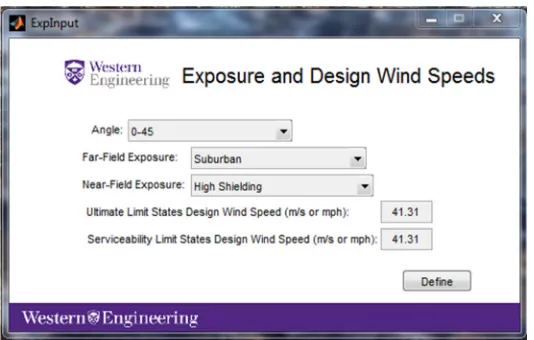
Figure 3.11: Exposure and Design Wind Speed Input ... 48
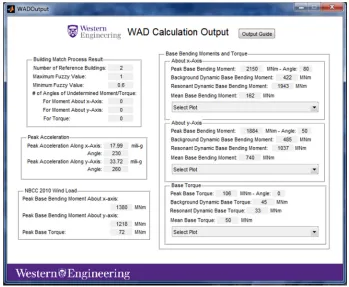
Figure 3.12: Graphical User Interface for Output of WAD ... 50
x
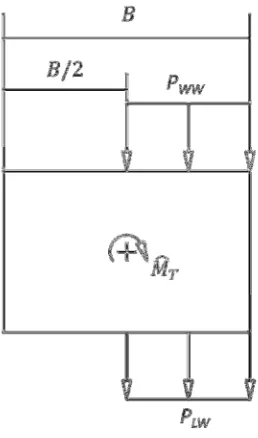
Figure 4.1: NBCC 2010 Partial Loading Case B for Torsion Wind Acting Perpendicular to D
... 58
Figure 4.2: NBCC 2010 Partial Loading Case B for Torsion Wind Acting Perpendicular to B ... 58
Figure 4.3: NBCC 2010 Partial Loading Case D for Torsion ... 59
Figure 4.4: ASCE 7-10 Wind Load Case 2 for Torsion Wind Acting Perpendicular to D .... 59
Figure 4.5: ASCE 7-10 Wind Load Case 2 for Torsion Wind Acting Perpendicular to B ... 59
Figure 4.6: ASCE 7-10 Wind Load Case 4 for Torsion ... 60
Figure 4.7: Peak Base Moment and Normalized Aerodynamic Loads for Building 9 at Wind Angle 30° - Base Moment (x-axis) ... 67
Figure 4.8: Peak Base Moment and Normalized Aerodynamic Loads for Building 21 at Wind Angle 280° - Base Moment (y-axis) ... 68
Figure 4.9: Peak Base Moment and Normalized Aerodynamic Loads for Building 25 at Wind Angle 230° - Base Moment (x-axis) ... 69
Figure 4.10: Example 1 Target Building ... 70
Figure 4.11: Example 1 Reference Buildings ... 70
Figure 4.12: Example 2 Target Building ... 71
Figure 4.13: Example 2 Reference Buildings ... 71
Figure 4.14: Example 3 Building # 10 ... 71
Figure 4.15: Scenario of Reference Building Selection Coverage (Moderate or high shielding = coverage, No shielding or low shielding = no coverage) ... 75
Figure 4.16: Box Plot for the Peak Base Moment Ratios ... 78
xi
Appendix B
Figure B.1: Input Guide User Interface ... 100
Figure B.2: Output Guide User Interface ... 100
Appendix D
Figure D.1: Peak Base Moment Ratio x-Axis ... 103
Figure D.2: Peak Base Moment Ratio y-Axis ... 104
Figure D.3: Peak Base Torque Ratio ... 105
Appendix E
xii : peak across-wind acceleration
: peak along-wind acceleration
, : peak acceleration along j-axis, at height z, and wind angle α
, : peak acceleration at H determined from wind tunnel analysis along j-axis and wind angle α
, : peak resultant acceleration at H and wind angle α determined from wind tunnel analysis
•, : peak resultant acceleration at H and wind angle α determined from WAD/design code/NALD
B
: background turbulence factorB: longer plan dimension of the building
Bi: longer plan dimension at height i
b: plan dimension of the building that is perpendicular to the direction of wind; across-wind
body width
CeH : terrain factor at H of the building in NBCC 2010
Cfs: across-wind force spectrum coefficient generalized for a linear mode shape
Cfx: total drag force coefficient
̅: non-dimensional mean base moment coefficient about j-axis and wind angle α Cj: linearization factor for the dynamic components for ESWL for dynamic moments about j
-axis
CP,LW: effective pressure coefficient at leeward wall for design code calculations
CP,WW: effective pressure coefficient at windward wall for design code calculations
D•(r•): fuzzy value for the aspect ratio (A) or slenderness ratio (S) and • is a generic symbol for A or S
Di: shorter plan dimension at height i
D: shorter plan dimension of the building
E: gust energy ratio
eR: distance between the elastic shear center and the center of mass
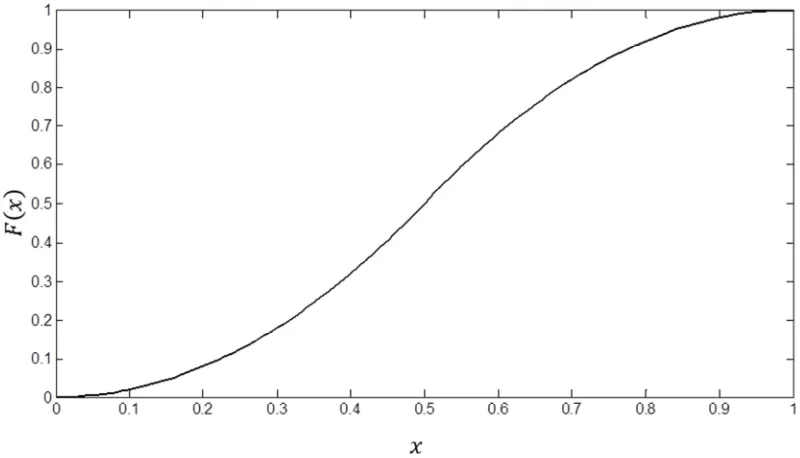
xiii F(x): fuzzy value of final matching index
f1i: fundamental natural frequency, i = along-wind, across-wind, or torque
fn: reduced frequency
f1: natural frequency of the fundamental along-wind mode of the building for design code
calculations
f2: natural frequency of the fundamental across-wind mode of the building for design code
calculations
fj: natural frequency of the building at mode dominant along j-axis
: reduced frequency of the building at mode dominant along j-axis and at wind angle α
fn(
α
) : reduced frequency at wind angle αf: frequency
̅: mean component of the three-dimensional moment gust loading factor, i = along-wind, across-wind, or torque
: background component of the three-dimensional moment gust loading factor, i = along-wind, across-along-wind, or torque
Gq: gust factor of wind velocity pressure
: resonant component of the three-dimensional moment gust loading factor, i = along-wind, across-along-wind, or torque
Gi: three-dimensional moment gust loading factor, i = along-wind, across-wind, or torque
G: gust loading factor : background peak factor : resonant peak factor
Hs: mode correction factor used for resonant response factor in AS/NZS 1170.2:2011
Hi: height of increment i
H: total height of structure
IH: turbulence intensity at H
I(z): mass moment of inertia per unit height
K
: factor related to the surface roughness coefficient of the terrain in NBCC 2010K*: generalized stiffness
Km: mode shape correction for the across-wind acceleration for design code calculations
K: along-wind mode shape correction factor
xiv ̅: turbulence length scale at ̅
!": peak base moment and torque about j-axis and at wind angle α !"#$%: peak base moment/torque calculated using design codes !": peak base moment, i = along-wind, across-wind, or torque
!"•: peak base moment evaluated by WAD, NALD, ASCE 7-10, AS/NZS 1170.2:2011, or NBCC 2010 about the j-axis
!": peak base moment evaluated by wind tunnel analysis about the j-axis !": peak along-wind base bending moment
!&: mean component of the base moment about j-axis and at wind angle α
!&: mean base bending moment or torque, i = along-wind, across-wind, or torque !&: mean along-wind base bending moment
!'(: dynamic base moments incorporating dynamic response of the building about j-axis and at time t
!): reference moment or torque, i = along-wind, across-wind, or torque !∗: modal mass for dominant mode along j-axis
Mj: base moment about j-axis
m1: generalized mass of the first mode
mo: average mass per unit height
m(z): mass per unit height
N(n): fuzzy value of near-field exposure input
ns: frequency of vortex shedding
+,, : peak equivalent static wind load along j-axis, at wind angle α, and elevation z +,: peak along-wind load at z
+-, : mean component of the equivalent static wind load along j-axis, at wind angle α, and elevation z
+-: mean along-wind load
+, : background component of the equivalent static wind load along j-axis, at wind angle α, and elevation z
+, : resonant component of the equivalent static wind load along j-axis, at wind angle
xv qdes: design wind velocity pressure
qdes,WW(k∆H): design wind velocity pressure for the windward wall
qdes,LW(k∆H): design wind velocity pressure for the leeward wall . ̅: along-wind velocity pressure at equivalent height of the building /0,, : factors for evaluating the size reduction factor in ASCE 7-10
R: resonance response factor
r: wind pressure turbulence factor
r•: denote the absolute difference between the aspect ratios of the target and candidate
buildings divided by the aspect ratio of the target building; rS is calculated in the same way as
rA but for the slenderness ratio
1: spectrum of the aerodynamic base bending moment or base torque, i = along-wind, across-wind, or torque
1: power spectrum of the aerodynamic base moment about j-axis 1): normalized spectrum of base moment about j-axis
St: Strouhal Number
s: size reduction factor
Td: observation period
t: time
2-3: mean hourly wind speed at H and at wind angle α 2-: mean velocity of the approaching flow
V: basic wind speed
W: B or D for wind acting perpendicular or parallel to the longer dimension of the building,
respectively
̅: equivalent height z: elevation
∆: maximum deflection at the top of the building for NBCC 2010
∆H: height of tributary area
α: wind angle
β: power-law exponent of the mean wind speed profile
ϕ
j(z): mode shape for fundamental mode along j-axisxvi •: peak base moment coefficient about j-axis ρ: air density
ρB: average bulk density of the building
56: RMS base moment coefficient about j-axis and at wind angle α
σ: background RMS base bending moment, i = along-wind, across-wind, or torque σ: resonant RMS dynamic base moment, i = along-wind, across-wind, or torque 5: resonant RMS dynamic base moment about j-axis
5: root-mean square component of the base moment about j-axis and at wind angle α
υ: up-crossing rate
ω
•: peak resultant acceleration coefficient
ξ
1: damping ratio for the fundamental mode of the buildingξ
2: damping ratio for the across-wind mode of the buildingξ
1i: damping ratio, i = along-wind, across-wind, or torquexvii
Appendix A: Derivation of the Modified 3D Moment Gust Loading Factor Approach ... 96
Appendix B: WAD Graphical User Interface Screenshots ... 100
Appendix C: Building Input Criteria in Validation Study ... 101
Appendix D: Peak Base Moment Ratios ... 103
Slender and lightweight structures such as tall buildings are susceptible to the
aerodynamic wind loads and corresponding wind-structure interaction. The aerodynamic
forces on tall buildings, which are generally treated as bluff bodies, are governed by
regions of separated flow, drag forces, and the formation of vortex shedding (Roshko
1993). A tall building submerged in the wind oscillates according to its dynamic
properties. Currently, there are three main approaches to determine the design wind
loads on tall buildings, namely design codes, the database-assisted approach, and wind
tunnel testing.
All the major design codes utilize the gust loading factor approach developed by
Davenport (1967) to estimate the design wind loads, but the design codes have limitations
on the building’s height, dynamic and aerodynamic characteristics, and exposure
conditions. The wind tunnel testing is the most accurate means of determining the design
wind loads on a tall building; however, the wind tunnel testing is usually not used for
determining the preliminary design wind loads. Detailed information with regards to the
building’s dynamic properties such as natural frequencies, mode shapes, distribution of
the mass and mass moment of inertia along the height of the building is required by the
wind tunnel analysis but are typically unavailable during the preliminary design phase.
Moreover, significant changes in the geometry of the building, which is not uncommon
during the course of building design, will result in retests that can be time-consuming and
costly.
A viable alternative to design codes for determining the preliminary design wind loads on
tall buildings is the assisted approach. The basic premise of the
database-assisted approach is that the quasi-steady wind loads on a building can be determined
using the aerodynamic loads of another building that has similar aerodynamics previously
tested in the wind tunnel. Buildings with similar aerodynamics have similar loads when
wind tunnel testing provides the best collection of the normalized aerodynamic loads.
The vibration-induced responses can be determined by applying the random vibration
analysis. Perhaps the most well-known example of the database-assisted approach is the
NatHaz Aerodynamic Load Database (NALD) developed at the University of Notre
Dame (Zhou et al. 2003), which is also recommended in ASCE7-10 (ASCE 2010) as an
acceptable alternative. NALD allows a user to calculate wind-induced responses such as
the across-wind and torsional responses, of which corresponding provisions are limited or
do not exist in design codes. The theoretical basis for NALD-based wind load evaluation
is the three-dimensional moment gust loading factor approach (3D MGLF) (Kareem and
Zhou 2003). Other examples of the database-assisted approach include those developed
by Main and Fritz (2006) for low-rise and high-rise structures, from the National Institute
of Standards and Technology (NIST) of the US.
Note that NALD only considers the wind load on isolated tall buildings, i.e. no
surrounding buildings; however, in reality a tall building is usually surrounded by other
buildings with various orientations, sizes and distances from the building under
consideration. The interference and shielding effects associated with a building’s
surrounding can significantly impact wind-induced responses of the building and
therefore should be taken into consideration in evaluating the design wind loads on the
building (Khanduri 1997). Furthermore, the aerodynamic data stored in NALD are from
a limited number of buildings. No guidance is provided in NALD as to which building to
select to evaluate the wind loads on a given tall building under consideration; which is
problematic if the building geometry does not exactly match one of the buildings stored
in NALD.
The Boundary Layer Wind Tunnel Laboratory (BLWTL) at Western University has been
conducting wind tunnel tests of tall buildings for the past four decades and accumulated a
large number of test data, which contain highly valuable information on aerodynamic
loads on tall buildings with a wide variety of geometric shapes exposed to diverse terrain
and interference/shielding conditions. The motivation of the study reported in this thesis
was to take advantage of the test data in BLWTL by compiling an aerodynamic database
buildings. A reasonably accurate estimate of the wind loads can help to set appropriate
initial design parameters and avoid costly concept changes in later stages of the building
development. The advantage of such a database, entitled the Western University
Aerodynamic Database (WAD) of tall buildings, is that it incorporates major influencing
factors for wind loads such as the wind attack angle, building geometry, general terrain
conditions, and direct surrounding conditions as described in Chapter 3 of this thesis. It
should be emphasized that WAD is intended to supplement the existing methods of
estimating the preliminary design wind loads and not aimed at replacing wind tunnel
testing.
The objectives of the study presented in this thesis were to 1) review the existing methods
of calculating design wind loads on tall buildings, 2) develop WAD and the procedure to
evaluate the wind-induced responses including the acceleration and base moments using
WAD, and 3) compare the WAD-based wind responses with those determined from wind
tunnel tests, design codes, and NALD for a range of tall buildings to validate the
WAD-based procedure.
This thesis is prepared in a monograph format and consists of five chapters. References
and appendices for all chapters are placed at the end of the thesis. The contents of each
chapter are briefly described in the following:
Chapter 2 presents an overview of wind loads on tall buildings, which includes a brief
discussion on bluff body aerodynamics, major factors that impact the aerodynamics of
tall buildings, and current approaches to evaluate the wind load on tall buildings. The
gust loading factor approach is also described in Chapter 2. Chapter 3 presents details of
the development of WAD as well as the WAD-based procedure to evaluate the
wind-induced responses of tall buildings including the base bending moments in two
orthogonal directions and base torque as well as the equivalent static wind loads and
acceleration. The validation of WAD-based procedure and comparison of different
methods of evaluating the wind responses are described in Chapter 4. Chapter 5 includes
the modified three-dimensional moment gust loading factor approach implemented in
WAD is presented in Appendix A. Supplementary figures, plots, and tables can be found
The aerodynamics of a tall building induced by the wind flow surrounding the building is
characterized as that of a bluff body (Roshko 1993). The key factors affecting the
aerodynamic loads on a bluff body include the approaching boundary layer wind, the
characteristics of the bluff body, and the conditions of the direct surroundings of the body
such as the presence of other bluff bodies.
Many tall buildings are slender and light structures that are sensitive to the gust buffeting
from the wind (Davenport 1966; Lin et al. 2005; Holmes 2007). Therefore, in addition to
the aerodynamics of a tall building, the vibration response of the structure is also a key
consideration in the design for wind. Structural engineers at present primarily rely on the
design codes and wind tunnel testing to determine the design wind loads on tall buildings.
The wind load provisions in all major structural design codes and standards worldwide
are based on the gust loading factor approach developed by Davenport (1967). Wind
tunnel testing provides accurate estimates of the wind loads by testing scaled models of
tall buildings in simulated atmospheric boundary layers. Recently, the database-assisted
procedure has emerged as an alternative means to design codes for estimating the
preliminary design wind loads (Main and Fritz 2006; Kwon et al. 2008).
The rest of Chapter 2 is organized as follows: Section 2.2 provides a brief description of
the bluff body aerodynamics; key factors that affect the aerodynamics of a tall building
are discussed in Section 2.3; a review of the gust loading factor approach is included in
Section 2.4; the three approaches for determining the design wind loads on tall buildings,
i.e. the design codes, wind tunnel testing and the NALD database-assisted procedure, are
Tall buildings under the action of wind are generally treated as prismatic bluff bodies that
have various plan dimensions and oscillate in the along-wind, across-wind, and torsional
directions (Lin et al. 2005; Holmes 2007). Compared to streamlined bodies, where the
flow streamlines follow the outlines of the body, bluff bodies are characterized by large
regions of separated flow, large drag forces, and the formation of vortex shedding
(Roshko 1993). Figure 2.1 is a schematic plan view of the average air flow around a
bluff body with a rectangular cross-section (Roshko 1993; Simiu 1996; Holmes 2007).
As indicated in the figure, the separated flow region consists of the outer region, where
there are no viscous effects, and the inner region, where viscous effects govern. A thin
region known as the free shear layer that has complex flow characteristics with high shear
and vorticity separates the inner and outer regions (Holmes 2007). If the bluff body has a
long after-body, the flow may reattach to the surface of the body and will be followed by
a second separation point at the corners downstream of the body (Taylor et al. 2011);
otherwise the flow will remain separated and generate a large wake at the lee of the body.
A separation bubble is formed between the free shear layer and the body from the initial
separation point and the reattachment point (Djilali 1992; Taylor et al. 2011). The wake
region downstream of the body is characterized by a region with low velocity and
turbulent flow (Holmes 2007).
The unstable nature of the flow surrounding the bluff body and the turbulent nature of the
approaching air flow generate highly fluctuating loads. First, the approaching flow
defined as the atmospheric boundary layer has natural turbulence or gustiness often called
buffeting. Second, the bluff body itself can generate unsteady flows through separation
of flow, reattachment, and vortex shedding. Finally, the movement of the body can also
generate fluctuating forces also known as the aerodynamic damping, which can be
significant for highly flexible vibration-prone aero-elastic structures. The response of a
tall building under wind load consists of components in the along-wind, across-wind, and
torsional directions, as illustrated in Figure 2.2. The along-wind response of a building is
is the building’s response perpendicular to the direction of wind. Lastly, the torsional
response describes the twisting motion of the building about the vertical axis.
Figure 2.1: Schematic of the Air Flow around a Bluff Body
Figure 2.2: Wind Load Axes
The along-wind load results from the net pressure fluctuations acting in the direction
parallel to the wind. The along-wind response of a tall building is generally considered
by applying the quasi-steady theory (Richards and Hoxey 2004), which assumes that the
fluctuating pressure on the windward face on the structure varies directly with the
fluctuation of the longitudinal wind velocity upstream. The total along-wind force is the
sum of the forces acting on the windward and leeward faces of the structure. The load in
the leeward face of the structure is generally caused by the pressure fluctuations in the
wake recirculation region. As discussed in Section 2.2.1, the wake recirculation region is
Vortex shedding is the primary mechanism for generating the across-wind response on a
bluff body (Davenport 1966; Lin et al. 2005; Holmes 2007). Vortex shedding is
described as the alternating shedding of vortices from the rolling up of separating shear
layers into the wake and is influenced by the turbulence in the approaching flow
(Davenport 1966; Holmes 2007). The frequency of the alternating forces, i.e. vortex
shedding, can be expressed as a non-dimensional value known as the Strouhal number, St,
defined as follows (Simiu 1996; Holmes 2007):
18 =<&:; (2.1)
where ns is the frequency of the vortex shedding (i.e. the Strouhal frequency); d is the
across-wind characteristic length, i.e. plan dimension perpendicular to the direction of
wind, and 2- is the mean velocity of the approaching flow. The forces generated by the shedding of vortices on the structure depend on the turbulence in the flow, the
dimensions of the bluff body, and the natural frequency of the bluff body (Davenport
1966). The across-wind force can be much larger than the along-wind force if the
Strouhal frequency is at resonance with the natural frequency of the bluff body within a
uniform steady flow (Davenport 1966).
The twisting motion of a bluff body subjected to air flow results from the non-uniform
pressure distribution around the wall faces of the bluff body. This mechanism was
generally studied through measuring aerodynamic loads in wind tunnel tests on bluff
bodies with varying shapes, presence of other interfering bodies, and various angles of
the approaching flow (Boggs et al. 2000). Figure 2.3 shows an example of the
streamlines and pressure distribution of the flow when the flow is approaching the bluff
body at an angle to a face. As shown in Figure 2.3, a non-uniform pressure distribution
around the rectangular cylindrical bluff body is formed, thus inducing torsion on the
body. The pressure distribution around the bluff body can change when the shape of the
shown in Figure 2.3 but with two opposite corners curved increases due to the imbalance
of pressures caused by separation of flow from one corner but not the other because of
the curved edge (Boggs 2000). Boggs (2000) also showed that the presence of interfering
bluff bodies can increase the effect of torsion.
Figure 2.3: Wind Load Streamlines and Pressure Distribution around a Bluff Body
Factors Affecting the Aerodynamics of Tall Buildings
The aerodynamics of a tall building is a complex phenomenon influenced by a number of
factors including the approaching boundary layer flow, building dimensions and direct
surroundings of the building. The impact of each of these factors on the aerodynamics of
the building is briefly described in the following:
The boundary layer flow approaching a tall building is described using the mean wind
speed and turbulence intensity profiles with respect to height; which govern the
magnitudes of the mean and root-mean square (RMS) values of the aerodynamic forces
on the building respectively. Note that the turbulence intensity is defined as the RMS
value of the fluctuating wind speed divided by the corresponding mean wind speed. The
boundary layer flow depends on the general roughness of the terrain characterized by the
(normalized by the mean wind velocity at the elevation of 600 m) and turbulence
intensity corresponding to different terrain roughness lengths, generated using the
Engineering Sciences Data Unit (ESDU) model (ESDU 2005). Each roughness length is
associated with certain terrain conditions as summarized in Table 2.1, which is adapted
from the Davenport Classification of Effective Terrain Roughness table provided in
ASCE 7-10 (ASCE 2010). As shown in Figure 2.4, as the general terrain becomes flat
and smooth the mean wind speed at a given height increases but the corresponding
turbulence intensity decreases. Therefore, with the application of the quasi-steady theory,
an increase in the roughness length leads to a decrease in the mean component of the load
but an increase in the fluctuating component of the load. The trade-off between the mean
and fluctuating components of the wind speed in response to the increase in the
roughness length results in similar peak wind speeds among different terrain conditions,
but in general terrains with less roughness have higher peak wind speeds.
Figure 2.4: Standard Profiles for Mean Wind Speed and Turbulence Intensity Normalized Hourly Mean Wind Speed
H
ei
g
h
t
(m
)
Hourly Mean Wind Spee d Profile
Turbulence Intensity
H
ei
g
h
t
(m
)
Table 2.1: Terrain Categories Defined in ASCE 7-10
Terrain
Category Terrain Characteristics
Roughness Length, zo (m)
Smooth Flat land surface without any noticeable
obstacles 0.005
Open Open country with low vegetation and
isolated obstacles 0.03
Roughly Open
Area with low crops or plant covers, or moderately open country with
occasional obstacles
0.1
Very Rough
Intensely cultivated landscape with
many large obstacles 0.5
Skimming Landscape regularly covered with
similar-size large obstacles 1.0
Chaotic City centers with mixture of low-rise
and high-rise buildings 2.0
Vickery (1968) and Sakamoto (1985) conducted studies on the fluctuating loads on bluff
bodies in turbulent flow. All of the bluff bodies were rectangular cylinders with varying
plan dimensions and heights. The shapes of the bluff bodies were found to impact the
patterns of the flow around the bodies and consequently the drag and lift forces on the
bodies. The results reported by Vickery (1968) show that the mean drag force decreases
as B/D or 2H/B decreases, where in this reference B and D are defined as the plan
dimensions perpendicular and parallel to the direction of flow, respectively, and H is the
overall height of the bluff body. In general, the total mean drag force coefficients
increases as the surface area of the bluff body increases. Furthermore, the shapes of the
power spectral density functions (or spectrum for simplicity) of the fluctuating drag and
lift forces were observed to depend on B/D: the spectrum becomes more peaked as B/D
increases above unity and conversely becomes flatter as B/D decreases below unity.
Tall buildings are often located in urban environments and surrounded by buildings of
similar sizes. The aerodynamics of a tall building is impacted by its surrounding
buildings, known as the interference and shielding effects (Khanduri 1997). The
building, distance between the interfering building and the building being interfered (i.e.
downstream in the wind), the orientation of both interfering building and downstream
building, lateral offset in building axes of the interfering building relative to the
downstream building and wind flow direction, the number of interfering buildings, attack
angle of the wind, and the roughness of the upstream terrain (Bailey 1985; Kareem 1987;
Tamiike 1991; Khanduri 1997; Gu 2005; Xie 2009). In general, the interference effects
increase the fluctuating load but decreases the mean load. The reduction of the wind load
caused by surrounding buildings is referred to as the shielding effect (English 1990;
English 1993; Khanduri 1997). A review and summary of the interference and shielding
effects of surrounding buildings can be found in Khanduri (1997).
It has been reported that neither the along-wind nor across-wind response of a
downstream building with a rectangular plan is significantly impacted by the interference
of buildings of any size in highly turbulent environments (Kareem 1987; Taniike 1991).
This is attributed to the fact that higher turbulence in the flow reduces the organization of
vortex sheding from the interfering building; which results in a reduction of the loads on
the downstream building. The size of the interfering building impacts the interference
effects as well, but an increase in the size of the interfering building does not always
result in more pronounced interference effects. An interfering building that is
significantly larger than the downstream building can shed vortices that are larger than
the size of the downstream building, the downstream building is shielded by the
interfering building and the overall wind loads are expected to be lower (Bailey 1985).
Studies of shielding and interference effects of grouped buildings are limited in the
literature due to the difficulty in considering numerous combinations of building
arrangements and sizes. Gu et al. (2005) and Xie and Gu (2009) studied the along-wind
and across-wind interference effects of two and three tall building arrangements,
respectively. Lam et al. (2008) studied the interference effects of tall buildings arranged
in a row. Lam and Zhao (2008) studied the interference effects of tall buildings arranged
in L- and T-shapes. All these studies focused on buildings of equal sizes. Stone (1987)
studied the interference caused by different orientations of a group of buildings of equal
reported by Soliman (1976), and Hussain and Lee (1980). All of the above-mentioned
studies suggest that the wind loads on a tall building surrounded by a large group of
buildings of equal size are generally less severe than those on the same building in an
isolated condition.
For highly dynamic structures, the gust loading factor (GLF) approach proposed by
Davenport (1967) is the basis of the procedures used to determine the along-wind
responses specified in all major structural design codes around the world. The peak
along-wind pressure (+,) at a given elevation z of a structure is expressed as the gust loading factor (G) multiplied by the corresponding mean along-wind pressure (+-) (Davenport 1967):
+, = +- (2.2)
The GLF approach accounts for the gustiness of the wind as well as amplification of the
wind load due to the dynamics of the structure. GLF can be computed based on the
displacement response, i.e. the so-called displacement gust loading factor (DGLF), or
other responses such as the bending moment and shear force at any elevation of the
structure. The evaluation of DGLF is briefly described in the following based on Kareem
and Zhou (2003):
Idealizing the structure as a single-degree-of-freedom system characterized by its
fundamental sway mode shape, one can evaluate DGLF as the gust loading factor for the
generalized coordinate associated with the first mode as follows:
= 1 + 2A3BC
B
+ C/ (2.3)where IH is the turbulence intensity at the top of the structure (i.e. z = H);
B
is theresponse factor. The resonant response factor is expressed as R = sE/
ξ
1, where s is sizereduction factor; E is the gust energy ratio, and
ξ
1 is the critical damping ratio for thefundamental mode. The resonant peak factor is given by (Davenport 1964):
≈ B2EFGH$ +BCMNI.KLLCO (2.4)
where G is the up-crossing rate that can be approximated as the fundamental frequency of the structure assuming the structural response to be a narrow-banded Gaussian process,
and Td is the observation period in seconds and typically equals 3600 s (one hour).
Based on the simplifying assumption used in codes that the structure can be idealized as a
single-degree-of-freedom system characterized by its linear mode shape, the DGLF given
by Eq. (2.3) is equal to the gust loading factor associated with the base bending moment
(Kareem and Zhou 2003). Therefore, the peak along-wind base bending moment (!") equals the mean along-wind base bending moment, !& (i.e. the base bending moment caused by the mean wind pressure), multiplied by G, i.e. !" = G!&.
In reality, slender structures such as tall buildings vibrate simultaneously in the
along-wind, across-along-wind, and torsional directions under the action of wind. The traditional
GLF approach described in Section 2.4.1 applies to the along-wind response only; little
guidance is provided in the design codes to deal with the across-wind and torsional
responses. Three-dimensional (3D) GLF approaches have been reported in literature (e.g.
Piccardo and Solari 2002; Kareem and Zhou 2003) that apply to building responses in the
along-wind, across-wind, and torsional directions. In particular, Kareem and Zhou
(2003) proposed a 3D moment gust loading factor (MGLF) approach that applies to the
base moments in the along-wind, across-wind and torsional directions. Because it is the
basis of the WAD-based wind load evaluation procedure developed in this study, the 3D
Denote the base bending moments and base torque in a building by a generic symbol, Mi,
where i = AL, AC and T, representing the along-wind, across-wind and torsional
directions respectively. The peak value of Mi, !", is given by
!" = !&+ PC5C + C5C (2.5)
where !& is typically close to zero in the across-wind and torsional directions for most symmetrical buildings (Kareem and Zhou 2003), and σ and σ are the background and resonant components of the RMS value of the dynamic base moments in the ith
direction respectively. Introducing the reference moment or torque !), where !) is typically a function of the building plan dimensions and height, as well as the mean wind
velocity at the roof top, one can recast Eq. (2.5) as follows (Kareem and Zhou 2003):
= ̅+ PC + C (2.6)
=
5
!)
Q (2.7)
= 5Q!) (2.8)
!) =R
CS2-3CTC (2.9)
!) =RCS2-3CC (2.10)
!) =RCS2-3CT (2.11)
based on the random vibration theory as follows, assuming that the mode shapes in the
fundamental modes are linear and uncoupled (Kareem and Zhou 2003):
5 = P
WXY
ZξY1R (2.12)
where f1i and
ξ
1i are the fundamental natural frequencies and corresponding criticaldamping ratios in the along-wind, across-wind or torsional direction respectively, and 1 is the spectrum of the fluctuating aerodynamic base bending moment or base torque.
In the following sections, provisions for determining wind loads on tall buildings that are
flexible, light-weight, and sensitive to the wind from three representative design codes
are briefly discussed. The design codes considered in this study are the National
Building Code of Canada NBCC 2010 (NRC 2010), Australian/New Zealand Standard
AS/NZS 1170.2:2011 (Australian/New Zealand Standard 2011), and American Society of
Civil Engineers Standard ASCE 7-10 (ASCE 2010) design codes. The general
procedures in these design codes are similar in that the peak along-wind design pressures
are determined as the product of the mean wind pressure and the gust loading factor
(GLF); however, there are differences among the three design codes, which lead to a
scatter in the predicted wind loads for a given structure. An in-depth study has recently
been carried out by Kwon and Kareem (2013), who compared eight international design
codes, including the above-mentioned three codes. The comparison carried out in this
study is focused on the definition of wind field characteristics and approaches to deal
with the wind-induced dynamic response of the structure in these three codes.
The design wind velocity pressure in all three design codes is calculated from the basic
surface roughness, and, for AS/NZS 1170: 2011 only, shielding conditions. The
averaging times for the basic wind speed and factors applied to the design wind velocity
pressure in the three codes are summarized in Table 2.2.
Table 2.2: Averaging Times for Basic Wind Speed and Formulas for Calculating
Design Wind Velocity Pressure
ASCE 7-10 AS/NZS 1170.2: 2011 NBCC
2010 Design Wind
Pressure, qdes
0.5ρV2KzKztKdG 0.5ρ(VMz,catMtMdMs)2G 0.5ρV2CeG
Terrain Factor Kz Mz,cat Ce
Topographic Factor Kzt Mt 1Ce*
Directionality Factor Kd Md -
Shielding Factor - Ms -
Basic Wind Speed
Averaging Time 3 seconds 3 seconds one hour
1
When the NBCC 2010 topographic factor is used, Ce* is used in place of Ce.
The basic wind speeds in all of the three design codes are defined at 10 m above ground
in the flat/open exposure condition but have different averaging times. NBCC 2010 is
based on the mean hourly wind speed, while ASCE7-10 and AS/NZS 1170: 2011 are
based on the 3-second gust peak wind speed. ASCE 7-10 and NBCC 2010 adopt a
power-law wind velocity profile, whereas AS/NZS 1170.2: 2011 adopts a logarithmic
wind velocity profile. The three codes consider two to four exposure categories that range
from open water to urban exposures, which are summarized in Table 2.3.
Table 2.3: Exposure Categories in Design Codes
Exposure ASCE AS/NZS NBCC
Open Water D 1 -
Open Country C 2 A
Suburban B 3 B
Urban - 4 -
Table 2.4 compares the GLF defined in the three design codes. As shown in the table, the
NBCC 2010 and AS/NZS 1170.2:2011. In NBCC 2010 the background () and resonant () peak factors are equal where an additional term (i.e. the term in the square root) is included in the average fluctuation rate (υ) to account for both the background
and resonant effects. As for ASCE 7-10 and AS/NZS 1170.2:2011, the background () peak factor is a constant value.
The duration of the peak associated with the wind-induced dynamic response are one
hour and ten minutes in ASCE 7-10 and AS/NZS 1170.2:2011, respectively. For designs
based on the mean hourly wind speed, the effect of gustiness of the wind is included by
factoring up the mean wind speed; on the other hand, the designs based on the 3-second
gust wind speeds inherently include the effects of gustiness. For this reason, a so-called
gust effect factor (GEF) or dynamic response factor (DRF) is defined in design codes
based on the 3-second gust wind speed to differentiate from the GLF employed in the
design codes based on the mean hourly wind speed (Holmes et al. 2009; Solari and
Kareem 1998). The general format of the GEF can be written as
[\ =] ^]_ (2.13)
` = 1 + a (2.14)
where r is the wind pressure turbulence factor (equal to 2IH for AS/NZS 1170.2:2011 and
1.7IH for ASCE 7-10; where IH is the turbulence intensity at the roof height); Gq is the
gust factor for the wind velocity pressure and is used to convert the GEF from the
duration of the wind-induced dynamic response to the averaging time of the basic wind
velocity. In calculating the gust energy ratio E, ASCE 7-10 uses Kaimal’s spectrum,
whereas AS/NZS 1170.2:2011 and NBCC 2010 use Karman’s spectrum and Davenport’s
spectrum, respectively. The resonant response factor (R) is a function of the size
reduction factor (s), gust energy ratio (E), and the damping ratio (ξ1). Clear differences
between the three codes can also be found in the evaluation of the background response
factor,
B
. The background factor for all design codes is a function of the building’sIn Table 2.4, A ̅ is the turbulence intensity at the equivalent height ̅;
K
is a factor related to the surface roughness coefficient of the terrain; CeH is the terrain factor at the roofheight of the structure; f1 is the fundamental frequency of the structure; T is the plan
dimension of the building that is perpendicular to the direction of the wind, and Hs is an
additional mode correction factor used for the resonant response factor in AS/NZS
1170.2:2011; which is equal to 1.0 for linear modes. The factors in the evaluation of the
size reduction factor using ASCE 7-10 are determined using the following equations:
/0,, = bcd,e,fR −
R
Ccd,e,fh 1 − ijCcd,e,f k0,, > 0
1 k0,, = 0
(2.15)
k0 = Z.nX<&o-Y3 (2.16)
k = Z.nX<&o-Y (2.17)
k = RK.ZXY
<&o- (2.18)
AS/NZS 1170.2:2011 also have provisions for both evaluating the across-wind base
bending moments and accelerations. Across-wind loads may be determined for buildings
with proportions of H:B:D of 3:1:1, 6:1:1, 6:1:2, and 6:2:1 and turbulence intensities of
0.12 and 0.2; and interpolation is used for buildings with intermediate values of H/B,
B/D, and turbulence intensity. More details on the across-wind base moments can be
found in literature (e.g. Kwon and Kareem 2013) and in the design code, AS/NZS
Table 2.4: Gust Loading Factor
ASCE 7-10 AS/NZS 1170.2:2011 NBCC 2010
Gust Loading Factor,
G 0.925 r
1 + 1.7A ̅BCB+ C/ 1 + 1.7A ̅ t
1 + 2A ̅BCB+ C/
1 + 2A ̅ 1 + u
K
%3
B+ /
Equivalent Height, ̅ 0.6H H H
Wind Velocity Peak Factor, gB
3.4 3.7 B2ln (3600G) + 0.577
B2ln (3600G)
Resonant Peak
Factor, gR B2ln (3600G) +
0.577
B2ln (3600G) B2ln (600G) B2ln (3600G) +
0.577 B2ln (3600G)
Average Fluctuation
Rate, υ f1 f1 Ru
z[ z[ + {B
Background Factor,
B
1 1 + 0.63 |T +
̅ }
I.n~ 1
1 + B0.26()C ̅+ 0.46TC
4
3 1 + 1 457
1 1 + T122
(1 + C)Z/~ RZ/3
I
Resonant Factor, R z[ {R z[ {R z[ {R Size Reduction
Factor, s /0/(0.53 + 0.47/ )
1 1 + 3.5R(1 + A ̅)
2- ̅ 1 + 4
RT(1 + A ̅)
2- ̅
3 1 + 81 R
32- ̅
1 1 + 10RT
2- ̅
Spectrum of Turbulence (Gust
Energy Ratio), E
7.47
(1 + 10.3)K/~ (Kaimal’s spectrum)
1 + 70.8CK/n (Karman’s spectrum)
C
1 + CZ/~ (Davenport’s spectrum)
Reduced Frequency, fn
R ̅
2- ̅
R ̅(1 + A ̅)
2- ̅
1220R
For serviceability design, the acceleration response under wind is of concern. As
discussed in Kwon and Kareem (2013), the acceleration response in the along-wind
direction at the top of the building can be expressed in the following general form per
ASCE 7-10 and AS/NZS 1170.2:2011:
() =`o-];3
Y R() (2.19)
where . ̅ is the velocity pressure at the equivalent height; Cfx is the drag force coefficient
of the absolute sum of the windward and leeward pressure coefficients (equal to 1.3); m1
is the generalized mass of the first mode; K is the mode shape correction factor;
ϕ
1(H
) isthe modal displacement of the first mode at the top of the building (typically equal to
1.0), and GR is the resonant gust factor. Both GR and K are summarized in Table 2.5.
Table 2.5: Along-wind Acceleration Terms
ASCE 7-101 1.7A ̅√/ 1.65
+ + 1
AS/NZS 1170.2:20112
2A ̅√/ 1 + 2A ̅
2()3 C I
23CC
1
and k are the exposure exponent of the wind speed profile and along-wind mode shape exponent respectively
2
the term used for K is an expression from Kwon and Kareem (2013)
The expression for estimating the peak along-wind acceleration in NBCC 2010 is not
included in Table 2.5 because the peak along-wind acceleration does not follow the same
approach and is calculated in terms of the maximum deflection of the building, Δ, as
follows:
() = 4CRCPK ¡¢Y
∆
] (2.20)
NBCC 2010 does not include equations for evaluating Δ, but suggests that it be evaluated
The peak across-wind acceleration, (), is estimated based on the base bending
moment as follows in AS/NZS 1170.2:2011:
() =R.K;¤¥¦ I.K§< h
(R¨¤e©o-)hª «P W:
¢h (2.21)
where mo is the average mass per unit height; Km is the mode shape correction for the
across-wind acceleration; ξ2 is the critical damping ratio for the across-wind mode, and
Cfs is the across-wind force spectrum coefficient generalized for a liner mode shape. In
NBCC 2010, the peak across-wind acceleration is estimated using the following
empirical formula derived from wind tunnel measurements:
() = CC√T ¬
I.ILKh√¯f®¡ °.°
.R§eB¢h; ± (2.22)
where f2 is the fundamental natural frequency of the structure in the across-wind
direction;
ξ
2 is the damping ratio for the across-wind mode, andρ
B is the average bulkdensity of the building. ASCE 7-10 wind load provisions do not include formulas for
evaluating the across-wind accelerations.
Although there are differences among design codes in the evaluation of the parameters
involved in calculating the GLF, Kwon and Kareem (2013) found that the overall loads
and accelerations are reasonably consistent in the along-wind direction.
All three codes recommend that the wind tunnel testing be carried out if a building meets
any of the following conditions:
• total height is above 200 m;
• building is immersed in an urban/chaotic exposure;
• site is prone to channeling effects or buffeting in the wake of upstream obstructions such as surrounding buildings that may require special attention, and
• building is irregularly shaped.
In addition to the above, NBCC 2010 recommends that the wind tunnel testing be carried
out if the fundamental frequency of a building is less than 0.25 Hz.
The wind tunnel testing of a tall building involves testing scaled models of the building in
a boundary layer wind tunnel. The simulated boundary layer is developed using
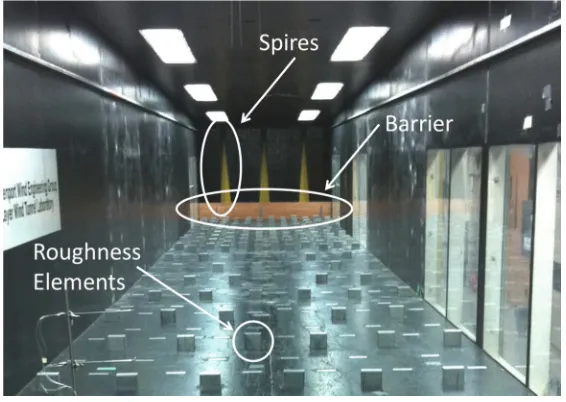
roughness elements, spires, and/or barriers as shown in Figure 2.5. Models of the
surroundings of the building being tested are also geometrically scaled in the wind tunnel.
Two methods commonly used to carry out the wind tunnel testing of tall buildings and
determine the overall structural wind loads and responses are the force-balance model
and pressure model tests (Tschanz 1982; Ho et al. 1999).
Force-balance models at the Boundary Layer Wind Tunnel Laboratory (BLWTL) of
Western University are constructed using a lightweight high density foam material where
only geometric scaling of the test building is considered when constructing the model
(Tschanz 1982). The aerodynamic forces at the base of the model are directly measured
by a high frequency ultra-sensitive force balance during the wind tunnel test. The
aerodynamic loads recorded by the force balance are quasi-steady loads and do not
include the effect of dynamic amplification. Care is taken either by model design or by
control of the testing parameters to avoid contamination of the aerodynamic force spectra
by resonance at the natural frequency of the balance-model system. The random
vibration theory is then used to analytically evaluate the dynamic response that includes
the resonant amplification at the natural frequencies for the fundamental modes of the
building, assuming that aerodynamic damping is negligible. This is based on the fact that
the generalized forces are directly related to the base moments given that the mode
shapes for the fundamental sway modes of the building are approximately linear.
Although the mode shape for the torsional mode is also approximately linear, the
influence function for the base toque is unity along the height, thus an empirical
correction is used to include the base torque in the generalized force. Detailed
formulations of the force-balance method for determining the wind loads can be found in
the literature (e.g. Ho and Jeong 2008).
In a pressure model test, pressure transducers are placed on the surface of a geometrically
scaled rigid model of the building. The pressure taps are connected through vinyl tubes
to pressure scanners that simultaneously measure pressures at various locations during
the test. Similar to the force balance technique, the pressure model test only measures the
quasi-steady aerodynamic loads. The aerodynamic force is determined from
measurements at each pressure transducer by multiplying the pressure by the
corresponding tributary area. The aerodynamic force can then be directly combined with
the mode shapes of the building to calculate the generalized forces without the need to
amplification is derived using the same random vibration theory-based procedure as
employed in the force-balance test.
The database-assisted approach provides a viable alternative to the design codes for
determining the wind loads on tall buildings at the preliminary stage of the design
process. The basic premise of the database-assisted approach is that the wind loads for a
target building can be estimated by using the aerodynamic loads of another building with
similar aerodynamics that has been previously measured in a wind tunnel test. The
NatHaz Aerodynamic Loads Database (NALD) (Kwon et al. 2008), developed at the
University of Notre Dame, as well as the databases developed at NIST are briefly
described in the following.
NALD stores aerodynamic data from 54 different force-balance tests, which include nine
different model cross-sections, three model heights (16, 20, and 24 inches) and two
exposure categories (open and urban exposures with the power law exponents for the
mean wind velocity profile equal to 0.16 and 0.35, respectively). All the test models
were built with balsa wood and tested under isolated conditions (i.e. no surrounding
buildings) in a 3×1.5×18 m boundary layer wind tunnel. In NALD, the mean
components of the responses in the along-wind, across-wind and torsional directions
corresponding to orthogonal angles of attack (i.e. wind acting perpendicular to a face) are
determined using the ASCE 7-98 (ASCE 1998) procedures. The background components
of the dynamic base moments are determined using the RMS aerodynamic base moment
coefficients stored in NALD, whereas the resonant components of the dynamic base
moments are determined using the non-dimensional aerodynamic base moment power
spectra either stored in NALD or input by the user, and the 3D MGLF approach.
The current version of NALD (v. 2.0) is hosted by an Apache Web server found at
http://www.nd.edu/~nathaz/. To use NALD to determine the wind loads on a tall
building, the user is required to select the appropriate building from NALD, input the
building’s dynamic properties and exposure condition, and select one of the three options
the base moment: namely selecting the power spectrum stored in NALD, entering a
user-defined spectrum, or inputting the spectrum obtained from the wind tunnel testing. Given
these inputs, a Matlab® script embedded in the database is then executed to determine the
wind loads on the building using the 3D MGLF approach (Kareem and Zhou 2003). The
output from the database includes the peak base bending moments and torque, the
displacement and accelerations at the top of the building, and the equivalent static wind
loads that accounts for the fluctuation in the wind load and amplification of the wind load
due to the dynamics of the structure.
Main and Fritz (2006) from NIST discuss in detail the so-called Database-Assisted
Design (DAD) for low-rise and high-rise buildings. The DAD used for rigid,
gable-roofed buildings, called the windPRESSURE, uses the time history of pressures at
various tap locations measured from wind tunnel tests in conjunction with structural
influence coefficients to determine the peak wind loads such as bending moments, shear
forces, and displacements at various locations. The database is composed of four
buildings with the same roof slope of 1:12, same width of 36.6 m, and heights of 3.7 m
(in open country terrain), 5.5 m (in open country and suburban terrains), and 7.3 m (in
open country terrain). The testing configurations, wind simulation, standard archiving
format, distribution of the data, and the analysis of the data are discussed in detail in Ho
et al. (2005), wherein seven buildings models were tested. The windPRESSURE requires
inputs with regards to the building dimensions, terrain conditions, and information on the
structural system such as frame locations and sizes and influence functions. An
interpolation procedure is used when the dimensions of the building of interest do not
match those of the buildings in the database.
The High-Rise Database Assisted Design for Reinforced Concrete Structures
(HR_DAD_RC) employs a time-domain analysis that combines the time histories of the
wind pressure measurements and climatological data to determine the wind-induced
response of tall buildings. The methodology and procedures used by HR_DAD_RC are
provided in detail in Yeo (2010). This approach accounts for the dynamic effects of wind
loads on tall buildings by considering the actual vibration modes of the buildings, and