
Properties of flavour-singlet pseudoscalar mesons from lattice QCD
CarstenUrbach1,
1HISKP (Theorie), Universität Bonn, Nussallee 14-16, 53115 Bonn, Germany
Abstract.We report on the status of the determination of properties of flavour-singlet pseudoscalar mesons using Wilson twisted mass lattice QCD at maximal twist. As part of projectC7, a large number of phenomeno-logically relevant quantities could be extracted from first principle, fromηandηmasses to decay widths of pseudoscalar mesons to two photons.
1 Introduction
In the early days of the theory of strong interactions, the peculiar mass hierarchy found experimentally for the nine light pseudoscalar mesons led to the formulation of the “U(1) problem” [1]. If also the axialU(1) symmetry was spontaneously broken in the SU(3) chiral limit of QCD, one would expect the ninth pseudoscalar meson to have a mass similar or a bit lighter than the kaons and theη me-son. The solution to this puzzle comes from the anomalous breaking of the corresponding axial current [2, 3]
∂μA0
μ=∂μ( ¯qγμγ5q)=
αs 4πGG˜
at the quantum level triggered by a non-trivial topologi-cal structure of QCD [4–6], which is known as theUA(1) -anomaly. Here,Gdenotes the SU(3) field strength tensor and ˜Gits dual.
The connection between the UA(1)-anomaly and the larger-than-expected mass of theηmeson is given by the famous Witten-Veneziano formula [7, 8], which is derived assuming the anomaly to be in place and in the largeNc limit of QCD:
f2 0 4Nf
(M2η+M2η−2M2K)=χ∞, . (1)
Here,χ∞is the topological susceptibility in the pure Yang-Mills (YM) gauge theory,Nfthe number of flavours,f0the flavour singlet decay constant andMη,MηandMKare the
η, theηand the kaon masses, respectively. It relates non-trivial topological fluctuations of the gauge field in YM to the corresponding meson masses and singlet decay con-stant f0in QCD withNf active quark flavours. Using lat-tice gauge theory techniques we have the unique possibil-ity to verify this relation.
In lattice QCD, the computation ofηandηmeson re-lated quantities represents a challenge because of so-called fermionic disconnected diagrams. These are usually very
e-mail: [email protected]
noisy and, therefore, the results available from lattice QCD were limited.
In the DFG funded project within the collaborative re-search centre CRC16 “Subnuclear Structre of Matter” we could increase the available lattice results in the flavour-singlet pseudoscalar sector significantly. This was possi-ble on the one hand due to the lattice discretisation we are using: the Wilson twisted mass formulation at maximal twist is particularly well suited to studyηandηmesons because of a powerful noise reduction method we devel-oped in Ref. [9]. On the other hand we have applied and developed other methods which allow us to extract the quantities of interest with less uncertainty. Finally, we could perform this study employing a wide range of pion mass values, several strange quark mass values, several volumes and three values of the lattice spacing. Therefore, continuum and chiral extrapolations could be performed in a controlled way.
The results presented in the remaining sections repre-sent an summary, update and extension of what was pub-lished in Refs. [10–15].
2 Lattice Action
The lattice QCD action forNf =2+1+1 Wilson twisted mass fermions reads
S =Sg+χ¯ D χ +χ¯hDhχh. (2) For the gauge action Sg we use the Iwasaki gauge ac-tion [16]. The twisted mass Dirac operator for the light – i.e. up/down quark – doublet reads [17]
D =DW+m0+iμγ5τ3 (3)
and for the strange/charm doublet [18]
β Z(M1) Z(M2) a[fm] r0/a 1.90 0.699(13) 0.651(06) 0.0885(36) 5.31(8) 1.95 0.697(07) 0.666(04) 0.0815(30) 5.77(6) 2.10 0.740(05) 0.727(03) 0.0619(18) 7.60(8)
tuned to its critical valuemcritas discussed in Refs. [19, 20] in order to realise automaticO(a) improvement at maximal twist [21]. The bare twisted massesμσandμδare related to the bare strange and charm quark masses via the relation
mc,s=μσ ± Zμδ, Z≡ ZP
ZS
, (5)
whereZdenotes the ratio of non-singlet, pseudoscalar and scalar renormalisation constantsZP andZS. Quark fields in the twisted basis are denoted byχ ,hand in the physical basis byψ ,h. They are related via the axial rotations
ψ =eiπγ5τ3/4χ , ψ¯ =χ¯ eiπγ5τ3/4,
ψh=eiπγ5τ 1/4
χh, ψ¯h=χ¯heiπγ5τ 1/4
. (6)
With automaticO(a) improvement being the biggest ad-vantage of twisted mass lattice QCD (tmQCD) at maximal twist, the downside is that flavour (and parity) symmetry is broken at finite values of the lattice spacing. This was theoretically and numerically shown to affect mainly the mass value of the neutral pion [22–24]. For this reason we use masses of charged pions throughout this paper denoted asMPS. However, in the case ofNf =2+1+1 dynamical quarks, the flavour symmetry breaking implies the compli-cation of mixing between strange and charm quarks. Note that the kaons are still degenerate, though.
We use gauge configurations as produced by the Eu-ropean Twisted Mass Collaboration (ETMC) with action described above [20, 25, 26]. The details of the configura-tions are described in Ref. [20] and we follow the notation adopted there: we use ensembles denoted withA, Band Dwith values of the lattice spacingaA = 0.0885(36)fm, aB =0.0815(30)fm andaD=0.0619(18)fm, correspond-ing to βA = 1.90, βB = 1.95 and βD = 2.10, respec-tively [26]. The physical volumes are – with only a few exceptions – larger than 3 fm.
Throughout this proceeding we will use the Sommer parameterr0[27] to investigate the scaling of our results. The actual numbers are taken from Ref. [28] and compiled in Table 1. In physical units we use r0 = 0.474(14) fm taken from the same reference.
For fixing the light and strange quark masses to their physical values we will use the experimental values of Mπ0=135 MeV andMK0=498 MeV. We use the masses of the neutral mesons to reduce uncertainties from the fact that we do not include electromagnetic effects in our sim-ulation. See also ref. [29] and references therein for a dis-cussion.
For everyβ-value the bare values ofaμσandaμδwere kept fixed, and only the value of the light twisted mass pa-rameteraμ is varied. The kaon masses measured on these ensembles are close to the physical value with a deviation of up to 10% [20] in particular for the AandD ensem-bles. The D-meson mass values have a large uncertainty, but they are also close to physical [20].
For theA lattice spacing we have two additional en-sembles with re-tuned values of strange and charm-quark masses, denoted byA80.24sandA100.24s, which repro-duce the physical kaon mass value more accurately than the originalA80.24 andA100.24 ensembles. We will use these ensembles to estimate the strange quark mass depen-dence of theηmass and other quantities.
3 Flavour-Singlet Pseudoscalar Mesons
from Lattice QCD
In order to compute masses of pseudoscalar flavour singlet mesons we have to include light, strange and charm con-tributions to build the appropriate correlation functions. In the light sector, one appropriate operator is given by [30]
1 √
2(−χ¯uχu+χ¯dχd) ≡ O , (7) in the twisted basis. With twisted mass fermions we have to work with doublets of quarks, hence, in the strange and charm sector the corresponding operators read
¯ χc
¯ χs
T −τ1±
iZγ5τ3 2
χc
χs
≡ Oc,s. (8)
Note that the sum of pseudoscalar and scalar contributions appears with the ratio of renormalisation factorsZ, which needs to be taken into account properly. The renormali-sation factors for Eq. (8) are again the non-singletZPand
ZS. It is another advantage of the Wilson twisted mass formulation at maximal twist that only non-singlet renor-malisation factors are required to obtain renormalised ma-trix elements. DefiningO =(Ol,Oc,Os)T, the correlation function matrix is given by
C(t)= x
O(x)⊗O(0). (9)
Scalar and pseudoscalar contributions can be disentangled by changing the operator basis via an appropriate orthog-onal matrixR
CR(t)=
RO(t)⊗ RO(0)=RC(t)RT , (10)
where
CR=
⎛ ⎜⎜⎜⎜⎜
⎜⎜⎜⎝ηηSOhOO ηηSOhSShh ηηOShPPhh ηPhO ηPhSh ηPhPh
⎞ ⎟⎟⎟⎟⎟
⎟⎟⎟⎠, (11)
is again a symmetric, real and positive definite correlation matrix with
Ph≡( ¯χciγ5χc−χ¯siγ5χs)/2,
Sh≡Z−1( ¯χsχc+χ¯cχs)/2, (12) Table 1.compilation of values for the Sommer parameterr0/a,
the lattice spacingaandZ≡ZP/ZSdetermined with methods M1,M2the three values of the lattice spacing. See Ref. [28] for
η
η
t/a
aM
15 10
5 0
1
0.5
0
η
η
t/a
aM
15 10
5 0
1
0.5
0
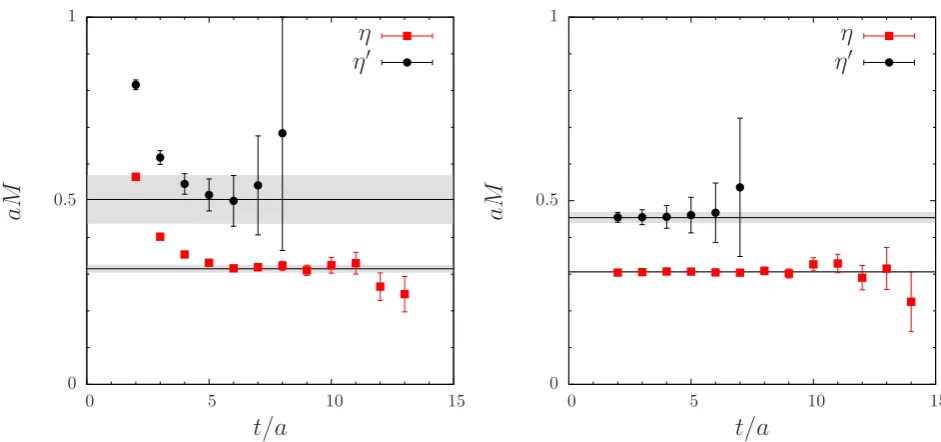
Figure 1. Left: Effective masses in lattice units determined from solving the GEVP for a 6×6 matrix witht0/a=1 for ensemble A100. Right: the same, but after removal of excited states in the connected contributions.
andηXY denoting the corresponding correlation function. The rotation matrixRis given by
R=
⎛ ⎜⎜⎜⎜⎜ ⎜⎜⎜⎜⎝
1 0 0
0 −√1 2 −
1 √ 2 0 +√1
2 − 1 √ 2
⎞ ⎟⎟⎟⎟⎟
⎟⎟⎟⎟⎠. (13)
Now we can drop the factor Z−1, which appears only as a constant scaling factor for Sh. We denote the corre-sponding correlation matrix by ˜CR. Solving the gener-alised eigenvalue problem (GEVP) [31–33]
˜
CR(t)η(n)(t,t0)=λ(n)(t,t0) ˜CR(t0)η(n)(t,t0), (14)
and taking into account the periodic boundary conditions for a meson, we can determine the effective masses Me(nff) by solving
λ(n)(t,t 0)
λ(n)(t+1,t 0)
= e−M (n)
efft+e−Me(nff)(T−t)
e−Me(nff)(t+1)+e−Me(nff)(T−(t+1)) (15) for Me(nff), wheren counts the eigenvalues. The state with the lowest mass should correspond to theηand the second state to theηmeson.
3.1 Excited State Subtraction
The result of solving the GEVP for a 6×6 matrix for en-semble A100 including fuzzed operators is shown as eff ec-tive massesMeffin the left panel of Figure 1. It is visible that the ground state, theη meson, can be extracted with good precision, while for theηmeson it is unclear that a plateau is reached before the signal is lost in noise.
However, there is a possibility to obtain a signifi-cant improvement for the extraction ofηmass (and fur-ther observables) using a powerful method to separate ground and excited states, which has first been proposed in Ref. [34] and that has already been successfully employed
for the case of theη2for two dynamical quark flavours in Ref. [30], and we have first used it for theNf =2+1+1 flavour case in Ref. [11].
The method is based on the assumption that the quark disconnected diagrams give a sizeable contribution only to theηandηstate, but are negligible for any heavier state with the same quantum numbers. Considering the fluctua-tions of the topological charge which are expected to give a dominant contribution to the mass of theη, this assump-tion would be valid if these fluctuaassump-tion mainly couple to the ηandηstates. Still, the validity of this assumption needs to be carefully checked from our data and may in-troduce systematic uncertainties.
Since the quark connected contributions exhibit a con-stant signal-to-noise ratio, it is in principle possible to de-termine the respective ground states at sufficiently large t/a with high statistical accuracy and without any signif-icant contamination from higher states. After fitting the respective ground states of the connected correlators, we can use it to subtract the excited state contributions such that the full connected correlators are replaced by correla-tors that contain only the ground state. Note that for suffi -ciently larget/athis reproduces the original ground state by construction.
low values oft/a. Therefore, we will use this method for all the results presented in this proceeding contribution.
However, we remark that in the twisted mass formula-tion with the non-degenerate doublet this procedure is in practice restricted to the connected correlation functions corresponding to physical light and strange quarks. This is due to the violation of flavour symmetry in the heavy sec-tor of the twisted mass formulation, implying that the four connected contributions in the heavy sector will all yield the same ground state. This ground state corresponds to an artificial particle, i.e. a connected-only, neutral pion-like particle made out of strange quarks. Therefore, we will restrict ourselves in the following discussion to the analysis of a 2×2 correlation function matrix correspond-ing to (local) physical operators made of light and strange quarks.
We remark that this procedure modifies correlators only at smallt/a and per construction the limit of large Euclidean times is not modified. The method only serves to reduce statistical uncertainties by extending the plateaus to smaller values oft/a.
3.2 Pollution by topological effects
It is a well known problem, in particular for small lattice spacing values, that in lattice QCD simulations the topo-logical charge is properly sampled [35]. This can lead in extreme cases to a freeze of the topological charge. We found in our ensembles that the topological charge has zero expectation value, however, the second moment of the charge distribution might not be sampled fully correctly. While being a finite volume effect, this can lead to time in-dependent contributions to the flavour-singlet correlation function [36, 37]. As a consequence, the corresponding correlation functions do not decay to zero at large time separations.
Such constants present in correlation functions can be subtracted by fitting the appropriate functional form to the data [37]. However, we found that shifting the correlation functions – invented to cancel so-called thermal pollution in multi-hadron correlation functions [38] – subtracts the constant without the need of any additional input. More-over, shifting decorrelates neighbouring time slices signif-icantly, which gives an additional advantage.
We define the shifted correlation matrix as ˜
Cs
R(t)=C˜R(t)−C˜R(t+δt). (16) While all time independent terms are cancelled in ˜CsR(t), every matrix element possesses now the following func-tional form
∝ n
e−En(t+δt/2)−e−En(T−(t+δt/2)),
withT the time extent of the lattice. The shift δtcan be adjusted for optimal results.
We did not observe obvious cases in our data where the correlation functions themselves do not decay to zero. Only on a few ensembles with small volume and lattice
spacings (e.g. D45) such a residual behaviour was ob-served for the resulting principal correlator of theη-state. However, in these cases the effect is of the size of a few standard deviations at most. Still, the shifting procedure turns out to systematically improve the signal for all and in particular for η related quantities significantly. Final results of this procedure are currently in preparation [39], and we will only showηandηmasses extracted with this procedure.
3.3 Decay Constants and Mixing
In general, decay constants are defined for any pseu-doscalar meson P from axial vector matrix elements
0|Aaμ|P (p) =i fPapμ, (17)
which leads to
0|∂μAaμ|P (0) = fPaM2P, (18)
for projection to zero momentum. Assuming thatηandη are not flavour eigenstates, each of them exhibits a cou-pling to the singlet and octet axial vector current A0
μand
A8
μ, respectively. Therefore, one ends up with four inde-pendent decay constants for the η,η-system, which are commonly parametrised in terms of two decay constants
f0,f8and two mixing anglesθ0,θ8
f8 η fη0
f8 η fη0
=
f8cosθ8 −f0sinθ0
f8sinθ8 f0cosθ0
≡Ξ(θ8, θ0) diag (f8, f0). (19)
The singlet decay constant f0 needs renormalisation, de-termined by the anomalous dimension of the axial singlet current [40]. The dependence on the scale isO(1/NC) and can, therefore, be dropped in the following discussion. For a detailed discussion see Refs. [41, 42].
We work in the quark flavour basis, with the axial vec-tor currentsA0
μandA8μreplaced by the combinations
Alμ=√2 3A
0 μ+
2 3A
8 μ=√1
2
¯
uγμγ5u+d¯γμγ5d
, (20)
Aμs =
2 3A
0 μ−
2 √
3A 8
μ=s¯γμγ5s, (21)
in which the light quarks and the strange quark contribu-tions are disentangled. In exact analogy to the singlet-octet basis this basis again allows for a parametrisation in terms of two decay constants and two mixing angles
fηl fηs
fl η fηs
= Ξ(φl, φs) diag (fl, fs), (22)
where the mixing matrixΞhas the same form as the one defined in Eq. (19). In this basis it is also expected that we have [41–45]
φl−φs
φl+φs
D45.32sc
D-EnsemblesB-Ensembles
A80.24s, A100.24sA-Ensembles
physical values
(r0MPS)2
r0 Mη,
η
1.4 1.2 1 0.8 0.6 0.4 0.2 0 4
3.5
3
2.5
2
1.5
1
0.5
0 experimental values
D45.32sc
D-EnsemblesB-Ensembles
A80.24s, A100.24sA-Ensembles
M2
PS[GeV2]
Mη,
η
[GeV]
0.2 0.1
0 1.5
1.25
1
0.75
0.5
0.25
0
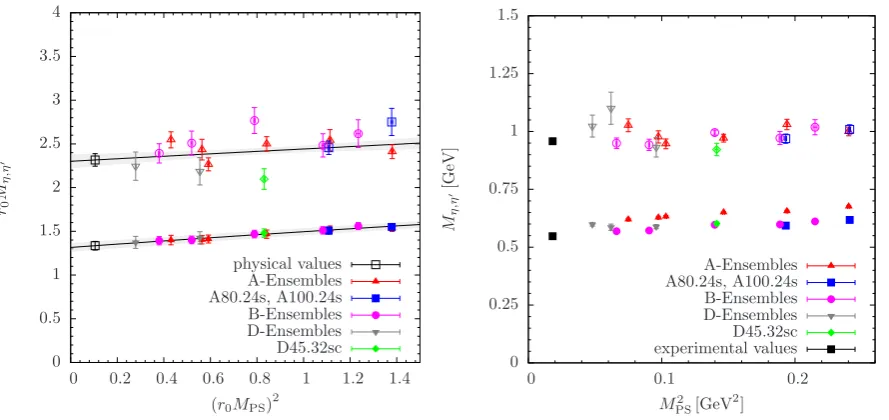
Figure 2. Left: Our results forr0Mη(filled symbols) (corrected for the mismatch inr0MK) andr0Mη(open symbols). The fitted curves are linear functions in (r0MPS)2as discussed in the text. Right: M
η(filled) andMη(open) in physical units (notcorrected for the mismatch inMK) determined from the shifted correlation matrix as a function ofM2
PS.
motivating a simplified mixing scheme in the quark flavour basis with only one angleφ
fl η fηs
fl η fηs
= Ξ(φ) diag (fl, fs)+O(Λ1), (24)
whereΞ(φ) ≡ Ξ(φ, φ) andΛ1 parametrises residual OZI violating terms. The mixing angleφis related to the dou-ble ratio of amplitudes
tan2(φ)=−f l ηfηs
fl ηfηs
, (25)
and hence independent of the ratio of renormalisation con-stantsZ. Axial vector current matrix elements turn out to be difficult to measure in actual simulations due to noise. This is why it is most convenient to consider pseudoscalar currents in the quark flavour basis in analogy to Eqs. (20), (21).
Pl= √1 2
¯
uγ5u+d¯γ5d
, (26)
Ps=si¯γ5s, (27)
such that the matrix elements for pseudoscalar mesons P are given by
hiP=2mi0|Pi|P , (28) which are free from renormalisation. Making use ofχPT and dropping sub-leading terms leads to the following ex-pression [46]
hlη hsη
hl η hsη
= Ξ(φ) diagMπ2fl,
2M2K−Mπ2
fs
. (29)
This expression allows access to the decay constants fsand fl from pseudoscalar matrix elements under the assump-tion that χPT can be applied. In terms of pseudoscalar
matrix elements the mixing angleφis obtained as
tan2(φ)=−h l ηhsη
hl ηhηs
, (30)
where actually quark masses and renormalisation con-stants drop out in the ratio. Expanding again to two angles, φlandφsare written as
tan(φl)= hl
η
hl η
, tan(φs)=− hs
η
hs η
. (31)
Finally, we remark that in order to compute the matrix el-ementshi
Pin Wilson twisted mass lattice QCD the ratio of renormalisation constantsZ=ZP/ZS is required.
4 Results
4.1 Masses
-0.3 -0.2 -0.1 0 0.1 0.2 0.3
0 0.01 0.02 0.03 0.04
r0
Δ
Mη
a2/r20
kaon matching
ηsmatching
Figure 3.r0ΔMηas a function of (a/r0)2for two matching pro-cedures of OS valence strange quark to the unitary one [14].
lattice spacing dependence within our errors, so we do not attempt to correct for those.
The results for Mη and Mη are summarised in
Fig-ure 2, where we showr0Mηas filled andMηas open sym-bols, respectively, both as functions of (r0MPS)2. For both mesons the data fall on a single line within errors such that in both cases we model the data for (r0M)2 inspired by chiral perturbation theory as constant plus a linear term in (r0MPS)2. The corresponding best fit to the data and its er-ror band is shown as lines with shaded bands. The erer-ror band forMηis mainly due to the error ofDη.
After extrapolating to the physical point and convert-ing to physical units we obtain
Mη(Mπ)=556(8)stat(5)sysMeV, (32) where the systematic error has been estimated from fitting to the data at each value of the lattice spacing separately. In addition, for the SU (2) chiral limit we findr0M˚ηSU(2)= 1.32(5)stat(1)sys, which yields
˚
MηSU(2)=548(9)stat(6)sysMeV. (33) We may extrapolate further quantities in order to check the validity of our correction procedure for mis-tuned values of the strange quark mass. First, we consider the GMO relation
3M2η =4MK2 −M2π,
and build ratios left hand side over right hand side. This ratio is evaluated directly on our data. Next we perform an extrapolation in (r0MPS)2. However, it turns out that taking the uncorrected values ofMηin the ratio the extrapolation misses the experimental value
(3Mη2/(4M2K−M2π))exp=0.926
considering only the statistical error by more than 2σ, i.e. we obtain
3M2η/(4M2K−Mπ2)
Mπ =0.965(15)stat(24)sys.
This may be seen as a hint that the significantly increased statistical precision of the improved analysis strategy al-lows to resolve a residual strange quark mass dependence which is not cancelled in the ratio. This was not possible with the statistical accuracy we could obtain in Ref. [10]. Note that compared to the direct extrapolation the statisti-cal precision is even further enhanced for the case of di-mensionless ratios because the physical value ofr0is only required for fixing the physical point, but not for the con-version to physical units. Considering only theB ensem-bles for which the value of the strange quark mass is close to physical yields
3M2
η/(4MK2 −Mπ2)
B
Mπ =0.928(26)stat,
indicating that the systematic error is mainly caused by such a residual effect. Using the corrected values ¯Mηand the corresponding values of the kaon mass to calculate the GMO ratio the extrapolation gives
3Mη2/(4MK2 −M2π)
Mπ=0.960(19)stat(22)sys,
which is slightly closer to the experimental value. For the physical value of theηmass we obtain
Mη=558(6)stat(7)sysMeV, (34) in agreement with the result from the direct extrapolation and the experimental value.
A similar picture arises from the light quark mass ex-trapolation of the ratioMη/MK. Using the uncorrected val-ues ofMηwhich yields
Mη/MK
Mπ =1.117(8)stat(23)sys,
missing the experimental value
Mη/MK
exp
=1.100
again by roughly 2σif taking only the statistical error into account. Like for the case of the GMO ratio taking only the B ensembles into account gives nice agreement with the experimental value, i.e.
Mη/MK
B
Mπ =1.093(14)stat,
whereasAandDensembles give significantly larger val-ues. Therefore, we have also repeated the extrapolation using the corrected values ¯Mηand the corresponding kaon masses. Within the statistical errors one obtains excellent agreement with experiment, i.e.
Mη/MK
Mπ=1.109(11)stat(09)sys,
which results in
Mη=0.552(6)stat(4)sysMeV, (35) compatible with the results from direct and GMO ratio ex-trapolations.
D45.32sc D-EnseB-Ensemmblesbles A80.24s, A100.24sA-Ensembles
(r0MPS)2
(
φl
−
φs
)[
de
g
]
1.4 1.2 1 0.8 0.6 0.4 0.2 0 10
0
-10 D45.32sc
D-EnseB-Ensemmblesbles A80.24s, A100.24sA-Ensembles
φSU(3)F φphys
(r0MPS)2
φ
[
de
g
]
1.4 1.2 1 0.8 0.6 0.4 0.2 0 90
80
70
60
50
40
30
20
10
0
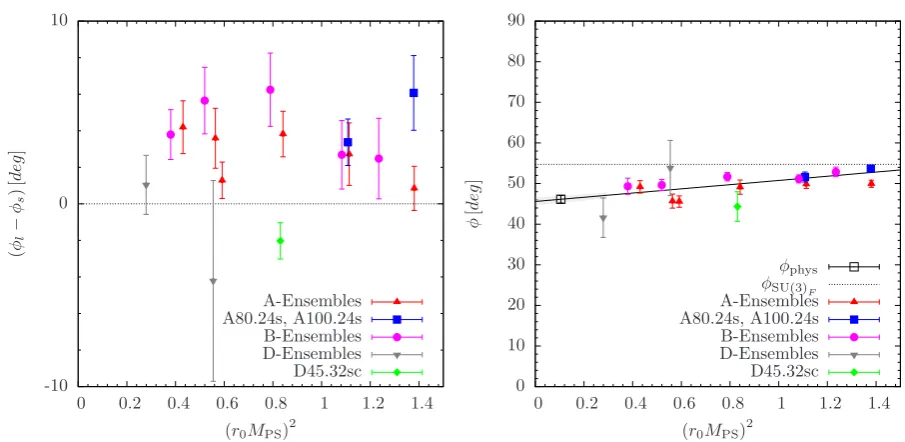
Figure 4.The differenceφl−φs(Left) andφ(Right) in degrees as functions of (r0MPS)2. Forφwe also show our best fit to the data and the extrapolation to the physical pion mass value. The dotted horizontal line represents the value 54.2◦one expects forφin the SU(3) flavour symmetric case.
three previously discussed methods used for the extrap-olation in the light quark mass. Accounting for any corre-lations, this yields
Mη=555(6)stat(5)sys. (36) which is in excellent agreement with experiment and ex-hibits substantially smaller errors compared to Ref. [10].
For theηmeson we obtain
Mη=964(41)stat(34)sys, (37) from a linear extrapolation in (r0MPS)2 of all the (uncor-rected) data. The corresponding fit is shown in the left panel of Figure 2. Again, the systematic error has been determined from fits to the data at single values of the lat-tice spacing. Within the larger errors this result is again in very good agreement with experiment, confirming that QCD indeed accounts for the significantly larger mass of theηthat is observed experimentally.
In the right panel of Figure 2 we show Mη,ηagain as
a function of M2
PS, but now Mη and Mη have been de-termined using the shifting procedure explained in sec-tion 3.2. The data is not corrected for the mismatch in the strange quark mass, and, therefore, the plot in the right panel is not directly comparable to the one in the left pane. But comparing it qualitatively to the left panel in the same figure shows that the shifting procedure greatly reduces the uncertainty inMη, possibly to a level where strange quark
and lattice spacing effects must be taken into account. A corresponding analysis is in progress [39].
4.1.1 Mixed Action
It is an interesting question whether or not quantities with a significant contribution of fermionic disconnected dia-grams can be reliably determined in a so-called mixed
ac-tion approach. In such an approach discretisaac-tion of va-lence and sea quark are different. Prime examples of quan-tities with large disconnected contribution areηandη me-son masses.
We have investigated this question using the so-called Osterwalder-Seiler (OS) discretisation [47] for the valence strange quark combined with unitary up/down quarks on top of the Wilson twisted mass gauge configurations. The additional advantage of this mixed action approach is the avoided flavour mixing in the strange/charm sector. The conclusion of this investigation [14] is that indeedηand ηmasses can be determined reliably in this mixed action approach. But we observed that lattice artefacts strongly depend on the chosen matching quantity. As an example we show in Figure 3 the difference between the OS and the unitaryηmeson mass
ΔMη=MηOS−Mηunitary
as a function of (a/r0)2. Results for two matching quanti-ties are shown: one where the valence strange quark mass was fixed by matching the masses of the OS and the uni-taryηsmeson. For the second the OS kaon was matched to the unitary for fixing the strange quark mass. As visible in Figure 3, kaon matching has significantly larger lattice artefacts, while they appear to be negligible forηs ing. Performing a continuum extrapolation of both match-ings, however, gives identical results within error bars.
4.2 Mixing Angles
D45.32sc D-EnseB-Ensemmblesbles A80.24s, A100.24sA-Ensembles (fl/fPS)phys
(r0MPS)2 fl
/fPS
1.4 1.2 1 0.8 0.6 0.4 0.2 0 1.5
1.25
1
0.75
0.5
0.25
0 D45.32sc
D-EnseB-Ensemmblesbles A80.24s, A100.24sA-Ensembles (fs/fK)phys
(r0MPS)2 fs
/fK
1.4 1.2 1 0.8 0.6 0.4 0.2 0 1.5
1.25
1
0.75
0.5
0.25
0
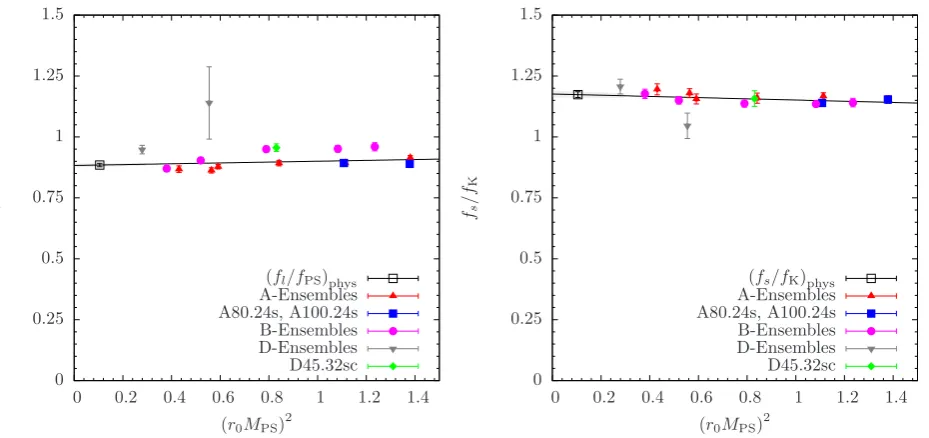
Figure 5. fl/fPS(Left) andfl/fK(Right) as functions of (r0MPS)2. The lines represent fits to our data with error band as explained in the text.
3(1)stat(3)◦sys, where the systematic error is estimated from the maximal difference compared to extrapolating the data sets for the three different lattice spacings separately.
In the right panel of Figure 4 we show the average an-gleφ(Eq. (30)) in degrees as a function of (r0MPS)2, with smaller statistical errors thanφlandφsseparately, because of correlation in the matrix elements. Our precision is not sufficient to resolve any residual lattice spacing or strange quark mass dependence. Hence, we extrapolate linearly in (r0MPS)2and obtain
φ=46(1)stat(3)◦sys, (38)
where the first error is statistical and the second system-atic from fitting the three values of the lattice spacing sep-arately.
Besides the mixing angle φ, we consider the angles φl,φs which are relevant to cross-check the assumptions entering our mixing scheme. Again, we have performed linear fits in (roMPS)2 and obtain at the physical value of the pion mass
φl=48(1)stat(4)◦sys, φs=44(1)stat(3)◦sys, (39)
where the systematic uncertainties have been determined in the same way as for the angleφitself. The results are compatible within errors. Notably, for φs there is very good agreement for the results within each of the two set (A80.24, A80.24s) and (A100.24, A100.24s), indicating that the influence of the strange quark is smaller for this quantity and in general more of the data points lie within the error band of the linear fit.
4.3 Decay Constants
The application of the excited state removal method dis-cussed in the previous section allows to extract the decay constants fland fsto a rather high statistical precision by
means of the pseudoscalar matrix elementshi
P and using Eq. (29). Of course, one needs to keep in mind that this is based on the assumption that the underlying chiral per-turbation theory analysis is valid. Currently, we cannot estimate a corresponding systematic uncertainty.
In Figure 5 we show fl/fPSand fs/fK as functions of (r0MPS)2in the left and right panel, respectively. We have chosen to plot these ratios because it appears that most of the quark mass and lattice spacing dependence cancels. A linear extrapolation of fl/fPS in (r0MPS)2 to the physical point results in
fl/fπ =0.884(7)stat(63)sys. (40) However, from the plot it appears that there is still a rather sizeable dependence on the lattice spacing present while the strange quark mass dependence seems to cancel in the ratio as allA-ensembles fall on one single curve. In fact, the systematic error estimated from fitting the data at each value of the lattice spacing separately is one order of magnitude larger than the statistical error and there is clear trend towards larger values of fl/fPSextrapolated to the physical pion mass for decreasing values of the lattice spacing. Therefore, we additionally quote the result of a linear fit restricted to the data at the finest lattice spacing, which yields
(fl/fπ)D=0.947(23)stat. (41) For the ratio fs/fKmost of the strange quark mass de-pendence is cancelled and the data seem almost perfectly linear in the light quark mass, exhibiting only a moderate slope. Moreover, for this case there are no discernible scal-ing artefacts within errors and the data are well described by a linear fit which gives
r 4 0χ
∞
D3 M2 D2 M2 D1 M2 D3 M1 D2 M1 D1 M1 YM 0.1
0.075
0.05
0.025
0
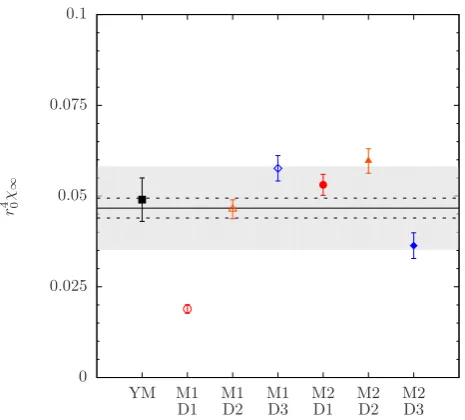
Figure 6.A comparison of the YM topological susceptibilityχ∞ to the right hand side of the Witten-Veneziano formula. The lat-ter is delat-termined using two different renormalisation procedures (M1, M2) and three different ways to estimate f0(D1, D2, D3).
for the physical value offl/fπ, confirming the smallness of any residual lattice artefacts or strange quark mass depen-dence for fs/fK.
Finally we have to remark that finite volume effects might play an important role for the decay constants, but they hopefully cancel in the ratios we used.
4.4 Witten-Veneziano Formula
Now we have all ingredients at hand to investigate the Witten-Veneziano formula in more detail. As we have shown in Ref. [15], one can relate the decay constants f and fs to the singlet decay constant f0 and the kaon and pion decay constants fKand fπusingχPT again
f02 = −7/6fπ2+2/3fK2+3/2f2, (43) f2
0 = +1/3fπ2−4/3fK2+f2+fs2, (44) f02 = +3fs2−8
3(2f 2
K−fπ2). (45)
respectively. We denote these three formulae for f0 with D1, D2, D3. f0 is not uniquely determined because of higher order terms that have been dropped, see Ref. [15] for details. These three equations together with the meth-ods M1 and M2 to determine the renormalisation con-stants [28], lead to six determinations of the left hand side of Eq. (1), which are compared to the YM susceptibility in Figure 6. We have determined the susceptibilityχ∞in a dedicated simulation of the YM theory with three val-ues of the lattice spacing applying the so-called spectral projector method [48].
This comparison is only meaningful up to higher order contributions in 1/Nc. Therefore, one cannot expect ex-act agreement. However, qualitatively the observed agree-ment is very good.
4.5 Decay WidthsΓP→γγ
The decay constants fl and fs are important low energy constants. However, they can also be used to estimate phe-nomenologically interesting quantities, most prominently the decay widths ofη, η → γγ. To the same order in the effective theory we worked until here, one can relate the decays widths with the mixing parameters in the quark flavour basis as follows [50, 51] (see Refs. [41, 42] for how to include these quantities into the effective field the-ory framework)
Γη→γγ = α 2
288π3M 3 η
⎡ ⎢⎢⎢⎢⎣5
fl cosφ−
√ 2 fs
sinφ
⎤ ⎥⎥⎥⎥⎦2
,
Γη→γγ = α 2
288π3M 3 η
⎡ ⎢⎢⎢⎢⎣5
fl sinφ+
√ 2 fs
cosφ
⎤ ⎥⎥⎥⎥⎦2
, (46) where again OZI suppressed terms have been dropped and our normalisation is that fπ =130.7 MeV. Using our lat-tice data for Mη,η, φ, fl and fs, we have computed the decay widths and show them in units of the Sommer pa-rameter as a function of (r0MPS)2 in Figure 7. We also include the PDG value for convenience [49]. ForΓη→γγ
we observe a flat dependence of the light quark mass and agreement between our data and the PDG value within our errors. However, the data show a tendency for lower val-ues with decreasing valval-ues of the lattice spacing.
The situation is not so clear forΓη→γγ, where the lattice data is of the right magnitude compared to the PDG value. But there are clearly strange quark mass and light quark mass effects visible that we cannot control at the moment. In addition there might be lattice artefacts.
Two remarks are in order: first of all the mass depen-dence of the widths has not been computed in effective field theory. Hence, we have no rigorous means to extrap-olate our data to the physical point. Eqs. (46) are strictly speaking only valid in the chiral limit. Second, the PDG value for Γη→γγ does not include Primakoffexperiments, which give a significantly smaller value1.
Related quantities are the pseudoscalar transition form factorsFηγγ∗ andFηγγ∗ for large momentum transferq2, which can be expressed as [52]
lim q2→∞q
2F
ηγγ∗(q2)= 10
3√2flcosφ− 2 3fssinφ = 100(5)stat(25)sysMeV,
lim q2→∞q
2F
ηγγ∗(q2)= 10
3√2flsinφ+ 2 3fscosφ
= 277(3)stat(20)sysMeV. (47)
These results have to be understood to be very prelimi-nary. They are obtained by using the values of fl/fπ and
fs/fK in Eqs. (41) and (42), respectively, together with the physical values of the pion and kaon decay constants fπ = 130.42 MeV and fK = 156.2 MeV[53]. The value forφhas been taken from Eq. (38). The systematic uncer-tainty is again calculated from the maximal difference to results from the separate lattice spacing values.
D45.32sc
D-EnseB-Ensemmblesbles
A80.24s, A100.24sA-Ensembles
experimental value (PDG 2012)
(r0MPS)2
r0
Γ[
η
→
γγ
]
1.4 1.2 1 0.8 0.6 0.4 0.2 0 0.000003
0.000002
0.000001
0.000000
D45.32sc
D-EnseB-Ensemmblesbles
A80.24s, A100.24sA-Ensembles
experimental value (PDG 2012)
(r0MPS)2
r0
Γ[
η
→
γγ
]
1.4 1.2 1 0.8 0.6 0.4 0.2 0 0.00004
0.00003
0.00002
0.00001
0.00000
Figure 7.We show the decays widthsΓη→γγ(Left) andΓη→γγ(Right) in units ofr0as functions of (r0MPS)2. In addition we show the corresponding estimate from the PDG [49].
UKQCD RBC/UKQCDHSC ETMC experimental values
M2
PS[GeV2]
Mη
,η
[GeV]
0.5 0.4
0.3 0.2
0.1 0
1.5
1
0.5
0
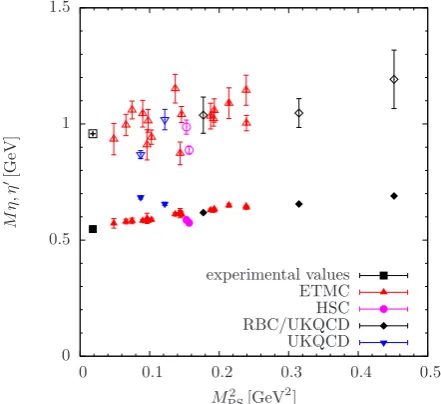
Figure 8. Results forMη and Mηin physical units as a func-tion ofM2
PScompared to results from other lattice QCD compu-tations (HSC: Ref. [54], RBC/UKQCD: Ref. [55] and UKQCD Ref. [56]). Open symbols represent theηand filled symbols the ηmass, respectively.
5 Summary
In this proceeding we have summarised the results obtained for properties of flavour-singlet pseudoscalar mesons from lattice QCD as part of the collaborative re-search centre CRC16.
In Figure 8 we show a compilation of our results for ηandηmasses together with results available in the lit-erature for Nf = 2+1 flavour lattice QCD. For Mη we show the values corrected for the mismatch in MK. We remark that in Ref. [57]ηandηmeson masses have been computed using Nf = 2 +1 flavours of overlap quarks at one value of the lattice spacing and large values of the pion mass, however, in this reference not enough details are given to be included in our comparison Figure 8. The
results in Ref. [55] have been obtained usingNf =2+1 flavours of domain wall fermions and again for a sin-gle value of the lattice spacing a ≈ 0.1 fm but for three values of the pion mass in a range from ∼ 400 MeV to ∼ 700 MeV. The corresponding data points in Figure 2 are labelled “RBC/UK QCD”. Another single data point is added from Ref. [54] by the Hadron Spectrum Collab-oration (HSC) for which Wilson fermions have been em-ployed. Again, it was not possible to include more recent results by the HSC [58] due to the lack of explicit numeri-cal values in this reference for the relevant masses. Finally, in Ref. [56] data from staggered fermions are presented for two different values of the lattice spacing with each of them also at a different value of the pion mass. In Figure 8 the corresponding data points are labelled “UKQCD”. The figure suggests an overall agreement between all collabo-rations.
In Table 2 we compare our results for various quan-tities to experimental results from the PDG [53] and to phenomenological results from the so-called FKS-scheme taken from Ref. [46] (see also Ref. [52]). We observe mostly quite good agreement with the exception of f/fπ. This exception is likely a systematic uncertainty coming from the fact that in this proceeding we did not yet include lattice artefacts in the analysis of f/fπ. A corresponding analysis is ongoing [39]. Note that in general the spread in the phenomenological determinations is substantial.
As discussed in Ref. [52], this determination of mix-ing parameters can be used to better estimate the hadronic light-by-light contribution to the anomalous magnetic mo-ment of the muon. Of course, eventually a computation of the corresponding transition form factors is desired as recently performed for the neutral pion in Refs. [59, 60].
this work literature Mη[MeV] 555(6)stat(5)sys 547.86(2)
Mη[MeV] 964(41)stat(34)sys 957.78(6)
f/fπ 0.884(7)stat(63)sys 1.07(2)
fs/fK 1.176(12)stat(28)sys 1.11(5)
φ 46(1)stat(3)◦sys 39(1)◦
The author wishes to thank K. Ottnad and C. Michael for their essential contributions to this project. Thanks also to Falk Zim-mermann for his work on the mixed action approach. The work reported here would not have been possible without the support from the Deutsche Forschungsgemeinschaft within the SFB/TR16. We thank the members of ETMC for the most en-joyable collaboration. The computer time for this project was made available to us by the John von Neumann-Institute for Computing (NIC) on the JUDGE, Jugene and Juqueen systems in Jülich. Support by the Bonn-Cologne Graduate School (BCGS) of Physics and Astronomie is acknowledged. The open source software packages tmLQCD [62–64], Lemon [65] and R [66] have been used.
References
[1] S. Weinberg, Phys.Rev.D11, 3583 (1975) [2] S.L. Adler, Phys. Rev.177, 2426 (1969)
[3] J.S. Bell, R. Jackiw, Nuovo Cim.A60, 47 (1969) [4] J.B. Kogut, L. Susskind, Phys. Rev. D11, 3594
(1975)
[5] A.A. Belavin, A.M. Polyakov, A.S. Schwartz, Yu.S. Tyupkin, Phys. Lett.B59, 85 (1975)
[6] G. ’t Hooft, Phys. Rev. Lett.37, 8 (1976) [7] E. Witten, Nucl.Phys.B156, 269 (1979) [8] G. Veneziano, Nucl.Phys.B159, 213 (1979)
[9] C. Michael, C. Urbach (ETM), PoSLAT2007, 122 (2007),0709.4564
[10] K. Ottnad, C. Michael, S. Reker, C. Urbach, C. Michael, S. Reker, C. Urbach (ETM), JHEP 11, 048 (2012),1206.6719
[11] C. Michael, K. Ottnad, C. Urbach (ETM), Phys. Rev. Lett.111, 181602 (2013),1310.1207
[12] C. Michael, K. Ottnad, C. Urbach (ETM), PoS LAT-TICE2013, 253 (2014),1311.5490
[13] K. Ottnad, Ph.D. thesis, Bonn U. (2013), hss.ulb.uni-bonn.de/2014/3506/3506.htm [14] K. Ottnad, C. Urbach, F. Zimmermann (OTM), Nucl.
Phys.B896, 470 (2015),1501.02645
[15] K. Cichy, E. Garcia-Ramos, K. Jansen, K. Ot-tnad, C. Urbach (ETM), JHEP 09, 020 (2015), 1504.07954
[16] Y. Iwasaki, Nucl. Phys.B258, 141 (1985)
[17] R. Frezzotti, P.A. Grassi, S. Sint, P. Weisz (ALPHA), JHEP08, 058 (2001),hep-lat/0101001
[18] R. Frezzotti, G.C. Rossi, Nucl. Phys. Proc. Suppl. 128, 193 (2004),hep-lat/0311008
[19] T. Chiarappa et al., Eur. Phys. J. C50, 373 (2007), hep-lat/0606011
[20] R. Baron et al. (ETM), JHEP 06, 111 (2010), 1004.5284
[21] R. Frezzotti, G.C. Rossi, JHEP 08, 007 (2004), hep-lat/0306014
[22] R. Baron et al. (ETM), JHEP 1008, 097 (2010), 0911.5061
[23] C. Urbach (ETM), PoS LAT2007, 022 (2007), 0710.1517
[24] P. Dimopoulos, R. Frezzotti, C. Michael, G. Rossi, C. Urbach, Phys.Rev. D81, 034509 (2010), 0908.0451
[25] R. Baron et al. (ETM), Comput.Phys.Commun.182, 299 (2011),1005.2042
[26] R. Baron et al., PoS LATTICE2010, 123 (2010), 1101.0518
[27] R. Sommer, Nucl.Phys. B411, 839 (1994), hep-lat/9310022
[28] N. Carrasco et al. (ETM), Nucl. Phys. B887, 19 (2014),1403.4504
[29] G. Colangelo, S. Durr, A. Juttner, L. Lellouch, H. Leutwyler et al., Eur.Phys.J.C71, 1695 (2011), 1011.4408
[30] K. Jansen, C. Michael, C. Urbach (ETM), Eur.Phys.J.C58, 261 (2008),0804.3871
[31] C. Michael, I. Teasdale, Nucl.Phys. B215, 433 (1983)
[32] M. Lüscher, U. Wolff, Nucl.Phys.B339, 222 (1990) [33] B. Blossier, M. Della Morte, G. von Hippel,
T. Mendes, R. Sommer, JHEP 0904, 094 (2009), 0902.1265
[34] H. Neff, N. Eicker, T. Lippert, J.W. Negele, K. Schilling, Phys.Rev. D64, 114509 (2001), hep-lat/0106016
[35] S. Schaefer, R. Sommer, F. Virotta (ALPHA), Nucl. Phys.B845, 93 (2011),1009.5228
[36] S. Aoki, H. Fukaya, S. Hashimoto, T. Onogi, Phys. Rev.D76, 054508 (2007),0707.0396
[37] G.S. Bali, S. Collins, S. D?rr, I. Kanamori, Phys. Rev.D91, 014503 (2015),1406.5449
[38] X. Feng, K. Jansen, D.B. Renner, Phys.Lett. B684, 268 (2010),0909.3255
[39] K. Ottnad, C. Urbach (2016), in preparation [40] J. Kodaira, Nucl.Phys.B165, 129 (1980)
[41] R. Kaiser, H. Leutwyler (1998),hep-ph/9806336 [42] R. Kaiser, H. Leutwyler, Eur.Phys.J. C17, 623
(2000),hep-ph/0007101
[43] J. Schechter, A. Subbaraman, H. Weigel, Phys.Rev. D48, 339 (1993),hep-ph/9211239
[44] T. Feldmann, P. Kroll, B. Stech, Phys.Lett.B449, 339 (1999),hep-ph/9812269
[45] T. Feldmann, P. Kroll, B. Stech, Phys.Rev. D58, 114006 (1998),hep-ph/9802409
Table 2.Summary of results. The literature values are taken from Ref. [53] forMηandMηand from Ref. [46] from the
[46] T. Feldmann, Int.J.Mod.Phys. A15, 159 (2000), hep-ph/9907491
[47] R. Frezzotti, G.C. Rossi, JHEP 10, 070 (2004), hep-lat/0407002
[48] L. Giusti, M. Luscher, JHEP 03, 013 (2009), 0812.3638
[49] J. Beringer et al. (Particle Data Group), Phys.Rev. D86, 010001 (2012)
[50] T. Feldmann, P. Kroll, Eur.Phys.J. C5, 327 (1998), hep-ph/9711231
[51] T. Feldmann, P. Kroll, Phys.ScriptaT99, 13 (2002), hep-ph/0201044
[52] R. Escribano, P. Masjuan, P. Sanchez-Puertas (2013), 1307.2061
[53] K.A. Olive et al. (Particle Data Group), Chin. Phys. C38, 090001 (2014)
[54] J.J. Dudek, R.G. Edwards, B. Joo, M.J. Peardon, D.G. Richards et al., Phys.Rev.D83, 111502 (2011), 1102.4299
[55] N. Christ, C. Dawson, T. Izubuchi, C. Jung, Q. Liu et al., Phys.Rev.Lett. 105, 241601 (2010), 1002.2999
[56] E.B. Gregory, A.C. Irving, C.M. Richards, C. Mc-Neile (UKQCD), Phys.Rev. D86, 014504 (2012), 1112.4384
[57] T. Kaneko et al. (TWQCD/JLQCD), PoSLAT2009, 107 (2009),0910.4648
[58] J.J. Dudek, R.G. Edwards, P. Guo, C.E. Thomas (2013),1309.2608
[59] X. Feng, S. Aoki, H. Fukaya, S. Hashimoto, T. Kaneko et al., Phys.Rev.Lett.109, 182001 (2012), 1206.1375
[60] A. Gérardin, H.B. Meyer, A. Nyffeler (2016), 1607.08174
[61] M. Cè, M.G. Vera, L. Giusti, S. Schaefer (2016), 1607.05939
[62] K. Jansen, C. Urbach, Comput.Phys.Commun.180, 2717 (2009),0905.3331
[63] A. Abdel-Rehim, F. Burger, A. Deuzeman, K. Jansen, B. Kostrzewa, L. Scorzato, C. Urbach, PoSLATTICE2013, 414 (2014),1311.5495 [64] A. Deuzeman, K. Jansen, B. Kostrzewa, C. Urbach,
PoSLATTICE2013, 416 (2014),1311.4521 [65] A. Deuzeman, S. Reker, C. Urbach,
Com-put.Phys.Commun.183, 1321 (2012),1106.4177 [66] R Development Core Team,R: A language and
![Figure 3. r0ΔMη as a function of (a/r0)2 for two matching pro-cedures of OS valence strange quark to the unitary one [14].](https://thumb-us.123doks.com/thumbv2/123dok_us/8150449.1359113/6.595.55.288.78.296/figure-dmh-function-matching-cedures-valence-strange-unitary.webp)
![Table 2. Summary of results. The literature values are takenfrom Ref. [53] for Mη and Mη′ and from Ref](https://thumb-us.123doks.com/thumbv2/123dok_us/8150449.1359113/11.595.62.286.121.196/table-summary-results-literature-values-takenfrom-ref-mh.webp)
