Article
Study of Low Frequency Phonon Modes in YBCO
System
J Yu
1,2, L Li
2, and H Zhang
2,*
1 Yellow River Conservancy Technical Institute, Kaifeng, Henan, 475004, China; [email protected]
2Materials Physics Laboratory, State Key Laboratory for Mesoscopic Physics, Department of Physics, Peking
University, Beijing 100871, China
* [email protected]; +86 (010)6275 4233
Abstract: The phonon modes in YBa2Cu3O7-δ and YBa2-xLaxCu3O7-δ systems have been
systematically studied by Raman spectroscopy. The new phonon modes of 104 cm-1, 94 cm-1, and 89
cm-1 were found in all these samples. A crude estimate about the wavenumber of the collective
vibration of the stable CuO2 plane was given in this paper. The standard deviations of the new phonons in YBa2Cu3O7-δ and YBa2-xLaxCu3O7-δ systems were discussed. The results of the calculation
indicated that the 104 cm-1 mode probably stands the c-direction collective vibration of the stable
CuO2 plane, the 94 cm-1 mode stands the a-direction vibration, and the 89 cm-1 mode stands b-direction vibration. The relevance between these phonons and the superconductivity was
discussed. It is found that, as the Tc decreased, the 104 cm-1 mode and the 94 cm-1 mode softened,
and the 89 cm-1 mode hardened slightly.
Keywords: collective vibration; raman spectroscopy; superconductivity; CuO2 plane; YBCO system
*Yu and Li equally contributed to this paper.
1. Introduction
High temperature superconductor (HTSC) has been found for many years, but its mechanism is still open. Conventional BCS theory [1], which core is electron-phonon interaction (EPI), once was abandoned by most researchers as some important properties of HTSC cannot been explained well by it. At the same time, many theories appeared to describe the HTSC, such as resonating valence bond (RVB) theory [2], exciton model [3], strong coupling theory [4], and so on. However, all these new theories were inadequate to account for the mechanism of HTSC. In 2001, Lanzara [5] et al studied different families of the cuprates with angle-resolved photoemission spectroscopy (ARPES), and they observed an abrupt change of the electron velocity at 50-80 meV. Meevasana [6] ascribed the “kink” to the coupling between electrons and special phonons of some collective behavior. Subsequently, many experiments focused on EPI occurred. Khasanov [7] observed evident oxygen-isotope (16O/18O) effect directly in the in-plane penetration depth of YBCO film, which demonstrated the significance of the EPI in the cuprates. Venturini et al [8] observed a pair-breaking peak in electron Raman spectra of Bi2212 when the samples were cooled below the critical temperature. Pallesy [9] et al reported that the frequencies of some phonons would change gradually with the content of Ca in Y1-xCaxBa2Cu3O7-δ system. And Jin et al [10] obtained similar results in
YBa2-xLaxCu3O7-δ system. In our previous work, these phenomenon was confirmed in
HTSC. Some review articles emphasized the importance of the EPI in the cuprates also [12, 13].
Recently,some researchers [14] discovered pressurised hydrogen sulphide with Tc exceeding 200
K, which is a conventional superconductor. This result means that there is no limitation of Tc value for conventional superconductors, and EPI can result in very high Tc value superconductors.
Coincidently, some experiments proved that the stable CuO2 plane plays a great role in HTSC [10, 15-17]. Some researchers pointed out that there may exist a collective vibration of the stable CuO2 plane, which probably is the core of the EPI in HTSC. Guo et al [15] reported that they had calculated out the wavenumber of the collective vibration in c-direction of the stable CuO2 plane in
YBa2Cu3O7-δ system as about 105 cm-1. However, phonons of the collective vibration have not been
accurately observed yet and the relationship between the phonon and superconductivity is still open. A further study on the collective vibration of the stable CuO2 plane in cuprates is helpful to make clear whether the EPI is significant to superconductivity or not. In this paper, YBa2Cu3O7-δ (YBCO) and Y1-xBa2-xLaxCu3O7-δ (YBLCO) systems were carefully studied by Raman spectroscopy. Fortunately, we found three new modes of phonons, which acted like the collective vibration of the stable CuO2 plane. By analyzation, the 104 cm-1 mode probably stands the c-direction collective
vibration of the stable CuO2 plane, the 94 cm-1 mode stands the a-direction vibration, and the 89 cm-1
mode stands b-direction vibration. The relationship between the phonons and the superconductivity shows a positive evidence for EPI in HTSC.
2. Materials and Methods
The samples of YBa2Cu3O7-δ (δ=0.08, 0.19, 0.23, 0.32, 0.51), YBa2-xLaxCu3O7-δ (δ=0.08, x=0, 0.1, 0.2, 0.3, 0.4) were prepared by the standard solid-state reaction method. An X’pert MRD diffractometer with Cu radiation was used to collect X-ray powder diffraction data. Rietveld refinement method with the X’pert Plus software was used to get the lattice parameters. The Tc was determined in a 20-Oe magnetic field by dc magnetic susceptibility measurements (Quantum Design MPMS). The samples of YBa2Cu3O7-δ(δ=0.19, 0.23, 0.32, 0.51) was obtained from YBa2Cu3O7-δ(δ=0.08) by releasing O atom in Ar atmosphere for different time. The oxygen contents were got by a method, estimating the oxygen content by the value of Tc [18, 19].
All the Raman spectra were collected from 50 cm-1 to 800 cm-1 at room temperature with a SP-2500 spectrometer equipped with a microscope and a CCD detector. The wavelength of laser is 532 nm. And the laser was focused to a spot of 2μm in diameter.
3. Results
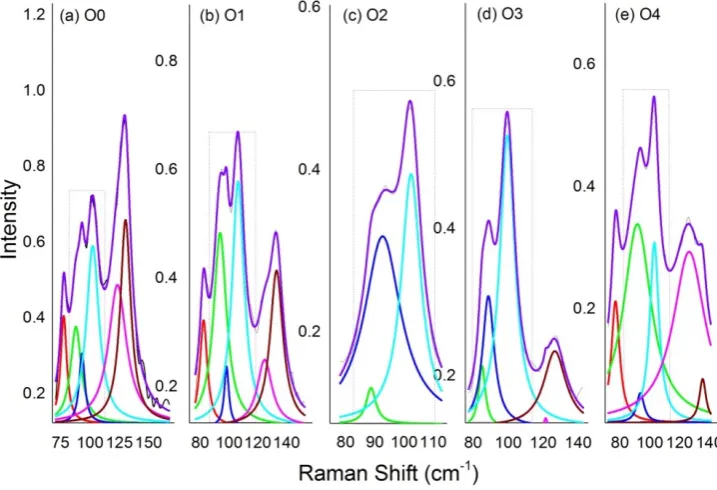
In the YBCO system, the Roman spectra are shown in Figure 1. It is found that there were new
peaks around 100 cm-1 in every sample never reported, which indicates new modes of phonons. For
a further study, we picked the period nearby 100 cm-1 of the spectra and fitted these curves by Lorentz shapes, respectively. The adjusted R squares (Adj. R-Squares) of the fittings are all lager
than 0.99, which demonstrates that the results were convincible. The peaks was consisted of 104 cm-1,
Fig. 1. Raman Spectra of theYBCO system. New peaks around 100 cm-1 were found.
Fig. 2. Fitted Lorentz shape in YBCO system. The Adj. R-Square were all large than 0.99, indicating that the fitting results were reliable.
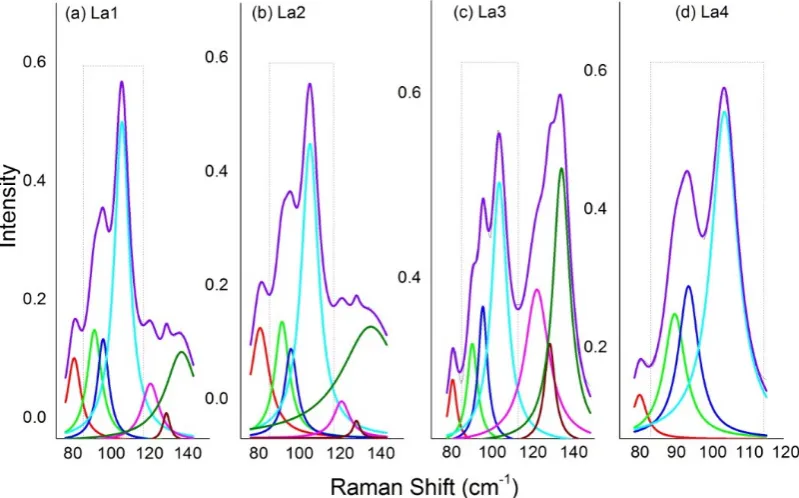
In the YBLCO system, the Raman spectra are shown in Figure 3. Also there existed new peaks
around 100 cm-1 in each sample. Also the period nearby the 100 cm-1 mode were picked and fitted
with Lorentz shape. The results were shown in Figure 4. The 104 cm-1, 94 cm-1, and 89 cm-1 modes
Fig. 3. Raman spectra of YBLCO system. New peaks around 100 cm-1 were found.
Fig. 4. Fitted Lorentz shape in YBLCO system. The Adj. R-Square were all large than 0.99, indicating that the fitting results were reliable.
4. Discussion
They assumed that the frequencies of phonons are inverse-square to its weight, the cluster of the stable CuO2 plane vibrates like a single atom, and the stable CuO2 plane is consisted of one Cu atom and four O atoms and they deduced the frequency of the phonon of the c-direction vibration of the
stable CuO2 plane was about 106 cm-1. In our model, the assumption that the frequencies of phonons
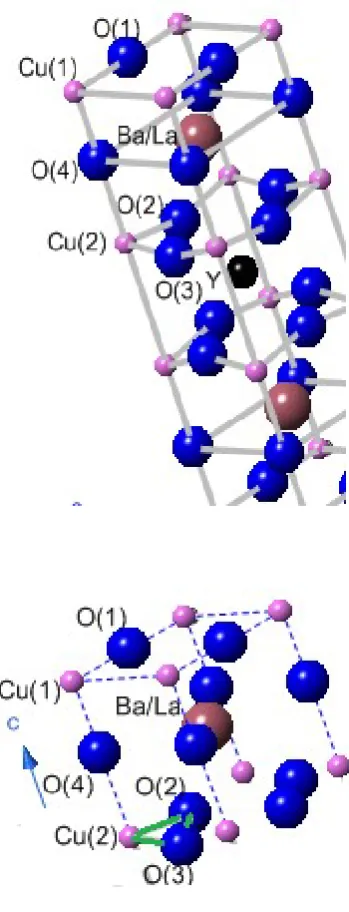
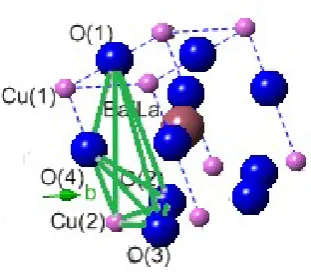
are inverse-square to its weight and the cluster of the stable CuO2 plane vibrates like a single atom was accepted. However, what was taken into consideration is that the Cu and O atoms was not just belong to the given unit cell, but shared with the others. Figure 5 shows the unit cell of YBCO. The Cu(2) atom was shared by four cells, and the O(2) and O(3) atoms were shared by two cells. In our model, only a quarter of Cu(2) atom, half O(2) atom and half O(3) atom were taken into consideration as shown in Figure 6.
Fig. 5. Cell structure of YBCO.
Fig. 6. The c-direction vibration of the stable CuO2 plane.
c Cu
1
m
4
=
0.707
1
1
1
2
2
4
Cu
o o Cu
m
m
m
(1)The frequency of the c-direction vibration of Cu (2) was reported as about 145 cm-1 [22]. The
c-direction vibration of the stable CuO2 plane could be obtained as
1 1
145
0.707 102.5
c
cm
cm
. This result was coincident with the 104 cm-1 mode obtainedabove. However, no explanations have been given for 94 cm-1 and 89 cm-1 modes of phonons.
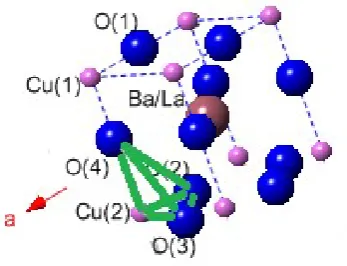
In our model, we took the a-direction and b-direction of the stable CuO2 plane into consideration also. We assumed that the nearest O atoms would vibrate together with the stable CuO2 plane as a single O atom. In c-direction, as shown in Fig. 5, the Cu(1) atom of heavy mass stand in the way of the c-direction vibration of O(4) atom. Thus the O(4) atom, the nearest atom to the stable CuO2 plane cannot vibrate together in c-direction. But in a-direction, as there is no roadblock, the O(4) atom, should vibrate together with the stable CuO2 plane. In this condition, as shown in Figure 7, a triangular pyramid was formed by Cu(2), O(2), O(3), and O(4) atoms, vibrating together.
Fig. 7. The a-direction vibration of the stable CuO2 plane. The O(4) atom vibrates together with the stable CuO2 plane.
Noticed that the O(4) atom was shared by four cells, the ratio of the frequencies was deduced as
1
4
0.667
1
1
1
1
2
2
4
4
Cu o
Cu
o o o Cu
m
m
m
m
m
(2)The frequency of the a-direction or b-direction of the Cu(2) was reported about 140 cm-1 [22].
We work out that phonon in the a-direction is
140
10.667 93.4
1a
cm
cm
, which matchesvery well with the new mode of 94 cm-1.
Fig. 8. The b-direction vibration of the stable CuO2 plane. The O(4) atom and the O(1) atom vibrate together with the stable CuO2 plane.
Considering that the O(1) atom was shared by four cells also, the ratio of the frequencies was deduced as
1
4
0.632
1
1
1
1
1
2
2
4
4
4
Cu b
Cu
o o o o Cu
m
m
m
m
m
m
(3)We work out the phonon in the b-direction is
140
10.632 88.5
1b
cm
cm
, whichmatches very well with the new mode of 89 cm-1.
Another evidence to support our opinion is that the fluctuations of the frequencies of these three modes are not as drastic as others. In YBCO system, Figure 9(a) compared these modes with
the 580 cm-1 mode, which represents the b-direction vibration of the O(2) atom [22] and was obtained
by fitted Lorentz shape also. And Figure 9(b) shows their standard deviation (STDEV). It is found
that the STDEV of 580 cm-1 mode is about two times as large as the 94 cm-1 mode or 89 cm-1 mode,
and three times as large as the 104 cm-1 mode. As reported that the CuO2 plane in HTSCS is very
stable [16], and the environment change hardly effects its structure. The standard deviations of the phonons related with the stable CuO2 plane should be very small. Coincidently, the similar phenomenon was observed in YBLCO system. The results are shown in Figure 10.
Fig. 10. (a) Fluctuations of the phonon modes in YBLCO system; (b) STDEV of the phonons of in YBLCO system.
Further searching about the relationship between the change of phonons and the superconductivity, we depicted the fluctuations of the phonon wavenumbers and the Tc in Figure
11. The wavenumbers were deposed by linear fitting. It is found that, in YBCO system, the 89 cm-1
mode phonon hardened slightly as the Tc decreased. On the contrary, the 94 cm-1 mode phonon and
104 cm-1 mode phonon softened obviously with the decreases of the Tc. The same trend was
observed in YBLCO system. It indicated that the collective vibration of the stable CuO2 plane plays a great role in HTSC.
Fig.11. Relevance between the phonons and superconductivity. In both YBCO and YBLCO system,
as the Tc decreased, the 89 cm-1 mode phonon hardened, but the 104 cm-1 mode and the 94 cm-1 mode
phonons softened.
5. Conclusions
The low frequency phonon modes in YBCO and YBLCO system were studied by Raman
spectroscopy. Three new modes of phonon around 100 cm-1 were found and a possible explanation
104 cm-1 mode probably represents the c-direction collective vibration of the stable CuO2 plane, the
94 cm-1 mode represents the a-direction vibration, and the 89 cm-1 mode represents the b-direction
vibration of the CuO2 plane. Besides, the relevance between the collective vibration and
superconductivity is revealed. In both YBCO and YBLCO system, as the Tc decreased, the 104 cm-1
mode and 94 cm-1 mode phonons softened, and the 89 cm-1 mode phonon hardened. The results hint
that the phonons of the collective vibration of the stable CuO2 plane obviously contribute to the high
Tc superconductivity and need to be further studied.
Acknowledgments
The authors are grateful for the support of the State Key Laboratory for Mesoscopic Physics at Peking University.
References
1. Bardeen J, Cooper L N; Schrieffer J R. Theory of Superconductivity. Phys. Rev. 1957, 108, 1175, DOI: 10.1103/PhysRev.108.1175.
2. Anderson P W. The Resonating Valence Bond State in La2CuO4 and Superconductivity. Science 1987, 235, 1196, DOI: 10.1126/science.235.4793.1196.
3. Hayden S M; Mook H A; Dai P C; Perring T C; Dogan F. The structure of the high-energy spin excitations in a high-transition-temperature superconductor. Nature 2004, 429, 531, DOI: 10.1038/nature02576.
4. Zeyher R; Zwicknagl G. Superconductivity-induced phonon self-energy effects in high-Tc
superconductors. Z. Phys. B 1990, 78, 175, DOI: 10.1007/BF01307833.
5. Lanzara A; Bogdanov P V; Zhou X J; Kellar S A; Feng D L; Lu E D; Yoshida T; Eisaki H; Fujimori A; Kishio K, Shimoyama J–I; Nodak T; Uchidak S; Hussain Z; and Shen Z X. Evidence for ubiquitous strong
electron–phonon coupling in high-temperature superconductors. Nature 2001, 412, 510,
DOI:10.1038/35087518.
6. Meevasana W; Ingle N J; Lu D H; Shi J R; Baumberger F; Shen K M; Lee W S; Cuk T; Eisaki H; Devereaux T P; Nagaosa N; Zaanen J; and Shen Z X. Doping dependence of the coupling of electrons to bosonic modes in the single-layer high-temperature Bi2Sr2CuO6 superconductor. Phys. Rev. Lett.2006, 96, 157003, DOI:
10.1103/PhysRevLett.96.157003.
7. Khasanov R; Eshchenko D G; Luetkens H; Morenzoni E; Prokscha T; Suter A; Garifianov N; Mali M; Roos
J; Conder K; and Keller H. Direct Observation of the Oxygen Isotope Effect on the In-Plane Magnetic Field Penetration Depth in Optimally Doped YBa2Cu3O7−δ. Phys. Rev. Lett. 2004, 92, 057602,
DOI:10.1103/PhysRevLett.92.057602.
8. Venturini F; Opel M; Devereaux T P; Freericks J K; Tüttő I; Revaz B; Walker E; Berger H; Forró L; Hackl R. Observation of an Unconventional Metal-Insulator Transition in Over doped CuO2 Compounds. Phys. Rev. Lett. 2002, 89, 107003, DOI:10.1103/PhysRevLett.89.107003.
9. Pallesy D; Liarokapis E; Leventouri Th; Chakoumakos B C. The effect of Ca substitution on the structure and the Raman active phonons in Y1-xCaxBa2Cu3O7-d. J. Phys.: Condens. Matter 1998, 10, 2515, DOI:
10.1088/0953-8984/10/11/015.
10. Jin W T, Hao S J; Wang C X; Guo C Q; Xia L; Zhang S L; Narlikar A V; Zhang H. Structural and spectroscopic evidence for stable chemical bonds and the correlation with high Tc superconductivity.
Supercond. Sci. Technol. 2012, 25, 065004, DOI: 10.1088/0953-2048/25/6/065004.
11. Li L; Guo C Q; Han J X; Yan Y; Jin W T; Hao S J; Lin F; Wei K; Zang H. Role of lattice in YBCO superconductors studied by Raman spectroscopy. International Journal of Modern Physics 2015, 29, 5, DOI: 10.1142/S0217979215420047.
12. Kresin V Z; Wolf S A. Electron-lattice interaction and its impact on high Tc superconductivity. Rev. Mod. Phys. 2009,81, 481, DOI:10.1103/RevModPhys.81.481.
13. Johnston S; Lee W S; Chen Y; Nowadnick E A; Moritz B; Shen Z-X; Devereaux T P. Material and Doping
Dependence of the Nodal and Antinodal Dispersion Renormalizations in Single- and Multilayer Cuprates.
Adv. Condens. Matter. Phys. 2010, 2010, 968304, DOI: http:10.1155/2010/968304.
15. Guo C Q; Yu J; Hao S J; Jin W T; Guo W; Zhang H. Low frequency phonon model in YxPr1−xBa2Cu3O7 system. Physic C 2013, 493, 60, DOI: j.physc.2013.03.025.
16. Hao S J; Jin W T; Guo C Q; Zhang H. The stability of the CuO2 plane and its influence on superconductivity in the doped YBa2Cu3O7−δ system. Supercond. Sci. Technol. 2013, 26, 065011,
DOI:10.1088/0953-2048/26/6/065011.
17. L. Li; C. Q. Guo; J. X. Han; Y. Yan; W. T. Jin. Role of lattice in YBCO superconductors studied by Raman spectroscopy. International Journal of Modern Physics 2015, 29, 1542004, DOI: 10.1142/S0217979215420047. 18. Jorgensen J D; Veal B; W, Paulikas A P; Nowicki L J; Crabtree G W; Clause H; Kwok W K. Structural
properties of oxygen-deficient YBa2Cu3O7−δ. Phys. Rev. B1990, 41,1863, DOI:10.1103/PhysRevB.41.1863.
19. Cava R J; Batlogg B; Fleming R M; Sunshine S A; Ramirez A; Rietman E A; Zahurak S M; an Dover R B.
Ba2−xLaxYCu3O7±δ perovskite compounds: Crystal chemistry. Phys. Rev. B 1988, 37, 5912,
DOI:10.1103/PhysRevB.37.5912.
20. Jin W T; Hao S J; Zhang H. The fixed triangle chemical bond and its effect in the Y1-xCaxBa2- yLayCu3Oz system from underdoped to overdoped. New Journal of Physics 2009, 11, 113036, DOI: 10.1088/1367-2630/11/11/113036.
21. Hao S J; Jin W T; Guo C Q; Zhang H. Structural and superconducting properties of co-doped YBa2−xLaxCu3−xMxOz and La-free YBa2Cu3−xMxOz (M = Al, Zn) high-TC superconductors. Physica C 2012, 475,
28, DOI: 10.1016/j.physc.2012.01.013.
22. Ambrosch-Draxl C; Auer H; Kouba R; Sherman E Ya; Knoll P; Mayer M. Raman scattering in YBa2Cu3O7: